
At age four, a child’s brain is a sponge for rules, patterns, and social interaction, making this the perfect moment to introduce structured play. The best games for this age group do more than occupy twenty minutes — they build fine motor control, teach turn-taking, and sneak in early literacy or math concepts without feeling like a lesson.
I’m Min — the co-founder and writer behind Gadgets Feed. This guide distills hundreds of hours spent comparing game mechanics, reading customer feedback, and checking component durability across dozens of titles designed specifically for preschoolers and kindergartners.
Whether you’re looking for cooperative adventures, phonics builders, or matching challenges, this roundup of the best 4 year old games will help you find the right fit for your family’s game shelf.
How To Choose The Best 4 Year Old Games
Not every box labeled “ages 4+” delivers the right balance of challenge and fun. Some games lean too heavily on luck, leaving kids bored after two rounds. Others demand reading skills or patience that a four-year-old simply doesn’t have yet. Here’s what to look for when narrowing down the options.
Game Mechanics That Fit a 4-Year-Old’s Brain
Four-year-olds thrive on simple rules they can internalize quickly — matching, pattern copying, color sorting, or cooperative missions where everyone wins or loses together. Games that rely on dexterity (catching bugs with tongs) or memory (flipping cards to find pairs) also work well because they tap into natural curiosity. Avoid games with lengthy instructions or reading requirements; visual cues and clear goal loops keep them engaged.
Component Quality and Safety
At this age, game pieces get dropped, thrown, stepped on, and occasionally chewed. Look for thick wooden discs, laminated cards that wipe clean, and chunky plastic pawns that small hands can grasp. Avoid flimsy paper cards that tear after one session. Check that all pieces are large enough to pose no choking hazard, and confirm the box lists a minimum age of 36 months or older.
Playtime and Repeatability
A good preschool game runs 10 to 20 minutes — long enough to feel satisfying, short enough to hold attention. Variable difficulty levels or multiple ways to play extend shelf life. Games that incorporate a beloved TV character (Numberblocks, for example) often get requested again and again, reinforcing the skills they teach through repetition.
Quick Comparison
On smaller screens, swipe sideways to see the full table.
| Model | Category | Best For | Key Spec | Amazon |
|---|---|---|---|---|
| Numberblocks Race to Pattern Palace | Pattern Building | Pattern recognition & counting | 40 pattern cards, 2 skill levels | Amazon |
| Wooden CVC Word Spelling Game | Phonics | Early reading & spelling | 50 double-sided cards, 53 letter blocks | Amazon |
| Educational Insights Frankie’s Food Truck | Shape Matching | Fine motor & shape ID | Frankie Squeezer, 20 food pieces | Amazon |
| NATIONAL GEOGRAPHIC My First Safari | Cooperative | Teamwork & strategy | 3 difficulty levels, 21 animals | Amazon |
| Hasbro Gaming Bed Bugs | Action/Dexterity | Hand-eye coordination | Motorized vibrating bed, 36 bugs | Amazon |
| Cottify Wooden Matching Game | Memory | Concentration & vocabulary | 36 wooden discs, carry pouch | Amazon |
| Toysmith Chasing Fireflies | Active/Sensory | Gross motor & sensory play | 2 glowing jars, 10 fireflies | Amazon |
In‑Depth Reviews
1. Numberblocks Race to Pattern Palace Board Game

Licensed directly from the hit TV show, this board game turns pattern recognition into a race to the Pattern Palace. Kids ages 3–6 move Numberblocks One through Four across a colorful board, using 25 bridge tiles to recreate the patterns shown on 40 cards. The two-tier card deck lets you start with simple AB patterns and progress to more complex sequences as skills grow, giving the game real longevity for a family with kids at different readiness levels.
The included dice popper adds a satisfying tactile element, and the chunky Numberblocks pawns are easy for small fingers to grip. Rounds run about 15 minutes — ideal for short attention spans. The game reinforces counting, color recognition, and turn-taking, and because it’s built around a beloved IP, many kids will ask to play it repeatedly, effectively drilling pattern skills through sheer enthusiasm.
Component quality is excellent: the board is thick and vibrant, the tiles click securely into place, and the box stores everything neatly. Some parents noted the 16 “Six’s Tricks” cards add a light luck element that keeps gameplay unpredictable without frustrating young players. For a structured educational game that feels purely like play, this is the standout pick.
Why it’s great
- Two difficulty levels extend replay value across ages 3–6
- High-quality, show-accurate pieces that survive rough handling
- Teaches patterns, counting, and strategy without feeling like homework
Good to know
- Only works if your child is familiar with the Numberblocks show
- Some trick cards can briefly sideline a player, frustrating sensitive kids
2. Wooden CVC Word Spelling Game

This Montessori-inspired set includes 50 double-sided phonics flash cards (CVC words like “cat,” “dog,” “bed”) and 53 lowercase wooden letter blocks with red vowels and blue consonants. The cards show a picture on one side and the word on the other, enabling self-checking — a child can build the word with blocks, then flip the card to confirm. The 5 included spelling boards keep letters organized during play.
The laminated cards are thick and wipeable, surviving sticky fingers and repeated use. The wooden letter blocks are chunky enough (roughly 1-inch squares) that a 4-year-old can easily pick them up and place them, and the color-coded vowel/consonant system subtly reinforces letter-type awareness. The set comes in a sturdy storage box that keeps everything contained when not in use.
A few parents noted that some picture choices are ambiguous — “bag” shows a purse and “hut” shows a shed — which can confuse early readers who are still building their object-word connection. Avoid this as a solo activity for absolute beginners, but for a child who already knows basic letter sounds, it is an exceptional tool for blending and segmenting practice.
Why it’s great
- Self-checking card design builds independent learning confidence
- Thick laminated cards and hardwood blocks resist wear
- Color-coded vowels and consonants support phonics instruction
Good to know
- A few card illustrations are unclear for absolute beginners
- Letters Q, Y, and Z are not included (not needed for included words)
3. Educational Insights Frankie’s Food Truck Fiasco
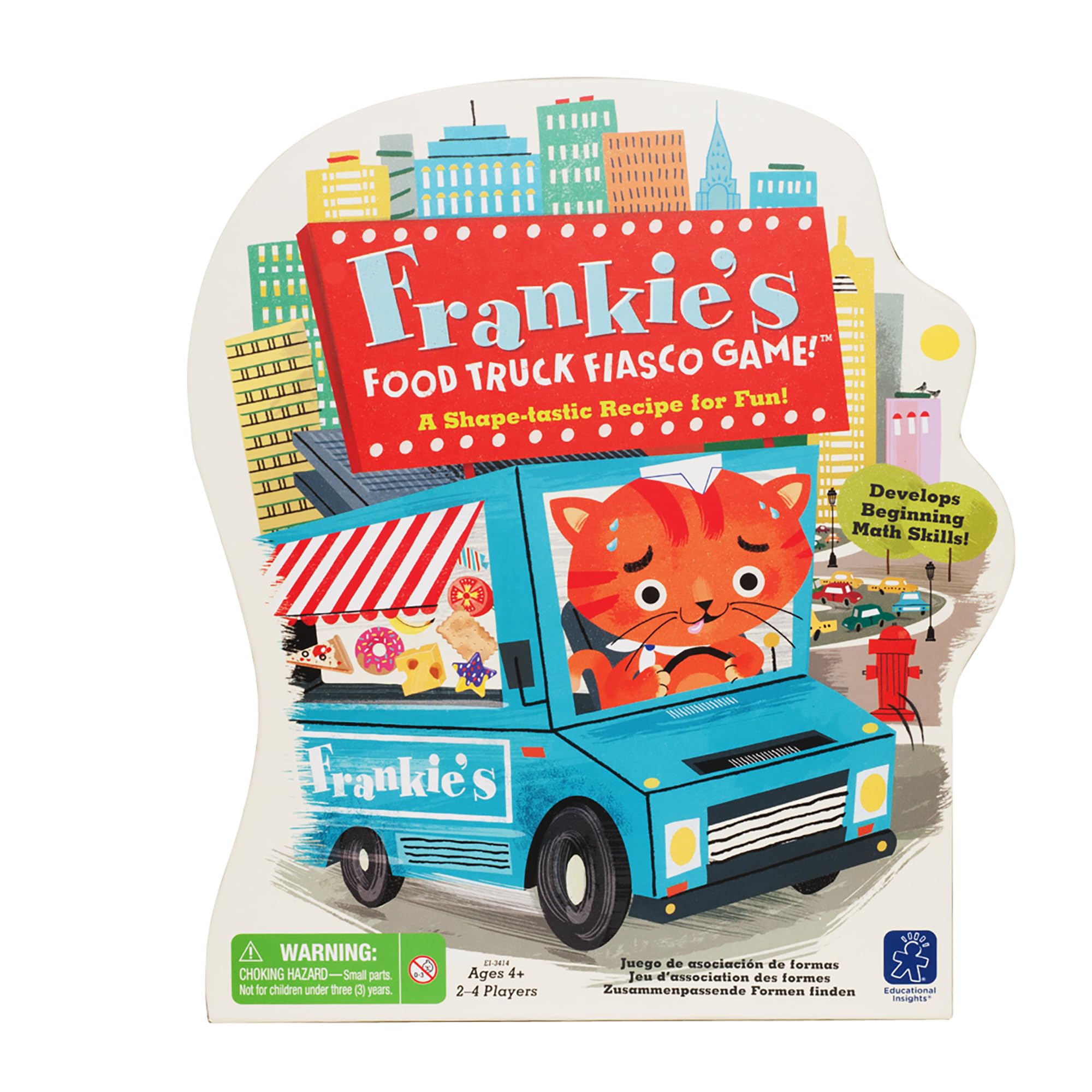
Frankie’s Food Truck Fiasco takes shape matching and turns it into a fine-motor workout. Players spin a spinner, then use the Frankie Squeezer — a pincer-like tool shaped like the game’s mascot — to grab the food item that matches the shape shown. The 20 food pieces are thick, molded plastic that’s easy to grip but tough enough to withstand drops. The box lid doubles as the game board, simplifying setup and storage.
The spinner includes actions beyond simple “pick a shape”: players can steal a piece from an opponent, lose a turn to a banana peel, or return a piece to the board when a fly appears. This variety keeps each 10- to 15-minute round fresh and teaches kids to handle both wins and setbacks gracefully. Designed for 2 to 4 players ages 4 and up, it works well as an introduction to board game etiquette.
Special education teachers praise the game for building hand strength and shape identification simultaneously. The only common criticism is that the Frankie Squeezer can be difficult for very small hands to operate effectively; some 3-year-olds may need adult assistance. Once a child masters the squeeze motion, however, the game becomes a genuinely engaging tool for fine motor development.
Why it’s great
- Combines shape identification with fine motor skill practice
- Spinner actions (steal, lose turn) teach social-emotional skills
- Box doubles as game board for easy cleanup
Good to know
- Frankie Squeezer can be challenging for smaller hands
- Pieces are not identical per shape, adding slight complexity
4. NATIONAL GEOGRAPHIC My First Safari Board Game

In My First Safari, everyone plays on the same team. The goal is to see all 21 animals (elephants, cheetahs, giraffes, and more) before the sun token moves across the board — a sunset timer that creates gentle urgency without pitting players against each other. Three difficulty levels let you ramp up the challenge as your child’s strategic thinking develops, making this a game that grows with your family for several years.
The included full-color Learning Guide is a standout feature: each animal gets a paragraph of fun facts, so the game doubles as a mini wildlife lesson. The 5 safari explorer pawns are chunky and easy to move, and the 36 item cards introduce decision-making (should we move toward the elephant or collect a tool that helps later?). Rounds last about 20 minutes, long enough for meaningful strategy without dragging.
The main assembly frustration is getting the small pawns into their plastic stands — several reviewers reported nearly breaking the pieces. Once set up, the pawns stay in place. The cooperative format is especially valuable for children who struggle with competitive pressure; everyone celebrates together when the team wins, reinforcing teamwork over individual glory.
Why it’s great
- Cooperative play removes the sting of losing for sensitive kids
- Learning guide teaches real animal facts during gameplay
- Three difficulty levels extend replayability from ages 4 to 7
Good to know
- Pawns are difficult to push into their stands without adult help
- Components are sturdy but the box is relatively small
5. Hasbro Gaming Bed Bugs Board Game
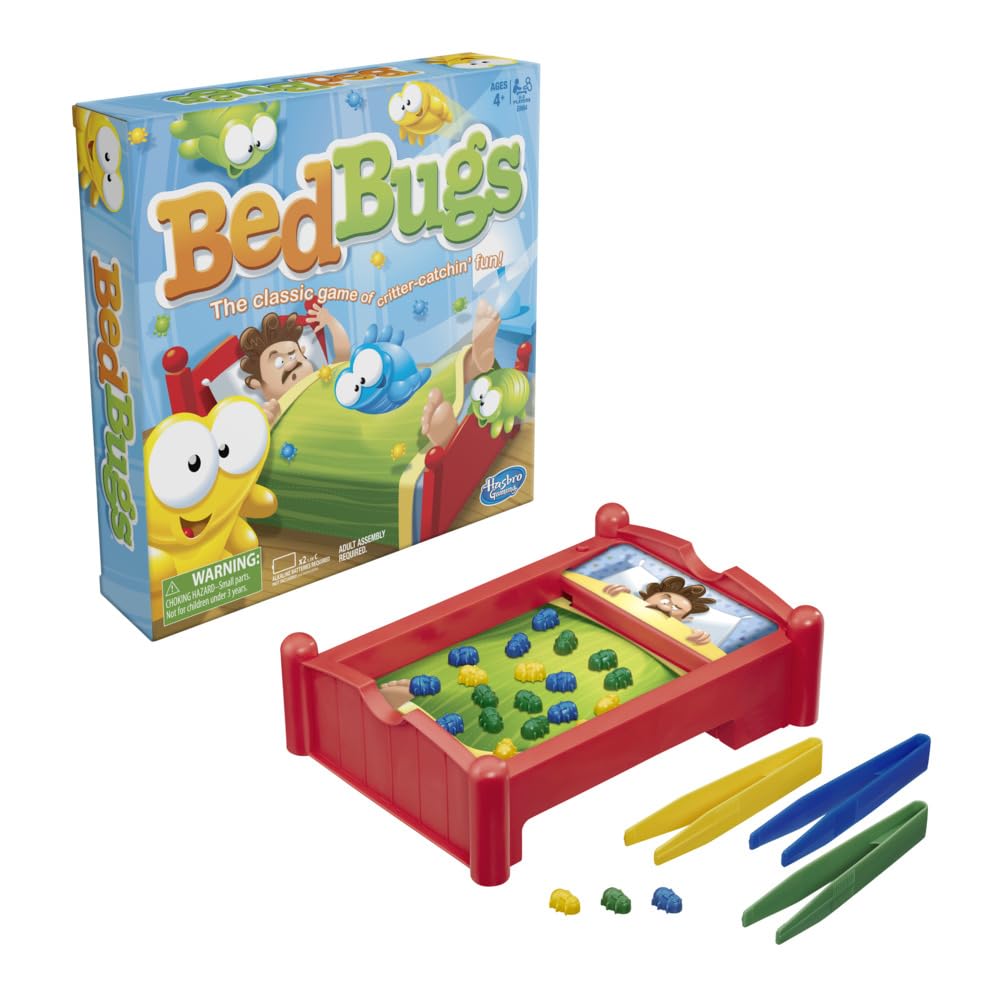
Bed Bugs is pure kinetic chaos in the best way. The motorized game board vibrates, sending 36 plastic bugs bouncing across the “bed” surface. Each player grabs one of three colored tongs (blue, yellow, or green) and races to catch all the bugs matching their tong’s color. The first to empty the bed of their color wins. Rounds are short — under 10 minutes — making it perfect for quick play sessions or as a warm-up before a longer game.
The game targets hand-eye coordination and color matching while generating genuine laughter. Kids find the bouncing, unpredictable movement hilarious, and the tongs provide valuable fine-motor practice. Assembly is minimal (snap the cardboard playing surface into the plastic frame), and the vibrating mechanism runs on standard AA batteries. The 2- to 3-player limit is notable — this is not a large-group game.
A few families noted that pressing the bugs too hard during play can cause the vibrating motor to stall temporarily, requiring a quick reset. The bugs themselves are small enough to lose, but the set includes extras. Despite the physical intensity, the game holds up well to repeated use; the motorized unit in particular has proven durable across hundreds of plays in customer reports.
Why it’s great
- Fast, physical gameplay keeps high-energy kids engaged
- Motorized bed creates unpredictable, hilarious action
- Tongs build fine motor coordination and grip strength
Good to know
- Limited to 2–3 players, not ideal for larger groups
- Motor can stall if bugs are pressed too firmly
6. Cottify Wooden Matching Game

This memory game trades flimsy paper cards for 36 solid wooden discs (about 2.2 inches in diameter) with colorful animal illustrations on one side and a repeating pattern on the other. Each pair has a unique background color that provides a subtle visual cue — helpful for younger players who aren’t yet ready for pure memory matching. The discs come in a drawstring pouch for easy portability.
The wood construction is the headline feature: discs are scratch-resistant, water-resistant, and heavy enough to stay put when placed on a table. The set includes 18 pairs featuring animals like lions, monkeys, and elephants, and parents can use them as flashcards for first-word practice. Play options range from simply naming animals for 2-year-olds to competitive matching tournaments for older siblings.
The only design drawback: the backs of the discs feature small animal heads rather than a uniform pattern, which can confuse toddlers who are still learning the rules of the game — they may try to match the back pattern instead of the front image. A simpler back design would be more beginner-friendly. Still, for durability and tactile appeal, this is the best wooden memory game in its class.
Why it’s great
- Solid wood discs survive drops, spills, and rough play
- Color-coded backgrounds assist beginner memorizers
- Compact pouch makes it easy to take on trips
Good to know
- Animal heads on the back can confuse younger children
- Some children may outgrow the 18-pair set quickly
7. Toysmith Chasing Fireflies Kids Game

Chasing Fireflies shifts gameplay from the table to the yard. The set includes two plastic mason jars (one green, one blue), each containing five glowing fireflies with soft flashing LED lights powered by included AG3 batteries. One player hides the glowing fireflies around a room or outdoor space while the other player searches for them using the jar as a collector. Switch roles each round for double the fun.
The lights are bright enough to find in daylight but create a magical effect in dimmer environments — perfect for evening play or indoor hide-and-seek on rainy days. The game builds gross motor skills (running, crouching, reaching) and spatial awareness as kids learn to scan environments for the flashing signals. The instructions suggest simple variations: count how many you find before the timer runs out, or hide them in harder spots for older children.
Battery life is reasonable, and the fireflies survive being dropped on grass and pavement. The main limitation is that with only 10 fireflies total (5 per jar), the hiding/searching cycle can feel brief for a group of more than two children. But for sibling play or one-on-one parent-child time, it provides active, screen-free entertainment that often becomes a nightly ritual.
Why it’s great
- Gets kids moving and exploring their environment
- Glowing effect works in both indoor and outdoor settings
- Simple role-switching encourages social play and turn-taking
Good to know
- Only 10 fireflies total; larger groups may need more hiding objects
- Lights flash intermittently, which can frustrate younger seekers
FAQ
How long should a game session last for a 4-year-old?
Are cooperative or competitive games better for this age?
What if my child isn’t ready for the recommended age on the box?
Final Thoughts: The Verdict
For most users, the best 4 year old games winner is the Numberblocks Race to Pattern Palace because it blends beloved characters with genuine pattern-learning progression across two difficulty levels, keeping kids engaged and growing. If you want a fine motor and shape-matching challenge, grab the Educational Insights Frankie’s Food Truck Fiasco. And for active, screen-free adventure, nothing beats the Toysmith Chasing Fireflies for getting kids moving and exploring.