
A 40-degree sleeping bag sits in a narrow sweet spot — warm enough for cool spring and autumn nights, yet light enough that you won’t curse it on the trail. The problem is that this temperature range attracts wildly different designs: ultralight down quilts that stuff smaller than a loaf of bread, synthetic mummy bags that shrug off damp ground, and spacious rectangular models that let you stretch out. Picking the wrong one means either freezing when the mercury dips or carrying unnecessary pounds. The good news is that the 40°F category has never offered more targeted options for backpackers, car campers, and hammock sleepers alike.
I’m Min — the co-founder and writer behind Gadgets Feed. I’ve spent dozens of hours cross-referencing fill materials, compression ratios, zipper quality, and real-world comfort limits to find the sleeping bags that actually deliver on their 40-degree promise without dragging your pack down.
Whether you need a backcountry-ready quilt that fits inside a hydration sleeve or a roomy bag for campsite comfort, this comprehensive 40 degree sleeping bag buying guide breaks down every spec that matters.
How To Choose The Best 40 Degree Sleeping Bag
At the 40°F mark, the difference between a great night and a miserable one often comes down to insulation type, shell construction, and shape. You don’t need the Arctic-grade baffling of a zero-degree bag, but you do need consistent loft across your shoulders and feet. The biggest mistake buyers make is assuming any “40-degree” rating works the same — in reality, EN/ISO ratings, fill quality, and draft protection vary drastically between budget bags and premium options.
Down vs Synthetic Fill at 40°F
Down (especially 650-fill and above) offers unmatched compressibility and warmth per gram, making it ideal for backpacking. However, down loses almost all insulating ability when wet. Synthetic fills like Cirroloft retain warmth when damp, pack down reasonably well for a 40°F bag, and cost less upfront. For a 40-degree bag used in reliably dry conditions, down is the lighter, pack-friendlier choice. For damp coastal or shoulder-season trips where rain is likely, synthetic keeps you warmer even when everything is wet.
Shape and Sleep Style
Mummy-shaped bags minimize internal air volume, which helps a 40°F bag feel warmer at its lower limit, but they restrict movement — a dealbreaker for side sleepers and those who toss. Rectangular and semi-rectangular (envelope) designs give you room to bend knees and shift positions, but you lose thermal efficiency. Hybrid designs, like a mummy upper body with a rectangular footbox, offer the best compromise. Quilts remove the back insulation entirely and rely on your sleeping pad for warmth, saving significant weight at 40°F.
Draft Protection and Zipper Quality
A draft tube along the zipper and a snug draft collar at the neck are non-negotiable for real-world 40°F comfort — even the best 650-fill down can’t save you if cold air pours in through a snagging zipper track. Look for anti-snag sliders (Coleman’s ZipPlow, YKK two-way zippers) and full-length draft tubes. The footbox also matters: a separate zippered foot vent lets you dump heat without opening the main zipper, which is invaluable when the temperature fluctuates between 40°F and 55°F overnight.
Quick Comparison
On smaller screens, swipe sideways to see the full table.
| Model | Category | Best For | Key Spec | Amazon |
|---|---|---|---|---|
| Naturehike Ultralight Down 40°F | Hybrid Semi-Rectangular | Side sleepers wanting a compact down bag | 650FP RDS down, 910g total weight | Amazon |
| Naturehike RDS Down 42/52°F | Classic Mummy | Ultralight backpackers on a budget | 650FP RDS down, 565g (CW295) | Amazon |
| ZOOOBELIVES Alplive T400 | Convertible Envelope | Couples or travelers wanting a double-bag option | 650FP duck down, 1.7lb total weight | Amazon |
| Kelty Cosmic Synthetic 40°F | Synthetic Mummy | Damp-condition camping with reliable synthetic fill | Cirroloft synthetic, 2lb 6oz total weight | Amazon |
| OneTigris Featherlite Quilt | Ultralight Quilt | Hammock users and gram-counting backpackers | 35oz total, 20D ripstop nylon shell | Amazon |
| Coleman Kompact 40°F | Rectangular Car Camp | Car campers wanting room and easy rolling | Coletherm Max fill, 4.5lb total weight | Amazon |
| Kelty Cosmic Synthetic 20°F | Warmer Synthetic Mummy | Cold sleepers wanting a 40°F comfort buffer | Cirroloft synthetic, 30.5oz fill weight | Amazon |
In‑Depth Reviews
1. Naturehike Ultralight Down Sleeping Bag 40°F

This bag nails the 40°F brief with a brilliant hybrid shape — a mummy upper that hugs your shoulders and head to prevent heat loss, paired with a rectangular lower section that gives side sleepers room to bend their knees. At just 2 pounds (910g) with an RDS-certified 650-fill down, it compresses to 13.8 x 7.1 inches, small enough for a lightweight backpack or motorcycle pannier. The 400T 20D ripstop nylon shell shrugs off light moisture, and the YKK zipper runs smoothly without snagging.
Reviewers consistently praise its comfort at the 41°F to 50°F range, with several noting it’s warm enough for side sleepers who typically feel cramped in traditional mummies. The footbox area gives you just enough wiggle to air out feet on warmer nights. It also comes with both a storage bag and a compression sack, so you can keep it lofty at home then cinch it down for the trail.
Some users report that the bag can feel too warm above 65°F, which is expected for a 40°F-rated bag. The zipper can catch slightly if rushed, but the overall build quality, loft, and packability justify the premium-tier price. If you want one bag for three-season backpacking without sacrificing sleep comfort, this is the pick.
Why it’s great
- Hybrid mummy-rectangular shape fits side sleepers perfectly
- RDS-certified 650-fill down compresses smaller than synthetic alternatives
- Includes both storage bag and compression sack
Good to know
- Uncomfortably warm above 65°F
- Zipper can snag if closed too quickly
2. Naturehike RDS Down Sleeping Bag 42/52°F

At just 565 grams (1.3 pounds) for the CW295 short size, this is one of the lightest 40-degree sleeping bags you can buy without stepping into premium cottage brands. The 650-fill RDS-certified duck down lofts generously for its weight, with individual down channels that prevent cold spots. The 20D 400T nylon shell is soft against the skin and includes a water-repellent treatment, while the YKK two-way zipper allows foot venting and can join two bags together for a double.
Owner feedback consistently highlights the 42°F limit rating as accurate for most sleepers when paired with an insulated pad. The bag’s ability to unzip fully into a flat quilt is a huge plus for warm nights — just use the side loops and hang it as a top quilt. The mummy cut is roomier than traditional mummies, with enough space for stomach and side sleepers to shift positions.
The main tradeoff is that the CW295 short size limits users under 5’6”, so taller campers need the CWM400 medium (still under 800g). The drawstring cord at the neck uses thin stitching that some reviewers found vulnerable to pulling. For dedicated ultralight backpackers who want a 40°F bag they can grab without a second thought, this is a phenomenal value.
Why it’s great
- Exceptional warmth-to-weight ratio at 1.3 lbs
- Converts to a flat quilt for warm nights
- RDS-certified down with no detectable odor
Good to know
- Short size only fits sleepers under 5’6”
- Neck drawstring stitching can fail under tension
3. ZOOOBELIVES Alplive T400

This mid-range bag stands out because it’s built to convert from a single bag into a full double sleeping bag when paired with another Alplive T400 — a rare feature at its weight. The 650-fill duck down packs down tight to 11 x 6.7 inches (1.7 lb), and the rectangular envelope shape gives broad-shouldered campers room to move. Two-way YKK zippers on both the main side and the bottom footbox let you vent without exposing your whole body.
Customers note that it’s genuinely warm to about 40-45°F for average sleepers, and the ability to unzip it completely into a large quilt makes it versatile for cabin stays or van life. The 20D nylon shell has a durable water-repellent finish that beads off condensation, and there’s no noticeable down odor even when new — a common complaint with cheap duck down.
The tradeoff is that the envelope cut sacrifices thermal efficiency; below 50°F, most users need a sleeping bag liner or extra insulation. The bag also needs vigorous shaking to get the down fully lofted after compression. For the price, it delivers convertible utility that bags costing three times as much often lack.
Why it’s great
- Two bags zip together to form a spacious double sleeping bag
- Full-length two-way zippers allow independent foot and side venting
- Excellent packability for its price point
Good to know
- Envelope shape is draftier than a mummy cut
- Needs aggressive shaking to restore loft after compression
4. Kelty Cosmic Synthetic 40°F
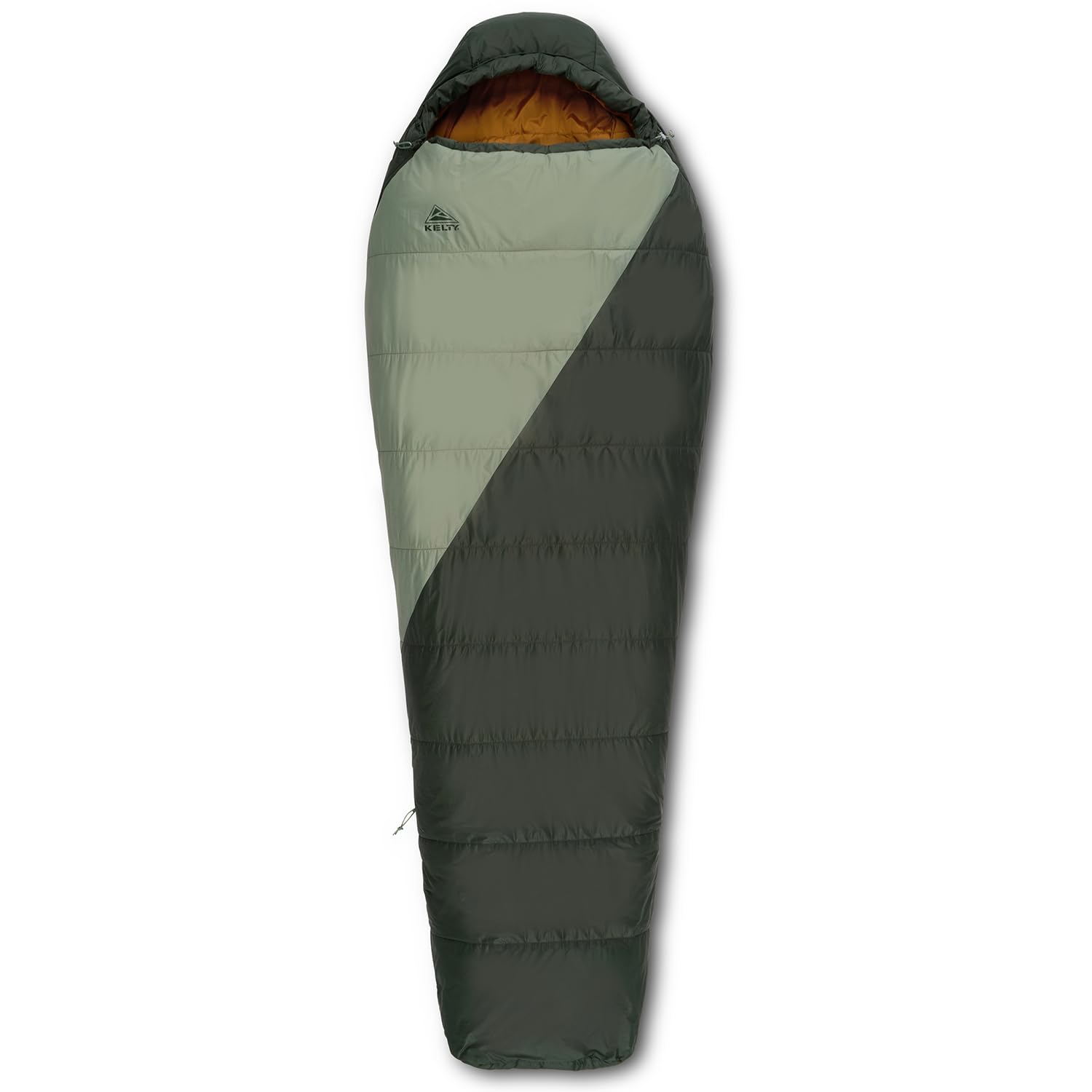
Kelty’s Cosmic Synthetic is a benchmark for what a reliable 40°F synthetic bag should be. The Cirroloft fill maintains consistent loft even when damp, making it a smart choice for campers who face unpredictable coastal weather or early morning dew. The 20D nylon shell has a PFAS-free DWR finish, and the integrated compression stuff sack lets you cinch the bag down to a compact 15 x 8 inches uncompressed (smaller with compression). An exterior stash pocket adds convenient storage for a phone or headlamp.
Reviewers praise the tailored fit — the natural footbox gives toes room to wiggle, and the draft tube along the zipper effectively blocks cold air. The mummy shape is snug, so broad-shouldered sleepers (over 5’11” and 220 lbs) may find it restrictive, but average-sized users love the thermal efficiency. The zipper runs smoothly with no snagging, and the bag feels well-constructed out of the box.
The tradeoff is that synthetic fill doesn’t compress as small as down — this bag won’t disappear into a hydration sleeve like the Naturehike options. It’s also heavier than down alternatives at 2 lb 6 oz. For car campers, canoe trippers, or anyone camping in consistently damp environments, the Cosmic Synthetic’s wet-weather resilience makes it a solid mid-range investment.
Why it’s great
- Cirroloft synthetic fill retains warmth when wet
- Integrated compression stuff sack reduces bulk on the trail
- Exterior stash pocket for small essentials
Good to know
- Snug fit for broad-shouldered or tall campers
- Heavier and more bulky than comparable down bags
5. OneTigris Featherlite Ultralight Sleeping Quilt

This quilt rethinks the 40°F sleeping bag entirely. At 35 ounces (under 1000g), the Featherlite drops the back insulation and relies on your sleeping pad for bottom warmth, saving significant packed volume — it rolls to about the size of a gallon jug. The 20D ripstop nylon outer resists wind, and the 380T polyester pongee inner is soft and breathable. A convertible footbox cinches around your feet to trap heat when temperatures drop, and the hollowed back design integrates with sleep pad straps for a draft-free seal.
Hammock campers and ultralight backpackers dominate the positive reviews. Most report comfort to about 41°F with a decent pad and base layer, and the quick entry/exit is a game-changer for middle-of-the-night bathroom trips. The footbox keeps the quilt in place even for restless sleepers, and the drawstring at the shoulder effectively seals drafts when cinched properly.
The quilt format isn’t for everyone. Below 40°F, drafts become a problem without a dedicated underquilt for hammocks or a high-R-value pad on the ground. The footbox stitching on some units tore after a handful of uses, though repairs were straightforward. This is a specialist tool for weight-conscious backpackers — not a family campground blanket.
Why it’s great
- Exceptionally light and packable for a 40°F synthetic system
- Convertible footbox keeps feet warm without restricting movement
- Quick entry/exit ideal for hammock camping
Good to know
- Requires a quality sleeping pad or underquilt to avoid drafts
- Footbox stitching durability is a concern for long-term use
6. Coleman Kompact 40°F Sleeping Bag

For car campers, cabin sleepovers, and scout groups, the Coleman Kompact delivers exactly what it promises: reliable 40°F warmth in a spacious 75 x 33-inch rectangular bag. The Coletherm Max synthetic fill provides even heat retention without the weight penalty of older Coleman bags, and the patented ZipPlow zipper genuinely eliminates snagging — a godsend when half-asleep. The entire package packs into a 8.7 x 8.3 x 15.7-inch stuff sack with side compression straps, much smaller than traditional Coleman rectangles.
Family buyers love the Thermolock draft tube and the Comfort Cuff that keeps the rough fabric away from your face. The Roll Control system and Quick Cord make rolling and tying almost foolproof for kids. Customer reviews consistently report warmth at 40°F without overheating, and the machine-washable construction is practical for frequent use.
At 4.5 pounds, this is not a backpacking bag — it’s a campsite bag. Side sleepers who curl their knees may find the 33-inch width slightly restrictive, and the built-in drawstrings for rolling can get in the way when using the bag normally. For the price, the Kompact offers the best value for anyone who drives to their campsite.
Why it’s great
- ZipPlow zipper technology eliminates snagging
- Roll Control and Quick Cord make packing simple
- Machine washable without losing loft
Good to know
- Too heavy and bulky for backpacking use
- Rolling drawstrings can interfere with sleeping comfort
7. Kelty Cosmic Synthetic 20°F

The 20°F version of Kelty’s Cosmic Synthetic might seem out of place in a 40-degree guide, but it earns its spot for cold sleepers who find 40°F bags insufficient. With a 30.5-ounce fill weight of Cirroloft synthetic, this bag has enough loft to keep you comfortable in the 35-40°F range even if you sleep cold — and it includes a bottom zipper for leg venting when temperatures climb. The 20-degree rating gives you a generous margin for error without the extreme bulk of a 0°F bag.
Reviewers consistently note that the regular size fits a 5’11”, 215-pound user with room to spare, and the mummy shape seals drafts effectively with draft tubes and a cinchable hood. The integrated compression stuff sack reduces pack size to roughly a small watermelon (14 x 9.5 inches). The two-way zipper starts about two feet from the bottom, allowing targeted foot ventilation without opening the entire bag.
At 2 lb 13 oz, it’s heavier than pure 40°F options, and the mummy shape is restrictive for side sleepers who need to bend their knees. Some owners find the bag too warm above 50°F even with the zipper partially open. For anyone who consistently runs cold or wants a single bag that works into early winter, this is the smart buy.
Why it’s great
- Lower temperature rating provides a warm margin for cold sleepers
- Bottom zipper vents legs without opening the main zip
- Compresses to a manageable size for a synthetic 20°F bag
Good to know
- Mummy shape restricts side sleeping
- Heavier and bulkier than dedicated 40°F bags
FAQ
Can I use a 40-degree sleeping bag in temperatures below freezing?
Should I buy a 40-degree down or synthetic sleeping bag?
What’s the difference between a mummy, rectangular, and quilt shape at 40°F?
Final Thoughts: The Verdict
For most users, the 40 degree sleeping bag winner is the Naturehike Ultralight Down 40°F because its hybrid shape accommodates side sleepers while the RDS-certified 650-fill down packs small enough for real backpacking. If you want maximum weight savings and already own a quality sleeping pad, grab the OneTigris Featherlite Quilt. And for damp-weather reliability where synthetic insulation shines, nothing beats the Kelty Cosmic Synthetic 40°F.