
Choosing the best 40 Series GPU means navigating a landscape where raw CUDA core counts, memory bandwidth, and power efficiency define the difference between a build that ages gracefully and one that chokes on tomorrow’s titles. You are not just buying frames per second — you are buying the architecture, the VRAM ceiling, and the cooling solution that determines whether that investment lasts three years or six.
I’m Min — the co-founder and writer behind Gadgets Feed. I’ve analyzed the thermal performance, memory interfaces, and real-world benchmarks across the entire Blackwell and Ada Lovelace stack to find exactly which cards deliver on their promise at every performance tier in this guide.
If you upgrade every two GPU cycles, the 5070 or 4070 Super hits the price-to-performance sweet spot, but if you plan to skip an entire generation, the 16GB VRAM on the 4080 Super or 4070 Ti Super future-proofs your rig against the next wave of texture-heavy titles — that is the real value of reading this 40 series gpu buying guide.
How To Choose The Best 40 Series GPU
Every 40 Series GPU from the RTX 4070 to the monstrous RTX 4090 shares the Ada Lovelace architecture, but the delta in CUDA core count, memory configuration, and cooling solution separates a balanced mid-range buy from a premium long-term investment. Before you sort by price, ask yourself what resolution you target and how many GPU generations you plan to skip.
VRAM Capacity and Memory Interface
12GB on a 192-bit bus handles 1440p ultra textures comfortably today, but upcoming titles like Monster Hunter Wilds already recommend 16GB. The 16GB cards with a 256-bit interface — the RTX 4070 Ti Super and RTX 4080 Super — provide the memory bandwidth headroom that prevents texture pop-in at 4K. If you game at 1440p and upgrade every two generations, 12GB is sufficient. For 4K or a five-year cycle, prioritize 16GB.
Cooling Solution and Form Factor
Triple-fan designs like the Windforce, TUF Gaming, and Tri-Frozr 3 keep high-TDP cards below 70°C under sustained load, but the physical size (often over 12 inches long) demands careful case compatibility checking. SFF-Ready models from PNY and ASUS with 2.5-slot or 2-slot profiles fit mini-ITX builds without sacrificing thermals. Always measure your case clearance and PSU cable routing before buying a 40 Series GPU with a 16-pin power connector.
Quick Comparison
On smaller screens, swipe sideways to see the full table.
| Model | Category | Best For | Key Spec | Amazon |
|---|---|---|---|---|
| PNY RTX 5070 ARGB OC | Mid-Range | 1440p competitive + AAA | 12GB GDDR7, 192-bit | Amazon |
| ASUS Prime RTX 5070 | Mid-Range | SFF compact builds | 12GB GDDR7, 2.5-slot | Amazon |
| Gigabyte RTX 4070 Windforce | Mid-Range | 1440p ultra efficiency | 12GB GDDR6X, 192-bit | Amazon |
| ASUS TUF RTX 5070 OC | Mid-Range | Durability + military-grade | 12GB GDDR7, 3.125-slot | Amazon |
| PNY RTX 4070 Super Verto | Mid-Range | SFF 1440p gaming | 12GB GDDR6X, 2-slot | Amazon |
| MSI RTX 4070 Super Ventus 3X | Mid-Range | Quiet triple-fan 1440p | 12GB GDDR6X, 192-bit | Amazon |
| ZOTAC RTX 4080 Trinity OC | Premium | 4K with DLSS 3 upscaling | 16GB GDDR6X, 256-bit | Amazon |
| MSI RTX 4070 Ti Super Ventus | Premium | 1440p ultra + future 16GB | 16GB GDDR6X, 256-bit | Amazon |
| Gigabyte RTX 4080 Super Windforce | Premium | 4K native ray tracing | 16GB GDDR6X, 256-bit | Amazon |
| MSI RTX 4080 Gaming X Trio | Premium | Silent 4K workstation/gaming | 16GB GDDR6X, 256-bit | Amazon |
| ASUS TUF RTX 4090 OC | Premium | Absolute 4K/8K flagship | 24GB GDDR6X, 384-bit | Amazon |
In‑Depth Reviews
1. ZOTAC Gaming GeForce RTX 4080 16GB Trinity OC

The ZOTAC RTX 4080 Trinity OC strikes the ideal balance between 4K-capable ray tracing performance and relatively restrained power draw — gaming loads hover around 55°C while idling at 28°C thanks to the IceStorm 2.0 advanced cooling system with dual 110mm and one 100mm fan. Its 16GB of GDDR6X memory on a 256-bit bus provides 22.4 Gbps memory bandwidth, eliminating texture stuttering in 4K titles even with ray tracing maxed.
DLSS 3 Frame Generation turns demanding path-traced scenes in Cyberpunk 2077 into smooth 60+ FPS experiences, while the FREEZE fan stop keeps the card completely silent during desktop use. The bundled GPU support stand is a practical necessity given the card’s 14-inch length, and the dual BIOS allows switching between quiet and performance fan profiles without software.
At 2,520 MHz boost clock out of the box, this card overclocks well — reviewers report stable +150 MHz core offsets without exceeding 70°C. The Spectra 2.0 ARGB lighting is subtle enough for professional builds yet customizable for those who want visual flair.
Why it’s great
- Excellent thermal performance (55°C gaming, 28°C idle)
- 16GB VRAM on 256-bit bus future-proofs for 4K
- Dual BIOS and bundled support stand
Good to know
- Requires careful case clearance measurement (14-inch length)
- Uses 3x 8-pin to 12VHPWR adapter
2. ASUS TUF Gaming NVIDIA GeForce RTX 4090 OC Edition

The ASUS TUF Gaming RTX 4090 OC Edition is the undisputed performance ceiling of the Ada Lovelace generation — 24GB of GDDR6X memory on a massive 384-bit bus delivering over 1 TB/s memory bandwidth. With 16,384 CUDA cores and a boost clock reaching 2,595 MHz in OC mode, this card demolishes 4K native rendering, 8K upscaling, and even the most demanding creative workloads like 8K video editing and 3D rendering.
The Axial-tech fan design with dual ball bearings pushes 23% more airflow than the previous generation, keeping this 450W+ TDP card manageable under sustained loads. The military-grade components and protective PCB coating add durability for long-term ownership, while the 3.5-slot cooler ensures thermals stay below 70°C even during extended gaming sessions.
Upgrading from a 3080 Ti requires a power supply with four separate PCIe power slots — a mandatory consideration. The card measures 13.7 inches and weighs over 5 pounds, so a GPU support bracket is essential to prevent PCB sag. Performance is generational — this card handles path-traced Cyberpunk 2077 at 4K with DLSS 3 Frame Generation at playable frame rates where even the 4080 struggles.
Why it’s great
- Unmatched 24GB VRAM with 384-bit bus for 4K/8K
- Axial-tech fans with 23% higher airflow
- Military-grade PCB coating for longevity
Good to know
- Requires 1000W+ PSU with four PCIe power slots
- Massive size (13.7 inches) needs full-tower case
3. MSI Gaming GeForce RTX 4080 16GB Gaming X Trio

The MSI Gaming X Trio RTX 4080 stands out for its Tri-Frozr 3 cooling system that keeps the card under 60°C even when undervolted — a common tweak among enthusiasts who want 90% of the performance at 250W power draw instead of the rated 320W. With 9,728 CUDA cores and a 256-bit memory interface feeding 16GB of GDDR6X, this card handles every 1440p title at maximum settings with ray tracing enabled without breaking a sweat.
The TORX 4.0 fans use a connected outer ring design that focuses airflow through the massive fin array, and the nickel-plated copper base plate captures heat from both the GPU die and memory modules. The 2.63-inch thickness (2.5-slot) makes it more compact than the ZOTAC or ASUS TUF offerings, though it still requires 13.27 inches of case length and a 850W PSU with three separate PCIe cables.
DLSS 3 Frame Generation works well here, though some reviewers note inconsistencies in certain titles. The idle fan stop mode keeps the card completely silent during desktop use, and the MSI Afterburner software gives granular control over voltage curves and fan profiles for those who want to optimize for noise or performance.
Why it’s great
- Tri-Frozr 3 cooling keeps temps below 60°C undervolted
- Compact 2.5-slot design for a 4080
- MSI Afterburner for fine-grained voltage control
Good to know
- Listed as 384-bit bus but actual is 256-bit (GPU-Z confirmed)
- Requires three separate PCIe power cables
4. Gigabyte GeForce RTX 4080 Super WINDFORCE V2

The Gigabyte RTX 4080 Super WINDFORCE V2 delivers the full 16GB GDDR6X on a 256-bit bus at 23,000 MHz memory speed — the highest memory bandwidth in this comparison after the 4090. With a core clock of 2,550 MHz and DLSS 3.5 support, this card renders 4K native at ultra settings in most titles without needing upscaling, though enabling ray tracing still benefits from DLSS for consistent 60+ FPS.
The WINDFORCE cooling system uses three 80mm unique blade fans with alternate spinning to reduce turbulence, and graphene nano lubricant extends the sleeve bearing life significantly over traditional ball bearings. The metal backplate adds structural rigidity and includes subtle RGB lighting on the Gigabyte logo. At 12.99 inches long, it fits most mid-tower cases, though the 3-slot thickness requires clearance for the PCIe slot below.
One reported issue: a single reviewer experienced defective fan bearings within a month and a half, suggesting quality control variance in the early production run. Customer service wait times exceeded 20 minutes in that instance. Overall, the card delivers top-tier 4K performance and efficiency, particularly for creative professionals using Adobe software with GPU acceleration.
Why it’s great
- Highest memory bandwidth (23,000 MHz) in the 4080 range
- Quiet alternate-spinning fan design with graphene lubricant
- DLSS 3.5 for enhanced ray tracing quality
Good to know
- Potential fan bearing quality control variance reported
- 3-slot thickness limits adjacent PCIe slot access
5. MSI GeForce RTX 4070 Ti Super 16G Ventus 3X Black OC

The MSI RTX 4070 Ti Super Ventus 3X Black OC is the entry point into the 16GB VRAM club with a 256-bit memory interface — a critical spec for future-proofing that the 12GB 4070 Super cannot match. At 2,655 MHz extreme clock speed with 16GB GDDR6X at 21 Gbps, this card delivers 1440p ultra performance with ray tracing and DLSS 3 at over 105 FPS in demanding titles like Monster Hunter Wilds, with 1% lows staying above 90 FPS.
The Ventus 3X cooling system keeps temperatures below 60°C in well-ventilated cases during winter ambient conditions, and reviewers consistently note the absence of coil whine — a common complaint in higher-tier cards. The black colorway is a Matte finish that fits stealth builds well, and the card uses a standard 12VHPWR connector compatible with modern modular PSUs.
One physical quirk: the bottom of the card is not completely flat, making the included GPU sag bracket difficult to fit properly. The card provides two HDMI 2.1a ports and two DisplayPort 1.4a outputs, which is more flexible than the typical three DP / one HDMI arrangement. This is the smart choice for buyers who want 1440p excellence today with enough VRAM headroom to skip the next GPU generation.
Why it’s great
- 16GB VRAM on 256-bit bus at the lowest entry price
- Sub-60°C temps with no reported coil whine
- Dual HDMI 2.1a ports for multi-monitor setups
Good to know
- Uneven bottom surface makes sag bracket installation tricky
- 2 DisplayPorts only (not 3 like most competitors)
6. PNY NVIDIA GeForce RTX 5070 Epic-X ARGB OC Triple Fan
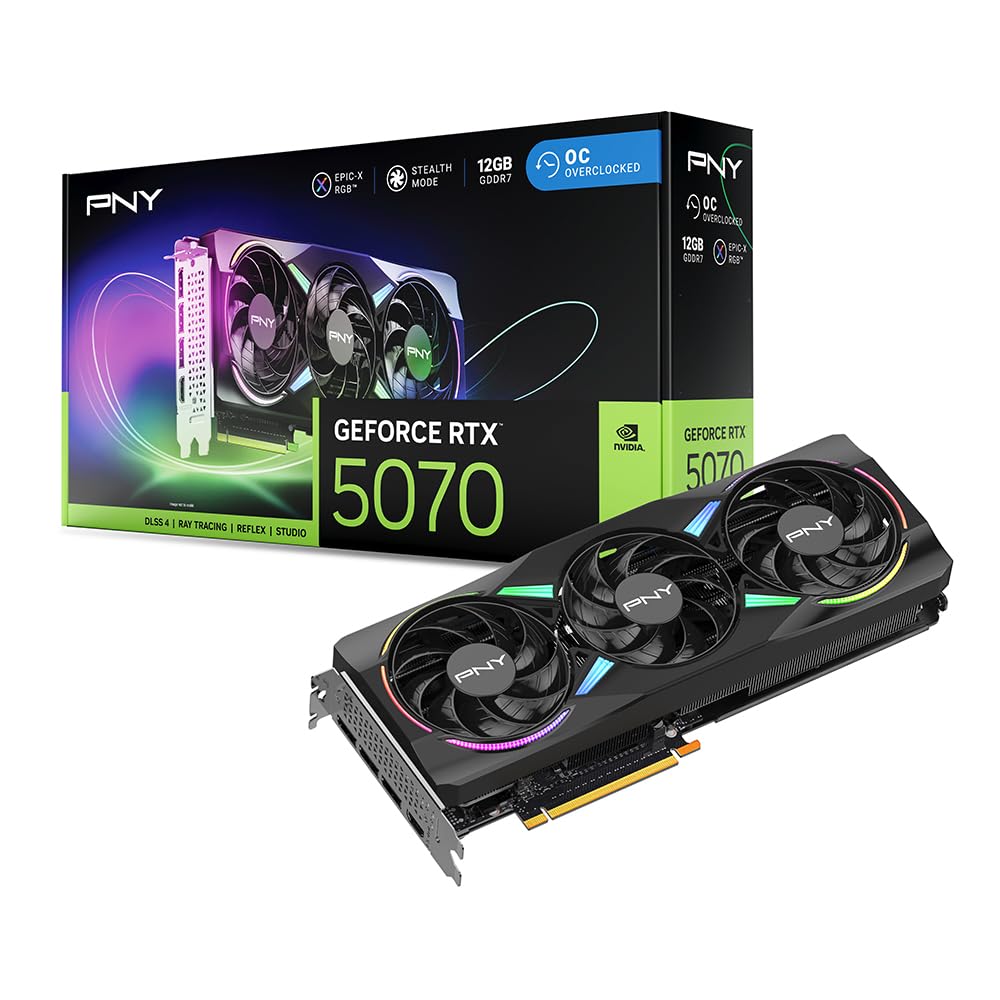
The PNY RTX 5070 Epic-X ARGB OC leverages the Blackwell architecture with GDDR7 memory running at 672 GB/s bandwidth — significantly faster than the GDDR6X memory on previous 40 Series cards. With 6,144 CUDA cores and a boost clock of 2,685 MHz, this 250W TDP card punches above its class, delivering better raw performance than a 4070 Super even without DLSS 4 or frame generation enabled.
DLSS 4 with Multi Frame Generation is the headline feature here — it uses fifth-gen Tensor Cores and fourth-gen RT Cores to generate multiple AI frames per traditionally rendered frame, dramatically boosting FPS in supported titles while maintaining image quality. The compact design fits smaller cases including the HP Z4-G4 workstation, and the triple-fan Epic-X cooler keeps the card quiet even under max load.
The card includes a 12-pin to dual 8-pin power adapter, making it compatible with 750W fully modular PSUs. Reviewers report all 80 ROPS are active and functional, with no disabled hardware. For pure 1440p gaming performance with access to the latest DLSS technology, this is the strongest choice in the mid-range segment.
Why it’s great
- GDDR7 memory with 672 GB/s bandwidth
- DLSS 4 with Multi Frame Generation
- Outperforms 4070 Super in raw gaming
Good to know
- 12GB VRAM may limit 4K texture settings
- Requires 750W PSU minimum
7. ASUS SFF-Ready Prime NVIDIA GeForce RTX 5070

The ASUS Prime RTX 5070 is specifically designed for small-form-factor (SFF) enthusiasts who refuse to compromise on performance. With a 2.5-slot profile and 12-inch length, this card fits ITX cases that reject bulkier triple-fan coolers, yet maintains the full Blackwell architecture with 12GB GDDR7 memory and DLSS 4 support. The axial-tech fans with a smaller fan hub allow longer blades and a barrier ring that increases downward air pressure for better heat extraction in cramped spaces.
The phase-change GPU thermal pad outperforms traditional thermal paste by maintaining optimal heat transfer even after thousands of thermal cycles, ensuring consistent performance over the card’s lifespan. The Jet Black aesthetic suits dark builds perfectly, and the dual BIOS lets users switch between quiet and performance profiles — a feature typically reserved for premium TUF Gaming cards.
Paired with a Ryzen 7800X3D, this card achieves smooth 1440p competitive gaming at high frame rates. The MSRP pricing makes it the most accessible Blackwell entry point, and the compact size means it fits in cases that previously required a compromise on GPU performance. The only trade-off is the smaller cooling surface, which means it runs warmer than triple-fan models under sustained max load.
Why it’s great
- SFF-Ready 2.5-slot fits compact ITX builds
- Phase-change thermal pad for long-term thermals
- Dual BIOS for quiet or performance profiles
Good to know
- Runs warmer than larger triple-fan alternatives
- Requires direct 16-pin PSU cable (recommended)
8. ASUS TUF Gaming NVIDIA GeForce RTX 5070 OC Edition

The ASUS TUF Gaming RTX 5070 OC Edition is built for longevity in harsh environments — military-grade capacitors, a protective PCB coating that guards against moisture and dust-induced short circuits, and a massive 3.125-slot cooler with three axial-tech fans. At 2,610 MHz boost clock, this factory-overclocked card delivers every ounce of performance the Blackwell architecture can offer while staying around 65°C under load.
The massive fin array with phase-change GPU thermal pad ensures the card maintains consistent cooling performance even after years of heavy use — the pad outlasts traditional thermal paste under sustained load. The included anti-sag stand doubles as a screwdriver, a thoughtful inclusion given the card’s 13-inch length and 3.4-pound weight. The TUF Magnet and Velcro Hook & Loop accessories help with cable management in the build.
At 12GB VRAM on a 192-bit bus, this card targets 1440p with ray tracing at maximum settings — it handles single-player RPGs without dropping frames, but the 12GB VRAM buffer is a concern for upcoming titles like Monster Hunter Wilds that recommend 16GB. The card is physically large, so measuring case clearance before purchase is non-negotiable.
Why it’s great
- Military-grade components with protective PCB coating
- 3.125-slot cooler keeps 65°C max under load
- Included anti-sag stand with screwdriver function
Good to know
- 12GB VRAM may be insufficient for future 16GB-recommended titles
- Large 13-inch length requires full mid-tower or larger case
9. Gigabyte GeForce RTX 4070 WINDFORCE OC 12GB
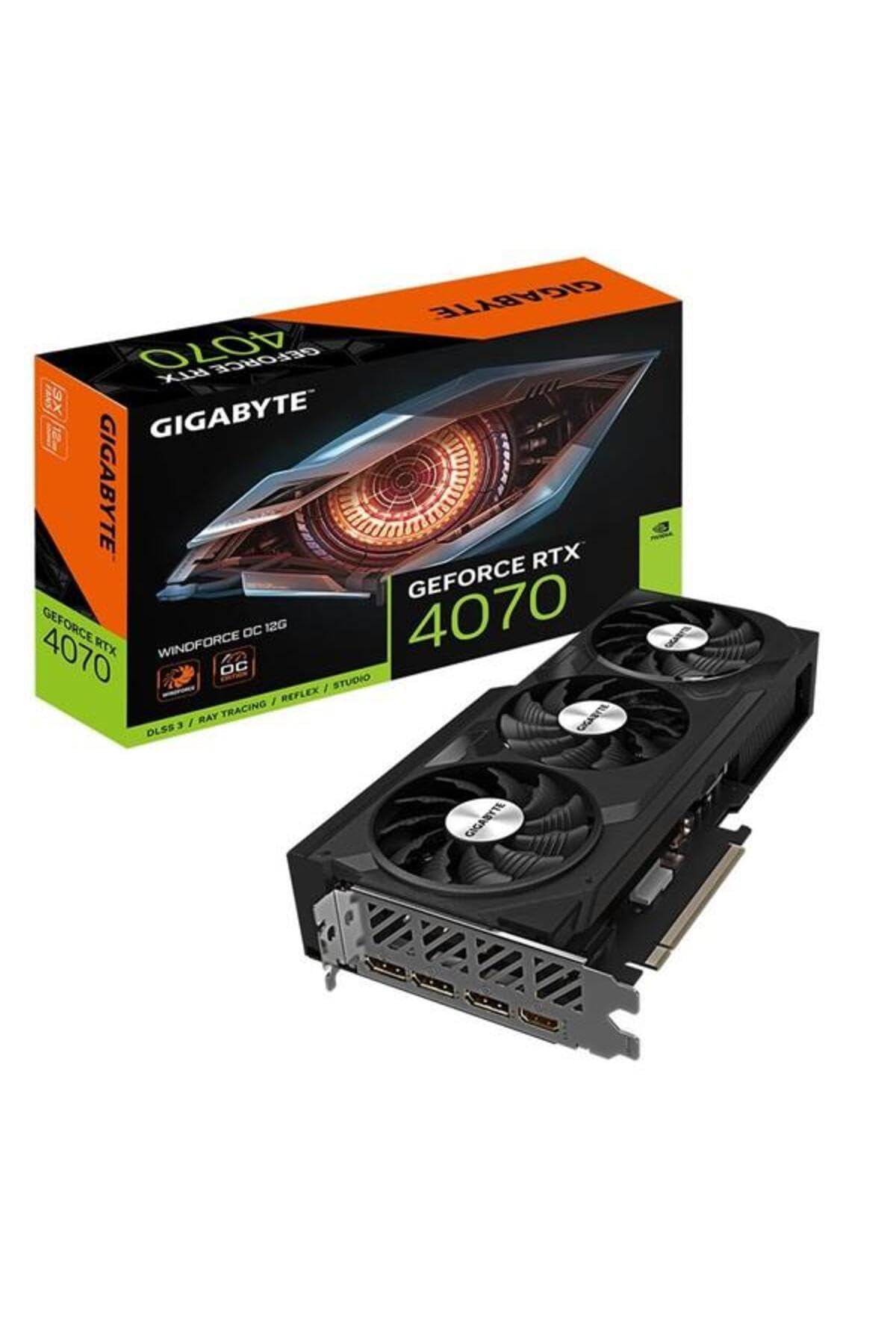
The Gigabyte RTX 4070 WINDFORCE OC is the efficiency champion of the 40 Series stack — its 200W TDP delivers 1440p ultra performance at 100-140 FPS average while maintaining just 60°C under load, making it one of the coolest-running graphics cards in its class. The WINDFORCE triple-fan system uses unique blade fan technology with graphene nano lubricant that outlasts standard sleeve bearings while running quieter.
With 12GB GDDR6X on a 192-bit bus and 2,490 MHz boost clock, this card handles any current title at 1440p max settings including ray tracing, with DLSS 3 providing the extra headroom for demanding scenes. The low power draw means it works with 550W PSUs, making it an ideal upgrade for existing systems without replacing the power supply — a significant advantage over the 650W minimum requirements of competing cards.
The card is physically compact at 10.28 inches, fitting most mid-tower cases with room to spare. At approximately 930 grams, it’s lightweight enough that GPU sag is not a concern. The 4th-gen Tensor Cores and 3rd-gen RT Cores provide solid DLSS 3 and ray tracing performance, though naturally below the 4070 Super and Ti Super tiers. This is the sensible pick for builders prioritizing low power consumption and thermal efficiency.
Why it’s great
- Excellent efficiency — 200W TDP with proper 1440p performance
- Compact 10.28-inch length fits most cases
- Runs at 60°C average under load, very quiet
Good to know
- 12GB VRAM may age faster than 16GB alternatives
- 192-bit memory bus limits 4K texture performance
10. MSI GeForce RTX 4070 Super 12G Ventus 3X OC

The MSI RTX 4070 Super 12G Ventus 3X OC leverages the TORX 4.0 fan design with pairs of fans tied together by a connected outer ring — this focuses airflow through the nickel-plated copper base plate and core pipes for 1440p gaming at 90+ FPS in demanding titles even while streaming simultaneously. With 7,168 CUDA cores and a 2.51 GHz boost clock, this card delivers approximately 15% more performance than the base 4070 while maintaining similar 220W power draw.
The solid nickel-plated copper base plate captures heat from the GPU and memory modules simultaneously, transferring it to precision core pipes with square-section contact for maximum thermal transfer. MSI Afterburner software provides granular control over voltage curves and fan profiles, making it easy to find the ideal balance between noise and thermals. The zero-RPM fan mode keeps the card silent during desktop use.
Streamers specifically benefit from the NVENC encoder quality — upgrading from an RTX 4060, one reviewer noted the 4070 Super eliminated stream lag at 1440p where the 4060 could not handle simultaneous gaming and encoding. The 12GB VRAM is sufficient for today’s titles, though the 192-bit bus means texture-heavy mods or 4K gaming will show the memory interface bottleneck.
Why it’s great
- TORX 4.0 fans with connected outer ring for focused airflow
- Excellent NVENC encoder quality for simultaneous streaming
- MSI Afterburner for fine-tuned voltage control
Good to know
- 12GB VRAM and 192-bit bus limit 4K performance
- Requires 650W PSU with 16-pin adapter
11. PNY GeForce RTX 4070 Super 12GB Verto OC Dual Fan

The PNY RTX 4070 Super Verto OC Dual Fan is the ultimate compact option for mini-ITX builds that cannot accommodate triple-fan solutions — at just 890 grams and a true 2-slot profile, it fits even the tightest SFF cases while delivering the full 7,168 CUDA core count and 2,490 MHz boost clock of the 4070 Super specification. The 12GB GDDR6X memory on a 192-bit bus provides 504 GB/s bandwidth, sufficient for 1440p gaming at ultra settings.
The dual-fan cooling solution is remarkably quiet — reviewers report 50% fan speed under load at approximately 56°C with good case airflow, outperforming many larger cards in noise-normalized comparisons. The PCIe 4.0 interface ensures full compatibility with modern motherboards, and the included DisplayPort and HDMI outputs support 4K resolution up to 7,680 x 4,320. The DLSS 3 support provides frame generation for demanding titles.
One build quirk: the 16-pin port is set deep into the card without a backplate notch, requiring approximately 1.5 inches of clearance for the power cable bend. The 220W power draw makes it compatible with 550W PSUs in most configurations. This is the smart pick for budget-conscious builders who want 4070 Super performance without paying for triple-fan cooling they cannot use in a compact case.
Why it’s great
- True 2-slot profile fits mini-ITX cases |
- Lightweight 890g eliminates GPU sag worries
Good to know
- Requires 1.5-inch clearance for 16-pin power cable bend
- Dual-fan cooling runs warmer than triple-fan in restricted airflow cases
FAQ
Is 12GB VRAM on a 192-bit bus enough for 1440p gaming in 2025?
Does GDDR7 on the RTX 5070 make it faster than the RTX 4080?
What power supply wattage do I need for a 40 Series GPU?
Final Thoughts: The Verdict
For most users, the 40 series gpu winner is the ZOTAC RTX 4080 Trinity OC because its 16GB VRAM on a 256-bit bus provides 4K ray tracing capability at the sweet spot of price and performance. If you want absolute 1440p value with DLSS 4 access, grab the PNY RTX 5070 ARGB OC. And for 4K flagship performance with 24GB VRAM that will remain relevant for the next half-decade, nothing beats the ASUS TUF RTX 4090 OC.