
Our readers keep the lights on and my morning glass full of iced black tea. As an Amazon Associate, I earn from qualifying purchases.
A 40-watt solar panel sits at a sweet spot — small enough to toss in a backpack yet powerful enough to top off a power bank, phone, or even a small portable power station during a weekend camp trip. But real-world wattage rarely matches the label, and build quality varies wildly between flimsy PET panels and rugged ETFE models.
I’m Min — the co-founder and writer behind Gadgets Feed. I’ve spent countless hours comparing monocrystalline cell efficiency, port output specs, and IP ratings across dozens of these panels to find the ones that actually deliver on their promise.
Skip the guesswork and the multi-tab research session — this guide cuts straight to the models that earn their space in your pack with genuine output, smart design, and durable construction for the best 40 watt solar panel.
How To Choose The Best 40 Watt Solar Panel
A 40W panel is a precision tool — too small for big appliances but perfect for keeping your essential electronics alive off-grid. Focus on three things: cell efficiency, port compatibility, and weather sealing.
Cell Type and Conversion Efficiency
Monocrystalline silicon is the standard for portable panels, offering the highest efficiency in a compact footprint. Look for conversion rates above 22% — models like the Jackery SolarSaga 40W Air hit 23% with PERC bifacial cells, meaning they pull power from both sides and perform better in low light.
Output Ports and Compatibility
The DC port (usually 18V or 15V) is what connects to most portable power stations like Jackery or VTOMAN. USB-C PD at 30W is becoming essential for modern phones and laptops — the SunJack and VTOMAN both offer this. Check the connector kit: a 10-in-1 adapter set covers more power stations out of the box.
Build Quality and IP Rating
PET laminate panels are budget-friendly but degrade faster. ETFE coating, found on premium models like SunJack, is more abrasion-resistant and lets in more light. IPX4 handles splashes, but IP67 (VTOMAN) or IP68 (Jackery Air) means the panel survives heavy rain and brief submersion without issue.
Quick Comparison
On smaller screens, swipe sideways to see the full table.
| Model | Category | Best For | Key Spec | Amazon |
|---|---|---|---|---|
| Jackery SolarSaga 40W Air | Premium | Ultralight hiking & Jackery ecosystem | 1.98 lbs, IP68, Bifacial PERC 23% | Amazon |
| SunJack 40W Foldable | Premium | Durability & USB-C PD30W charging | ETFE, IP67, 20.9V max, 3.5 lbs | $129.99Amazon |
| VTOMAN 40W | Mid-Range | Featherweight backpacking | 1.81 lbs, IP67, 25% efficiency | $79.99$109.99PrimeAmazon |
| Powkey 40W | Mid-Range | Power station companion with stand | 4.2 lbs, IPX4, 15V/2.6A DC | $49.99Amazon |
| SinKeu 40W | Mid-Range | Proven long-term reliability | 3.3 lbs, IPX4, 22% efficiency | from $89.99Amazon |
| Apowking 40W | Value | Budget-friendly with kickstands | IPX4, 22% efficiency, 3 Amps DC | $49.99$69.99PrimeAmazon |
| EnginStar 40W | Value | Heavy-duty feel on a budget | 3.3 lbs, 24% efficiency, QC3.0 USB | Amazon |
In‑Depth Reviews
1. Jackery SolarSaga 40W Air
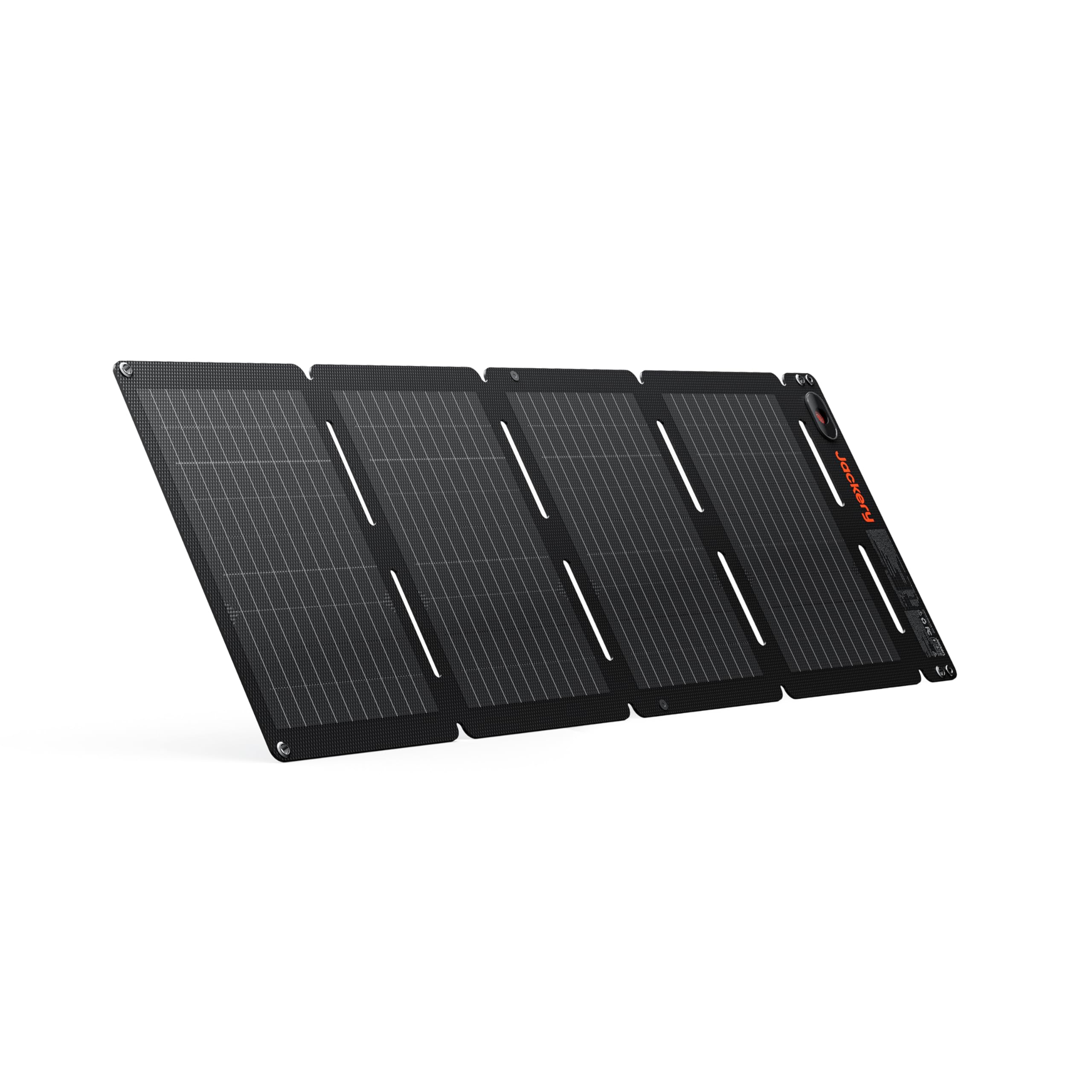
The Jackery SolarSaga 40W Air redefines what a 40W panel can weigh. At 1.98 pounds with a book-sized W-fold, it’s 30% lighter than most competitors. The PERC bifacial cells capture sunlight from both sides, hitting 23% conversion efficiency — meaning it still pushes usable power on cloudy days or when angled away from the sun.
IP68 waterproofing and 4,000-fold durability testing make this the most adventure-ready option on this list. Dual USB ports (A and C) let you charge two devices simultaneously, and the included DC8020 to USB-C adapter connects directly to newer Jackery power stations. It’s purpose-built for ultralight backpackers and kayakers who count every gram.
Real-world output sits around 23W when laying flat, which is typical — a quick angle adjustment toward the sun boosts that considerably. The DC power cord uses a non-standard 8020 connector, so older Jackery 240 owners will need an adapter. That minor compatibility note aside, this is the most intelligently designed portable panel at 40W.
Why it’s great
- Industry-leading 1.98 lb weight with bifacial PERC cells
- IP68 rated for rain, dust, and submersion
- Book-sized fold packs flat into any backpack
Good to know
- DC connector is non-standard (DC8020) — adapter needed for older stations
- Runs about , premium pricing for premium build
2. SunJack 40 Watt Foldable Solar Panel

The SunJack 40W is built like a piece of expedition gear. Its ETFE laminate coating resists scratches and lets more light through than standard PET, and the IP67-rated ports mean rain and dust won’t stop the charge. The four-panel fold collapses to about the size of a tablet — 9 x 12.5 x 1.5 inches — and weighs 3.5 pounds.
What sets this apart is the USB-C PD30W output. It fast-charges a smartphone in under two hours and pushes roughly 34W through the USB-C port in direct sun, which is excellent real-world performance for a 40W panel. The accessory pocket holds cables, and the included adapter cable covers DC5521, XT60, and Anderson connectors for power station compatibility.
At it’s not the cheapest option, but the build quality justifies the price — users report surviving drops, rain, and months of trail abuse. The integrated kickstands and carabiners make setup quick on any terrain. It’s slightly heavier than the Jackery Air, but the USB-C PD charging speed and ruggedness make it a top-tier pick for serious campers.
Why it’s great
- USB-C PD30W delivers ~34W real output for fast device charging
- ETFE coating and IP67 ports for extreme durability
- Includes adapter cable for DC5521, XT60, and Anderson connectors
Good to know
- At 3.5 lbs, it’s heavier than ultralight options
- Premium price tag —
3. VTOMAN 40W Solar Panel
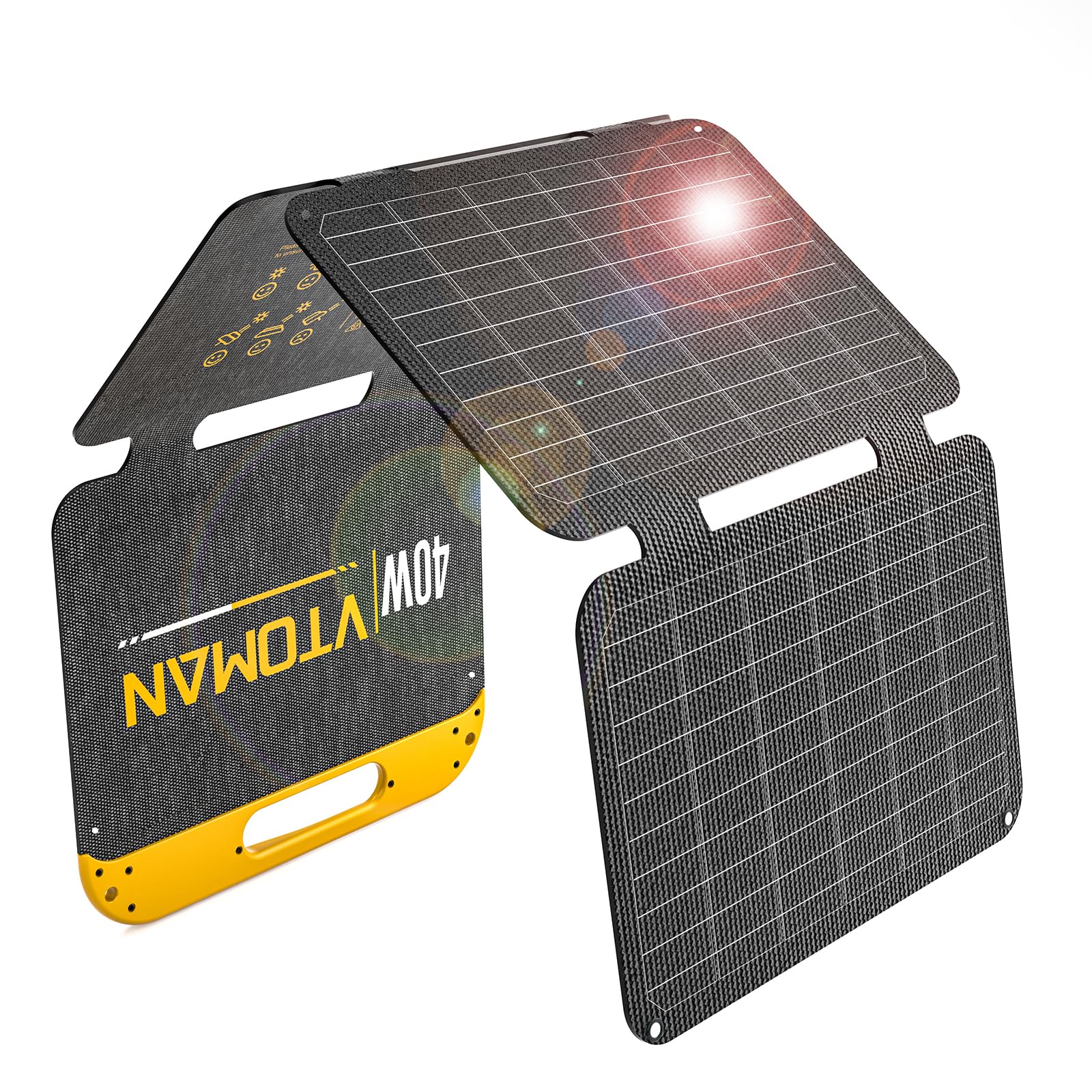
The VTOMAN 40W panel claims the title of lightest in this roundup at just 1.81 pounds, making it a serious contender for backpackers who need to shave ounces. Despite the low weight, it delivers a 25% conversion efficiency — the highest claimed rate here — and features IP67 waterproofing with ETFE laminate for long-term durability.
Port selection is simple but effective: one USB-A and one USB-C PD30W output. The USB-C PD port is a standout at this price point, enabling direct fast charging for modern smartphones, tablets, and even some laptops. It lacks a dedicated DC barrel connector for power stations, so you’ll rely on the USB-C to power a small portable station or battery bank.
Folded dimensions of 11.02 x 11.97 x 0.94 inches make it barely thicker than a magazine. The four-corner mounting holes and included carabiners allow attachment to a backpack while hiking. Expect around 30W real output in peak sun — solid for the weight. The trade-off for the featherlight build is the absence of a DC output, which limits compatibility with some power stations.
Why it’s great
- Ultralight 1.81 lb design with IP67 waterproof rating
- 25% monocrystalline efficiency for top-tier output
- USB-C PD30W charges phones and tablets directly
Good to know
- No DC barrel output — relies on USB-C for power station charging
- Missing carabiners reported in some units
4. Powkey 40W Portable Solar Panel

The Powkey 40W is the practical choice for campers who aren’t counting every gram. At 4.2 pounds and a folded size of 13.6 x 9.8 x 2.4 inches, it’s not the lightest, but it packs features that matter: a built-in charge controller integrated into the zippered storage panel, adjustable kickstands, and a 15V/2.6A DC output (40W max) plus a USB QC3.0 port.
The built-in controller is a real convenience — it prevents overcharging your power station without needing an extra device inline. Real-world tests show ~29-31W output in full sun, which is competitive for a mid-range panel. TIR-C technology automatically detects connected devices and optimizes the charging profile for safety.
IPX4 water resistance handles light rain, and the polyester fabric build feels durable enough for regular weekend trips. Users specifically praise its dash-charging capability — laying it on a car’s dashboard passively tops off a power bank while driving. For under , this is the most balanced value package, especially if you pair it with a small 100-200W power station.
Why it’s great
- Built-in charge controller prevents overcharging
- Adjustable kickstands for optimal sun angle
- TIR-C technology for safe, optimized device charging
Good to know
- Weighs 4.2 lbs — heavier than ultralight options
- IPX4 only — avoid prolonged heavy rain exposure
5. SinKeu 40W Foldable Solar Panel

The SinKeu 40W has been a consistent seller for years, and for good reason — it delivers reliable 22% efficiency in a compact 3.3-pound package. Folded size is 12.6 x 9.1 x 2 inches, making it one of the more packable mid-range panels. The 18V/2.27A DC output and USB QC3.0 port cover the basics well.
Users report years of dependable service with this panel, using it to charge Jackery power banks and camping lights consistently. The TIR-C technology is also present here, matching the Powkey’s safety features. The Velcro straps and handle make packing and carrying straightforward, and the IPX4 rating handles splashes without issues.
The main drawback is the outdated port selection — only USB-A output, with no USB-C PD. For charging a modern smartphone or tablet at full speed, you’ll need an adapter. It also tops out at 18V DC, which is slightly lower voltage than the 20.9V from the SunJack, meaning slightly slower charging for some power stations. Still, for proven long-term dependability at a reasonable mid-range price, this is a solid bet.
Why it’s great
- Proven track record — users report 5+ years of use
- Compact 3.3 lb design with easy Velcro strap storage
- TIR-C technology for safe device charging
Good to know
- USB-A only — no USB-C PD for modern fast charging
- 18V DC output is lower voltage than premium panels
6. Apowking 40W Portable Solar Panel

Apowking’s 40W panel is the entry-level workhorse that punches above its price. It delivers 22% conversion efficiency from its monocrystalline cells and provides three output ports: 18V/2.27A DC, USB QC3.0, and USB-C. The USB-C port supports up to 12V/2.5A, which offers decent charging speed for modern devices.
The adjustable kickstands are a welcome feature at this price point, letting you angle the panel toward the sun rather than laying it flat. Folded size is 12.6 x 9.1 x 2 inches, comparable to the SinKeu. Users report charging a 40,000mAh power bank from 0-100% in about five hours on a sunny day using the 15V/2A DC port — solid real-world performance.
The IPX4 rating means it handles light rain, but the junction box is not waterproof and must be kept dry. A strong chemical smell out of the box is a common complaint that airs out after a day. The PET laminate is less durable than ETFE, so expect faster wear with heavy use. For occasional car camping or emergency kits, this is a fantastic budget pick, but expect to upgrade the DC cable to 18-gauge for better current handling.
Why it’s great
- Excellent value with USB-C, QC3.0, and DC outputs
- Adjustable kickstands for optimal sun tracking
- Real-world ~5 hour charge for large 40k mAh power banks
Good to know
- PET laminate less durable than ETFE — not for rough trail use
- Strong chemical smell reported out of box
7. EnginStar 40W Foldable Solar Panel
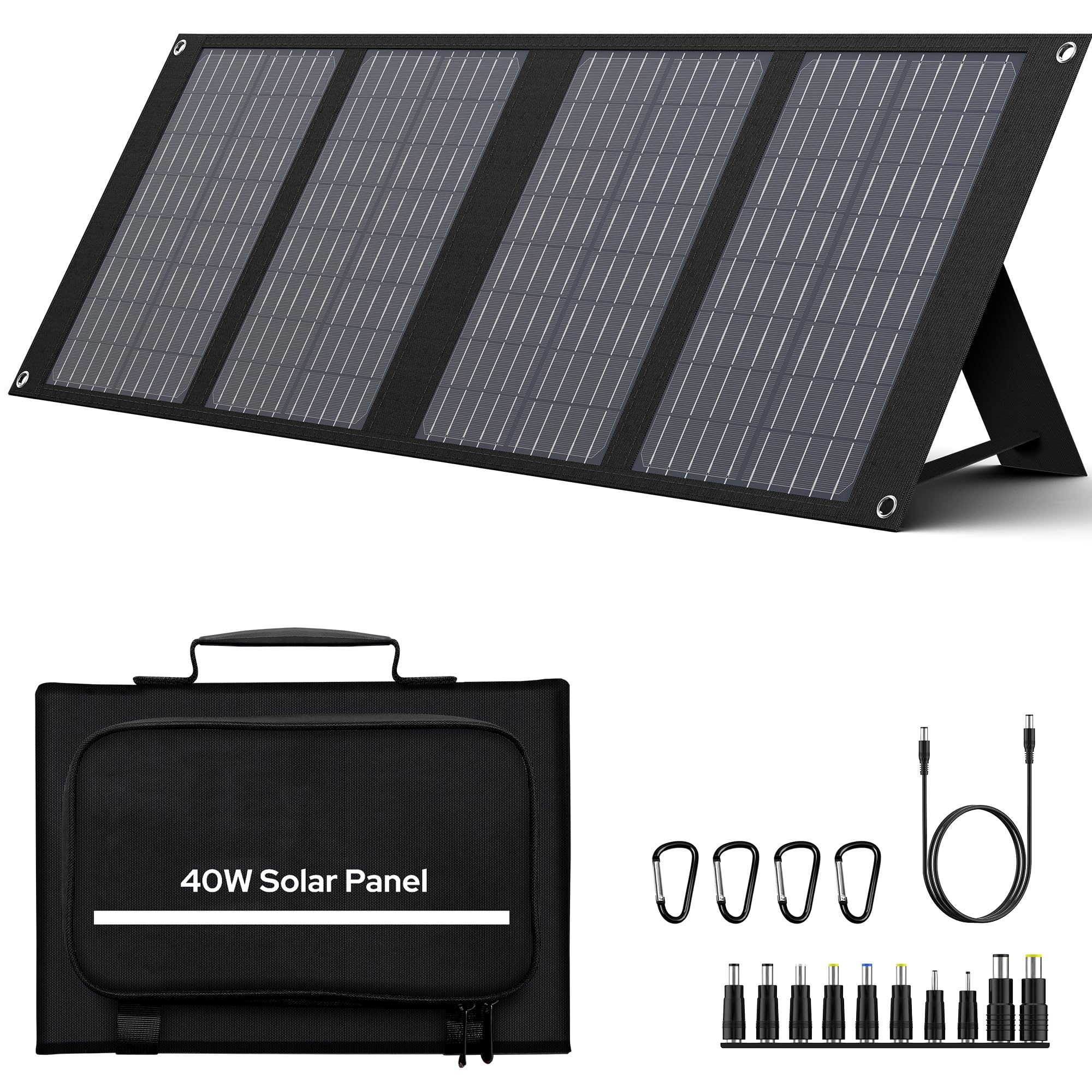
The EnginStar 40W is a surprisingly robust panel for its budget-friendly price. Claimed conversion efficiency of 24% puts it ahead of many mid-range options, and users consistently praise the heavy-duty feel of the build. At 3.3 pounds with a folded size of 12.6 x 9.1 x 2 inches, it’s comparable to the SinKeu in portability.
Output ports include a USB-A QC3.0, USB-C, and 18V/2.27A DC. The 10-in-1 DC connector kit provides broad compatibility with power stations, and the panel has been tested in real-world power outage scenarios — a user reported powering a portable AC and phone chargers during an 8-hour Florida outage. The automatic restart feature helps it recover charging after clouds pass.
Like many affordable panels, performance drops significantly in cloudy conditions — that’s physics, not a defect. A few users note the panel is “fairly heavy” for a 40W unit, though at 3.3 lbs it’s actually average. The PET laminate is standard for this tier. For budget-conscious buyers who want a durable panel that feels substantial and includes a good connector kit, the EnginStar delivers strong value.
Why it’s great
- Claimed 24% conversion efficiency — best in value tier
- Heavy-duty build feel with 10-in-1 connector kit
- Automatic restart feature after cloud coverage
Good to know
- Performance drops sharply in cloudy/indirect light
- PET laminate — less durable than premium ETFE panels
FAQ
Can a 40W solar panel charge a power station?
What’s the difference between PET and ETFE solar panels?
How many watts will a 40W panel actually output?
Do I need a charge controller with a 40W solar panel?
Final Thoughts: The Verdict
For most users, the best 40 watt solar panel is the VTOMAN 40W because it combines ultralight 1.81 lb portability with IP67 durability and USB-C PD30W fast charging at a mid-range price point. If you want the highest real-world output and build quality, grab the SunJack 40W. And for ultralight backpacking and seamless Jackery ecosystem pairing, nothing beats the Jackery SolarSaga 40W Air.
Product prices and availability are accurate as of the date/time indicated and are subject to change. Any price and availability information displayed on Amazon at the time of purchase will apply to the purchase of this product. As an Amazon Associate I earn from qualifying purchases.
CERTAIN CONTENT THAT APPEARS ON THIS SITE COMES FROM AMAZON. THIS CONTENT IS PROVIDED "AS IS" AND IS SUBJECT TO CHANGE OR REMOVAL AT ANY TIME.
Amazon and the Amazon logo are trademarks of Amazon.com, Inc. or its affiliates.