
Our readers keep the lights on and my morning glass full of iced black tea. As an Amazon Associate, I earn from qualifying purchases.
Specs are compiled from manufacturer listings and verified buyer reviews and can change over time — please confirm the key details on the product page before buying.
When you search for a 400W solar panel, you are hunting for serious off-grid power — enough to run a fridge, charge a power station in a few hours, or keep an RV’s batteries topped off through a cloudy weekend. But that “400W” label on the box is the ideal lab number, and real-world output depends on sunlight angle, temperature, shade, and how you wire it. You need to know which panel actually delivers the power you expect in your exact setup — roof-mounted rigid or campsite portable.
I’m Min — the founder and writer behind Gadgets Feed. This guide is built by comparing the manufacturers’ published specifications and the patterns across verified customer reviews, so you get each pick’s real strengths and trade-offs instead of marketing spin.
Whatever your setup — rooftop, backyard, or campsite — the right choice among the 400w solar panel options here depends on whether you prioritize permanent high output or portable pack-and-go convenience.
Quick Picks
- Renogy 400W Portable Solar Panel Suitcase — Best Overall
- AFERIY 400W Portable Foldable Bifacial Solar Panel — Top Efficiency
- DOKIO 400W 31V Mono Solar Panel — Fixed Powerhouse
- Ecosonique 400W Portable Solar Panel — Budget Camping Kit
How To Choose The Best 400W Solar Panel
All 400W panels are not equal. The first fork in the road is rigid glass panels vs portable foldable ones. Rigid panels mount permanently on a roof or ground rack and generally produce more power because they stay at a fixed, tune angle all day. Portable suitcase-style panels are meant to be carried, set up at camp, and packed away. Each has a different weight, footprint, and voltage range, so your choice depends on how mobile you need to be.
Rigid vs Portable: The Performance Trade-Off
A rigid glass panel like the DOKIO weighs about 49.4 lbs and measures over 67 inches long. It delivers consistent, high daily output for a house, shed, or garden, but you are not moving it around. A portable panel like the Ecosonique is about 22.9 lbs and folds to a 26-inch case — it goes in your car trunk. The catch is portable panels average lower real-world wattage because they lie flat on the ground without active tracking. Buyers of portable panels often report 270-350W peak, while rigid panel buyers report closer to 400W and higher.
Efficiency: Higher = More Power in Less Sun
Conversion efficiency tells you how much of the sunlight hitting the surface turns into electrical power. Standard portable panels hover around 23-23.5%. The AFERIY hits 25% with N-type solar cells, meaning it squeezes more wattage from the same surface area in limited sunlight. If you camp in partially shaded spots or have a small roof, a higher-efficiency panel makes a real difference in charging speed.
Quick Comparison
| Model | Best For | Wattage | Weight | Efficiency | Amazon |
|---|---|---|---|---|---|
| DOKIO 400W 31V Mono | Fixed roof/ground installation | 400W | 49.38 lbs | High Efficiency | $249.77Amazon |
| Renogy 400W Portable Suitcase | Premium RV/overlanding | 400W | 30.2 lbs | 23% | $421.59$495.99Amazon |
| AFERIY 400W Bifacial Foldable | Max efficiency in portable size | 400W | 25.3 lbs | 25% | $499.00Amazon |
| Ecosonique 400W Portable | Budget-friendly portable kit | 400W | 22.9 lbs | 23.5% | $304.99$459.99Amazon |
In‑Depth Reviews
1. Renogy 400W Portable Solar Panel Suitcase

The premium portable built to survive decades of RV trips and still deliver over 300W in overcast conditions.
If you want a portable panel that feels as solid as a permanent installation, this Renogy 400W suitcase is your pick. At 30.2 lbs it is noticeably heavier than the DOKIO rigid panel? Actually it is 19 lbs lighter than that 49.4 lb glass panel, and it folds to 33.7 x 27.9 inches — compact enough to stash in an RV compartment. The fiberglass construction with ETFE coating resists hail and UV, so owners mention taking it through rain and snow without degraded output. One owner noted they “achieved 385W in Chicago sun,” while another says typical real-world output runs “200W+ in overcast, 300W+ typical, peak 395W.” The parallel wiring helps: if a tree branch shadows one section, the other panels keep pulling power.
The 23% high-efficiency monocrystalline cells are backed by a 3-year material and workmanship warranty. The kickstands are sturdy steel but not adjustable, so some buyers DIY PVC extensions to tilt the panel steeper in winter — a small mod for year-round use. It connects via IP68 solar connectors, which are waterproof and compatible with most modern power stations.
What Solid Build Means on Site
- Real-world output hits 300-395W even under partial clouds — rivals many fixed panels
- Fiberglass + ETFE coating is hail-resistant and IP67 waterproof for all-weather camping
- Parallel wiring keeps shade from dropping full array output
The Frustrating Detail
- Non-adjustable kickstands are too short for optimal winter angle; some users add PVC pipe extensions
- At 30.2 lbs, heavier than most portable competitors — justified by build, but not a weight you want to hike with
Reach for this if: you are outfitting an RV or sailboat with a high-durability portable that can stay outdoors in rain and produce reliable power year-round.
The caveat: the kickstands lack adjustability, so you may need to DIY a tilt solution for winter sun angles.
2. AFERIY 400W Portable Foldable Bifacial Solar Panel
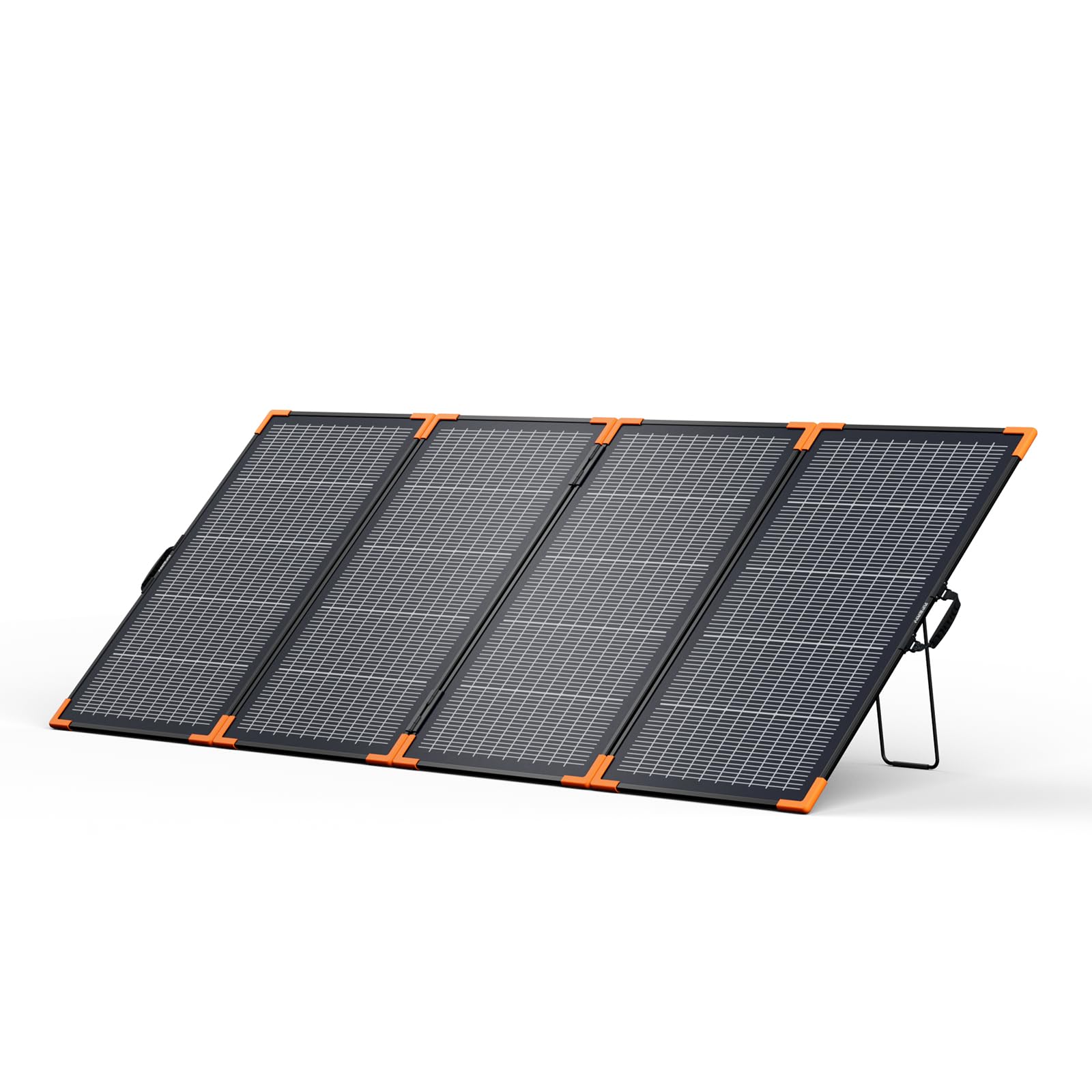
The bifacial panel that pulls sunlight from both sides, hitting 25% efficiency for faster charging in limited sun.
Most portable panels capture sunlight from one face only. This AFERIY uses N-type bifacial cells — you can prop it up so light reaches the back too, which boosts total harvest, especially on bright ground or snow. Its 25% high conversion efficiency beats the Renogy’s 23% and the Ecosonique’s 23.5%, meaning you get more wattage per square foot when sky conditions are mediocre. Customers note it charges an EcoFlow Delta Max 2 (2000Wh) in about 1.5 days from zero, though one noted a max real-world output of 242W vs the 400W rating in their test conditions. The foldable design packs to a 96.5 x 38.5 inch footprint and weighs 25.3 lbs — lighter than the Renogy by about 5 lbs.
The IP67 waterproof rating means you can set it up in light rain without worry, and the scratch-resistant ETFE surface shrugs off branches and gravel. It includes a 3m MC4 extension cord and an Oxford fabric carry bag with reflective film. The kickstands are adjustable, which is a notable step up from the fixed Renogy stands, though some owners say the seatbelt-style braces can be finicky to retract.
Why Higher Efficiency Matters
- 25% conversion efficiency is the highest in this list — more power per panel in partial sun
- Bifacial design captures reflected light from ground, snow, or tent surfaces for a boost
- Adjustable kickstands let you tilt the panel for optimal sun angle
The Real-World Gap
- One buyer recorded max 242W vs the 400W rating — consistent output depends heavily on aiming and cloud cover
- Folding mechanism uses retractable braces that some find fussy to reset; lacks stake rings for windy sites
Best for efficiency hunters: if you camp in partially shaded areas or want the fastest per-panel charging speed, the N-type bifacial cells give you a real edge.
One honest limitation: real-world peak output may fall short of 400W in imperfect conditions, so manage expectations for cloudy days.
3. DOKIO 400W 31V Mono Solar Panel

The heavy glass panel that actually exceeds its rating — buyers saw 560W in partial shade on the ground.
This DOKIO is a traditional rigid monocrystalline panel with a tempered glass face and an aluminum frame, designed to be bolted to a roof, ground rack, or shed. It is large: 67.8 x 44.6 inches and 49.38 lbs. That is a 2.6x longer and 2.2x heavier footprint than the Ecosonique portable, which is what you expect for a fixed installation — but the trade-off is real output. One buyer using two panels in parallel measured “560W on ground with partial shade” and expects even higher output roof-mounted where ventilation is better. Another reported “838W from two panels in series” feeding a 3600W power station. A different owner noted getting 180-185W per panel at peak — about 45% of the 400W rating, which is lower but plausible if the panel was not optimally aimed.
The 9.84 ft (3m) MC4 leads mean fewer extension cables and connection joints than short-lead panels. The junction box is sealed for outdoor rain exposure, and pre-drilled holes fit common Z-brackets and tilt mounts. One buyer emphasizes it delivers “ample power” to keep a 20Ah AGM battery charged continuously for security cameras and actuators, calling it an easy alternative to running long cable runs. It is also the most budget-friendly option here.
Why a Glass Panel Still Wins
- Reviewers point out real-world peak output exceeding advertised 400W — one recorded 560W in partial shade
- 9.84 ft MC4 leads reach farther than short-lead panels, reducing cable joints
- Tempered glass + aluminum frame is proven durable for permanent outdoor installation
Where It Does Not Fit
- At 49.38 lbs and over 5.5 ft long, this is not portable — you need a vehicle or stationary mount
- Output drops significantly if any part of the glass is shaded by trees, branches, or debris
Best for fixed setups: if you have a shed, greenhouse, or ground mount and want the most proven high-output panel at a budget price, this is your pick.
Who should skip: anyone needing a portable panel for camping or travel — the weight and size make it unsuitable for carrying.
4. Ecosonique 400W Portable Solar Panel
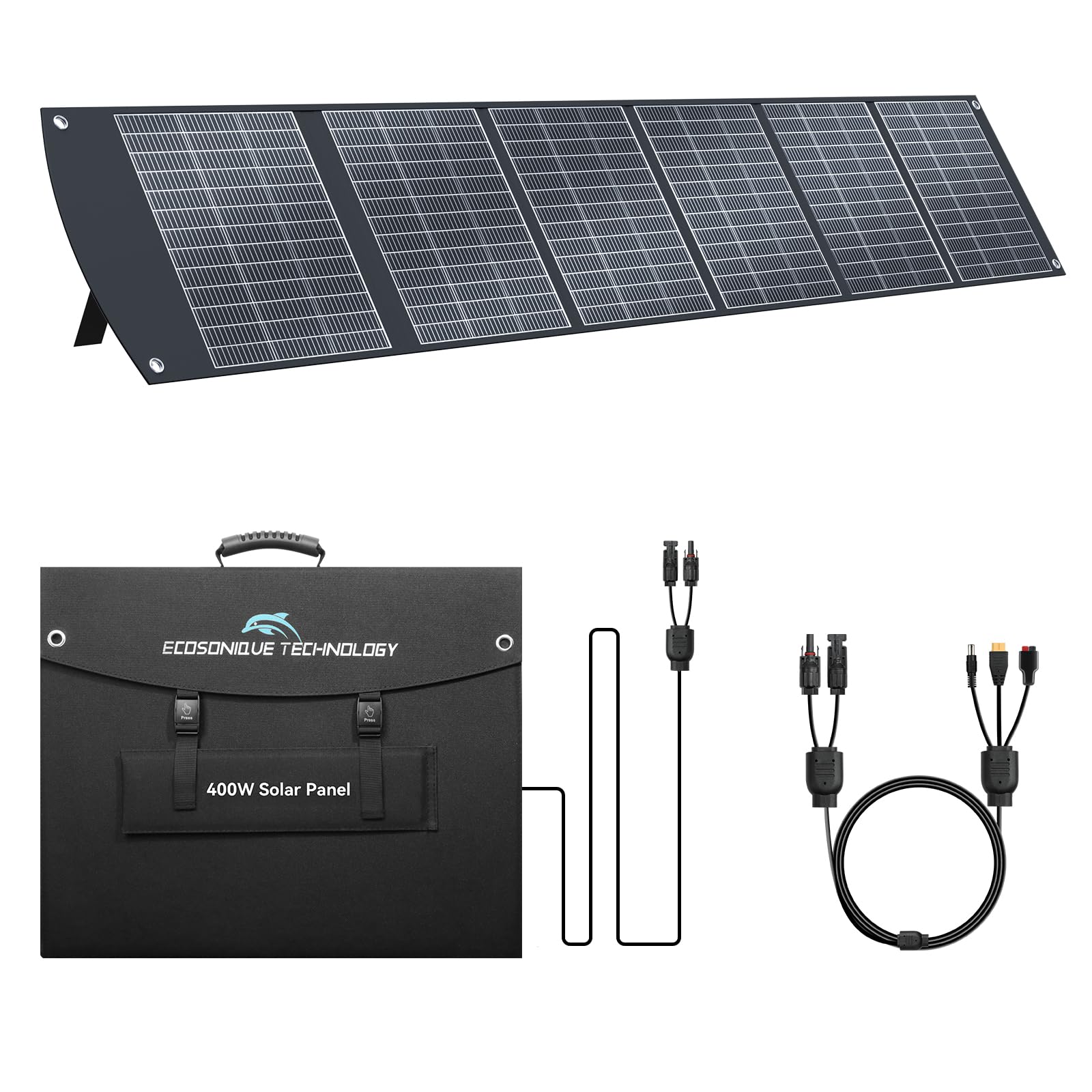
The lightweight foldable that fits in a trunk and charges fast — but buyers average 270-280W, not 400W.
This Ecosonique panel is built for car camping and van life where every pound counts. At 22.9 lbs, it is the lightest portable here — about 7.4 lbs lighter than the AFERIY and 7.3 lbs lighter than the Renogy. It folds six times to a 26.2 x 22.4 x 2.95 inch package that slides into most car trunks. The 23.5% high conversion rate is middle-of-the-pack, and buyers confirm it charges a power station to 80% within a few hours on a good day. One reviewer noted a peak of 350W but notes “270-280 on average,” while another said peak was 302W. That is a consistent pattern: the panel delivers solid daily output but seldom hits the full 400W label in typical campsite conditions.
The included cables cover MC4, XT60, Anderson, and DC8020 connections, so it works with Jackery, Bluetti, EcoFlow, and Anker power stations without adapters. The semi-flexible CPC-laminated panels are rated IP65 and survive extreme temps from -4°F to 158°F. The 6-angle kickstand gives you tilt choices — but several buyers mentioned the panel “slightly delaminates” at the creases when folding, which you can press back down. It carries a 12-month warranty with free replacement for defects, and 24/7 customer support.
What You Get for the Weight Savings
- At just 22.9 lbs, this is the easiest 400W panel to carry and store — fits in most car trunks
- Includes MC4 + XT60 + Anderson + DC8020 cables — wide compatibility from the start
- Buyers saw 350W peak and 720W with two panels in parallel on a Delta 3 Max Plus
The Consistent Trade-Off
- Average real-world output is 270-280W — a 30% gap from the 400W rating that many shoppers say
- Semi-flexible panels can delaminate at fold creases; you need to press them smooth after each use
- Flimsy kickstand supports make aiming in wind a challenge — one buyer says 12 ft of cable adds setup hassle
Go for this if: you value lightweight carry and plug-and-play connectivity over absolute wattage — a solid companion for car campers and van dwellers.
The one catch to know: average output settles around 270-280W, so factor that into your power budget rather than expecting the full 400W label.
Understanding the Specs
Conversion Efficiency
This is the percentage of sunlight hitting the panel that actually turns into electrical power. Most portable panels run 23-23.5%. The AFERIY hits 25% with advanced N-type cells, which means you get more wattage out of the same surface area — important when sunlight is limited or you have room for only one panel. A 2% efficiency difference may not sound like much, but it can mean an extra 50-80Wh per day in typical camping sun.
Weight and Portability
Weight determines whether you carry the panel or mount it permanently. The DOKIO at 49.38 lbs is strictly for a roof or ground rack. Portable panels range from 22.9 lbs (Ecosonique) to 30.2 lbs (Renogy). Lighter panels are easier to carry but often use semi-flexible materials that can delaminate at the fold creases. Heavier portable panels with fiberglass frames are more durable but eat into your vehicle’s payload.
FAQ
Will a 400W solar panel run my RV fridge and lights?
Can I use a portable 400W panel with my Jackery or EcoFlow power station?
How much power does a 400W panel actually produce in real-world conditions?
What is the difference between a rigid glass panel and a portable foldable panel?
Do I need an MPPT charge controller for a 400W panel?
How long does a 400W panel take to charge a typical power station?
Is a 400W panel too large for a compact car roof?
What does “bifacial” mean and is it worth the extra cost?
Final Thoughts: The Verdict
Across the board, the 400w solar panel winner is the Renogy 400W Portable Suitcase because it balances rugged fiberglass build, consistent 300-395W real-world output, and a 3-year warranty — all in a reasonably portable 30.2 lb package. If you want the highest charging efficiency in a lightweight foldable, grab the AFERIY 400W Bifacial with its 25% efficiency and bifacial boost. And for a permanent installation on a shed or ground mount, the standout is the DOKIO 400W rigid panel — buyers have seen it exceed 560W in partial shade, and it costs less than any portable option.
How We Picked
We do not accept paid placement. Every pick is matched to a real buyer and a real use-case; we do not hands-on test units.
Sources & Methodology
Specifications: manufacturer listings and product documentation. Review insights: verified customer reviews, as of July 2026. Pricing: not shown on this page (it changes often); check the current price via the retailer link.
As an Amazon Associate, Gadgets Feed earns from qualifying purchases. This does not affect which products we feature.
Product prices and availability are accurate as of the date/time indicated and are subject to change. Any price and availability information displayed on Amazon at the time of purchase will apply to the purchase of this product. As an Amazon Associate I earn from qualifying purchases.
CERTAIN CONTENT THAT APPEARS ON THIS SITE COMES FROM AMAZON. THIS CONTENT IS PROVIDED "AS IS" AND IS SUBJECT TO CHANGE OR REMOVAL AT ANY TIME.
Amazon and the Amazon logo are trademarks of Amazon.com, Inc. or its affiliates.