
The 1440p gaming arena has a clear champion, and it’s built on the Ada Lovelace architecture. The problem isn’t finding a 4070-class card; it’s choosing between the base model, the Super refresh, and the Ti variants without burning cash on an overkill cooler or missing the VRAM ceiling in a year. Each board partner — ASUS, Gigabyte, MSI, ZOTAC, PNY — applies its own spin on cooling, power delivery, and dimensions, turning what looks like the same chip into drastically different physical experiences inside your case.
I’m Min — the co-founder and writer behind Gadgets Feed. I’ve spent hundreds of hours cross-referencing clock speeds, thermal benchmarks, VRAM bus widths, and real-world frame-time graphs across all eleven cards in this deep-dive stack to isolate the exact models that justify their sticker price versus those that bank purely on brand loyalty.
Whether you’re upgrading from a 20-series card, building a compact SFF rig, or chasing 4K with DLSS 3 frame generation, the best 4070 video card for your specific build hinges on power connector type, physical slot size, cooling fan count, and the subtle binning deltas that separate a good bin from a great one.
How To Choose The Best 4070 Video Card
Selecting the right RTX 4070-tier card goes far beyond picking the cheapest option on the shelf. The physical dimensions, power connector, cooling assembly, and factory overclock delta create real performance and compatibility differences that can make or break a build. Start with your case size and PSU wattage, then narrow by VRAM target and cooler noise profile.
VRAM Allocation and Bus Width
All standard 4070 and 4070 Super cards ship with 12GB of GDDR6X across a 192-bit memory bus. The 4070 Ti Super jumps to 16GB on a 256-bit bus, offering a material bandwidth advantage for 4K texture packs and professional rendering. If your primary use is 1440p gaming, 12GB remains ample for the next three to four years. For 4K or heavy video editing workloads, the 16GB variant justifies the premium.
Cooler Design and Physical Footprint
The difference between a dual-fan and triple-fan cooler on the same GPU die is not marginal — it determines sustained boost clock stability, noise under load, and whether the card fits in a Mini-ITX case. Dual-fan designs like the ASUS Dual and ZOTAC Twin Edge keep length under 10 inches and slot count at 2 or 2.5, ideal for compact builds. Triple-fan solutions such as the Gigabyte WINDFORCE OC and MSI Ventus 3X run cooler and quieter but require at least 12 inches of clearance and a wider chassis.
Power Connector Compatibility
The 4070 family uses three distinct power interfaces: a single 8-pin PCIe (found on the MSI Ventus 3X), a dual 8-pin-to-12VHPWR adapter (standard on Super and Ti cards), and direct 12VHPWR on Founders Edition models. Single 8-pin cards are the safest for older PSUs without native 12VHPWR support. The 12VHPWR connector, while cleaner, requires careful cable routing to avoid bending stress against the side panel.
Quick Comparison
On smaller screens, swipe sideways to see the full table.
| Model | Category | Best For | Key Spec | Amazon |
|---|---|---|---|---|
| PNY RTX 4070 Ti 12GB Verto Triple Fan | Premium | High-FPS 1440p & 4K | 7680 CUDA Cores / 2610 MHz Boost | Amazon |
| ZOTAC RTX 4070 Ti Trinity OC | Premium | ARGB Builds & VR | 2625 MHz Boost / 3x 90mm Fans | Amazon |
| PNY RTX 4070 Super 12GB Verto OC Dual Fan | Mid-Range | SFF 1440p Gaming | 2490 MHz Boost / 2-Slot | Amazon |
| ZOTAC RTX 4070 Super Twin Edge | Mid-Range | Compact Performance | 2475 MHz Boost / IceStorm 2.0 | Amazon |
| Gigabyte RTX 4070 WINDFORCE OC | Mid-Range | Silent Operation | 2490 MHz Boost / Graphene Nano Lubricant | Amazon |
| MSI RTX 4070 Ventus 3X 12G OC | Mid-Range | Power Efficiency | 2520 MHz Boost / Single 8-pin / 200W TDP | Amazon |
| ASUS Dual RTX 4070 Super EVO OC | Mid-Range | Micro ATX Builds | 0dB Technology / 2.5-Slot | Amazon |
| Gigabyte RTX 4070 Ti Super WINDFORCE OC | Premium | 4K Gaming & Rendering | 16GB GDDR6X / 256-bit Bus | Amazon |
| ASUS TUF Gaming RTX 4070 Ti Super OG OC | Premium | Maximum Airflow & Durability | 2670 MHz Boost / Axial-tech 23% More Airflow | Amazon |
| NVIDIA GeForce RTX 4070 Founder’s Edition | Premium | Reference Design & Resale Value | 2.48 GHz Boost / 5888 CUDA Cores | Amazon |
| NVIDIA GeForce RTX 4070 Super Founders Edition | Premium | Super Performance in FE Form | 2.48 GHz Boost / 12GB GDDR6X | Amazon |
In-Depth Reviews
1. ASUS TUF Gaming GeForce RTX 4070 Ti Super OG OC Edition

The ASUS TUF Gaming OG OC Edition occupies the top tier for good reason — it pairs the 4070 Ti Super die with a massive triple-fan heatsink and an OC mode pushing 2670 MHz out of the box. The Axial-tech fans are scaled up to deliver 23% more airflow than the previous generation, keeping core temperatures below 55°C even under sustained Cyberpunk 2077 ray tracing loads. This is the card to buy if you want 4K gaming with DLSS 3.5 and refuse to compromise on thermal headroom.
The 16GB GDDR6X frame buffer on a 256-bit memory bus gives it a clear advantage over every 12GB card in this roundup when loading high-resolution texture packs or rendering complex 3D scenes. Build quality is military-grade — a full metal backplate, dual BIOS, and a 3-year warranty back the investment. The card is heavy at 3.5 pounds, so the bundled GPU support stand is essential to prevent long-term PCB sag.
Reviewers consistently note that it handles 4K Cyberpunk with ray tracing overdrive effortlessly, and the upgrade from a standard 4070 Super is substantial. The main caveat is availability of a water block for custom loops; the OG design is air-cooled only. For air-cooled builds with a premium PSU and a spacious case, this is the undisputed performance king of the 4070 family.
Why it’s great
- Highest factory boost clock at 2670 MHz in the segment
- Axial-tech fans provide 23% more airflow for exceptional cooling
- 16GB VRAM on a 256-bit bus future-proofs for 4K
Good to know
- Heavy 3.5-pound build requires included support bracket
- Water block options are scarce for custom loops
2. ZOTAC Gaming GeForce RTX 4070 Ti Trinity OC

The ZOTAC Trinity OC takes the 4070 Ti die and wraps it in a three-fan IceStorm 2.0 cooler with Spectra 2.0 ARGB lighting that syncs across the card and the bundled GPU support stand. Peak boost sits at 2625 MHz — competitive with the ASUS TUF but with a more aggressive RGB implementation. The 12GB GDDR6X memory runs at 21 Gbps on a 192-bit bus, identical to other 4070 Ti cards, but the binning on this unit consistently allows +100 MHz core overclock without voltage changes.
Real-world gaming at 1440p sees Battlefield 2042 maxed out at over 120 FPS with ray tracing off, and Cyberpunk 2077 hovers near 100 FPS with DLSS 3 frame generation enabled. Thermal performance peaks at 72°C under full load, with the fans remaining quiet enough to go unnoticed in a closed case. The 12VHPWR connector requires careful cable management — the card is 12.1 inches long and the adapter cable can press against a glass side panel if not routed properly.
Reviewers praise the card’s efficiency at 128W during lighter loads and its ability to handle VR at 1080p 90Hz without stutter. The included support bracket is a necessity; without it, the triple-fan cooler induces noticeable PCB flex over time. For builders who want RGB, high factory clocks, and a quiet triple-fan solution, this is the strongest 4070 Ti option in the premium tier.
Why it’s great
- 2625 MHz boost with excellent binning for further overclocking
- SPECTRA 2.0 ARGB syncs across the entire card and bracket
- Quiet operation despite triple-fan configuration
Good to know
- 12.1-inch length may not fit compact or mid-tower cases
- 12VHPWR connector benefits from a 90-degree adapter
3. Gigabyte GeForce RTX 4070 Ti Super WINDFORCE OC

The Gigabyte WINDFORCE OC bridges the gap between the 4070 Ti and full-fat 4080 by adding 16GB of GDDR6X on a 256-bit memory bus — a spec bump that directly addresses the 12GB bottleneck some users hit with 4K texture-heavy titles. The core clock reaches 2625 MHz, identical to the ZOTAC Trinity OC, but the wider memory interface delivers 672 GB/s of bandwidth versus 504 GB/s on standard 4070 Ti cards. For video editors working with 8K timelines or gamers running Cyberpunk with path tracing, this bandwidth delta translates into smoother scrubbing and higher minimum frame rates.
The WINDFORCE cooling system uses three 80mm unique blade fans with alternate spinning to reduce turbulence, plus a metal backplate for structural rigidity. Under load, the card stays below 65°C while maintaining silent operation — the graphene nano lubricant in the fan bearings keeps noise lower than comparable ball-bearing designs. The triple-fan cooler extends the card to 10.3 inches, which fits most mid-tower cases but requires checking clearance in smaller chassis.
Reviewers highlight the silent operation and flawless performance after two years of use. The main complaint is inconsistent packaging from third-party sellers — some units arrive with the antistatic bag resealed and missing HDMI port covers, suggesting returned units are resold as new. Buying from an authorized Gigabyte seller or Amazon directly mitigates this risk.
Why it’s great
- 16GB VRAM with 256-bit bus for 4K texture-heavy workloads
- Graphene nano lubricant fans run quieter than ball-bearing designs
- Excellent thermal performance under 65°C at full load
Good to know
- 10.3-inch length requires mid-tower case clearance
- Some units arrive with opened packaging from third-party sellers
4. PNY GeForce RTX 4070 Ti 12GB Verto Triple Fan

The PNY Verto Triple Fan brings 7680 CUDA cores to the table — the highest count in the standard 4070 Ti lineup — with a 2610 MHz boost clock that extracts every bit of performance from the AD104 die. The 12GB GDDR6X memory runs at 21 Gbps across a 192-bit bus, providing 504 GB/s of bandwidth. For 1440p gaming, this card delivers frame rates that rival the RTX 3090 at less than half the power draw, with users reporting Time Spy scores exceeding 22,000.
The triple-fan cooler keeps thermals in check even in a compact Cooler Master NR200 Mini-ITX case, where reviewers noted stable operation with a 650W PSU. The card is large at 15.4 inches long, far exceeding typical triple-fan dimensions, so case compatibility is the primary constraint. DLSS 3 frame generation improves visual smoothness significantly, though one reviewer noted it does not reduce input latency — that’s the domain of NVIDIA Reflex, which is also supported.
User feedback consistently highlights that the Ti version provides enough VRAM to avoid compromising on texture quality, a direct upgrade from 2080 Ti owners who often had to dial back settings. The 12GB frame buffer is the only limitation for 4K path tracing scenarios, but for pure 1440p rasterization and ray tracing, this card represents the highest CUDA core count available on a 4070-class PCB.
Why it’s great
- 7680 CUDA cores — the highest count in the standard 4070 Ti lineup
- Triple-fan cooler maintains stability even in compact cases
- Rivals RTX 3090 performance at significantly lower power draw
Good to know
- 15.4-inch length is among the longest and may not fit many cases
- 12GB VRAM can be a bottleneck for 4K path tracing
5. PNY GeForce RTX 4070 Super 12GB Verto OC Dual Fan

The PNY Verto OC Dual Fan hits the sweet spot of the entire RTX 40-series stack: the 4070 Super die offers roughly 15% more performance than the base 4070 for a moderate price uplift, while the dual-fan cooler keeps the card at a compact 2-slot profile certified as SFF-Ready by NVIDIA. The 12GB GDDR6X frame buffer and 7168 CUDA cores handle 1440p max-settings gaming with ease — Gray Zone Warfare runs at approximately 120 FPS at ultra presets, and the 220W power draw is 30% lower than the equivalent Ampere card.
The Verto OC ships with a 16-pin to dual 8-pin adapter, and the power connector is deeply recessed into the PCB, which prevents the use of most 90-degree adapter cables without filing the shroud. Stock boost clocks are advertised at 2500 MHz, but reviewers consistently observe the card sustaining 2800 MHz out of the box, suggesting generous binning on the AD104-350 die. The fan curve is aggressive enough to keep temperatures around 56°C under heavy load at only 50% fan speed.
For Mini-ITX builders, this card fits a wide range of small cases without clearance issues. The all-black shroud lacks RGB, which appeals to stealth-build enthusiasts. The dual-fan design is slightly louder than triple-fan alternatives at the same temperature target, but the noise profile is a low-pitched whoosh rather than high-frequency whine.
Why it’s great
- 15% performance uplift over base 4070 at a fair premium
- SFF-Ready 2-slot design fits most Mini-ITX cases
- Sustains 2800 MHz boost out of the box despite 2500 MHz rating
Good to know
- Recessed 12VHPWR port doesn’t accommodate 90-degree adapters
- Dual-fan cooler is slightly louder than triple-fan under load
6. ZOTAC Gaming GeForce RTX 4070 Super Twin Edge

The ZOTAC Twin Edge compresses the 4070 Super die into a 9.2-inch dual-fan package with IceStorm 2.0 cooling and Spectra RGB lighting. At just 4.9 inches wide and occupying a standard 2-slot bracket, it fits comfortably in SFF cases where triple-fan cards simply won’t fit. The boost clock of 2475 MHz is slightly lower than the PNY Verto OC, but real-world 1440p performance remains within 3% of the fastest 4070 Super cards, making the difference imperceptible in game.
The FREEZE Fan Stop feature halts the fans entirely under low-load scenarios like desktop work or light browsing, dropping noise to zero. Active Fan Control allows fine-tuning the fan curve through ZOTAC’s FireStorm utility. The metal backplate adds structural rigidity without increasing the card’s weight significantly, and the Spectra RGB can be synchronized with motherboard ARGB headers or left on a static color.
Reviewers who bought renewed units report the card is indistinguishable from new and runs Folding@Home at 100% load 24/7 for months without degradation. The 12VHPWR adapter requires two 8-pin PCIe connectors, so older PSUs without native support need the included Y-cable. For pure 1440p gaming at max settings, this card delivers 80-240 FPS depending on title, outperformed only by the 4080 at roughly double the cost.
Why it’s great
- 9.2-inch length fits the tightest SFF cases
- FREEZE Fan Stop runs completely silent at idle
- Spectra RGB syncs with motherboard ARGB
Good to know
- 2475 MHz boost is slightly lower than competing Super cards
- 12VHPWR adapter adds cable bulk in compact builds
7. Gigabyte GeForce RTX 4070 WINDFORCE OC 12GB
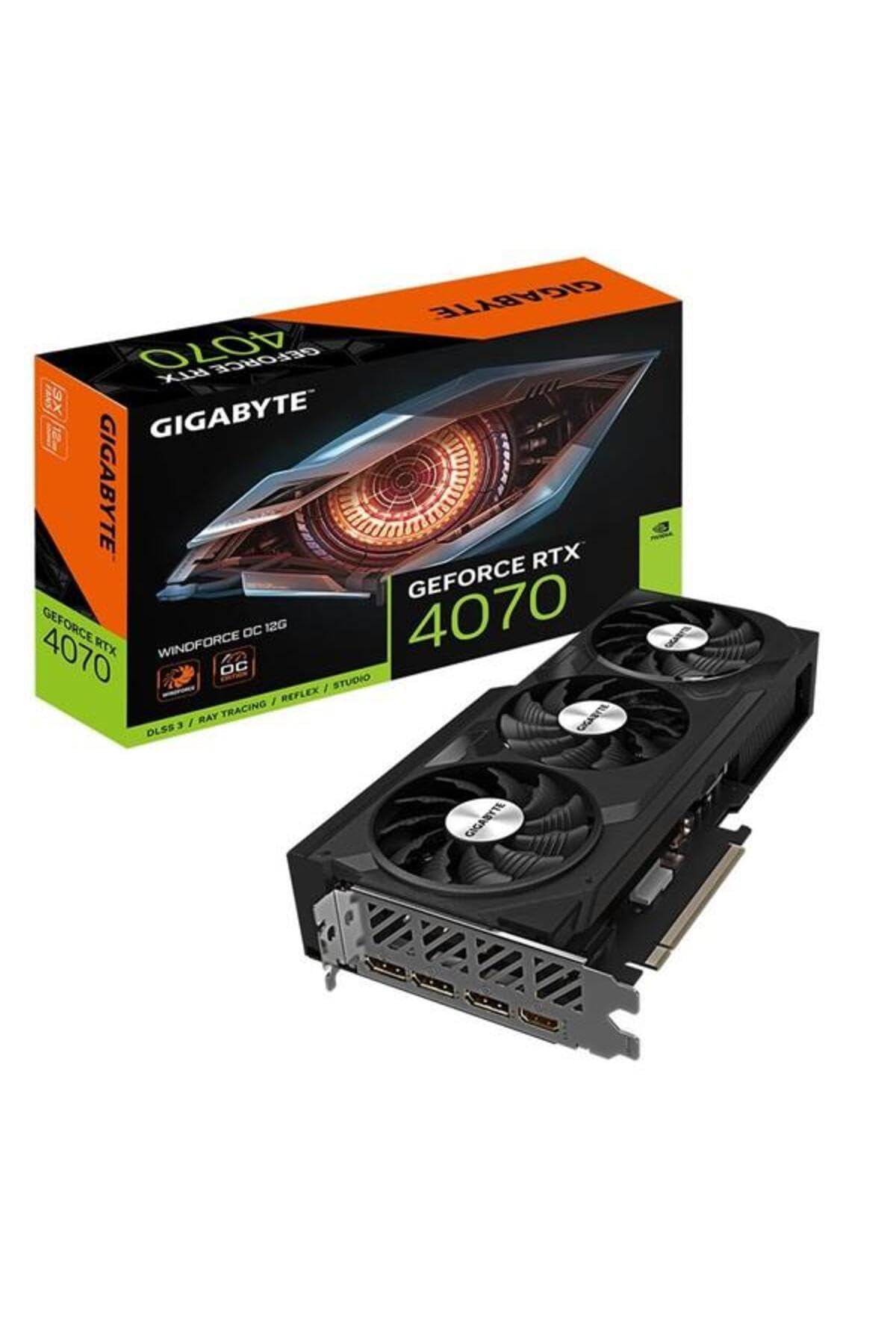
The Gigabyte WINDFORCE OC is built for silent operation first and foremost. The three 80mm fans use graphene nano lubricant in the sleeve bearings, which reduces friction noise to a level well below ball-bearing designs and extends the fan lifespan. The alternate spinning configuration reduces turbulence between adjacent fans, further lowering acoustic output. Under load, users report average temperatures of 55-60°C with the fans barely audible inside a closed case.
The base 4070 die with 12GB GDDR6X delivers 2490 MHz boost out of the box, and the card is significantly smaller than the RTX 3070 it replaces — a common upgrade path for owners of last-gen cards. DLSS 3 frame generation provides a visible smoothness boost in supported titles, and the 192-bit memory bus is sufficient for 1440p ultra textures. The recommended 650W PSU requirement is among the lowest in the 40-series, making it a drop-in upgrade for systems with older power supplies.
Reviewers upgrading from GTX 1080s and RTX 2060s report night-and-day differences in both performance and noise. The card works with a 550W PSU when paired with a mid-range CPU like the i5-11400. The main limitation is the absence of RGB lighting, which may disappoint builders with windowed cases seeking a visual statement. For pure quiet computing, this is the most acoustically refined card in the roundup.
Why it’s great
- Graphene nano lubricant bearings are significantly quieter than ball bearings
- Alternate spinning fans reduce turbulence noise
- Can operate on a 550W PSU with a mid-range CPU
Good to know
- No RGB lighting — all-black design only
- Base 4070 die lacks the Super refresh’s performance uplift
8. MSI Gaming GeForce RTX 4070 Ventus 3X 12G OC

The MSI Ventus 3X OC stands out for one critical design choice: it uses a single 8-pin PCIe power connector instead of the 12VHPWR interface. This makes it the safest and most compatible option for builders with older PSUs that lack native 12VHPWR support or who want to avoid the connector issues reported on higher-tier cards. The 200W TDP is the lowest in the 4070 family, and undervolting to 0.95V drops power draw to approximately 160W with less than 1% performance loss.
The triple-fan TORX Fan 4.0 design keeps the 12GB GDDR6X memory and AD104 die at 60-63°C under load with the fans running at just 30% speed, making the card virtually silent. The 2520 MHz extreme clock is the highest among the base 4070 cards in this list, and memory overclocking to +1500 MHz is common without instability. The 2-slot profile and compact dimensions fit most ATX and Micro-ATX cases, though the 12.1-inch length requires checking clearance in smaller builds.
Reviewers praise the Ventus 3X as the best value 4070 for 1080p to 1440p upgrades, noting that DLSS and ray tracing cores extend the card’s usable lifespan well beyond raw rasterization expectations. The lack of RGB is a deliberate design choice to reduce cost and power draw. For users who want a card that sips power, runs cool, and avoids the 12VHPWR connector entirely, this is the obvious pick.
Why it’s great
- Single 8-pin connector avoids 12VHPWR compatibility issues
- 200W TDP with undervolt potential to 160W
- TORX Fan 4.0 runs at 30% speed under load for silent operation
Good to know
- No RGB — utilitarian design only
- 12.1-inch length may not fit all compact cases
9. ASUS Dual GeForce RTX 4070 Super EVO OC Edition (Renewed)

The ASUS Dual EVO OC Edition crams the 4070 Super die into a 2.5-slot, 8.94-inch dual-fan package that is purpose-built for Micro-ATX and Mini-ITX builds where every millimeter matters. The Axial-tech fan design incorporates 0dB Technology, which stops the fans entirely when the GPU temperature drops below a threshold, making the card completely silent during desktop work, video playback, and light gaming.
The 12GB GDDR6X frame buffer and 7168 CUDA cores deliver 1440p gaming at over 105 FPS in demanding titles like Battlefield 6 on the overkill preset. The dual-fan cooler is less thermally efficient than triple-fan designs, but the card runs cool enough for the fans to stay below audible levels during most gaming sessions. The renewed pricing makes this one of the most accessible Super cards on the market, though the trade-off is inconsistent accessory inclusion — multiple buyers report the power adapter cable is missing from the box.
Reviewers confirm that the card itself runs flawlessly when it arrives, with zero defects and full functionality. The main frustration is the missing power adapter, which requires a separate purchase of a 12VHPWR to dual 8-pin cable if your PSU doesn’t have a native 12VHPWR port. For builders on a tighter budget who want the Super performance uplift in the smallest possible footprint, this is a strong candidate provided you factor in the adapter cost.
Why it’s great
- 8.94-inch length fits the tightest Micro-ATX and ITX cases
- 0dB Technology ensures complete silence at idle
- Super die provides 12GB GDDR6X and DLSS 3 support
Good to know
- Renewed units often ship without the power adapter cable
- Dual-fan cooling runs warmer than triple-fan under prolonged load
10. NVIDIA GeForce RTX 4070 Founder’s Edition

The NVIDIA Founder’s Edition represents the reference design that all board partners must at least match in quality. The titanium and black shroud is iconic, with a dual-fan flow-through cooler that exhausts air out the rear IO, making it ideal for small cases where recirculated hot air degrades CPU cooler performance. The 2.48 GHz boost clock and 5888 CUDA cores deliver exactly the baseline 4070 experience — no binning premium, just pure reference engineering.
The 12GB GDDR6X memory runs on a 192-bit bus, and the PCIe 4.0 interface ensures compatibility with systems going back to Ryzen 3000 and Intel 10th gen. The card supports NVIDIA DLSS 3, ray tracing, G-SYNC, and NVIDIA Broadcast out of the box. The primary advantage of the FE card is resale value — NVIDIA’s own warranty process and the clean aesthetic make it the easiest card to sell when upgrading. However, the price on secondary channels often exceeds the performance value of partner cards with better coolers.
Reviews on Amazon are mixed primarily due to pricing rather than product quality. Several buyers warn against paying a premium over the MSRP when equivalent partner cards with triple-fan coolers are available for less. The FE card runs louder and warmer than the Gigabyte WINDFORCE or MSI Ventus 3X at the same performance level. It’s a collector’s piece for NVIDIA enthusiasts, but the practical choice for most buyers remains a partner card.
Why it’s great
- Flow-through cooler exhausts hot air out of the case
- Iconic titanium and black design holds resale value
- Direct NVIDIA warranty and driver support
Good to know
- Priced above the performance value of partner cards
- Dual-fan design runs louder and warmer than triple-fan alternatives
11. NVIDIA GeForce RTX 4070 Super Founders Edition

The 4070 Super Founder’s Edition carries the same all-black shroud as the 4070 FE but with the Super die’s enhanced CUDA core count — 7168 cores versus 5888 — delivering the 15% performance uplift that makes the Super refresh worth seeking. The 2.48 GHz boost clock and 12GB GDDR6X memory at 21 Gbps offer the same reference layout as the standard FE but with materially higher rasterization and ray tracing throughput. The 220W TDP is 20W higher than the standard 4070 but well within the thermal envelope of the flow-through cooler.
The card supports PCIe 4.0 and includes DisplayPort 1.4a and HDMI 2.1a outputs capable of driving up to 8K displays. The build quality matches the standard FE — a solid metal chassis with a clean, minimalist aesthetic. However, the Amazon listing is plagued by reports of being sent used or refurbished units at full price, with several buyers receiving cards that produce beeping noises or fail to detect secondary monitors due to driver incompatibilities. The pricing on third-party marketplaces often exceeds the Best Buy MSRP by a wide margin, making this the hardest card to recommend on value.
For buyers willing to gamble on packaging integrity, the card itself delivers pure Super performance in the svelte FE form factor. The all-black design is a visual upgrade over the standard FE’s titanium accents. The practical advice is to purchase from an authorized NVIDIA retailer like Best Buy rather than third-party Amazon sellers to avoid the used-unit lottery.
Why it’s great
- All-black FE design is visually striking and compact
- Super die delivers 7168 CUDA cores for 15% uplift
- Flow-through cooling ideal for small cases
Good to know
- Amazon listings frequently ship used or refurbished units as new
- Pricing often exceeds Best Buy MSRP significantly
FAQ
Is the 12GB VRAM on 4070 cards enough for 4K gaming?
Should I pay more for the 4070 Super over the base 4070?
Does the 12VHPWR connector on 4070 cards have melting issues?
Will a 4070 card fit in my Mini-ITX case?
Final Thoughts: The Verdict
For most users, the best 4070 video card winner is the PNY RTX 4070 Super 12GB Verto OC Dual Fan because it delivers the Super die’s 15% performance uplift in a compact, SFF-ready dual-fan package at a fair price. If you want 16GB VRAM and maximum thermal headroom for 4K, grab the Gigabyte RTX 4070 Ti Super WINDFORCE OC. And for pure power efficiency and single 8-pin compatibility, nothing beats the MSI RTX 4070 Ventus 3X 12G OC.