
Our readers keep the lights on and my morning glass full of iced black tea. As an Amazon Associate, I earn from qualifying purchases.
Specs are compiled from manufacturer listings and verified buyer reviews and can change over time — please confirm the key details on the product page before buying.
You want a solar panel that keeps your phone, power bank, or small power station charged during a camping trip or power outage — but it also has to fit in your backpack. A 40W panel is the balance for that. The trick is picking one that delivers close to its rated wattage in real sunlight, folds small enough to carry, and lasts for many trips. This guide breaks down the best options by real-world output, build quality, and what actual buyers report about using them in the field.
I’m Min — the founder and writer behind Gadgets Feed. This guide is built by comparing the manufacturers’ published specifications and the patterns across verified customer reviews, so you get each pick’s real strengths and trade-offs instead of marketing spin.
Choosing the right 40w solar panel depends on matching its design, connectors, and weight to your specific gear and how you plan to use it — whether that is topping off a phone on a day hike or recharging a power station at a remote campsite.
Quick Picks
- Jackery SolarSaga 40W Air — Best Overall
- SunJack 40W Foldable Solar Panel — Premium Pick
- MHPOWOS 40W Portable Solar Panel — Top Performer
- SinKeu 40W Foldable Solar Panel — Best Value
- EnginStar 40W Foldable Solar Panel — Emergency Kit Pick
- Apowking 40W Portable Solar Panel — Fast Charging Pick
- Powkey 40W Portable Solar Panel — Budget Champion
How To Choose The Best 40W Solar Panel
A 40W solar panel is a portable power source that converts sunlight into electricity to charge your devices. Before you buy, focus on these three factors that determine whether a panel actually works for your gear and your trips.
Real Output vs. Rated Wattage
A 40W rating is measured under perfect lab conditions. In the real world, expect 30-38W on a clear sunny day with the panel tilted directly at the sun. Clouds, shade, or a flat angle will drop output significantly. The best panels are honest about this range — owners mention the MHPOWOS averages 32-37W, while some cheaper models struggle to hit 30W.
Weight, Size, and Portability
If you are backpacking, every ounce matters. The lightest 40W panels weigh as little as 2 lbs (like the Jackery SolarSaga 40W Air), while heavier models top 4.2 lbs. The folded size also varies — some fold to the size of a tablet (12.5″ x 8.8″), others are bulkier at 13.6″ x 9.8″. Match the panel to how far you plan to carry it.
Output Ports and Compatibility
Check what your devices need. DC output (usually 18V) is essential for charging most portable power stations. USB-A and USB-C ports let you charge phones, tablets, and power banks directly. Some panels include a USB-C PD (Power Delivery) port that can fast-charge modern laptops and devices. A panel with a 3 Amp DC output, like the Apowking, fills a battery faster than a 2 Amp panel.
Quick Comparison
| Model | Best For | Weight | Folded Size | DC Output | Amazon |
|---|---|---|---|---|---|
| Jackery SolarSaga 40W Air | Ultralight Backpacking | 2 lbs | Book-sized | DC (via adapter) | Amazon |
| SunJack 40W | Rugged All-Weather Use | 3.5 lbs | 9″ x 12.5″ x 1.5″ | DC5521/XT60/Anderson | Amazon |
| MHPOWOS 40W | High Real-World Output | 3.7 lbs | 12.5″ x 8.8″ x 1.5″ | 19V DC | Amazon |
| SinKeu 40W | Power Station Companion | 3.3 lbs | 13.3″ x 11″ x 2″ | 18V/2.27A DC | Amazon |
| EnginStar 40W | Emergency Kit Stash | 3.3 lbs | 12.6″ x 9.1″ x 2″ | 18V/2.27A DC | Amazon |
| Apowking 40W | Fast Battery Charging | — | 12.6″ x 9.1″ | 18V/2.27A DC | Amazon |
| Powkey 40W | Budget Mid-Range | 4.2 lbs | 13.6″ x 9.8″ x 2.4″ | 15V/2.6A DC | Amazon |
In‑Depth Reviews
1. Jackery SolarSaga 40W Air
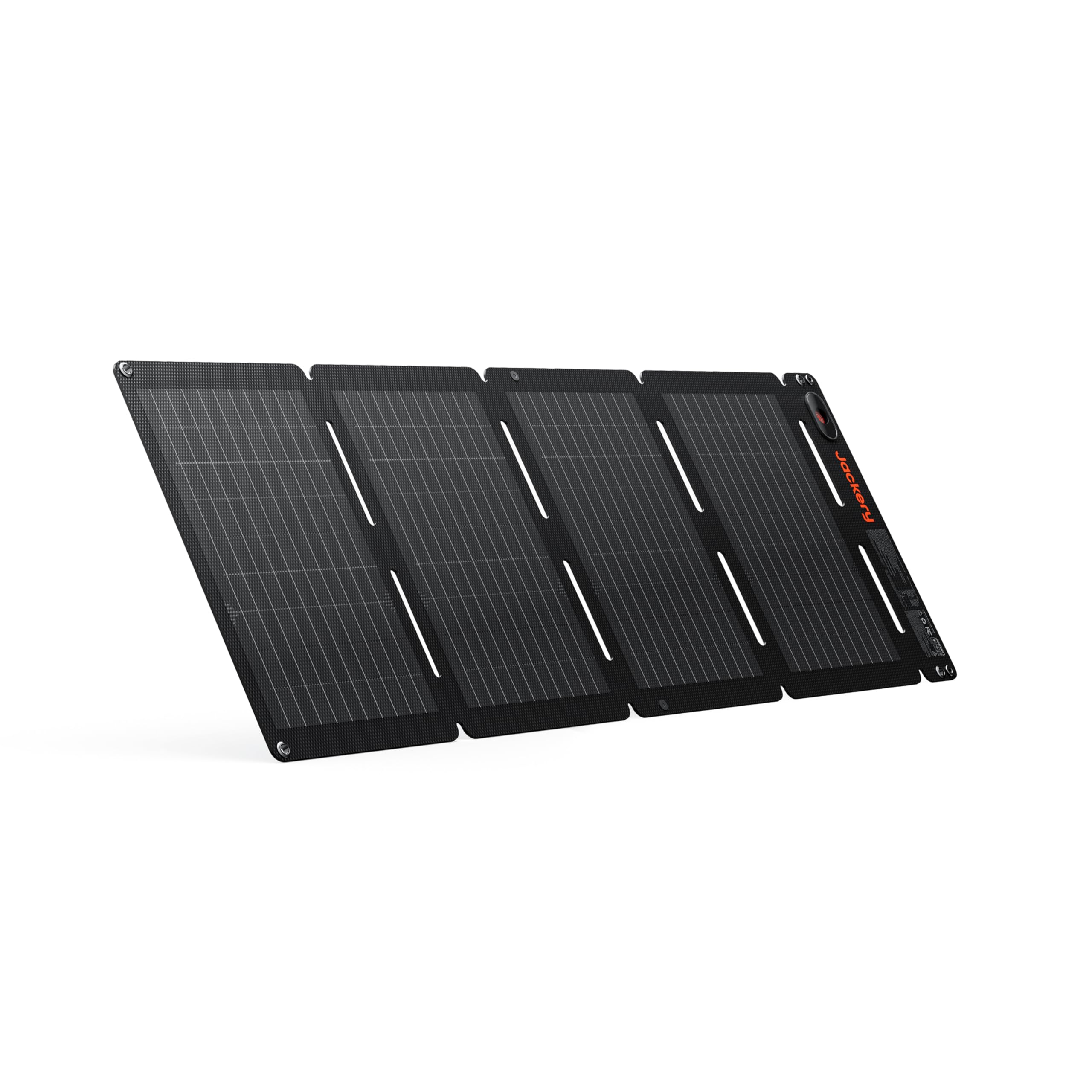
The ultralight that weighs just 2 lbs and captures sunlight from both sides.
This Jackery panel is about 30% lighter than mainstream 40W panels, weighing just 2 lbs. That makes it a realistic choice for hiking, kayaking, or any trip where every ounce in your pack matters. Its W-fold design collapses to book size, so it takes up very little space in a backpack. The unique feature here is the bifacial design — it captures sunlight on both sides using advanced PERC cells at 23% conversion efficiency, so you get usable power even on cloudy days or from indirect light.
Customers note it is lightweight, reliable, and performs well in partial sunlight, making it perfect for charging phones, power banks, and a Jackery Explorer. One reviewer noted it achieved 23W while laying flat, not aimed directly at the sun, which shows its ability to harvest some power even in imperfect conditions. It comes with carabiners and mounting holes so you can hang it on a backpack or tent. Keep in mind that at this price point, you are paying a premium for the weight savings and brand reliability.
Why It Earns the Top Spot
- At 2 lbs versus the Powkey 40W at 4.2 lbs, making it the best choice for ultralight trips
- Bifacial PERC cells generate power from both sides for better low-light performance
- Compact W-fold collapses to book size for easy packing
The Real Trade-Off
- Premium price reflects the weight savings and brand name
- Power cord may be incompatible with older Jackery models like the 240, though it fits the 300 via USB-C
- Not ideal for large power stations — better suited for small power banks and mobile devices
Reach for this if: every pound matters on a backpacking or kayaking trip and you want a panel that folds tiny and still delivers solid output in less-than-perfect sunlight.
Look elsewhere if: you need to charge a large power station quickly or you want a panel with multiple built-in output ports — this one relies on adapter cables.
2. SunJack 40W Foldable Solar Panel

The rugged survivor built to handle rain, drops, and extreme weather without flinching.
If your solar panel will live on the roof of an RV, get strapped to a kayak, or sit through sudden storms, the SunJack is built for that life. Its ports are IP67-rated (fully protected against dust and water immersion up to 1 meter), and the panel itself is made from rugged ETFE (ethylene tetrafluoroethylene) material that resists wear. It delivers up to 40 watts from high-efficiency ETFE monocrystalline cells, and features a USB-C PD30W port that can fast-charge modern laptops and devices — a feature most budget panels skip.
Reviewers point out it charges a phone in under 2 hours and handles tablets and power banks with ease. One buyer mentioned the real output is around 33W, which is typical for a 40W panel in real conditions. The kickstands and carabiners make it easy to set up at the right angle or hang from a tree. The trade-off? At 3.5 lbs, it is heavier than the ultralight Jackery, and buyers consistently mention the price is steep compared to alternatives. Designed in the USA with a solid warranty, you are paying for durability and customer support.
What Justifies the Price
- IP67 waterproof rating on ports means it can survive heavy rain and splashes
- USB-C PD30W provides fast charging for modern laptops and devices
- Rugged ETFE construction is more durable than standard PET laminate
- Includes DC5521, XT60, and Anderson adapters for wide power station compatibility
The Catch
- At 3.5 lbs, it is noticeably heavier than the 2 lb Jackery
- Buyers consistently flag the high price as its main drawback
- Real-world output averages around 33W, not the full 40W
Buy this for: an all-weather panel that can handle rain, rough handling, and still fast-charge your gear using USB-C PD — the warranty and US-based support are bonuses.
skip it if: you are on a tight budget or need the lightest possible panel for multi-day backpacking — a cheaper or lighter option will serve you better.
3. MHPOWOS 40W Portable Solar Panel
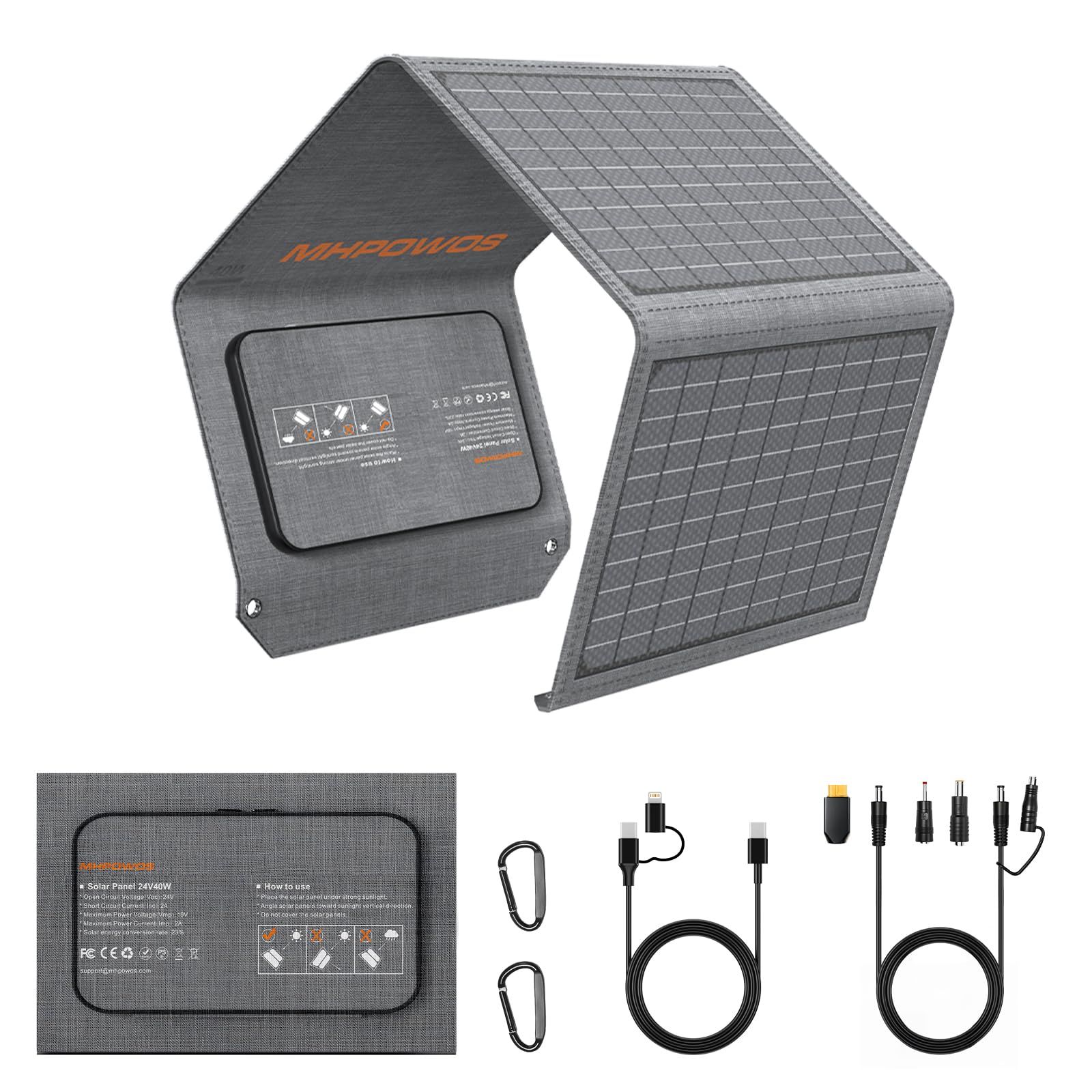
The mid-range workhorse that punches above its weight with real-world output near 38W.
What sets the MHPOWOS apart is the real output numbers shoppers say — an average of 32-37W and a peak of 38W, which is excellent for a 40W rated panel. It uses a 23% efficient ETFE (ethylene tetrafluoroethylene) monocrystalline cell, a premium material that resists wear better than standard panels, and is IP65 water resistant, so it handles light rain and splashes. The panel folds to a compact 12.5″ x 8.8″ x 1.5″, making it easy to stuff in a backpack for hiking or picnics.
A buyer using it for backpacking reported it charges a 99.9Wh power bank in about 3 hours and an Ecoflow Trail 300 (288Wh) from 10% to 100% in 8 hours — solid performance for a 40W panel. Another reviewer found it reliable for powering a portable charger during summer guiding trips. The main downside is the lack of a built-in stand, and some buyers report the wiring quality could be better — one owner reported the cable broke and needed a neighbor’s repair. At this price, the high real-world output makes it a strong value.
Why It Stands Out
- Owners mention real output of 32-37W, peaking at 38W — well above average for a 40W panel
- 23% efficient ETFE cells are more durable and efficient than standard panels
- Compact folded size fits easily in a backpack
- Folds to 12.5″ x 8.8″ x 1.5″
Areas for Improvement
- No integrated stand — you must prop it up yourself
- Wiring quality is a concern; one customer observed a broken wire that required repair
- One user highlighted the panel destroyed an Anker 548 battery via XT-60, though this may be a unit-specific issue
Grab this if: you care most about actual wattage reaching your devices and want a compact panel with ETFE durability that won’t break the bank.
Think twice if: you need a built-in kickstand for easy setup or are connecting it to expensive power stations — consider a panel with a better track record on safety.
4. SinKeu 40W Foldable Solar Panel

The balanced all-rounder that pairs well with portable power stations at a mid-range price.
The SinKeu panel hits the balance between features and cost. It has three output ports: one DC output (18V/2.27A max) for power stations, one USB-C output, and one USB QC3.0 (Quick Charge 3.0) port for fast-charging phones and tablets. The 22% conversion efficiency from its monocrystalline cells is standard for the category. With a folded size of 13.3″ x 11″ x 2″ and a weight of 3.3 lbs, it is portable without being ultralight — think car camping or basecamp use rather than a long hike.
Customers note the panel folds neatly with Velcro and has a handle for carrying. One shopper added it takes about 7 hours to charge a battery (which then holds that charge for about 7 hours of use). Another noted it works well on a car dashboard for passive charging. The TIR-C (True Intelligent Recognition & Charge) technology inside recognizes your device and adjusts charging speed while protecting against overloading. One drawback some buyers mention is that it only has USB-A output, lacking dedicated USB-C — less ideal if your devices are all USB-C.
What Makes It a Value Pick
- Three output ports (DC + USB-C + USB QC3.0) offer flexibility for multiple devices
- TIR-C technology tune charging speed and prevents overloading
- 10 DC adapters ensure compatibility with most portable power stations
- At 3.3 lbs and a compact folded size, it is easy to pack for car camping
The Trade-Off
- One reviewer noted it only has USB-A output and lacks dedicated USB-C PD, making it less ideal for modern USB-C laptops
- Charges slower in cloudy conditions, which is normal for most panels
- Folded size of 13.3″ x 11″ is slightly bulkier than some competitors
Go for this if: you want a reliable panel with multiple port options and wide power station compatibility without spending premium money — great for campsite or emergency use.
Pass if: you need USB-C PD for a modern laptop or you are backpacking and need something under 3 lbs.
5. EnginStar 40W Foldable Solar Panel
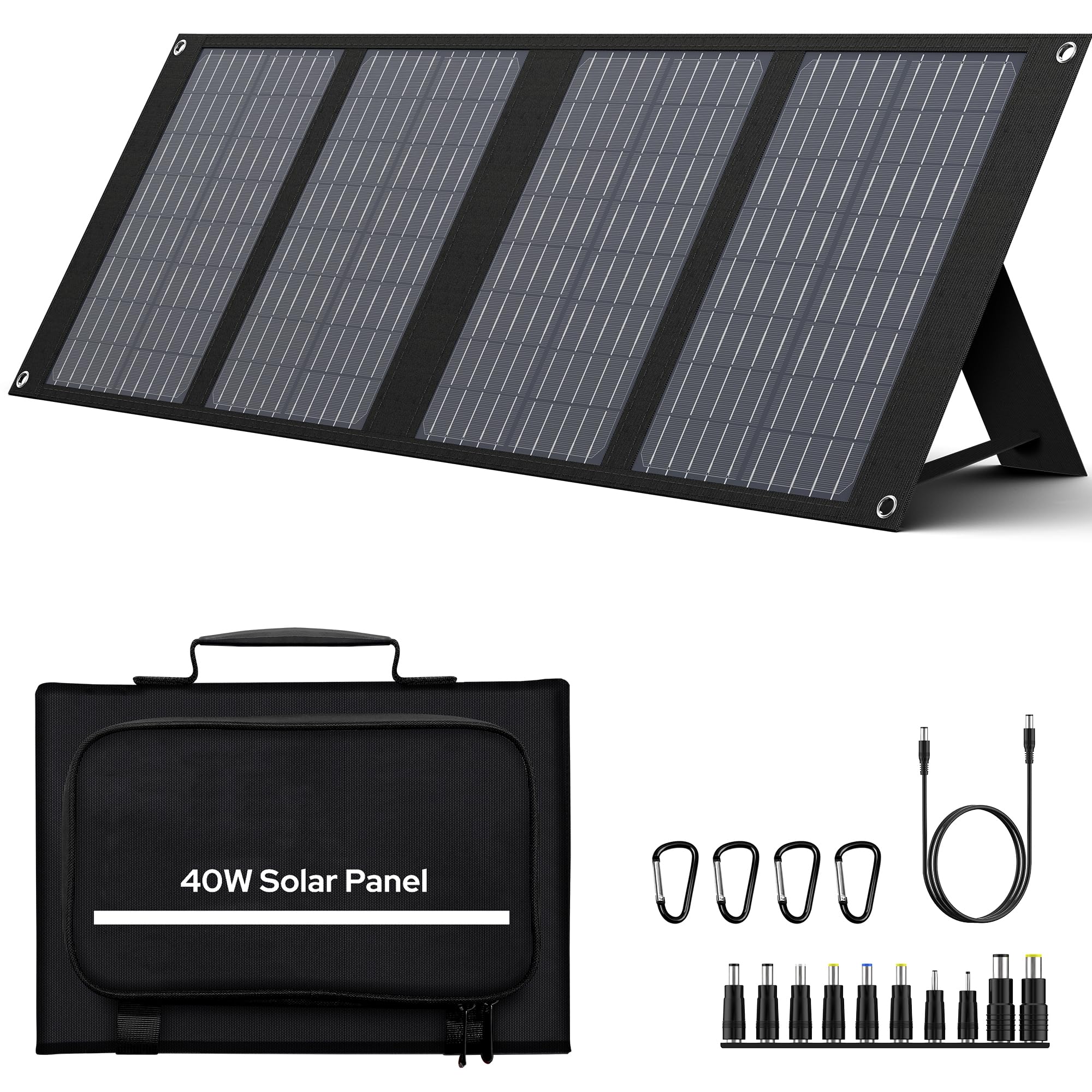
The compact stash panel that kept a Florida home running through an 8-hour July blackout.
The EnginStar 40W is designed to be the panel you throw in your emergency kit and forget about until you need it. When folded, it measures just 12.6″ x 9.1″ x 2″ and weighs 3.3 lbs, making it easy to tuck in a car trunk or closet. It uses monocrystalline silicon cells with a claimed 24% conversion rate (higher than many competitors) and includes a QC3.0 (Quick Charge 3.0) USB port plus an 18V/2.27A DC output. The 10-in-1 DC connector kit ensures it works with most power stations on the market.
One buyer shared a real-world testimonial that sums up its value: “Fast charging for external battery; powered portable AC and phone chargers during 8-hour Florida power outage in July.” That is the exact scenario this panel was built for. Other reviewers point out it feels durable and reliable in full sun, though like most panels, it hardly charges in low or cloudy light. The trade-off is the relatively low amperage of 2.6 Amps compared to the Apowking’s 3 Amps, meaning it fills batteries slower.
Why It Works for Emergencies
- Compact folded size of 12.6″ x 9.1″ tucks into emergency kits easily
- Buyer reports it powered a portable AC and phone chargers during an 8-hour power outage in July
- 10-in-1 DC connector kit ensures compatibility with most power stations
- Lightweight at 3.3 lbs for easy carrying
Limitations
- At 2.6 Amps, it charges slower than the 3 Amp Apowking
- Like most panels, it barely charges in cloudy or low-light conditions
- Unfolded length of 41.2″ means it needs a fair bit of space when fully laid out
Best for: emergency preparedness kits or car camping where you want a reliable backup panel that won’t take up much space and has proven it can handle a real outage.
Not for: backpackers who need the lightest possible panel or anyone needing to charge large batteries quickly — the lower amperage means longer charging times.
6. Apowking 40W Portable Solar Panel

The high-amperage charger that refills a 40,000 mAh battery in about 5 hours on a sunny day.
The Apowking stands out for its higher amperage (electric current) — 3 Amps compared to the MHPOWOS’s 2 Amps. This means it pushes more current to your battery, filling it faster. One buyer mentioned that this 40W panel charges a 40,000 mAh battery (a unit of battery capacity) at 15V/2A DC from 0-100% in about 5 hours on a sunny day — a useful benchmark for anyone using a power station. The panel uses 22% efficient monocrystalline cells and has two adjustable kickstands so you can angle it toward the sun or hang it on a tent via the two holes.
It includes three output options: a DC output (18V/2.27A max), a USB QC3.0 (Quick Charge 3.0) port, and a Type-C port (5V/3A through 15V/2A). The IPX4 water resistance (protected from splashing water from any direction) means it handles light rain and splashes. The main trade-off is that the folded dimensions (12.6″ x 9.1″) and weight are average for the category, so it won’t win any ultralight awards. One owner reported a strong chemical smell upon arrival that required airing out. Another buyer was skeptical, saying panels from this price tier don’t put out full power and can be heavy.
The Amperage Advantage
- 3 Amps means it can push current compared to the 2 Amp MHPOWOS
- Shoppers say it charges a 40,000 mAh battery from 0-100% in about 5 hours
- Adjustable kickstands and hanging holes make setup flexible
- Type-C port adds modern device compatibility
Real-World Notes
- Some reviewers question whether it delivers full 40W output in practice
- Strong chemical smell reported upon first use — needs airing out
- Heavier and bulkier than ultralight competitors
Choose this if: you need the fastest DC charging speeds for your power station battery and want the flexibility of kickstands and multiple port types at a mid-range price.
pass on it if: you are weight-conscious or need a panel that feels premium from the first unboxing — the chemical smell and average build quality may disappoint.
7. Powkey 40W Portable Solar Panel

The no-frills solar charger that gets the job done without costing a week’s grocery budget.
The Powkey 40W is the most affordable entry on this list, designed for buyers who need a functional solar panel without paying for premium materials. It delivers a DC output at 15V/2.6A (40W max) and one USB QC3.0 (Quick Charge 3.0) port for phones and small devices. With 22% high conversion efficiency, it uses standard monocrystalline silicon cells. It is IPX4 water resistant (protected from splashing water), meaning it can handle splashes and light rain, and the durable polyester fabric build is meant for outdoor conditions like camping and hiking.
Buyers report it works well as a dash charger for power banks — one customer observed they lay it on the car dashboard to passively charge a power bank, and it works even behind a windshield. Another noted it outputs 29-31W in full sun, which is enough to charge phones. At 4.2 lbs, it is the heaviest panel here — that is 27% more weight than the 3.3 lb EnginStar. The folded size of 13.6″ x 9.8″ x 2.4″ is also on the bulkier side, so it is better suited for car camping than backpacking.
What You Get for the Low Price
- IPX4 water resistance handles splashes and light rain
- Owners mention real-world output of 29-31W, enough to charge phones
- Works on a car dashboard for passive charging
- TIR-C Technology protects devices from overcharging
The Compromises
- At 4.2 lbs compared to the 3.3 lb EnginStar
- Bulkier folded size — harder to pack in a backpack
- Only one USB output limits simultaneous device charging
Go with this if: budget is your main concern and you need a functional panel for car camping, dash charging, or emergency backup where weight doesn’t matter.
Pass it by if: you need to carry your panel on foot trips or you want a panel that can keep multiple devices charging at once.
Understanding the Specs
Monocrystalline vs. ETFE vs. PET Laminate
The type of solar cell and its coating determines how efficient and durable the panel is. Monocrystalline silicon cells are the standard for portable panels — they offer the best efficiency for their size. ETFE (ethylene tetrafluoroethylene) is a premium coating that lets more light through and resists wear, scratches, and water better than the cheaper PET (polyethylene terephthalate) laminate. If your panel will see rough use or constant sun exposure, ETFE is worth the upgrade. The MHPOWOS and SunJack both use ETFE, while the SinKeu and EnginStar use standard monocrystalline with PET or fabric covers.
Amperage and Charging Speed
Amperage (Amps) measures how much current the panel can push to your battery. Higher amperage means faster charging. The Apowking offers 3 Amps, while the MHPOWOS is rated at 2 Amps. If you are charging a large power station battery, a panel with higher amperage will get it to full significantly faster. However, amperage matters most when the panel is in direct sun; in cloudy conditions, both panels will produce less current. Always check the DC output specs when comparing panels for power station use.
FAQ
Can a 40W solar panel charge a power station?
How long does a 40W solar panel take to charge a phone?
What is the difference between a 40W and a 100W solar panel?
Can I use a 40W solar panel with a Jackery power station?
How do I position a 40W solar panel for maximum output?
Will a 40W solar panel work on cloudy days?
Can I leave a 40W solar panel out in the rain?
How do I clean and maintain my 40W solar panel?
Can I charge a laptop directly from a 40W solar panel?
What does the IP rating mean on a solar panel?
Final Thoughts: The Verdict
For most buyers, the best 40w solar panel is the Jackery SolarSaga 40W Air because it combines an ultralight 2 lb design with bifacial PERC technology that captures power from both sides — a true standout for hikers and campers who need to carry their power supply on their back. If you want the fastest DC charging speeds for your power station battery, grab the Apowking 40W with its 3 Amp output. And for rugged all-weather reliability with USB-C PD laptop charging, the standout is the SunJack 40W.
How We Picked
We do not accept paid placement. Every pick is matched to a real buyer and a real use-case; we do not hands-on test units.
Sources & Methodology
Specifications: manufacturer listings and product documentation. Review insights: verified customer reviews, as of July 2026. Pricing: not shown on this page (it changes often); check the current price via the retailer link.
As an Amazon Associate, Gadgets Feed earns from qualifying purchases. This does not affect which products we feature.