
The gap between your current zoom lens and the wildlife you want to capture is measured in millimeters — specifically, the 420-800mm range where subjects like distant birds, the lunar surface, and far-off athletes finally fill the frame instead of being a speck in the distance. Whether you are shooting a great blue heron at the edge of a marsh or the craters of a full moon, a super telephoto lens in this focal range is what transforms your camera rig from a generalist tool into a specialized capture device. The challenge is navigating the sharp divide between budget manual optics that demand patience and a tripod, versus premium autofocus systems that cost as much as a used car.
I’m Min — the co-founder and writer behind Gadgets Feed. I spend hundreds of hours dissecting the technical specifications, optical designs, and real-world user feedback on super telephoto lenses to help you decide where your money is best spent without needing to test a dozen copies yourself.
After analyzing nine different options ranging from compact Micro Four Thirds zooms to dedicated prime lenses, I have assembled this guide to help you identify your perfect 420 800mm super telephoto lens based on your camera system, shooting style, and budget reality.
How To Choose The Best 420 800Mm Super Telephoto Lens
Selecting a lens in this extreme focal range is a battle of trade-offs between budget, weight, autofocus capability, and image quality. Understanding the fundamental categories of these lenses will prevent you from buying a lens that your camera cannot drive or that produces unusably soft images at the long end.
Manual Focus vs. Autofocus
The single biggest decision is whether you want a lens that lets your camera’s autofocus system do the work, or one that requires you to twist the focus ring yourself. Budget-oriented 420-800mm lenses are almost universally manual focus and manual aperture, which makes them viable for static subjects like the moon or perched birds but nearly unusable for flying birds or fast sports. Premium options like the Tamron 150-500mm or Canon RF 100-500mm include linear motors and electronic aperture control, dramatically improving your keeper rate with moving subjects.
Image Stabilization and Tripod Dependency
At 800mm, the reciprocal rule means you need a shutter speed of at least 1/800s for a sharp handheld shot — and that is with good technique. Lenses with built-in optical stabilization (OIS) can give you 4 to 5.5 stops of correction, turning a 1/50s shutter speed into a practical handheld option. If your chosen lens lacks stabilization and your camera body does not have in-body stabilization (IBIS), plan on using a sturdy tripod and a remote shutter release for every shot.
Camera Mount Compatibility
Every lens in this guide is locked to a specific mount system — Canon EF, Canon RF, Nikon Z, Sony E, Fujifilm X, or Micro Four Thirds. A manual 420-800mm lens with a T-mount adapter can switch between mounts, but native autofocus lenses are permanently attached to their system. Verify that the lens you want fits your camera body before adding it to your cart.
Quick Comparison
On smaller screens, swipe sideways to see the full table.
| Model | Category | Best For | Key Spec | Amazon |
|---|---|---|---|---|
| Nikon NIKKOR Z 800mm f/6.3 VR S | Prime | Ultimate reach & image quality | 800mm f/6.3 prime, 5-stop VR | Amazon |
| Canon RF100-500mm F4.5-7.1 L is USM | Zoom | Canon R-series wildlife | 100-500mm f/4.5-7.1, 5-stop IS | Amazon |
| Nikon NIKKOR Z 180-600mm f/5.6-6.3 VR | Zoom | Nikon Z value & versatility | 180-600mm f/5.6-6.3, 5.5-stop VR | Amazon |
| OM SYSTEM M.Zuiko Digital ED 100-400mm F5.0-6.3 IS II | Zoom | Micro Four Thirds reach | 100-400mm f/5.0-6.3, 7-stop Sync IS | Amazon |
| Tamron 150-500mm f/5-6.7 Di III VC VXD | Zoom | Sony E-mount budget telephoto | 150-500mm f/5-6.7, VC OIS | Amazon |
| Fujifilm Fujinon XF70-300mmF4-5.6 LM OIS WR | Zoom | Fujifilm X lightweight tele | 70-300mm f/4-5.6, 5.5-stop OIS | Amazon |
| Panasonic LUMIX G II Vario 100-300mm | Zoom | Panasonic/Oly splashproof setup | 100-300mm f/4-5.6, Power O.I.S. | Amazon |
| Canon Rebel T7 Bundle w/ 420-800mm Lens | Kit | Complete beginner starter kit | 420-800mm manual, 24.1MP APS-C | Amazon |
| High-Power 420-1600mm f/8.3 HD Manual Lens | Manual | Moon photography on a budget | 420-1600mm f/8.3 manual | Amazon |
In‑Depth Reviews
1. Nikon NIKKOR Z 800mm f/6.3 VR S

The Nikon Z 800mm f/6.3 VR S is the gold standard for reach in the Nikon Z ecosystem, leveraging a Phase Fresnel element to shrink the lens to a manageable 5.25 pounds and 15 inches long — dimensions previously impossible for an 800mm prime. The optical design delivers exceptional center-to-edge sharpness wide open, and the 5-stop Vibration Reduction system makes handheld shooting at 1/640s a realistic proposition for stationary subjects.
Teleconverter compatibility is a major advantage here: pairing the lens with the Z TC-2.0x yields a 1600mm field of view at f/12.6, which is ideal for extreme wildlife or astrophotography scenarios. The focus limit switch, two customizable Fn buttons, and a Memory Set button for instant recall of a preset focus distance give bird photographers an edge when tracking erratic flight paths. The center of gravity is shifted rearward, so panning feels balanced on a monopod.
Be realistic about the f/6.3 maximum aperture — in low light at dawn or dusk, you will need to push ISO higher than you would with a f/4 or f/5.6 lens, and modern denoise software becomes a necessary companion. The lens is also a significant investment, but it undercuts the F-mount 800mm f/5.6 by a wide margin while offering superior optical performance with the Z9 and Z8 bodies.
Why it’s great
- Phase Fresnel element keeps weight and length dramatically low for an 800mm prime
- Synchro VR with Z9 provides 5.5 stops of stabilization for handheld use
- Accepts 1.4x and 2.0x teleconverters with no AF point loss
Good to know
- f/6.3 aperture requires higher ISO in low-light conditions
- Heavy enough to warrant a monopod for extended sessions
- Premium pricing places it out of reach for casual shooters
2. Canon RF100-500mm F4.5-7.1 L is USM

The Canon RF 100-500mm f/4.5-7.1 L is the definitive super-telephoto zoom for the EOS R system, delivering L-series build quality and optics in a package that balances well on bodies from the R6 to the R3. The Dual Nano USM autofocus motor is both silent and swift enough for birds in flight, and the three-mode Optical Image Stabilization — Standard, Panning, and during exposure only — gives you 5 stops of correction that makes 1/30s handheld shots at 500mm achievable with good technique.
Variable aperture is the main compromise: at 100mm you get f/4.5, but at 500mm the lens darkens to f/7.1, which means you are often shooting at ISO 1600 or higher in overcast conditions. The compensation is that the L-series optics produce exceptional contrast and color rendition even wide open, and the lens pairs beautifully with the Canon RF 1.4x and 2x extenders — pushing your reach to 700mm or 1000mm while retaining autofocus on most R bodies.
Weather sealing is robust, with a dust-resistant and moisture-resistant construction that survives light rain and dusty trails. The lens is white to reduce heat absorption in direct sunlight, and the zoom ring action is smooth with minimal play. Some users report internal fogging in high-humidity environments, but this typically clears within an hour and does not affect long-term reliability.
Why it’s great
- L-series optics deliver outstanding sharpness and color
- Three-mode 5-stop IS enables handheld use at extreme focal lengths
- Dual Nano USM autofocus is silent, fast, and tracks moving subjects
Good to know
- f/7.1 at the long end demands good light or higher ISO
- Heavy enough that a tripod collar is beneficial for long sessions
- Teleconverters are sold separately and add cost
3. Nikon NIKKOR Z 180-600mm f/5.6-6.3 VR

The Nikon Z 180-600mm f/5.6-6.3 VR strikes the hardest value proposition in the Z mount telephoto lineup by delivering 600mm reach, internal zooming, and 5.5 stops of Vibration Reduction in a lens that costs about a third of the 800mm f/6.3 prime. The internal zoom mechanism is a major ergonomic win — the lens does not extend when you zoom, so the balance point stays constant and dust ingress is minimized compared to external-zoom designs.
Sharpness is excellent across the entire zoom range, with the sweet spot falling around f/8 to f/11. The lens pairs beautifully with the Z Teleconverter TC-1.4x to reach 840mm, and the TC-2.0x to hit 1200mm, though autofocus speed slows noticeably with the 2x extender. Minimum focus distance of 4.27 feet at 180mm allows for a 0.25x reproduction ratio, letting you capture close-up details of butterflies and flowers in between wildlife shots.
At 4.7 pounds, this lens is heavy enough that you will appreciate the tripod collar during long sessions, but balanced well enough for short handheld bursts. The customizable control ring and Fn buttons integrate seamlessly with Nikon Z body controls. The bundled lens case is essentially a padded sleeve rather than a hard case, so budget for a proper lens bag if you plan to travel with it.
Why it’s great
- Internal zoom keeps the lens sealed and balanced at any focal length
- 5.5-stop VR makes handheld shooting viable at 600mm
- Excellent sharpness and contrast for the price, especially stopped down
Good to know
- 4.7 pounds is heavy for all-day hiking
- f/6.3 at 600mm limits low-light performance
- Bundled case is a soft sleeve, not a protective hard case
4. OM SYSTEM M.Zuiko Digital ED 100-400mm F5.0-6.3 IS II

The OM SYSTEM M.Zuiko 100-400mm f/5.0-6.3 IS II is the ultimate reach-per-weight champion in the Micro Four Thirds world, offering a 35mm equivalent focal range of 200-800mm in a lens that weighs just under three pounds. The 2x crop factor of the MFT sensor means you get the equivalent of an 800mm full-frame lens in a package that is roughly half the size and weight, making it an ideal choice for backpackers and hikers who refuse to sacrifice reach.
The Sync IS system is the standout feature here: when paired with an OM-1 Mark II body, the lens and body stabilization work in concert to deliver up to 7 stops of correction at 100mm and 5.5 stops at 400mm. This translates to crisp handheld shots at shutter speeds as low as 1/15s at the wide end — a genuinely impressive feat for a super-telephoto optic. The lens is also compatible with the MC-14 1.4x and MC-20 2.0x teleconverters, pushing your reach to 1120mm or 1600mm equivalent.
Build quality includes dust and splashproof construction, a tripod collar with a foot that attaches to Arca-Swiss plates, and a nine-blade circular aperture that produces smooth, round bokeh highlights. The only real trade-off is that the f/5.0-6.3 maximum aperture combined with the MFT sensor’s noise characteristics means you are often shooting at ISO 800-1600 in overcast conditions, but the stabilization compensates by allowing slower shutter speeds.
Why it’s great
- 200-800mm equivalent reach in a sub-3-pound package
- Sync IS delivers up to 7 stops of stabilization on OM-1 bodies
- Dust and splashproof construction for outdoor reliability
Good to know
- f/6.3 at 400mm demands good light on Micro Four Thirds sensors
- Teleconverters reduce autofocus speed significantly
- Higher price point than some full-frame alternatives
5. Tamron 150-500mm f/5-6.7 Di III VC VXD

The Tamron 150-500mm f/5-6.7 Di III VC VXD is the lens that democratized 500mm reach for Sony E-mount shooters who could not justify the cost of the native Sony 200-600mm G. The VXD linear motor delivers fast and near-silent autofocus that tracks moving subjects reliably on the Sony a6400 and a7 series bodies, and the VC (Vibration Compensation) system provides noticeable stabilization at the long end, though it is not quite as effective as the Sony or Canon implementations.
What sets this lens apart is its compact external zoom design that keeps the overall length manageable when retracted. At 150mm, the lens is relatively short and easy to pack; when extended to 500mm, the barrel extends noticeably but the center of gravity stays close to the camera body for reasonable handheld balance. The minimum focus distance of 23.6 inches at 150mm gives you a surprising 0.35x maximum magnification for close-up insect and flower shots.
The f/6.7 aperture at 500mm is the weakest link — it is a full stop dimmer than the Sony 200-600mm at the long end, which translates to noticeably noisier images in twilight conditions. The lens is also front-heavy when mounted on smaller APS-C bodies like the a6400, and the external zoom mechanism is more susceptible to dust accumulation over time compared to internal-zoom alternatives.
Why it’s great
- Provides 500mm reach on Sony E-mount at a competitive price
- VXD autofocus motor is fast, quiet, and reliable for wildlife
- Close focus at 150mm enables tele-macro photography
Good to know
- f/6.7 at 500mm limits low-light performance
- External zoom collects dust over time
- Front-heavy balance on smaller camera bodies
6. Fujifilm Fujinon XF70-300mmF4-5.6 LM OIS WR
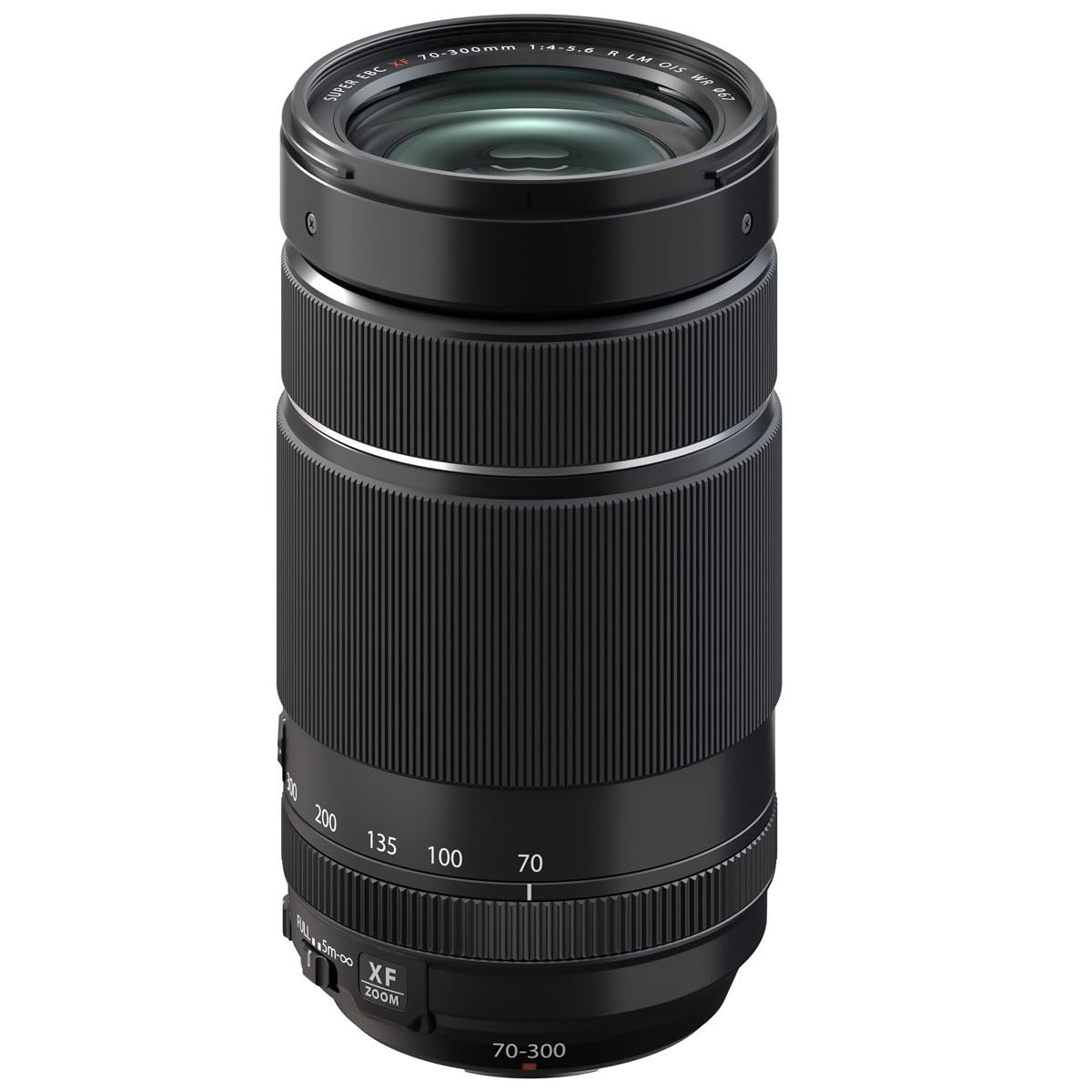
The Fujifilm XF 70-300mm f/4-5.6 LM OIS WR is the lightweight telephoto that every Fuji X shooter should consider, delivering a 35mm equivalent range of 107-457mm in a lens that weighs only 580 grams. At 5.2 inches long when retracted, it fits easily into a daypack alongside the 18-55mm kit lens, making it a perfect travel companion for hikers and adventure photographers who need reach without the weight penalty.
The linear motor autofocus is near-silent and fast enough for most wildlife scenarios, though it struggles slightly with erratic birds in flight compared to the larger XF 100-400mm. The 5.5-stop Optical Image Stabilization is genuinely impressive for a lens this size — you can reliably handhold at 1/15s at 70mm and 1/60s at 300mm with steady technique. Close focusing at 0.83 meters throughout the zoom range gives you a 0.33x maximum magnification for tele-macro shots of insects and flowers.
Weather resistance is built to Fujifilm’s WR standard, with nine sealed points that handle light rain and dust without issue. The lens also accepts the XF 1.4x and 2.0x teleconverters, pushing your reach to 420mm (640mm equivalent) or 600mm (914mm equivalent) respectively, though autofocus speed drops noticeably with the 2x converter. The only real compromise is the variable f/4-5.6 aperture, which requires higher ISO in overcast conditions.
Why it’s great
- Incredibly lightweight at 580 grams for a telephoto zoom
- 5.5-stop OIS enables handheld shooting in marginal light
- Close focus distance allows tele-macro photography
Good to know
- 457mm equivalent reach is shorter than dedicated super-telephotos
- Autofocus slows noticeably with 2x teleconverter
- Variable aperture requires ISO adjustment in low light
7. Panasonic LUMIX G II Vario 100-300mm

The Panasonic LUMIX G II Vario 100-300mm f/4-5.6 is a gateway lens into Micro Four Thirds wildlife photography, offering a 200-600mm equivalent field of view in a weather-sealed package that weighs just over a pound. The updated Mark II version brings splashproof and dustproof construction, a significant upgrade for outdoor shooters who previously had to baby the original model in damp conditions.
The Power O.I.S. system is compatible with Panasonic’s Dual I.S. 2.0, which combines in-lens and in-body stabilization for effective handheld shooting at 300mm. The 240 fps linear motor provides faster focus tracking than the original version, but autofocus still hunts noticeably in low contrast scenarios and at the long end. Sharpness is best between f/7.1 and f/8, and the lens is noticeably softer at 300mm wide open compared to the more expensive Panasonic 100-400mm.
This lens is best understood as an affordable entry point into telephoto wildlife on Micro Four Thirds — it delivers acceptable image quality for web sharing and small prints, but serious bird photographers will quickly outgrow its optical limitations. The build quality is solid for the price point, with a metal mount and smooth zoom ring, but the focus ring feels plasticky and loose. Buyers should be aware that decentered optics causing softness on one side is a known quality control issue.
Why it’s great
- Weather-sealed construction for outdoor reliability
- Lightweight and compact for easy hiking carry
- Power O.I.S. works with Panasonic Dual I.S. 2.0
Good to know
- Soft at 300mm wide open compared to premium alternatives
- Autofocus hunts in low contrast conditions
- Quality control issues with decentered optics reported
8. Canon Rebel T7 Bundle w/ 420-800mm Lens

This Al’s Variety bundle packages a Canon EOS Rebel T7 DSLR with the 18-55mm kit lens and a separate High-Power 420-800mm f/8.3 HD manual telephoto lens, creating an all-in-one starter kit for beginners who want to try wildlife and moon photography without a massive upfront investment. The T7 body uses a 24.1MP APS-C sensor with the DIGIC 4+ processor, which is dated by modern standards but still capable of producing good images in good light.
The 420-800mm manual lens included in this bundle is identical in design to the standalone Big Mike’s lens — it requires a T-mount adapter (included) and is entirely manual focus and manual aperture. This means you are shooting at f/8.3 regardless of the light, and focusing requires a steady hand and live view magnification on the T7’s 3-inch LCD. The lens produces significant chromatic aberration and softness at 800mm, but it can capture recognizable moon shots and distant bird silhouettes.
The bundle also includes a 64GB memory card, tripod, spare battery, slave flash, filter kit, and sling backpack — roughly 42 pieces total, many of which are basic accessories that a new photographer would need to buy anyway. The T7 body and 18-55mm lens are genuine Canon products, but the telephoto lens and most accessories are third-party items that lack the build quality and optical performance of native Canon glass.
Why it’s great
- Complete kit includes everything a beginner needs to start shooting
- Provides 420-800mm reach for moon photography at a low entry cost
- Genuine Canon T7 body and kit lens for everyday use
Good to know
- Telephoto lens is entirely manual focus and operates at fixed f/8.3
- Third-party accessories lack the quality of Canon-branded items
- T7 body is a dated entry-level DSLR with limited dynamic range
9. High-Power 420-1600mm f/8.3 HD Manual Lens

The Big Mike’s 420-1600mm f/8.3 HD manual telephoto zoom lens is the polarizing budget king of the super-telephoto world — it offers an absurd 1600mm reach when the included 2x teleconverter is attached, all for a price that is a fraction of what a single element of a premium lens costs. The optical design uses 4 elements in 2 groups, and the HD coating is a basic anti-reflective treatment that helps but does not eliminate the heavy chromatic aberration and contrast loss at the long end.
Real-world performance is exactly what the price suggests: the lens captures recognizable lunar craters and distant bird shapes, but details are soft, purple fringing is visible even at web resolution, and the f/8.3 fixed aperture means you are shooting at high ISO even on sunny days. The manual focus ring has a long throw that makes precise focusing possible but tedious, and the lens absolutely requires a sturdy tripod — the included foot is functional but basic.
Build quality is a mixed bag: the barrel is mostly plastic with a metal T-mount adapter, and some units ship with debris or dust inside the lens elements, indicating inconsistent quality control. This lens is best understood as a disposable experiment — it can produce satisfying moon photos on a clear night, but it will frustrate anyone expecting the sharpness or usability of even entry-level autofocus telephoto zooms.
Why it’s great
- Unmatched reach-per-dollar ratio with 1600mm capability
- Light enough to carry without a dedicated camera backpack
- Can produce recognizable moon and distant subject photos
Good to know
- Significant chromatic aberration and softness at all focal lengths
- Entirely manual operation with no electronic communication
- Inconsistent quality control with debris reported inside elements
FAQ
Does a 420-800mm manual lens work with my Canon DSLR autofocus system?
What is the 35mm equivalent focal length of a 420-800mm lens on an APS-C camera?
Can I use a teleconverter with the Tamron 150-500mm or Fujifilm 70-300mm?
Why does the budget manual 420-800mm lens produce purple fringing on my photos?
Final Thoughts: The Verdict
For most users, the best 420 800mm super telephoto lens winner is the Nikon NIKKOR Z 180-600mm f/5.6-6.3 VR because it delivers native Z-mount autofocus, internal zoom construction, and 5.5 stops of stabilization at a price that undercuts the competition by a meaningful margin. If you want the maximum reach in a compact weather-sealed package, grab the OM SYSTEM M.Zuiko 100-400mm IS II. And for the absolute sharpest image quality and longest reach, nothing beats the Nikon NIKKOR Z 800mm f/6.3 VR S.