
Our readers keep the lights on and my morning glass full of iced black tea. As an Amazon Associate, I earn from qualifying purchases.
Specs are compiled from manufacturer listings and verified buyer reviews and can change over time — please confirm the key details on the product page before buying.
You need a clean 45-degree saw for tile, not just any wet saw. That angled cut on your countertop edge or backsplash corner is what separates a professional finish from a DIY tell — and the saw you pick decides if that edge is crisp or chipped. This guide breaks down the best 45 degree saw for tile options by what they actually do, from pro-level rigs to small DIY cutters.
I’m Min — the founder and writer behind Gadgets Feed. This guide is built by comparing the manufacturers’ published specifications and the patterns across verified customer reviews, so you get each pick’s real strengths and trade-offs instead of marketing spin.
You will learn which bevel-capable saws are worth your money, what specs like RPM and arbor size mean for your tile, and how to match the tool to your job size. 45 degree saw for tile.
Our Picks at a Glance


How To Choose The Best 45 Degree Saw For Tile
A 45-degree tile saw is defined by how it achieves that angle. Some cut the tile at an angle across its face for mitered edges; others tilt the blade to bevel the edge for a chamfered finish. Knowing which you need changes everything.
Bevel or Miter: Which 45° Do You Need?
For joining two tile edges at a corner, you need a miter cut — the blade passes through the tile at an angle. For finishing a single exposed edge with a chamfer, you need a bevel cut — the blade tilts relative to the flat table. Most wet saws with an adjustable table or head handle both to 45 degrees, but portables often only do one well.
Match the Motor to the Material
Cutting porcelain and stone at a 45-degree angle is harder than a straight plunge cut. A 1.5 HP motor on a mid-size saw handles a 24-inch porcelain tile without laboring. Small DIY saws with 4.8-amp motors are fine for ceramic and thin stone, but expect them to bog down on dense material. The diamond blade quality matters as much as the motor — several buyers report that the stock blade chips porcelain, and swapping to a better mesh blade fixes the cut quality.
Don’t Forget the Water
Wet cutting keeps the blade cool and the dust down. A built-in reservoir is convenient for small jobs, but a submersible pump and water pan gives better flow and cools the blade over long cuts. Check whether the water system is recirculating or needs an external bucket, and whether the reservoir is removable for easy cleaning.
Quick Comparison
| Model | Best For | Blade Size | Motor | Max Depth | Amazon |
|---|---|---|---|---|---|
| DEWALT D24000S★ Best Overall | Pro 24″ tile cuts | 10″ | 1.5 HP | 3-1/8″ | Amazon |
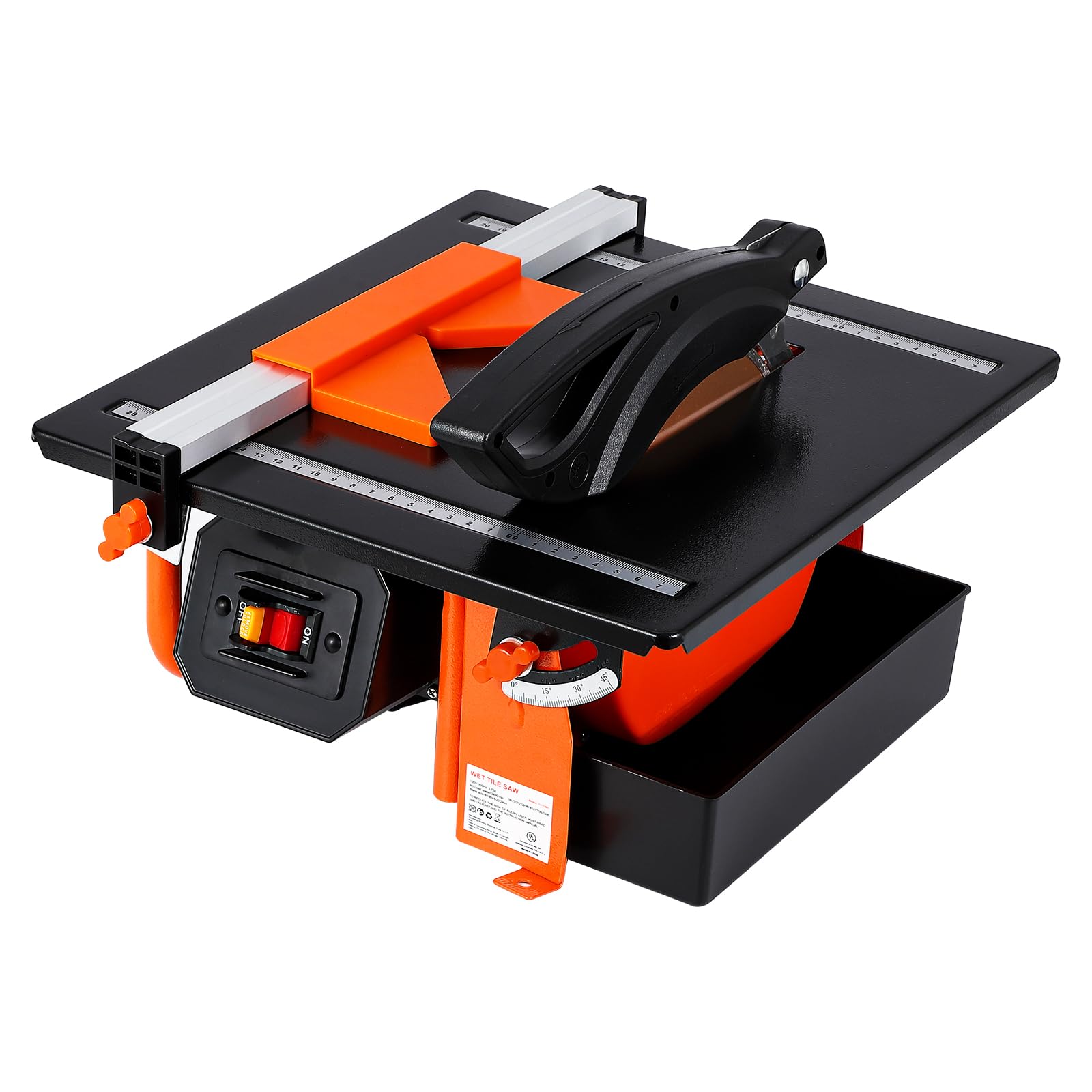
| ExploreHorizon 7-inchBudget Champion | First DIY saw | 7″ | 3450 RPM | 1.34″ | Amazon |
| VEVOR 7-inchQuiet Operator | Budget DIY value | 7″ | 3500 RPM | 1.25″ | Amazon |
| Hoteche 4-1/2-inch | Small ceramic jobs | 4-1/2″ | 4.1A | 7/8″ | Amazon |
| QEP 22700Q | Portable backsplashes | 7″ | 3/4 HP | 1-1/4″ | Amazon |
| RAIZI Bevelo | 45° edge chamfering | 116mm | 1200W | 20mm | Amazon |
| POWERTEC HTS1045 | Handheld cutting | 4.5″ | 12A | — | Amazon |
| Mempa TC-800 | Large format scoring | Manual | — | 16mm | Amazon |
In-Depth Reviews
1. DEWALT Wet Tile Saw with Stand, 10-Inch, Corded (D24000S)
Our pick — over 4.5★ from 800+ verified ratings; the strongest balance of quality and price.
The pro-grade rig that swallows a 24-inch porcelain tile whole.
This is the saw owners call the crowd favorite — a 4.7-star reputation held by a wide margin of buyers. The defining number is the 10-inch blade driven by a 1.5 HP motor, which owners mention lets you “cut a 24-inch tile with no problem.” You get a 45-degree bevel capacity, a 3-1/8-inch max depth of cut, and a diagonal capacity of 18 x 18 inches, so it spans kitchen floor work and big-format wall tile.
It arrives as a complete kit: the saw, the folding stand, a 10-inch XP4 porcelain blade, a submersible pump, the water pan, side and rear water trays, plus the angle and rip guides and both wrenches. The cutline indicator and stainless steel rollers keep cuts accurate to within 1/32 inch over an 18-inch cut. Owners note the sliding table is smooth and the pump is reliable without clogging; the splash guard stops about 90% of the spray. The trade-off is weight — the tool itself is 53.6 pounds, and even the boxed dimensions of 36″L x 29″W x 24″H mark it as a stationary machine rather than a carry-along.
Setup needs a few manual checks from the start, mainly squaring the blade and letting the guards break in over the first half-dozen cuts. Owners also advise swapping the stock blade for a Pearl P5 mesh if you cut porcelain heavily, since the included blade can chip it. The water pan holds roughly 5 gallons, and using an external bucket for the pump reduces mist on long sessions. The 1.5 HP motor handles the work without tripping breakers — a recurring point of praise.
What Owners Crown It For
- Cuts a 24-inch tile cleanly — the most-cited win, with over 260 buyers praising raw performance
- Sturdy build and reliable pump that doesn’t clog mid-job
- Accurate to within 1/32 inch over an 18-inch cut thanks to the cutline indicator
What Holds It Back
- Heavy at 53.6 pounds — best left for a fixed spot rather than daily hauling
- The stock blade chips porcelain; plan on a better mesh blade for that material
Reach for this if: you’re tiling floors or large format walls and want one saw that does 45-degree bevels plus straight rips on 24-inch material without fighting the motor.
Look elsewhere if: you need to carry your saw between rooms — at 53.6 pounds, this one stays put.
2. ExploreHorizon 7-inch Wet Tile Saw
A 15-pound starter saw that brings 45-degree bevels to the first-time tiler.
At just 15 pounds with a compact 8″L x 5″W x 10″H footprint, this is the entry-level pick for cutting tiles and stones, and it covers the full 0-to-45-degree range. The 3450 RPM induction motor and a 16mm thick diamond disc give it enough speed for ceramic and thinner stone.
The design priorities are safety and cleanliness. A reset safety switch stops accidental restarts after a power interruption, and the removable water reservoir dampens dust so your workspace stays breathable. The galvanized 13″x14″ worktable is rust and scratch resistant. For small rooms or a weekend backsplash, the appeal is that you own the tool instead of renting one.
The honest caveat: the motor is modest, and some owners found it underpowered for dense material, with one reporting it broke after seven pieces of tile. Others praise it as quick and sharp for its size, well suited to rocks and light stone. The blade cover blocks your view of the cut line — a few owners wished it were transparent. This is a tool for light to moderate DIY, not a production saw.
Who it fits: A first-time DIYer who wants one cheap, 15-pound machine for occasional ceramic, stone, and rock cuts around the house and doesn’t want to rent a saw for the weekend.
Who it doesn’t: Anyone cutting dense porcelain in volume — the 3450 RPM motor will struggle and the blade guard obscures the cut line.
3. VEVOR 7-inch 65Mn Steel Blade Wet Tile Saw
A brushless induction motor makes this budget saw unusually smooth and quiet.
VEVOR’s 7-inch wet saw runs a 3500 RPM induction motor with no carbon brushes, which owners say minimizes vibration and noise while delivering solid starting torque. It cuts tiles, stones, and ceramics at angles from 0 to 45 degrees, with angle markings at 0°, 22.5°, and 45° positions. The max cutting depth is 1.25 inches / 31 mm, slightly shallower than the ExploreHorizon’s 1.34 inches. The 65Mn steel blade is thick, and the galvanized work surface resists rust and scratches.
The water reservoir is removable and the PP plastic tray dampens dust during cutting. It ships with three wrenches for setup, though the assembly instructions drew complaints for being wrong and confusing — a few owners had to work out the guard and mount install themselves. The 7-inch blade carries a 7/8″ arbor, not the 5/8″ some ads suggest, so check that when you replace the disc.
The value story is strong: as an owner summed it up, renting a wet saw for a weekend costs more than buying this one outright, so you end up owning it.
The Case For It
- Brushless induction motor runs smoother and quieter than brushed rivals
- Genuine value — cheaper than a weekend rental, and you keep the tool
- Removable PP water reservoir keeps dust down
The Catch
- Stock blade durability is the recurring complaint — treat it as a throwaway and upgrade
- Assembly instructions are poor; plan a little wrestling time
Best for: the DIYer who wants a quiet, smooth-cutting saw for ceramic and stone and already plans to fit a good diamond blade.
Not for: anyone who wants a ready-to-cut tool from the start without fiddling with assembly or a blade swap.
4. Hoteche 4-1/2-Inch Portable Wet Tile Saw

A 14.5-pound tabletop cutter that spins at 5300 RPM for fast small-tile work.
Hoteche’s portable cutter brings a high 5300 RPM no-load speed and a 4.1A motor to ceramic, porcelain, and stone. The blade is a Φ4-1/2-Inch disc with a 5/8″ arbor, and the table tilts from 0° to 45° so you can make both straight and bevel cuts. Max cutting depth is 7/8-inch at 90° and 1/2-inch at 45°, which sets expectations for thinner materials. The 13-Inch x 14-11/64-Inch table supports the workpiece steadily.
Owners call it a great simple wet saw for small ceramic jobs and find it newbie-friendly, with easy cleanup. The hidden water reservoir keeps the setup tidy. The recurring advice is to make sure the blade sits straight and to use minimal water. The blade cover does obstruct visibility on L-cuts, so owners raise it for those passes. It ships with one saw blade and two wrenches.
The mixed reviews matter here: some customers note it works beautifully while others had the opposite. One issue flagged was a missing rip guide on arrival, and another found the on/off switch unreliable, needing an unplug to stop the saw. The quality consensus is positive — owners praise the build for the price — but the functionality verdict is split, so this is a pick for patient small jobs, not critical production work.
Where it shines: Quick, tidy cuts on small ceramic tiles and terracotta where portability and a small footprint beat raw power.
Where it falls short: The 1/2-inch depth at 45° caps your material thickness, and the on/off system drew complaints on some units.
5. QEP 22700Q 7 in. 700XT Wet Tile Saw with Table Extension

The long-serving portable that tames backsplash tile with a built-in handle.
A professional tile installer replaced a saw that lasted 20 years with this QEP 700XT, and that durability story is the theme here. It cuts tile up to 1-1/4 inches thick with a 3/4 peak HP motor and a 7-inch blade, handling ceramic, marble, stone, travertine, and porcelain. The compact frame with a built-in handle makes it a natural for backsplash work and other portable jobs, and the water recirculation channel keeps the mess down. It makes rip and diagonal cuts on any size tile, with 45-degree capacity for bevels.
Owners find it simple to use and strong on value. For a 3×6 subway tile backsplash, it handled tricky cuts after a small learning curve, and cleanup and storage are easy. A few owners note you get a little wet running it, but it works well for kitchen tile work. The table extension supports larger material, and the low-spray design keeps splash contained enough for indoor work.
The honest note: it’s a budget, lightweight saw that requires thoughtful cutting rather than pro speed. Patience yields clean cuts on 30x30cm ceramic and marble, but it won’t match a big stationary rig on speed. One owner received a “used like new” unit in poor condition, so check your unit on arrival. Upgrading the blade, per installers, improves cut quality and blade life.
Why It Endures
- One installer’s last QEP lasted 20 years — durability is the core reputation
- Built-in handle and compact frame make it genuinely portable
- Handles 1-1/4-inch thick material including porcelain and marble
What To Manage
- 3/4 HP motor needs patient, steady feed on denser tile
- You’ll get a little wet; plan for splash despite the recirculation channel
Grab it for: a portable second saw or a first saw for backsplash and small-room tile where you carry the tool to the job.
Think twice if: you cut dense porcelain all day — the 3/4 HP motor wants a slower feed than a pro rig and the splash is real.
6. RAIZI Bevelo Electric Tile Bevel Cutter
The specialist that lives for one job: a perfect 45-degree chamfered edge.
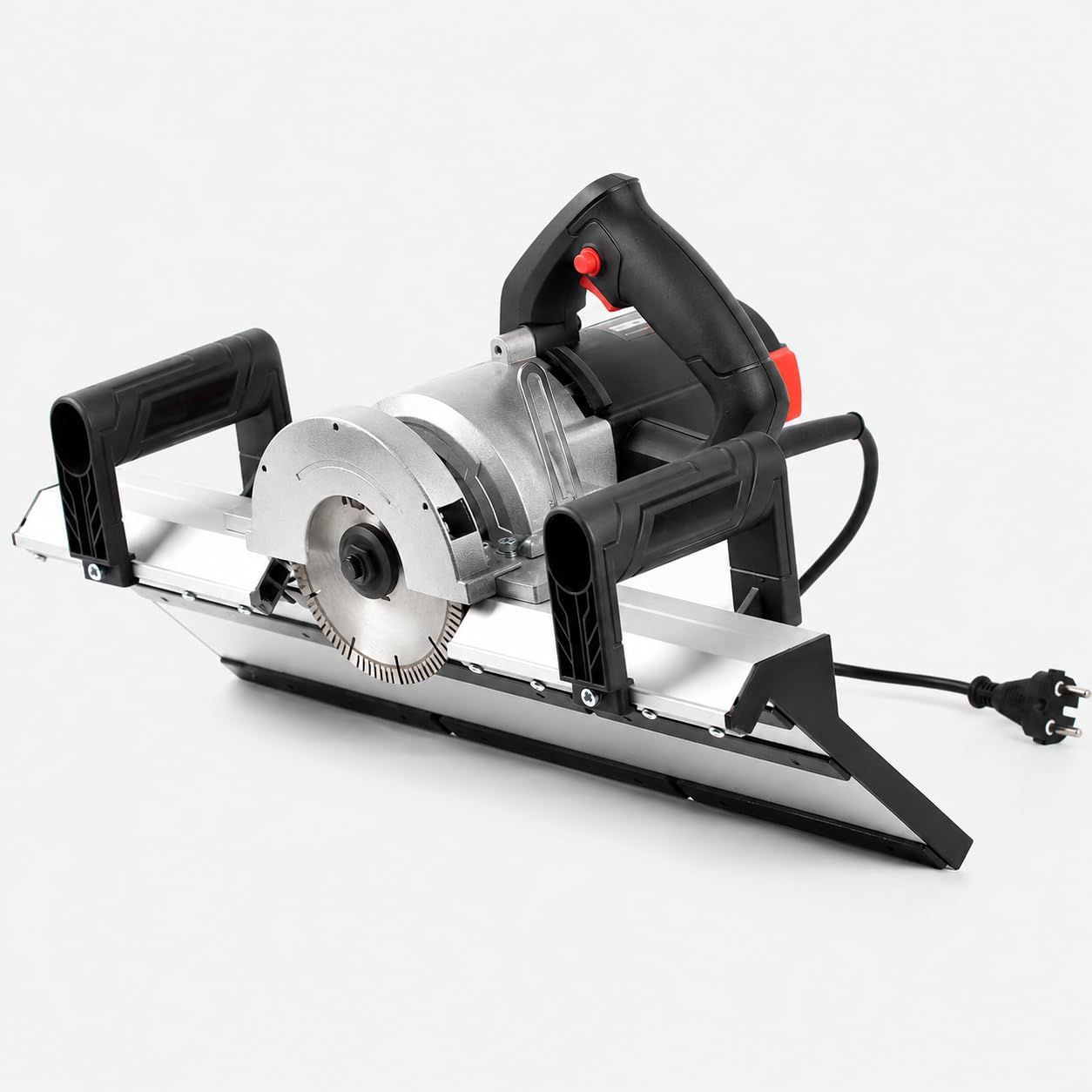
This is not a general-purpose tile saw — it’s a dedicated bevel cutter for chamfering the edges of ceramic tile and marble. The RAIZI Bevelo creates clean 45-degree beveled edges, with an adjustable edge depth from 1mm to 3mm so you control exactly how much material comes off. It handles large-format tiles over 2.2m in length and cuts up to 20mm thick tile — a real advantage for slab and big-tile projects. It runs on a 1200-watt motor at 110 volts.
The kit includes a 116mm diameter diamond saw blade with a 20mm arbor, a 12V mini water pump, and a 2.2m water hose for wet cutting. Owners who use it for big format work report they have “never done such perfect angle cuts” — that’s the core strength. It solves a specific problem: getting a true 45-degree chamfer on large tile that a standard wet saw can’t reach because the tile is too big for the table.
The setup is the catch, with one owner calling it “a pain in the arse to set up” and another noting it’s likely only useful for very large format tile — for smaller pieces an angle grinder with a diamond blade does the job faster. A few reviewers point out that switching to a proper tile blade is necessary for best results. One disappointing experience involved a damage fee on return.
The Strong Suit
- Cuts beautiful 45° bevels on large-format tile over 2.2m long — a job most wet saws can’t do
- Adjustable 1-3mm edge depth for consistent chamfer control
- Handles thick tile up to 20mm
The Drawback
- Setup is finicky and owners advise a blade swap for best results
- Overkill for small tile — an angle grinder is often faster
Choose it if: you’re finishing large-format slab tile edges and need a true, repeatable 45° chamfer you can’t get on a standard table saw.
skip it if: your work is mostly small tile — the setup cost outweighs the benefit on pieces an angle grinder handles quickly.
7. POWERTEC 4.5″ Handheld Tile Saw
A 9.5-pound handheld with a 12A motor that cuts granite like butter.
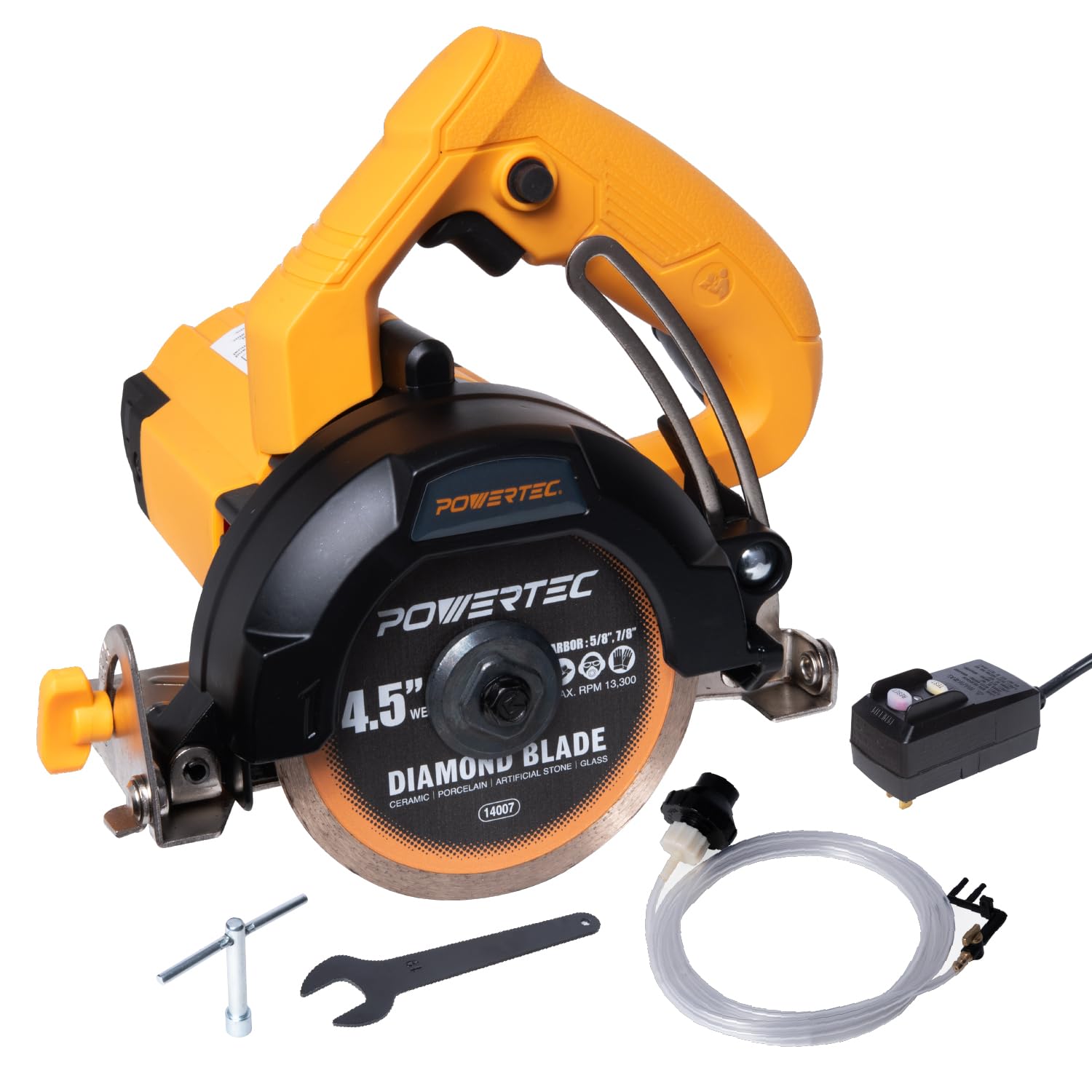
This is the powerhouse of the handheld category — a 12Amp / 1400W motor reaching up to 12,000 RPM in a frame that weighs just 9.5 pounds. Shoppers say it cuts through granite countertops “like warm butter,” proof of its torque. It handles ceramic, porcelain, granite, marble, and masonry, and the 0-45° bevel plus depth adjustment gives you the angled cuts you need. The blade is a 4.5-inch continuous diamond rim with a 7/8″ arbor.
Safety and wet cutting are built in. The in-line GFCI plug cuts power instantly if water contact or an electrical overload occurs — a real job-site feature. The adjustable water feed system uses a metal control valve to manage flow, which reduces flying dust, cools the blade, prevents chipping, and extends blade life. It connects via a standard 3/4-inch brass garden hose fitting.
The included diamond blade has a removable reducer ring — owners note it must be removed before mounting on the 7/8″ spindle shaft, a detail the instructions gloss over. Build quality is praised as excellent, with one owner calling it “pro-level.” One critical owner had to modify the housing to reach a true 90° blade angle and noted the platform flexes when tightened. For a beginner, this saw delivers a surprisingly pro result.
What Earns It A Spot
- 12A / 1400W motor at 12,000 RPM handles granite and porcelain without bogging
- GFCI plug adds real electrical safety for wet work
- 9.5-pound weight keeps fatigue low for handheld cutting
What To Watch
- The reducer bushing removal isn’t in the manual — check arbor fit before first use
- One owner needed housing modification to reach true 90°; check angle on arrival
Reach for it if: you want a handheld saw that follows the work — cutting granite slabs, countertop edges, and masonry in place without a table.
Pass if: you need repetitive, straight production cuts — a table saw holds the line better than any handheld.
8. Mempa Manual Tile Cutter with Dust-Sealed Roller, 32 Inch
A dust-free, quiet alternative that scores a 45° edge and snaps it clean.
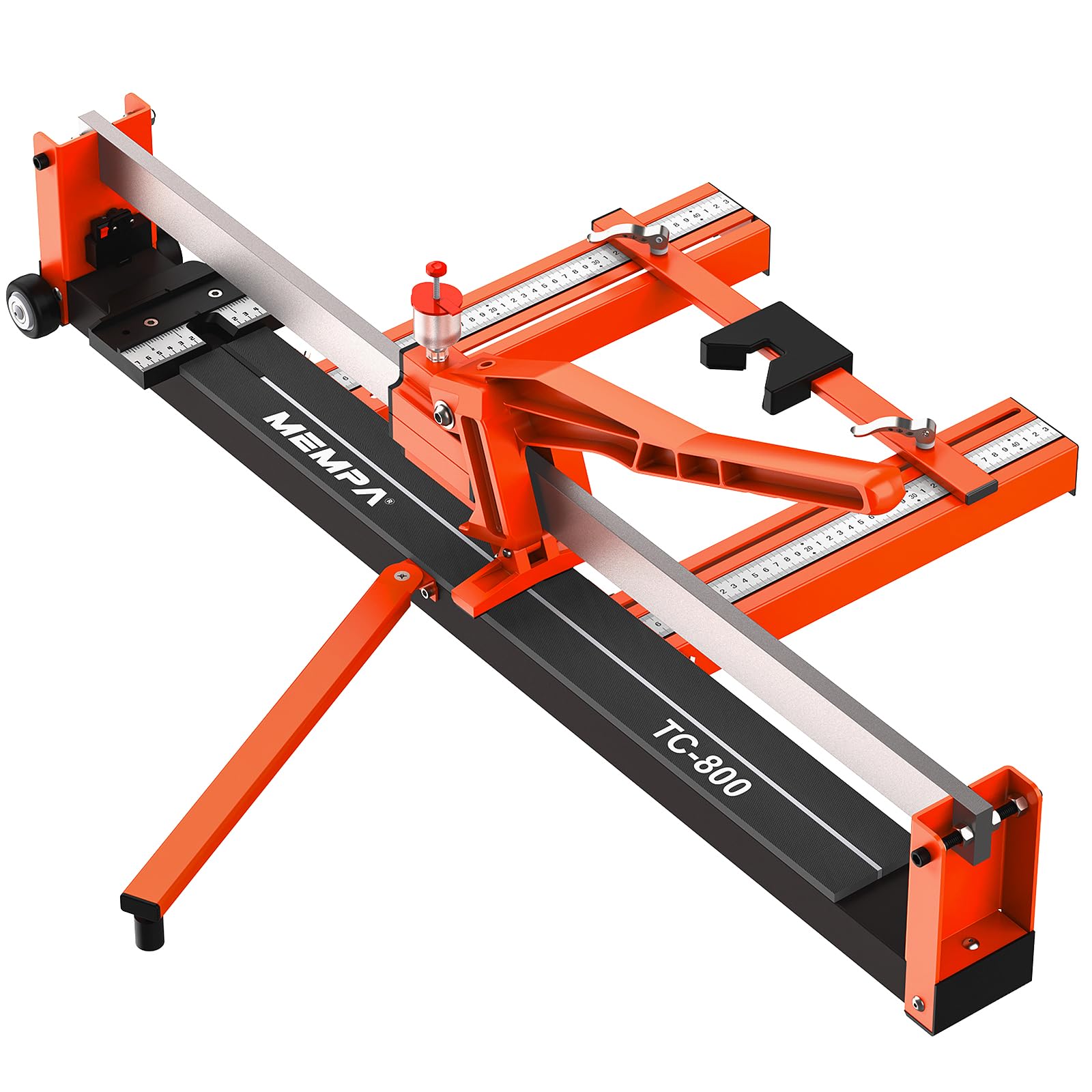
Not every 45-degree tile job needs a spinning blade. The Mempa is a manual score-and-snap cutter with a tungsten carbide wheel that runs on a sealed rail — the dust-sealed roller keeps grit out for smooth, long-lasting travel. It provides clean 0° and 45° cuts on a non-slip steel base. The auto-return handle resets after each score for faster, low-effort operation. It cuts tiles 5-16mm thick, and the 32-inch capacity handles large-format ceramic and porcelain.
Owners find the solid single rail has no wobble, and a clean break comes from a single steady score. The integrated support arms stabilize oversized material so it doesn’t shift while scoring or snapping. The 33-pound weight is the trade-off for that rigidity — the reinforced steel body and 15×45mm solid rail deliver accuracy but not portability. An included oil bottle keeps the rail moving smoothly; owners note it needs regular oiling.
The advantage over a wet saw is a cleaner, quieter workspace — no water, no slurry, no dust. One owner said it “made my big format job manageable” with dead-straight scoring and chip-free porcelain snaps. The critical review points to quality control issues: pre-stripped bolts and a rail misaligned by about 1/16″ on one unit. This is a tool for straight and 45° cuts only — it won’t do curves or thick stone.
Why Go Manual
- No water, no dust, no mess — quieter and cleaner than any wet saw
- Sealed rail roller stays smooth and chip-free on porcelain snaps
- 33-pound steel body with a solid rail resists flex on long cuts
The Limits
- Straight and 45° cuts only — no curves or thick stone
- Quality control is inconsistent; a few units arrive with misaligned rails
Pick this if: you cut large-format porcelain in a finished space and want clean, chip-free straight and 45° scores without wet slurry.
Avoid if: your work includes curves, thick stone, or tile thicker than 16mm — a manual scorer can’t do those.
Understanding the Specs
Motor Power and RPM
The motor drives everything. A 1.5 HP motor on the DEWALT handles a 24-inch porcelain tile easily, while a 3/4 HP motor on the QEP needs a patient feed on dense material. RPM matters for the blade’s cutting speed — the Hoteche spins at 5300 RPM, while the VEVOR’s induction motor runs at 3500 RPM with no carbon brushes, which cuts vibration and noise. The 12A motor on the POWERTEC reaches 12,000 RPM for fast handheld cuts. In plain terms: bigger motors and higher RPM cut faster and smoother, but they also weigh more and cost more.
Arbor Size and Blade Compatibility
The arbor is the hole in the center of the blade that fits onto the saw’s spindle. Common sizes are 5/8-inch and 7/8-inch. The OVE VEVOR uses a 7/8″ arbor, not the 5/8″ some listings suggest, so check before buying a replacement blade. The POWERTEC’s included blade has a removable reducer bushing that must come off before mounting on the 7/8″ shaft — a detail the manual skips. Get the arbor wrong and a new blade simply won’t fit, so confirm this spec first.
FAQ
What is the difference between a miter cut and a bevel cut on a tile saw?
Can a small 4.5-inch saw cut a true 45-degree bevel on thick porcelain?
Does the water reservoir on these saws keep the workspace dust-free?
What arbor size do I need when replacing the blade on a 7-inch tile saw?
Is a manual tile cutter better than a wet saw for 45-degree cuts?
How thick a tile can a 45-degree tile saw handle?
What does a higher RPM motor do for cutting tile?
Why might a tile saw chip porcelain, and can I prevent it?
Final Thoughts: The Verdict
Across the board, the 45 degree saw for tile winner is the DEWALT D24000S because the 1.5 HP motor and 10-inch blade cut a 24-inch porcelain tile with no problem, making it the only pick here that handles serious floor and wall work at 45 degrees without compromise. If you want portability for backsplash jobs, grab the QEP 22700Q. And for finishing a perfect chamfer on large-format slab edges, the RAIZI Bevelo is the one to reach for — the single crowd favorite among owners is the DEWALT at 4.7 stars across 800+ verified buyers, more than double the review volume of any other pick here.
How We Picked
We do not accept paid placement. Every pick is matched to a real buyer and a real use-case; we do not hands-on test units.
Sources & Methodology
Specifications: manufacturer listings and product documentation. Review insights: verified customer reviews, as of August 2026. Pricing: not shown on this page (it changes often); check the current price via the retailer link.
As an Amazon Associate, Gadgets Feed earns from qualifying purchases. This does not affect which products we feature.