
Stepping up to a 450-watt class solar panel means you are done playing with starter kits. One single panel can deliver nearly as much daily energy as four or five smaller 100W modules, slashing mounting hardware, wiring runs, and roof penetration points. The catch is that not every 450-watt panel actually delivers its rated power in the real world — shading from a vent pipe, a cloudy afternoon, or a less-than-optimal tilt angle can cut output by 50% or more. That is why the busbar count, cell type, and panel architecture matter far more here than they do for a small trickle charger.
I’m Min — the co-founder and writer behind Gadgets Feed. I have spent hundreds of hours cross-referencing datasheets, warranty fine print, and real-user power logs to isolate the panels that truly earn their wattage rating.
This guide ranks the best hardware for home backup, RV boondocking, and off-grid installations, focusing on efficiency, thermal stability under load, and real-world shading tolerance. Whether you need a rigid bifacial module for a ground mount or a folding array for emergency deployment, the 450 watt solar panel you choose determines whether your battery bank ever sees full charge current during the four-hour solar window.
How To Choose The Best 450 Watt Solar Panel
A 450-watt panel is a significant investment in your energy infrastructure. Making the right choice means understanding three core technologies that separate high-yield modules from units that underperform the moment the sun is less than perfect.
N-Type Cells and 16BB Busbars
The single biggest performance upgrade in the last two years has been the shift from P-Type (Borondoped) cells to N-Type (Phosphorus-doped) cells. N-Type cells suffer zero Light Induced Degradation and retain higher voltage under load as the panel heats up, which directly translates to more watt-hours during a summer afternoon. Combined with 16 busbars instead of the old 9BB standard, the cells capture more current from micro-reflections and are far less likely to develop hot spots from micro-cracks during shipping or thermal cycling.
Bifacial vs. Monofacial — Real Incremental Gain
A bifacial panel with a transparent backsheet can generate 10-25% additional power from light reflected off snow, white gravel, or a light-colored roof membrane. However, that gain is only realized when the back side has clearance and a reflective surface below. If you are mounting flat on a dark asphalt roof or flush against an RV deck with no air gap, the bifacial advantage shrinks to near zero. For ground mounts or pergola arrays, bifacial is a no-brainer. For tight roof installs, a high-efficiency monofacial panel often makes more sense.
Voltage Matching and System Voltage
Many 450W panels produce an open-circuit voltage between 45V and 54V. That voltage matters because most portable power stations and mid-range MPPT charge controllers have a max PV input of around 50V or 60V. Pairing a 54V panel with a controller that caps at 50V means you leave energy on the table or risk damaging the controller on cold mornings when voltage rises. Always check the controller’s max input voltage before you buy a panel with a high Voc.
Quick Comparison
On smaller screens, swipe sideways to see the full table.
| Model | Category | Best For | Key Spec | Amazon |
|---|---|---|---|---|
| Callsun 450W Bifacial | Bifacial Rigid | Ground-mount & off-grid arrays | 25.4% efficiency, dual-module anti-shade | Amazon |
| Renogy 400W Portable Suitcase | Foldable Portable | Emergency backup & RV camping | 30.2 lbs, folds to 33.7×28 inches | Amazon |
| ZOUPW 450W Portable | Foldable Portable | High-power station pairing (40-60V input) | 29.5 lbs, 45.9V Voc, 25% efficiency | Amazon |
| JJN 425W Bifacial | Bifacial Rigid | Residential rooftop & off-grid | 30-year transferable warranty | Amazon |
| Renogy N-Type 400W (2x200W) | Monofacial Rigid | Class B van & RV roof | Compact size, low degradation rate | Amazon |
| Callsun 400W (4x100W) | Monofacial Rigid | Small space & tight access installs | 31.1 x 22.7 inches per panel | Amazon |
| AeternaSol 400W (2x200W) Bifacial | Bifacial Rigid | Bifacial starter array | 25% efficiency, IP68 junction box | Amazon |
| AeternaSol 400W (2x200W) Mono | Monofacial Rigid | Budget-friendly rigid array | 25% efficiency, 11 AWG OFC wire | Amazon |
| SUNGOLDPOWER 450W (2 Pack) | Monofacial Rigid | Large home backup & full off-grid | UL61730 & CEC listed, 2x450W | Amazon |
In‑Depth Reviews
1. Callsun 450W Bifacial Solar Panel
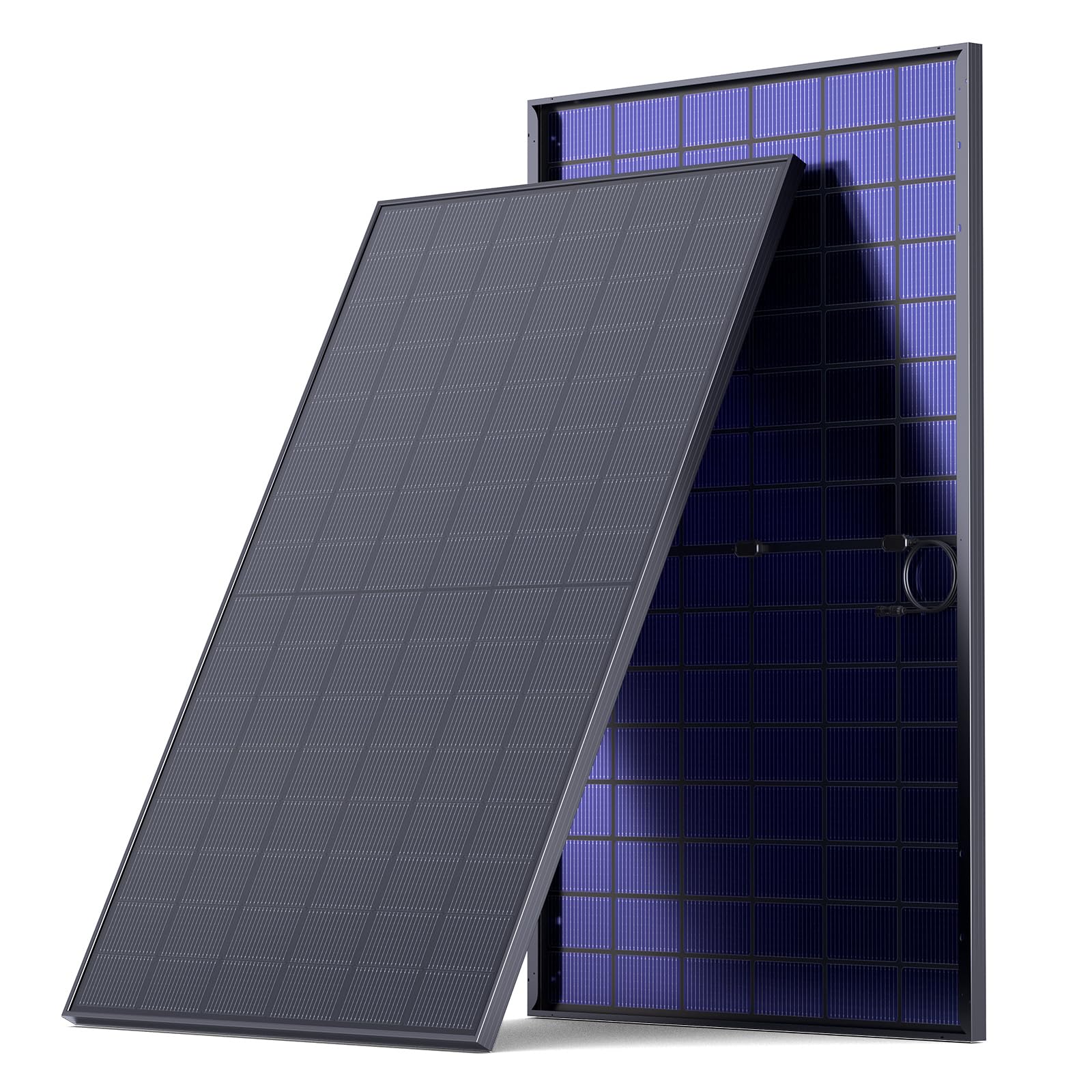
The Callsun 450W Bifacial is the benchmark for what a modern 450-watt panel should be. It uses N-Type 16BB cells that hit a certified 25.4% efficiency, and its dual-module parallel architecture means that if a leaf or a vent pipe shadows one half of the panel, the other half keeps pumping out full voltage. Users consistently report peak outputs of 420-450W from the 450W rating, thanks to the bifacial backsheet grabbing extra light off the ground.
At 54 pounds and 69.4 x 44.7 inches, this is a full-size residential module, so it demands a proper ground mount or sturdy roof rails. The double-glass construction with an anodized aluminum frame gives it a 2400 Pa wind and 5400 Pa snow load rating, making it suitable for harsh weather zones. The 30.08V max power voltage and 14.97A current make it easy to pair with a 60V MPPT controller for 48V battery banks.
The 10-year materials warranty and 25-year linear power guarantee provide real long-term confidence. For anyone building a high-yield ground array or a pergola installation where the back can capture reflected light, this is the panel to beat.
Why it’s great
- Dual-module design halves shading losses.
- True 25.4% cell efficiency produces reliable 420W+ peaks.
- Double-glass and IP68 rating ensure decades of outdoor life.
Good to know
- Requires a 60V or higher MPPT controller for full use.
- Heavy at 54 lbs — requires two-person installation.
2. Renogy 400W Portable Solar Panel Suitcase

Renogy’s 400W Suitcase redefines what portable solar can deliver. It folds down to a 33.7 x 28 x 3.2 inch package and weighs 30.2 lbs, meaning one person can carry it from the car to the campsite. The fiberglass-reinforced ETFE-coated panels are far more resilient than glass panels for transport, and the integrated kickstands let you angle the array toward the sun in under 60 seconds with no tools.
Real-world output logs show 300W under partial overcast and peaks of 395W in full sun. The parallel-wired sub-panels mean a shadow on one section does not cripple the other sections, which is critical for portable use where you cannot control every patch of shade. The IP67 waterproofing and hail-resistant coating make this a legit “leave it outside in a sudden storm” panel.
The 47.2V open-circuit voltage means you must check your power station’s max input. It is ideal for 48V-input units like the EcoFlow Delta Pro or Bluetti AC300, but it will over-voltage a 12V or 24V input controller. The included Cordura carry bag is a nice touch, though the kickstands are not adjustable for tilt angle, which some users modify with PVC extensions for winter sun angles.
Why it’s great
- Truly one-person setup in under 60 seconds.
- Parallel wiring mitigates partial-shading power loss.
- ETFE coating and fiberglass build survive rough handling.
Good to know
- Kickstands are fixed angle — need DIY shims for steep winter tilt.
- High Voc (47.2V) incompatible with low-voltage power stations.
3. ZOUPW 450W Portable Solar Panel
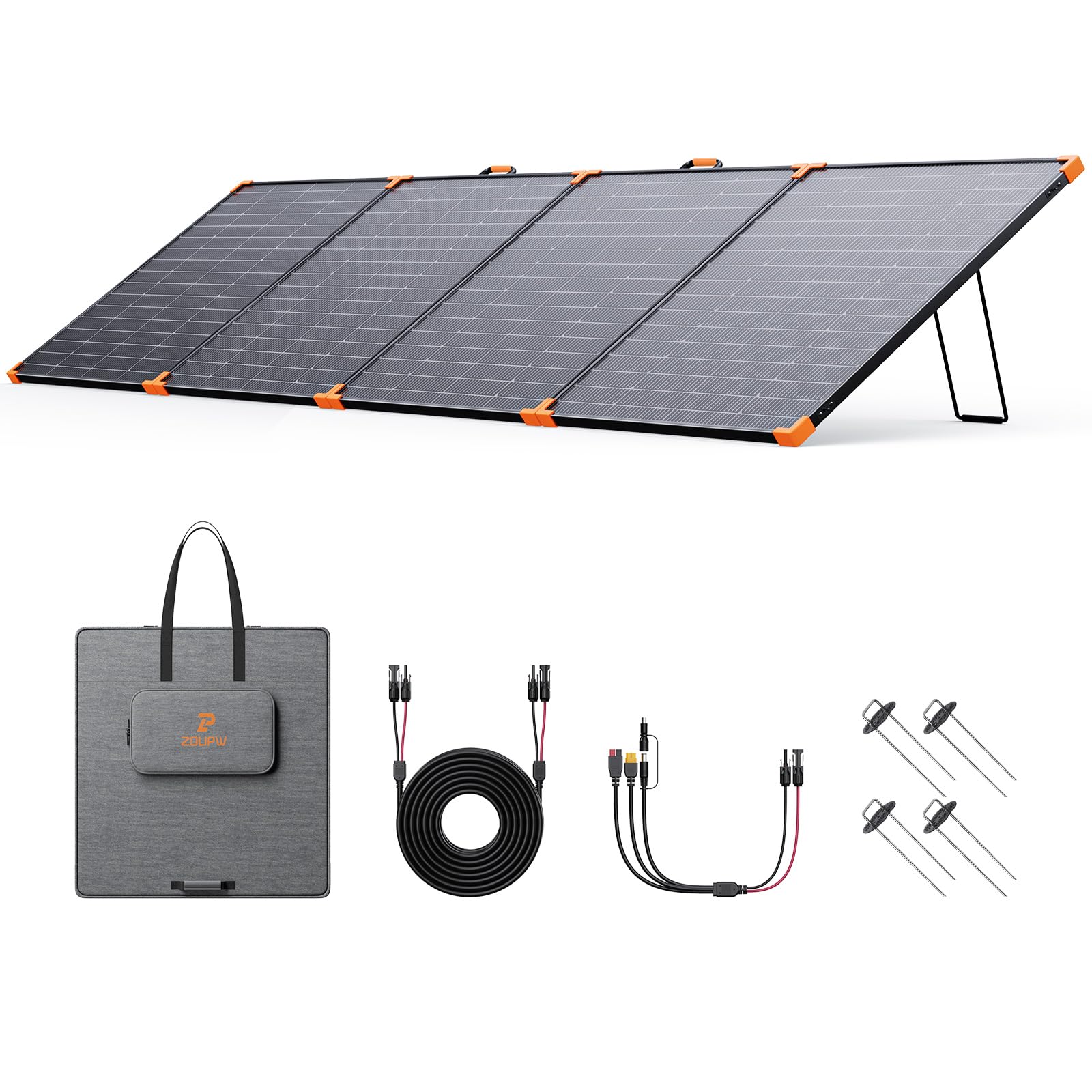
The ZOUPW 450W Portable is purpose-built for the new generation of high-capacity power stations that accept 40-60V PV input. Its open-circuit voltage of 45.9V slots perfectly between the 50V and 60V input limits of popular models like the EcoFlow Delta 2, Anker C1000, and Bluetti Elite 100. At just 29.5 lbs, it is lighter than many 400W rigid panels, thanks to the aerospace-grade fiberglass substrate.
Users consistently report peak outputs above 450W, with some logging over 500W on cold sunny days. The N-Type 16BB cells deliver 25% efficiency and maintain output surprisingly well under thin cloud cover. The 4-in-1 adapter cable with XT60, Anderson, DC7909, and DC8020 connectors means it works out of the box with virtually every major power station brand without needing an extra adapter.
The IP68 waterproof rating and ETFE coating protect against rain and dust, but the manufacturer explicitly warns against permanent series or parallel connections or long-term fixed installations. This is a deploy-and-retrieve portable panel, not a roof mount. The four ground stakes help stabilize it in wind, but the legs are relatively long and benefit from being staked down.
Why it’s great
- Extremely light for a 450W panel at 29.5 lbs.
- Voltage perfectly matched to 40-60V input power stations.
- Comes with a full set of common adapter cables included.
Good to know
- Not recommended for permanent roof or series-parallel installation.
- Must be staked down in windy conditions.
4. JJN 425W Bifacial Solar Panel
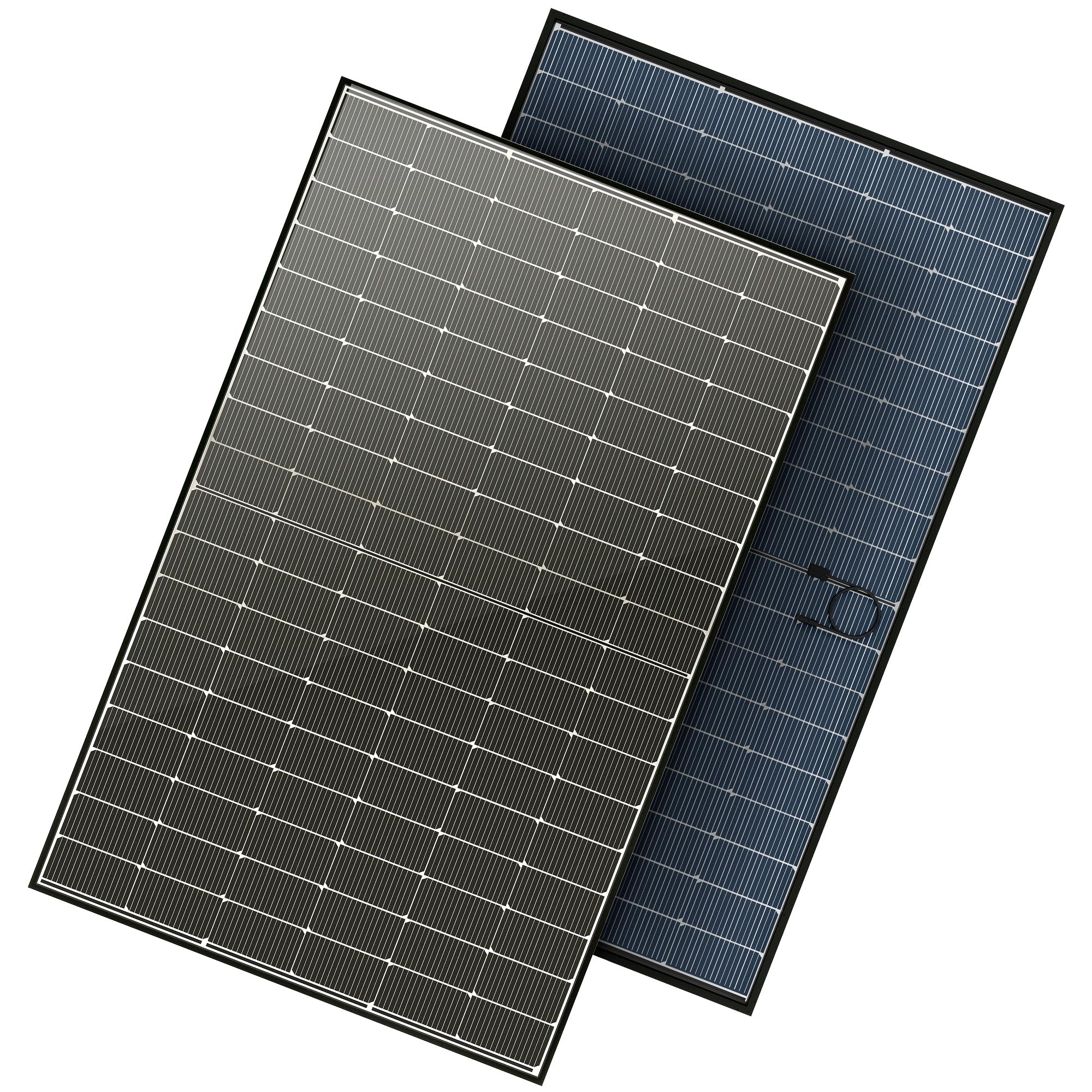
The JJN 425W Bifacial sits just below the true 450W class but deserves strong consideration for its extraordinary warranty and proven real-world output. Users on flat-mounted camper roof arrays report 90-106% of rated output from eight panels, and ground-mount users hit 380W+ per panel consistently. The N-Type 16BB cells with a transparent backsheet capture reflected light, adding a measurable boost when mounted over light-colored surfaces.
At 51.6 pounds and a footprint of 67.8 x 44.7 inches, it is slightly narrower than full-size residential panels, which can help fit tighter roof layouts. The IP65 junction box and IP68 connectors are fully weather-sealed, and the black anodized aluminum frame resists corrosion in coastal environments. One user noted minor cosmetic “dots” on some cells that did not affect output, suggesting slight variation in cell binning quality.
The standout feature is the 30-year transferable power output warranty, which is rare at this price point. If you plan to own your property for decades or might sell it with the solar array in place, that transferability adds tangible resale value.
Why it’s great
- 30-year transferable warranty is a class leader for resale value.
- Bifacial design consistently over-performs rated output on reflective surfaces.
- Strong 380-425W real-world output verified by multiple users.
Good to know
- Rated at 425W vs. the 450W class — slightly lower peak.
- Some cosmetic cell imperfections reported that do not affect performance.
5. Renogy N-Type 400W (2x200W) Solar Panel

Renogy engineered this 400W N-Type panel specifically for Class B vans and smaller RV roofs where every inch counts. It is 7.5% smaller and 11.7% lighter than its predecessor while delivering the same 400W output, packing a 25% cell efficiency into a 49.7 x 30.1 inch frame. The 16BB architecture reduces micro-crack risk during the vibration-heavy life of a motorhome.
Users consistently report output that meets or exceeds the 400W rating, with some logging 1189W from a 1000W array. The low temperature coefficient (-0.3%/°C) means it holds voltage better than P-Type panels on hot asphalt roofs. The 37.44V max power voltage makes it easy to wire two in series for a 48V battery bank without exceeding most MPPT controllers’ 150V limit.
One important note: the open-circuit voltage is 37V per panel, which is higher than many 200W panels. If you series-wire them with older 12V panels, you will waste performance. Pair them with a modern MPPT controller that can handle the higher voltage for maximum harvest.
Why it’s great
- Compact size fits tight RV and van roofs with no overhang.
- Low degradation rate of ≤1% first year, ≤0.4% annually after.
- Proven Renogy brand support and replacement parts availability.
Good to know
- Higher Voc (37V) than typical 200W panels — check series config.
- Rated at 400W total for the pair — not a single 450W module.
6. Callsun 400W (4x100W) Solar Panel Kit
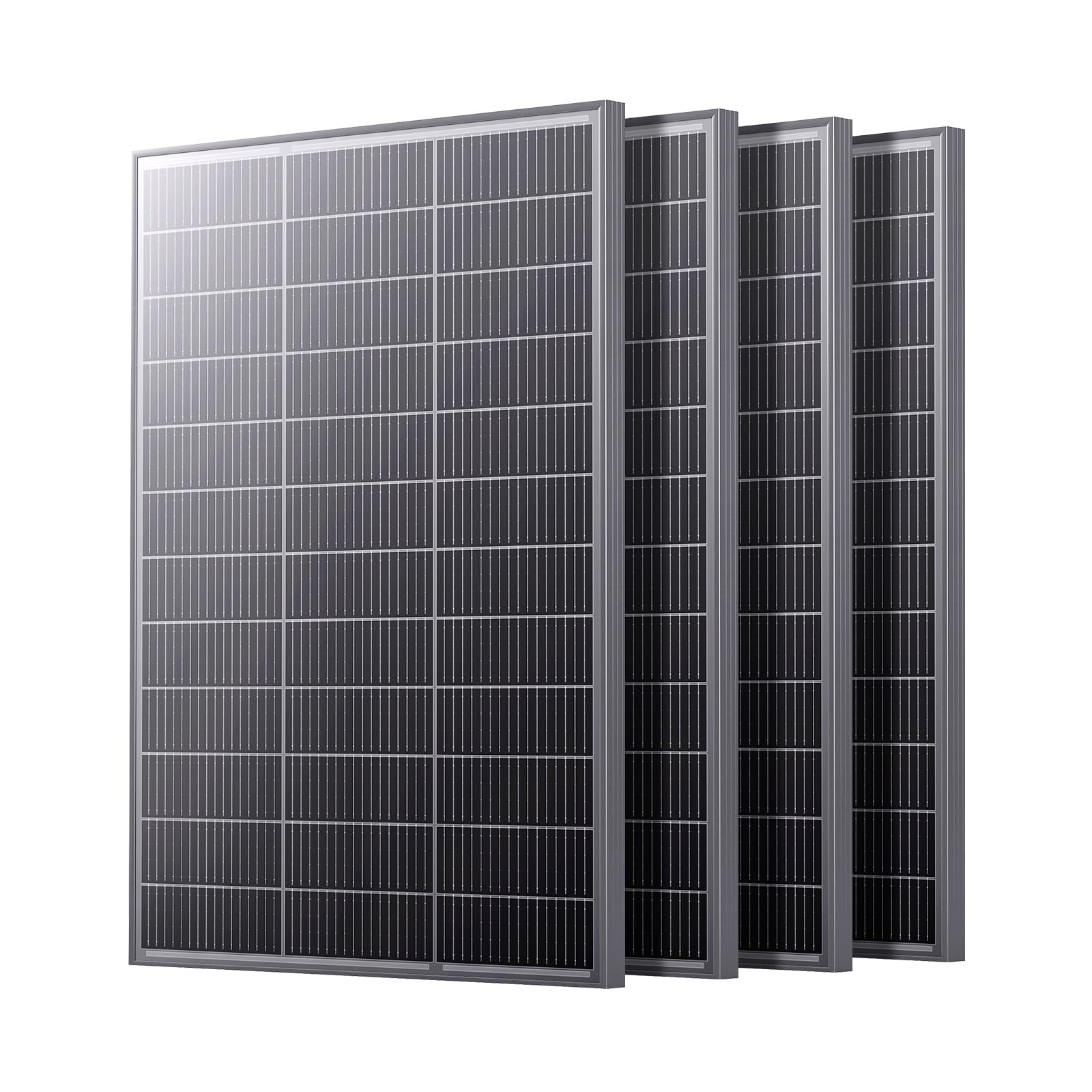
The Callsun 400W kit splits its power into four 100W panels, each measuring just 31.1 x 22.7 x 1.1 inches and weighing 11.4 lbs. This format solves a critical problem for installations where moving a single 50-pound panel up a ladder or through a tight attic access is not feasible. Each panel can be carried and positioned by one person, then wired in series or parallel on the roof.
Despite the small per-panel size, these are genuine N-Type 16BB cells with 25% efficiency, not the old polycrystalline tech common in budget 100W panels. Users report that even thick fog yields 25-30% of rated output, and full sun produces up to 125% of rated power. The -0.3%/°C temperature coefficient means they stay productive on hot roofs where P-Type panels would fade.
The 10-year materials support and 25-year 84.5% output guarantee are solid for the price tier. The compact size also makes this kit ideal for portable ground deployment where you want to move panels throughout the day to track the sun by hand.
Why it’s great
- Easy one-person installation due to 11.4 lb per panel weight.
- N-Type 16BB cells deliver real 25% efficiency despite small format.
- Excellent low-light performance in fog and overcast conditions.
Good to know
- Four panels require more wiring and connectors than a single 400W module.
- Total 400W — not a single 450W panel if you need maximum wattage per footprint.
7. AeternaSol 400W (2x200W) Bifacial Solar Panel
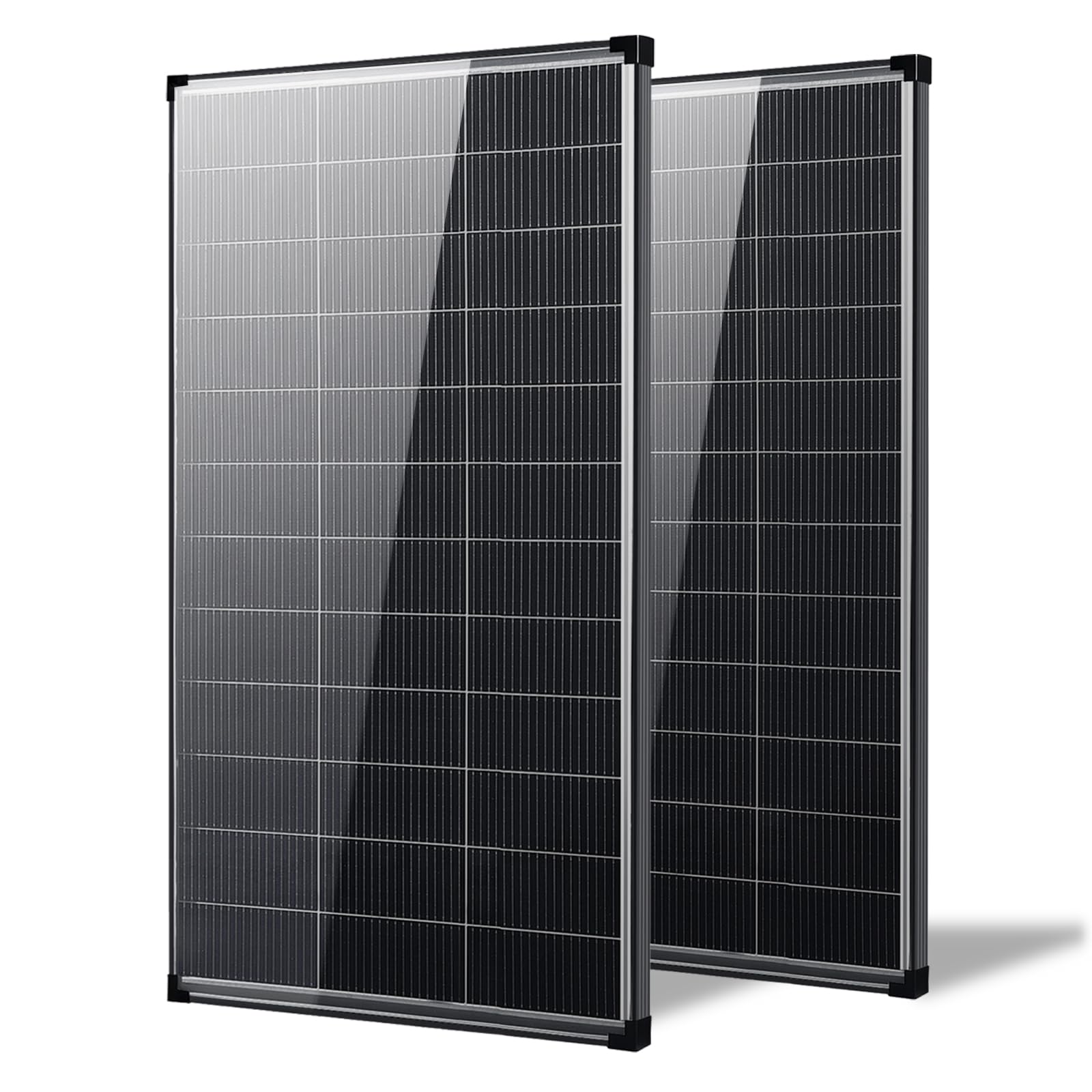
AeternaSol’s bifacial 400W kit pairs two 200W panels with an 18BB N-Type cell architecture that goes a step beyond the common 16BB standard. The extra busbars further reduce internal resistance and improve current collection, particularly in the lower-light conditions where bifacial panels rely on reflected back-side light. The transparent backsheet allows the rear cells to capture ground reflection for a measured boost.
Owners report 92W output from a single panel even at suboptimal tilt angles, suggesting strong real-world current generation. At 4.7 kg per panel and 52.8 x 26.4 inches, these are easy to handle for a two-panel roof install. The reverse current blocking diode technology prevents nighttime drain, which is a nice safety feature for systems without a charge controller that includes a blocking function.
The IP68 waterproof junction box filled with polyurethane polymer is a premium touch that prevents moisture ingress far better than standard potted boxes. However, one user noted the MC4 junction box feels less robust than the panel itself, so careful cable management is advised to avoid putting tension on the connectors.
Why it’s great
- 18BB busbars offer the highest current collection in this price tier.
- Bifacial design provides a real energy boost on reflective ground.
- Polyurethane-filled IP68 junction box resists moisture better than standard seals.
Good to know
- MC4 junction box feels less robust than the panel frame and glass.
- Total array is 400W — not a single 450W module for highest density.
8. AeternaSol 400W (2x200W) Monocrystalline Solar Panel
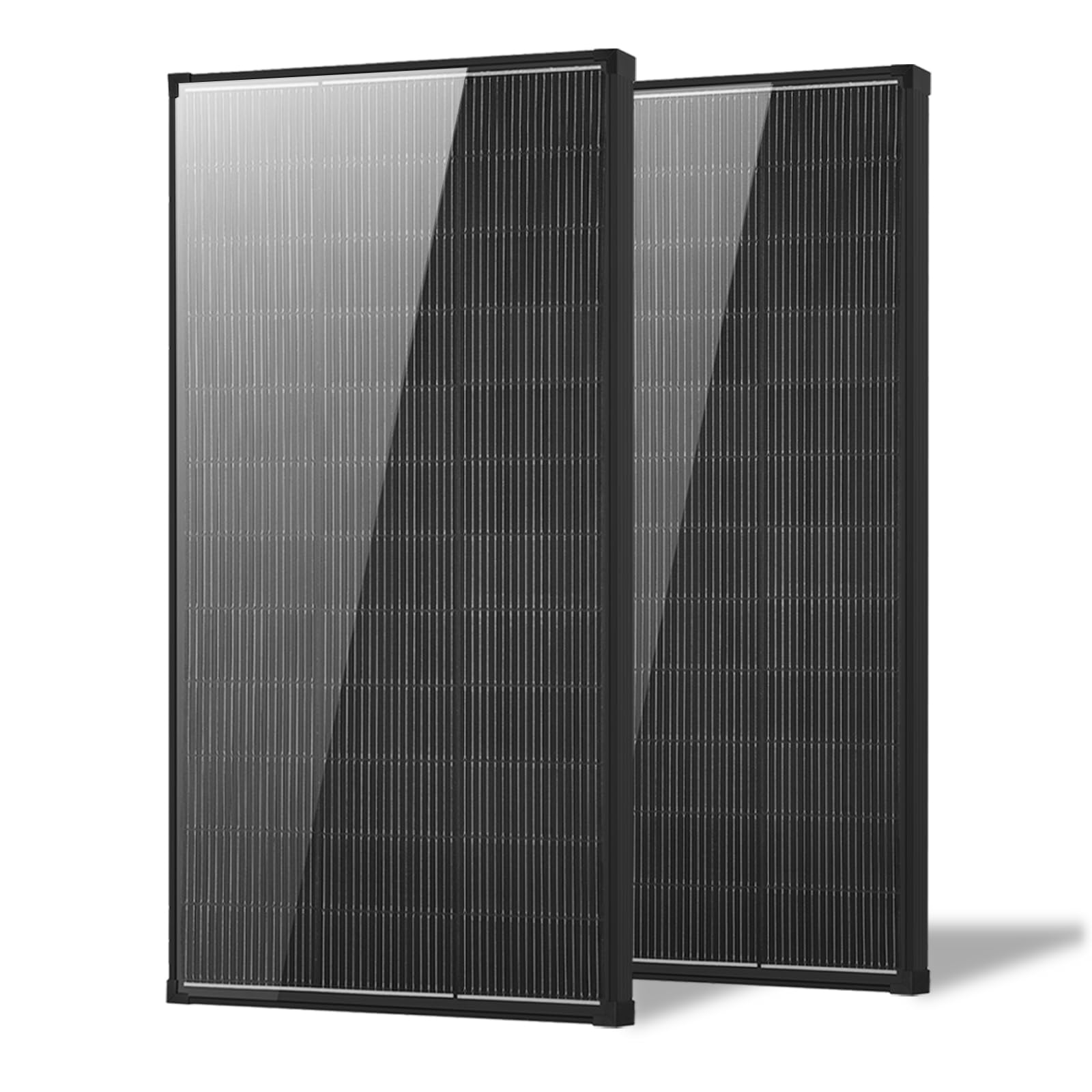
If you are building a budget-conscious ground array and need to maximize watts per dollar, the AeternaSol 400W kit delivers solid N-Type 18BB technology at an entry-level price. The two 200W panels use Grade A+ monocrystalline cells with a claimed 25% efficiency, and the 11 AWG 100% oxygen-free copper cabling reduces resistive losses in longer wire runs — a detail often skimped on at this price point.
Users report that the panels “work as advertised” with quick shipping and protective packaging. The 52.8 x 26.4 inch footprint per panel is manageable for a single person to lift and position on a ground rack. The anodized aluminum frame with 2400 Pa wind and 5400 Pa snow load ratings means it can survive real weather without flexing.
The main trade-off is the lower-tier MC4 junction box quality, noted by a user who warned to avoid putting cable tension on the box. For a fixed ground or roof mount where cables are strain-relieved, this is a non-issue. For mobile or frequently adjusted setups, the junction box may be a weak point over years of movement.
Why it’s great
- Cost-effective entry point into N-Type 18BB solar technology.
- 11 AWG oxygen-free copper wire reduces voltage drop on long runs.
- Reinforced foam packaging minimizes shipping damage risk.
Good to know
- MC4 junction box is less robust than premium panels — secure cables well.
- Total array is 400W, not a single high-density 450W module.
9. SUNGOLDPOWER UL61730 450W Solar Panel (2 Pack)

The SUNGOLDPOWER 450W 2-pack is built for the homeowner who wants to deploy serious capacity — 900W total — in one shipment. Each panel measures 75.2 x 44.7 inches and weighs 49.2 lbs, making for a substantial residential-grade module that produces up to 2250Wh per panel per day (based on 5 peak sun hours). The UL61793 listing and CEC approval mean these panels meet the safety and compliance standards required for grid-tied system rebates in many regions.
Users running 24-panel off-grid systems report that the panels have handled harsh Michigan winter weather for two months without issue, keeping a five-person household fully powered. The packaging is consistently praised as being robust enough to survive cross-country freight from California to Florida. The 41.72V max power voltage and 13.16A current make them easy to configure in series strings for 48V systems without exceeding controller limits.
The 5-year 95% output, 10-year 90%, and 25-year 80% warranty structure is standard for the industry but covers the expected lifespan. The panels are rigid and heavy, so a two-person installation crew and proper roof racking are required. For anyone building a serious off-grid home system or a large battery backup, this 2-pack delivers the most clean watts per square foot of roof space.
Why it’s great
- UL61793 and CEC listed for grid-tie eligibility and rebates.
- Each panel produces up to 2250Wh per day in good sun.
- Proven in full off-grid setups with harsh winter conditions.
Good to know
- Very large — 75.2 inches long, requires ample roof space and two-person install.
- Wattage warranty is standard 25-year degradation curve, not the longest available.
FAQ
Can a 450W solar panel charge a 12V battery directly?
Why does my 450W panel only produce 380W in full sun?
Can I mix a 450W panel with smaller 100W panels in the same array?
Final Thoughts: The Verdict
For most users, the 450 watt solar panel winner is the Callsun 450W Bifacial because its dual-module anti-shade architecture and 25.4% efficiency deliver real-world output that consistently hits or exceeds its rating. If you need portable emergency power, grab the Renogy 400W Portable Suitcase for its 60-second setup and rugged fiberglass build. And for the largest home backup array, nothing beats the SUNGOLDPOWER 450W 2-pack for total compliance and pure watts per dollar.