
Our readers keep the lights on and my morning glass full of iced black tea. As an Amazon Associate, I earn from qualifying purchases.
Specs are compiled from manufacturer listings and verified buyer reviews and can change over time — please confirm the key details on the product page before buying.
The real question when you shop for a 4G LTE router is whether it will hold a stable connection in your specific location. That means a router that works reliably for a farmhouse, an RV, or as a backup when your fiber drops. We’ve tested and compared the top models to help you choose one that fits your carrier, signal, and setup tolerance.
I’m Min — the founder and writer behind Gadgets Feed. This guide is built by comparing the manufacturers’ published specifications and the patterns across verified customer reviews, so you get each pick’s real strengths and trade-offs instead of marketing spin.
4g lte router choices come down to carrier compatibility, speed class, and failover smarts — here is how the top contenders really stack up for homes, RVs, and remote work.
Our Picks at a Glance

How To Choose The Best 4G LTE Router
First, check your carrier’s compatibility—some routers are certified for specific networks, others are open up. Some routers are certified for AT&T or T-Mobile data plans, while others are fully open up and work with any SIM you drop in. This one factor can make setup a breeze or a nightmare.
Carrier Certification Matters Most
Even top hardware is useless if your carrier won’t activate the IMEI. Look for explicit certification for your specific carrier — AT&T, T-Mobile, or Verizon — in the product description. open up routers give you flexibility to switch carriers, but you may need to adjust APN settings or TTL values to get them working, which some buyers find frustrating.
LTE Category Determines Your Speed Ceiling
The LTE category (Cat 4, Cat 6, Cat 12) tells you how fast the modem can theoretically pull data. A Cat 4 modem tops out around 150 Mbps download, while a Cat 12 modem with carrier aggregation can go much higher. Your actual speed still depends on the tower near you, but a higher category gives you more headroom when the signal is good.
Dual SIM and Failover Keep You Online
If you live somewhere with flaky coverage, a router with two SIM slots can automatically switch to the second carrier when the first one drops. This failover feature is a lifesaver for rural homes and RVs. Just know that most routers use the second SIM as a backup only — they don’t combine both connections for double speed.
Quick Comparison
| Model | Best For | Max Speed | Wi-Fi Standard | SIM Slots | Amazon |
|---|---|---|---|---|---|
| MOFI6500★ Best Overall | Demanding homes & RVs | 3.4 Gbps | Wi-Fi 6 | Dual | Amazon |
| GL-X2000 Spitz PlusFast Failover | Fast failover & Wi-Fi 6 | 2402 Mbps | Wi-Fi 6 | Dual | Amazon |
| Netgear Orbi LBR20Whole Home | Whole-home mesh coverage | 2.2 Gbps | Wi-Fi 5 | Single | Amazon |
| Teltonika RUT951 | Industrial & harsh environments | 150 Mbps | Wi-Fi 4 | Dual | Amazon |
| Cudy LT500 | Outdoor & large properties | 150 Mbps | Wi-Fi 5 | Single | Amazon |
| GL-E750V2 Mudi | Travel & portability | 433 Mbps | Wi-Fi 5 | Single | Amazon |
| GL-X750V2 Spitz | Budget-friendly backup | 750 Mbps | Wi-Fi 5 | Single | Amazon |
| TUOSHI N300 | Entry-level & cameras | 300 Mbps | Wi-Fi 4 | Single | Amazon |
In‑Depth Reviews
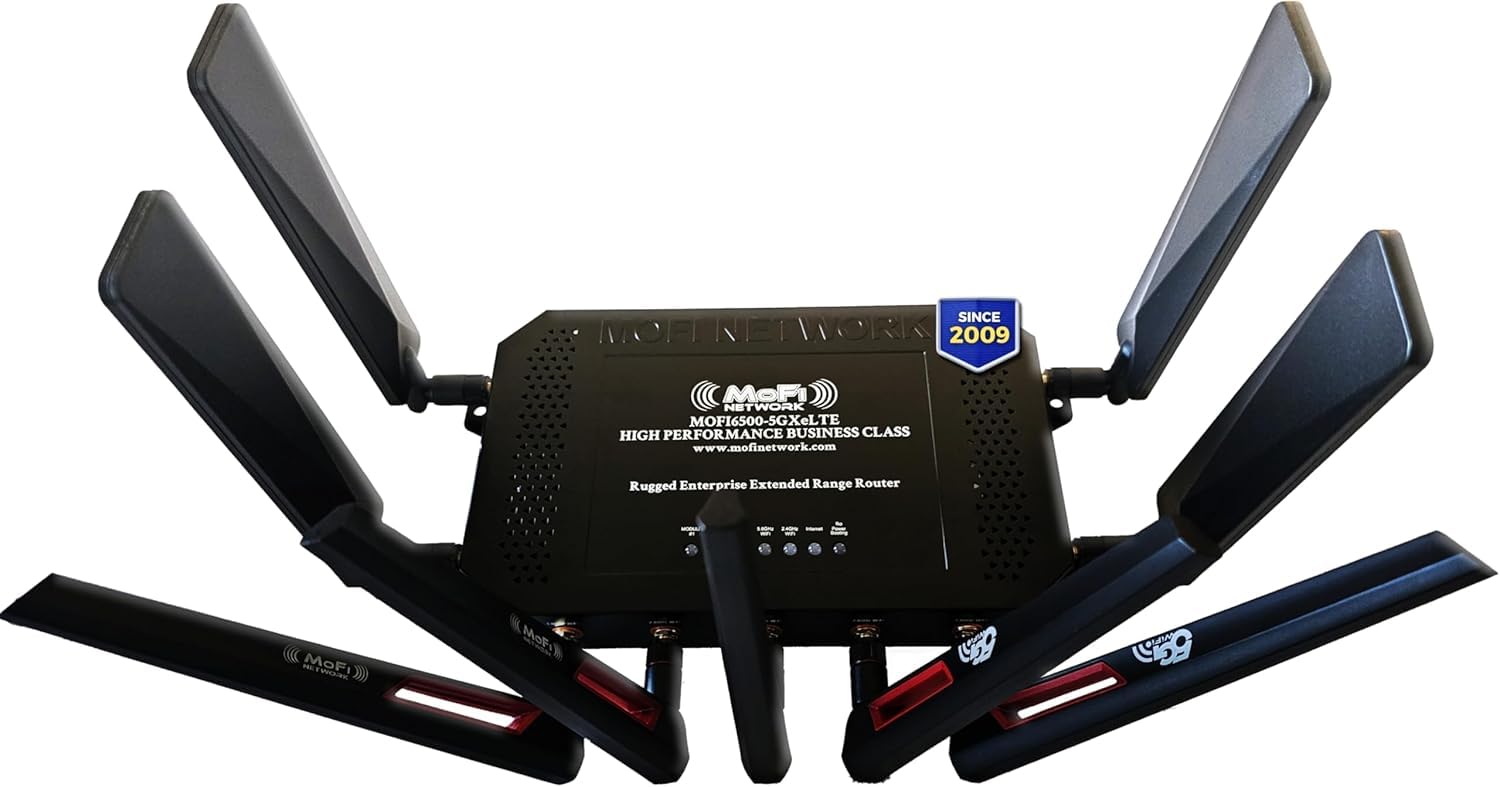
1. MOFINETWORK MOFI6500-5GXeLTE-RM520-HP
Our pick — over 4★ from 850+ verified ratings; the strongest balance of quality and price.
The armored workhorse that turns a dead zone into a reliable office-grade network.
The defining reason to look at the MOFI6500 is its rugged metal case and internal signal amplification, which together mean it can sit in a hot RV cabinet or a dusty barn loft and still push Wi-Fi 6 across two buildings. Buyers report solving a long-standing rural problem: “Rural two-building WiFi solved,” with one owner boosting a weak signal from 1 to 4 bars simply by adding a Yagi antenna.
What you get for the premium is the headline 3.4 Gbps data transfer rate and a full metal chassis with detachable antennas for better heat dissipation. The dual SIM slots do automatic failover, which means if your primary carrier drops, the router switches to the second SIM to keep you online. It’s certified to work with Verizon, AT&T, and T-Mobile, and the built-in tech support line is a genuine safety net.
Note: dual SIM is failover-only, not simultaneous—you can’t combine speeds unless you get the DUAL model. And while signal strength earns mixed feedback, most of the negative experiences trace back to a specific carrier mismatch rather than a bad unit. An RV owner who has used it full-time for two years notes the initial setup was tricky but that tech support responded in 20 minutes to fix an outage.
Built to Last
- Rugged metal case handles heat and bumps
- Wi-Fi 6 with amplification for extended range
- Auto failover between two SIM cards
Know Before You Buy
- Dual SIM means failover, not combined speed
- Signal strength depends heavily on your carrier
Choose it if: you need a permanent, high-performance connection for a home, RV, or small business in a tough signal area.
The trade-off: you pay more upfront, and you must pick a carrier this unit is certified for.
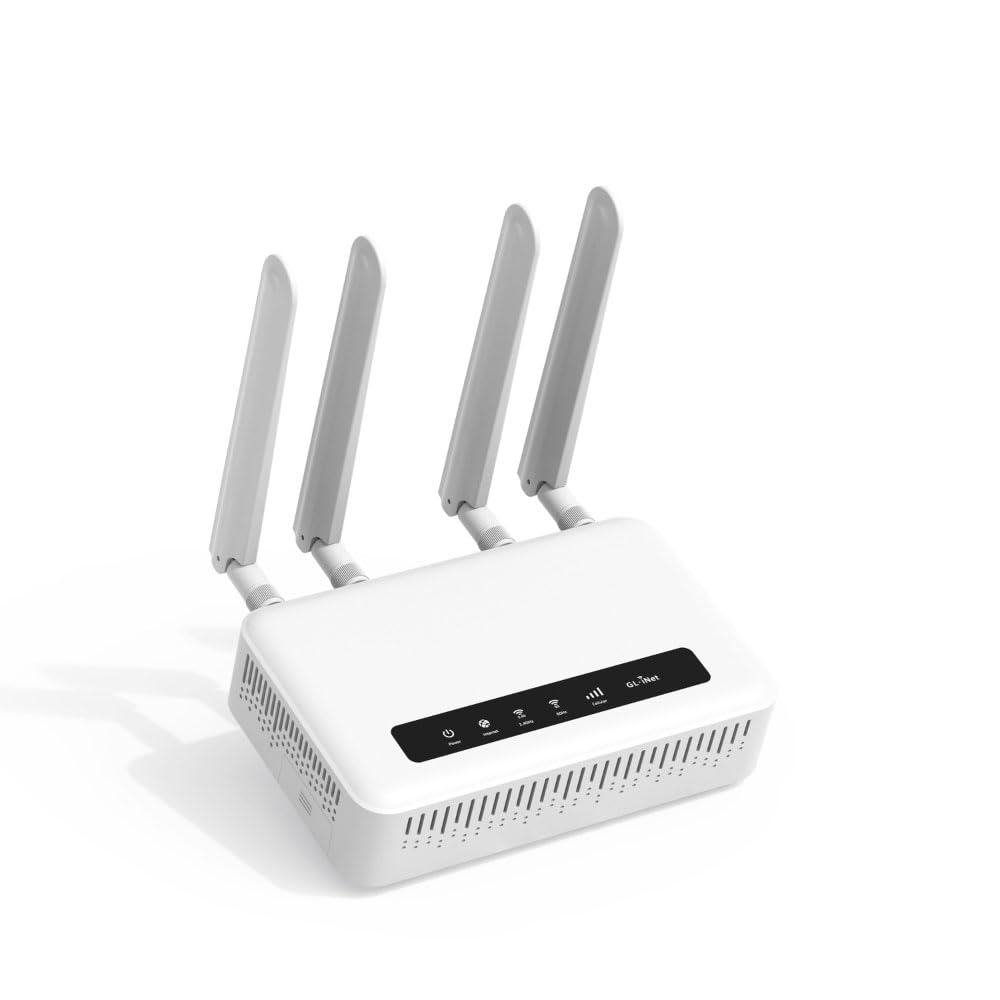
2. GL.iNet GL-X2000 Spitz Plus
A dual-SIM Wi-Fi 6 router that juggles Starlink, cellular, and Ethernet without breaking a sweat.
The GL-X2000 earns its place with fast Wi-Fi 6 wireless speed of up to 2402 Mbps on the 5 GHz band, plus a Cat 12 modem that uses three-carrier aggregation to pull more bandwidth from the tower. That combination translates to a noticeable jump in real-world reliability, which is why a rural Maine owner saw a weak 1-bar LTE signal improve to a strong 20 Mbps connection.
Where it really shines is the multi-WAN flexibility. It has dual SIM slots with failover, but it also lets you plug in Ethernet, tether a phone, or repeat another Wi-Fi network and then balance the load between them. One owner pairs it with a Starlink Mini as the primary and a Consumer Cellular SIM as the automatic backup, using the OpenWRT plugins to fine-tune the failover behavior.
The build is heavy aluminum with four SMA connectors for external antennas, so it’s clearly made to be mounted and forgotten. Owners mention the setup is easy through the GL.iNet app, and it streamed multiple devices at 18 Mbps down without a hiccup. The one reported gripe is that a hardwired connection failed for one owner while wireless worked fine, so it’s worth testing your preferred connection method early.
Reach for it if: you want a fast, flexible gateway that can juggle multiple internet sources and fail over automatically.
Look elsewhere if: you need a simple plug-and-play box with zero configuration appetite.
3. NETGEAR Orbi 4G LTE Mesh WiFi Router (LBR20)
The mesh option that blankets a 2,000-square-foot house with LTE-powered Wi-Fi.
This is the one to pick if your main problem is coverage area, not just getting online. The Orbi LBR20 covers up to 2,000 sq. ft. and handles 25 devices, and you can expand it further with additional satellites sold separately. It’s certified with AT&T, T-Mobile, and Verizon, so carrier compatibility is less of a guessing game.
Speed taps out at 2.2 Gbps Wi-Fi and 1.2 Gbps download over LTE, and the dual-band Wi-Fi 5 is plenty for streaming and cameras. One owner in a rural barn 25 miles from town had it connecting Arlo cameras within the day, with the cameras holding 92-94% battery after a full day of use. Another notes it streams 4K without issue over a weak cellular signal.
The honest trade-offs are that setup can be fiddly — the Orbi app is glitchy and you may need to enter an APN manually (one owner used “RESELLER” with no user/pass, another needed Verizon’s APN). And because it uses a single Nano SIM, there’s no automatic failover to a second carrier. Some customers note the LTE reconnect can take a few minutes after a drop, so treat it as a dependable primary rather than an instant-switch backup.
Best for families: a single box that pushes a strong, consistent signal across a whole house or barn without needing multiple access points.
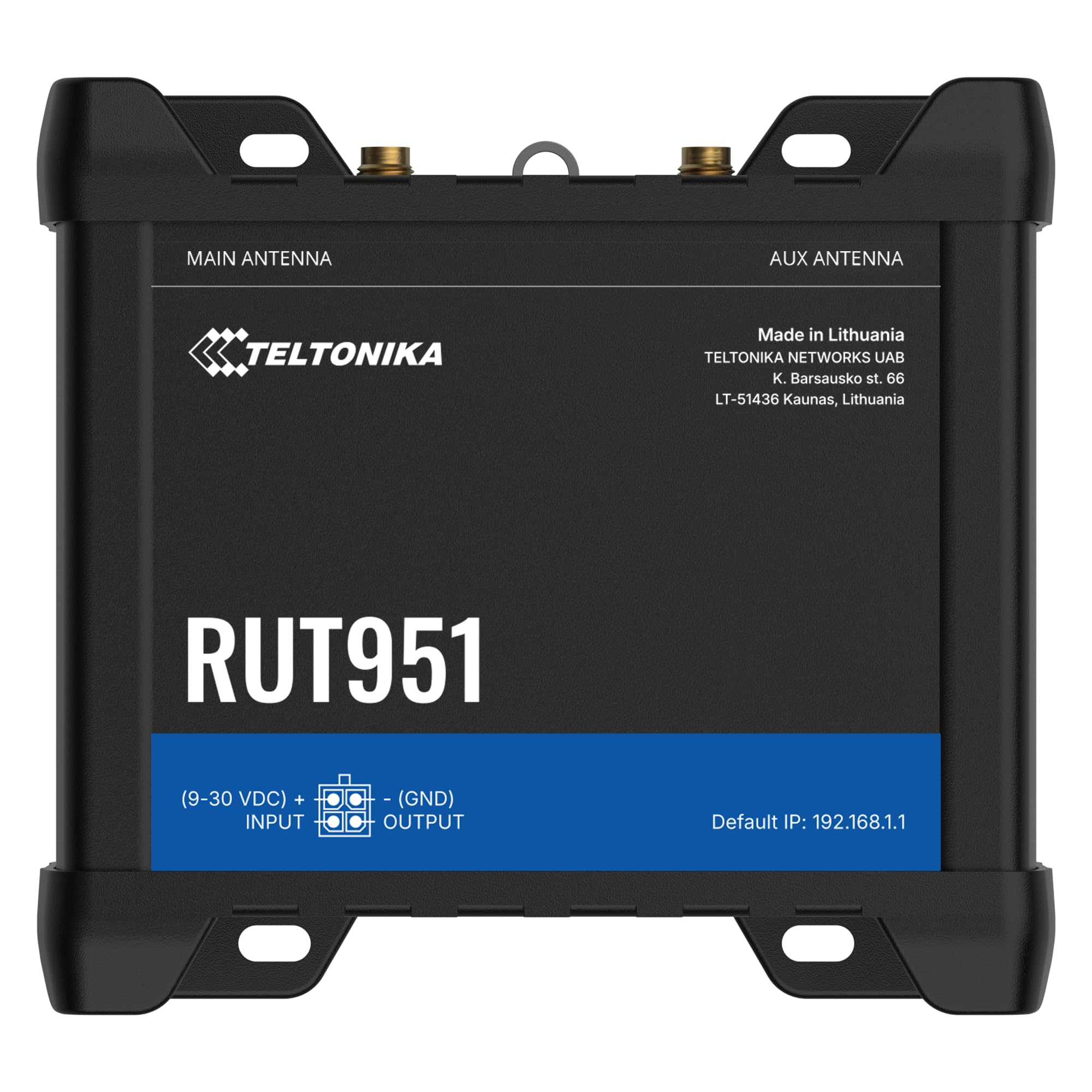
4. Teltonika RUT951
A compact industrial router built for PLCs, sensors, and mission-critical remote monitoring.
The Teltonika RUT951 is a different breed — it’s aimed at industrial automation, transportation, and IoT deployments where reliability trumps speed. The rugged aluminum housing and dual SIM failover are designed so that when one network drops, the router switches to the second to keep sensors, cameras, and PLCs reporting. It supports 4G LTE, 3G, and 2G for maximum backward compatibility.
It’s not a speed demon — the data transfer rate is 150 Mbps and the LAN ports run at 100 Mbps, and one owner measured a max of 30 Mbit up/down even with an external antenna. But that owner still praised the easy, intuitive setup and the fact it works with VPN networks. The side-by-side OpenVPN support is the standout for secure industrial links.
Because it’s built for harsh environments, the wide operating temperature range and compact 4.33″ x 3.94″ x 1.97″ footprint mean it mounts easily in a control cabinet or vehicle. Just know the Wi-Fi is functional, not powerful — one owner called it weak but workable. This is the right tool when you need guaranteed uptime for machinery or remote monitoring, not when you want to stream 4K on the couch.
Built for uptime: dual SIM failover and rugged construction make it the dependable choice for industrial and remote-monitoring setups where a dropped connection is not an option.
5. Cudy Outdoor 4G LTE AC1200 Wi-Fi Router (LT500)

The weatherproof router that mounts on a pole and beams LTE across your whole property.
This is the pick for outdoor surveillance, large properties, campgrounds, and remote worksites where you need coverage outside the walls of a house. The Cudy LT500 is IP65 weatherproof, meaning it survives rain and dust, and it’s rated to operate from -40°C to 65°C. It delivers 150 Mbps download over 4G LTE Cat. 4 and pumps out AC1200 dual-band Wi-Fi 5 with MU-MIMO for up to 50 devices.
The clever part is power over Ethernet (PoE) — one owner powered it 50 feet away through a single Ethernet cable, and mounting it high on a pole boosted the received signal by +10 dB. The dual-band Wi-Fi served outdoor spaces reliably, and the detachable SMA antennas are upgradeable if you need even more reach.
The catch is that it’s Cat 4 only, so it won’t be future-proof as carriers push faster LTE or 5G, and a few owners found the weatherproofing needed a little help — one added O-rings and tape as a precaution. Setup is generally easy, though one buyer called the instructions confusing. For a permanent outdoor installation in a tough spot, this is a solid, honest workhorse at a mid-range price.
Outdoor Champion
- IP65 rated for rain, dust, heat, and cold
- PoE powers it via a single Ethernet cable
- Upgradeable SMA antennas for weak signals
Outdoor Reality
- Cat 4 modem is not future-proof
- Some found the weatherproofing needs extra sealing
6. GL.iNet GL-E750V2 Mudi

A pocket-sized travel router with a built-in battery that keeps your work and maps online anywhere.
The Mudi is the one to grab when your “office” is a hotel room, a train, or a cafe. It’s a portable Wi-Fi hotspot with a 4G LTE SIM slot that produces 300Mbps (2.4G) + 433Mbps (5G) combined Wi-Fi speed, and its built-in 7000mAh battery delivers up to 8 hours of use. At just 285g and 5.7 x 3.1 x 0.9 inches, it slides into a bag pocket without a second thought.
Security is a major draw for travelers — OpenVPN and WireGuard are built in, with WireGuard speeds up to 50 Mbps and OpenVPN up to 10 Mbps. That means you can tunnel your traffic through a home server or a VPN provider on a public network and keep your banking and emails private. It also has a USB 2.0 port and supports up to 1 TB MicroSD for file sharing on the go.
The trade-offs are real, though. One long-term owner found the older SoC bottlenecks performance and the battery life less impressive after a year of daily use. Speeds on T-Mobile measured around 10-20 up and 50 down, which is fine for work and maps but not for heavy 4K streaming. The boot time is also slow, so it’s not a grab-and-go instant-on device.
Reach for it if: you need a secure, portable hotspot for work travel, road trips, and backup internet on the move.
Look elsewhere if: you need a permanent high-speed home router — this is a companion, not a replacement.
7. GL-X750V2 (Spitz) 4G LTE VPN Router

The budget-friendly failover router that quietly keeps a backup connection alive.
If you already have a primary internet line and just want an affordable safety net, the Spitz V2 is a smart, low-cost answer. It’s an AT&T-certified device (also works with T-Mobile) that turns a 4G LTE signal into dual-band Wi-Fi — 300Mbps on 2.4G plus 433Mbps on 5G. Average 4G speed lands around 15-20 Mbps, which is plenty for a backup line or a basic rural connection.
What makes it special for the price is the OpenWrt software. It’s fully open source and programmable, with 128MB RAM and a microSD slot that accepts up to 128GB, plus a USB 2.0 port. One owner runs it as a smooth failover WAN for a TP-Link Omada setup with a Google Fi data SIM, calling it “slow but reliable.” Another swapped out a Cradlepoint for it because it needs no subscriptions.
The honest caution is carrier compatibility: T-Mobile is plug-and-play, but AT&T and Cricket can be problematic due to IMEI issues or older 3G SIMs. Also, there’s no auto band selection, so you may need to change bands manually when you travel. And a few owners warn against firmware upgrades, which have bricked some older stock units.
Why It Wins Fans
- Very low cost for a capable dual-band LTE router
- OpenWrt makes it endlessly programmable
- Solid failover backup for an existing network
The Fine Print
- AT&T compatibility can be hit-or-miss
- No auto band selection when traveling
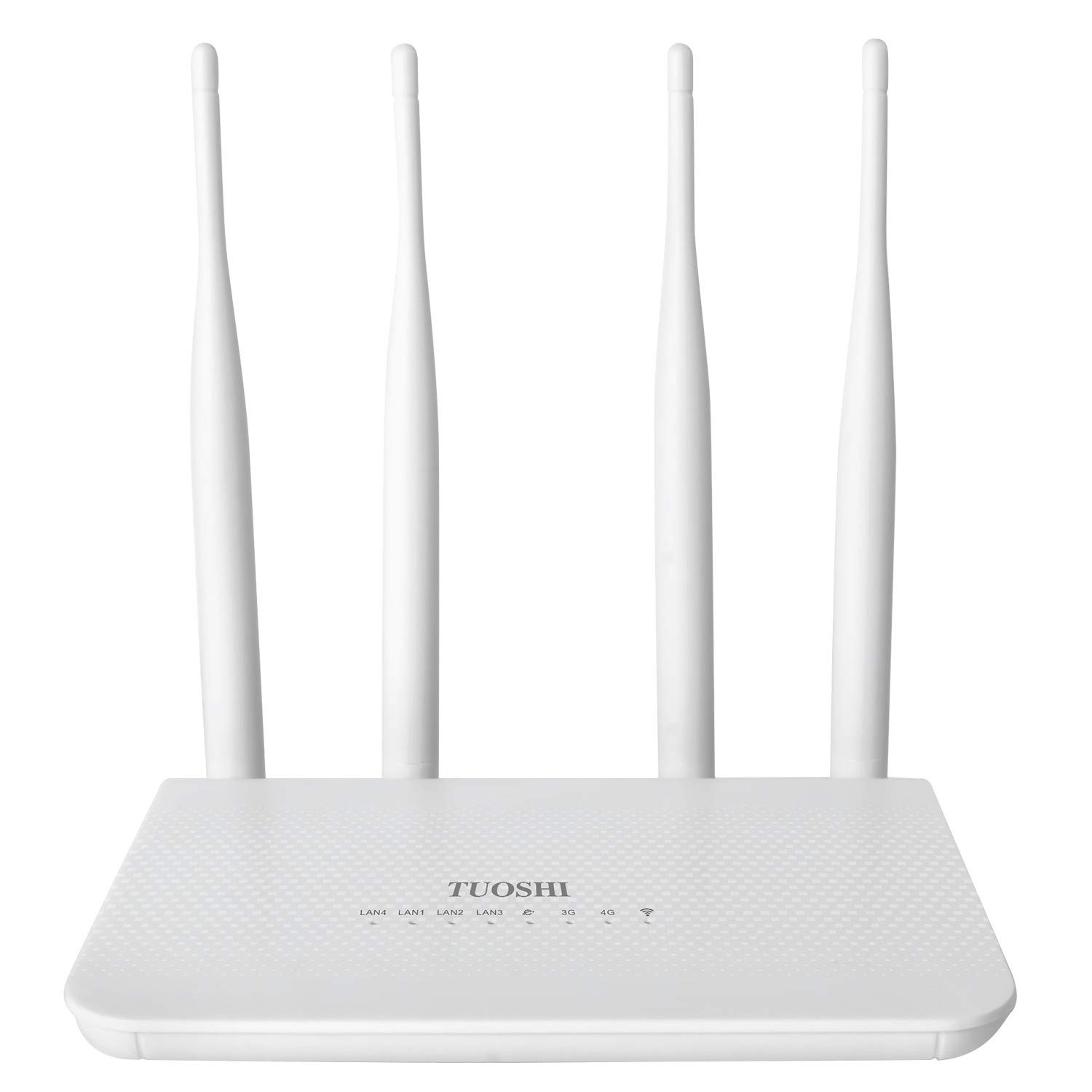
8. N300 WiFi open up 4G LTE Modem Router (LT15F)
The budget entry point that gets your SIM online fast, if you pick the right carrier.
At the very bottom of the price ladder, the TUOSHI N300 is a genuinely open up 4G LTE modem router that works with AT&T and T-Mobile SIMs for download speeds up to 150 Mbps. It covers a claimed up to 300 square meters and can handle 50 smart home devices, and it comes with three fast Ethernet ports for wired devices like security cameras and PCs.
Setup is the standout feature — reviewers point out a fast 10-minute setup with an active SIM, and it works with Verizon and US Mobile too, with one owner getting excellent rural speeds on a pooled /GB plan without any tether throttle. It’s a popular pick for powering security cameras over an IoT SIM.
The honest truth is that performance varies wildly by carrier and placement. Some shoppers say it works flawlessly with AT&T and delivers great speeds, while others struggle to get a stable connection and see only 0.1-0.5 Mbps down. It’s placement-sensitive, so you may need to experiment with where you put it. A few owners also noted the build feels cheap and the range is limited to the same room. This is a low-risk, low-cost experiment, not a guaranteed fix.
Budget experiment: fast setup and carrier flexibility make it worth trying for cameras or a cabin, but expect to tinker with placement and treat big speed claims with caution.
Understanding the Specs
LTE Category (Cat 4 vs Cat 12)
This number tells you how fast the modem can theoretically pull data from the tower. A Cat 4 modem tops out around 150 Mbps download, while a Cat 12 modem uses carrier aggregation — combining multiple signal channels — to go much faster. Your real speed still depends on the tower near you, but a higher category gives you headroom when the signal is strong.
Dual SIM and Failover
A router with two SIM slots can automatically switch to the second carrier when the first one drops. This is a lifesaver for rural homes and RVs. Just know that most routers use the second SIM as a backup only — they don’t combine both connections for double speed unless the product explicitly says so.
Wi-Fi Standard (Wi-Fi 5 vs Wi-Fi 6)
This determines how many devices your network can handle smoothly and how fast data moves between them. Wi-Fi 6 is the newer standard — it handles congestion better and offers higher speeds, which matters if you stream 4K in multiple rooms. Wi-Fi 5 (AC) is still plenty for most homes with fewer than 25 devices.
Wired Ethernet Ports
If you’re plugging in a security camera, PC, or game console, the number of Ethernet ports matters. Most LTE routers offer at least two, and the industrial models like the Teltonika RUT951 are built specifically to connect sensors and PLCs via wired links.
FAQ
Will a 4G LTE router work with my current phone plan’s SIM card?
What is the difference between a 4G LTE router and a mobile hotspot?
How do I know if a router is compatible with AT&T, T-Mobile, or Verizon?
Can I use two SIM cards at the same time for double speed?
How fast will my internet actually be with a 4G LTE router?
Can I mount a 4G LTE router outdoors?
What is OpenWrt and why would I want it?
Is a 4G LTE router good for gaming or streaming 4K?
How does failover work if my primary internet goes down?
Why does my 4G LTE router sometimes get slow speeds?
Final Thoughts: The Verdict
If you want one dependable pick, the 4g lte router winner is the MOFINETWORK MOFI6500 because it combines a rugged metal build, Wi-Fi 6, and dual SIM failover into the most reliable all-around package for homes and RVs. If you want fast failover with flexible multi-WAN options, grab the GL.iNet GL-X2000 Spitz Plus. And if your priority is covering a whole property with a weatherproof unit, the Cudy LT500 mounted high on a pole is the one to reach for — its IP65 rating and PoE power make it the standout for outdoor installations.
How We Picked
We do not accept paid placement. Every pick is matched to a real buyer and a real use-case; we do not hands-on test units.
Sources & Methodology
Specifications: manufacturer listings and product documentation. Review insights: verified customer reviews, as of August 2026. Pricing: not shown on this page (it changes often); check the current price via the retailer link.
As an Amazon Associate, Gadgets Feed earns from qualifying purchases. This does not affect which products we feature.