
Our readers keep the lights on and my morning glass full of iced black tea. As an Amazon Associate, I earn from qualifying purchases.
Specs are compiled from manufacturer listings and verified buyer reviews and can change over time — please confirm the key details on the product page before buying.
A signal booster cannot create coverage out of nothing. Every unit here needs at least a bar or two of usable signal at the outdoor antenna, and that one rule decides whether you end up with four bars in the kitchen or a box of expensive metal on your shelf. The second thing that matters is the gain number in decibels (dB) — the amplifier’s strength rating — because it sets how far that rescued signal travels inside your walls. Get outdoor signal and gain right and a rural cabin or metal-roofed shop becomes a place where calls connect.
I’m Min — the founder and writer behind Gadgets Feed. This guide is built by comparing the manufacturers’ published specifications and the patterns across verified customer reviews, so you get each pick’s real strengths and trade-offs instead of marketing spin.
Below you will find home systems that cover thousands of square feet, band-specific units built around a single carrier, and vehicle boosters for trucks and RVs, all sorted by what they genuinely do well. Here is the honest breakdown of the best 4g signal booster choices, judged by gain, band support and the coverage each one realistically delivers.
Our Picks at a Glance


How To Choose The Best 4G Signal Booster
The single most common mistake is buying a booster before measuring the signal outside your building. A booster amplifies the signal already at your outdoor antenna; it cannot create one where none exists. If you have one bar on the roof, a strong amplifier can turn that into three or four bars indoors. If you have nothing on the roof, no amplifier on this list will fix it.
Start With The Signal Outside, Then Pick The Gain
Gain is measured in decibels, written dB, and it describes how much the amplifier lifts a weak signal. A 70dB unit on this list has more amplification headroom than a 65dB one. More gain generally means the rescued signal can push through more walls and reach more rooms, which is why the high-gain home units cover several rooms while the smaller units are honest about covering one or two.
Automatic Gain Control, usually shortened to AGC, is the circuit that turns the boost down when the incoming signal is already strong. Without it, a booster can overload and create interference. Every major unit here uses some form of it, and several let you watch the gain readings live on an app or an LCD screen.
Match The Bands To Your Carrier
Your phone talks to the tower on specific frequency bands, and a booster has to support the band your carrier uses at your address. Band 13 sits around 700MHz and is heavily used by Verizon, while Band 12 and Band 17 also live in the 700MHz range. Band 2 and Band 25 sit near 1900MHz, and Band 4 covers 1700 to 2100MHz. A multi-band unit supports all of these at once, so it works across carriers and across family members on different plans.
A single-band unit is cheaper and simpler, but it commits you to one carrier’s band. If you switch providers later, or a guest on another network visits, the boost may not apply to them. Check your carrier’s band before you commit to a single-band box.
Directional Vs Omnidirectional Outdoor Antennas
A directional antenna has to be aimed at the nearest tower, and it rewards that aim with a stronger, cleaner signal. It suits a fixed building where you can point the antenna once and leave it. An omnidirectional antenna picks up from every direction at once, which is what makes it the right call on a moving truck or an RV that parks in a new spot every night.
Why FCC Certification Is Not Optional
A booster that is not FCC certified can interfere with the carrier network, and carriers are entitled to shut it down. Every unit on this list is FCC approved, which means it operates within the legal limits and will not put you in that position. Installation is also simpler than it sounds: an outdoor antenna, a cable run, the amplifier, and an indoor antenna that broadcasts the boosted signal into the room.
Quick Comparison
| Model | Best For | Max Gain | Coverage | Bands Supported | Amazon |
|---|---|---|---|---|---|
| HiBoost Home Office & Multi Room★ Best Overall | Large homes and offices | 70dB | 8000 sq ft | 2, 4, 5, 12, 13, 17, 25 | Amazon |
| GAGBK Verizon Band 13 BoosterBest Value | Verizon and Straight Talk homes | 65dB | 5000 sq ft | Band 13 (700MHz) | Amazon |
| FreeQueen Verizon BoosterCompact Pick | Single-carrier home use | 65dB | 5000 sq ft | Band 13 (700MHz) | Amazon |
| Metarepeater MG1 | Installers who want live readouts | — | 5000 sq ft | 12/17, 13, 5, 4/66, 2/25 | Amazon |
| ZORIDA Ace 5S | Small homes and single rooms | 72dB | 2000 sq ft | 12/17, 13, 5, 4, 2/25 | Amazon |
| SignalBrick Truck & RV Booster | Moving vehicles and remote routes | — | 5-8 miles | 4, 12, 13, 17, 5, 2, 25 | Amazon |
| SureCall Flare 3.0 | Small homes with a clear tower view | — | 3500 sq ft | 700/850/1900/1700-2100MHz | Amazon |
| HiBoost Car & SUV Booster | Daily driving in weak-signal areas | — | Vehicle cabin | 12/17, 13, 5, 4, 25/2 | Amazon |
| weBoost Drive X OTR | Long-haul truckers | 50dB | Vehicle cabin | 12/17, 13, 5, 4, 25/2 | Amazon |
| weBoost Destination RV | Parked RVs and campers | — | Many miles | 12/17, 13, 5, 4, 25/2 | Amazon |
| CEL-FI GO G41 | Whole-home coverage in weak areas | 100 dB | 15000 sq ft | 700MHz, 1700/2100MHz | Amazon |
In‑Depth Reviews
1. HiBoost Cell Phone Signal Booster for Home Office and Multi Room, Covers up to 8000 Sq Ft
Our pick — 4.5+★ from 650+ verified ratings; the strongest balance of quality and price.
Two indoor antennas and 70dB of gain turn a whole floor of dead zones into usable bars.
If your problem is a house where the signal dies the moment you walk past the kitchen, this is the unit built for that exact frustration. HiBoost pairs a 70dB amplifier (the strength rating that sets how far the boosted signal travels) with 2 indoor antennas, so the rescued signal is broadcast from more than one point instead of a single corner. Two broadcast points are what let the boost reach 5-6 rooms instead of one.
The width here is the headline: 8000 square feet of claimed coverage against the 5000 square feet of the GAGBK and FreeQueen units. Its 70dB gain also edges past the 65dB those two carry. For a rambling farmhouse, a metal workshop, or a basement office, that extra headroom is the difference between a signal that survives three walls and one that gives up at the second.
Band coverage is where it separates itself further. It handles bands 2, 4, 5, 12, 13, 17 and 25, which means Verizon, AT&T, T-Mobile, Sprint and US Cellular phones all get boosted from the same box — no juggling if your household splits across carriers. Setup is guided through the HiBoost app or the built-in LCD display, and Automatic Gain Control keeps the amplifier from overdriving itself when the outdoor signal is already strong.
Where it earns its keep
- 8000 square feet of coverage reaches 5-6 rooms from 2 indoor antennas
- 70dB gain pushes the boost through more walls than the 65dB units below
- Seven supported bands keep every major US carrier boosted at once
- AGC plus app and LCD monitoring means no manual tuning during setup
- 3-year warranty with a 3-month free return window
What to weigh first
- The heaviest home unit here at 2 kg, so plan where it sits before mounting
- You still need usable signal at the outdoor antenna — this amplifies, it does not create
- Wiring two indoor antennas takes more cable planning than a single-antenna kit
Reach for this if: your house is large enough that one indoor antenna leaves half the rooms cold, or your family spans more than one carrier.
Think twice if: you are boosting a single room and would rather not run cable for a second indoor antenna.
2. GAGBK Verizon Cell Phone Signal Booster for 5G 4G LTE on Band 13
A single-band Verizon specialist that does one job and does it across a small house.
Here is the booster for the household that has already answered the band question. It works on Band 13, the 700MHz slice Verizon and Straight Talk lean on heavily, and it does nothing else. If that is your carrier, that focus is a feature rather than a limit — 65dB of gain and 5000 square feet of coverage for up to 2-5 rooms, with a directional outdoor antenna aimed at the tower and an indoor whip antenna broadcasting inside.
It is also the lightest full home kit on this list at 1.02 kg, which matters if you are carrying it up a ladder to a roof mount. Against the HiBoost above it carries 65dB of gain versus 70dB and 5000 square feet versus 8000 square feet of claimed coverage, but it costs a fraction of what that flagship unit runs. That trade is real, and it is the right one if your dead zone is a bedroom and a living room rather than an entire wing.
The honest catch is carrier lock-in. Switch to T-Mobile and this box stops helping, because T-Mobile’s traffic does not ride Band 13. The recurring practical gripe with single-band kits is exactly that — they are brilliant for one network and silent for the next. Setup itself is straightforward, with all parts in the box and an LED indicator showing working condition, plus a 3-year manufacturer warranty behind it.
The real trade: 65dB and 5000 square feet is enough to pull 1-2 bars up to 4-5 bars in a normal-sized home, and the 30-day money-back window takes the risk out of finding out.
Size the limit honestly: this is a Verizon and Straight Talk tool. Guests on AT&T will see no change at all.
Best for: a Verizon or Straight Talk household that wants stronger calls without paying flagship money.
Look elsewhere if: more than one carrier lives under your roof.
3. FreeQueen Verizon Cell Phone Signal Booster 5G 4G LTE Band 13
Same Band 13 mission as the GAGBK, but lighter in the hand and aimed squarely at a tower.
This is a near-twin of the GAGBK above on paper — 65dB gain, 5000 square feet, Band 13 only, Verizon and Straight Talk. Where it differentiates is the hardware: a directional antenna you point at the tower and a body that registers at 1.02 kg, the same as the GAGBK and against 2 kg for the HiBoost. If you are the one up on the roof with a drill, that lightness is not a footnote.
Owners consistently flag build quality as the thing that reassures them here — the housing feels solid in the hand rather than hollow, and it holds up to being handled during installation. The directional antenna design is the other practical win: aim it correctly and you get a cleaner feed from the tower than an omnidirectional whip would pull in from all sides at once.
What you should know going in: this is a single-band amplifier, so the 5000 square feet only applies to Band 13 traffic. Coverage also depends entirely on how strong the signal is where the outdoor antenna lands, which is true of every booster here but especially worth measuring with a weak-band unit like this one. The 2-year warranty is shorter than the 3-year cover on the HiBoost and the GAGBK.
What the buyers notice: solid build and a light 1.02 kg body make the install itself painless, and setup is quick once the outdoor antenna is aimed.
The trade you accept: 2 years of warranty cover instead of 3, and no help for any carrier outside Verizon and Straight Talk.
Pick this one when: you are on Verizon or Straight Talk, want a directional antenna for a cleaner tower lock, and value a light unit for roof work.
Pass if: you need multi-carrier support or the longest warranty available.
4. Metarepeater MG1 Home Cell Phone Signal Booster with Smart LCD Display

A color screen that shows all five bands live makes antenna aiming a two-minute job instead of a guessing game.
The MG1 solves the part nobody warns you about: finding the spot on your roof where the signal is strongest. Its large color LCD display shows the gain of all five frequency bands at the same time, so as you move the outdoor antenna you can literally watch the reading climb. That takes the trial-and-error out of installation, and it is a genuinely different approach from the app-only monitoring on the HiBoost.
It covers bands 12/17, 13, 5, 4/66 and 2/25, which is broad enough for AT&T, Verizon, T-Mobile, Sprint, Straight Talk and US Cellular.
Setup runs off the printed manual, with no app to download, and the kit includes a 60ft cable and roof or pole mounting bracket. The install is the one part to plan for — the outdoor antenna wants roof placement and the maker suggests 1-2 people to help. Buyers report the reliability holds up well once it is dialed in, which is what you want from a device that sits quietly on a wall for years.
Why installers like it
- Color LCD shows all five band readings at once during aiming
- Honest coverage tiers tied to real outdoor signal strength
- Five supported bands cover every major US carrier
- 60ft cable and mounting hardware included in the kit
Before you buy
- Roof mounting generally needs a second pair of hands
- Only delivers full coverage if your outdoor signal is genuinely strong
- No app — everything is read off the display and the manual
The right buy for: anyone installing solo who wants to see the signal numbers rather than trust a phone app’s verdict.
Second thoughts if: you have a genuinely weak outdoor signal — the 5000 square feet assumes a strong one.
5. ZORIDA Ace 5S Cell Phone Signal Booster 72dB for All US Carriers

The highest gain in the mid-range group, packed into a box that covers one room well.
72dB is the number to start with. That is more raw amplification than the HiBoost’s 70dB and well above the 65dB on the two Verizon units, and it means this booster works hard to rescue a faint outdoor signal. The catch is that ZORIDA deliberately sized the coverage at 2000 square feet, aimed at small homes, studios and single rooms. High gain, modest reach — those two facts together tell you exactly who this is for.
Band support is the other strength: 12/17, 13, 5, 4 and 2/25, covering Verizon, AT&T, T-Mobile and US Cellular without a carrier commitment. Setup is genuinely easy because the indoor whip antenna attaches directly to the booster and can sit on a wall or a table — no separate coax run indoors. Registering the ZORIDA app open up one-to-one technical support, step-by-step install videos, and a before-and-after signal readout so you can see what the boost actually bought you.
Fair warning on two counts. First, it needs at least one bar outside to work with, which the maker states plainly. Second, 2000 square feet really does mean roughly one room or a small open-plan space — this is not a whole-house system, and buyers who expect it to cover a two-story home will be disappointed by physics rather than by the product. What it does, it does with more gain than anything else at this tier.
Measured verdict: 72dB of gain in a compact single-room footprint is an unusual pairing, and the app-based support and 3-year warranty back it properly.
The honest limit: 2000 square feet is a single room. Size your expectations to that and it delivers.
Who it fits: a studio, a single bad-signal room, or a small cabin where maximum gain matters more than maximum area.
Skip it for: a large house that needs the boost carried across several rooms.
6. SignalBrick Cell Phone Booster for Truck RV, 5G/4G LTE/3G
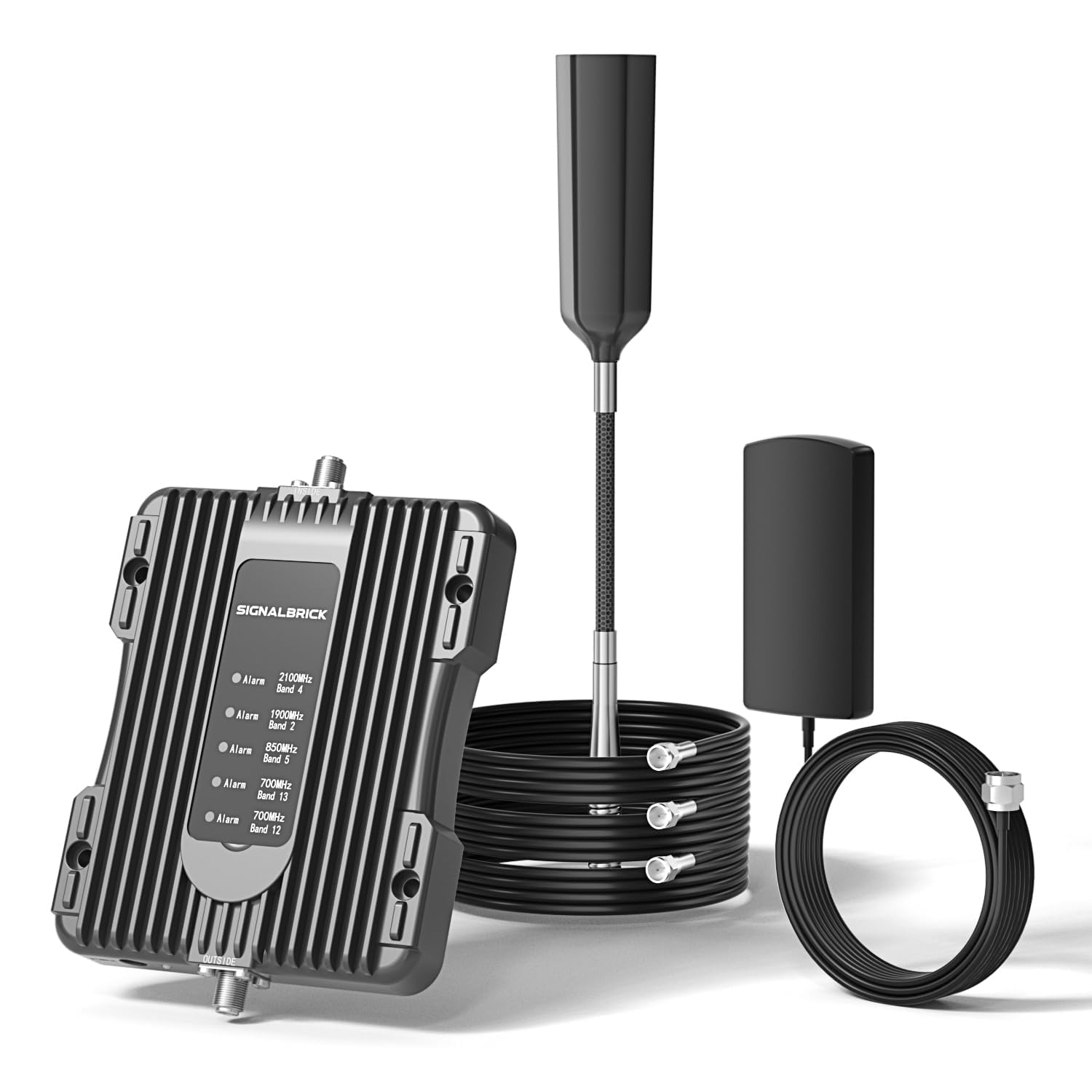
Built for the truck cab that changes location every day, with an antenna that never needs re-aiming.
A fixed home booster points at one tower forever. This one cannot, because the truck moves. SignalBrick uses an omnidirectional outdoor antenna (it pulls signal from every direction rather than one) so the booster keeps working as you drive, and the maker lists a maximum communication distance of 5-8 miles. That range figure is the reason this sits in the vehicle conversation at all — for open highway and rural routes where bars vanish between towns, it is the difference between a dead stretch and a working call.
Multi-user is handled properly: a phone, a tablet and a data modem can all connect at once, so passengers are not competing for the boost. Band support covers 4, 12, 13, 17, 5, 2 and 25, which puts Verizon, AT&T, Sprint, T-Mobile and US Cellular all in play. The outside antenna is designed for a harsh life, with a spring mount and protection against dust, oil and water, so a winter of road salt and a summer of gravel do not end it.
Installation is a one-person job per the manual, and everything including the 12V DC power cord ships in the box. The item here is newer with a smaller track record than the established vehicle kits further down, so weigh that against the omnidirectional design if you want the longest possible history of owner experience. The 3-year warranty and FCC certification both stand behind it.
Suits you if: you drive a route that crosses dead zones and want an antenna that needs zero aiming.
Reconsider if: you park in one place — a directional home unit will pull a cleaner signal for less.
7. SureCall Flare 3.0 Cell Phone Signal Booster for Home & Office
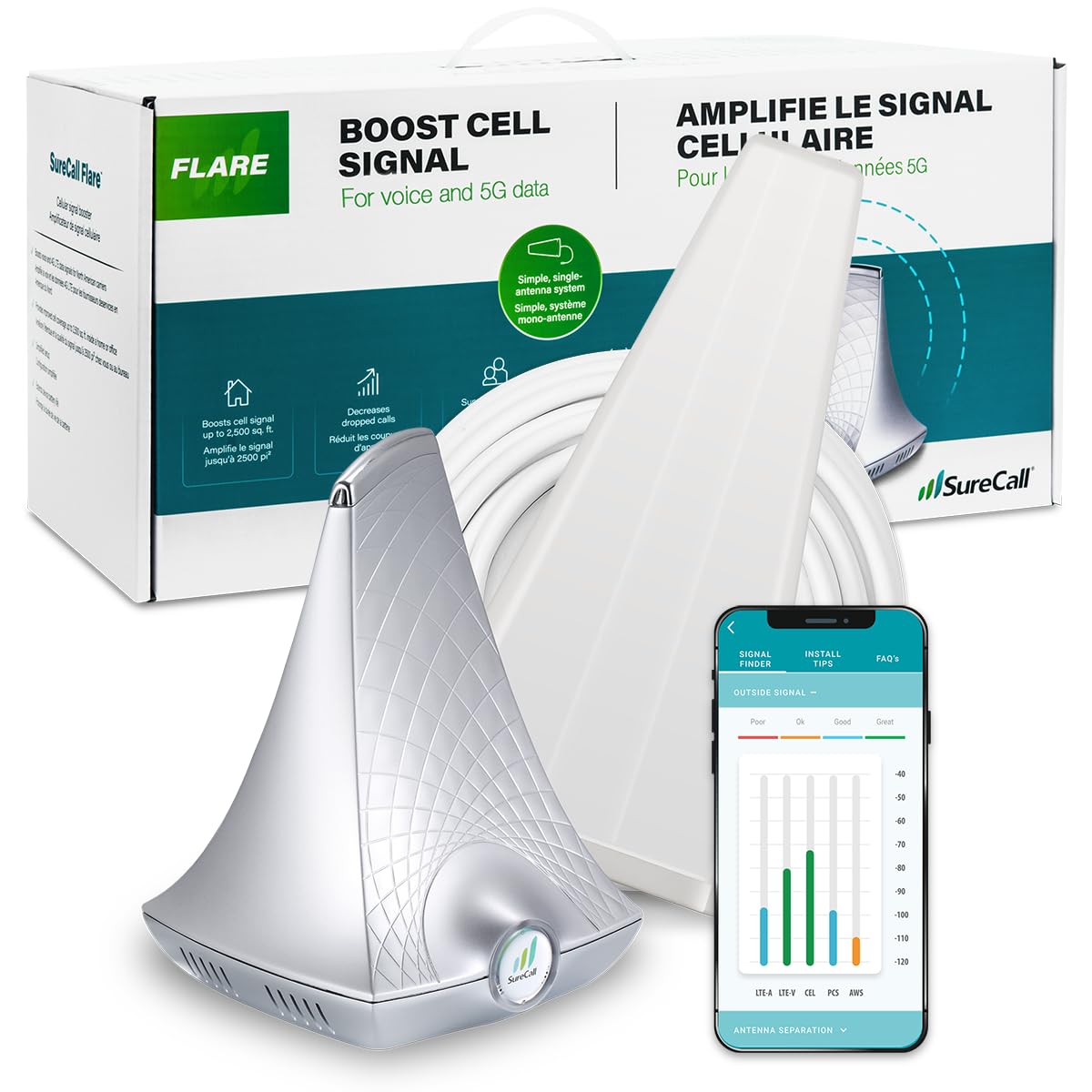
A Yagi-antenna kit that is refreshingly blunt about how much coverage your outdoor signal will actually support.
SureCall publishes tiered coverage instead of a single headline number, and that honesty is the most useful thing about the Flare 3.0. With 1-2 bars outside you get up to about 500 square feet inside. With 3-4 bars you reach roughly 1500. Only a full five-bar outdoor signal open up the full 3500 square feet. If you have measured your roof and know it is strong, this is a well-built kit from a US company; if you have not, those tiers are your reality check.
The Yagi outdoor antenna is directional and rewards being aimed properly, which the free SureCall app helps you do on iOS and Android. Installation itself is the part owners consistently rate highly — clear directions, all-in-one kit, no monthly fees. It supports all major US carriers on a wide spread of bands covering 700MHz through 2100MHz, and it is designed, assembled and tested in the USA with a 3-year warranty.
Where this one needs managing is expectations. It is the lowest-rated pick here, and the split in owner experience is real: for people with a solid outdoor signal it lifts 0-1 bars up to 4, while for people in a genuine dead zone it can do very little at all. That reflects the physics of amplification, not a flaw in the Flare 3.0 or the 100 dB CEL-FI below. It is also the heaviest home kit on the list at 7.9 pounds.
The refreshing part: tiered coverage published up front, a directional Yagi antenna, app-guided aiming, and US-based support with a 3-year warranty.
The catch: it is the most signal-dependent pick here. Measure the roof before you buy, not after.
The right fit: a small home with a genuinely decent outdoor signal and a buyer who wants a US-made kit with app guidance.
Not for you if: your outdoor signal is already marginal — this one has the least headroom to rescue it.
8. HiBoost Cell Phone Signal Booster for Cars and SUVs

A magnetic roof antenna and a metal body make this the car kit that survives daily driving.
Most car boosters are a compromise. The HiBoost Car 3.0 leans into the parts that matter for a daily driver: a magnetic outdoor antenna that drops onto the roof in seconds, a rugged metal booster body, and a silicone cover to shrug off bumps and scratches. The inside antenna runs on a 9.84ft cable and the outside antenna on 13.12ft, which is enough slack to route both cleanly in a sedan or SUV without a rat’s nest of wire across the dash.
Band support is the full set — 12/17 and 13 at 700MHz, 5 at 850MHz, 4 at 1700/2100MHz, and 25/2 at 1900MHz — so AT&T, Verizon and T-Mobile all get boosted. What owners praise most is signal strength, with 3-4 bars of coverage reported even in remote areas, and the value for a car kit this complete is the second most-cited strength. Range extension and ease of installation both land positively too.
What wins people over on the road is reliability in weak-signal stretches: highways, rural roads, and parking areas where the bars usually drop. The recurring gripe is durability of the exposed antenna hardware over a long, hard life — treat the magnetic mount and antenna with a little care and it holds up, but this is a device living on the outside of a moving vehicle. The 3-year warranty and HiBoost app for signal detection and install guidance soften that. As on the home unit above, the app walks you through setup step by step.
What earns the price
- Magnetic roof antenna installs in seconds with no permanent drilling
- Seven supported bands including 5G, so all major carriers benefit
- Metal body with silicone cover protects against bumps and scratches
- 3-year warranty plus an app for signal detection and setup
Worth knowing
- Exterior antenna hardware is the wear point over years of driving
- Cabin-sized coverage only — this is not a home system
- Requires usable signal outside the vehicle to have something to amplify
Made for: commuters and road-trippers whose calls drop on the same stretches every week.
Think again if: you want whole-building coverage — the cabin is the room here.
9. weBoost Drive X OTR Cell Phone Signal Booster for Trucks

The tall 17-inch trucker antenna is the giveaway — this kit is built for a cab that never stops moving.
The number that jumps out is the antenna: 17 inches tall, omnidirectional, and weather-resistant, mounted via a 3-way CB antenna mount with a mast extension and side exit adapter. That hardware is not decorative. A tall omnidirectional mast grabs signal from every direction as the truck rolls, which is exactly what a long-haul driver needs and exactly what a magnetic car puck cannot do as well. Up to 50dB of gain sits behind it.
The other practical spec is battery life. weBoost rates the Drive X OTR at up to 2 hours of additional talk time, because a phone holding a strong signal does not burn power searching for a tower. For a driver on an 11-hour stretch, that is a working phone at the end of the day rather than a dead one. Support spans bands 12/17, 13, 5, 4 and 25/2 across AT&T, Verizon, Sprint and T-Mobile, and multi-user means a co-driver or passenger gets the benefit too.
What owners rate most consistently is the quality of the hardware itself, with installation and service close behind — the mount and antenna hardware feel like professional gear. The honest limitation is that performance is signal-dependent in the extreme: a properly aimed setup transforms the cab, while a marginal outdoor signal leaves it doing very little. That is a question of matching the kit to your signal, not a hardware defect. It weighs 5 pounds and is FCC approved under FCC ID PWO460021.
Where the money goes: a 17-inch weather-resistant mast, a 3-way CB mount, and up to 2 extra hours of talk time per charge cycle.
Set your expectations: the boost is only as good as the signal at the antenna, so mount placement is the whole ballgame.
Built for: owner-operators and long-haul drivers who need a permanent, tall antenna rig on the cab.
Too much if: you drive a sedan — the 17-inch mast and CB mount belong on a truck.
10. weBoost Destination RV Cell Phone Signal Booster for Stationary Use

A 25-foot collapsible pole lifts the antenna above the treeline — the trick most RV kits miss.
Height is the whole idea here. The Destination RV ships with a 25-foot collapsible pole so the outdoor antenna can clear the roof of the rig and the trees around the campsite, and weBoost describes it as designed for parked use with 10-minute setup and takedown. That installed height is the reason this kit can pull a signal that a roof-mounted car booster simply cannot reach from inside a tree-covered site.
It supports 5G and 4G LTE across bands 12/17, 13, 5, 4 and 25/2, works with all US carriers including Verizon, T-Mobile, AT&T, Dish and US Cellular, and handles multiple users at once — so the whole family can hotspot and stream from a single booster. The weBoost app provides the installation guidance, and it is made in the USA and FCC approved.
Two things to plan around. First, this is a stationary unit — the directional antenna is made for parked use, not for boosting while you drive, so it is the companion to a moving-day kit rather than a replacement. Second, it is heavy and bulky at 24 pounds with a 25-foot pole to wrangle. What owners praise most is build and connectivity quality, which fits a kit aimed at campsite use where you set it up once and leave it. The value question is the honest sticking point at this premium tier.
The standout: a 25-foot collapsible pole plus a directional antenna is genuine campsite engineering, and the 10-minute setup and takedown keeps it practical.
Be straight with yourself: 24 pounds and a tall pole are a real chore, and this only works parked — not on the move.
Choose it for: a seasonal campsite or a rig parked in tree cover where antenna height beats every other variable.
Not the one if: you need boost while driving — this is a parked-only design.
11. CEL-FI GO G41 Smart Signal Booster, 1 Indoor Antenna

100 dB of gain and 15000 square feet of coverage is the biggest number in this entire roundup.
Start with the spec that separates it from everything else here: 100 dB of gain, against 72dB on the ZORIDA and 70dB on the HiBoost. The GO G41 runs the 4th generation IntelliBoost chipset and supports 4G LTE, 5G-DSS and 5G NR, and it covers 15000 square feet — a whole home rather than a room. Those are CEL-FI’s own figures, not independently verified.
Installation is easier than the spec sheet implies. The kit includes both a single dome and a panel antenna, and you use one and discard the other, so you can match the antenna to the room. Owners describe it working from the start, lifting 1-2 bars to a consistent 4 bars across the house, with a clear manual and an app that helps tune placement. Call quality is a consistent positive too — reliable calls plus streaming without interruptions. It is FCC certified under FCC ID YETG41-BE.
Here is the trade you have to make peace with. This is a premium pick, and the value question is the one place buyers waver — it costs more than any other unit here by a wide margin, so it makes sense for a large home with a stubborn signal problem rather than a one-room fix. It also supports 700MHz and 1700/2100MHz bands only, which covers the major carriers but is not the widest band spread on this list. For a big house where nothing else has worked, the gain and coverage justify it; for a small apartment, it is more machine than you need.
The case for the flagship
- 100 dB gain — the highest on this list by a clear margin
- 15000 square feet of whole-home coverage
- 5G-ready 4th generation IntelliBoost chipset
- Single dome and panel antenna both included, so you choose what fits
- Works from the start with app-guided setup
Where it asks a lot>
- Premium pricing at the very top of this list
- Band support limited to 700MHz and 1700/2100MHz
- Far more coverage than a small home or apartment needs
The pick for: a large home that has already tried a mid-range booster and still has dead rooms.
Hard to justify if: you are covering a single room — the ZORIDA does that for far less.
Understanding the Specs
Gain In dB
Gain is the amplifier’s strength, written in decibels (dB). A higher dB number means the booster can lift a weaker incoming signal and push it further through walls. The range in this roundup runs from 50dB on the weBoost Drive X OTR up to 100 dB on the CEL-FI GO G41. More gain is not automatically better in every situation, though: if the outdoor signal is already strong, a very high gain unit can overdrive, which is why Automatic Gain Control exists to dial the boost back automatically. Match the gain to your situation — a small room needs less than a whole home.
Coverage Area And Signal Strength
The square footage printed on the box is a best-case figure that assumes a strong outdoor signal. SureCall and Metarepeater both publish honest tiers: a weak outdoor signal supports only a few hundred square feet, a moderate one reaches a room or two, and only a strong outdoor signal open up the full claimed area. Before you buy, check how many bars you get outside at roof height. That number, not the box, tells you which coverage tier you will actually experience.
Band Support And Carrier Matching
A band is a slice of radio frequency your carrier uses, and the booster has to support the specific band in use at your address. Band 13 sits near 700MHz and is used heavily by Verizon and Straight Talk. Bands 12 and 17 also sit in the 700MHz range. Band 5 is near 850MHz, Band 4 covers 1700 to 2100MHz, and Bands 2 and 25 sit near 1900MHz. A multi-band booster covers all these at once and works across carriers; a single-band unit is simpler and cheaper but locks you to one carrier.
Antenna Type And Installation
Directional antennas must be aimed at the tower and reward that aim with a cleaner, stronger feed — ideal for a fixed building. Omnidirectional antennas receive from all directions, which is what makes them right for a moving truck or a repositioned RV. Installations need an outdoor antenna at roof or mast height, a cable run to the amplifier, and an indoor antenna that broadcasts the boost into the room. Some kits add an LCD screen or app to help you find the strongest antenna position.
FAQ
Will a 4G signal booster work if I have no bars at all outside my house?
How do I find out which band my carrier uses at my address?
Does a signal booster help 5G as well as 4G LTE?
Can I install a signal booster myself or do I need a professional?
What is the difference between a directional and an omnidirectional antenna?
How much coverage will I actually get compared to the box number?
Is a signal booster legal and safe to use?
Will a home booster work in a metal building or basement?
How much gain in dB do I need for a small home versus a large one?
Do I need a separate booster for my car and my house?
Final Thoughts: The Verdict
For most homes, the 4g signal booster winner is the HiBoost Home Office & Multi Room because its 70dB gain and two indoor antennas push a rescued signal across 5-6 rooms and every major US carrier band at once. If you want the highest gain and biggest coverage on the list, the CEL-FI GO G41 at 100 dB over 15000 square feet is the top-tier pick for a large home that has fought its dead zones already. And for a single weak-signal room where maximum gain matters more than area, the ZORIDA Ace 5S delivers 72dB into 2000 square feet. Before you buy any of them, step outside at roof height and count your bars — that one reading tells you which tier you are actually shopping in.
How We Picked
We do not accept paid placement. Every pick is matched to a real buyer and a real use-case; we do not hands-on test units.
Sources & Methodology
Specifications: manufacturer listings and product documentation. Review insights: verified customer reviews, as of November 2026. Pricing: not shown on this page (it changes often); check the current price via the retailer link.
As an Amazon Associate, Gadgets Feed earns from qualifying purchases. This does not affect which products we feature.