
Our readers keep the lights on and my morning glass full of iced black tea. As an Amazon Associate, I earn from qualifying purchases.
Specs are compiled from manufacturer listings and verified buyer reviews and can change over time — please confirm the key details on the product page before buying.
You want a motor that starts on the first pull, moves your dinghy or kayak without fuss, and never leaves you hunting for a charging cable. The 4HP outboard motor class delivers real gasoline power for small boats like dinghies, kayaks, and inflatables, without the weight or cost of a big twin-cylinder. Here are the models that actually hold up on the water, so you can match one to your boat and your patience level.
I’m Min — the founder and writer behind Gadgets Feed. This guide is built by comparing the manufacturers’ published specifications and the patterns across verified customer reviews, so you get each pick’s real strengths and trade-offs instead of marketing spin.
If you’re pushing a 10-foot inflatable or a 14-foot jon boat, each engine below is matched to the boats and buyers it genuinely suits. This is the practical rundown of the best 4hp outboard motor choices available right now.
Quick Picks
- 4Hp 4 stroke Heavy Duty Outboard Motor 52CC — Best Value
- 4 Stroke 7.5HP Outboard Motor 200CC — Top Performer
- 4HP 4 Stroke Outboard Motor 55CC (CLIENSY) — Compact Pick
- 4 Stroke Small Outboard Motor 4 hp (KUSINDOG) — Precision Pick
- Outboard Motor Boat Engine 4.0 HP 54CC (CUKUSIN) — Budget Champion
How To Choose The Best 4HP Outboard Motor
Matching the engine to your boat is the whole game here. Too much motor and you’re hauling dead weight; too little and you’ll be paddling home. Here’s what separates a good match from a frustrating one.
Weight vs. Portability
The single biggest daily factor is how heavy the motor is to lift on and off your transom. A 23.8-pound unit is a one-arm lift; a 52.4-pound unit is a two-person job. If you beach-launch solo, the lighter engine wins every time.
Displacement and Real Power
Displacement in cubic centimeters (CC) tells you the engine’s internal size — more CC generally means more torque and better hill-climbing through waves. A 52CC engine is a modest pusher for a kayak; a 200CC engine is a different beast entirely, closer to 7.5 hp and built for pontoons over 13 feet.
Cooling System
Air-cooled engines use fins and airflow to shed heat, which removes the need for a water pump. They’re simpler and lighter, but they can run hot during long full-throttle runs. Know your usage pattern before you commit.
Quick Comparison
| Model | Best For | Displacement | Weight | Fuel Capacity | Amazon |
|---|---|---|---|---|---|
| 4Hp Heavy Duty 52CC | Lightweight solo launching | 52 CC | 23.8 lb | 1.5 liters | Amazon |
| CLIENSY 4HP 55CC | Inflatable & fishing boats | 55 CC | — | — | Amazon |
| KUSINDOG 4HP 62CC | Dinghies from 6 to 14 feet | 62 CC | 18 kg | 1.5 liters | Amazon |
| CUKUSIN 4.0HP 54CC | Boats under 100 kg | 54 CC | 10 kg | 0.32 gallons | Amazon |
| KTYHNPM 7.5HP 200CC | Pontoons 13.12–19.69 ft | 200 CC | 52.4 lb | 0.95 gallons | Amazon |
In-Depth Reviews
1. 4Hp 4 stroke Heavy Duty Outboard Motor 52CC

The featherweight that starts on the first pull, every time, straight from the start.
At 23.8 pounds, this is the lightest engine in the lineup, making solo beach launches a one-arm lift. This 52CC four-stroke runs on unmixed gasoline from its 1.5-liter tank, with no battery or oil mixing required.
Buyers report it “start right up every time with one pull even comes with an aluminum prop unlike the plastic ones they send you.” That aluminum prop matters because plastic versions flex and lose bite in the water, so your thrust stays firm. The red-and-black transom mount is rated for both fresh and salt water, so you can run it in a lake or the ocean without worry.
The honest catch is fit. It’s a true 4HP, but feedback notes it feels “a little less power than advertised” — fine for a kayak or small dinghy, less so for a loaded jon boat. Though rated for salt water, some deliveries arrived with torn boxes and missing lower-drive bolts, so inspect on arrival.
Solo-launch star: the 23.8-pound weight plus the durable aluminum prop make it the pick for anyone who lifts their motor on and off at every ramp.
The trade-off: keep expectations at true 4HP — it’s not a speed demon, and checking bolts on arrival avoids a frustrating first day.
Reach for this if: you launch alone and want the lightest four-stroke that starts reliably.
Look elsewhere if: you need serious push for a heavy boat — the “runs like a 5HP” crowd wants more displacement.
2. 4 Stroke 7.5HP Outboard Motor 200CC
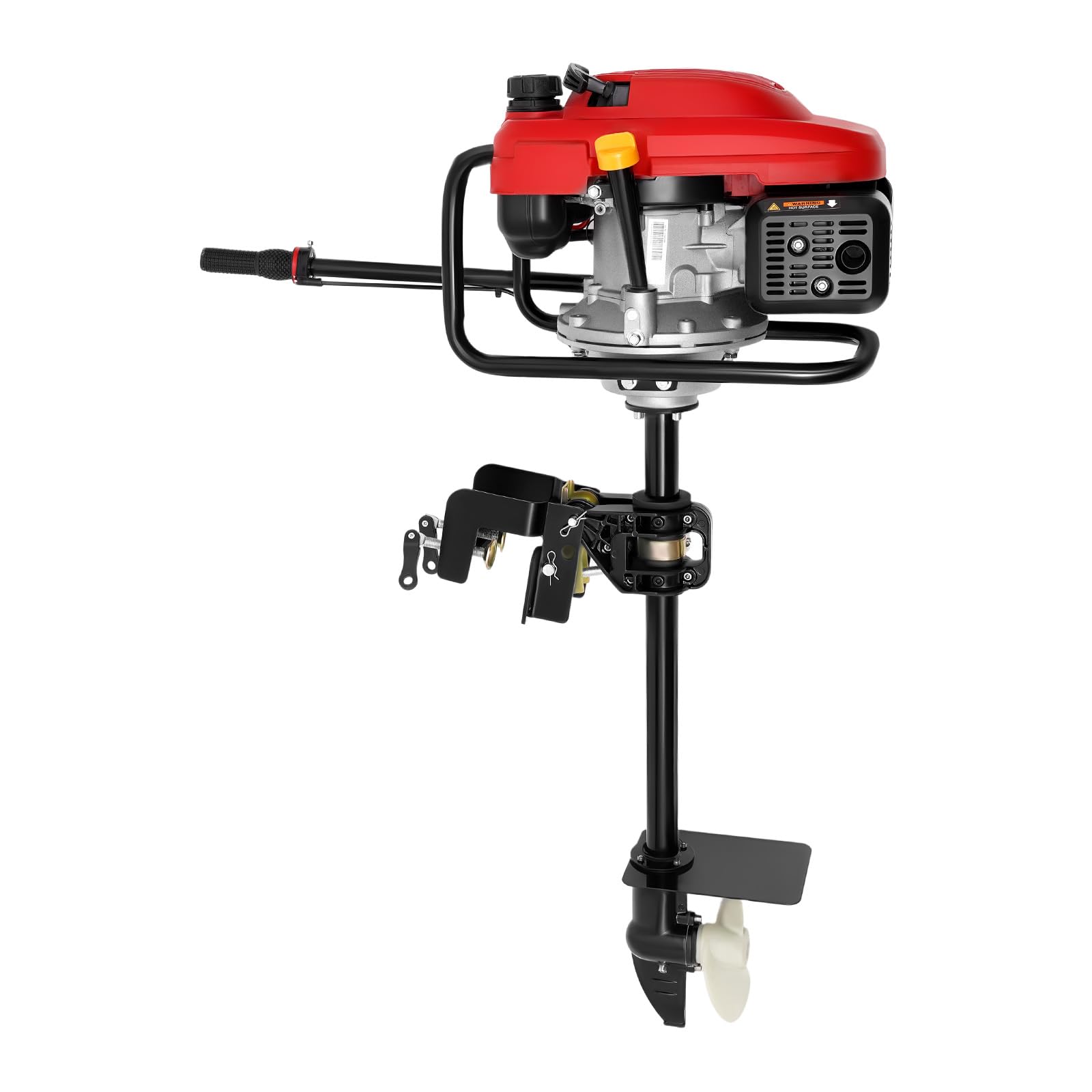
The big-displacement bruiser that treats a 24-foot pontoon like a quick errand.
This one bends the 4HP rule on purpose. The listing calls for 13.12–19.69-foot boats, and the 200CС displacement (a 3.8x gap over a true 52CC 4HP) delivers a genuine 7.5 hp with 3.5 kW of maximum power at 3600 rpm. The result is a motor that “cruises it just fine” on a 24-foot pontoon loaded with people — something no small 4HP can claim.
The trade-off is the 52.4-pound weight you carry for that power. At 52.4 pounds, it’s a 2.2x gap over a 23.8-pound 4HP, and owners mention it as “excessively heavy” for repeated lifting. That’s the physical price of the aluminum housing, the built-to-last frame, and the anti-rust build that makes it a permanent fixture on bigger boats rather than a portable.
Reliability feedback is split. The 0.95-gallon tank and clutch control earn praise — “starts after 1 pull” and “outperforms prior engines” — but one owner reported “position and rings are shot after one hour of use.” With the 2-year warranty against manufacturer defects, that’s a reason to test your unit immediately, not to avoid the motor entirely.
The heavy-duty upside
- 200CС engine delivers 7.5 hp — 88% more than a standard 4HP
- 360-degree steering plus clutch control for tight dock work
- Aluminum build with anti-rust properties for long service
The price you pay
- 52.4 pounds — a two-person lift for most
- An occasional unit shows serious early wear despite proper fuel and oil
The standout spec mic-drop: 200CС and 7.5 hp in a package that moves a 24-foot pontoon — no 4HP here.
The single caveat: the 52.4-pound weight only works if the motor stays mounted; plan for permanent installation.
3. 4HP 4 Stroke Outboard Motor 55CC (CLIENSY)

The air-cooled fisherman’s friend that runs all day on a single pull and a can of gas.
The patented air-cooling CDI system (a capacitor discharge ignition) cools the engine without a water pump, so you can “fish all day without overheating.” The 55CC four-stroke runs on clean gasoline with no battery, and the 360-degree steering rotation lets you reverse by swinging the whole motor — no gear shifting required.
Real-world reports back the “goes all day” promise: on a Mariner 4 raft it pushed 6 MPH with 600 pounds aboard, sipping about one hour of fuel per tank at full throttle. The aluminum construction and the safety twist-grip throttle control round out a package that’s genuinely “great for the price” for inflatables and rubber boats.
The catch is reliability roulette. The clutch is a known weak point — reports of it “falling apart after a few uses” are the most-discussed durability concern, and one unit arrived with a stripped bolt hole leaking gear oil. The manufacturers covers it with a 5-year warranty, but you’re more likely to need it here than with other picks.
All-day angler: the air-cooling system plus the no-battery design make this the set-and-forget choice for long fishing sessions.
Inspect on arrival: the clutch durability means a thorough first-use check is the smart move, and the 5-year warranty is your safety net.
Who it beats: the angler who wants a simple, light, air-cooled pusher for an inflatable and prizes uptime over peak speed.
Who it doesn’t: anyone who can’t afford a possible early clutch replacement — that risk is real in the feedback.
4. 4 Stroke Small Outboard Motor 4 hp (KUSINDOG)

The precision-engineered 62CC single-cylinder that treats kayaks and dinghies with a surgeon’s touch.
This engine is built around numbers that tell a specific story: a 62CС displacement with a 44 x 335mm bore and stroke, putting out a maximum 2.8kW (4HP) at up to 10000 r/min. That translates to a real 10km/h speed on the water — the sort of measured output that serious small-boat owners appreciate.
The target is boats from 6ft to 14ft — canoes, kayaks, inflatable dinghies, and aluminum jon boats. The 360-degree steering system and a constant velocity handle give you precise control for slow-speed fishing, and the corrosion-resistant aluminum shaft with a three-blade prop is built for both fresh and salt water. The 1.5-liter tank was the fuel-efficiency standout, with one 4/5 owner reporting a single tank lasting two full days of fishing.
Reliability is genuinely mixed: it “starts right up” for many, but others report it “won’t start at all.” The difference is often break-in — a recurring note says the engine needs “extensive break-in” with roughly 10 oil changes (one per hour of running) to clear metal flakes, after which it “runs great.” Budget for that break-in time and you get a solid unit.
Precision is the point: the 62CС displacement and 10km/h top speed give it the most measured, predictable performance in the true-4HP class.
The honest caveat: the break-in is non-negotiable — skip the oil-change ritual and the reliability complaints become self-inflicted.
Grab it when: you want a true 4HP with predictable 10km/h speed and top-tier corrosion resistance for saltwater kayaks and dinghies.
Pass if: you won’t follow a break-in schedule — this engine demands the first 10 hours of attention.
5. Outboard Motor Boat Engine 4.0 HP 54CC (CUKUSIN)

This featherweight four-stroke is built for tiny boats, and its price is tough to top for the 55CC power you get.
At just 10 kg (22 lb), this is the lightweight specialist in the lineup, designed for boats weighing 100kg or less carrying 2-3 people — the classic inflatable, fishing boat, or small sailboat tender. The 54CС four-stroke is a manual pull-start, air-cooled single-cylinder that runs on clean gasoline, and the 0.32-gallon tank keeps the whole package easy to manage.
The clever bit is the “Easy Reverse” system: a hook-sized handle rotates the motor a full 180 degrees to reverse the boat — no gearbox drama. And the height adjustment between propeller and fixation lets you fit different boat transom heights, which is a rare versatility at this size. Motor quality and power are the most-praised aspects, with owners reporting 6 MPH pushing their boat and easy choke starts.
The durability chatter is the flip side. While the motor “survived saltwater submersion” and handles bays and rivers, there are reports of a fragile coil pack and throttle spring looseness after heavy use, plus one owner who was “forced paddling back” when it died mid-run. The 180-day manufacturer warranty is shorter than the 5-year on the CLIENSY — a trade-off to weigh against the low entry price.
The lightweight wins
- 10 kg (22 lb) total — easiest to carry and store
- 180-degree handle reverse, no gear shifting needed
- Adjustable height fits different boat transoms
The budget reality
- Durability is the most-mentioned negative — small parts can fail
- 180-day warranty is the shortest in this lineup
The standout spec mic-drop: 22 pounds with 180-degree reverse — the most portable true-4HP for a tiny inflatable.
The single caveat: the durability question means this shines as a fair-weather, near-shore engine, not an offshore workhorse.
Understanding the Specs
Displacement (CC) and Real Power
Displacement, in cubic centimeters (CC), is the size of the engine’s combustion chamber — the internal space where fuel burns. Bigger CC generally means more torque and better wave-climbing ability. In this class, a 52CC-62CC engine is a true 4HP pusher for kayaks and small dinghies. A 200CC engine, by contrast, is a much larger animal that delivers around 7.5 hp — the difference between moving a 10-foot inflatable and a 24-foot pontoon.
Air Cooling vs. Water Cooling
Air-cooled outboards use metal fins and airflow to dissipate engine heat, which removes the need for a water-pump impeller. That makes them simpler, lighter, and cheaper to maintain. The trade-off is that they can run hotter during sustained full-throttle runs. Water-cooled engines run cooler but add pump complexity and a part that can wear out. For small, occasional-use boats, air cooling is the smart, low-fuss choice.
FAQ
Will a 4HP outboard push my 10-foot inflatable boat?
Do these motors need a battery or oil mixing?
What is the break-in period and why does it matter?
Is a 52CC 4HP enough for saltwater use?
How much does a 4HP outboard weigh and can one person lift it?
What does 360-degree steering mean on these motors?
How long does a tank of gas last on a 4HP motor?
Is a 7.5HP 200CC motor overkill for a 13-foot boat?
What warranty do these outboard motors come with?
Why do some reviews mention metal shavings in the oil?
Final Thoughts: The Verdict
For most small-boat owners, the real 4hp outboard motor winner is the GoMax 52CC because it combines a featherweight 23.8-pound build with the one-pull reliability and the aluminum prop that owners consistently praise. If your priority is serious displacement and you run a pontoon, grab the KTYHNPM 200CC — its 7.5 hp and 360-degree steering make it a different class of machine. And for solo kayakers and tiny inflatables who lift their motor every trip, the CUKUSIN 54CC at 22 pounds is the one to reach for.
How We Picked
We do not accept paid placement. Every pick is matched to a real buyer and a real use-case; we do not hands-on test units.
Sources & Methodology
Specifications: manufacturer listings and product documentation. Review insights: verified customer reviews, as of August 2026. Pricing: not shown on this page (it changes often); check the current price via the retailer link.
As an Amazon Associate, Gadgets Feed earns from qualifying purchases. This does not affect which products we feature.