
Our readers keep the lights on and my morning glass full of iced black tea. As an Amazon Associate, I earn from qualifying purchases.
Specs are compiled from manufacturer listings and verified buyer reviews and can change over time — please confirm the key details on the product page before buying.
Buying a 4K 144Hz monitor is a real turning point. Step below that spec, and you lose either sharpness or smoothness — and you feel both in every game, every scroll, every frame. Here are the seven strongest picks at this level, what each does best, and where each cuts a corner so you know exactly what you are getting.
I’m Min — the founder and writer behind Gadgets Feed. This guide is built by comparing the manufacturers’ published specifications and the patterns across verified customer reviews, so you get each pick’s real strengths and trade-offs instead of marketing spin.
You will learn about everything from the pure color vibrancy of QD-OLED panels (Quantum Dot OLED — a type of OLED that uses tiny particles called quantum dots for richer, wider colors) to the smart-TV convenience built into a Samsung. All of it helps you find the right 4k 144hz monitor for the games you play and the desk space you have.
Quick Picks
- ASUS ROG Swift 32” 4K OLED Gaming Monitor (PG32UCDM) — Top Performer
- MSI MPG 321URX QD-OLED — Premium Pick
- LG 32GX850A-B UltraGear — Glossy OLED
- INNOCN 27″ GA27W1Q — Budget OLED
- LG 32GQ750-B Ultragear — Mid-Range VA
- KTC 32 Inch 4K Gaming Monitor, 165Hz (H32P22P) — High Contrast
- Samsung 27” Odyssey G7 (G70D) — Smart IPS
How To Choose The Best 4K 144Hz Monitor
Picking a 4K 144Hz monitor means balancing three things: the panel technology you can afford, how fast your graphics card actually pushes frames, and if you want extras like built-in smart TV apps or extra USB connectivity. You do not need to be an expert — you just need to know which trade-offs work for you.
Panel Type: IPS, OLED, or QD-OLED
The panel is the heart of the monitor. IPS panels (In-Plane Switching — a common LCD type with good color and wide 178-degree viewing angles) like the Samsung Odyssey G7 or the LG 32GQ750-B are common at mid-range pricing. They give you good color and wide viewing angles, but their contrast is typically around 1000:1, meaning blacks look more like dark gray in a dim room. OLED and QD-OLED panels (like the MSI MPG 321URX or the ASUS ROG Swift PG32UCDM) deliver true blacks by turning off individual pixels, hitting contrast ratios like 1,500,000:1, and they offer near-instant response times of 0.03ms (GtG — Gray-to-Gray, a measurement of how fast a pixel changes from one shade to another, measured in milliseconds). The catch is that OLED panels cost more and have a finite lifespan measured in years of cumulative bright-pixel use, though modern models include OLED Care features to reduce burn-in risk.
Refresh Rate and What Your PC Can Actually Drive
144Hz is the floor here, but many monitors climb to 165Hz or 240Hz. That headroom matters only if your graphics card can push that many frames at 4K resolution. If you are gaming on a mid-range card, you might hit 60-90 fps in modern AAA titles — in that case, a 240Hz panel is not wasted, but its main benefit is that it runs at a higher refresh rate for smoother motion when you do get the frames. The real-world difference between 144Hz and 165Hz is small, while jumping from 144Hz to 240Hz is a bigger step that you can actually feel in fast-paced shooters.
Connectivity: HDMI 2.1 vs DisplayPort 1.4
To run 4K at 144Hz without compression, you need HDMI 2.1 or DisplayPort 1.4 with DSC (Display Stream Compression — a technique that squeezes the video signal so it fits through the cable, with no visible quality loss according to manufacturers). HDMI 2.1 is the standard for modern gaming consoles like the PS5 and Xbox Series X. If you plan to connect a console and a PC, look for a monitor with both HDMI 2.1 and DP 1.4 ports. Some mid-range monitors include DP 1.4 but only HDMI 2.0, which limits you to 4K at 60Hz on that port — check the spec sheet.
HDR: What the Certifications Actually Mean
HDR (High Dynamic Range — a feature that makes bright parts of the image brighter and dark parts darker, creating more realism) comes in different certification levels. VESA DisplayHDR 400 is the entry level you see on many mid-range IPS monitors — it means the panel can hit 400 nits peak brightness, which is okay for basic HDR but not enough for the full effect. VESA DisplayHDR True Black 400 is a different standard for OLED panels — it guarantees deep blacks, not just high peak brightness. True Black 400 typically means better contrast in dark scenes, even though the peak brightness may be lower (around 250-275 nits) than a high-end IPS.
Quick Comparison
On smaller screens, swipe sideways to see the full table.
| Model | Best For | Panel Type | Refresh Rate | Contrast Ratio | Amazon |
|---|---|---|---|---|---|
| ASUS ROG Swift PG32UCDM | No‑compromise gaming and HDR | QD-OLED | 240Hz | 1,500,000:1 | $1,199.00Amazon |
| MSI MPG 321URX QD-OLED | High refresh with OLED blacks | QD-OLED | 240Hz | Extremely high | $849.99Amazon |
| LG 32GX850A-B UltraGear | Glossy OLED with dual‑mode | OLED | 165Hz / 330Hz | 1,500,000:1 | $799.00Amazon |
| INNOCN 27″ GA27W1Q | Budget‑friendly QD-OLED | QD-OLED | 240Hz | 1,500,000:1 | $799.49$926.24PrimeAmazon |
| LG 32GQ750-B Ultragear | Solid mid‑range 4K gaming | VA | 144Hz | 2,500:1 | $629.99$685.00Amazon |
| KTC 32″ H32P22P | High contrast on a budget | Fast IPS | 165Hz | 3,000:1 | $449.99Amazon |
| Samsung Odyssey G7 G70D | All‑in‑one with Smart TV | IPS | 144Hz | 1,000:1 | from $599.99Amazon |
In‑Depth Reviews
1. ASUS ROG Swift 32” 4K OLED Gaming Monitor (PG32UCDM)

ASUS packs a glossy QD-OLED panel with 240Hz, true blacks, and Dolby Vision — the most complete HDR package here.
This monitor pulls no punches. It uses a QD-OLED panel (Quantum Dot OLED, which combines OLED’s per-pixel lighting with quantum dots for wider color coverage) at 32 inches, delivering a 4K 240Hz experience with a 0.03ms response time. That means motion blur is essentially gone — you see each frame as a sharp slice of time, not a smeared transition. The peak brightness hits 1000 nits (Candela per Square Meter — a measure of screen brightness), which is the highest in this roundup by far, making HDR content genuinely punchy rather than just a checkbox. The ASUS also packs a custom heatsink and graphene film to manage heat and reduce burn-in risk, plus VESA DisplayHDR 400 True Black compliance and a 99% DCI-P3 color gamut (the percentage of the DCI-P3 color space, a standard for digital cinema color reproduction). Buyers report that the glossy screen delivers exceptional clarity and vibrant colors, cutting down on eye fatigue compared to matte finishes.
There are a few things to know. The glossy coating handles reflections decently, but a bright window behind you will still show. Text fringing — a slight color halo around white text on a black background — exists at normal viewing distances but is minimal, according to buyers. The monitor also relies on OLED Care features like pixel refresh and a dark Windows theme to keep burn-in at bay long-term. Compared to the MSI MPG 321URX, the ASUS leads on peak brightness at 1000 nits, while the MSI is rated at 250 nits for SDR, and it includes Dolby Vision, making it the stronger HDR performer of the two.
Who this is for: Gamers and creators who want the best HDR and motion clarity available in a 32-inch package — and are willing to pay for it.
Fair warning: You need a powerful graphics card (think RTX 4080 or above) to push 4K at 240Hz in demanding titles, or you will mostly see the monitor running at lower frame rates.
The high-end champ: If you want zero compromises and have the budget, this is the 4K 144Hz+ monitor to buy.
2. MSI MPG 321URX QD-OLED

MSI’s QD-OLED delivers buttery 240Hz motion with exceptionally accurate color straight from the start.
It is VESA DisplayHDR True Black 400 certified, which guarantees deep blacks and realistic contrast in dark scenes, even though its SDR brightness is rated at 250 nits — lower than high-end IPS panels. The MSI includes a USB Type-C port that delivers 90W of power delivery (enough to charge a laptop), plus HDMI 2.1 and DP 1.4a for full-bandwidth 4K at high refresh rates. Buyers upgrading from a 1440p IPS panel report that the jump in color vibrancy and HDR brightness is massive — one called it “breathtakingly beautiful.”
There is a quirk with Mac dual-monitor setups: buyers found that disabling DSC and locking the DP input to 120Hz resolves flicker issues. The stand is large (the base takes up notable desk space) and lacks height adjustment, which is a strange omission at this tier. The 240Hz refresh rate versus the Samsung Odyssey G7’s 144Hz gives it a clear edge in motion clarity for competitive gaming. If you prioritize raw color accuracy and do not mind the slightly lower SDR brightness, the MSI is arguably the better value than the ASUS for pure gaming.
What stands out
- DCI-P3 99% color gamut with ΔE ≤2 accuracy from the start
- 240Hz + 0.03ms response for elite motion handling
- USB-C with 90W power delivery charges a laptop while displaying 4K
What to watch
- Large stand base takes up significant desk room
- 240Hz headroom requires a top-tier GPU to fully exploit
Reach for this if: You want a top-tier QD-OLED with great color accuracy and laptop charging, at a lower entry price than the ASUS flagship.
3. LG 32GX850A-B UltraGear
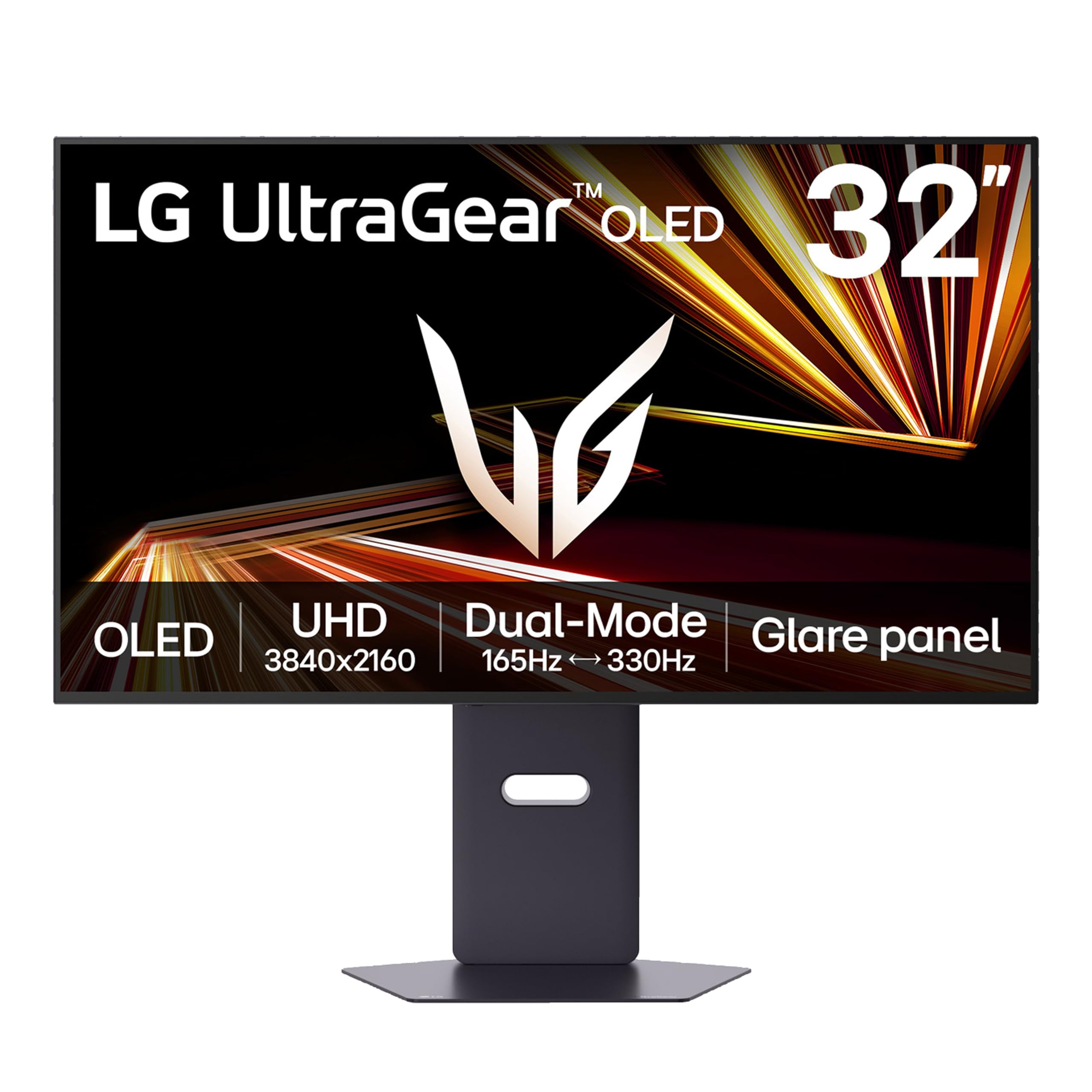
LG’s glossy OLED gives you two refresh-rate profiles in one screen — 4K at 165Hz or 1080p at 330Hz — for versatile gaming.
This 32-inch UltraGear is a WOLED panel (White OLED — a type of OLED that uses white sub-pixels with color filters, common in LG displays) with a glossy finish, which means colors appear punchier and blacks stay truly black, even in a bright room. It uses Micro Lens Array+ technology to boost typical brightness to 275 nits — brighter than earlier LG OLED gaming monitors. The dual-mode feature lets you toggle between 4K UHD at 165Hz and Full HD at 330Hz via a hotkey, which is useful for switching between story-driven single-player games and competitive shooters where frame rate matters more than resolution. The contrast ratio is 1,500,000:1, and it covers 98.5% of the DCI-P3 color gamut. It qualifies as a 4K 144Hz monitor search because 165Hz is higher than 144Hz, giving you extra smoothness. Buyers moving from a 1440p IPS panel to this OLED call it a “massive upgrade,” specifically highlighting the perfect blacks and clean text rendering on the glossy surface.
The glossy finish does reflect light — if your desk faces a window, you will notice it. The dual-mode is a nice bonus, but some owners mention that at 1080p 330Hz, the image is softer and they prefer gaming at 165Hz with full 4K detail. The stand supports height, tilt, swivel, and pivot adjustments (full ergonomic control), which is more flexible than the MSI or KTC stands. It has three TUV certifications — for anti-glare, flicker-free, and low blue light — which is a sign it is designed for long sessions. Compared to the ASUS PG32UCDM, the LG has lower peak brightness at 275 nits versus 1000 nits and lacks Dolby Vision, so its HDR performance is less dramatic.
Best for: Gamers who want a glossy OLED with flexible ergonomics and the ability to switch between resolution modes for different game types.
The trade-off: Lower peak brightness than high-end QD-OLEDs means HDR highlights are less impactful, and the glossy screen shows reflections more than a matte panel.
Pick this if: You like the crisp look of a glossy screen and want the flexibility of two refresh-rate profiles without buying two monitors.
4. INNOCN 27″ GA27W1Q
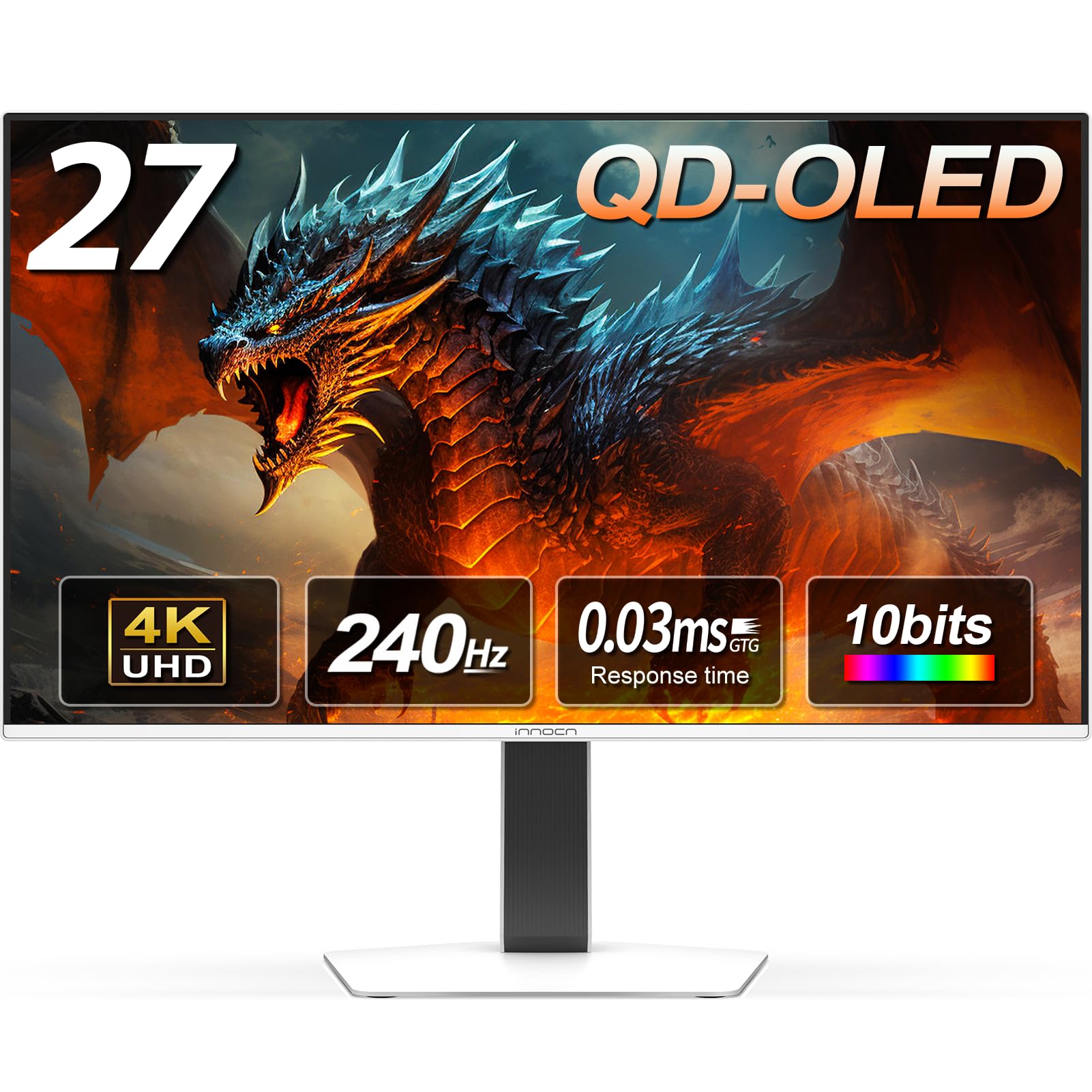
A 27-inch QD-OLED that brings flagship specs — 240Hz, 0.03ms, 1,500,000:1 contrast — to a near-budget price.
This is the smallest panel in the roundup at 27 inches, which is actually a plus if you prefer a tighter field of view for competitive gaming or have a desk that cannot fit a 32-inch monitor. It is a QD-OLED panel with a 240Hz refresh rate, 0.03ms response time, and a contrast ratio of 1,500,000:1. The color gamut is 99% DCI-P3, meaning colors across the spectrum are vivid and accurate — close to the MSI’s spec. It also supports HDR400 (not True Black 400, but HDR400 — a lower certification that guarantees 400 nits peak brightness but does not require deep black performance). The INNOCN includes built-in speakers, a height/tilt/swivel adjustable stand, and VESA mount support with 100mm x 100mm spacing. Buyers coming from a 1080p monitor call the quality jump “absurd,” and one switching from a higher-priced brand noted that this model undercuts ASUS by a significant margin for essentially the same QD-OLED panel.
The main trade-offs are in build quality and software. Buyers describe the chassis as “cheap” and note the external power brick has short cables. The on-screen menu is basic, and HDR settings are confusing — customers note that “Normal” mode actually delivers HDR1000-like brightness while “Highlights” mode is True Black 400. The speakers are reportedly poor, so you will want separate desktop speakers or a headset. Compared to the LG 32GX850A-B, the INNOCN is cheaper but lacks the dual-mode flexibility and full ergonomic stand. It is valid for a 4K 144Hz monitor search because 240Hz is higher than 144Hz, giving you smooth motion plus future headroom.
Why it stands out
- QD-OLED with flagship specs at a fraction of the premium-brand price
- 240Hz and 0.03ms response for elite motion clarity in a compact 27-inch size
- MAC-View mode optimizes color matching for Mac users
Where it cuts corners
- Cheap feeling plastic build and external power brick
- Confusing HDR modes with no manual to explain them
The budget OLED winner: If you want the best spec-per-dollar ratio and can live with a basic build quality, this is the pick.
5. LG 32GQ750-B Ultragear

LG’s 32-inch VA panel delivers a high 2,500:1 contrast ratio and solid color without the OLED price tag.
This monitor uses a VA panel (Vertical Alignment — a type of LCD panel known for better contrast than IPS, typically around 2,500:1 to 3,000:1, and deeper blacks). It runs at 144Hz via HDMI 2.1 (up to 120Hz on next-gen consoles) and has a 1ms response time. The DCI-P3 color gamut is 90%, which is respectable for the price but falls short of the 99% coverage on the MSI or the 121% sRGB on the KTC. It has built-in 5W stereo speakers with Waves MaxxAudio — a step up from the basic speakers on most monitors. The stand supports height, tilt, swivel, and pivot adjustments, giving you full ergonomic control. Buyers call it a “great gaming screen” with impressive color and refresh rate, though one notes the menu navigation is single-button and the power brick is large. If you search for a 4K 144Hz monitor, this LG fits exactly the spec you are looking for.
There are two significant concerns from buyer reviews. One unit arrived with a column of dead pixels across all inputs, and another buyer mentioned “slight ghosting with text” — an issue that affects VA panels more than IPS or OLED due to slower pixel transitions in dark tones. The adaptive brightness feature (which automatically changes screen brightness based on content) is described as “annoying” by one buyer. Compared to the KTC H32P22P, the LG has a 2,500:1 contrast ratio versus 3,000:1 on the KTC and a 90% DCI-P3 color gamut versus 121% sRGB on the KTC, but the LG has a brighter panel at 400 nits versus 300 nits, which helps in well-lit rooms.
Who it is for: Mid-range buyers who want a large 32-inch 4K screen with good contrast and built-in speakers, without jumping to OLED pricing.
The catch: VA panel quirks like slight ghosting on dark text and an annoying adaptive brightness feature may bother some users.
A solid value pick: If a reliable 32-inch 4K 144Hz panel with full ergonomic control at a mid-range price is what you need, this is it.
6. KTC 32 Inch 4K Gaming Monitor, 165Hz (H32P22P)
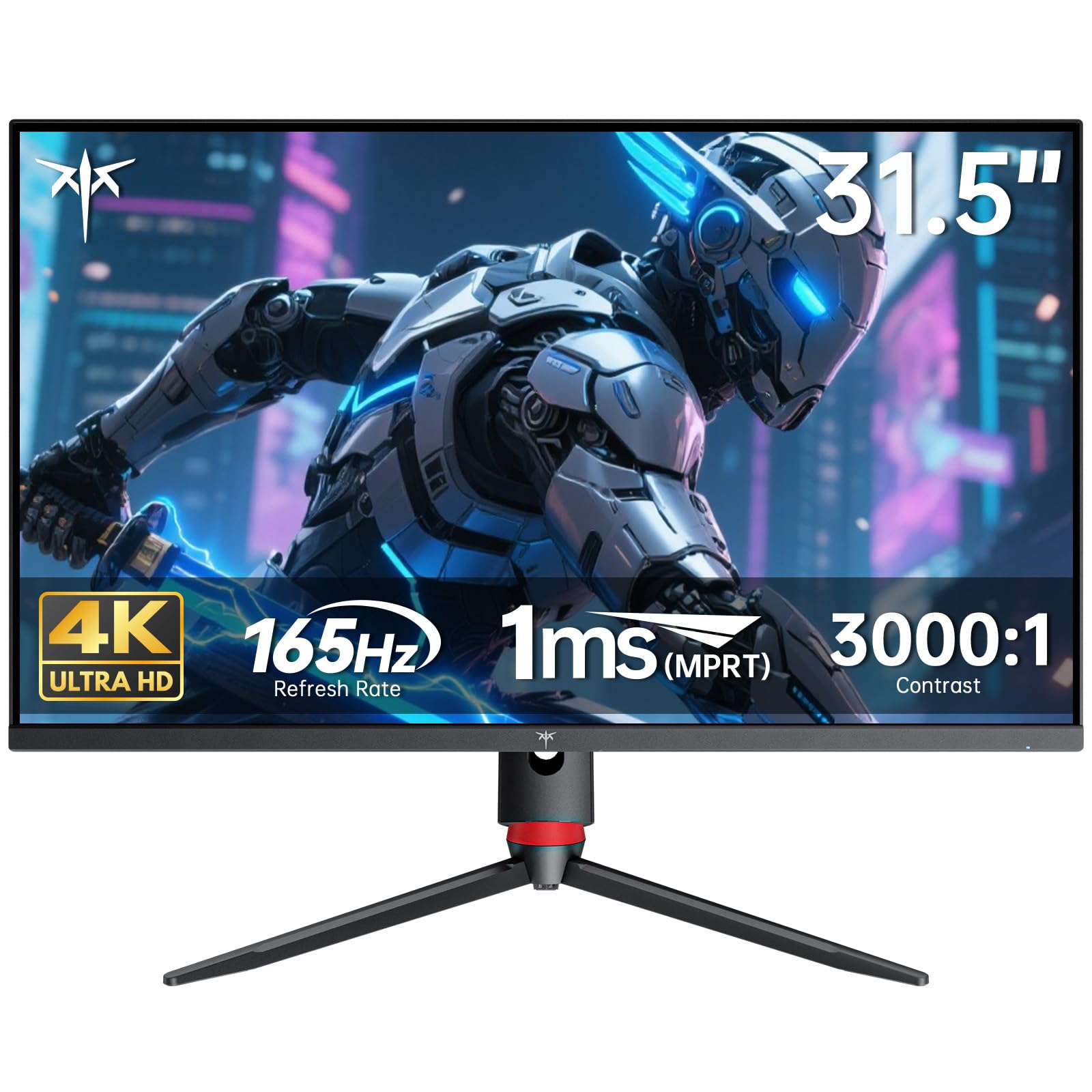
KTC squeezes a 3,000:1 contrast ratio and 165Hz into a Fast IPS panel at a striking price — but at a cost to reliability.
This monitor stands out because its Fast IPS panel achieves a 3,000:1 contrast ratio, versus the Samsung Odyssey G7’s 1,000:1, meaning blacks look significantly deeper for an IPS screen. The 121% sRGB color gamut is listed alongside the LG 32GQ750-B’s 90% DCI-P3 coverage, though those are different color spaces. It runs at 165Hz with a 1ms MPRT response time (MPRT is Moving Picture Response Time — a different measurement from GtG that accounts for pixel persistence, so a lower number means less motion blur). The panel brightness is 300 nits versus the Samsung’s 350 nits. It includes HDMI 2.1 and DP 1.4 ports, plus a blue light filter. It qualifies for a 4K 144Hz monitor search because 165Hz is higher than 144Hz and serves the same purpose.
The catch, and it is a real one, is in the reliability. Buyer reviews consistently report significant backlight bleed at the top edge — one describes it as “severe backlight bleed at top (not just glow)” — and another had a dead red subpixel from the start. A third review describes a bug where the monitor would not power on with the PC, requiring an unplug/replug sequence. There are also reports of colors being “blurry/oversaturated” and random disconnects. These reliability complaints are frequent enough that the pattern is clear: the specs are impressive for the price, but you may get a unit with defects. KTC offers a three-year warranty and claims 12-hour response support, but returning a defective large monitor is a hassle you should factor in. Compared to the LG 32GQ750-B, the KTC has higher contrast and more vivid color coverage, but the LG has a stronger build track record based on buyer reports.
Spec highlights
- 3,000:1 contrast ratio — outstanding for IPS, versus a more typical 1,000:1
- 121% sRGB color gamut for vivid, rich colors
- 165Hz refresh rate slightly above the 144Hz baseline
Reliability concerns
- Frequent buyer reports of backlight bleed, dead pixels, and power-on bugs
- Colors described as blurry or oversaturated by some users
Only for the risk-tolerant: You get a spec-sheet win on a tight budget, but you may get a defective unit. The LG 32GQ750-B is the safer choice.
7. Samsung 27” Odyssey G7 (G70D)
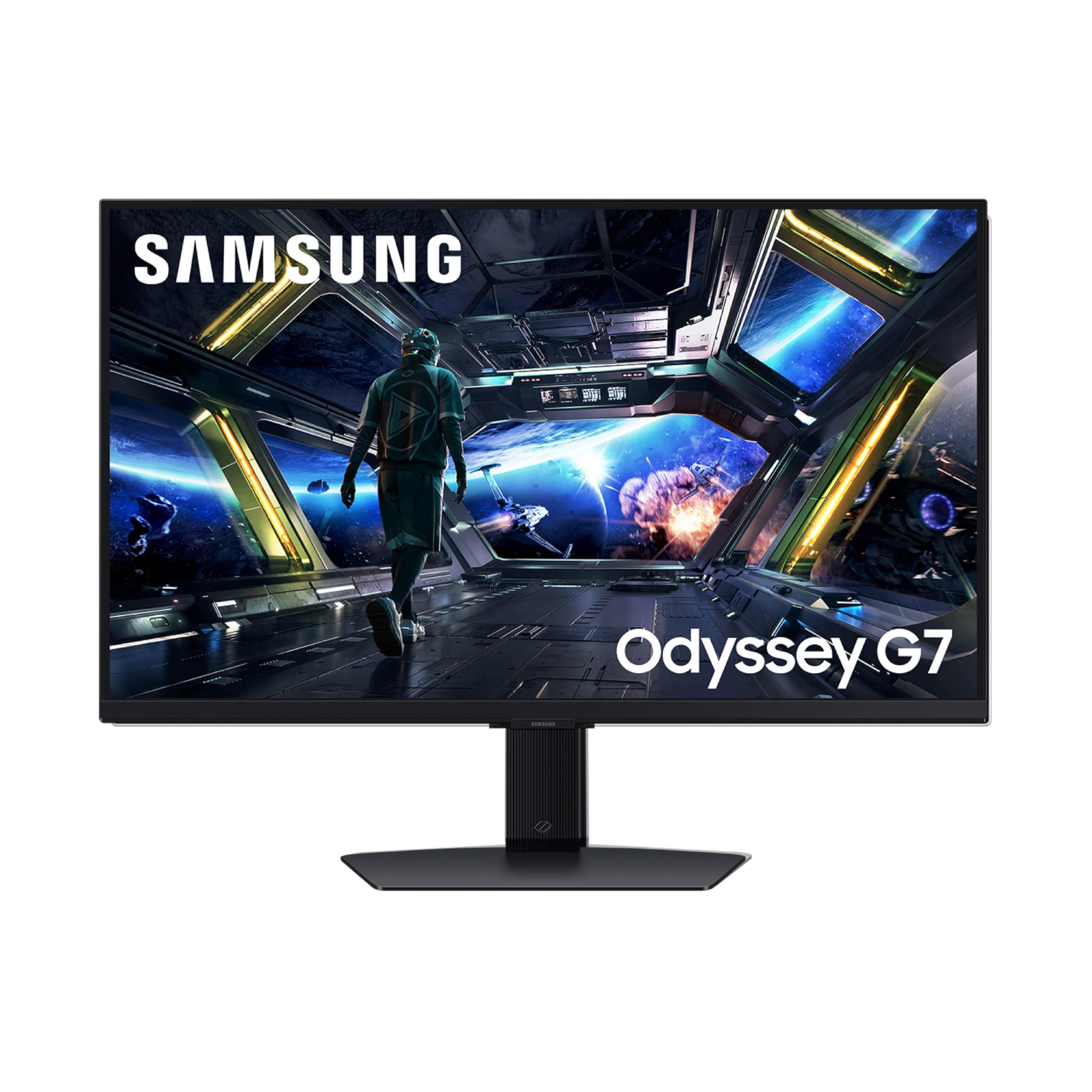
The 27-inch G7 wraps a reliable 4K 144Hz IPS panel inside a full Smart TV experience — but it feels like a TV first.
This monitor is unique in this roundup because it also works as a standalone smart TV. It runs Samsung’s Tizen OS through the Gaming Hub, giving you instant access to streaming apps like Netflix and Xbox Cloud Gaming without needing a PC or console turned on. The panel is Fast IPS (In-Plane Switching — an LCD type known for wide 178-degree viewing angles and consistent color from any angle) with a 4K 144Hz refresh rate, 1ms GtG response time, and a brightness of 350 nits versus the KTC monitor’s 300 nits. It supports both G-Sync Compatibility and AMD FreeSync Premium, so it works with Nvidia and AMD graphics cards without screen tearing. The Dynamic Black Equalizer automatically adjusts brightness, sharpness, and black details to help you spot enemies in dark corners. One buyer who moved the monitor across four different states noted, “It’s light and easy to set up and move.”
The Smart TV features are a double-edged sword. One buyer gave a 1-star review specifically because the forced setup and ads on the smart interface were frustrating — they described it as “a Smart TV first, monitor second.” The monitor also lacks a USB-C port, which is disappointing if you want a single-cable connection for a modern laptop. The contrast ratio is 1,000:1, which is standard for IPS but below the 3,000:1 of the KTC and the 1,500,000:1 listed for the OLED models in this list, so blacks in a dark room will look gray. The 27-inch size is smaller than the other picks here, which is good for desk depth but less rich for movies. Compared to the INNOCN 27-inch, the Samsung has a 1,000:1 contrast ratio versus 1,500,000:1 and a 144Hz refresh rate versus 240Hz, but it includes built-in smart TV features that the INNOCN lacks.
Who it fits: Gamers who want a single screen for both PC gaming and streaming TV content in a bedroom or dorm setup.
The trade-off: The smart interface adds setup friction and ads, and no USB-C port limits modern laptop connectivity.
Best for the all-in-one buyer: If you value a gaming monitor that doubles as a streaming TV and do not mind a 27-inch screen, this is your pick.
Understanding the Specs
Contrast Ratio
This number tells you how deep the blacks look compared to the brightest white. A higher ratio means darker shadows and more punchy, realistic images. IPS panels typically sit around 1,000:1 (blacks look dark gray in dim light), while VA panels reach 2,500:1 to 3,000:1 (darker, but still not perfect). OLED panels hit 1,500,000:1 because each pixel can turn off completely for absolute black. If you game in a dark room, contrast ratio matters a lot — the difference between 1,000:1 and 1,500,000:1 is instantly visible in any scene with shadows.
Refresh Rate & Response Time
Refresh rate (measured in Hz) is how many times per second the screen updates the image. 144Hz is the baseline here, meaning 144 updates per second — and 165Hz and 240Hz are higher, giving you smoother motion. Response time (measured in milliseconds, like 1ms or 0.03ms GtG) is how fast a pixel changes color. A lower response time means less motion blur and ghosting — the trail left behind by fast-moving objects. For competitive shooters, both matter: high refresh rate keeps the image fluid, and fast response time keeps individual objects sharp in motion.
FAQ
Can I run a 4K 144Hz monitor on an Xbox Series X or PS5?
Does a 240Hz monitor waste money if my PC can only push 60 fps?
What is the difference between G-Sync and FreeSync?
Will an OLED monitor get burn-in from static HUD elements?
Can a 4K 144Hz monitor work with a MacBook?
What is the ideal screen size for 4K: 27-inch or 32-inch?
Does a higher refresh rate mean better HDR?
How do I check if my graphics card supports 4K 144Hz?
What is the difference between 1ms MPRT and 1ms GtG?
Do all 4K 144Hz monitors support HDMI 2.1?
Final Thoughts: The Verdict
If you want one dependable pick, the 4k 144hz monitor winner is the MSI MPG 321URX QD-OLED because it delivers elite 240Hz motion clarity, professional-grade color accuracy, and a USB-C port with 90W laptop charging, all at a lower price than the ASUS flagship. If you want the absolute best HDR performance with Dolby Vision support and the highest peak brightness, grab the ASUS ROG Swift PG32UCDM. And for budget-conscious buyers who still want OLED contrast and 240Hz, the INNOCN 27″ GA27W1Q offers the best spec-per-dollar ratio, provided you are comfortable with a more basic build quality.
How We Picked
We do not accept paid placement, and we did not hands-on test every unit. Instead, we match each pick to a real buyer and use-case by comparing the manufacturers’ published specifications against the patterns in verified customer reviews — so you get each pick’s real strengths and trade-offs instead of marketing copy.
Sources & Methodology
Specifications: manufacturer listings and product documentation. Review insights: verified customer reviews, as of July 2026. Pricing: not shown on this page (it changes often); check the current price via the retailer link.
As an Amazon Associate, Gadgets Feed earns from qualifying purchases. This does not affect which products we feature.
Product prices and availability are accurate as of the date/time indicated and are subject to change. Any price and availability information displayed on Amazon at the time of purchase will apply to the purchase of this product. As an Amazon Associate I earn from qualifying purchases.
CERTAIN CONTENT THAT APPEARS ON THIS SITE COMES FROM AMAZON. THIS CONTENT IS PROVIDED "AS IS" AND IS SUBJECT TO CHANGE OR REMOVAL AT ANY TIME.
Amazon and the Amazon logo are trademarks of Amazon.com, Inc. or its affiliates.