
Four thousand pixels across, refreshed one hundred sixty-five times each second — that’s the dual promise of a monitor category that demands your graphics card work as hard as your eyes. Moving from 60Hz or even 144Hz to 165Hz at 4K isn’t just a number bump; it’s the threshold where motion blur dissolves into fluidity and text sharpens to print-grade clarity. The challenge is filtering through panel technologies, connectivity standards, and HDR certifications that all claim to deliver this experience without compromise.
I’m Min — the co-founder and writer behind Gadgets Feed. I’ve spent hundreds of hours cross-referencing specification sheets, analyzing real-world benchmark performance, and dissecting user experiences across dozens of models to separate the genuinely exceptional 4K 165Hz monitors from those that merely check boxes.
Whether you’re building a high-end gaming rig, upgrading a creative workstation, or future-proofing your desk for the next console generation, the best 4k 165hz monitor balances resolution, refresh rate, color fidelity, and connectivity without breaking your budget or your workflow.
How To Choose The Best 4K 165Hz Monitor
Choosing a 4K 165Hz monitor means evaluating more than just the headline specs. Panel technology dictates contrast and response time; connectivity determines if you can actually drive the display at full resolution and refresh rate; and HDR certification separates a monitor that looks vibrant from one that washes out in bright scenes. Here are the factors that matter most.
Panel Technology: IPS vs. VA vs. OLED
Fast IPS panels dominate the mid-range of this category because they offer wide viewing angles, strong color accuracy, and response times as low as 1ms GtG without the ghosting issues that plague older LCD tech. VA panels, like the one in the Samsung Odyssey Neo G7, deliver superior native contrast ratios and deeper black levels thanks to Mini-LED local dimming, making them excellent for HDR content. QD-OLED and WOLED panels, found in the premium tier, offer near-infinite contrast, per-pixel lighting, and 0.03ms response times — but come with burn-in considerations and higher price tags. Your choice depends on whether you prioritize contrast and HDR pop (VA or OLED) or raw motion handling and color consistency at a lower cost (Fast IPS).
Connectivity and Bandwidth: HDMI 2.1 vs. DisplayPort 1.4
To run a 4K 165Hz signal with 10-bit color, you need at least HDMI 2.1 (48 Gbps) or DisplayPort 1.4 with Display Stream Compression (DSC). HDMI 2.1 is the gold standard for console gaming — PS5 and Xbox Series X can output 4K 120Hz natively, and 165Hz with VRR is possible. DisplayPort 1.4 with DSC is standard on most PC GPUs and works flawlessly, though purists sometimes prefer the uncompressed bandwidth of DisplayPort 2.1. If your monitor lacks DSC, 4K 165Hz may require lowering color depth to 8-bit. Always verify that the included cable supports the required bandwidth — many monitors ship with HDMI 2.0 cables that cap out at 4K 60Hz.
HDR Performance and Brightness
HDR at 4K 165Hz isn’t uniform across price tiers. Entry-level and mid-range models often carry VESA DisplayHDR 400 certification, which guarantees 400 nits peak brightness but lacks the local dimming zones needed for true high dynamic range. Premium IPS monitors with Mini-LED backlighting and OLED panels earn DisplayHDR 600 or True Black 400/600 certification, delivering real perceptual improvements with specular highlights and shadow detail. If HDR gaming or HDR video editing is your primary use case, prioritize models with at least 600 nits peak brightness and a meaningful number of local dimming zones or per-pixel lighting.
Quick Comparison
On smaller screens, swipe sideways to see the full table.
| Model | Category | Best For | Key Spec | Amazon |
|---|---|---|---|---|
| Samsung Odyssey Neo G7 | Premium Mini-LED | HDR gaming & high contrast | 32″ 4K 165Hz VA, 1196-zone Mini-LED, 2000 nits peak | Amazon |
| LG 32GX850A-B UltraGear | Glossy OLED | Vibrant colors & near-instant response | 32″ 4K 165Hz WOLED, 0.03ms, TrueBlack 400 | Amazon |
| ASUS ROG Strix XG27UCDMG | QD-OLED | Competitive & immersive gaming | 27″ 4K 240Hz QD-OLED, 0.03ms, 99% DCI-P3 | Amazon |
| Samsung Odyssey G8 G81SF | QD-OLED | Anti-glare & high pixel density | 27″ 4K 240Hz QD-OLED, 166 PPI, Glare Free | Amazon |
| MSI MPG 321URX QD-OLED | QD-OLED | Productivity & gaming hybrid | 32″ 4K 240Hz QD-OLED, 0.03ms, KVM | Amazon |
| MSI MPG 321URXW QD-OLED | QD-OLED White | Bright-room setup & HDR creation | 32″ 4K 240Hz QD-OLED, 1000 nits peak, 90W USB-C | Amazon |
| INNOCN GA27W1Q | QD-OLED Value | Budget-friendly OLED gaming | 27″ 4K 240Hz QD-OLED, 0.03ms, HDR 400 | Amazon |
| ASUS ROG Strix XG27UCG | Fast IPS Dual-Mode | Versatile refresh rate switching | 27″ 4K 160Hz/1080p 320Hz Fast IPS, 1ms | Amazon |
| BenQ MOBIUZ EX271U | Fast IPS with KVM | Multi-device workflow | 27″ 4K 165Hz Fast IPS, 95% P3, USB-C 65W PD | Amazon |
| MSI MAG 321UPX QD-OLED | QD-OLED | High-refresh QD-OLED at competitive price | 32″ 4K 240Hz QD-OLED, 0.03ms, True Black 400 | Amazon |
| KTC H32P22P | Budget Fast IPS | Entry-level 4K 165Hz | 32″ 4K 165Hz Fast IPS, 1ms, 3000:1 | Amazon |
In‑Depth Reviews
1. Samsung 32″ Odyssey Neo G7

The Samsung Odyssey Neo G7 strikes a rare balance between premium HDR performance and a price that undercuts OLED competition by hundreds. Its 32-inch 1000R curved VA panel uses Quantum Mini-LED technology with 1,196 local dimming zones, delivering a 1,000,000:1 contrast ratio and a peak brightness of 2,000 nits. This is the brightest monitor on this list by a wide margin, making HDR gaming — whether it’s the sun-scorched deserts of Horizon Forbidden West or the neon-drenched alleys of Cyberpunk 2077 — genuinely breathtaking.
The 165Hz refresh rate with 1ms GtG response time keeps motion smooth in fast-paced titles, and the combination of NVIDIA G-Sync compatibility and AMD FreeSync Premium Pro ensures tear-free frame delivery from both GPU ecosystems. The 1000R curvature fills peripheral vision on a 32-inch panel, creating an immersive cockpit feel that flat monitors cannot replicate. Text clarity is excellent for a VA panel, and the included height-adjustable stand offers solid ergonomic range.
Some early firmware quirks — boot loops in multi-monitor setups and occasional backlight flicker at 165Hz — have been partially addressed through updates, but users report that running at 120Hz is a stable workaround for competitive play. The on-screen menu buttons are stiff, and the stand wobbles slightly on uneven surfaces. For the open-box price around mid-range, the HDR and contrast performance here rivals displays costing significantly more.
Why it’s great
- 1,196-zone Mini-LED delivers near-OLED black levels with no burn-in risk
- 2,000 nits peak brightness sets the standard for HDR gaming at this price
- G-Sync compatible and FreeSync Premium Pro certified for tear-free play
Good to know
- Firmware glitches at 165Hz; some users drop to 120Hz for stability
- Stiff OSD buttons and wobbly stand detract from premium feel
- 1000R curve may not suit productivity users who prefer flat panels
2. LG 32GX850A-B UltraGear
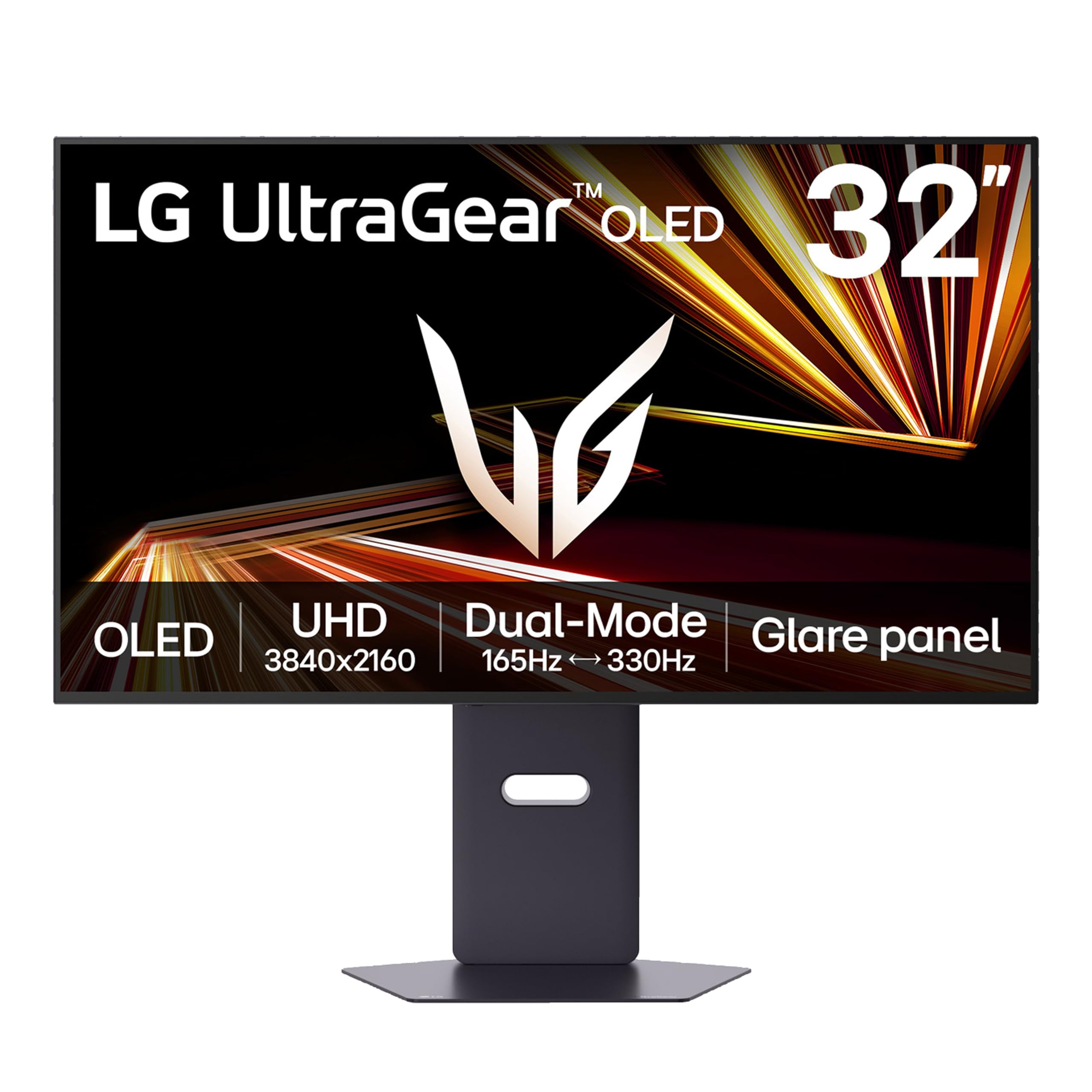
The LG 32GX850A-B brings glossy WOLED technology to the 4K 165Hz segment, a combination that eliminates the hazy diffusion common on matte OLED panels. With a 0.03ms GtG response time, this monitor is effectively instantaneous — motion transitions are so fast that ghosting is nonexistent even in the most demanding competitive shooters. The 1.5M:1 contrast ratio produces perfect blacks and infinite depth in dark scenes, and VESA DisplayHDR True Black 400 certification ensures that HDR content looks punchy without crushing shadow detail.
LG includes a Dual Mode feature that switches between 4K 165Hz and Full HD 330Hz via a hotkey, a smart addition for players who want ultra-high frame rates in esports titles without sacrificing 4K clarity for story-driven games. The Micro Lens Array+ technology boosts typical brightness to 275 nits, which is respectable for OLED but falls short of Mini-LED competitors in brightly lit rooms. The glossy finish delivers eye-popping vibrancy and reflection-free viewing under controlled lighting.
Three UL certifications for anti-glare, flicker-free, and low blue light make this one of the most comfortable OLED monitors for extended use. The stand supports height, tilt, swivel, and pivot adjustments, and the virtually borderless design fits cleanly into multi-monitor arrays. Text clarity is slightly less sharp than high-PPI LCD panels due to the WOLED subpixel layout, but LG’s ClearType tuning helps. For buyers seeking OLED black levels at 165Hz without exceeding budget boundaries, this is the strongest candidate.
Why it’s great
- Glossy WOLED eliminates haze, delivering vibrant colors and true blacks
- 0.03ms response time is the fastest available at 4K 165Hz
- Dual Mode (4K 165Hz / FHD 330Hz) adds versatility without extra cost
Good to know
- 275 nits typical brightness is lower than Mini-LED competitors in bright rooms
- WOLED subpixel layout may cause slight text fringing for productivity work
- No built-in speakers; budget for external audio solution
3. ASUS ROG Strix 27″ XG27UCDMG

The ASUS ROG Strix XG27UCDMG uses a 4th-generation 26.5-inch QD-OLED panel that pushes 4K resolution to 240Hz — exceeding the 165Hz target while maintaining the 0.03ms response time that OLED is known for. The 99% DCI-P3 color gamut and true 10-bit color depth deliver reference-grade accuracy (Delta E < 2) out of the box, making this monitor equally suited for color-critical photo editing and competitive gaming. OLED Anti-Flicker 2.0 reduces perceived flicker by 20% compared to previous-gen panels, a meaningful improvement for users sensitive to PWM.
The standout feature is the Neo Proximity Sensor, part of ASUS OLED Care Pro, which detects when you leave the desk and automatically switches to a black screen to reduce burn-in risk. This is paired with a custom heatsink that improves thermal management without a fan. Connectivity is comprehensive: DisplayPort 1.4, HDMI 2.1, and USB-C with 90W Power Delivery, plus a USB hub. The included VESA mount kit and microfiber cloth show attention to unboxing detail that few competitors match.
The glossy QD-OLED coating produces extraordinary color saturation and deep blacks, but it is reflective in direct sunlight — careful room lighting is required. The 26.5-inch diagonal is slightly smaller than standard 27-inch panels, a detail that matters for side-by-side comparisons. At its price point, this monitor competes directly with Samsung’s G8 OLED and MSI’s QD-OLED line, winning on ASUS’s superior burn-in warranty coverage and thoughtful care features. If you want the fastest 4K refresh rate available with OLED color, this is the monitor to beat.
Why it’s great
- 240Hz QD-OLED with 0.03ms response sets the speed benchmark for 4K gaming
- Neo Proximity Sensor and custom heatsink offer best-in-class burn-in prevention
- 90W USB-C PD simplifies single-cable laptop setups
Good to know
- Glossy panel is highly reflective; best used in controlled ambient lighting
- 26.5-inch size is slightly smaller than standard 27-inch monitors
- Premium pricing places it alongside high-end OLED competitors
4. Samsung 27″ Odyssey G8 G81SF
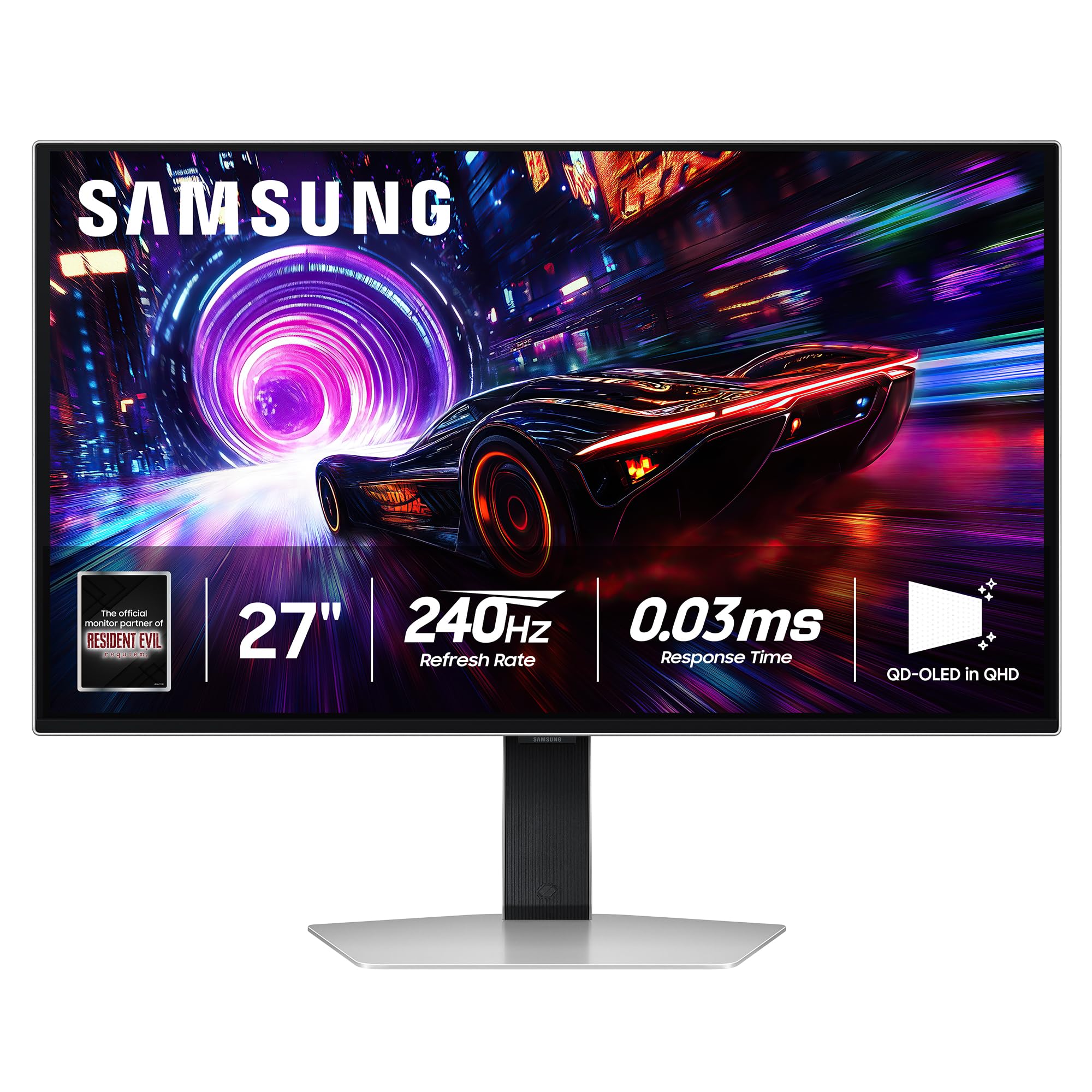
Samsung’s Odyssey G8 G81SF packs 4K resolution into a 27-inch QD-OLED panel, yielding a pixel density of 166 PPI — noticeably sharper than 32-inch 4K options and ideal for users who value text clarity alongside gaming performance. The 240Hz refresh rate and 0.03ms GtG response time match the fastest OLED competitors, and the VESA DisplayHDR True Black 400 certification ensures that dark scenes retain detail without blooming. The Glare Free technology reduces reflection by 54% compared to conventional anti-reflection films, making this the best OLED choice for rooms with windows or overhead lighting.
Samsung has integrated a Pulsating Heat Pipe cooling system — a first in a monitor — that dissipates heat five times faster than graphite sheets, reducing core temperature and extending panel lifespan. The Thermal Modulation System automatically adjusts brightness to prevent overheating during long sessions. Logo and Taskbar Detection dims static elements to further protect against burn-in. CoreSync lighting projects on-screen colors around the monitor, adding immersion without requiring third-party RGB software.
The ergonomic stand supports height, tilt, swivel, and pivot adjustment, matching LG and ASUS on adjustability. Some users report that the Glare Free coating gives a very slightly matte appearance that reduces perceived pop compared to glossy QD-OLED panels, but this trade-off is worth it for anyone gaming in a bright space. Customer reports of dead pixels appearing after two months underscore the importance of Samsung’s warranty — verify coverage before purchasing. For users who want the highest pixel density in a 4K OLED at 240Hz, this is the clear winner.
Why it’s great
- 166 PPI delivers the sharpest text and finest detail among 4K OLED monitors
- Glare Free coating makes it usable in bright rooms without reflection issues
- Pulsating Heat Pipe cooling system is unique and extends panel lifespan
Good to know
- Glare Free coating slightly reduces color pop compared to glossy alternatives
- Dead pixel reports exist; verify warranty terms before purchase
- Mini joystick OSD is finicky compared to full button arrays
5. MSI MPG 321URX QD-OLED

The MSI MPG 321URX QD-OLED combines a 32-inch 4K Quantum Dot OLED panel with a 240Hz refresh rate and 0.03ms response time, making it one of the most well-rounded high-end monitors available. The DCI-P3 99% color gamut and Delta E ≤2 accuracy mean this monitor is ready for professional creative work straight out of the box — no calibration required. VESA DisplayHDR True Black 400 certification ensures that the 1,500,000:1 native contrast ratio translates into HDR content that looks rich and detailed rather than blown out.
MSI’s OLED Care 2.0 suite includes pixel shift, panel protect, and taskbar detection to mitigate burn-in, and the 3-year warranty that covers burn-in provides peace of mind for long-term ownership. The KVM functionality with PiP/PbP support is a genuine productivity advantage, allowing a single keyboard and mouse to control a PC and a Mac or console simultaneously. The included HDMI 2.1 ports support full 48 Gbps bandwidth, so next-gen consoles can hit 4K 120Hz without compromise, and the USB-C port with 90W Power Delivery handles laptop charging and video in one cable.
The 32-inch size and QD-OLED subpixel structure mean text clarity is very good but not quite as sharp as high-PPI IPS monitors — users who spend 8+ hours reading documents should check their tolerance. The stand is solid but lacks the full ergonomic range of LG or ASUS competitors, and the chunky base consumes significant desk space. For buyers who want a single monitor that excels at both 4K 240Hz gaming and color-accurate creative work, the MPG 321URX delivers without forcing compromises on either front.
Why it’s great
- Delta E ≤2 color accuracy out of the box suits professional creative workflows
- KVM with PiP/PbP is genuinely useful for multi-device setups
- 3-year burn-in warranty provides long-term confidence in QD-OLED
Good to know
- Text clarity is good but not as sharp as high-PPI IPS monitors
- Chunky stand base occupies significant desk space
- Full ergonomic height/tilt range is slightly less than LG/ASUS competitors
6. MSI MPG 321URXW QD-OLED

The MSI MPG 321URXW is the white variant of the 321URX, sharing the exact same 31.5-inch QD-OLED panel, 240Hz refresh rate, 0.03ms response time, and DCI-P3 99% color gamut. The primary differentiator is the aesthetic: a clean white chassis with subtle RGB accent lighting that blends into lighter desk setups and white PC builds. The 10-bit Quantum Dot color conversion delivers 1.07 billion colors with exceptional vibrancy, and the VESA DisplayHDR True Black 400 certification ensures deep blacks and bright highlights in HDR content.
The graphene heatsink (fanless) keeps the panel cool without introducing noise, and the OLED Care 2.0 software includes pixel shift and panel protect routines. MSI Gaming Intelligence AI features like Smart Crosshair and Console Mode add utility for competitive players without requiring third-party software.
The white finish is prone to visible discoloration over time — Samsung’s own documentation warns that white plastics may yellow in 1-2 years, so consider this before committing to the color variant if you plan years of daily use. The stand lacks full pivot adjustment, and the OSD joystick is recessed, making navigation slightly awkward. For buyers with an all-white setup who want identical QD-OLED performance to the 321URX, this is the obvious choice — but the standard black model offers the same specs at a lower price.
Why it’s great
- Identical QD-OLED performance to the 321URX in a clean white aesthetic
- 90W USB-C PD supports single-cable laptop charging and video
- Fanless graphene heatsink keeps operation silent during long sessions
Good to know
- White plastic may yellow over extended use; black model is more durable
- No pivot adjustment on the included stand
- Higher price than the functionally identical black 321URX variant
7. INNOCN 27″ GA27W1Q
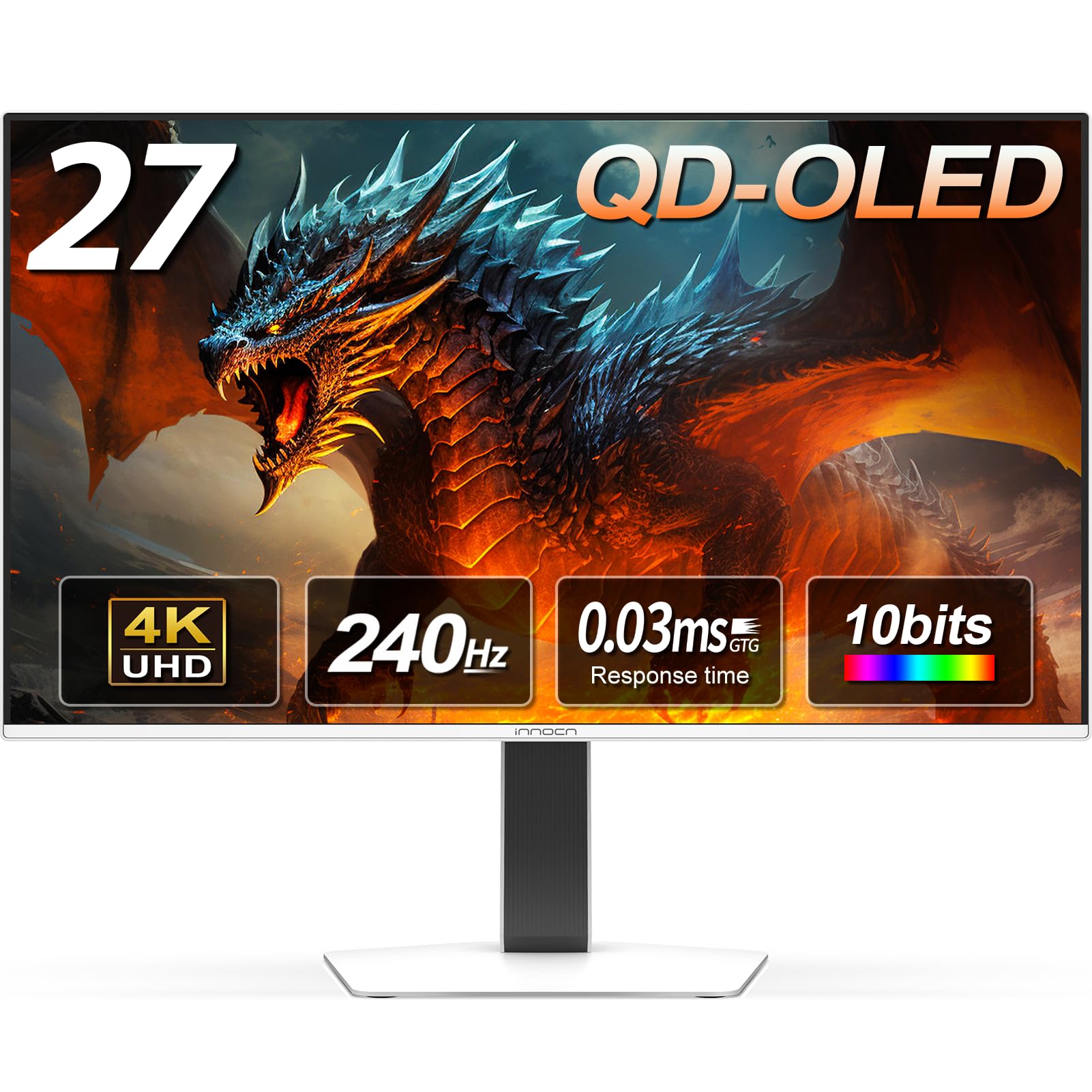
The INNOCN GA27W1Q offers QD-OLED technology at a price that undercuts ASUS, Samsung, and MSI by a wide margin, making it the most affordable entry point into 4K 240Hz OLED gaming. The 27-inch panel delivers 99% DCI-P3 color gamut, a 1,500,000:1 contrast ratio, and 1.07 billion colors (10-bit) with VESA DisplayHDR 400 certification. The 0.03ms response time eliminates ghosting entirely, and the 240Hz refresh rate provides headroom well above the 165Hz target for future-proofing.
Connectivity includes dual DisplayPort and dual HDMI 2.1 ports, plus a 3.5mm audio jack — enough for multi-platform setups without a switch. The monitor supports Adaptive-Sync and G-Sync compatibility, ensuring tear-free gameplay with both NVIDIA and AMD GPUs. The included stand offers height, tilt, and swivel adjustment, and the 3-sided ultra-narrow bezel design looks premium for the price. Built-in speakers are present, though their sound quality is poor — budget for external speakers or a headset.
The trade-offs are in build quality and ergonomic refinement. The external power supply dangles awkwardly, the OSD menu is unintuitive, and the monitor lacks the burn-in prevention features (like proximity sensors or robust pixel shift) found on premium OLEDs. Some users report a slight haziness to the image, likely from the panel coating. For buyers who prioritize the QD-OLED viewing experience — infinite contrast, vibrant colors, and instant response — and are willing to accept less polish in the user experience, the GA27W1Q delivers extraordinary value per dollar spent.
Why it’s great
- Lowest price for a 4K 240Hz QD-OLED monitor by a significant margin
- Dual HDMI 2.1 and DP ports for flexible multi-platform connectivity
- Infinite contrast and vibrant colors that rival monitors costing much more
Good to know
- Build quality feels budget-tier; external PSU and OSD are underwhelming
- Lacks advanced burn-in prevention features found on premium OLEDs
- Built-in speakers are poor; external audio is necessary
8. ASUS ROG Strix 27″ XG27UCG

The ASUS ROG Strix XG27UCG is a dual-mode 27-inch Fast IPS monitor that runs 4K at 160Hz in native mode or switches to Full HD at 320Hz — a unique feature for players who want high-resolution immersion for story-driven titles and ultra-high frame rates for competitive shooters on the same panel. The 1ms GtG response time and ASUS Extreme Low Motion Blur Sync (ELMB SYNC) technology eliminate ghosting and tearing simultaneously, something few monitors in this price range can claim.
The 95% DCI-P3 color gamut and advanced gray-scale tracking produce smooth color gradation and uniform brightness across the panel. Connectivity includes DisplayPort, HDMI, and USB-C with DP Alt Mode, covering modern laptops and consoles. The built-in DisplayWidget Center software allows OSD adjustments via mouse — a small convenience that makes a real difference during daily use. The included three-month Adobe Creative Cloud subscription adds value for creative professionals switching to this monitor.
The 160Hz refresh rate is slightly below the 165Hz target, though the difference is imperceptible in practice — most users won’t notice the 5Hz gap. The dual-mode functionality requires DSC to hit 320Hz at 1080p, which adds negligible latency but is worth noting for competitive purists. The monitor’s build quality is solid with a full directional stand, but it requires significant desk depth. For buyers who want the versatility of switching between 4K and high-refresh 1080p without buying two monitors, the XG27UCG offers unmatched flexibility at its price point.
Why it’s great
- Dual Mode (4K 160Hz / 1080p 320Hz) offers two monitors worth of versatility
- ELMB SYNC eliminates both ghosting and tearing simultaneously
- DisplayWidget Center software makes OSD adjustments painless
Good to know
- 160Hz is 5Hz short of the 165Hz target — imperceptible but worth noting
- Dual-mode 320Hz at 1080p requires DSC, adding minimal latency
- Hefty build demands ample desk depth and strong support
9. BenQ MOBIUZ EX271U

The BenQ MOBIUZ EX271U distinguishes itself from other Fast IPS 4K 165Hz monitors with a built-in eARC port that supports up to 7.1-channel surround sound — a first for gaming monitors that addresses console users who previously needed separate HDMI audio extractors. The 27-inch panel covers 95% DCI-P3 with DisplayHDR 400 certification, delivering punchy colors and 400 nits of sustained brightness. The Pixsoul Engine processes image data to enhance detail and color saturation in supported games without introducing input lag.
The KVM functionality is a headline feature, allowing seamless switching between a Mac/work PC and a gaming desktop with a single keyboard and mouse set. The USB-C port delivers 65W Power Delivery, sufficient to charge most ultrabooks during use. The included remote controller makes OSD navigation genuinely pleasant — a rare convenience in this category. The white color scheme and matte screen finish reduce reflections effectively, and BenQ’s Eye-Care Technology (low blue light, flicker-free) supports long sessions without fatigue.
The KVM implementation has a major limitation: it only works when the video source is connected via USB-C. If you use DisplayPort or HDMI as your primary input, the KVM requires an external switch — a design flaw that contradicts the plug-and-play promise. The monitor lacks built-in speakers despite the eARC emphasis; Amazon’s listing is misleading on this point, so budget for external speakers. For multi-device users who can work within the USB-C KVM limitation, the EX271U offers a uniquely integrated workspace solution.
Why it’s great
- Built-in eARC supports 7.1-channel surround sound without external extractors
- KVM with 65W USB-C PD simplifies multi-device desk setups
- Remote controller and Eye-Care features enhance long-session comfort
Good to know
- KVM only works with USB-C as video source; fails with DP/HDMI
- No built-in speakers despite eARC support — external audio required
- White plastic chassis may discolor over extended use
10. MSI MAG 321UPX QD-OLED

The MSI MAG 321UPX QD-OLED is a 32-inch 4K display that uses a 3rd-generation Quantum Dot OLED panel capable of 240Hz refresh rates and 0.03ms GtG response times, but it is priced significantly below the MPG series — making it the entry point for QD-OLED in MSI’s lineup. The QD Premium Color certification ensures Delta E ≤2 accuracy, and the VESA DisplayHDR True Black 400 certification guarantees deep, rich blacks with minimal blooming. The 1,500,000:1 dynamic contrast ratio produces infinite depth in dark scenes that IPS panels cannot touch.
The monitor includes HDMI 2.1 ports with full 48 Gbps bandwidth, allowing consoles to run 4K at 240Hz when supported. MSI OLED Care 2.0 provides pixel shift, panel protect, and taskbar detection to reduce burn-in risk, though the 3rd-generation panel has slightly less efficient heat management than the newer 4th-gen panels in the MPG series. The stand is adjustable but lacks the full ergonomic range of premium competitors, and the included cables — DisplayPort and HDMI — are standard length, so plan your desk layout accordingly.
The most common user complaint involves MSI’s mandatory “OLED Care” notification that covers the screen periodically, requiring the monitor to run a protection cycle that can interrupt gameplay for roughly 10 minutes. This cannot be dismissed or disabled, and while it protects the panel, it frustrates users who bought the monitor for uninterrupted gaming. For budget-conscious buyers who want QD-OLED performance and are willing to work around the care routine, the MAG 321UPX delivers stunning image quality at a price that undercuts the MPG series by a notable margin.
Why it’s great
- Most affordable 32-inch QD-OLED with 240Hz and True Black 400
- HDMI 2.1 with full 48 Gbps bandwidth supports next-gen consoles at 4K 240Hz
- Delta E ≤2 color accuracy suits both gaming and creative work
Good to know
- Mandatory OLED Care notification interrupts gameplay for ~10 minutes daily
- Stand has limited ergonomic range compared to MPG series
- 3rd-gen QD-OLED panel is less thermally efficient than newer generations
11. KTC 32″ H32P22P

The KTC H32P22P aims to deliver 4K 165Hz gaming at the lowest possible entry price, using a 32-inch Fast IPS panel with a 1ms MPRT response time and a 3000:1 contrast ratio that is noticeably higher than standard IPS panels. The 121% sRGB color gamut and support for 1.07 billion colors suggest decent color performance for the category, and the inclusion of both HDMI 2.1 and DisplayPort 1.4 ensures compatibility with modern GPUs and consoles. The stand offers tilt and height adjustment, and VESA 100×100 mount support provides flexibility for arm setups.
The monitor includes Adaptive Sync technology that works with both FreeSync and G-Sync to minimize screen tearing and stuttering. The 300 cd/m² brightness is adequate for indoor use but falls short of the 400-nit standard for comfortable HDR viewing. The 3000:1 contrast ratio is impressive on paper for an IPS panel, though real-world performance depends heavily on panel uniformity — which varies significantly between units at this price tier.
Customer reviews paint a concerning picture of quality control. Multiple reports describe monitors that randomly turn off, develop dead pixels within weeks, or arrive with physical damage from poor packaging. The power supply has been reported to overheat under sustained use, and the panel suffers from ghosting and washed-out colors above 120Hz — exactly where you’d expect 165Hz performance to shine. The manufacturer’s support is widely described as unresponsive. While the KTC H32P22P is temptingly priced, the reliability and performance risks make it difficult to recommend over more established brands at a slightly higher cost.
Why it’s great
- Lowest price point for a 32-inch 4K 165Hz monitor with Fast IPS panel
- 3000:1 contrast ratio is higher than typical IPS panels in this tier
- Includes HDMI 2.1 and DP 1.4 for modern GPU and console compatibility
Good to know
- Quality control is inconsistent; dead pixels and power failures are common
- Panel performance degrades above 120Hz with visible ghosting and washout
- Manufacturer support is unresponsive, making returns difficult
FAQ
Is 4K 165Hz noticeable compared to 4K 144Hz?
Can HDMI 2.0 run 4K at 165Hz?
Should I get a 27-inch or 32-inch 4K 165Hz monitor?
Does a 4K 165Hz monitor require a powerful graphics card?
Is burn-in still a risk on modern QD-OLED monitors?
Final Thoughts: The Verdict
For most users, the best 4k 165hz monitor winner is the Samsung Odyssey Neo G7 because its Mini-LED backlight delivers OLED-like contrast and HDR brightness without the burn-in risk, at a price that undercuts OLED competitors. If you want the deepest blacks and zero-compromise motion clarity, grab the LG 32GX850A-B UltraGear for glossy WOLED performance that makes every game pop. And for the buyer who wants 240Hz QD-OLED speed at the sharpest pixel density available, nothing beats the Samsung Odyssey G8 G81SF.