
Our readers keep the lights on and my morning glass full of iced black tea. As an Amazon Associate, I earn from qualifying purchases.
Specs are compiled from manufacturer listings and verified buyer reviews and can change over time — please confirm the key details on the product page before buying.
That moment when your character steps from a pitch-black shadow into a blinding explosion — can your monitor actually show both without losing detail? Not all gaming monitors handle that contrast. This guide breaks down the four best 4K 240Hz OLED gaming monitors you can buy right now, focusing on the real-world specs that decide whether you spot your enemy first or end up with blurry motion.
I’m Min — the founder and writer behind Gadgets Feed. This guide is built by comparing the manufacturers’ published specifications and the patterns across verified customer reviews, so you get each pick’s real strengths and trade-offs instead of marketing spin.
The right 4k 240hz oled gaming monitor depends on three main things: how fast pixels change (response time), how accurately it shows colors, and how well it resists permanent screen burn-in.
Quick Picks
- ASUS ROG Swift 32” 4K OLED Gaming Monitor (PG32UCDM) — Top Performer
- LG 32GX870A-B 32-inch UltraGear 4K UHD OLED Gaming Monitor — Dual Mode
- MSI MPG 321CURX QD-OLED, 32-Inch, 4K UHD, 1700R Curved Monitor — Best Value
- Samsung 27-inch Odyssey QD-OLED G8 (G81SF), 4K, 240Hz — Budget Champion
How To Choose The Best 4K 240Hz OLED Gaming Monitor
Buying a monitor in this tier is a commitment. Here are the three specs you need to get right before you click add to cart.
Panel Technology: W-OLED vs. QD-OLED
W-OLED (white OLED, used by LG) produces rich blacks even in a bright room but can look slightly grainy on static white web pages. QD-OLED (quantum dot OLED, used by Samsung, MSI, and ASUS) generally delivers more vibrant color and a wider color gamut, but it can show a black level raised in direct sunlight. Your room lighting should guide this choice.
Burn-in Protection and Warranty
Every OLED monitor can develop permanent image retention if you leave a static taskbar loaded for months. Look for pixel-refresh cycles, logo-detection software, and a strong warranty. Some brands, like MSI and ASUS, now offer 3-year burn-in coverage. LG provides a 2-year limited warranty that includes the OLED panel.
Connectivity and Refresh Rate Flexibility
You need at least HDMI 2.1 or DisplayPort 2.1 to run 4K at 240Hz at full bandwidth. Check for “Dual Mode” if you want to drop to 1080p and push the refresh rate to 480Hz for ultra-competitive shooters. Also, a USB-C port with power delivery (like 90W or 98W) can simplify your desk by charging a laptop.
Quick Comparison
On smaller screens, swipe sideways to see the full table.
| Model | Best For | Response Time | Brightness (Typical) | Contrast Ratio | Amazon |
|---|---|---|---|---|---|
| ASUS ROG Swift PG32UCDM | The Ultimate All-Rounder | 0.03ms GtG | 1000 cd/m² | 1,500,000:1 | $1,199.00Amazon |
| LG 32GX870A-B UltraGear | Dual-Mode FPS/Story Gamer | 0.03ms GtG | 275 cd/m² | 1,500,000:1 | $1,029.99$1,399.99Amazon |
| MSI MPG 321CURX QD-OLED | Curved Immersion & Work Hub | 0.03ms GtG | — | 1,500,000:1 | $899.99Amazon |
| Samsung Odyssey G8 G81SF | Budget-Friendly Glare Fighter | 0.03ms GtG | 250 cd/m² | 1,000,000:1 | $808.41$1,299.99Amazon |
In‑Depth Reviews
1. ASUS ROG Swift 32” 4K OLED Gaming Monitor (PG32UCDM)

A glossy QD-OLED screen that delivers true black levels without turning your bright room into a mirror.
You want one monitor that excels at everything — HDR gaming, daily productivity, console use — at a premium level. This 32-inch ASUS is that pick because it hits a peak brightness of 1000 cd/m², versus the Samsung G8’s typical 250 cd/m², so in-game explosions and sunlight actually feel intense. Its glossy screen reduces eye fatigue compared to matte finishes, and it covers 99% DCI-P3 (the color standard for HDR movies and modern game art), making a sunrise in Horizon look exactly as the artist intended.
Unlike the LG UltraGear, which tops out at 275 cd/m² typical brightness, the ASUS keeps highlights punchy. Buyers report that FreeSync Premium Pro (a technology that synchronizes the monitor’s refresh rate with your graphics card) eliminates old-school frame rate capping, making it an excellent Xbox Series X companion. The custom heatsink and graphene film are designed to reduce burn-in, which gives you more confidence to use it for daily productivity.
However, the glossy finish is not for everyone — if you play in a room with a floor-to-ceiling window behind you, you may want the Samsung’s matte coating instead. Also, it lacks a “Dual Mode” feature, so you cannot switch to 480Hz at a lower resolution like you can with the LG below.
Three Reasons To Buy
- True 10-bit color and 99% DCI-P3 gamut for stunning HDR performance
- 1000 cd/m² peak brightness versus the Samsung’s 250 cd/m²
- Custom heatsink and graphene film for advanced burn-in protection
Two Trade-Offs
- Glossy finish may still reflect strong direct light; check your room layout
- No Dual Mode — you are locked to 240Hz at all resolutions
The no-compromise buy: You get the brightest highlights, the widest color gamut, and a premium build that doubles as a productivity monitor. The person who buys this wants one screen to rule them all and is willing to pay for it.
Look elsewhere if: You need a matte anti-glare screen for a sun-drenched room or want the option to jump to 480Hz for competitive shooters.
2. LG 32GX870A-B 32-inch UltraGear 4K UHD OLED Gaming Monitor
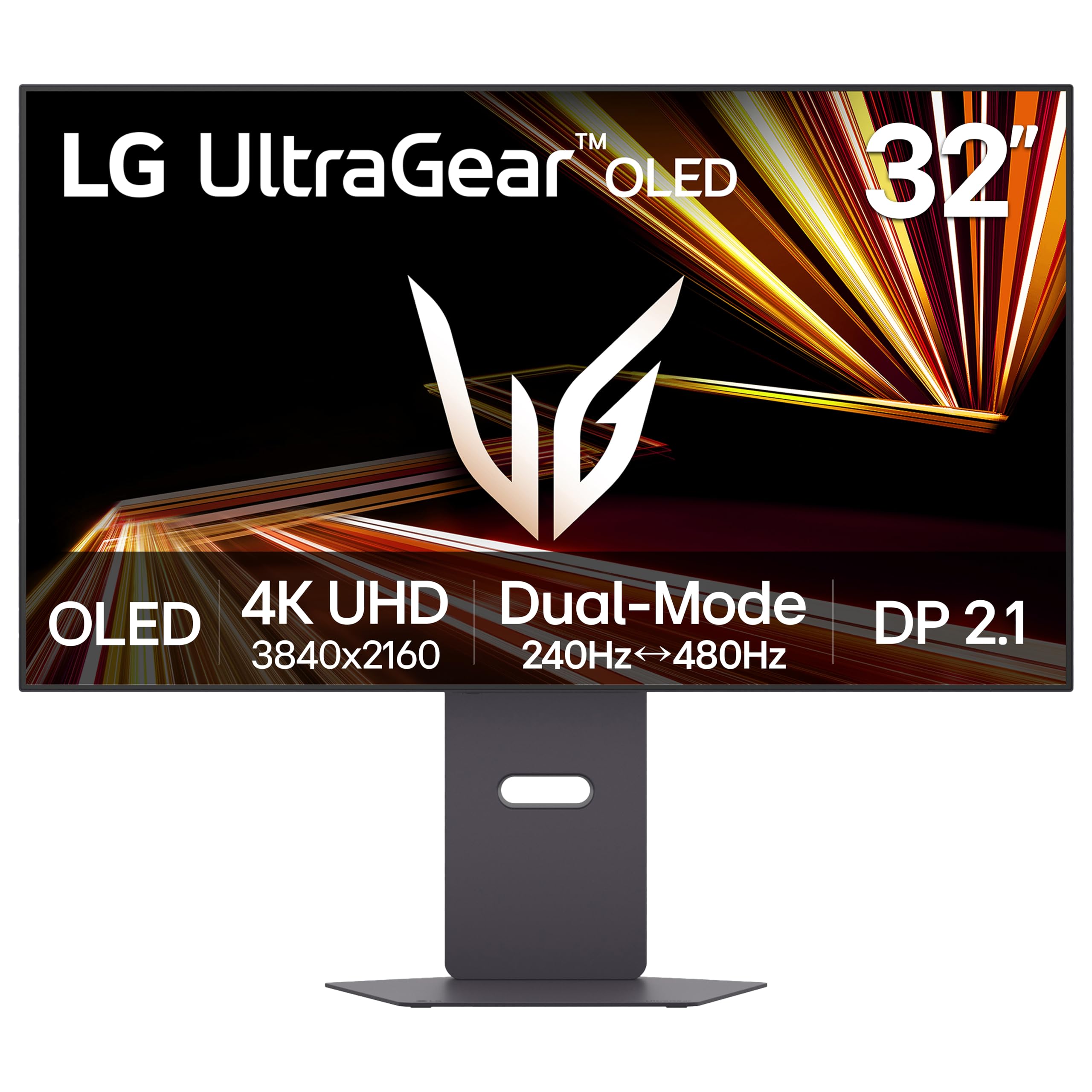
One hotkey press jumps you from 4K story mode at 240Hz to Full HD at 480Hz for competitive shooters.
This LG UltraGear is the only pick on this list with a VESA-certified Dual Mode. In one hotkey press, you jump from 4K at 240Hz to Full HD at 480Hz — so you can enjoy Cyberpunk’s neon-lit streets in full detail, then flip to 480Hz for a Valorant round where every millisecond counts. It is a one-monitor solution for the person who plays both heavy RPGs and competitive shooters.
It also leads on brightness compared to the Samsung, with a typical brightness of 275 cd/m² versus the Samsung’s 250 cd/m². Owners mention that the initial vertical banding disappears after a few hours of use — a common W-OLED break-in phenomenon, not a defect. The 2-year limited warranty covers the OLED panel, which is one year shorter than what MSI and ASUS offer, but the built-in OLED Care tools (pixel cleaning etc.) are easy to run.
The catch is text clarity. As one reviewer noted, text can look soft without Windows ClearType adjustments (a tool that sharpens font rendering), and the matte coating appears slightly grainy on static bright pages. If you plan to read a lot of documents on this screen, consider the ASUS’s glossy panel instead.
Why It Stands Out
- Dual Mode: 4K 240Hz or Full HD 480Hz at the touch of a hotkey
- Micro Lens Array+ technology delivers a peak brightness of up to 1300 nits
- 1,500,000:1 contrast ratio versus the Samsung G8’s 1,000,000:1
Keep In Mind
- Text clarity requires tweaking; not ideal for heavy document work from the start
- Matte coating can look grainy on white web pages
Reach for this if: You switch between story-driven games and competitive shooters and want one monitor that handles both without compromise. It is the only pick that gives you 480Hz speed without buying a second screen.
skip it if: You do most of your gaming at 4K and never plan to use the 480Hz mode — the ASUS may give you better image quality for the same investment.
3. MSI MPG 321CURX QD-OLED, 32-Inch, 4K UHD, 1700R Curved Monitor

A curved 1700R QD-OLED that cleans your desk clutter by charging your laptop through a single USB-C cable.
Immersion meets workspace convenience here. The MSI’s 1700R curve (the screen wraps at a curve radius of 1700mm, so it fills your peripheral vision) is great for racing games and RPGs. But what separates it is the built-in KVM (a feature that lets you control two different computers with one keyboard and mouse) and a 98W USB-C port that charges your laptop while it extends the display. For hybrid workers who game at night and work spreadsheets in the day, this is a rare convenience at this price tier.
It uses a 3rd-generation QD-OLED panel, which means vibrant colors and a 1,500,000:1 contrast ratio — the same high contrast as the more expensive LG and ASUS. Customers note the image quality is “stunning,” with deep blacks and vibrant colors, and that the MSI OLED Care 2.0 (pixel refresh and taskbar detection) reduces burn-in risk significantly. The 240Hz and 0.03ms GtG (gray-to-gray) response keep motion perfectly smooth in games like Halo Infinite and Forza.
The trade-off is size. At 32 inches and curved, this monitor needs a deep desk. Multiple buyers warn you to measure your space before buying, as the curve makes it feel larger than a flat 32-inch screen. Also, the built-in KVM only offers two USB ports, which may require an external hub if you have multiple peripherals.
The Productivity Edge
- 98W USB-C power delivery charges a laptop through the monitor
- Built-in KVM lets you control two PCs with one keyboard and mouse
- 3rd-Gen QD-OLED with 1,500,000:1 contrast ratio for deep blacks
One Catch
- Large curved frame needs a deep desk or monitor arm; measure your space
- Only two USB ports on the KVM — you may need a hub
Who It Suits: Gamers who also work from home and want a cable-reducing setup with a single USB-C connection. This is the pick for the person whose desk is a tangle of wires right now.
Not Ideal For: Competitive players who want a flat 27-inch screen for fast flick shots in shooters — the curve can feel unnatural at first.
4. Samsung 27-inch Odyssey QD-OLED G8 (G81SF), 4K, 240Hz
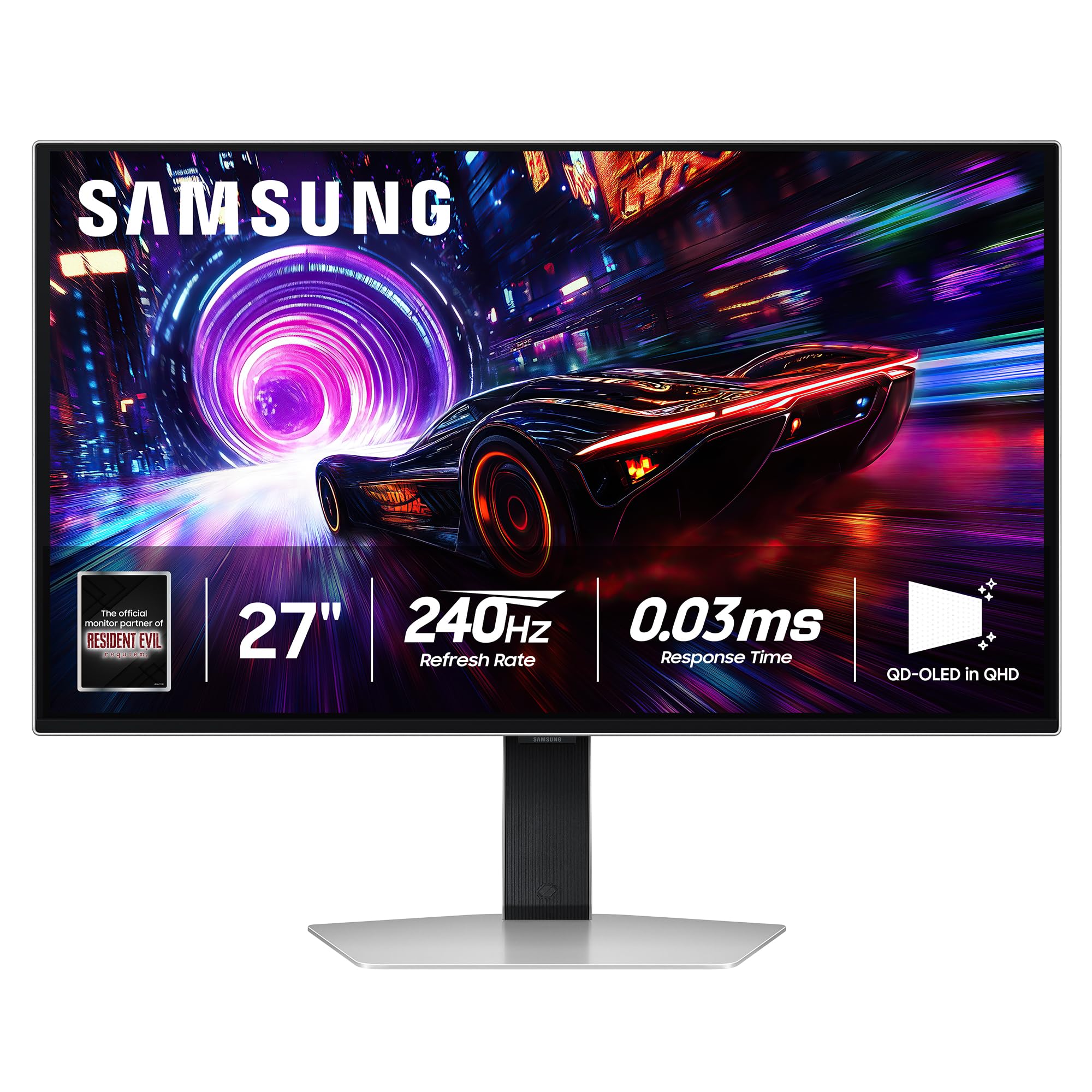
A compact 27-inch QD-OLED that kills reflections better than anything else here, with the sharpest text of the bunch.
If your gaming setup sits in a bright room with windows or overhead lights, this Samsung is your best option. Its Glare Free technology — which Samsung claims is 54% less glossy than conventional anti-reflection film — means you see the game instead of your own reflection. At 27 inches with a 4K resolution, it packs a pixel density of 166 PPI (pixels per inch), the sharpest in this comparison, so icons and text look incredibly crisp.
It also includes a Dynamic Cooling System with a Pulsating Heat Pipe that diffuses heat five times faster than a graphite sheet, which helps prevent burn-in over long sessions. Buyers rave about the “stunning picture quality with richer colors and jet blacks.” However, there is a serious caution: one buyer mentioned dead pixels after two months of use, which is a risk at this price level. The warranty paperwork shows only 1 year, despite a 3-year claim in some advertising, so double-check that before buying.
Compared to the LG above, the Samsung has a lower typical brightness (250 cd/m² vs 275 cd/m²) and a lower contrast ratio (1,000,000:1 vs 1,500,000:1). You trade some visual pop for excellent glare resistance and the smaller 27-inch form factor that fits better on compact desks.
Why It Makes Sense
- 54% less glossy than conventional anti-reflection film — best in class for bright rooms
- 166 PPI pixel density for sharpest text and details at 27 inches
- Dynamic Cooling System with heat pipe to prevent burn-in
Two Caution Points
- Reviewers point out dead pixel risk after the return window closes; check warranty
- Lower contrast and brightness than the LG and ASUS (1,000,000:1 vs 1,500,000:1)
Who It Is For: Gamers in bright rooms who want a compact 27-inch screen and are willing to trade some HDR pop for excellent glare rejection. This is the pick for the person who refuses to close the blinds just to play a game.
Reconsider If: You want the deepest blacks and highest brightness for dark-room HDR gaming — the LG or ASUS outperform the Samsung in those metrics.
Understanding the Specs
Response Time (0.03ms GtG)
This number tells you how fast a pixel changes from one color to the next. All four monitors here hit 0.03ms GtG (gray-to-gray), which is nearly instantaneous. For competitive gaming, this means no ghosting trails behind fast-moving enemies. For single-player games, it simply makes motion look impossibly smooth.
Contrast Ratio (1,000,000:1 vs 1,500,000:1)
This measures the range between the deepest black and the brightest white the screen can show. A 1,500,000:1 ratio (found on the LG, MSI, and ASUS) produces richer blacks and more pronounced highlights than a 1,000,000:1 ratio (found on the Samsung). In a dark room, the difference is clear: shadows look deeper and stars look brighter. In a bright room, the difference becomes less noticeable.
FAQ
Do I need a powerful graphics card to run a 4K 240Hz OLED monitor?
What is the difference between W-OLED and QD-OLED?
How do I prevent OLED burn-in on my gaming monitor?
Can I use a 4K 240Hz OLED monitor for work and spreadsheets?
Is a curved or flat 32-inch OLED better for gaming?
What is DisplayHDR True Black 400?
Do I need HDMI 2.1 for 4K at 240Hz?
Why do some monitors list a peak brightness of 1000 nits and others 250 nits?
Will a 4K 240Hz OLED work with my Xbox Series X or PS5?
What does “0.03ms GtG” mean in real gaming?
Final Thoughts: The Verdict
For most buyers, the best 4K 240Hz OLED Gaming Monitor is the ASUS ROG Swift PG32UCDM because it combines the brightest highlights (1000 cd/m²), the widest color gamut (99% DCI-P3), and a glossy screen that makes every game look richer. If you want the flexibility to switch between 4K story mode and 480Hz competitive speed, grab the LG UltraGear 32GX870A-B. And for a budget-friendly entry that fights glare better than any other, the standout is the Samsung Odyssey G8 G81SF.
How We Picked
We do not accept paid placement, and we did not hands-on test every unit. Instead, we match each pick to a real buyer and use-case by comparing the manufacturers’ published specifications against the patterns in verified customer reviews — so you get each pick’s real strengths and trade-offs instead of marketing copy.
Sources & Methodology
Specifications: manufacturer listings and product documentation. Review insights: verified customer reviews, as of July 2026. Pricing: not shown on this page (it changes often); check the current price via the retailer link.
As an Amazon Associate, Gadgets Feed earns from qualifying purchases. This does not affect which products we feature.
Product prices and availability are accurate as of the date/time indicated and are subject to change. Any price and availability information displayed on Amazon at the time of purchase will apply to the purchase of this product. As an Amazon Associate I earn from qualifying purchases.
CERTAIN CONTENT THAT APPEARS ON THIS SITE COMES FROM AMAZON. THIS CONTENT IS PROVIDED "AS IS" AND IS SUBJECT TO CHANGE OR REMOVAL AT ANY TIME.
Amazon and the Amazon logo are trademarks of Amazon.com, Inc. or its affiliates.