
A projector that delivers both true 4K resolution and north of 5,000 lumens isn’t a casual purchase—it’s a commitment to a dedicated home theater or a demanding commercial space. For years, buyers had to choose between bright 1080p images or dim, grainy 4K visuals. That compromise is now dead. Modern laser light engines and advanced pixel-shifting or native 4K panels let you flood a 150-inch screen with intense, daylight-viewable brightness while maintaining the razor-sharp detail that makes 4K content truly immersive.
I’m Min — the co-founder and writer behind Gadgets Feed. I’ve spent countless hours comparing laser light engine specs, native contrast ratios, HDR tone-mapping implementations, and real-world lumen outputs to build a guide that cuts through the jargon and focuses on what actually matters for your specific setup.
After analyzing over a dozen models across different price tiers and use cases, we’ve identified the true standouts that balance brightness, color accuracy, and smart features. This is the definitive guide to finding the perfect 4k 5000 lumen projector for your space.
How To Choose The Best 4K 5000 Lumen Projector
Finding a projector that delivers true 4K resolution alongside serious brightness requires understanding a few critical specifications that define the category. Focus on these key areas before you commit your budget.
ANSI Lumens vs. ISO Lumens: Reading the Brightness Numbers
Not all lumen ratings are measured the same way. ANSI lumens are the older standard, measured across a nine-point grid on the projected image. ISO lumens are a newer, often more conservative standard that accounts for production variations. A projector rated at 5,000 ANSI lumens is typically slightly brighter than one rated at 5,000 ISO lumens, but the difference is marginal in real-world use. For a dedicated theater with some ambient light, you want at least 3,000 lumens. For a living room or commercial space with windows, aim for 4,500 lumens or higher.
Laser Light Source vs. Lamp: Why It Matters for 4K
Laser projectors dominate the 4K 5,000 lumen space for good reason. They maintain peak brightness for 20,000 to 30,000 hours with virtually no degradation, while lamp-based projectors lose 20-30% of their output within the first 1,000 hours. Lasers also deliver a wider color gamut—often 100% of DCI-P3 or higher—which is essential for HDR content. The instant power on/off capability of laser projectors also eliminates the cooldown wait times that lamp projectors require.
Native 4K vs. Pixel-Shifted 4K: The Resolution Reality
A true native 4K panel has 8.3 million distinct pixels (3840 x 2160). Pixel-shifted projectors (like Epson’s 4K PRO-UHD or DLP XPR technology) rapidly shift a 1920 x 1080 chip to create a perceived 4K image. While pixel-shifting delivers a very sharp picture that most viewers can’t distinguish from native 4K, it can introduce slight artifacts in fast-moving content. For critical home theater enthusiasts, native 4K panels (SXRD or LCoS) offer the ultimate clarity, but they come at a significant premium.
Contrast Ratio and Black Levels: The Secret to HDR Performance
Brightness means nothing if your blacks look gray. Dynamic contrast ratios in the millions-to-one range are common marketing numbers, but what matters is the native contrast ratio. LCD projectors typically struggle below 1,000:1 native, while DLP laser projectors can reach 3,000:1 or higher. The best models use an iris or dynamic laser dimming to push viewing contrast past 50,000:1. For HDR content, a projector that can deliver deep blacks alongside high brightness creates the true cinematic look.
Quick Comparison
On smaller screens, swipe sideways to see the full table.
| Model | Category | Best For | Key Spec | Amazon |
|---|---|---|---|---|
| ViewSonic LS901-4K | Laser 4K | Home Theater & Golf Sims | 5,500 ANSI Lumens | 4.2ms Lag | Amazon |
| Epson Home Cinema 5050UB | 3LCD Laser | Cinema Black Levels | 1,000,000:1 Contrast | Pixel Shift | Amazon |
| Valerion VisionMaster Max | Triple Laser | Ultimate Gaming & HDR | 3,500 ISO Lm | 4ms @ 240Hz | Amazon |
| Sony VPL-XW5000ES | Native 4K SXRD | Purest Picture Quality | Native 3840×2160 | X1 Ultimate | Amazon |
| AWOL Aetherion Pro | Ultra Short Throw | Compact UST Setup | 6,000:1 Native | Anti-RBE | Amazon |
| Nebula X1 | Triple Laser | Indoor/Outdoor Flexibility | 3,500 ANSI Lm | Dolby Vision | Amazon |
| BenQ TK710 | Laser 4K | Living Room Gaming | 3,200 ANSI Lm | 4ms @ 240Hz | Amazon |
| JMGO N1S Ultimate | Triple Laser | Portable Premium Cinema | 3,300 ISO Lm | 110% Rec.2020 | Amazon |
| ViewSonic LS741HD | 1080p Laser | Commercial & Church Use | 5,000 ANSI Lm | 3,000,000:1 | Amazon |
| Optoma GT2100HDR | Short Throw Laser | Golf Simulator | 4,200 ANSI Lm | 300,000:1 | Amazon |
| Epson Pro EX11000 | 3LCD Laser | Business & Education | 4,600 Lm Color | 20,000 Hrs | Amazon |
In‑Depth Reviews
1. ViewSonic LS901-4K

The ViewSonic LS901-4K delivers a rare combination: true UHD 4K resolution paired with a blistering 5,500 ANSI lumens. That brightness puts it in a class where most competitors top out at 3,500 or 4,000 lumens, making it genuinely daylight-viewable on screens up to 150 inches. The 1.7X optical zoom and 360-degree projection support give you enormous flexibility for ceiling mounts or unconventional room layouts.
Gamers will appreciate the 4.2ms low input lag at 1080p 240Hz, which eliminates perceptible delay even in competitive titles. The Golf Mode integration is a standout feature for simulator enthusiasts, supporting major golf software with lifelike color and contrast. The 3,000,000:1 dynamic contrast ratio ensures that HDR content retains punchy highlights without washing out shadow detail.
Setup is straightforward thanks to H/V keystone and 4-corner adjustment, though the remote control is the primary interface—there’s no built-in smart OS. For users who want a pure, bright 4K image with gaming-grade responsiveness and commercial-grade brightness, the LS901-4K is the most versatile high-lumen option currently available.
Why it’s great
- Industry-leading 5,500 ANSI lumens for ambient light use
- Ultra-low 4.2ms input lag for competitive gaming
- Flexible 1.7X optical zoom and 360-degree installation
Good to know
- No built-in smart TV OS—requires external streaming device
- Native 4K achieved via pixel-shifting, not a native panel
2. Epson Home Cinema 5050UB

The Epson 5050UB remains a benchmark in the home theater projector world for one reason: its black levels. The 3-chip 3LCD design with a dynamic iris delivers a native contrast ratio that rivals far more expensive LCoS projectors, producing deep, inky blacks that make HDR content pop. The 4K PRO-UHD pixel-shifting engine sharpens the 1080p panels to a resolution that easily passes for true 4K in most viewing conditions.
Motorized lens memory is a standout convenience—it lets you store multiple zoom/focus/lens shift presets for switching between 16:9 and 2.35:1 aspect ratios at the push of a button. With 2,600 lumens of real-world brightness, it’s not designed for brightly lit rooms, but in a dedicated light-controlled theater, the 5050UB delivers a cinematic image that many owners describe as near-OLED quality.
The main tradeoff is the large chassis—at 25 pounds, it requires a sturdy ceiling mount. The HDMI handshake can occasionally cause brief blackouts, though firmware updates and quality HDMI cables mitigate this. For purists who prioritize contrast over raw brightness, the 5050UB remains the gold standard under .
Why it’s great
- Outstanding native contrast with deep, film-like blacks
- Motorized lens memory for 16:9/2.35:1 switching
- Excellent HDR tone mapping with 10-bit processing
Good to know
- Large and heavy at 25 pounds
- 2,600 lumens limits ambient light performance
- HDMI handshake may cause occasional blackouts
3. Valerion VisionMaster Max
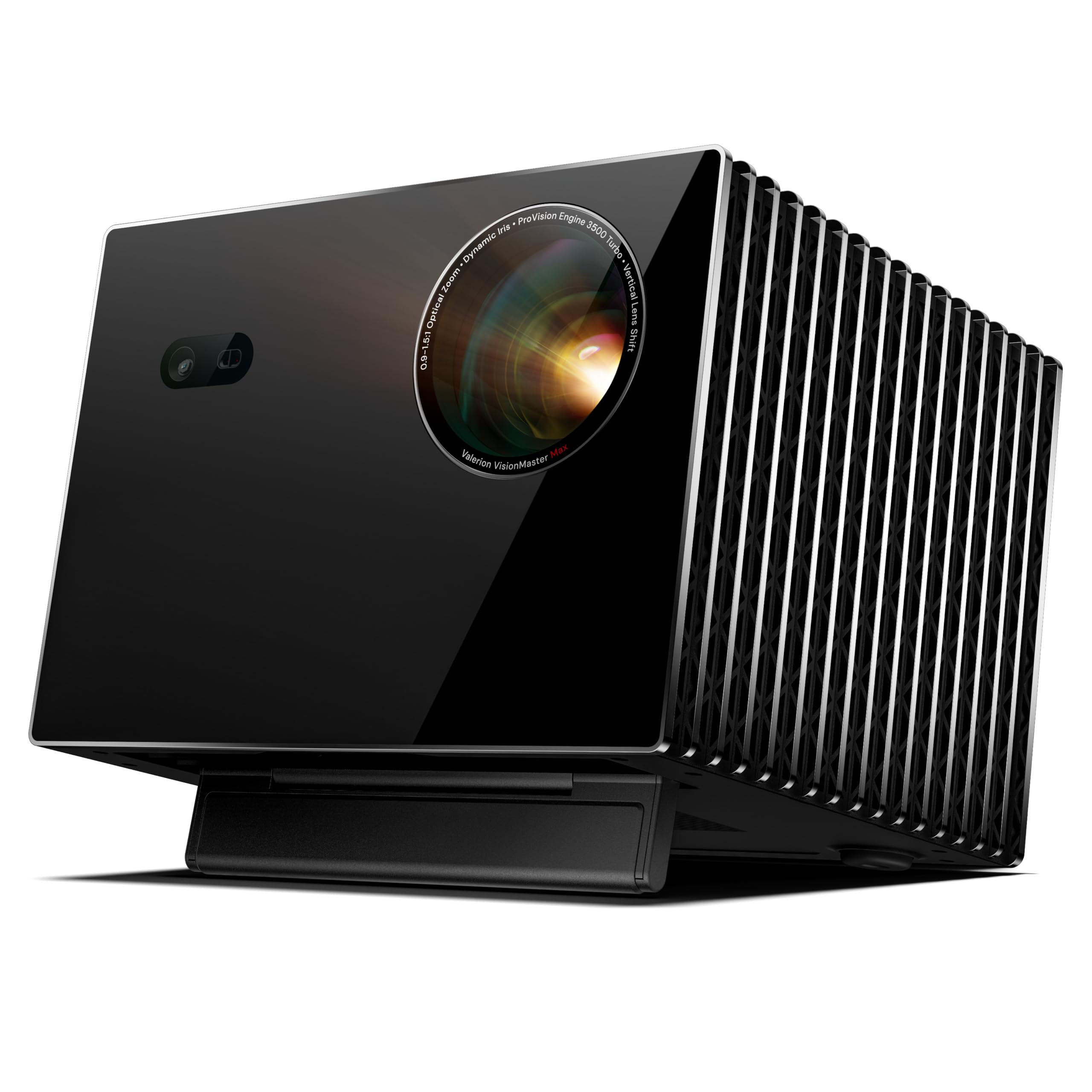
The Valerion VisionMaster Max is an absolute powerhouse that targets the enthusiast who demands everything: high brightness, deep blacks, and gaming-grade responsiveness. Its triple-laser light source delivers 3,500 ISO lumens with 110% Rec.2020 color coverage, producing a vibrant, saturated image that handles HDR10+, Dolby Vision, and IMAX Enhanced content with equal poise. The NoirScene Dark Field Engine with its iris and stray light shield achieves a 50,000:1 viewing contrast ratio—blacks are genuinely deep even in HDR scenes.
Gamers benefit from a 4ms response time at 1080p 240Hz and full support for VRR and ALLM, making it viable for both cinematic single-player experiences and competitive multiplayer. The 0.9–1.5:1 optical zoom and ±105% vertical lens shift provide generous placement flexibility. Built-in Google TV with Gigabit Ethernet and WiFi 6E ensures smooth 4K streaming without external dongles.
The Anti-RBE technology is a genuine blessing for viewers sensitive to rainbow artifacts—it reduces the effect by 99.99%, making DLP technology comfortable for the entire family. The only caveat is the price, which sits near the top of the mid-range, but for the feature set, the VisionMaster Max offers exceptional value compared to projectors costing twice as much.
Why it’s great
- Excellent 50,000:1 viewing contrast with iris system
- Near-total elimination of rainbow effect (RBE)
- 4ms input lag with 240Hz for competitive gaming
- Comprehensive smart TV and voice assistant integration
Good to know
- Short throw ratio may need optical zoom adjustment for very large screens
- Fan noise is audible during fast-action scenes
4. Sony VPL-XW5000ES

The Sony VPL-XW5000ES is the projector that purests dream about. It uses a native 4K SXRD panel—meaning there’s no pixel-shifting, no gimmicks—just 8.3 million individually addressable pixels. The X1 Ultimate for Projector processor, borrowed from Sony’s flagship TVs, delivers incredible upscaling and HDR tone mapping that pulls detail out of shadows other projectors simply lose. At 2,000 lumens, it’s the least bright model in this roundup, but the image quality in a dark room is stunning.
TRILUMINOS PRO color processing produces over a billion colors with a natural, organic feel that’s especially noticeable in skin tones and foliage. The Wide Dynamic Range Optics achieve 95% DCI-P3 coverage, and while 2,000 lumens seems low on paper, Sony’s laser efficiency means the perceived brightness is excellent on screens up to 150 inches. The fan noise is virtually silent—a major advantage for quiet movie scenes.
The manual lens shift requires careful physical leveling, and there is no keystone correction, so permanent installation demands precise measurements. The slow startup (around 60 seconds) is slightly annoying. If raw brightness is your primary need, look elsewhere, but if pixel-perfect sharpness and Sony’s legendary image processing are what you crave, the XW5000ES delivers an unmatched cinematic experience.
Why it’s great
- Truly native 4K panel—no pixel-shifting artifacts
- Reference-grade HDR tone mapping and upscaling
- Extremely quiet operation for immersive viewing
- Compact and lightweight for its class
Good to know
- Limited to 2,000 lumens for dedicated light-controlled rooms
- No keystone correction—requires precise physical alignment
- Slow startup time of about one minute
5. AWOL Aetherion Pro
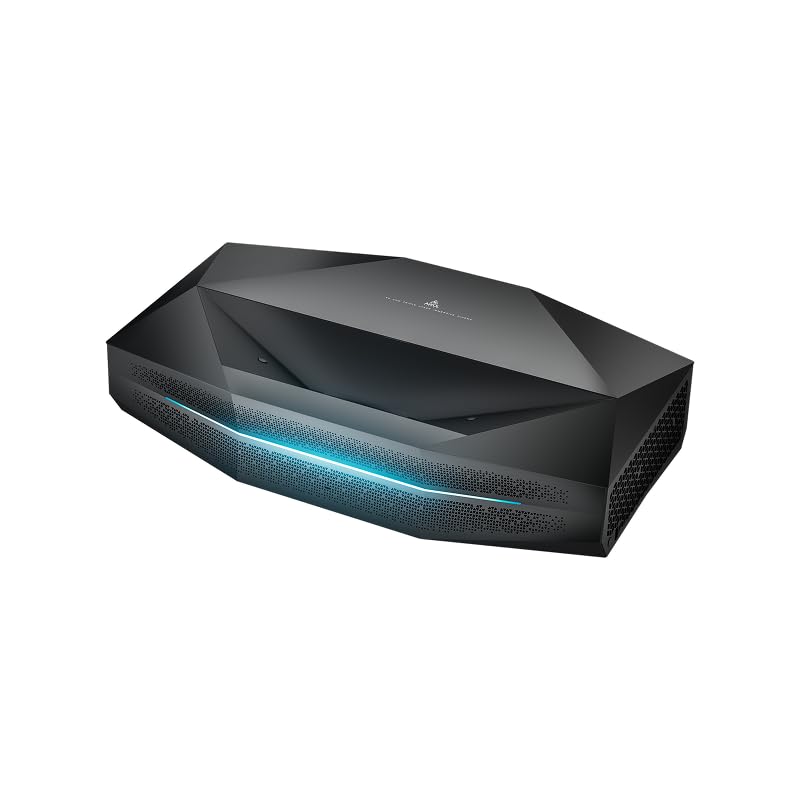
The AWOL Aetherion Pro is an ultra short throw 4K laser projector that sits inches from the wall, projecting a 200-inch image from a media console. Its 2,600 ISO lumens are purposefully tuned for a UST design—brighter than most UST competitors—and combine with a 6,000:1 native contrast ratio that pushes to 60,000:1 viewing contrast with the IRIS system. The Noirscene System II and 6-level IRIS deliver genuinely deep blacks for a UST projector, which is a rare achievement.
PixelLock technology ensures edge-to-edge sharpness even on large screens, and the 1ms ultra-low latency mode makes it viable for gaming. The built-in Google TV interface (via the integrated Fire TV 4K Max) provides a seamless streaming experience. Anti-RBE technology is effective at reducing rainbow artifacts, and TÜV certification for low blue light ensures comfortable long sessions.
The UST form factor requires a perfectly flat wall or dedicated ALR screen, and placement is finicky—a slight table wobble can misalign the image. The built-in speakers are surprisingly good for a projector, but serious users will still want an external sound system. For buyers who want a massive 4K image without ceiling mounts or long throw distances, the Aetherion Pro is the best UST option in this brightness class.
Why it’s great
- Excellent native contrast for a UST projector
- 200-inch image from inches away from the screen
- Ultra-low 1ms input lag for responsive gaming
- Effective Anti-RBE and TÜV low blue light certification
Good to know
- Placement is critical and sensitive to surface level
- Best performance requires a dedicated ALR screen
- Built-in sound is good but not a replacement for a system
6. Nebula X1 by Anker

The Anker Nebula X1 packs a triple-laser light source and 3,500 ANSI lumens into a surprisingly portable chassis with an auto-aligning gimbal. This is one of the few projectors at its price point that supports Dolby Vision, which, when combined with the 56,000:1 dynamic contrast ratio, produces an image with genuine HDR punch. The ISF-calibrated color accuracy ensures that streaming content looks as close to the filmmaker’s intent as possible.
The auto-alignment system uses a 3D-TOF sensor and CMOS camera to instantly adjust keystone, focus, and screen fit—making this the easiest projector to set up in the lineup. The built-in Google TV with Netflix certification means you don’t need an external fire stick. The 20W subwoofer and Dolby Digital+ support deliver decent built-in audio for casual viewing.
The 60Hz input limit means it’s not for high-refresh-rate gaming, and some users report a noticeable rainbow effect in bright scenes. Quality control has been inconsistent, with some units requiring exchange. For users who value portability, auto-setup, and Dolby Vision support above all else, the Nebula X1 offers a compelling package at a competitive price point.
Why it’s great
- Dolby Vision support with ISF-calibrated color
- Auto-aligning gimbal makes setup effortless
- Built-in Google TV with Netflix certification
- Compact and portable design with good built-in sound
Good to know
- 60Hz input limit—not suitable for high-refresh gaming
- Rainbow effect may be visible in bright scenes
- Some reports of inconsistent quality control
7. BenQ TK710

The BenQ TK710 is purpose-built for the living room gamer who wants a 4K image without sacrificing responsiveness. Its 3,200 ANSI lumens laser light source is bright enough for use with some ambient light, and the 4ms response time at 1080p 240Hz makes it one of the fastest projectors available. The 16ms input lag at 4K 60Hz is still highly responsive for console gaming on PS5 and Xbox Series X.
The 600,000:1 dynamic contrast ratio and HDR10/HLG support deliver solid HDR performance, though the Rec.709 color coverage (95%) is more suited to SDR content. The 1.3x zoom and vertical lens shift provide decent placement flexibility, and the 3D keystone ensures the image can be corrected in tricky mounting scenarios. The built-in 5W speaker is passable for casual use but external audio is recommended.
The relatively short throw distance (around 10 feet for a 100-inch image) makes it suitable for smaller rooms. For gamers who want a bright, responsive 4K laser projector without breaking the bank, the TK710 is a top choice.
Why it’s great
- Ultra-low 4ms response time at 240Hz for competitive gaming
- Bright 3,200 ANSI lumens laser light source
- Good placement flexibility with lens shift and 3D keystone
Good to know
- 95% Rec.709 color coverage—not wide gamut for HDR
- Built-in speaker is weak for immersive use
- Lacks native 4K panel—uses pixel-shifting
8. JMGO N1S Ultimate

The JMGO N1S Ultimate is a triple-laser portable projector that redefines what’s possible in a compact gimbal design. With 3,300 ISO lumens and 110% Rec.2020 color gamut coverage, the color volume is genuinely reference-grade. The 360-degree horizontal and 135-degree vertical rotation gimbal lets you project onto the ceiling, walls, or outdoors with zero setup fuss. The auto screen fit and real-time keystone correction are remarkably fast and accurate.
The built-in Google TV 3.0 interface includes certified Netflix, and the 20W subwoofer with Dolby Digital+ and DTS-HD Master Audio delivers surprisingly rich sound for a portable projector. Blu-ray 3D support is a niche but welcome feature. The triple-laser system produces a clean, speckle-free image with excellent color uniformity across the entire 300-inch maximum projection size.
The main drawbacks are the lack of optical zoom (digital zoom only) and a UI that feels slightly sluggish compared to dedicated streaming devices. The power brick is bulky, which slightly hinders true portability. For users who want a premium, flexible projector that can move from the living room to the backyard and deliver reference-grade color, the N1S Ultimate is a standout.
Why it’s great
- Excellent 110% Rec.2020 color coverage from triple laser
- Fully flexible gimbal for ceiling, wall, or outdoor projection
- Certified Netflix and Google TV 3.0 built-in
- Supports Blu-ray 3D and has good built-in sound
Good to know
- No optical zoom—uses digital zoom only
- User interface can be sluggish at times
- Bulkier power adapter reduces portability
9. ViewSonic LS741HD

The ViewSonic LS741HD is a 1080p laser projector built for commercial endurance—rated for 24/7 operation with instant power on/off and a 5,000 ANSI lumen output. While it’s not a 4K projector, its 1080p resolution with a 3,000,000:1 contrast ratio produces a sharp, vibrant image that’s ideal for church sanctuaries, conference rooms, or educational spaces where reliability matters more than pixel count.
The 1.6x optical zoom and 360-degree projection make installation flexible. Advanced LAN control via Crestron, AMX, and Extron allows IT managers to schedule and monitor the projector remotely. The Golf Mode is a surprising inclusion for a commercial projector, supporting golf simulators with realistic image rendering. The laser light source ensures up to 30,000 hours of maintenance-free operation.
The lack of 4K resolution means it’s not suitable for critical home theater use, and the manual keystone is inconvenient for installations that require frequent repositioning. For organizations that need a bomb-proof, bright 1080p laser projector that will run for years without bulb replacements, the LS741HD is a workhorse.
Why it’s great
- 5,000 ANSI lumens with 24/7 rated operation
- Advanced LAN control for commercial installations
- 1.6x optical zoom and 360-degree flexible placement
- Long-lasting laser source with instant power control
Good to know
- 1080p resolution—no 4K support
- Manual keystone adjustment can be inconvenient
- Designed for commercial use, not home theater
10. Optoma GT2100HDR

The Optoma GT2100HDR is a compact short throw laser projector built specifically for golf simulators and gaming. Its 4,200 ANSI lumens ensure a bright, clear image on simulator screens, and the short throw ratio lets you project a 100-inch image from just a few feet away—perfect for confined simulator bays. The DuraCore laser technology provides 30,000 hours of bright, maintenance-free operation.
With 1080p resolution and native 4K HDR input support, the image is sharp and detailed for both simulator software and casual gaming. The 300,000:1 contrast ratio delivers good dynamic range for golf courses and game environments. The compact design (smaller than a letter-size piece of paper) and 6.6-pound weight make it easy to mount in tight spaces.
The focus adjustment can be stiff, making fine-tuning slightly frustrating. The remote control’s buttons are hard to read in dim light, and the lack of a model number on the unit itself makes identification after unboxing tricky. For dedicated golf simulator enthusiasts who need a bright, short throw, compact laser projector, the GT2100HDR is a proven solution.
Why it’s great
- Short throw design ideal for golf simulators and tight spaces
- Bright 4,200 ANSI lumens for simulator screens
- Ultra-compact and lightweight for easy mounting
- 30,000-hour laser light source
Good to know
- 1080p native resolution with 4K input support only
- Focus ring is stiff and hard to fine-tune
- Remote buttons are difficult to read in low light
11. Epson Pro EX11000
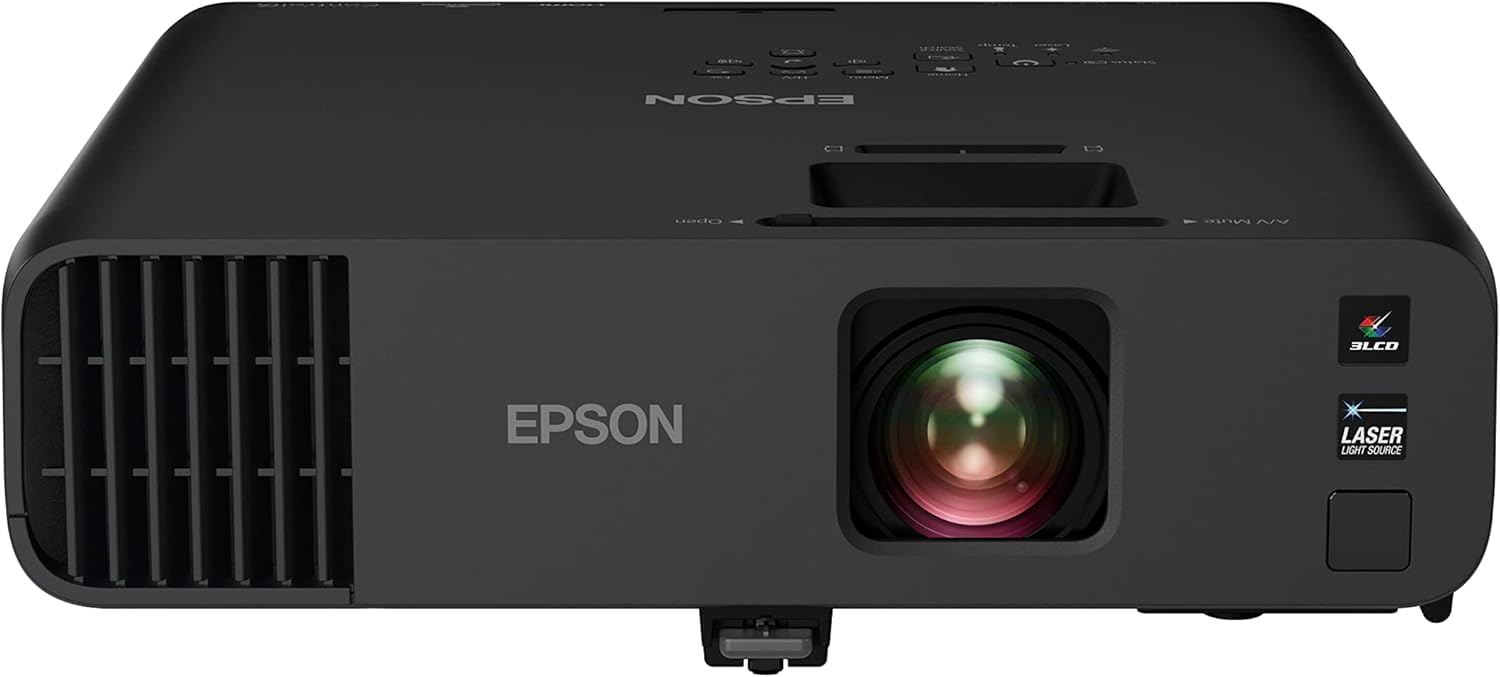
The Epson Pro EX11000 is a 3-chip 3LCD laser projector with 4,600 lumens of both color and white brightness. The 3LCD design eliminates rainbow effects entirely, making it ideal for long presentation sessions. The 20,000-hour laser light source ensures consistent brightness with no bulb replacements, and the 100,000:1 dynamic contrast ratio provides good legibility for spreadsheets, documents, and video conferencing.
The built-in Miracast screen mirroring and two HDMI ports with USB power for streaming sticks make it versatile for both wired and wireless presentations. The 16W built-in speaker is loud enough for a medium-sized conference room. The included carrying case makes it portable for off-site presentations, though at a sizable weight, it’s more of a luggable unit than a truly portable one.
The 1080p resolution is adequate for business use but not suitable for critical home theater. The fan noise in high brightness mode is noticeable in quiet environments. For businesses, schools, and churches that need a reliable, bright, rainbow-free laser projector with comprehensive connectivity, the EX11000 is a solid investment.
Why it’s great
- 4,600 lumens color and white brightness—no rainbow effect
- 20,000-hour laser source with no bulb replacements
- Miracast screen mirroring and dual HDMI ports
- Good built-in 16W speaker for presentations
Good to know
- 1080p resolution only—not 4K
- Large and heavy compared to DLP competitors
- Fan noise is audible in quiet rooms
FAQ
How many lumens do I need for a 4K projector in a living room with windows?
What is the rainbow effect and how do I avoid it in a 4K projector?
Can a 4K 5000 lumen projector replace a television for daily use?
What screen material is best for a 5000 lumen projector?
Final Thoughts: The Verdict
For most users, the 4k 5000 lumen projector winner is the ViewSonic LS901-4K because it delivers the rare combination of true 4K resolution, 5,500 ANSI lumens, and a 4.2ms input lag that satisfies both home theater enthusiasts and gamers. If you want the deepest black levels and cinematic color accuracy for a dedicated theater room, grab the Epson 5050UB. And for a compact, portable powerhouse with triple-laser color and a flexible gimbal, nothing beats the JMGO N1S Ultimate.