
Choosing the wrong camera for 4K at 60 frames per second means footage that looks more like a slideshow than cinema, with pulsing autofocus hunting and rolling shutter artifacts that ruin every pan. The most expensive body doesn’t guarantee the cleanest image, and the cheapest often drops frames the moment you need them most. This guide isolates exactly which sensor size, processor, and codec delivers true 4K 60fps performance versus which cameras simply advertise it.
I’m Min — the co-founder and writer behind Gadgets Feed. I cut through the marketing noise by analyzing raw specifications, reading thousands of verified owner experiences, and comparing the actual codec bitrates, sensor readout speeds, and thermal throttling limits across the entire price spectrum of the 4K 60fps video camera market.
Whether you need a compact vlogging companion or a full-frame hybrid rig, this analysis filters the real performers from the spec-sheet bluffers to help you find the best 4k 60fps video camera for your specific shooting needs.
How To Choose The Best 4K 60fps Video Camera
Not every camera claiming 4K 60fps delivers the same quality. Some crop the sensor heavily, others overheat after ten minutes, and many rely on pixel binning that robs fine detail. Understanding the three pillars below will save you from buying a spec-sheet mirage.
Sensor Size and Readout Speed
Full-frame sensors offer the best low-light performance and shallower depth of field, but they require faster processing to read all those pixels at 60fps without significant rolling shutter. A 1-inch sensor is far easier to read cleanly at 60p, which is why dedicated camcorders like the Canon XA70 can deliver nearly artifact-free footage while cheaper full-frame bodies introduce wobble. APS-C sits in the middle, offering a strong balance of light gathering and manageable readout speed. Always check if the 4K 60fps mode uses the full sensor width or a heavy crop.
Bitrate, Colour Sampling, and Codec
A raw 4K 60fps stream without compression would require gigabytes per second. Every camera uses a codec — typically H.264 or H.265 — to shrink that data. The bitrate (measured in Mbps) determines how much detail survives. Look for at least 150 Mbps for 4K 60fps; half that and macroblocking in busy scenes is inevitable. Colour sampling matters just as much. 4:2:0 is standard for consumer delivery, but 4:2:2 or 10-bit recording gives you real flexibility when grading shadows and skies. 10-bit colour is the single biggest upgrade you can chase for serious video work.
Autofocus Reliability at 60 Frames Per Second
Phase-detection autofocus points covering the entire frame are non-negotiable if you track moving subjects. Contrast-detect systems hunt visibly at 60p, producing pulsing focus that ruins a take. Canon’s Dual Pixel CMOS AF II and Sony’s Real-time Tracking set the benchmark here. If your shooting style relies on manual focus, a camera with focus peaking and a usable zebra pattern is more important than AF speed. For run-and-gun content creation, fast and sticky phase-detect AF saves more shots than any other feature.
Quick Comparison
On smaller screens, swipe sideways to see the full table.
| Model | Category | Best For | Key Spec | Amazon |
|---|---|---|---|---|
| Canon EOS R8 | Mirrorless | Full-Frame Value | Uncropped 4K 60p oversampled from 6K | Amazon |
| Nikon Z6 III | Mirrorless | Pro Video Hybrid | 6K/60p N-RAW internal recording | Amazon |
| Canon XA70 | Camcorder | Event Recording | 15x optical zoom, 1″ sensor, 4K UHD 160Mbps | Amazon |
| Panasonic LUMIX S5 | Mirrorless | Budget Full-Frame | 4K 60p 10-bit, Dual Native ISO | Amazon |
| Sony A6100 | Mirrorless | Fast Hybrid AF | 0.02 sec AF, 4K oversampled from 6K | Amazon |
| Canon EOS R50 V | Mirrorless | Vlogging Starter | 4K 30p, FHD 120p, vertical video mode | Amazon |
| Panasonic LUMIX G85 | Mirrorless | Stabilization Demo | 5-axis IBIS + OIS, weather-sealed body | Amazon |
| OBSBOT Tail Air | PTZ/Camcorder | AI Auto-Tracking | NDI compatible, 320° pan, gesture control | Amazon |
| DJI Osmo Nano | Action Camera | Pocket POV | 1/1.3″ sensor, 143° FOV, 200-min battery | Amazon |
| Canon EOS Rebel T7 | DSLR | Budget Photography Entry | 24.1MP APS-C, 9-point AF, Wi-Fi | Amazon |
In‑Depth Reviews
1. Canon EOS R8 Mirrorless Camera Body

Stepping up to full-frame with the EOS R8 unlocks the single best 4K 60p value proposition on the market today. Its 24.2MP sensor oversamples from a 6K readout, delivering uncropped footage that retains every pixel of the lens’s field of view — no surprise crop factor eating your wide-angle work. The DIGIC X processor supports 10-bit 4:2:2 internal recording with Canon Log 3, giving you over 14 stops of dynamic range to grade highlights and shadows independently without banding.
Autofocus performance inherits the same Dual Pixel CMOS AF II system found in the flagship R6 Mark II, covering 100% of the frame with 1,053 zones. Animal, vehicle, and human detection holds tight at 60fps even when subjects move unpredictably. The 40fps electronic shutter with full AF tracking is a bonus for hybrid shooters who also want clean stills from the same body. Rolling shutter is well-controlled thanks to the sensor’s readout speed, and the 3.0-inch vari-angle touchscreen makes gimbal work straightforward.
Battery life is the hardest compromise — the LP-E17 pack struggles to hit 60 minutes of continuous 4K 60p recording. The lack of in-body image stabilization means you must rely on stabilized RF lenses or a gimbal for handheld work. Overheating protection kicks in around the 30-minute mark in 4K 60p, though firmware updates have improved this. For the price, no other full-frame body offers this level of 4K 60p image quality and autofocus accuracy.
Why it’s great
- Uncropped 4K 60p oversampled from 6K delivers exceptional detail and sharpness.
- Dual Pixel CMOS AF II with 1,053 zones provides reliable eye and subject tracking at 60fps.
- 10-bit 4:2:2 internal recording with C-Log 3 offers professional-grade colour grading flexibility.
Good to know
- No in-body image stabilization, requiring stabilized RF lenses or a gimbal for smooth handheld footage.
- Small LP-E17 battery yields roughly one hour of continuous 4K 60p recording before needing a swap.
- Overheating can occur after approximately 30 minutes of 4K 60p in warm ambient conditions.
2. Nikon Z6 III Full-Frame Mirrorless Camera

The Z6 III pushes professional hybrid recording into the sub- range by enabling 6K/60p internal N-RAW recording — a capability that previously required dedicated pro camcorders. The oversampled 4K UHD from that 6K readout produces footage with extraordinary edge definition and minimal aliasing. Nikon’s deep-learning autofocus has improved roughly 20% over the Z6 II, detecting human faces as small as 3% of the frame, and the -10EV low-light sensitivity means reliable focus even in near-darkness.
Battery life is rated for approximately two hours of mixed use, which is generous for a full-frame mirrorless body. The 4000-nit electronic viewfinder is the brightest in its class, reducing eye strain during lengthy shoots in harsh outdoor conditions. Dual card slots accept CFexpress Type B and SD UHS-II, giving you flexibility between speed and cost for media. Weather sealing has proven reliable in real-world downpours, making this a legitimate field camera for documentary work.
The menu system remains less intuitive than Sony or Canon offerings, and the 299 phase-detect points, while accurate, don’t cover the entire frame top to bottom as completely as Canon’s Dual Pixel system. The body weight with a standard zoom approaches three pounds, which is fine for tripod work but noticeable during all-day handheld shoots. For filmmakers who demand internal raw and 4K 120p slow motion, the Z6 III delivers features that outclass its price tier.
Why it’s great
- Internal 6K/60p N-RAW recording offers maximum post-production flexibility without external recorders.
- 4000-nit EVF with 120fps refresh rate provides clear viewing in direct sunlight.
- Dual card slots (CFexpress Type B + SD UHS-II) allow flexible and redundant media workflows.
Good to know
- Menu interface is less streamlined than Canon or Sony systems, requiring time to learn fully.
- Autofocus coverage is extensive but not full-frame, with minor tracking gaps at extreme edges.
- Body and lens kit weight is substantial for extended handheld or gimbal use.
3. Panasonic LUMIX S5 Full Frame Mirrorless Camera

When budget constraints demand full-frame sensor performance without sacrificing video quality, the LUMIX S5 delivers 4K 60p in 10-bit 4:2:0 internally with no record time limit — a rare feature in its price bracket. The Dual Native ISO technology means ISO 4000 is genuinely clean, allowing you to shoot in low-light environments without the noise penalty typical of competing sensors. The 5-axis in-body image stabilization provides a full 6.5 stops of compensation, making handheld 4K 60p usable without a gimbal for static or slow-pan shots.
Classic Panasonic color science is on display here, with V-Log/V-Gamut offering up to 14 stops of dynamic range. This single feature alone justifies the purchase for colourists who want to match footage with professional cinema cameras. The 225-area autofocus system detects heads, faces, and bodies, and while it’s not as sticky as Sony’s Real-time Tracking for erratic movement, it performs reliably for interview, vlog, and controlled studio environments.
The body-only weight is remarkably light at approximately 714 grams with battery, making it one of the most portable full-frame bodies available. The 4K 60p mode does apply a 1.5x crop, which is the primary trade-off — your wide-angle lenses become tighter, requiring native wide glass or a speed booster. Autofocus hunting in low light is also more pronounced than competitors, especially when tracking fast-moving subjects. For controlled shoots where you manual focus or shoot interviews, the S5 is an outright bargain.
Why it’s great
- Internal 4K 60p 10-bit recording with no record time limit, ideal for long form content.
- 6.5-stop 5-axis IBIS enables smooth handheld footage without additional stabilisation gear.
- Dual Native ISO delivers exceptionally clean low-light video at ISO 4000.
Good to know
- 4K 60p mode applies a 1.5x crop factor, reducing effective field of view.
- Continuous autofocus hunts more noticeably than Sony or Canon systems in low light.
- USB-C power delivery is not supported during active video recording.
4. Canon XA70 Pro Camcorder

Its 1-inch 8.29MP CMOS sensor with DIGIC DV 6 processor captures 4K UHD at up to 160Mbps in XF-AVC format, ensuring the codec never becomes the bottleneck. The integrated 4K 15x optical zoom lens (25.5-382.5mm equivalent) gives you the reach to cover a stage or field without changing glass, and the optical image stabilization keeps long-telephoto shots steady.
Audio recording is handled by two XLR inputs on the detachable handle, offering 4-channel linear PCM with phantom power support. This is a massive advantage over mirrorless bodies that require a separate audio interface. USB Type-C with UVC support enables plug-and-play HD live streaming to a PC or Mac without a dedicated capture card. The dual SD card slots support relay and simultaneous recording, so you can shoot extended events without interruption.
The biggest usability complaint is the low-resolution rear LCD panel, which makes judging precise focus in the field difficult — you’ll need to rely on the OLED EVF or an external monitor. Users also report that the three built-in ND filter options (1/4, 1/16, 1/64) have an inconsistent optical effect that varies with the aperture. Some owner reports indicate QC concerns with certain units, so verifying the return policy is wise. For professional video work where reliability and ergonomics beat sensor size, this is the most complete tool in the list.
Why it’s great
- 15x optical zoom lens with OIS provides unmatched reach for event and documentary shooting.
- Dual XLR inputs with phantom power deliver professional audio without extra accessories.
- USB-C UVC support enables direct HD live streaming to computer without a capture card.
Good to know
- Low-resolution rear LCD makes critical manual focusing difficult without an external monitor.
- ND filter performance is inconsistent and may not reduce light as expected in all scenarios.
- Some units have experienced reliability issues, making a solid return policy essential.
5. Sony ILCE6100KB Alpha 6100 Mirrorless Camera

The A6100 proves that 2019-era technology can still compete in the 4K 60fps category, provided your primary need is fast and accurate autofocus. Its 425 phase-detection points with Real-time Eye Tracking and Object Tracking deliver 0.02-second acquisition times, making it one of the most responsive cameras for capturing fast-moving subjects like kids, pets, or sports action. The 24.2MP Exmor sensor records 4K oversampled from a 2.4x readout of the full pixel area, resulting in highly detailed footage with minimal moire.
The 1.44-million-dot LCD tilts 180 degrees upward, making it functional for self-recording and vlogging, though the lack of a fully articulating screen limits framing flexibility. Built-in Wi-Fi and Bluetooth allow quick transfers to a smartphone for social media sharing. Continuous shooting at 11fps with AF/AE tracking means you can pull high-quality stills from the same device.
The biggest limitation is the lack of internal 4K 60p recording — this body peaks at 4K 30p. If 60 frames per second is a hard requirement, this camera cannot deliver it in 4K. The electronic viewfinder is also small and dated, offering only 1.44 million dots, which makes manual focus verification challenging. Plastic body construction feels less premium compared to magnesium-alloy competitors. For hybrid shooters who prioritise autofocus speed over 4K frame rate, it remains a capable tool, but 4K 60p seekers should look elsewhere.
Why it’s great
- 425-point phase-detection AF with Real-time Eye Tracking is among the fastest and most reliable systems available.
- 4K oversampled from 2.4x pixel readout delivers detailed, moire-free footage in 4K 30p mode.
- 180-degree tilting LCD and continuous 11fps shooting make it a solid hybrid for vloggers and action stills.
Good to know
- 4K 60p recording is not supported; maximum 4K frame rate is 30p.
- Plastic body construction lacks the dust and moisture sealing of higher-tier Sony models.
- Small, low-resolution electronic viewfinder makes critical manual focus difficult.
6. Canon EOS R50 V Mirrorless Camera
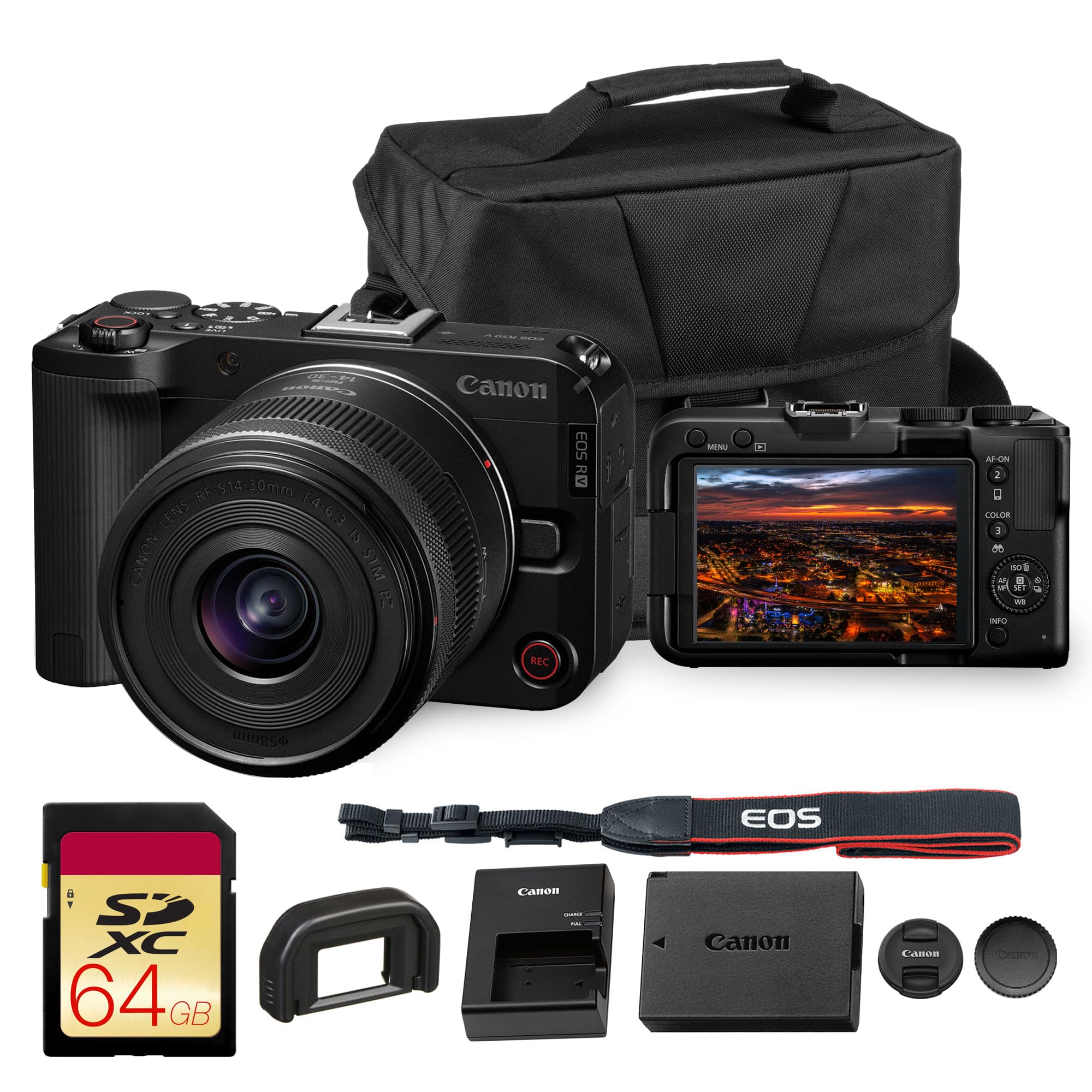
Canon designed the R50 V specifically for content creators who want a compact body with modern connectivity and a fully articulating touchscreen. The 24.2MP APS-C CMOS sensor paired with the DIGIC X processor delivers clean 4K video at 30p and Full HD slow motion up to 120p. Dual Pixel CMOS AF with eye and face detection works reliably for both stills and video, making it simple to stay in focus while moving the camera for vlogging walkthroughs.
The kit includes an RF-S 14-30mm f/4-6.3 IS STM PZ lens with power zoom, which provides a versatile wide-angle range for interior real estate, group shots, and handheld self-recording. Built-in image stabilization on the lens compensates for minor hand shake, though you cannot swap to non-stabilized lenses without noticing the lack of IBIS. USB-C livestreaming to a PC or Mac is supported without additional hardware, making it a tidy desktop webcam replacement.
Maximum 4K resolution is capped at 30p — there is no 4K 60fps recording option. The plastic lens mount feels less sturdy than metal mounts found on higher-tier RF bodies. The small grip is challenging for users with larger hands to hold comfortably for extended periods, and the lack of a built-in flash limits flexibility in dim indoor settings. For pure 4K 60fps performance this isn’t the right tool, but for lightweight 4K 30p vlogging with a friendly menu, it’s an excellent entry point into the RF ecosystem.
Why it’s great
- Fully articulating flip screen and vertical video mode simplify content creation for social platforms.
- Compact RF-S lens with power zoom provides wide-angle versatility for vlogging and travel.
- Dual Pixel CMOS AF delivers accurate eye and face detection for both stills and video.
Good to know
- No 4K 60fps recording option; maximum video frame rate is 4K 30p.
- Plastic lens mount is less durable than metal mounts on higher-end RF cameras.
- Small grip design is uncomfortable for users with larger hands during long shooting sessions.
7. Panasonic LUMIX G85 Mirrorless Camera

The G85 remains a popular entry-level mirrorless camera precisely because it bundles professional-grade Dual I.S. 2 stabilization into a weather-sealed body at a mid-range price. The 16MP Micro Four Thirds sensor with no low-pass filter resolves sharper detail than earlier 16MP MFT sensors, and the 5-axis in-body stabilization works with both photo and video, producing remarkably stable handheld 4K footage without the need for a gimbal.
Video features are built around 4K QFHD recording at 30fps, with unique tools like 4K Photo mode (30fps burst extraction) and Post Focus that let you pull stills from video or adjust focus point after capture. The electronic viewfinder has 2.36 million dots with 100% coverage, and the 3-inch tilt-and-touch LCD is responsive for menu navigation and touch-to-focus. The 12-60mm kit lens covers a useful range for general shooting, with OIS that pairs with the IBIS for even smoother results.
Maximum video resolution is 4K at 30fps — this camera does not support 4K 60fps recording. Autofocus is contrast-detect only, which hunts noticeably in low-light conditions when shooting video at 4K. Battery life is also below average, typically delivering around 300 shots or roughly 80 minutes of continuous video recording. The G85 is a solid stabilisation-first option for vloggers and beginner hybrid shooters who prioritise smooth handheld footage over raw 4K frame rate capabilities.
Why it’s great
- 5-axis IBIS combined with lens OIS provides class-leading Dual I.S. 2 stabilization for smooth handheld video.
- Weather-sealed magnesium alloy body offers durability and environmental protection at this price point.
- 4K Photo and Post Focus modes are genuinely useful hybrid tools for extracting stills from video.
Good to know
- 4K recording is limited to 30fps; 4K 60fps is not supported by the sensor or processor.
- Contrast-detect autofocus hunts and struggles in low-light video scenarios.
- Battery life is below average, especially when recording continuous 4K video.
8. OBSBOT Tail Air NDI Streaming Camera

The Tail Air is a specialised PTZ camera that brings AI-powered auto-tracking to live streaming and content creation at a significantly lower price than traditional broadcast PTZ solutions. It tracks humans, animals, and objects using upgraded AI that follows subjects automatically with smooth 320° pan and 180° tilt rotation. The integrated AI Director function can autonomously frame and zoom, making it ideal for solo presenters, church services, and lecture capture where no camera operator is available.
Connectivity is comprehensive: Micro HDMI, USB-C, Ethernet (Power over Ethernet), and Wi-Fi are all built in, supporting RTMP, RTSP, and VISCA protocols for direct streaming to YouTube, Twitch, or Facebook without a separate capture device. NDI support is available via a separately purchased license, allowing network-based multi-camera production. The companion OBSBOT Start app gives full manual control over exposure, white balance, and AI tracking behaviour from a smartphone or tablet.
The camera records internal 4K footage to a microSD card, but the internal battery has a known reliability issue — multiple long-term owners report the battery failing after 12-18 months, rendering the camera unusable even when connected to power. This is a critical design flaw that makes the camera effectively disposable on a fixed lifecycle. The maximum 4K frame rate is 30fps, not 60fps. For users who need reliable 4K 60fps recording, this is not the correct device. For autonomous PTZ tracking at 1080p 60fps, it is a unique and powerful tool.
Why it’s great
- AI auto-tracking for humans, animals, and objects eliminates the need for a dedicated camera operator.
- Multiple connectivity options (HDMI, USB-C, Ethernet, Wi-Fi) with RTMP/RTSP/VISCA support enable versatile streaming workflows.
- NDI compatibility (license purchased separately) allows seamless integration into professional network-based production systems.
Good to know
- Internal battery has a known failure issue after 12-18 months, and the camera is inoperable without a functioning battery.
- Maximum 4K recording resolution is 30fps; 4K 60fps is not supported.
- NDI license requires an additional purchase beyond the initial camera price.
9. DJI Osmo Nano Standard Combo (128GB)
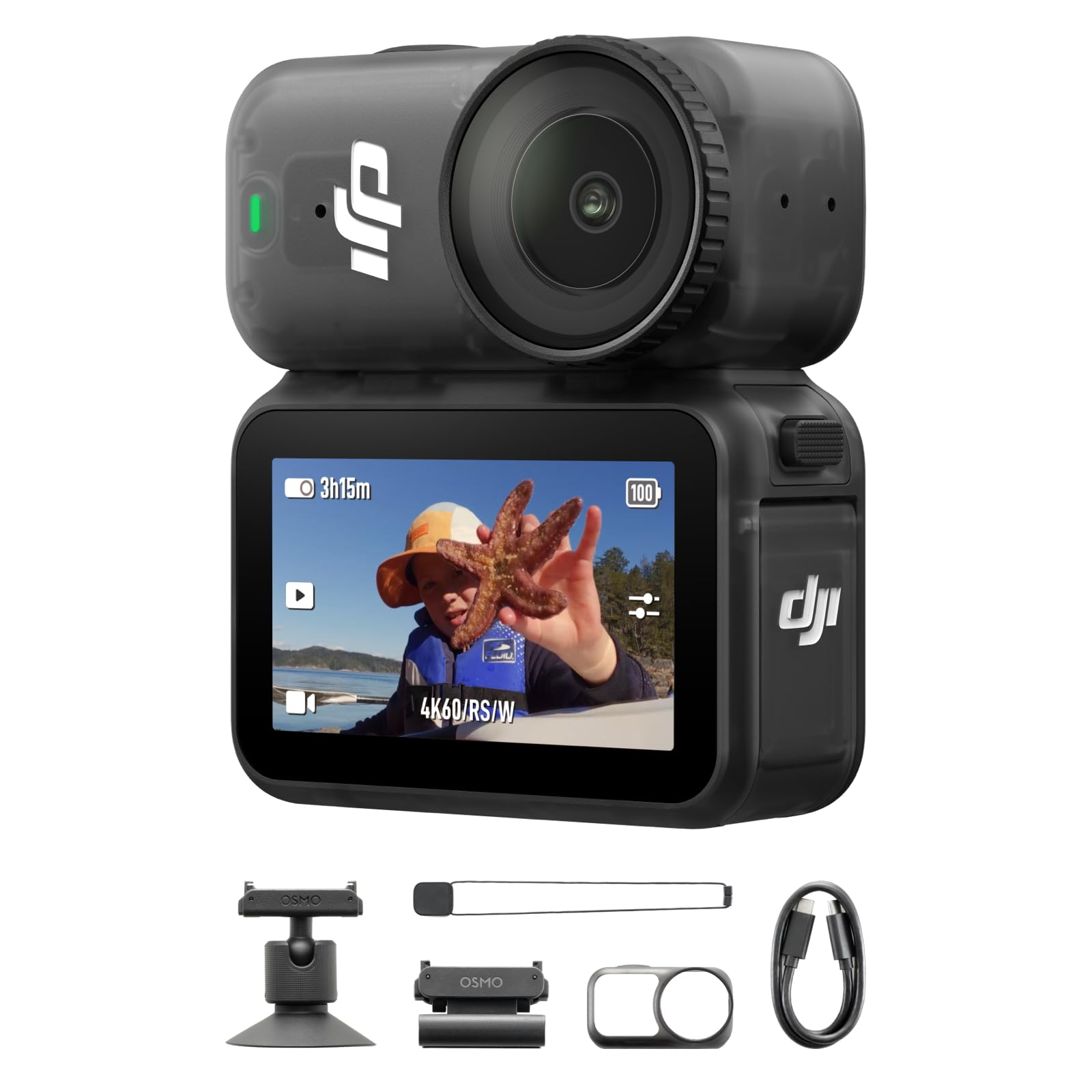
The Osmo Nano is designed for pocketable action and POV filming, leveraging a 1/1.3-inch sensor to capture 4K/60fps footage with a 143° ultra-wide field of view. This sensor size is unusually large for a camera this small, allowing better low-light performance and dynamic range than typical smartphone-sized sensors found in budget action cameras. The magnetic mounting system with accessories like the lanyard mount and hat clip makes it exceptionally easy to attach to bags, helmets, or clothing for hands-free recording.
Built-in 128GB storage means you can start recording immediately without buying a separate memory card, and the microSD expansion slot adds capacity for longer shoots. The 200-minute total battery life is achieved through the Vision Dock, which functions as both a charger and extended battery pack. DJI’s OsmoAudio supports direct connection to two microphones, providing clean, original-quality audio for vlogging without external recorders. The camera is waterproof to 10 meters, making it suitable for surface-level water sports.
Recording in 4K 60fps generates heat inside the compact body, and built-in overheat protection will automatically stop recording to protect the hardware — you can enable Endurance Mode for longer sessions at reduced performance. The magnetic clips can be dislodged during high-impact activities like mountain biking or skiing, so a secure mount is essential for action sports. For everyday POV vlogging, the Nano hits a unique sweet spot between an action camera and a dedicated vlogging camera at a competitive price.
Why it’s great
- 1/1.3-inch sensor captures superior 4K 60fps footage with better low-light performance than typical action cameras.
- Magnetic mounting system with various accessories enables truly hands-free POV recording.
- 128GB built-in storage plus microSD expansion offers immediate recording capability without extra purchases.
Good to know
- Compact body generates heat during 4K 60fps recording, triggering overheat protection and stopping the clip.
- Magnetic clips may dislodge during high-impact activities without additional secure mounting.
- DJI Mimo app has been removed from Google Play, requiring direct download from DJI’s website for Android users.
10. Canon EOS Rebel T7 DSLR Kit
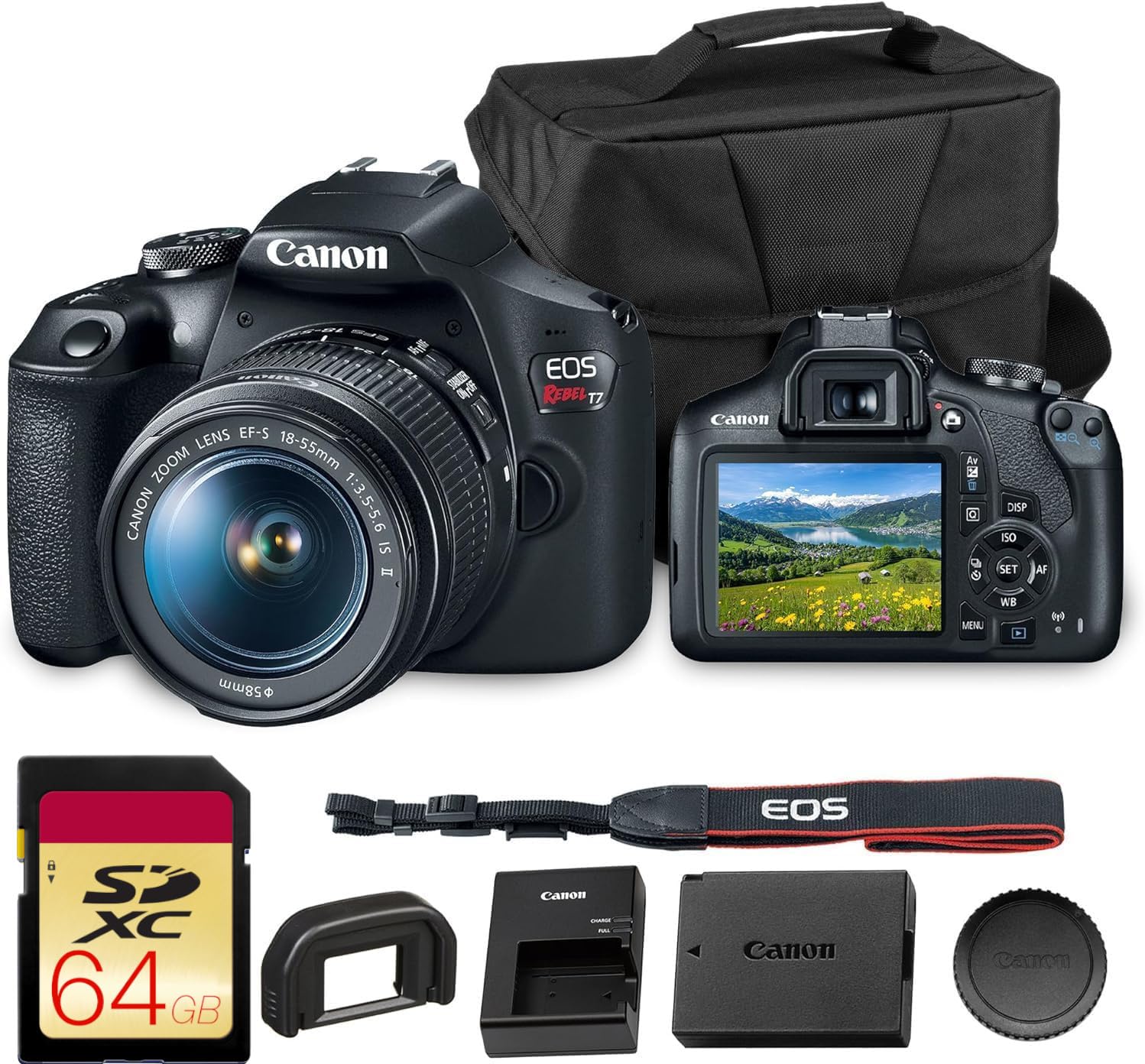
The Rebel T7 is a beginner-focused DSLR that prioritises ease of use and still photography over advanced video features. Its 24.1MP APS-C sensor and DIGIC 4+ processor produce decent image quality for entry-level photographers capturing family events, school sports, and travel stills. The included 18-55mm kit lens covers a basic zoom range, and the optical viewfinder provides a traditional DSLR shooting experience that many newcomers prefer over through-the-lens display.
Built-in Wi-Fi and NFC enable wireless photo transfer to a smartphone via the Canon Camera Connect app, making it simple to share images on social media. The bundle includes a shoulder bag and 64GB memory card, giving a new photographer everything needed to start shooting straight out of the box. The camera is compatible with the full Canon EF and EF-S lens ecosystem, providing a clear upgrade path as skills develop.
The Rebel T7 does not record 4K video at any frame rate — maximum video resolution is Full HD 1080p at 30fps, making it unsuitable for anyone specifically seeking a 4K 60fps video camera. The 9-point autofocus system is slow and audible in video mode, further limiting its usability for moving subjects. The LCD screen is a fixed 3.0-inch panel with a relatively low 920K dot resolution. For pure still photography on a tight budget it works acceptably, but video-focused buyers should cross this off their list.
Why it’s great
- Bundle includes bag, memory card, and all accessories needed to start shooting immediately out of the box.
- 24.1MP APS-C sensor with DIGIC 4+ produces acceptable image quality for beginner still photographers.
- Full compatibility with Canon EF and EF-S lenses provides a clear and affordable upgrade pathway.
Good to know
- Does not support 4K video recording at any frame rate, making it unsuitable for video-first buyers.
- 9-point autofocus system is slow and produces audible noise during video recording.
- Fixed LCD screen with low resolution limits live-view composing and video monitoring.
FAQ
Does 4K 60fps footage require a V60 or V90 memory card for stable recording?
What causes the ‘overheat’ warning on mirrorless cameras when recording 4K 60fps continuously?
Final Thoughts: The Verdict
For most users, the 4k 60fps video camera winner is the Canon EOS R8 because its uncropped full-frame oversampled 4K 60p, Dual Pixel AF II, and 10-bit C-Log 3 recording deliver professional image quality at a price that undercuts the competition. If you need internal raw recording and 4K 120p slow motion, grab the Nikon Z6 III. And for studio-grade audio, servo zoom, and uncompromised event recording, the Canon XA70 remains the most purpose-built camcorder in this comparison.