
A 4K AV receiver is the central nervous system of any serious home theater. It routes your video sources, decodes object-based surround sound, and powers your entire speaker array—all while demanding you navigate a thicket of HDMI 2.1 ports, room correction suites, and channel counts. The wrong pick leaves you with a system that never sounds quite right, while the right one delivers cinematic immersion for years.
I’m Min — the co-founder and writer behind Gadgets Feed. I’ve spent weeks cross-referencing channel configurations, HDMI bandwidth specs, room-correction algorithms, and real-world user experiences to separate the genuinely capable units from the ones that just look good on paper.
This guide cuts through the noise to deliver a clear, spec-backed verdict on the best 4k av receiver for every kind of buyer, from the space-constrained apartment dweller to the dedicated home theater builder chasing reference-quality sound.
How To Choose The Best 4K AV Receiver
Selecting a 4K AV receiver is a decision that ties directly to your current speaker configuration, your TV’s capabilities, and your gaming or movie-watching habits. Three factors dominate every serious buying decision.
Channel Count and Your Speaker Layout
The first number—7.2, 9.2, or 5.2—tells you how many speakers the receiver can power and how many subwoofer outputs it offers. A 5.2-channel receiver drives a standard 5.1 setup with a second subwoofer output, while a 7.2-channel unit supports either a 7.1 layout or a 5.1.2 Atmos configuration with two height or ceiling speakers. If you plan to build a 5.1.4 or 7.2.4 system, you need a 9.2-channel receiver with pre-outs for an external amplifier. Count your planned speakers before you count the channels on the spec sheet.
HDMI 2.1 Features and Bandwidth
HDMI 2.1 isn’t a single checkbox. The bandwidth matters: 40 Gbps supports 4K/120Hz and 8K/60Hz with 10-bit color, while 48 Gbps allows full uncompressed 12-bit signals. Variable Refresh Rate (VRR) and Auto Low Latency Mode (ALLM) are essential for gamers who want tear-free, low-lag gameplay. Quick Frame Transport (QFT) reduces latency further. Verify that the receiver’s HDMI inputs explicitly list 4K/120Hz if you own a PlayStation 5 or Xbox Series X.
Room Correction and Calibration Quality
Room correction software is what turns decent hardware into a great-sounding system. Dirac Live, sold as a premium upgrade on many receivers, offers sophisticated time-domain correction and is widely considered the most effective system at taming room modes. YPAO R.S.C. with multipoint measurement from Yamaha does an excellent job for non-enthusiasts. Denon’s Audyssey MultEQ XT is solid for mid-range models, while Sony’s Digital Cinema Auto Calibration IX provides fast, effective calibration for its ecosystem. A receiver may boast high wattage, but without good room correction, that power is wasted on standing waves and muddied bass.
Quick Comparison
On smaller screens, swipe sideways to see the full table.
| Model | Category | Best For | Key Spec | Amazon |
|---|---|---|---|---|
| Denon AVR-S970H | Mid-Range | Balanced performance & connectivity | 90W x 7, 8K/60Hz, HEOS Multi-Room | Amazon |
| Yamaha RX-A4A AVENTAGE | Premium | High-end build & Surround:AI | 7.2 ch, 8K/60Hz, Auro-3D, Pre-outs | Amazon |
| Sony STR-AN1000 | Mid-Range | 360 Spatial Sound Mapping | 7.2 ch, 8K/60Hz, DCS Calibration IX | Amazon |
| Onkyo TX-NR7100 | Mid-Range | Dirac Live room correction | 9.2 ch, 100W/ch, THX, Dirac Live | Amazon |
| Denon AVR-S770H | Mid-Range | Entry-level 8K & gaming features | 75W x 7, 8K/60Hz, HEOS, Audyssey | Amazon |
| Yamaha RX-V6A | Mid-Range | Reliable all-around 7.2 performance | 7.2 ch, 8K/60Hz, MusicCast, YPAO | Amazon |
| Onkyo TX-NR6100 | Mid-Range | THX Certified value | 7.2 ch, 8K/60Hz, THX, 210W/ch | Amazon |
| JBL MA710 | Mid-Range | Compact 7.2 with phono input | 7.2 ch, 8K/60Hz, 110W/ch, Phono | Amazon |
| Marantz NR1510 | Budget | Slim 5.2 for small spaces | 5.2 ch, 4K/60Hz, 50W/ch, Slim 4″ | Amazon |
| Pioneer VSX-935 | Budget | Budget 7.2 with Height Virtualization | 7.2 ch, 8K/60Hz, Atmos Virtualization | Amazon |
| Sony STR-AZ1000ES | Premium | Reference-grade 7.2 ES lineup | 7.2 ch, 8K/60Hz, 100W/ch, 360SSM | Amazon |
In‑Depth Reviews
1. Denon AVR-S970H 8K Ultra HD 7.2 Channel AV Receiver

The Denon AVR-S970H strikes a rare balance between features and user experience. Its 90W-per-channel amplification across seven channels provides enough headroom for medium to large rooms, and the inclusion of three 8K HDMI inputs with 4K/120Hz passthrough makes it a natural partner for both current-gen consoles and future 8K displays. The HEOS multi-room platform allows seamless music streaming via Wi-Fi and Bluetooth, and the built-in phono input caters to vinyl enthusiasts without requiring an external preamp.
Setup is handled through Denon’s guided on-screen assistant, which walks you through speaker detection and Audyssey MultEQ calibration. The receiver also supports VRR, ALLM, and QFT for a smooth, tear-free gaming experience. The remote lacks a dedicated direct-input button, but the overall ease of use and robust feature set make this receiver the most versatile pick for a wide range of setups.
One minor drawback is the Zone 2 functionality: it borrows the rear surround channels, limiting the main zone to 5.1 when powered Zone 2 is active. Additionally, the HEOS app remains functional but can feel slightly clunky compared to dedicated music streaming apps. For most buyers, none of these caveats outweigh the S970H’s exceptional value proposition.
Why it’s great
- Three 8K HDMI 2.1 inputs with full gaming feature support (VRR, ALLM, QFT).
- Audyssey MultEQ room correction improves clarity across seating positions.
- Built-in phono input and HEOS multi-room streaming.
Good to know
- Powered Zone 2 uses rear surround channels, limiting main room to 5.1.
- Remote lacks dedicated input number buttons for quick switching.
- No Auro-3D or IMAX Enhanced support.
2. Yamaha RX-A4A AVENTAGE 7.2-Channel AV Receiver

The Yamaha RX-A4A belongs to the AVENTAGE line, Yamaha’s top-tier series built with a rigid chassis, anti-vibration feet, and premium component selection. It features 7.2 channels with 8K/60Hz and 4K/120Hz support on all seven HDMI inputs, and it adds Auro-3D decoding alongside Dolby Atmos and DTS:X. The Surround:AI technology analyzes audio scenes in real time and adjusts the sound field to prioritize dialogue or effects, offering a genuinely adaptive listening experience.
YPAO R.S.C. with 3D and multipoint measurement provides precise room calibration, and the receiver includes pre-outs for all channels, allowing future expansion with external amplification. The MusicCast multi-room platform is reliable and supports high-res audio up to 24-bit/192kHz. The build quality is evident in the weighted volume knob and the clean front-panel design, which eschews a front HDMI port but remains visually understated.
The setup process can be unusually involved. Firmware updates require a USB flash drive and a computer, which is a step backward from receivers that update over Wi-Fi. The remote control is dense with small buttons, and the navigation can feel convoluted initially. Once configured, however, the RX-A4A delivers audio precision that justifies its premium status.
Why it’s great
- Surround:AI dynamically optimizes sound in real time for movies and games.
- Pre-outs on all channels for future amplifier upgrades.
- Supports Auro-3D, Dolby Atmos, DTS:X and YPAO R.S.C. with 3D.
Good to know
- Firmware update requires USB drive and computer, not fully networked.
- No front HDMI input for quick device connection.
- Remote control button layout is dense and takes time to learn.
3. Sony STR-AN1000 7.2 CH 8K A/V Receiver

Sony’s STR-AN1000 brings proprietary 360 Spatial Sound Mapping technology to a mid-range price point. This system analyzes your room and creates phantom surround and height speakers from your existing layout, delivering a convincingly immersive soundstage even without ceiling-mounted speakers. The 165W-per-channel rating (at 6 ohms) provides ample power, and the six HDMI 2.1 inputs support 8K/60Hz and 4K/120Hz with VRR and ALLM, making it fully ready for PS5 and Xbox Series X.
Digital Cinema Auto Calibration IX automates the setup process, measuring speaker distances and levels in minutes. The receiver also integrates seamlessly with Sony’s Bravia TVs via S-Center Sync, which uses the TV’s speakers as a center channel for clearer dialogue. The Works with Sonos certification allows easy integration into a Sonos ecosystem, and Chromecast built-in, AirPlay 2, and Spotify Connect cover all major streaming protocols.
Some users report that the front display is difficult to read from a distance, and the remote control lacks a backlight. There is no phono input for turntable users, which may require an external preamp. Despite these omissions, the STR-AN1000’s spatial audio capabilities are genuinely impressive for its price tier, especially in rooms where physical height speakers are impractical.
Why it’s great
- 360 Spatial Sound Mapping creates convincing overhead effects without ceiling speakers.
- Full HDMI 2.1 support for 4K/120Hz gaming and 8K pass-through.
- Works with Sonos certification and extensive streaming protocol support.
Good to know
- No built-in phono input for turntable connections.
- Front display is small and hard to read from a distance.
- Remote control lacks backlighting.
4. Onkyo TX-NR7100 9.2-Channel AV Receiver
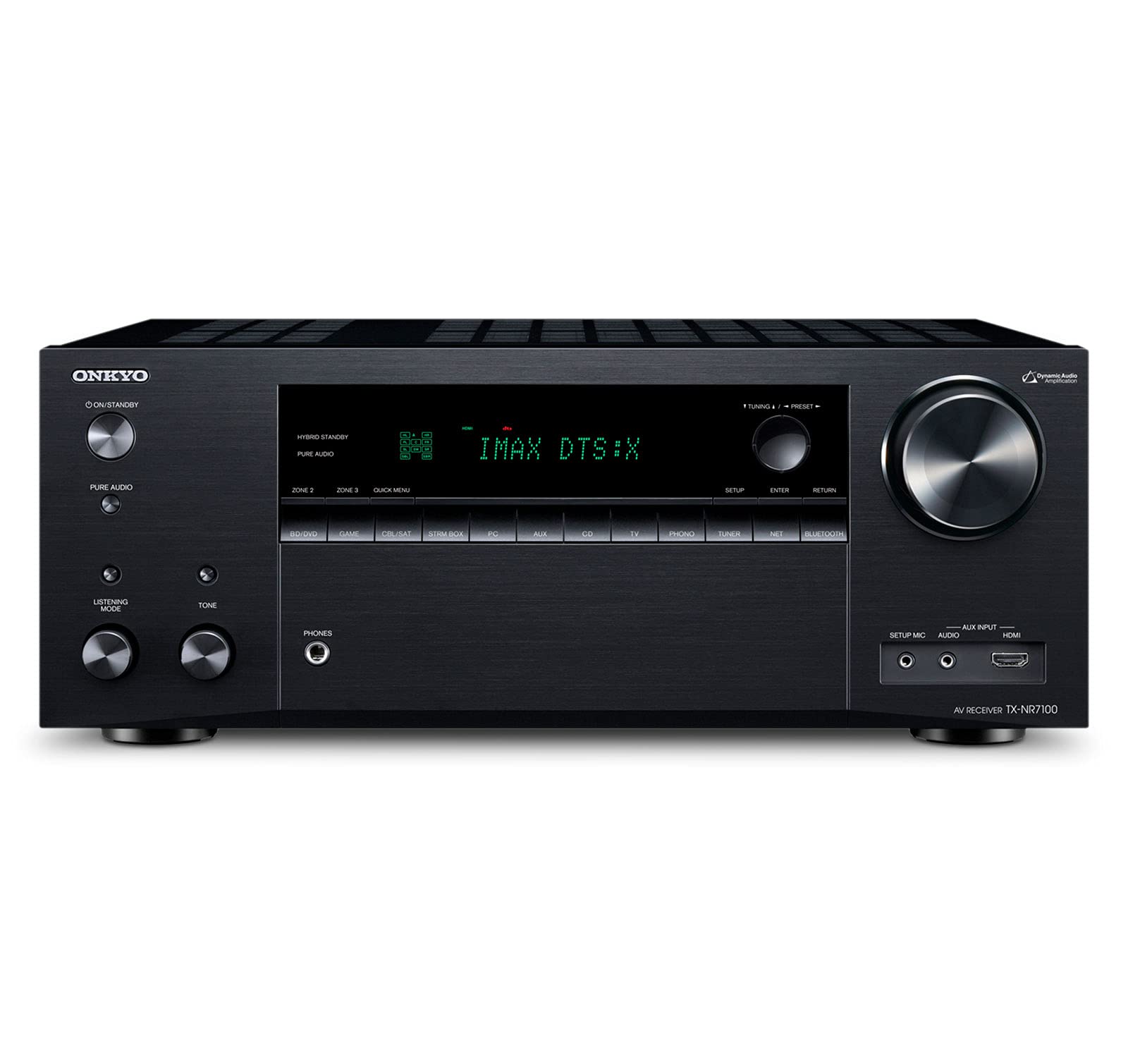
Dirac Live room correction is the headline feature on the Onkyo TX-NR7100, and it delivers a measurable improvement in bass accuracy and soundstage precision that few rivals in this price range can match. The 9.2-channel configuration supports 5.2.4 or 7.2.2 Atmos layouts, and the 100 watts per channel (all channels driven) provides clean power for a full immersive system. The receiver is also THX Certified Select, ensuring consistent performance in rooms up to 2,000 cubic feet.
On the gaming side, the TX-NR7100 offers six HDMI 2.1 inputs with 40 Gbps bandwidth, supporting 4K/120Hz, VRR, ALLM, and QFT. It also supports bi-directional Bluetooth with aptX HD for high-quality wireless headphone streaming. The Works with Sonos certification lets it integrate into a Sonos system, and the DTS Play-Fi protocol enables multi-room audio across compatible speakers.
Setup is time-consuming, particularly the Dirac Live calibration process, which requires a PC or Mac for full-bandwidth correction (the included smartphone app works but is limited to 500 Hz). The remote control is not backlit, and the front panel menus feel dated. Some units have also been reported to run warm, so adequate ventilation is essential. For buyers who prioritize room correction above all else, the TX-NR7100 is a formidable choice.
Why it’s great
- Dirac Live provides professional-grade room correction for superior sound accuracy.
- 9.2 channels support 5.2.4 or 7.2.2 Atmos setups.
- THX Certified Select ensures consistent performance in standard home theater rooms.
Good to know
- Full Dirac Live calibration requires a PC or Mac for best results.
- Remote control is not backlit.
- Some units may run warm; sufficient clearance needed.
5. Denon AVR-S770H 7.2 Ch 8K Home Theater Receiver

The Denon AVR-S770H is the most affordable entry point into the Denon 8K lineup without sacrificing core HDMI 2.1 features. Its 75W-per-channel output into 8 ohms is sufficient for a 5.1.2 Atmos configuration in a medium-sized room, and the receiver’s support for 8K/60Hz and 4K/120Hz passthrough means it will handle both current and next-generation consoles without issue. The HEOS platform is included, along with support for Dolby Vision, HDR10+, and Dynamic HDR.
Audyssey MultEQ room calibration is standard, and the on-screen setup assistant makes the initial configuration approachable even for first-time receiver buyers. The receiver also features Dolby Height Virtualization and DTS Virtual:X, allowing a 5.1 or 2.1 system to simulate overhead effects without dedicated height speakers. Voice control works with Alexa, Google Assistant, and Siri via AirPlay 2.
Some users have reported occasional volume drops to zero and picture-on-startup glitches, though firmware updates appear to have mitigated these issues over time. The remote is functional but not backlit, and the 75W-per-channel rating means it may struggle with very inefficient speakers in large rooms. For budget-conscious buyers who want true HDMI 2.1 features, the AVR-S770H remains a strong entry point.
Why it’s great
- Affordable 8K/60Hz and 4K/120Hz passthrough for next-gen gaming.
- Audyssey MultEQ calibration improves sound for any room layout.
- Dolby Height Virtualization enables convincing Atmos effects without ceiling speakers.
Good to know
- 75W/channel may lack headroom for low-sensitivity speakers in large rooms.
- Occasional firmware-related stability issues reported by some users.
- Remote control is not backlit.
6. YAMAHA RX-V6A 7.2-Channel AV Receiver

The Yamaha RX-V6A is a workhorse 7.2-channel receiver that delivers reliable performance without demanding a premium price. It supports 8K/60Hz and 4K/120Hz on three of its HDMI inputs, with HDCP 2.3 compliance and eARC. Yamaha’s YPAO R.S.C. room correction with multipoint measurement provides solid calibration, and the MusicCast multi-room platform is one of the most stable and easy-to-use systems available. Dolby Atmos with Height Virtualization and DTS:X are both supported.
Setup is straightforward via the on-screen menu, and users consistently note that the receiver produces clear dialogue, dynamic surround effects, and vibrant video processing. The RX-V6A also features a phono input for turntables and supports voice control through Alexa, Google Assistant, and Siri via AirPlay 2. The build quality is robust, with a clean front panel and a comfortable remote layout.
Some users report that eARC may not auto-turn on with every TV brand, requiring a manual input switch after power-up. The receiver’s learning curve is moderate for advanced configurations, but Yamaha’s legacy of reliability and consistent firmware support makes the RX-V6A a safe, long-term investment for buyers who value stability over flashy features.
Why it’s great
- Three HDMI 2.1 inputs with 8K/60Hz and 4K/120Hz support.
- YPAO R.S.C. multipoint calibration provides accurate room correction.
- MusicCast platform is stable, easy to use, and supports high-res audio.
Good to know
- eARC may not auto-detect with all TV brands; manual input switching sometimes needed.
- Advanced features have a moderate learning curve for new users.
- No Auro-3D support.
7. Onkyo TX-NR6100 7.2 Channel THX Certified AV Receiver
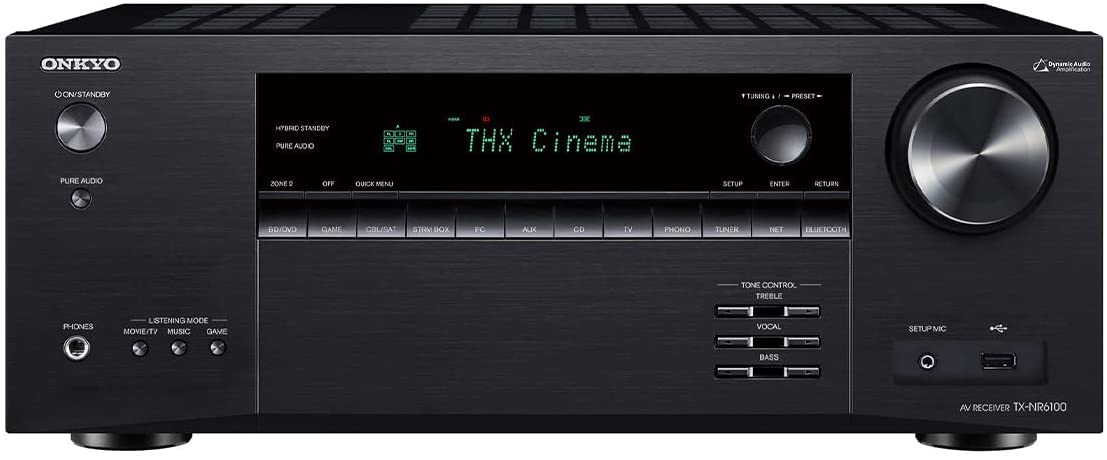
The Onkyo TX-NR6100 packs THX Select certification and a claimed 210W per channel into a 7.2-channel package that offers exceptional value for the price. It supports 5.2.2 Dolby Atmos and DTS:X playback, with three HDMI 2.1 inputs capable of 40 Gbps bandwidth for 8K/60Hz and 4K/120Hz signals. The amplifier delivers punchy, dynamic sound that pairs particularly well with high-sensitivity speakers like Klipsch reference series.
The receiver also features discrete Zone 2 video switching, allowing a different 4K source to be sent to a second room. The built-in network capabilities support Chromecast, AirPlay 2, Spotify Connect, and DTS Play-Fi. The Onkyo app allows basic control and room customization, though it is less polished than Denon’s HEOS or Yamaha’s MusicCast.
Long-term reliability has been a point of concern for some users. Isolated reports of HDMI 2.1 processor failures after extended use suggest that the unit may be less durable than some competitors. The remote lacks backlighting, and the interface is functional but not particularly visually refined. For buyers who prioritize THX certification and raw power over long-term track record, the TX-NR6100 remains a compelling option.
Why it’s great
- THX Select certification ensures reliable performance in standard home theater rooms.
- Three HDMI 2.1 inputs support 8K/60Hz and 4K/120Hz for next-gen gaming.
- Discrete Zone 2 video switching for independent second-room viewing.
Good to know
- Some reports of HDMI 2.1 processor failures over extended use.
- Remote control is not backlit.
- Onkyo app is less polished compared to HEOS or MusicCast.
8. JBL MA710 7.2 Channel 8K AV Receiver

The JBL MA710 distinguishes itself with a remarkably shallow chassis—just 4.3 inches deep—making it one of the few 7.2-channel receivers that fits easily into a standard media console without protruding from the back. Despite its slim profile, it delivers 110 watts per channel into 7 channels and supports 8K/60Hz passthrough with Dolby Atmos, DTS:X, and a moving magnet phono input. The six HDMI inputs include one output with eARC, and the unit supports Bluetooth, Apple AirPlay 2, and Google Chromecast for streaming.
Setup is reasonably straightforward, though an initial firmware update is required during first power-on. The on-screen GUI appears only through the HDMI output, making initial configuration impossible without a connected TV. The MA710 drives standard floor-standing speakers and bookshelf pairs with authority, delivering clean sound that belies its compact dimensions. The built-in phono stage is a welcome addition for vinyl listeners.
The remote is not backlit, which is a common complaint across this price tier, and the auto-shutoff timer defaults to 20 minutes, requiring a manual change through the menu. Some users also report that the unit does not mix down DTS-HD Master Audio to 2.1, making it less suitable for stereo-only setups with Blu-ray audio. For buyers with tight depth constraints, however, the MA710’s form factor is a rare and valuable asset.
Why it’s great
- Extremely shallow 4.3-inch depth fits in tight media consoles.
- 110W per channel provides solid headroom for most speakers.
- Built-in moving magnet phono input for turntables.
Good to know
- Remote control is not backlit.
- Auto shut-off timer defaults to 20 minutes and must be manually changed.
- Does not downmix DTS-HD Master Audio to 2.1 for stereo setups.
9. Marantz NR1510 UHD AV Receiver – Slim 5.2 Channel

The Marantz NR1510 is a 5.2-channel receiver designed for those who need high-quality audio in a tight space. Standing just 4.1 inches tall, it fits into shallow cabinets and open shelving where full-height receivers simply cannot go. While its 50 watts per channel into 8 ohms is modest, it is enough for efficient bookshelf or in-wall speakers in a small to medium-sized room. The unit supports 4K/60Hz with HDCP 2.2, HDR, Dolby Vision, and eARC, but it does not support 8K or 4K/120Hz.
Marantz includes its setup assistant, a clear on-screen guide that walks through input mapping and speaker calibration. The HEOS platform enables multi-room audio and streaming from Spotify, TIDAL, and other services. The built-in phono input and analog inputs provide flexibility for legacy audio sources. The build quality is excellent, with a brushed aluminum front panel and a clean, symmetrical design that looks refined in any setting.
The 5.2-channel limitation means you cannot expand to a full Atmos system with height speakers—this is strictly a 5.1 or 5.2 layout. The HDMI ports are limited to 4K/60Hz, so next-gen console owners cannot use 4K/120Hz. Finally, the unit runs noticeably warm during extended use, so ventilation is critical. For a secondary room, a dedicated audio setup, or a minimalist living room, the NR1510 is a class-leading slim option.
Why it’s great
- Ultra-slim 4.1-inch height fits in tight spaces where full-size receivers cannot.
- Excellent build quality with a brushed aluminum front panel and refined design.
- Built-in phono input and HEOS multi-room streaming.
Good to know
- Limited to 5.2 channels; no Atmos height channel support.
- No 8K or 4K/120Hz support; max 4K/60Hz.
- 50W per channel may lack headroom for low-sensitivity speakers or large rooms.
10. Pioneer VSX-935 7.2 Channel Network Receiver
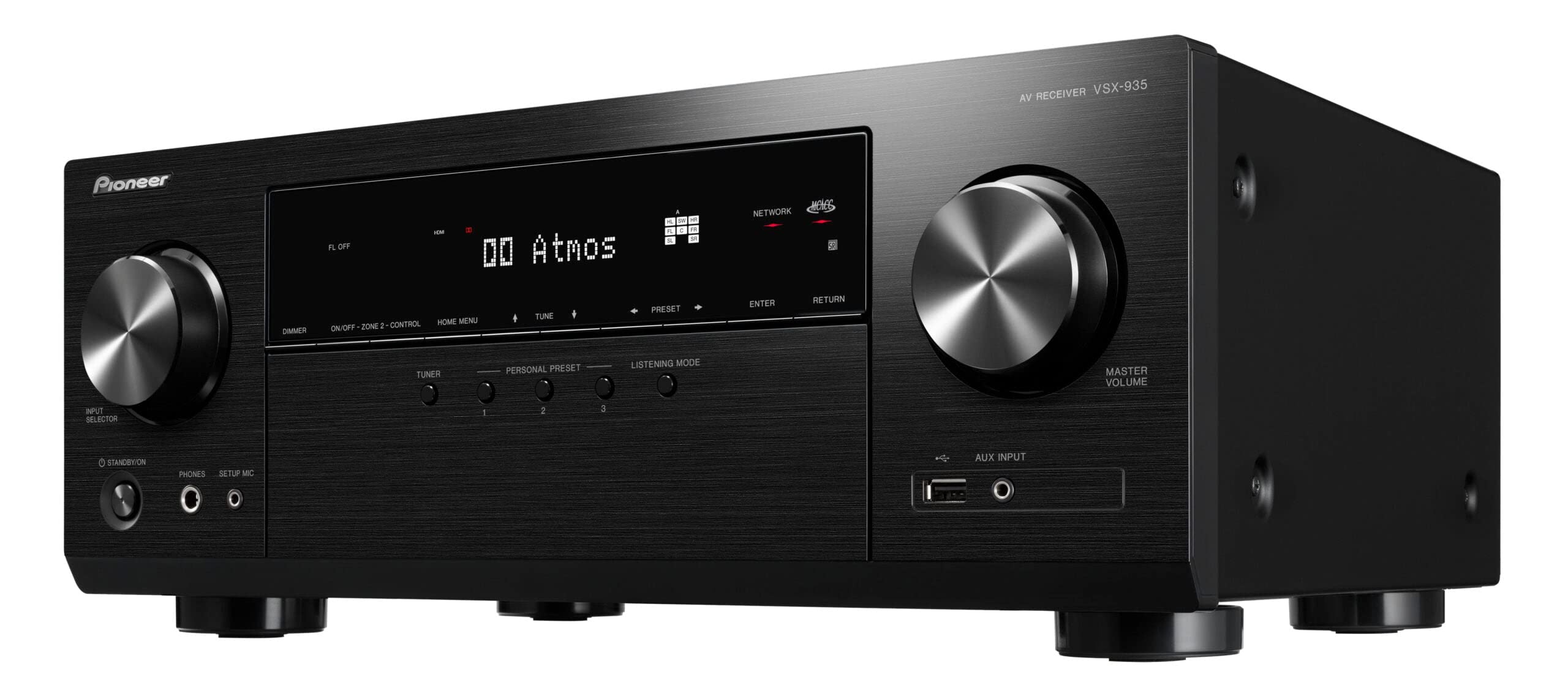
The Pioneer VSX-935 offers a full 7.2-channel complement with Dolby Atmos Height Virtualization at an entry-level price point. The virtualization technology creates a convincing sense of height and surround from a standard 5.1 or 7.1 speaker layout without requiring ceiling-mounted speakers. It also supports 8K/60Hz pass-through on its HDMI inputs, though it does not include the full HDMI 2.1 gaming feature set like VRR or ALLM.
Sound quality is crisp and clear, with good detail retrieval for both movies and music. The dual-zone output allows independent audio in a second room, and the built-in Wi-Fi and Bluetooth support streaming from popular services. The remote is RF-based, which means it works without line-of-sight—a minor but appreciated convenience. The front-panel display is clear and includes a dimmer for dark rooms.
Firmware usability is a weak point. Bluetooth implementation is reportedly cumbersome, buried in menus with no dedicated remote button. Some users have received DOA units and replacements with minor defects, suggesting inconsistent quality control. The interface also looks a generation older than competitors from Yamaha and Denon. For buyers on a tight budget who need a 7.2-channel count with height virtualization, the VSX-935 gets the job done at a low barrier to entry.
Why it’s great
- Dolby Atmos Height Virtualization creates immersive effects without ceiling speakers.
- RF remote works without line-of-sight.
- Full 7.2 channel support at a budget-friendly price.
Good to know
- Bluetooth functionality is cumbersome to access and control.
- Occasional DOA or defective units reported by users.
- No HDMI 2.1 gaming features like VRR or ALLM.
11. Sony STR-AZ1000ES Premium ES 7.2 CH 8K A/V Receiver

The Sony STR-AZ1000ES is the entry point into Sony’s Elite Series (ES) lineup, which prioritizes build quality, acoustic accuracy, and custom integration. The receiver delivers 100 watts per channel into 7 channels (8 ohms, 2ch driven) and includes all the processing power of the STR-AN1000, including 360 Spatial Sound Mapping and Digital Cinema Auto Calibration IX. The six HDMI 2.1 inputs support 8K/60Hz and 4K/120Hz, though the ES series omits HDR10+ support.
The backlit remote control is a welcome upgrade over Sony’s non-ES models, and the front panel includes a discreet cover plate that hides inputs for a clean, professional look. The unit also supports Works with Sonos, Chromecast built-in, AirPlay 2, and Spotify Connect. Setup can be performed via the on-screen GUI, a web browser interface, or a dedicated iPhone app, providing exceptional flexibility for custom installers.
The receiver runs very hot during operation, and Sony recommends active cooling solutions like the AC Infinity Aircom T10 for rack installations. Some high-end features like HDR10+ and QMS (Quick Media Switching) are absent, which may matter for buyers with compatible displays. For those building a dedicated home theater with Sony TV and speakers, the STR-AZ1000ES delivers cohesive, audiophile-quality performance backed by Sony’s robust ES build standards.
Why it’s great
- 360 Spatial Sound Mapping and DCS Calibration IX deliver exceptional surround immersion.
- Backlit remote control and front panel cover plate for a clean aesthetic.
- Multiple setup interfaces (GUI, web browser, iOS app) for custom integrators.
Good to know
- Runs very hot; active cooling is recommended in enclosed spaces.
- No HDR10+ or QMS support.
- Not expandable to 11 channels without external amplification.
FAQ
What is the difference between 5.2.2 and 7.2.4 channel configurations?
Do I need a 9.2-channel receiver for a good Dolby Atmos experience?
Can I use a 4K AV receiver with an older 1080p TV?
What does eARC do that regular ARC does not?
Final Thoughts: The Verdict
For most users, the best 4k av receiver winner is the Denon AVR-S970H because it delivers the complete package—8K HDMI 2.1 support, 90W per channel, HEOS multi-room streaming, and a phono input—at a price that undercuts many competitors with fewer features. If you want the most advanced room correction available for under a thousand dollars, grab the Onkyo TX-NR7100 and its included Dirac Live software. And for a compact, high-performance system in a tight media console, nothing beats the JBL MA710‘s shallow depth and clean power delivery.