
Moving from a flat 27-inch 1440p panel to a curved 4K monitor changes how you see your desktop. The curvature, typically 1000R or 1800R, wraps the screen edges into your peripheral vision, reducing eye saccades during long productivity sessions and pulling you deeper into game worlds. But with panel types spanning VA, Mini-LED, and QD-OLED, and refresh rates climbing past 240Hz, the choice is far from simple.
I’m Min — the co-founder and writer behind Gadgets Feed. I’ve spent hundreds of hours analyzing panel technologies, refresh rate implementations, and HDR certification nuances across the current curved 4K monitor market to cut through the marketing claims and identify which models deliver a real daily upgrade.
If you want a display that combines immersive curvature with pixel-dense detail, the best 4k curved monitor for your setup depends on whether you prioritize motion clarity, color accuracy, or sheer screen real estate.
How To Choose The Best 4K Curved Monitor
Choosing the right curved 4K monitor means balancing three elements: panel technology determines black levels and HDR quality; curvature radius dictates how natural the screen feels in your field of view; and connectivity (HDMI 2.1 bandwidth, DisplayPort version) dictates whether you can actually run the panel at its full refresh rate. Beginners often assume a higher curvature number means more immersion, but a 1000R curve at 49 inches is a completely different experience than a 1800R curve at 32 inches.
Panel Technology: VA vs Mini-LED vs QD-OLED
The panel is the single biggest factor in image quality. VA panels offer decent contrast without the risk of burn-in, making them a reliable choice for mixed-use desks where static UI elements are common. Mini-LED panels like those in Samsung’s Neo G8 use thousands of local dimming zones to approach OLED-like contrast with much higher sustained brightness — critical for HDR content in bright rooms. QD-OLED panels deliver the best color volume and true black levels but require burn-in mitigation features like pixel refresh cycles and taskbar hiding.
Curvature: 1000R vs 1500R vs 1800R
The curvature number refers to the radius of the circle the curve would form if completed. A 1000R curve is tighter, meaning the edges of the screen point more directly at your eyes. For a 32-inch monitor, a 1000R curve can feel aggressive and cause a temporary tunnel vision effect until your brain adapts. At 49 inches, 1000R is nearly essential to keep both screen edges in your peripheral vision. 1800R is gentler and more natural for a 34-inch ultrawide, reducing geometric distortion on straight lines.
Refresh Rate and GPU Requirements
Driving a 4K curved monitor at 240Hz requires significantly more GPU horsepower than a standard 60Hz panel. A 4K 240Hz signal demands DisplayPort 1.4 with Display Stream Compression (DSC) or HDMI 2.1. If your graphics card lacks these outputs, you will be limited to lower refresh rates even if the monitor can go higher. For mid-range GPUs like the RTX 4070, targeting 120-144Hz at 4K is realistic, while the RTX 4090 can push closer to 240Hz in many titles.
Quick Comparison
On smaller screens, swipe sideways to see the full table.
| Model | Category | Best For | Key Spec | Amazon |
|---|---|---|---|---|
| MSI MPG 321URX | QD-OLED | Best all-around 4K gaming | 32″ | 240Hz | 0.03ms | Amazon |
| ASUS ROG Swift PG32UCDM | QD-OLED | Premium gaming with Dolby Vision | 32″ | 240Hz | Custom heatsink | Amazon |
| Samsung Odyssey Neo G8 G85NB | Mini-LED VA | High brightness HDR gaming | 32″ | 240Hz | 2000 nits | Amazon |
| LG 32GX850A-B UltraGear | WOLED | Dual-mode 4K/FHD switching | 32″ | 165Hz | 0.03ms | Amazon |
| Alienware AW3423DWF | QD-OLED | Immersive ultrawide gaming | 34″ | 165Hz | 1800R | Amazon |
| Alienware AW3425DW | QD-OLED | Ultrawide with 240Hz refresh | 34″ | 240Hz | 1800R | Amazon |
| Samsung Odyssey G9 G91F | VA | Super-ultrawide multitasking | 49″ | 144Hz | 32:9 | Amazon |
| INNOCN 49Q1S OLED | OLED | Super-ultrawide OLED | 49″ | 240Hz | 1800R | Amazon |
| Philips Evnia 34M2C6500 | QD-OLED | Mid-range QD-OLED ultrawide | 34″ | 175Hz | 1800R | Amazon |
| Acer Predator X32 | QD-OLED | 16:9 curved 4K OLED | 32″ | 240Hz | 1700R | Amazon |
| CRUA 32″ Curved 4K | VA | Budget-friendly 4K gaming | 32″ | 240Hz | 1500R | Amazon |
In‑Depth Reviews
1. MSI MPG 321URX QD-OLED

The MSI MPG 321URX strikes the ideal balance between price, performance, and feature set for a 32-inch 4K curved gaming monitor. Its QD-OLED panel delivers a 3840×2160 resolution at 240Hz with a 0.03ms GtG response time, backed by VESA DisplayHDR True Black 400 certification. The color accuracy is factory-calibrated to Delta E ≤ 2, and the 99% DCI-P3 coverage makes this panel equally suitable for color-critical creative work.
Connectivity is generous: two HDMI 2.1 ports support full 48Gbps bandwidth for console gaming, while the DisplayPort 1.4a and a USB-C port with 90W power delivery cover PC and laptop needs. OLED Care 2.0 provides burn-in mitigation, and the KVM function with PiP/PbP simplifies multi-device setups. The stand offers full height, tilt, and swivel adjustment.
Users consistently praise the HDR performance, describing colors as “breathtakingly beautiful” and noting a massive upgrade over IPS and VA panels. The only compromise is the large base footprint, which requires a deep desk to accommodate the stand. For a pure 32-inch 4K curved QD-OLED experience, this is the reference point.
Why it’s great
- Factory-calibrated Delta E ≤ 2 out of the box
- 240Hz with 0.03ms response for fluid motion
- USB-C with 90W PD for single-cable laptop connection
- Full HDMI 2.1 bandwidth (48Gbps) for consoles
Good to know
- Stand base is wide and consumes significant desk depth
- Requires DisplayPort DSC for full 4K 240Hz 10-bit
- No built-in speakers
2. ASUS ROG Swift PG32UCDM

The ASUS ROG Swift PG32UCDM uses a custom heatsink and graphene film for thermal management, which reduces the risk of burn-in and allows the QD-OLED panel to maintain consistent brightness levels during extended sessions. The 32-inch 4K UHD display runs at 240Hz with a 0.03ms response time, and the glossy screen coating delivers exceptional clarity and color pop compared to matte alternatives.
This monitor supports both FreeSync Premium Pro and G-SYNC Compatible adaptive sync, and it includes Dolby Vision HDR support — a rarity among gaming monitors. The VESA DisplayHDR 400 True Black certification ensures deep blacks, and the 99% DCI-P3 gamut with true 10-bit color depth produces smooth gradients without banding. The 100x100mm VESA mount is included, along with a 1/4-inch tripod socket for streaming setups.
Users consistently rank this as the best monitor they have ever used, noting that the glossy finish reduces reflections better than expected while delivering “zero-nit blacks” and brilliant highlights. The three-year warranty with burn-in coverage provides peace of mind. The premium cost and the lack of built-in speakers are the main trade-offs.
Why it’s great
- Custom heatsink and graphene film for OLED longevity
- Dolby Vision HDR support for media consumption
- Glossy QD-OLED panel with exceptional clarity
- Three-year warranty with burn-in protection
Good to know
- Glossy finish may reflect ambient light in sunny rooms
- No built-in speakers
- Premium pricing above direct competitors
3. Samsung Odyssey Neo G8 G85NB

The Samsung Odyssey Neo G8 is the only monitor in this lineup that combines a true 4K 3840×2160 resolution with a 240Hz refresh rate and a 1000R curvature. Its Quantum Mini-LED panel with 1,196 local dimming zones delivers a peak brightness of 2000 nits — far exceeding any OLED in this list — which makes it ideal for bright rooms and HDR content that demands specular highlights.
The matte display coating absorbs ambient light reflections, keeping you focused during competitive gaming. The VA panel provides a 1,000,000:1 contrast ratio with local dimming enabled, approaching OLED black levels in dark scenes. Adaptive sync supports both AMD FreeSync Premium Pro and G-SYNC Compatible, though some users report scan lines at 240Hz that disappear when dropping to 120Hz.
Users describe the blacks as “near-OLED quality” and note that the 1000R curve takes about two weeks to fully adjust to but becomes natural afterward. The panel’s 1ms GTG response time ensures minimal ghosting. The main concerns are QC variance — some units arrive with dead pixels or scan lines — and the small, hard-to-find OSD buttons underneath the bezel.
Why it’s great
- 2000 nits peak brightness for brilliant HDR highlights
- 1,196-zone Mini-LED for excellent local dimming
- Aggressive 1000R curve for deep immersion
- Matte screen eliminates reflections
Good to know
- Potential scan line artifact at 240Hz on some units
- 1000R curve may feel unnatural for the first week
- OSD joystick is small and placed awkwardly
4. LG 32GX850A-B UltraGear
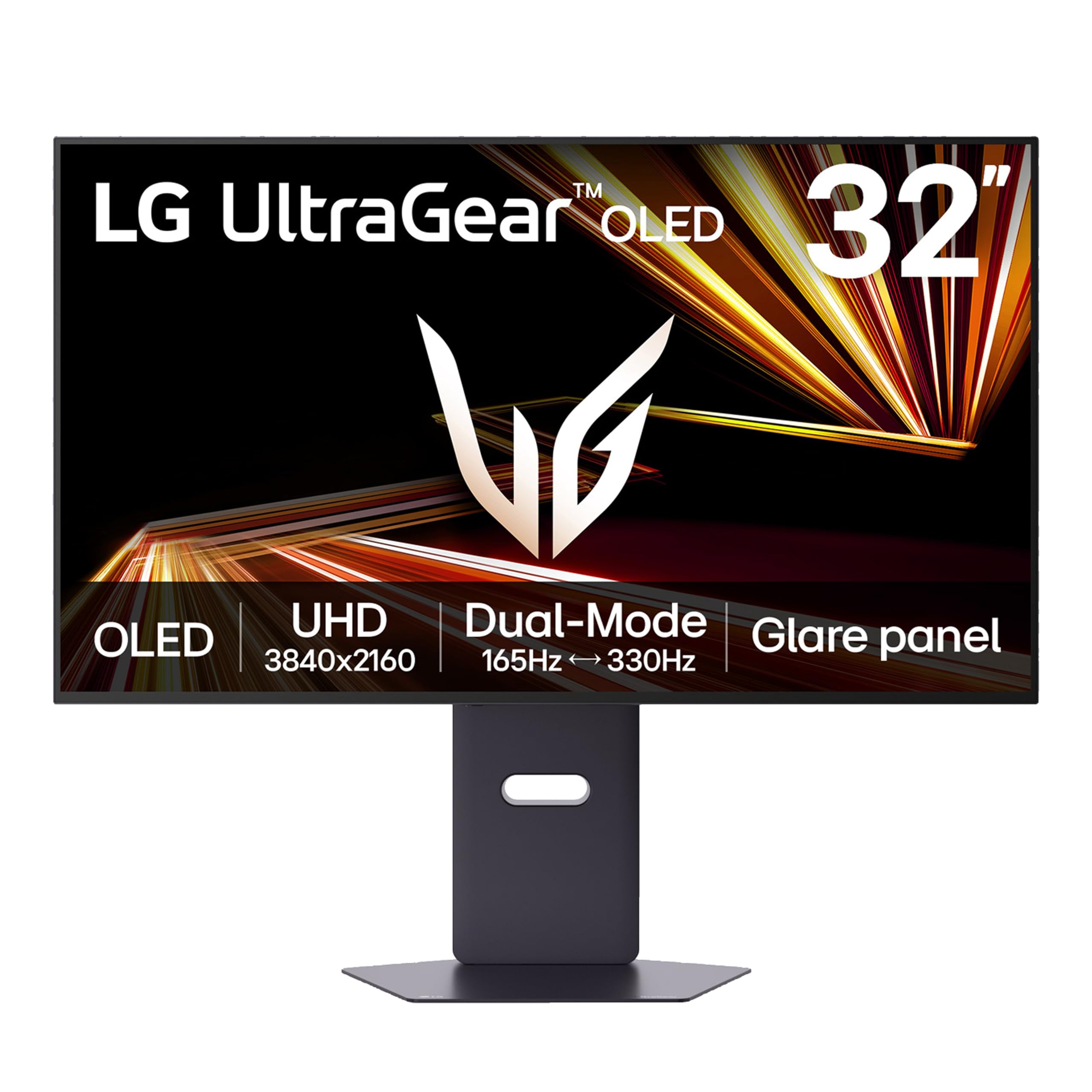
The LG 32GX850A-B offers a unique dual-mode feature that lets you switch between 4K UHD at 165Hz and Full HD at 330Hz with a hotkey, making it a single solution for both graphically rich story games and competitive shooters. The glossy WOLED panel uses Micro Lens Array+ technology to reach 275 nits typical brightness, improving upon previous LG OLED gaming monitors.
The 16:9 aspect ratio and 32-inch size pair with a contrast ratio of 1,500,000:1 and VESA DisplayHDR True Black 400 certification. Color accuracy reaches 98.5% DCI-P3 coverage. The monitor is validated for both G-SYNC Compatible and FreeSync Premium Pro, and includes Dynamic Action Sync and Black Stabilizer for competitive advantage. The stand offers height, tilt, swivel, and pivot adjustment.
Users upgrading from IPS panels describe the difference as “crazy,” noting perfect blacks, vibrant colors, and excellent HDR for titles like Cyberpunk and Elden Ring. The glossy finish enhances vibrancy but is reflective in bright environments. Some users report minor text clarity banding common to WOLED panels, and the 165Hz ceiling feels limiting when compared to the 240Hz competition at a similar price point.
Why it’s great
- Dual-mode switching between 4K 165Hz and 1080p 330Hz
- Glossy WOLED with Micro Lens Array+ for better brightness
- Full ergonomic stand with pivot adjustment
- Triple UL certification for eye comfort
Good to know
- 165Hz refresh rate is lower than the 240Hz competition
- Glossy panel reflects bright room lighting
- Text rendering shows minor banding typical of WOLED
5. Alienware AW3423DWF

The Alienware AW3423DWF is the ultrawide champion for immersive gaming at a price that undercuts many 32-inch 4K options. The 34-inch 3440×1440 QD-OLED panel uses a 1800R curvature that feels natural at this width, delivering 99.3% DCI-P3 color coverage and VESA DisplayHDR TrueBlack 400 certification. The 165Hz refresh rate and 0.1ms response time eliminate motion blur in fast-paced games.
The monitor includes AMD FreeSync Premium Pro technology for tear-free gaming, and the Creator Mode allows switching between DCI-P3 and sRGB color spaces for color-critical work. The Legend 2.0 design integrates customizable AlienFX RGB lighting and a central OSD joystick. The stand provides height, tilt, swivel, and slant adjustment, and the 360-degree ventilation helps with heat dissipation.
Users describe the image quality as “unreal” with deep blacks and vibrant colors that make VA panels look inferior. The panel performance is praised for zero ghosting and low input lag. However, the monitor requires a mandatory pixel refresh every four hours that briefly disrupts work, and some users find the 1440p vertical resolution limiting for productivity compared to a true 4K 16:9 panel.
Why it’s great
- Excellent QD-OLED color volume and contrast
- Creator Mode for DCI-P3 to sRGB switching
- Included factory calibration report
- Three-year warranty with burn-in coverage
Good to know
- Mandatory pixel refresh every 4 hours disrupts workflow
- 3440×1440 offers less vertical space than 4K 16:9
- Text clarity slightly worse than IPS due to OLED subpixel layout
6. Alienware AW3425DW

The Alienware AW3425DW upgrades the 34-inch QD-OLED formula with a 240Hz refresh rate, making it the fastest ultrawide in this lineup. The WQHD 3440×1440 resolution combined with the 1800R curvature and 0.03ms response time delivers exceptionally smooth motion in racing and first-person shooters. The panel covers 99.3% DCI-P3 with Delta E < 2 color accuracy.
Adaptive sync support includes NVIDIA G-SYNC Compatible, AMD FreeSync Premium Pro, and VESA AdaptiveSync certifications, ensuring compatibility across GPU ecosystems. The VESA DisplayHDR TrueBlack 400 certification with 1000 nits peak brightness provides impactful HDR. The Alienware Legend 2.0 design language continues here with premium build quality and a height-adjustable stand.
Users praise the “stunning” QD-OLED picture and note that 240Hz with zero ghosting and deep blacks makes the monitor “the best monitor ever” when paired with an RTX 5090. The lower brightness in bright rooms and slight text clarity issues are typical QD-OLED trade-offs. The main consideration is whether the 3440×1440 resolution and premium price justify the upgrade from the 165Hz AW3423DWF.
Why it’s great
- 240Hz refresh rate on a QD-OLED ultrawide
- Triple certification for adaptive sync (G-SYNC, FreeSync, VESA)
- 0.03ms response time for zero motion blur
- Premium build with customizable AlienFX lighting
Good to know
- 34-inch ultrawide has less vertical space than 32-inch 16:9
- Lower peak brightness than Mini-LED alternatives
- Requires pixel refresh maintenance cycles
7. Samsung Odyssey G9 G91F

The Samsung Odyssey G9 G91F is a 49-inch super-ultrawide monitor with a 32:9 aspect ratio and 5120×1440 DQHD resolution. The 1000R curvature wraps the display around your field of view, effectively replacing a dual-monitor setup without bezels. The VA panel delivers DisplayHDR 600 certification and a 1,000,000:1 contrast ratio for deeper blacks and brighter highlights than standard VA monitors.
The 144Hz refresh rate and 1ms response time, combined with AMD FreeSync Premium Pro, ensure smooth gameplay. The split screen function allows side-by-side gameplay from two sources, and Picture-in-Picture mode enables simultaneous viewing of content from different inputs. Auto Source Switch+ detects connected devices and switches inputs automatically. The ergonomic stand offers tilt and height adjustment.
Users who replaced three separate monitors with this single panel praise the elimination of bezels and the reduced neck strain from the curved design. The display is praised for clear text and a streamlined workflow with up to three apps visible simultaneously. The lack of built-in speakers and the monitor’s significant width requiring a large desk are the main practical concerns.
Why it’s great
- 49-inch 32:9 screen replaces a dual-monitor setup
- 1000R curve matches human eye for reduced eye strain
- DisplayHDR 600 for better contrast than standard VA
- Excellent for productivity with resizable window layouts
Good to know
- Requires a very deep desk (47.2 inches wide)
- No built-in speakers
- VA panel has narrower viewing angles than IPS
8. INNOCN 49Q1S OLED

The INNOCN 49Q1S brings OLED technology to the 49-inch super-ultrawide form factor with a 5120×1440 resolution and 240Hz refresh rate. The 1800R curvature is gentler than Samsung’s 1000R, making it more comfortable for productivity work while still providing an immersive gaming experience. The 0.03ms response time eliminates motion blur entirely.
Connectivity is a standout feature: two DisplayPort 1.4 ports, one HDMI 2.1, USB-C with 90W power delivery, two USB-A ports, USB-B upstream, RJ45 Ethernet, and a 3.5mm audio jack. This makes the monitor a complete docking station for laptops. The built-in speakers are functional for casual use, and the height-adjustable stand with tilt and swivel supports comfortable viewing positions.
Users describe the display as “crisp” and “clear” with an amazing refresh rate for gaming, particularly racing simulators. The glossy finish works well in controlled lighting. Some users report that certain apps display tiny or misaligned text due to the unusual resolution, and there are isolated reports of units failing after three months, which highlights the importance of a good warranty policy.
Why it’s great
- 49-inch OLED with 240Hz and 0.03ms response
- USB-C with 90W PD, RJ45 Ethernet as a hub
- Built-in speakers for basic audio
- Gentle 1800R curve for mixed use
Good to know
- Some apps have scaling issues at 5120×1440
- Glossy screen may reflect ambient light
- Reliability reports are mixed based on early user reviews
9. Philips Evnia 34M2C6500
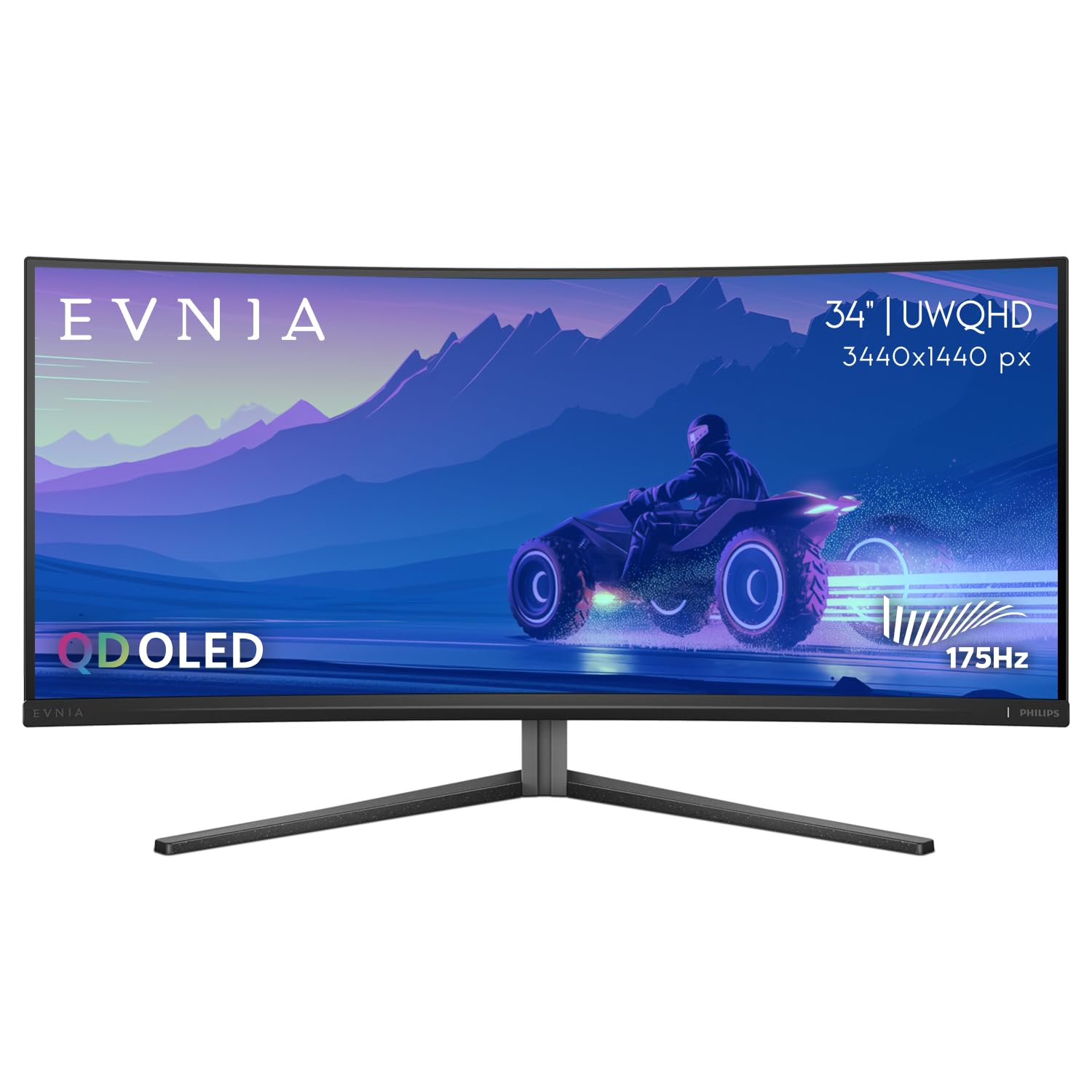
The Philips Evnia 34M2C6500 offers a QD-OLED panel at a price point that undercuts many competitors, making it an attractive entry point for ultrawide OLED gaming. The 34-inch 3440×1440 resolution with a 175Hz refresh rate and 1800R curvature provides the core QD-OLED benefits of infinite contrast and vibrant colors without the premium of higher-end models.
The VESA DisplayHDR TrueBlack 400 certification ensures deep blacks, while the 1,000,000:1 contrast ratio delivers impactful HDR in dark scenes. Adaptive Sync via FreeSync eliminates screen tearing. The Ambiglow backlighting projects ambient light onto the wall behind the monitor, which can enhance immersion but has limitations — it is not bottom-lit and has a noticeable delay in color transitions.
Users praise the “stunning” QD-OLED colors and deep blacks, noting the HDR performance is excellent for dark-themed games. The main criticisms focus on the OSD menu system, described as “garbage” with many greyed-out options, and the mandatory pixel refresh after 12 hours of cumulative use, which forces the screen to go black for several minutes. The two-year warranty with advance replacement is a solid inclusion.
Why it’s great
- Most affordable QD-OLED ultrawide option
- DisplayHDR TrueBlack 400 for dark HDR scenes
- Four-year advance replacement warranty
- 1800R curve is comfortable for productivity
Good to know
- OSD menu is clunky with many unavailable options
- Mandatory pixel refresh after 12 hours is disruptive
- Ambiglow backlight lacks bottom lighting and has lag
10. Acer Predator X32
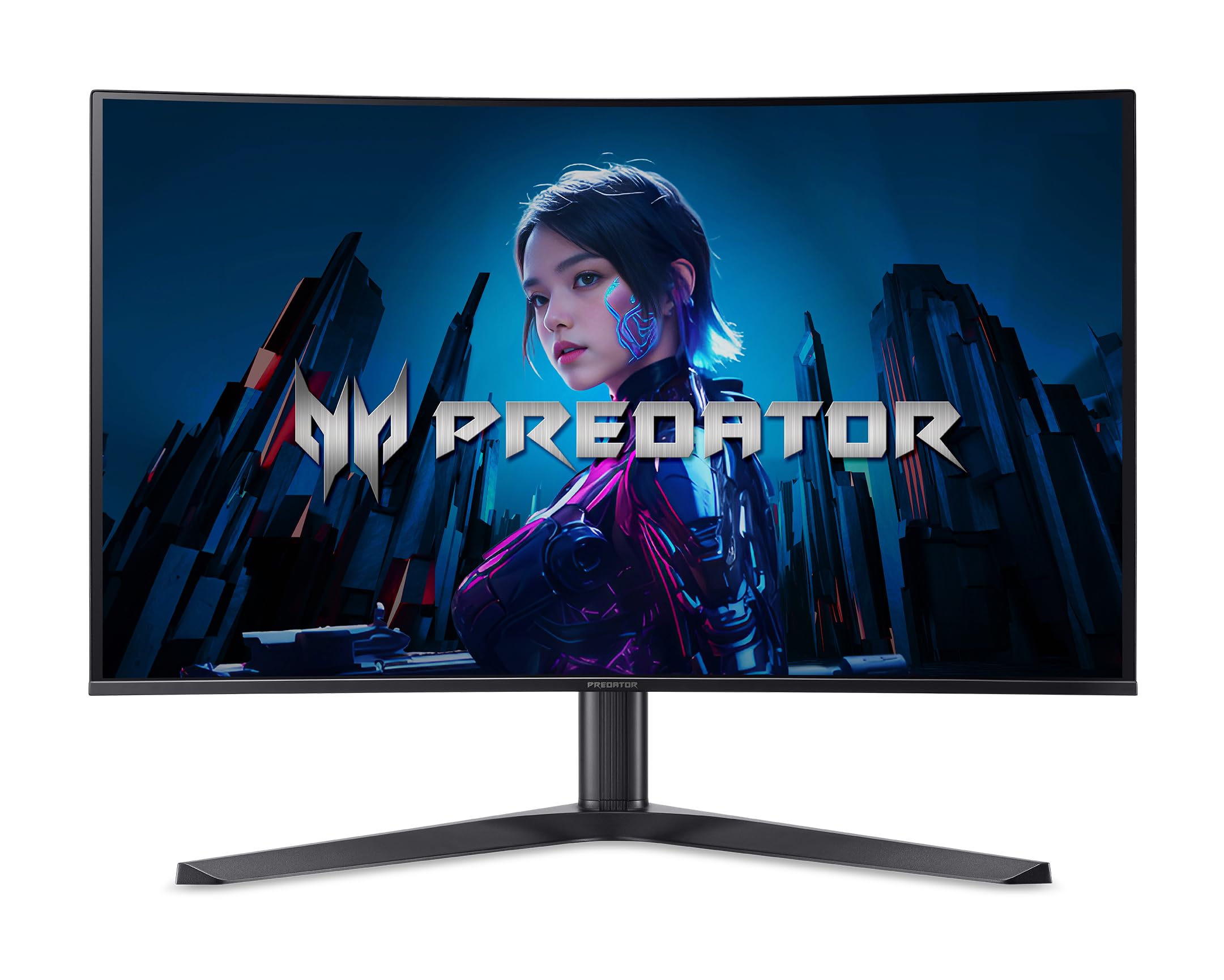
The Acer Predator X32 combines a 31.5-inch 4K UHD QD-OLED panel with a 1700R curvature and a 240Hz refresh rate, making it one of the few curved 4K OLEDs in a 16:9 format. The true 10-bit panel covers 99% DCI-P3 and is VESA DisplayHDR TrueBlack 400 certified, with a peak brightness of 1000 nits at the 3% HDR window for impactful specular highlights.
The 0.03ms response time and AMD FreeSync Premium support ensure fluid gameplay. Connectivity includes two HDMI 2.1 ports, two DisplayPort 1.4, and a USB-C port with USB 3.1 speeds. The ergonomic stand offers height, tilt, and swivel adjustment. Image retention refresh technology actively prevents burn-in.
Users upgrading from standard IPS panels describe the OLED blacks as making games like Elden Ring and Cyberpunk look “unreal.” The 4K 240Hz combination is praised as incredible. However, some users find the panel too dark overall, requiring 100% brightness, and the HDR performance in Windows can be problematic. The stand design with deep V-shaped feet is polarizing and consumes significant desk space.
Why it’s great
- 4K 240Hz QD-OLED in a curved 16:9 format
- True 10-bit panel with 99% DCI-P3
- Dual HDMI 2.1 for multi-console setups
- Image retention refresh for burn-in protection
Good to know
- Panel brightness may feel low compared to Mini-LED
- Annoying monitor prompts require user intervention
- Stand has a large footprint with V-shaped feet
11. CRUA 32″ Curved 4K
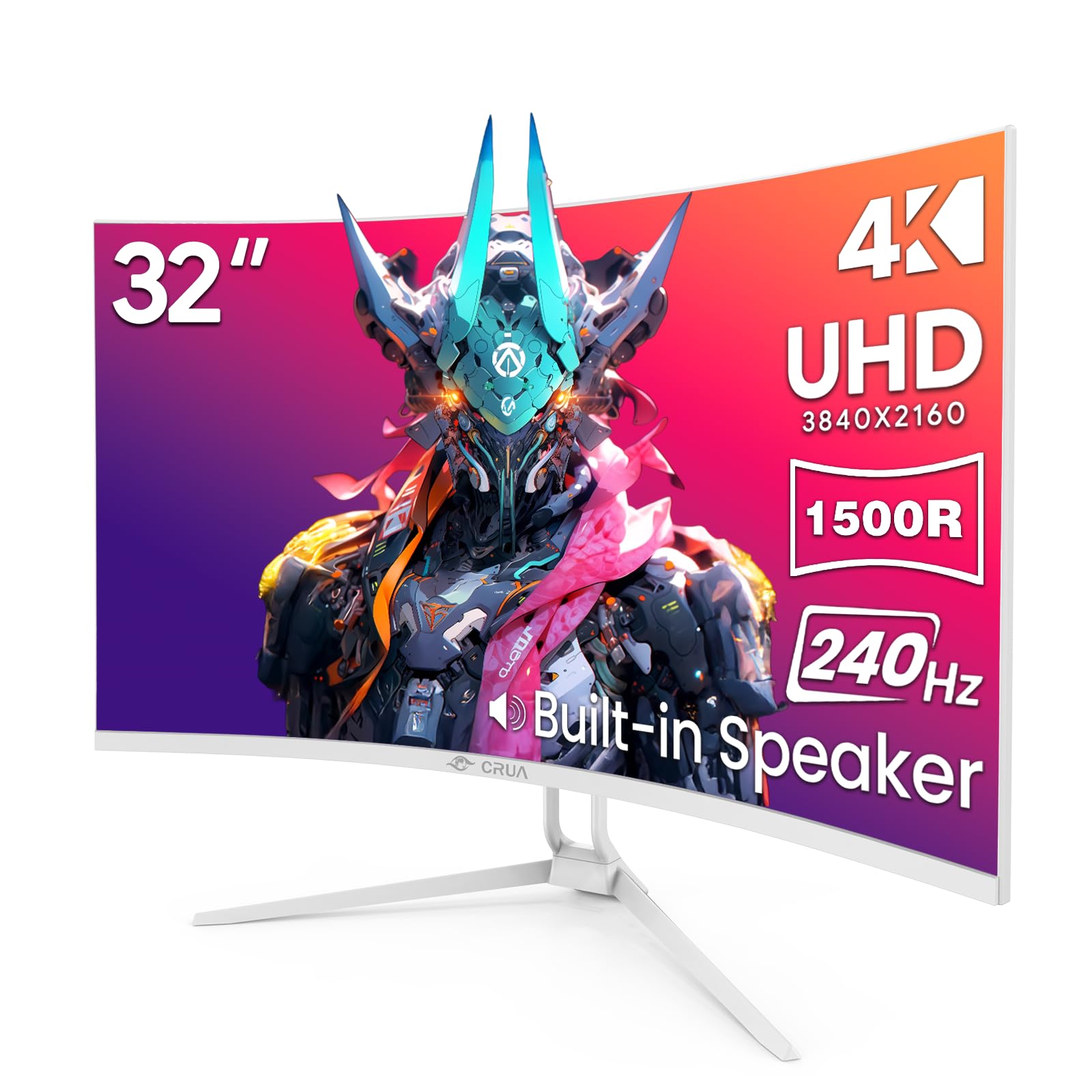
The CRUA 32-inch curved monitor delivers 4K UHD resolution at 240Hz with a VA panel and 1500R curvature at an entry-level price point. The 3840×2160 resolution offers ample screen space for productivity, while the 3000:1 contrast ratio and 120% sRGB coverage provide decent color saturation for media consumption and casual gaming.
AMD FreeSync technology reduces screen tearing, and the monitor includes HDMI 2.1, DisplayPort 1.4, built-in speakers, PIP/PBP functionality, and 75x75mm VESA mount support. The tilt-adjustable stand and RGB back lighting add aesthetic flexibility. The white color option is unique in a market dominated by black monitors, fitting lighter desk setups.
Users describe the monitor as a “great budget” option for cozy gaming setups, noting crisp visuals, excellent anti-blue light filtering, and lightweight design. The built-in speakers are noted as non-functional by some users, requiring external speakers. The OSD settings without a physical remote are described as confusing. For the price, this monitor offers the core 4K curved experience with significant compromises in build quality and feature depth.
Why it’s great
- 4K resolution with 240Hz at an entry-level price
- 1500R curve for comfortable immersion
- White color option fits lighter desk aesthetics
- PIP/PBP for multi-source productivity
Good to know
- Built-in speakers are reportedly non-functional on some units
- VA panel has slower response than OLED alternatives
- OSD menu is confusing without a remote control
FAQ
Does a curved monitor cause distortion in productivity apps like Excel or design software?
Is QD-OLED burn-in still a concern with modern 4K curved monitors?
Can I use a 4K curved monitor with a MacBook Pro via USB-C?
Why do some 4K curved monitors advertise 240Hz but my console only outputs 120Hz?
Final Thoughts: The Verdict
For most users, the best 4k curved monitor is the MSI MPG 321URX QD-OLED because it delivers the optimal combination of 4K resolution, 240Hz speed, QD-OLED image quality, and comprehensive connectivity at a price that undercuts the premium competition. If you need the highest HDR brightness for a sunlit room, grab the Samsung Odyssey Neo G8. And for the immersive ultrawide experience without sacrificing refresh rate, the Alienware AW3425DW is the best pick.