
Chasing smooth aerial footage often means fighting against wind, vibration, and a camera that jitters with every gust. For every stunning skyline you capture, there are a dozen shaky, unusable clips that get deleted. The real challenge isn’t finding a drone that shoots 4K—it’s finding one that keeps that 4K steady, frame after frame, without forcing you into a budget-breaking decision.
I’m Min — the co-founder and writer behind Gadgets Feed. My deep-dive research focuses on the transmission stability, gimbal mechanics, and sensor specifications that separate a genuinely capable 4K drone from one that simply advertises the resolution.
Whether you’re scouting property, documenting travel, or just exploring the sky, finding the right balance of stabilization, flight time, and range defines the perfect 4k drone for your specific needs.
How To Choose The Best 4K Drone
The 4K drone market spans everything from pocket-sized travel companions to serious aerial workstations. The right choice comes down to understanding what matters most for your shooting style, not just the spec sheet headline.
Gimbal Axis Count and Stabilization
A 3-axis brushless gimbal provides independent compensation for pitch, roll, and yaw, which is the gold standard for smooth 4K video. Drones with only a 2-axis gimbal or electronic image stabilization (EIS) will show noticeable horizon tilt and micro-jitters during aggressive turns or in moderate wind.
Weight Class and Regulatory Impact
Models under 250 grams generally avoid FAA registration and Remote ID requirements in the U.S., making them ideal for casual or travel use. Heavier drones, especially those exceeding 249g, may require registration and open you to additional flight restrictions. This weight difference directly affects wind resistance and battery capacity as well.
Transmission System and Real-World Range
Digital transmission systems (like DJI’s O4 or Bwine’s GQ2.0) offer much lower latency and better penetration through trees and buildings than older Wi-Fi-based solutions. A drone that claims 20,000 feet of range may only deliver a stable 4K feed at half that distance in suburban environments, so look for advertised ranges that exceed your actual needs by a comfortable margin.
Quick Comparison
On smaller screens, swipe sideways to see the full table.
| Model | Category | Best For | Key Spec | Amazon |
|---|---|---|---|---|
| DJI Mini 5 Pro | Premium | Professional Enthusiasts | 1-inch CMOS Sensor | Amazon |
| Bwine F7MINI 4K(RC3) | Premium | Built-In Screen Controller | 5.5″ 1080p RC Screen | Amazon |
| DJI Flip (RC-N3) | Premium | Beginner-Friendly Travel | Propeller Guards Included | Amazon |
| Bwine F7GB2 Pro | Mid-Range | Extended Flight Sessions | 75 Mins (3 Batteries) | Amazon |
| Ruko Drone | Mid-Range | Travel and Portability | Under 249g, 96 Min Flight | Amazon |
| Gleesfun G11PRO | Mid-Range | Professional Camera Value | 3-Axis Brushless Gimbal | Amazon |
| Holy Stone HS600 | Mid-Range | Wind Resistance | Level 6 Wind Resistance | Amazon |
| Veeniix V11Air | Budget-Friendly | Value with 3-Axis Gimbal | 70 Mins (2 Batteries) | Amazon |
| Potensic ATOM SE | Budget-Friendly | Entry-Level Flying | 93 Mins (3 Batteries) | Amazon |
In‑Depth Reviews
1. DJI Mini 5 Pro Fly More Combo Plus
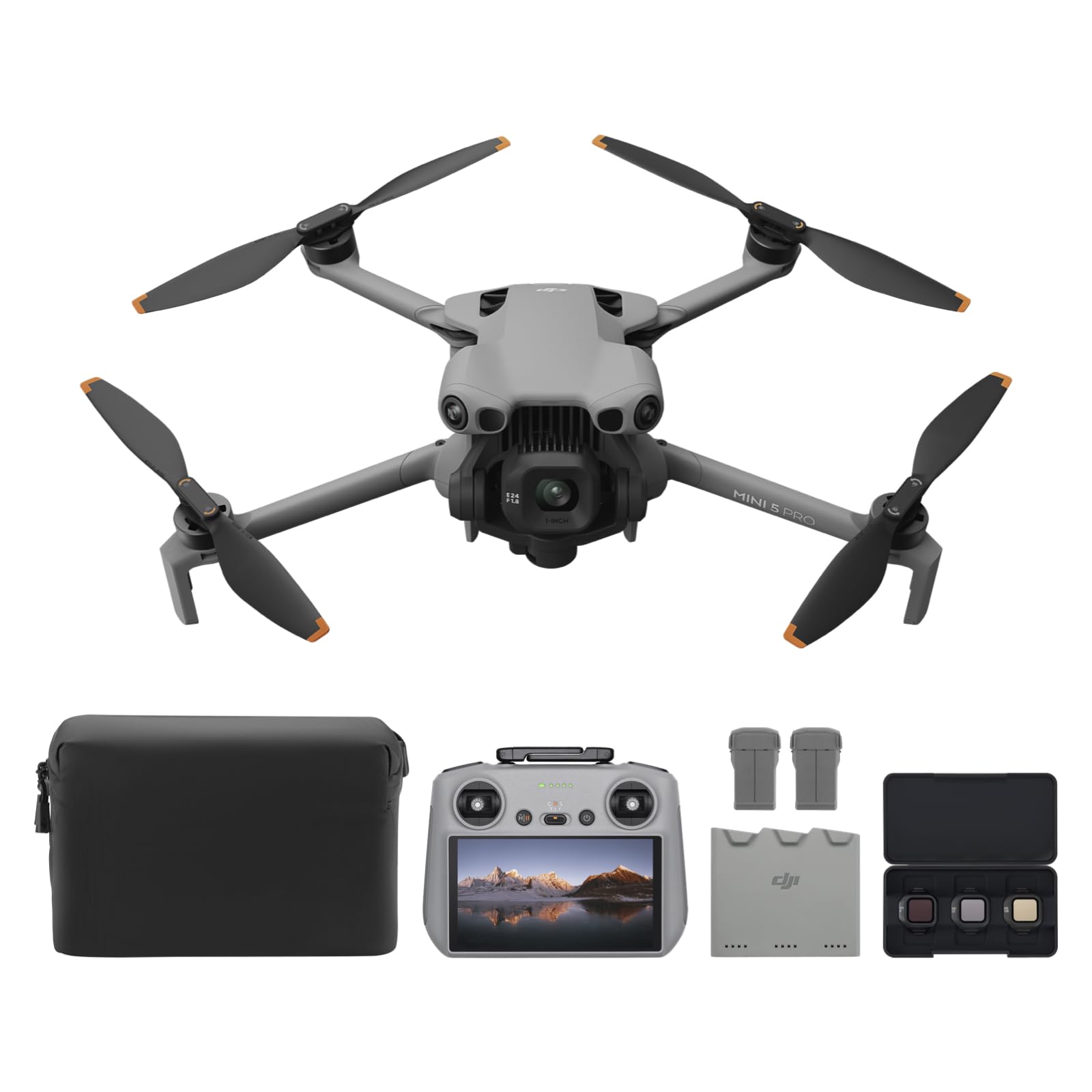
The DJI Mini 5 Pro raises the bar for compact drones with its 1-inch CMOS sensor, delivering 4K/60fps HDR video that retains detail in both shadows and highlights. The 225-degree gimbal rotation enables true vertical filming without cropping, making it ideal for social-media-first creators who want full-resolution portrait footage.
Nightscape omnidirectional obstacle sensing uses forward-facing LiDAR and vision sensors to detect objects in all directions, which dramatically improves safety during low-light returns and complex maneuvers. The upgraded ActiveTrack 360° reliably locks onto moving subjects like cyclists or runners even through turns and partial occlusion.
The Fly More Combo Plus bundles three Intelligent Flight Batteries Plus for up to 52 minutes of flight time each, a two-way charging hub that powers all three in roughly 193 minutes, and ND filter set. The RC 2 controller’s built-in screen eliminates phone dependency, though the plus batteries push the total weight over 250g, which requires FAA registration and Remote ID for compliance in the US.
Why it’s great
- 1-inch sensor captures far more light and detail than smaller CMOS alternatives
- Omnidirectional obstacle sensing with LiDAR for safe night flights
- 225-degree gimbal allows true vertical shooting without crop
Good to know
- Plus batteries exceed 250g, requiring FAA registration
- DJI Care Refresh isn’t currently available for US buyers
2. Bwine F7MINI 4K(RC3)
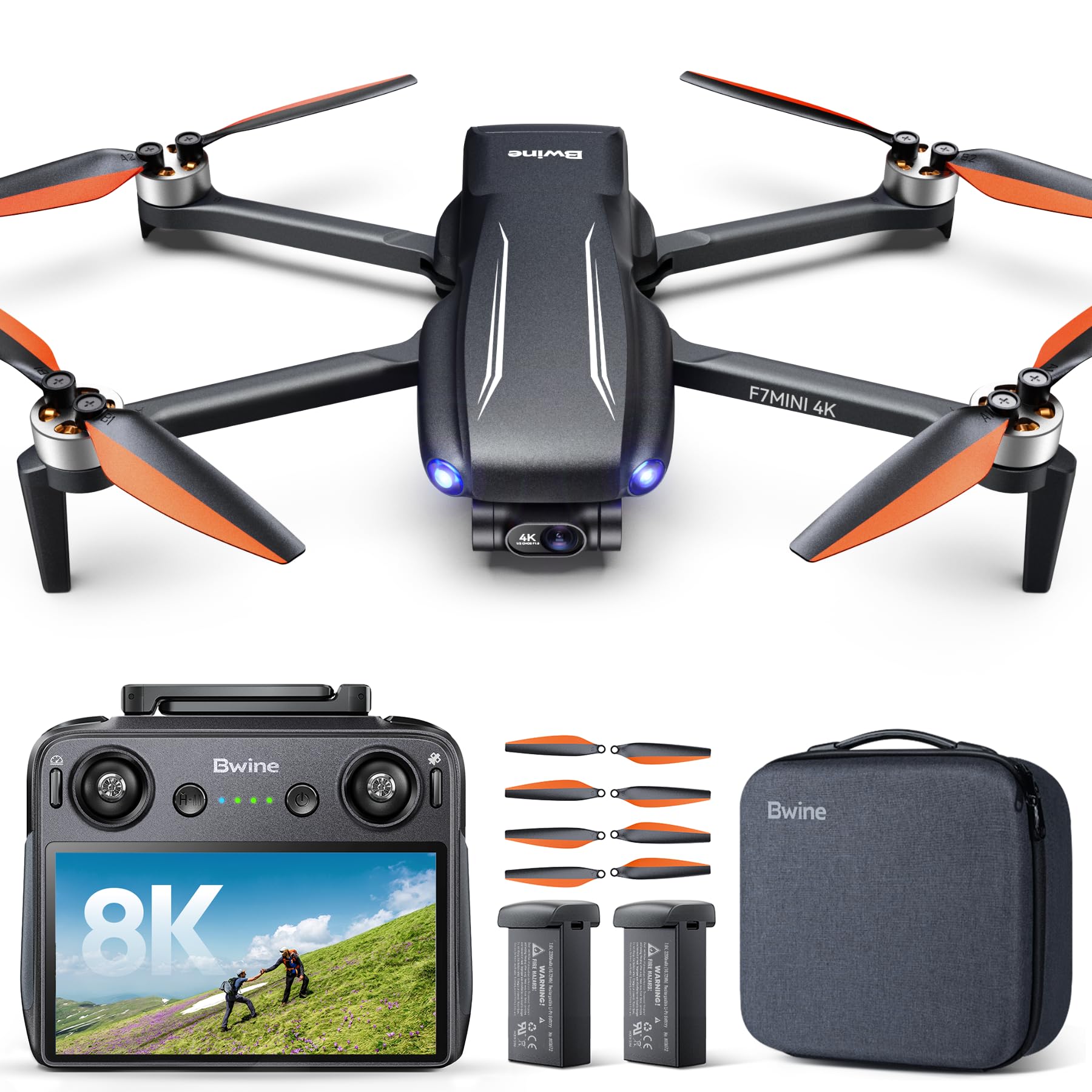
The Bwine F7MINI 4K(RC3) stands out for its integrated 5.5-inch 1080p screen on the remote controller, which eliminates the need to attach your phone and provides a bright 500-nit display even in direct sunlight. The 3-axis brushless gimbal paired with electronic image stabilization keeps 4K video exceptionally smooth, and the 48MP sensor captures 8K still photos with solid detail.
Its digital transmission system claims a 20,000-foot range, but real-world testing shows a stable 4.5km (about 14,700 feet) feed in suburban conditions with 0.1-second latency. The sub-250g weight keeps it FAA-exempt, and the built-in 120dB beeper helps locate the drone if it lands out of sight.
The included two batteries provide 64 minutes of total flight time, and PD 3.0 fast charging (charger not included) reduces downtime. The RC screen also has 32GB of internal storage, allowing you to review and share clips directly from the controller without transferring files to a separate device.
Why it’s great
- Built-in 5.5″ 1080p screen eliminates phone dependency
- Sub-250g weight requires no FAA registration
- 3-axis gimbal plus EIS for steady 4K footage
Good to know
- PD 3.0 fast charger must be purchased separately
- File transfer from controller to phone is slower than direct cable
3. DJI Flip (RC-N3)

The DJI Flip is designed around safety and ease of use, featuring full-coverage propeller guards made from lightweight carbon fiber that protect both people and the drone during close-quarters flying. The palm takeoff and land feature lets you launch directly from your hand, which is particularly useful when you don’t have a flat surface available.
The 1/1.3-inch CMOS sensor captures 4K/60fps HDR video with excellent dynamic range, and the 3-axis gimbal keeps the footage steady even in 15 mph wind. It weighs under 249 grams, so it avoids FAA registration and Remote ID requirements.
The O4 video transmission system delivers a 13-kilometer (44,000-foot) range with low latency, though real-world range will be less in dense environments. Subject tracking works reliably for following a single person during hikes or parties, and the 31-minute maximum flight time is sufficient for most recreational outings. The RC-N3 controller requires attaching your phone for the live feed.
Why it’s great
- Integrated propeller guards make it safer for beginners and crowded spaces
- Palm takeoff and landing removes the need for a launch pad
- Under 249g and no FAA registration needed
Good to know
- RC-N3 controller requires a phone; no built-in screen
- Only forward obstacle avoidance, not omnidirectional
4. Bwine F7GB2 Pro

The Bwine F7GB2 Pro is built for extended sessions with three 2600mAh intelligent batteries providing a total of 75 minutes of flight time. The FAA-compliant remote ID is integrated into the drone arm, and the included hard-shell carrying case makes transport secure and organized.
The 3-axis gimbal paired with a detachable 4K camera and 120° FOV lens delivers smooth footage, and the 5x digital zoom lets you frame distant subjects without moving closer. The level-6 wind resistance test certification means it can handle gusts that would send lighter drones drifting, and it can fly at altitudes up to 2000 meters.
GPS features include follow me, waypoint flight, orbit mode, and automatic return on low battery or signal loss. The Bwine app adds in-editor filters and background music for quick social media sharing, and the 2-year warranty provides long-term peace of mind.
Why it’s great
- Three batteries deliver 75 minutes of total airtime
- Level-6 wind resistance certified for gusty conditions
- FAA-compliant remote ID built into the frame
Good to know
- Weighs 550g, requiring FAA registration
- Optional 65W fast charger sold separately for quicker recharge
5. Ruko Drone with 4K UHD Camera

The Ruko drone packs a 1/2-inch 48MP CMOS sensor into a sub-250g frame, capturing 8K photos and 4K/30fps video through a 3-axis brushless gimbal plus EIS. The triple-battery setup provides a full 96 minutes of flight time, making it one of the longest-flying options in the weight class that avoids FAA registration.
The R2 digital transmission system delivers a 20,000-foot range without Wi-Fi interference, which is a significant upgrade over the drones in this price tier that still rely on Wi-Fi repeaters. The AI takeoff and landing system uses quadruple positioning (GPS, barometric, TOF, and optical flow) for precise hovering both indoors and outdoors.
The built-in beeper makes it easy to locate the drone after landing in tall grass or brush, and the included hard carrying case keeps everything organized. Ruko’s customer service consistently receives high marks for responsiveness, with multiple users reporting quick replacement for defective components.
Why it’s great
- 96 minutes total flight time with three batteries in a sub-250g package
- R2 digital transmission avoids Wi-Fi interference
- 3-axis gimbal plus EIS for smooth 4K
Good to know
- Joysticks are sensitive; beginners may need to dial in rates
- SD card not included for storing footage
6. Gleesfun G11PRO

The Gleesfun G11PRO focuses on image stability with its 3-axis brushless gimbal system that synchronizes with the flight controller for millisecond-level compensation during maneuvers. The 1/3.2-inch CMOS sensor captures 6K stills and 4K/30fps video with a wide dynamic range, and the GQ2.0 digital transmission provides a 10,000-foot range without frame drops.
Cruise Control technology simplifies cinematic shots by maintaining a steady speed and heading while the gimbal stays level, which is particularly useful for sweeping landscape pans. The GL2.0 Smart Battery Management System fast-charges both batteries in about 2.5 hours and maintains 80% capacity retention after 300 cycles.
FAA compliance is confirmed through Remote ID, and the kit includes a comprehensive set of 40 items including a carrying case, multiple cables, and spare propellers. Customer reviews consistently highlight the responsive support team as a major advantage.
Why it’s great
- 3-axis brushless gimbal with millisecond synchronization for stable footage
- Cruise Control automates cinematic pans and steady shots
- Smart battery management system with 300+ cycle life
Good to know
- At 357g, it exceeds the sub-250g threshold for FAA exemption
- Gimbal may require calibration after transport in the case
7. Holy Stone HS600

The Holy Stone HS600 distinguishes itself with level-6 wind resistance certification, meaning it can fly stably in conditions that would push most sub-300g drones into uncontrolled drift. The 2-axis gimbal paired with EIS provides stabilization, though it doesn’t offer the same horizon-level control as a true 3-axis gimbal during aggressive banked turns.
The integrated Remote ID fulfills FAA requirements without needing an extra module, and the Wi-Fi repeater transmission system extends control range to 20,000 feet. The Sony sensor-enhanced camera shoots 4K/30fps video and 8.29MP stills, and Holy Stone’s latest connection technology uses a single USB cable for a stable video feed without Wi-Fi dropout.
The drone weighs 541g, which places it firmly in the FAA-registration category, and the included carrying case is a nice touch for transport. GPS intelligent return-to-home activates on low battery, signal loss, or one-key command, giving beginners a reliable safety net.
Why it’s great
- Level-6 wind resistance handles gusty coastal or mountain conditions
- Integrated Remote ID complies with FAA without extra hardware
- Single USB cable connection reduces Wi-Fi dropouts
Good to know
- 2-axis gimbal cannot fully correct horizon tilt during turns
- Camera app lacks manual ISO and exposure controls
8. Veeniix V11Air
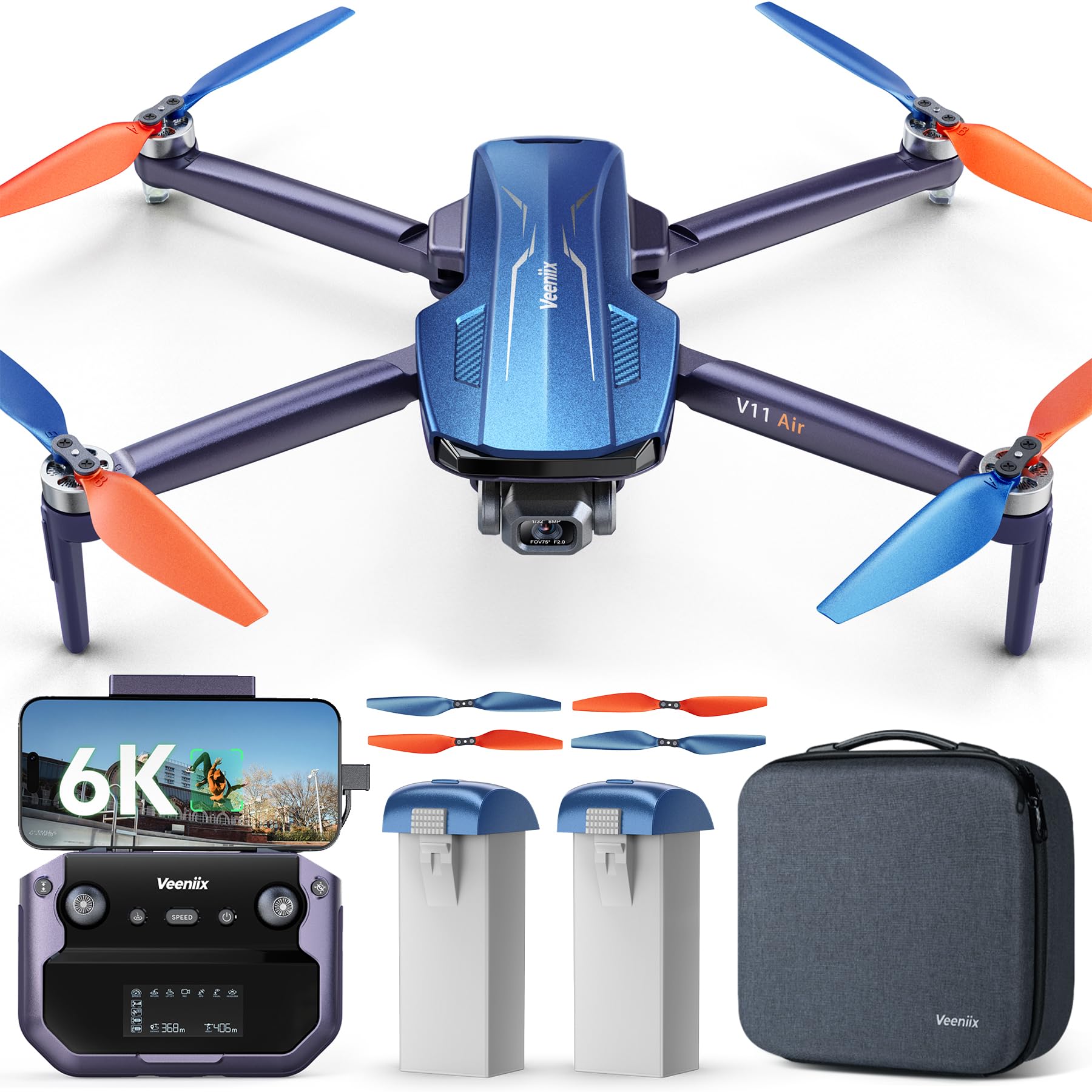
The Veeniix V11Air brings a 3-axis brushless gimbal to a more accessible price point, capturing 4K/30fps video and 6K stills with significantly better stability than similarly priced EIS-only drones. The dual-battery setup delivers 70 minutes of total flight time, and the upgraded digital transmission system maintains a clear feed up to 10,000 feet.
The 5x lossless zoom lets you frame distant subjects without losing image detail, and the night mode is specifically tuned for low-light flying, with exposure settings that capture sharper details after sunset. The intelligent GPS modes include follow me, orbit flight, and waypoint planning, all accessible through the app.
The blue and orange propeller color scheme provides high visibility against the sky, making it easier to maintain visual line of sight. Customer reviews note that signal penetration through heavy tree cover is limited and can trigger early auto-return, so it’s best flown in open areas for maximum range.
Why it’s great
- 3-axis brushless gimbal at a budget-friendly price point
- 5x lossless zoom without image quality degradation
- Dedicated night mode for low-light aerial shots
Good to know
- Signal loss in dense tree cover limits effective range
- Controller data port is separate from charging port; easy to mix up
9. Potensic ATOM SE

The Potensic ATOM SE is a sub-249g drone that uses EIS (electronic image stabilization) rather than a physical gimbal, so while it captures 4K/30fps video, footage during fast turns or in wind will show more micro-jitter than gimbal-equipped alternatives. The Sony 1/3-inch CMOS sensor produces 12MP stills with acceptable detail for social media sharing.
The three-battery kit provides 93 minutes of total flight time, and the 60W parallel charging hub fills all three batteries simultaneously in about 1.5 hours. The PixSync 2.0 transmission system delivers a 4-kilometer range, and the SurgeFly flight control system includes a dedicated Beginner Mode that limits speed and altitude for new pilots.
GPS features include follow me, waypoint flight, and circle flight, and the automatic return functions on low battery or signal loss provide a safety net. The drone’s 249g weight class means it avoids FAA registration, and the included shoulder bag makes it convenient for casual outings. The solid-mount camera does cause a noticeable tilt effect during coordinated turns.
Why it’s great
- 93 minutes of flight time with three-battery kit is class-leading
- Under 249g with no FAA registration required
- 60W parallel charger fills all batteries in 1.5 hours
Good to know
- EIS only; no mechanical gimbal means less stable footage during turns
- Fixed camera mount causes visible horizon tilt
FAQ
Can I fly a 4K drone without FAA registration?
Why does my drone footage look shaky even at 4K resolution?
Is a higher range always better for a 4K drone?
Final Thoughts: The Verdict
For most users, the 4k drone winner is the DJI Mini 5 Pro Fly More Combo Plus because its 1-inch sensor, omnidirectional obstacle sensing, and 225-degree gimbal deliver professional-grade footage without a massive airframe. If you want a built-in controller screen and sub-250g convenience, grab the Bwine F7MINI 4K(RC3). And for maximum flight time on a budget, nothing beats the Ruko sub-249g drone with its 96-minute total airtime.