
That 4K footage from a smartphone gimbal looks clean on a phone screen, until you grade it on a proper monitor and the color falls apart. 10-bit 4:2:2, a Super 35 or full-frame sensor, and a proper codec like Blackmagic RAW or ProRes are the thresholds that separate content from cinema. Spending on the body is only half the battle — the lens mount, dynamic range, and recording media budget dictate your final image.
I’m Min — the co-founder and writer behind Gadgets Feed. I’ve sorted through hundreds of spec sheets, customer reliability reports, and real-world footage comparisons to find the cameras that actually deliver on their 4K promise without hidden workflow costs.
Whether you need NDI-ready streaming, a pocket gimbal for vlogging, or a Netflix-approved cinema body with 15+ stops of dynamic range, this guide ranks the best options to help you find the right best 4k film camera for your production pipeline.
How To Choose The Best 4K Film Camera
Choosing a 4K film camera isn’t about picking the highest resolution number. It’s about matching your pipeline — lens mount, codec, recording media, battery system, and stabilization — to the type of content you shoot. A PTZ streaming camera, a pocket vlogger, and a cinema body serve completely different workflows despite all recording 4K.
Sensor Size and Dynamic Range
A 1-inch sensor (like the DJI Osmo Pocket 3) gives you portability and decent low light, but it can’t match the shallow depth of field or noise performance of a Super 35 or full-frame sensor. For narrative work, prioritize at least 13 stops of dynamic range and dual native ISO — the Blackmagic Pocket 6K and Sony FX3 both exceed this threshold, giving you clean shadows and recoverable highlights.
Codec and Bit Depth
8-bit 4:2:0 footage falls apart when you push the grade. Look for 10-bit 4:2:2 recording at minimum — this is non-negotiable for color correction. Blackmagic RAW and ProRes offer the most headroom, while Sony’s XAVC S-I and Canon’s XF-AVC are strong alternatives. Recording media costs scale with bitrate: a Blackmagic 6K in BRAW at 12:1 uses roughly 27 GB per hour, while a Sony FX3 in all-intra 4K can exceed 60 GB per hour.
Lens Mount and Workflow
The lens mount locks you into an ecosystem. Canon RF and Sony E-mount offer the widest selection of native lenses and third-party support. Micro Four Thirds (Blackmagic Micro Studio G2) is budget-friendly but limits low-light ceiling. EF mount (Blackmagic Pocket 6K) gives access to inexpensive Canon glass. Factor in whether you need internal ND filters, XLR audio, or built-in cooling fans — these features can save thousands in accessories later.
Quick Comparison
On smaller screens, swipe sideways to see the full table.
| Model | Category | Best For | Key Spec | Amazon |
|---|---|---|---|---|
| DJI Osmo Pocket 3 Creator Combo | Gimbal Camera | Vlogging & Travel | 1-inch CMOS, 4K/120fps | Amazon |
| Canon EOS R5 C | Mirrorless Cinema | Hybrid Photo/Video | 45MP, 8K/60p RAW | Amazon |
| Nikon RED Z Cinema | Cinema Camera | Professional Narrative | 6K FF, 15+ stops DR | Amazon |
| Blackmagic Pocket Cinema Camera 6K | Cinema Camera | Indie Filmmaking | Super 35, 6K BRAW | Amazon |
| Sony Alpha FX3 | Cinema Line | Low-Light Pro Video | FF, 4K/120p, 15+ stops | Amazon |
| Sony Alpha 7 IV | Hybrid Mirrorless | All-Round Content | 33MP FF, 4K/60p 10-bit | Amazon |
| Sony FX2 | Cinema Line | Entry-Level Cinema | 33MP FF, dual ISO | Amazon |
| Blackmagic Micro Studio Camera 4K G2 | Studio PTZ | Live Production | MFT, 12G-SDI, 25,600 ISO | Amazon |
| Panasonic HC-X20 | Professional Camcorder | Events & News | 1-inch, 20x optical zoom | Amazon |
| Canon VIXIA HF G70 | Consumer Camcorder | Family & Travel | 1/2.3-inch, 20x zoom | Amazon |
| OBSBOT Tail Air | PTZ Streaming | Streaming & Webcam | 4K, NDI, AI Tracking | Amazon |
In‑Depth Reviews
1. DJI Osmo Pocket 3 Creator Combo

The Osmo Pocket 3 packs a 1-inch CMOS sensor into a body smaller than a soda can, delivering 4K at 120fps with 3-axis mechanical stabilization that eliminates the need for a gimbal. The 2-inch rotatable touchscreen lets you switch between horizontal and vertical framing in seconds — a killer feature for cross-platform content creators who post to both YouTube and TikTok.
ActiveTrack 6.0 locks onto subjects reliably during movement, and the included DJI Mic 2 transmitter syncs directly via OsmoAudio, removing the need for dongles or separate wireless receivers. The Creator Combo bundle adds a battery handle, wide-angle lens, mini tripod, and carrying case, extending the 166-minute internal battery significantly.
Low-light performance is a clear step above smartphone cameras, though the fixed 2x digital zoom and small sensor still fall short of interchangeable-lens systems for shallow depth of field. D-Log M with 10-bit color depth provides decent grading headroom for compact vlog footage, but serious colorists will want the flexibility of Blackmagic RAW or ProRes.
Why it’s great
- 3-axis mechanical stabilization produces gimbal-smooth footage without extra gear
- Built-in DJI Mic 2 connectivity simplifies audio workflow
- Compact enough for one-handed vlogging and pocket carry
Good to know
- Fixed lens with only 2x digital zoom limits creative framing options
- 1-inch sensor can’t match full-frame shallow depth of field
2. Canon EOS R5 C

The EOS R5 C is a true hybrid that switches between stills camera and cinema camera modes with a dedicated toggle. Its 45MP full-frame sensor records 8K/60p internal RAW using the built-in cooling fan — a feature that prevents the overheating shutdowns that plagued the original R5. The RF mount gives access to Canon’s sharpest L-series glass.
In cinema mode, you get XF-AVC and oversampled 4K/120p with 10-bit 4:2:2 recording, plus Canon Log 3 for extended dynamic range. The 12 fps mechanical shutter and 20 fps electronic shutter with full AF subject tracking make it viable for fast-moving action photography alongside video work. Dual Pixel CMOS AF with ITR X delivers sticky eye-tracking for both humans and animals.
Battery life is the main compromise — expect roughly 45 minutes of 4K recording on a single LP-E6NH pack. A battery grip or external V-mount solution is essential for extended shoots. The mini-HDMI port is fragile without a clamp, and the absence of Clog2 means you trade some highlight recovery compared to the C300 line.
Why it’s great
- 8K/60p internal RAW with active cooling prevents thermal throttling
- 45MP stills at 20fps make it a genuine stills/video hybrid
- Dual Pixel CMOS AF with eye tracking is best-in-class for fast lenses
Good to know
- Battery life is sub-60 minutes for video; external power recommended
- Mini-HDMI port is fragile and requires a lockable cable clamp
3. Nikon RED Z Cinema

Combining Nikon’s Z-mount engineering with RED’s legendary color science, the RED Z Cinema is a 6K full-frame body that weighs only 1.18 lbs — remarkably light for a cinema camera. It records 12-bit REDCODE RAW (R3D NE) files with 15+ stops of dynamic range and dual base ISO, giving colorists the same grading latitude found on RED V-RAPTOR and KOMODO systems.
The 4-inch DCI-P3 touchscreen is bright enough for outdoor monitoring, and the 32-bit float audio recording handles external microphones without gain-staging — practically eliminating clipped audio. The Z-mount is the widest full-frame mirrorless mount on the market, offering shallow depth of field and excellent lens stabilization for gimbal or handheld use.
The trade-offs are significant for hybrid shooters: there’s no mechanical shutter for stills, fast storage is mandatory for 6K R3D files (CFexpress Type B), and battery life relies on the included NP-F system rather than standard Sony NP-FZ100 cells. Editing R3D NE RAW requires DaVinci Resolve or Avid — Adobe Premiere doesn’t yet support it.
Why it’s great
- RED color science and 15+ stops DR rival high-end cinema systems
- 32-bit float audio eliminates gain-staging errors entirely
- Ultra-light 1.18 lb body easy to rig for gimbal or drone mounting
Good to know
- R3D NE RAW not yet supported in Premiere Pro
- No mechanical shutter — pure electronic only
4. Blackmagic Pocket Cinema Camera 6K
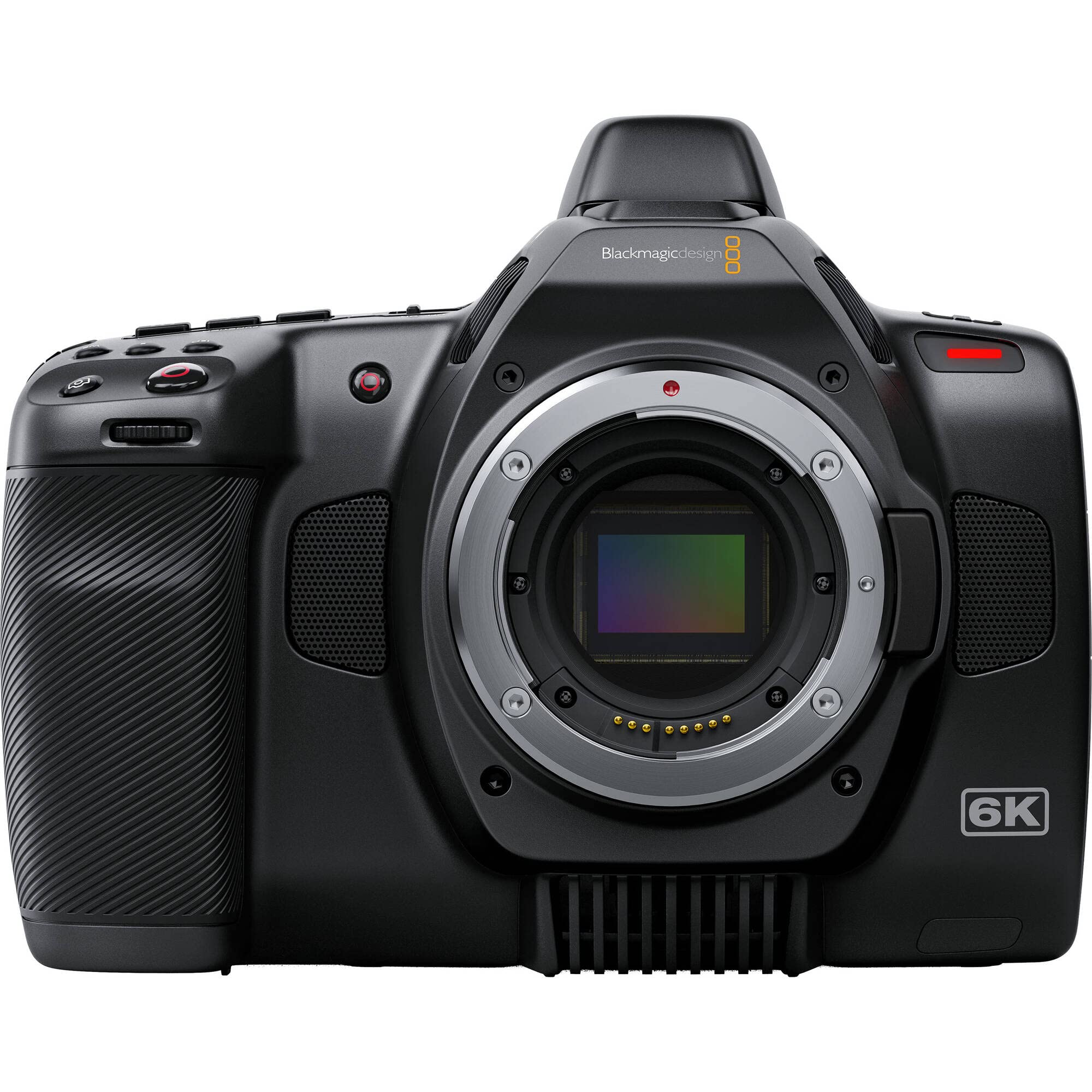
The BMPCC 6K remains the benchmark for affordable cinema production. Its Super 35 sensor with an EF lens mount shoots 6K Blackmagic RAW at up to 50 fps, or 2.8K at 120 fps for slow motion. The 13 stops of dynamic range and dual native ISO (400 and 3200) deliver clean shadows and roll-off that competes with cameras costing three times as much.
DaVinci Resolve Studio comes included in the box — a value — and the camera records directly to standard SATA SSDs via USB-C, saving significant media costs compared to CFexpress or RED Mini-Mag systems. The 5-inch touchscreen is sharp and responsive for focus pulls, though its brightness washes out in direct sunlight, making an external monitor a wise investment.
EF mount lenses are abundant and cheap, but the lack of autofocus performance relative to Sony or Canon means this camera rewards manual-pulling workflows. Battery life using LP-E6 packs is famously poor — expect around 30-40 minutes of recording — so an NP-F plate or V-mount battery rig is essential for any serious shoot.
Why it’s great
- 6K BRAW with 13 stops DR at a price point unmatched by competitors
- Records to cheap SATA SSDs via USB-C, reducing media costs dramatically
- Includes full DaVinci Resolve Studio license
Good to know
- LP-E6 battery gives only 30-40 minutes of recording time
- Contrast-detect autofocus is unreliable for tracking moving subjects
5. Sony Alpha FX3

The FX3 is Sony’s compact cinema-line workhorse, built around a full-frame 12MP sensor (optimized for video, not stills) that delivers 4K/120p 10-bit 4:2:2 with full-pixel readout and zero crop. Its 15+ stops of dynamic range and dual base ISO of 800 and 12,800 make it a low-light monster — you can shoot usable footage in near-darkness with minimal noise.
The built-in cooling fan allows uninterrupted 4K 60p recording indefinitely, a critical feature for long interviews or live streaming. S-Cinetone color science, derived from the VENICE cinema camera, gives the FX3 a filmic look straight out of camera without grading. The XLR handle provides professional audio inputs, and the 627-point phase-detection AF rivals the A7S III for reliability.
Netflix-approved for original production, the FX3 is overkill for casual users. It lacks internal ND filters, which means matte boxes or screw-on NDs are necessary for outdoor shooting. The CFexpress Type A and SD dual card slot configuration works well but Type A cards are pricey and slower than Type B or SATA SSDs.
Why it’s great
- Dual base ISO (800/12800) delivers exceptional low-light noise performance
- Built-in cooling fan enables unlimited 4K 60p recording without shutdown
- S-Cinetone provides VENICE-derived color science in a compact body
Good to know
- No internal ND filters require external solutions for daylight shooting
- CFexpress Type A media is expensive compared to Type B or SSDs
6. Sony Alpha 7 IV

The A7 IV bridges the gap between enthusiast stills cameras and serious video tools. Its 33MP full-frame Exmor R sensor shoots 4K 60p 10-bit 4:2:2 with full-pixel readout in all formats, including 7K oversampled 4K 30p that delivers exceptional sharpness. The BIONZ XR processor is 8x faster than its predecessor, enabling real-time eye AF for humans, animals, and birds.
S-Cinetone is available out of the box, giving you filmic color straight from the camera without complex LUTs. The 759-point phase-detection autofocus covers 96% of the sensor area, making it nearly impossible to miss focus during gimbal or handheld work. The articulating touchscreen is useful for vlogging and low-angle shots, and the improved menu system finally makes Sony cameras user-friendly.
Video features are generous but not cinema-grade — there’s no built-in fan, so 4K 60p recording is limited to roughly 30 minutes before thermal throttling in hot environments. The 28-70mm kit lens is workable for learning but lacks the aperture and sharpness for professional work. Upgrade to a fast prime or a 24-105mm f/4 G for better results.
Why it’s great
- 7K oversampled 4K 30p delivers class-leading sharpness
- 759-point PDAF with real-time eye tracking for multiple species
- S-Cinetone color profile provides filmic look without complex grading
Good to know
- No active cooling — 4K 60p recording may thermally throttle
- Kit lens (28-70mm) is adequate but not optically excellent
7. Sony FX2

The Sony FX2 brings cinema-line features — 15+ stops dynamic range, dual base ISO (800/4000), and S-Log3 gammas — into a body that shares the familiar A7 form factor. Its 33MP full-frame sensor records 4K 60p 10-bit 4:2:2 with phase-detect AF and a high-resolution angle-adjustable EVF that’s useful for outdoor monitoring.
Flexible ISO, Cine EI, and Cine EI Quick modes let you adapt to any shooting scenario without crossing the exposure line. The “BIG6” interface groups the most-used cinema settings on dedicated dials, reducing menu diving. Weight is also manageable for a rig-up — the body is compact enough for gimbal stabilization with a sigma 24-70mm f/2.8.
Where the FX2 falls short is the sensor crop at 4K 60p, which switches to Super 35 mode and reduces the wide-angle field of view. The absence of a built-in fan means recording is subject to thermal limits, and the CFexpress Type A + SD card slot is merely adequate compared to the FX3’s dual media handling.
Why it’s great
- 15+ stops DR and dual base ISO deliver pro-grade dynamic range
- Integrated EVF is rare in cinema-line cameras and great for outdoor use
- “BIG6” interface puts key settings on physical dials
Good to know
- 4K 60p introduces a Super 35 crop, reducing wide-angle coverage
- No active cooling can limit record times in hot ambient conditions
8. Blackmagic Micro Studio Camera 4K G2

The Micro Studio Camera 4K G2 is purpose-built for live production, pairing beautifully with ATEM switchers for multicamera workflows. Its 4K sensor hits 25,600 ISO, and the MFT lens mount gives access to inexpensive, fast glass. The carbon composite body is tiny enough to mount in tight spaces, and the 12G-SDI input and output allow daisy-chaining multiple units.
Blackmagic RAW recording to USB drives is a standout for live environments, letting you archive camera ISO footage alongside the switched feed. Tally, remote control, and built-in color correction are accessible through the SDI return signal, streamlining broadcast setups. The dual native ISO of 400 and 3200 with 13 stops of DR handles most stage lighting conditions.
There is no built-in screen — reliance on an external monitor is mandatory. Battery life with LP-E6n packs is under 30 minutes, so rigging with external power or an NP-F plate is standard. Some users report color mismatch with other Blackmagic cameras, and the Micro SDI cable requirement is a point of frustration. Designed for studio tethered use, not field recording.
Why it’s great
- Ultra-compact carbon fiber body fits into tight studio or vehicle mounts
- 12G-SDI with tally, control, and color correction over SDI
- Blackmagic RAW recording to USB drives for archive ISO footage
Good to know
- No built-in monitor requires adding an external display to the rig
- LP-E6n battery lasts less than 30 minutes — external power essential
9. Panasonic HC-X20

The HC-X20 is a dedicated camcorder for news, events, and corporate productions where zoom reach and operational speed outweigh the shallow DOF aesthetic of large-sensor cameras. Its 1-inch 15MP MOS sensor records 4K 60p/24p in HEVC with a stellar 20x optical zoom (24.5mm wide-angle equivalent), comparable to ENG-style lenses.
5-Axis Hybrid OIS stabilizes handheld shots effectively, and the 4K High Precision AF with face detection locks onto subjects quickly. The triple manual ring (focus, zoom, iris) and XLR audio inputs give broadcasters the tactile control they need without menu-digging. Wi-Fi and Ethernet (via USB-LAN adapter) enable wired or wireless livestreaming.
The 1-inch sensor can’t match the shallow DOF or low-light performance of a full-frame cinema camera, and the limited codec choices (MOV, MP4, AVCHD) mean less grading headroom than BRAW or ProRes. For documentary run-and-gun or multi-hour event coverage where the zoom range matters more than color science, the X20 is unmatched.
Why it’s great
- 20x optical zoom with 24.5mm wide-angle covers huge focal range
- 5-Axis Hybrid OIS delivers smooth handheld footage without a gimbal
- XLR audio inputs and triple manual ring for broadcast-style control
Good to know
- 1-inch sensor limits shallow depth of field compared to large-sensor cameras
- Codec options lack raw or high-bitrate ProRes for heavy grading
10. Canon VIXIA HF G70

The VIXIA HF G70 is a traditional camcorder aimed at families, travel, and hobbyist filmmakers who want point-and-shoot ease with 4K recording. Its 1/2.3-inch CMOS sensor and DIGIC DV6 processor deliver UHD 4K30 footage with an 8-blade aperture for smoother background highlights. The 20x optical zoom with image stabilization makes it effective for daytime wildlife and sports.
UVC livestreaming over USB works directly with a PC or Mac for webcam duty, and the On-Screen Display time-stamp embeds date and timecode in the original files — useful for archival or legal video. The Hybrid AF system with face detection is fast and reliable in good light, and dual SD card slots enable relay recording for long events.
Low-light performance is the main weakness: gain above +4 dB introduces visible noise, and +10 dB is mushy. The 4K HDMI output is limited to 1080p, so external recorders won’t capture UHD. This is not a camera for detailed color grading or shallow depth of field — it’s a reliable, affordable camcorder for family memories and simple video projects.
Why it’s great
- 20x optical zoom with stabilization covers most consumer shooting scenarios
- USB UVC streaming turns it into a capable 1080p webcam
- Time-stamp OSD recording is invaluable for legal or archival use
Good to know
- Small 1/2.3-inch sensor produces noisy footage in low light
- HDMI output is limited to 1080p — no 4K external recording
11. OBSBOT Tail Air

The OBSBOT Tail Air is the smallest 4K PTZ camera on the market, similar in size to a cola can but packing AI tracking, gesture control, and NDI compatibility. Its 4K sensor records at 30 fps and 1080p60 for smooth streaming. The 320° horizontal / 180° vertical rotation covers a room fully, and the AI tracking can follow humans, animals, and objects.
Four connectivity options — micro HDMI, USB-C, Ethernet, and Wi-Fi — make it adaptable to any streaming setup, from church services to YouTube gaming streams. The Obsbot Start companion app provides control over AI Director, preset positions, and visual settings. Gesture control allows camera-free operation, and the remote control includes PTZ, record, and laser pointer.
Reliability concerns surface in user reviews: a non-replaceable battery that bricks the camera after 13 months, and sporadic failures requiring warranty support. Battery life is approximately 2.5 hours, and the NDI license is an additional purchase. For dedicated PTZ streaming, it’s feature-packed at its price, but the battery longevity and component failure rate give us pause for mission-critical daily use.
Why it’s great
- AI tracking supports humans, animals, and objects with gesture control
- Four connectivity options (HDMI, USB-C, Ethernet, Wi-Fi) for flexible setup
- Ultra-compact size fits into small spaces for discreet streaming
Good to know
- Non-replaceable battery can brick the camera after 12-13 months
- NDI license key is not included — requires additional purchase
FAQ
Why is 10-bit 4:2:2 important for 4K film cameras?
What is the actual storage cost of 6K Blackmagic RAW per hour?
Can I use a camcorder for professional narrative work?
Why do cinema cameras have poor battery life compared to stills cameras?
Final Thoughts: The Verdict
For most users, the best 4k film camera winner is the DJI Osmo Pocket 3 Creator Combo because its 1-inch sensor, 3-axis stabilization, and integrated audio solution produce professional-quality vlog footage without the rigging costs of larger cinema systems. If you need shallow depth of field and robust codecs for narrative work, grab the Blackmagic Pocket Cinema Camera 6K. And for extreme low-light environments with Netflix-approved specs, nothing beats the Sony Alpha FX3.