
Pushing a 4K monitor at native resolution without compromising graphical fidelity demands a graphics card that can sustain high frame rates across demanding AAA titles. The battle for smooth 4K gameplay isn’t just about raw core count; it’s about memory bandwidth, VRAM capacity, and the efficiency of ray tracing and upscaling technologies like DLSS and FSR. A card that stutters at 4K is a bottleneck for the entire system.
I’m Min — the co-founder and writer behind Gadgets Feed. I’ve spent hundreds of hours analyzing benchmark databases, poring over architectural white papers, and cross-referencing real-world performance data to identify which GPUs actually deliver the consistent, high-frame-rate 4K experience gamers and creators demand.
Whether you are targeting a high-refresh-rate 4K monitor or just want to max out settings in the latest titles, finding the best 4k gpu requires balancing raw rasterization power with next-gen features like DLSS 4 and a robust VRAM buffer to prevent texture pop-in.
How To Choose The Best 4K GPU
Selecting a GPU for 4K gaming or content creation is a multi-year investment. Unlike 1440p, where mid-range cards excel, 4K demands a holistic approach to specifications. You cannot simply look at the core count or clock speed and assume it will perform. You must consider the full system of memory, bandwidth, architecture efficiency, and software ecosystem.
VRAM Capacity and Memory Bandwidth
4K textures require significantly more video memory. A card with 12GB of VRAM can stutter in modern titles that stream high-resolution texture packs. A 16GB baseline is the new standard for avoiding buffer overflow, while 24GB is essential for heavy creative workloads or modded gaming. Pair this with a wide 256-bit or 384-bit memory bus to ensure high bandwidth, preventing the GPU from starving for data.
Architecture and Upskaling Technology
Nvidia’s Blackwell architecture brings DLSS 4 with Multi Frame Generation, which can dramatically boost frame rates in supported games without a proportional increase in power draw. AMD’s RDNA 4 focuses on raw rasterization value with FSR 4 offering solid upscaling. For 4K, the efficiency of these neural rendering technologies is often the difference between 60 FPS and 120 FPS at the highest settings.
Cooling, Power Delivery, and Physical Size
High-end 4K GPUs can draw over 300W under full load, requiring a robust power supply unit (750W or higher) and efficient thermal management. Multi-fan designs with large heatsinks are standard, but you must verify the card’s length and slot width fits your case. Cards with a 2.5-slot or 3-slot design require ample chassis clearance, especially if you plan to use a side panel with a glass window.
Quick Comparison
On smaller screens, swipe sideways to see the full table.
| Model | Category | Best For | Key Spec | Amazon |
|---|---|---|---|---|
| MSI RTX 5070 Ti | Premium | High-Refresh 4K Gaming | 16GB GDDR7, 256-bit | Amazon |
| Sapphire RX 9070 XT Nitro+ | Premium | Silent 4K Raster | 16GB GDDR6, 256-bit | Amazon |
| ASUS Prime RX 9070 XT | Mid-Range | Value 4K Gaming | 16GB GDDR6, 256-bit | Amazon |
| GIGABYTE RX 9070 XT Gaming OC | Mid-Range | OC Potential | 16GB GDDR6, 256-bit | Amazon |
| ASRock RX 9070 XT Challenger | Mid-Range | Budget 4K Entry | 16GB GDDR6, 2970 MHz | Amazon |
| ASUS Prime RTX 5070 | Mid-Range | SFF 4K Builds | 12GB GDDR7, 192-bit | Amazon |
| GIGABYTE RTX 5070 Windforce | Mid-Range | Quiet 1440p/Entry 4K | 12GB GDDR7, 192-bit | Amazon |
| PNY RTX 5070 Epic-X | Mid-Range | ARGB Aesthetics | 12GB GDDR7, 192-bit | Amazon |
| NVIDIA RTX 5080 FE | Premium | High-End DLSS 4 Gaming | 16GB GDDR7, 256-bit | Amazon |
| VIPERA RTX 4090 FE | Premium | Ultimate 4K Power | 24GB GDDR6X, 384-bit | Amazon |
| EVGA RTX 3090 FTW3 | Previous Gen | AI/Compute Workloads | 24GB GDDR6X, 384-bit | Amazon |
In‑Depth Reviews
1. MSI Gaming RTX 5070 Ti 16G Ventus 3X OC

The MSI RTX 5070 Ti Ventus 3X OC represents the sweet spot for high-refresh-rate 4K gaming. It packs 16GB of GDDR7 memory on a 256-bit bus, a configuration that matches the last-gen RTX 4080 Super in raw performance while leveraging the Blackwell architecture’s DLSS 4 for massive frame generation boosts in supported titles. The TORX Fan 5.0 system keeps the card running under 65°C even during sustained gaming sessions, and the nickel-plated copper baseplate efficiently pulls heat away from both the GPU die and the memory modules.
In terms of real-world performance, users report hitting 120 to 140 FPS at 4K high settings in demanding titles like Tarkov and DayZ, and over 200 FPS in competitive shooters like Valorant. The 256-bit memory interface provides the bandwidth headroom needed to drive high-resolution textures without stuttering, and the inclusion of a support bracket ensures the card won’t sag in your case despite its substantial size. The lack of RGB keeps the aesthetic professional and understated.
The primary consideration here is that the 5070 Ti commands a premium over the standard 5070, but the performance delta—roughly 15% slower than the 5080 at 33% less cost—makes it the logical choice for buyers who want true 4K capability without venturing into the four-digit flagrant tier. It is also a strong candidate for AI and cybersecurity tasks like Hashcat or running local LLMs thanks to those 16GB of VRAM.
Why it’s great
- Exceptional 4K frame rates with DLSS 4
- Runs cool and quiet under load
- Excellent price-to-performance ratio for a high-end card
Good to know
- No RGB lighting for those who want it
- Can be large; check case clearance
2. Sapphire 11348-01-20G Nitro+ RX 9070 XT

The Sapphire Nitro+ RX 9070 XT is the definitive premium Radeon card for 4K. It leverages the RDNA 4 architecture to deliver exceptional raw rasterization performance, beating many Nvidia equivalents in pure frame rate without relying on upscaling. The triple-fan cooling solution is among the quietest on the market, maintaining low noise levels even when the GPU is maxed out. The card is built like a tank, with a massive heatsink and a metal backplate that includes a clever cutout for tidy 12V cable routing.
For 4K gaming, this card handles demanding titles without breaking a sweat. It consistently delivers smooth frame rates at high settings, and the 16GB of GDDR6 memory on a 256-bit bus provides adequate bandwidth for modern texture packs. The card also features two HDMI and two DisplayPort outputs, allowing for flexible multi-monitor configurations. Users upgrading from a 6750 XT report a 60-90% performance uplift, making this a substantial generational leap.
The main drawback here is the size. The Nitro+ is a triple-slot card that exceeds 300mm in length, so you must verify your case can accommodate it. The power draw is also significant, requiring at least an 850W PSU. While AMD’s FSR 4 has improved, it still trails Nvidia’s DLSS 4 in ray tracing and upscaling quality, which could be a deciding factor if you prioritize those features.
Why it’s great
- Extremely quiet even under full load
- Premium build quality with excellent thermals
- Strong rasterization performance for 4K
Good to know
- Very large; triple-slot and over 300mm long
- Ray tracing still trails Nvidia equivalents
3. ASUS Prime AMD Radeon RX 9070 XT 16GB OC

The ASUS Prime RX 9070 XT OC Edition strips away the flashy RGB and unnecessary frills to deliver pure 4K performance at a lower price point than its TUF and Nitro+ siblings. It maintains the essential RDNA 4 features with a 2.5-slot design that fits in more cases, and the Axial-tech fans with dual-ball bearings ensure a long operational lifespan. The card is optimized for efficiency, with many users reporting power draws of only 180-190W under stress, which is remarkably low for a 4K-capable card.
In real-world 4K gaming, this card handles titles like Red Dead Redemption 2 at ultra settings, jumping from 80-90 FPS to 100-110 FPS compared to the previous generation. It can handle 4K without ray tracing at max settings and can manage 4K with ray tracing at good settings. The 16GB VRAM buffer is a strong foundation for the next few years of game releases, and the card runs cool, with idle temperatures around 28-32°C.
The build quality is adequate but does feel slightly more plasticky compared to the premium offerings. While it performs admirably at 4K, some users have noted it can struggle to hit 240Hz at 1440p or maintain a solid 144 FPS at 4K in the most demanding titles. It also requires three PCIe power connectors. The card works flawlessly on Linux out of the box, which is a bonus for open-source enthusiasts.
Why it’s great
- Excellent value for 16GB VRAM at 4K
- Low power draw and runs cool
- Fits in more cases than premium variants
Good to know
- Build quality feels less premium than TUF
- May struggle at 4K 144Hz in ultra settings
4. GIGABYTE Radeon RX 9070 XT Gaming OC 16G

The GIGABYTE RX 9070 XT Gaming OC is the overclocker’s dream for the RDNA 4 platform. It comes with a factory boost clock of 3060 MHz, but its robust WINDFORCE cooling system—featuring Hawk fans and server-grade thermal conductive gel—allows for substantial manual overclocking headroom. Users have reported stable overclocks that push the card past 500 FPS in esports titles at 1440p when paired with a top-tier CPU like the 9800X3D.
For 4K, this card is a beast. It can run Cyberpunk 2077 at 150 FPS at 1440p and maintains excellent frame rates at 4K60. The cooling system is impressively quiet, keeping the GPU under 65°C under load. The design is compact for its class at just 11.34 inches long, making it easier to fit into more chassis than some of the larger triple-slot competitors. The subtle RGB lighting is a nice touch without being overbearing.
The primary concern with this card is that it tends to run slightly hotter at the edge-to-junction delta compared to other RX 9070 XT models. This is manageable with an undervolt, especially in warmer climates. While it is a fantastic gaming card, Nvidia’s DLSS 4 remains superior for ray tracing heavy workloads. The value proposition is extremely high for those who prioritize raw frame rates.
Why it’s great
- Excellent overclocking potential and cooling
- Compact size for a high-end card
- Great value for 4K rasterization performance
Good to know
- Edge-to-junction temps can be higher
- Ray tracing performance trails Nvidia
5. ASRock Radeon RX 9070 XT Challenger 16GB OC
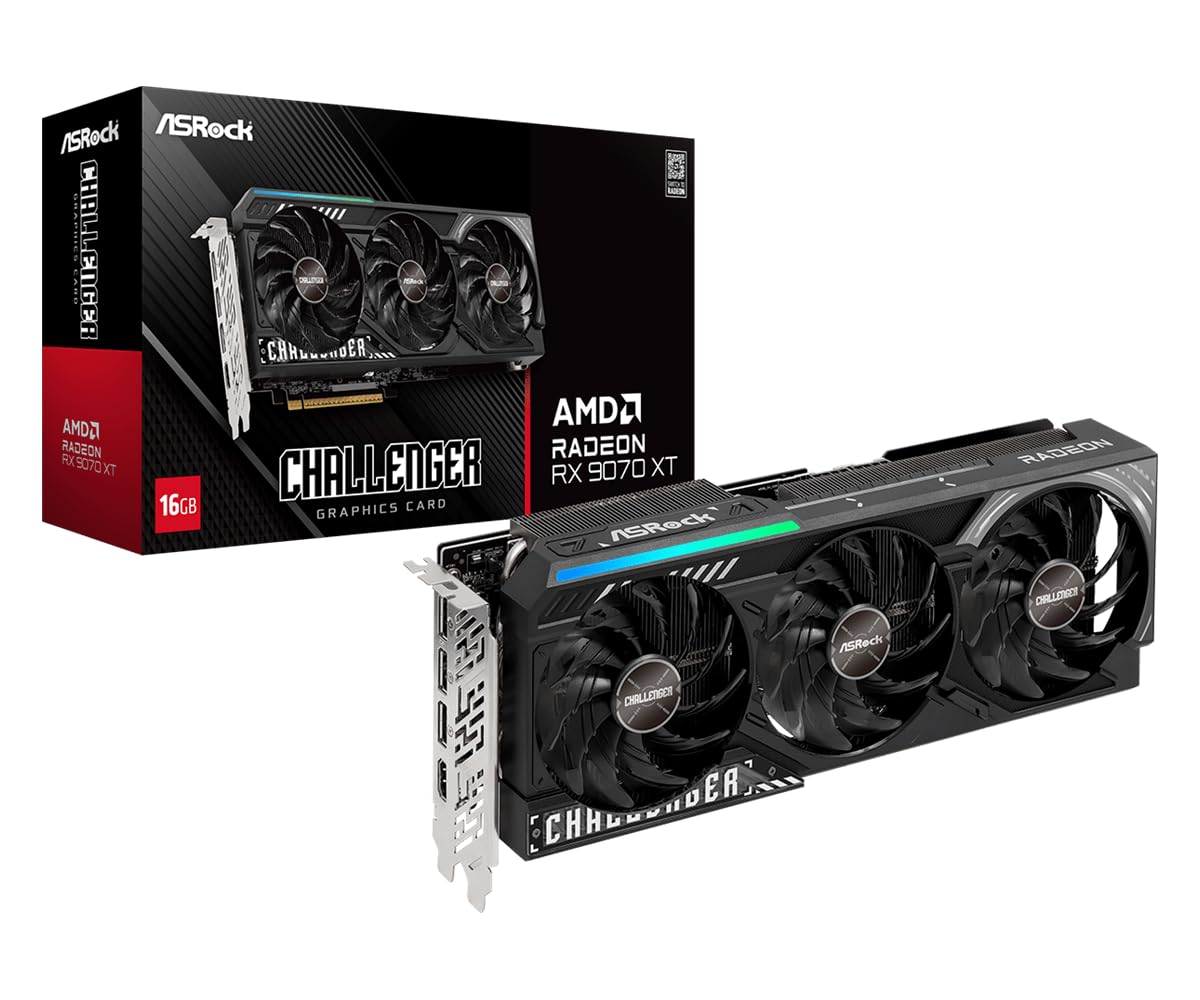
The ASRock RX 9070 XT Challenger is the entry-level ticket to 4K gaming on the RDNA 4 platform. With a boost clock of 2970 MHz and 16GB of GDDR6 on a 256-bit bus, it delivers the essential specs required for smooth 4K gameplay while undercutting the competition on cost. The triple-fan design with striped axial fan technology and 0dB silent cooling provides adequate thermal management for long gaming sessions.
In practice, this card maxes out 1440p with ease and handles 4K well, providing a smooth experience in most modern titles. Users upgrading from older cards like the RX 5700 XT report a massive generational leap. It also undervolts effectively through the Adrenaline software, allowing you to lower power draw and temperatures without a noticeable performance hit. The physical switch to control LED lighting is a nice user-friendly touch.
The budget positioning does come with some compromises. The RGB software is reportedly buggy and can lose connection with the card. Furthermore, the build quality is not as refined as the Nitro+ or Gaming OC variants, though it is still perfectly functional. You will need at least a 750W power supply to run this card safely. It is an excellent choice for anyone wanting to get 16GB of VRAM and 4K capability without stretching their budget.
Why it’s great
- Most affordable entry to 16GB 4K gaming
- 0dB silent mode for low-load scenarios
- Undervolts well for better efficiency
Good to know
- RGB software can be buggy
- Build quality is basic compared to higher-end models
6. ASUS SFF-Ready Prime RTX 5070

The ASUS Prime RTX 5070 is designed for enthusiasts who want Blackwell architecture and DLSS 4 in a small-form-factor build. Its 2.5-slot design and compact footprint make it compatible with ITX and SFF cases that larger cards cannot fit. Despite its size, it houses 12GB of GDDR7 memory on a 192-bit bus and includes Axial-tech fans with a phase-change GPU thermal pad to keep temperatures in check.
For 4K, this card is a capable entry point. While 12GB of VRAM is tight for the most demanding 4K textures of the future, the 5070’s core performance is strong enough to drive high settings in current AAA titles when combined with DLSS 4 upscaling. Users report excellent 1440p performance (over 180 FPS in competitive titles) and decent 4K capability. The dual BIOS system allows you to prioritize quiet operation or higher performance.
The main limitation here is the 192-bit memory bus and 12GB VRAM, which means it is not a true “future-proof” 4K card for the highest texture settings in the next few years. It also lacks the raw compute of the 5070 Ti or 5080. The card requires careful power management; you should avoid using splitter cords and instead use a direct PSU cable for the 16-pin connector. It is a fantastic card for those who need peak performance in a small space.
Why it’s great
- Fits in SFF and ITX cases easily
- Runs cool and quiet with dual BIOS
- Power-efficient Blackwell architecture
Good to know
- 12GB VRAM may be limiting for future 4K titles
- Not as powerful as the 5070 Ti or 5080
7. GIGABYTE GeForce RTX 5070 WINDFORCE OC SFF 12G

The GIGABYTE RTX 5070 WINDFORCE OC is the definition of a silent performer. It uses a triple-fan WINDFORCE cooling system that is remarkably quiet, even under full load, with users noting it is quieter than their old dual-fan cards from a previous generation. As an SFF-ready card, it fits in compact builds but also provides excellent thermal performance, keeping the GPU well under 75°C during extended 1440p gaming sessions.
This card is exceptional for 1440p high-refresh-rate gaming and serves as a solid entry point for 4K. With 12GB of GDDR7 memory and DLSS 4 support, it can handle 4K in many titles at medium to high settings. The compact size (11.1 inches long) is a bonus for cable management and case compatibility. It draws relatively low power and runs efficiently, making it a good upgrade for those moving from a 3080.
The primary limitation for dedicated 4K use is the 12GB VRAM buffer, which may be a bottleneck in future unoptimized titles or games using high-resolution texture packs. It also lacks RGB lighting, which may be a pro or a con depending on your aesthetic. For those who prioritize near-silent operation and excellent 1440p performance, this is a top-tier choice that can still dabble in 4K.
Why it’s great
- Exceptionally quiet cooling system
- Compact and fits in SFF cases
- Great value for entry-level 4K
Good to know
- 12GB VRAM limits future 4K capability
- No RGB lighting for customizable builds
8. PNY NVIDIA GeForce RTX 5070 Epic-X ARGB OC
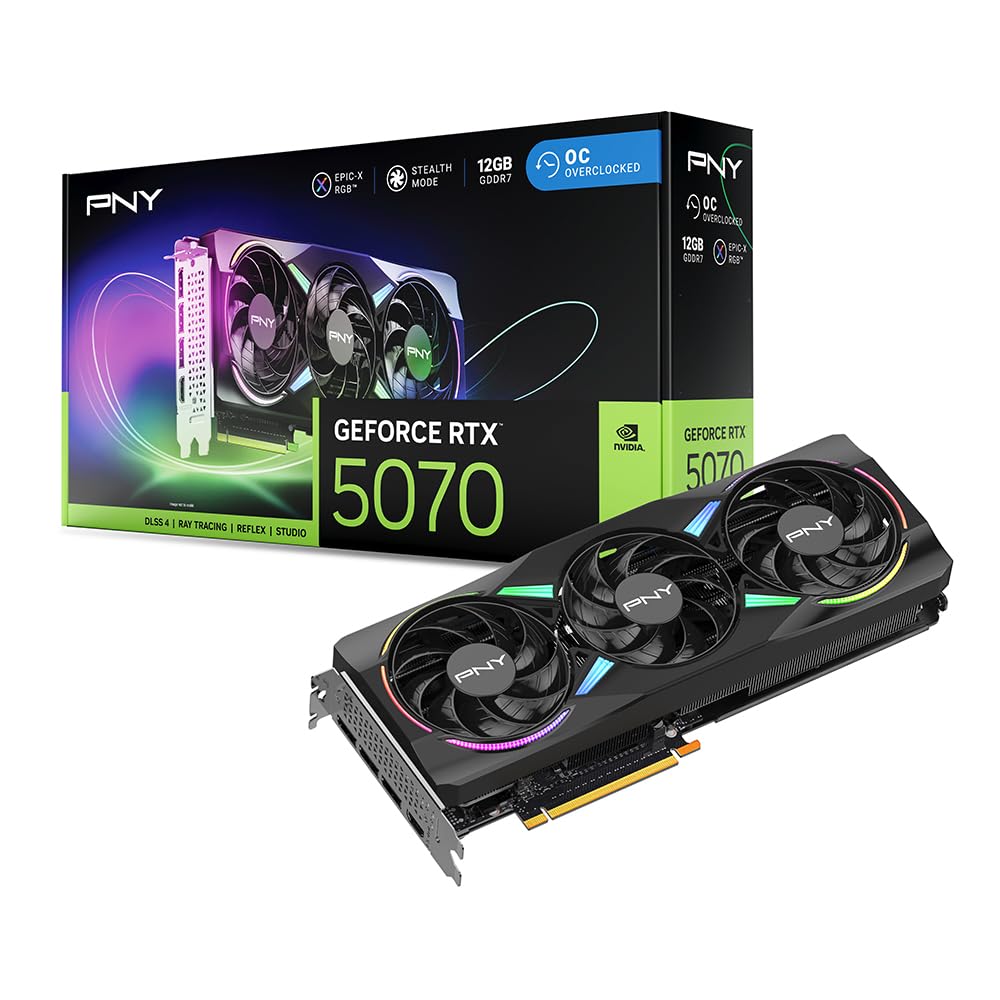
The PNY RTX 5070 Epic-X ARGB OC is designed for gamers who want their GPU to be a visual centerpiece. It features a factory overclock of 8% over the base boost clock and includes vivid ARGB lighting that can be fully customized. Under the hood, it packs the full Blackwell feature set, including fifth-gen Tensor Cores and fourth-gen Ray Tracing Cores, which allow it to punch well above its weight in DLSS 4-enhanced games.
For 4K, this card performs admirably, particularly in titles that leverage DLSS 4 frame generation. With 12GB of GDDR7 on a 192-bit bus, it can handle 4K gaming at high settings, though it is more at home at 1440p where it can be maxed out. User reviews highlight the incredible cooling, noting the card remains quiet even under a full load and runs at very low temperatures, outperforming previous generation cards like the 4070 Super.
The main drawback is the VRAM. 12GB is enough for current 4K gaming, but it is unlikely to be sufficient for the highest texture quality in games releasing two to three years from now. The card also requires a 750W PSU and a dual 8-pin to 12-pin adapter. It is the best choice for anyone building a showpiece PC who wants strong 4K performance right now and values aesthetics.
Why it’s great
- Excellent factory overclock with headroom
- Stunning ARGB lighting effects
- Runs cool and quiet under load
Good to know
- 12GB VRAM is borderline for future 4K
- Requires a 750W PSU and adapter cable
9. NVIDIA GeForce RTX 5080 Founders Edition

The NVIDIA RTX 5080 Founders Edition is the flagship for the Blackwell generation outside of the 5090. It manages to be remarkably compact and lightweight for a card of its caliber, making it easy to install without a support bracket. The card features 16GB of GDDR7 memory and a boost clock of 2806 MHz, and its architectural efficiency allows it to deliver 4K max settings with ray tracing at 120+ FPS in the most demanding titles.
This card is a massive generational upgrade for users coming from the RTX 30-series. It runs noticeably cooler than previous high-end cards, and the dual-slot design is a marvel of engineering. The DLSS 4 performance is transformative for 4K, pulling frame rates well above 200 FPS in many games. It is a true “set and forget” card for 4K where you can max out settings without worrying about performance.
The major downside is the price, which is significantly above the MSRP on third-party markets, placing it in a very premium tier. While the 16GB VRAM is a lot, some users worry it may not be future-proof for the eventual demands of Unreal Engine 5.5 titles. For those who can afford it, this is the most polished 4K gaming experience available today from Nvidia’s own factory.
Why it’s great
- Exceptional 4K performance with DLSS 4
- Compact, lightweight Founders Edition design
- Runs much cooler than last-gen flagships
Good to know
- Very expensive at retail
- 16GB VRAM may not be future-proof for 4K
10. VIPERA NVIDIA GeForce RTX 4090 Founders Edition

The RTX 4090 remains the absolute pinnacle of consumer GPU performance, even after the launch of the RTX 50-series. Its 24GB of GDDR6X memory on a massive 384-bit bus provides the bandwidth and capacity that no other card can match. It is the only card that can brute-force 4K gaming without any reliance on upscaling, and it excels at creative workloads like 3D rendering, Blender, and Unreal Engine 5 development.
For 4K gaming, the 4090 is unstoppable. It can run any game at the highest settings and maintain smooth frame rates. The 24GB VRAM buffer allows for the heaviest texture mods and is a godsend for AI work such as running large language models locally or training LoRAs in ComfyUI. The performance is still competitive with the 5080, and in many memory-intensive scenarios, it outperforms it.
The price is the single biggest factor. The 4090 commands a very high premium, especially as it is now a previous-generation card. It is also a massive power user, often spiking to over 400W under load, generating significant heat that will warm up your room. For the vast majority of gamers, a 5080 or 5070 Ti is a better value. The 4090 is for those who require the absolute maximum performance for professional or niche enthusiast use cases.
Why it’s great
- 24GB VRAM is unmatched for AI and heavy modding
- Destroys any game at 4K ultra without upscaling
- Massive 384-bit memory bus for high bandwidth
Good to know
- Extremely expensive
- High power draw and generates a lot of heat
11. EVGA GeForce RTX 3090 FTW3 Ultra Gaming (Renewed)

The EVGA RTX 3090 FTW3 Ultra is a previous-generation legend, and its renewed availability on Amazon makes it a compelling option for specific use cases, particularly AI and compute workloads. It offers 24GB of GDDR6X VRAM on a 384-bit bus, the same memory configuration as the 4090, for a much lower price. This makes it the budget king for running large AI models like LLaMA, Stable Diffusion, and for complex 3D rendering.
For 4K gaming, while it lacks the architectural efficiency and features like DLSS 4 of the 50-series cards, it still holds its own. It can run most games at 4K high settings with good frame rates, often exceeding 60 FPS. Users report it handles a four-monitor setup smoothly and provides 70-120 FPS in demanding games at 4K ultra. The EVGA iCX3 cooling is robust, though the card fans are objectively loud at full speed.
The trade-offs are significant. This is a refurbished product, so its lifespan may vary. It runs very hot, with backside VRAM temperatures reaching 90°C, and it draws over 400W under load, essentially functioning like a space heater. It requires three 8-pin PCIe power connectors and an 800W minimum PSU. For gaming alone, newer cards offer better performance per watt, but for anyone needing 24GB of VRAM on a budget, this is the choice.
Why it’s great
- 24GB VRAM at the cheapest possible price
- Excellent for AI and heavy rendering workloads
- Proven compatibility and driver stability
Good to know
- Runs very hot and loud under full load
- Refurbished unit; lifespan is not guaranteed
- Gaming performance is behind current-gen cards
FAQ
Is 12GB of VRAM enough for 4K gaming in 2025?
What is the difference between DLSS and FSR for 4K?
How much power supply do I need for a 4K GPU?
Should I wait for the next generation of GPUs?
Final Thoughts: The Verdict
For most users, the best 4k gpu winner is the MSI RTX 5070 Ti Ventus 3X OC because it provides the perfect balance of VRAM, memory bandwidth, and latest-generation features at a price point that is demanding but accessible, making it the true sweet spot for high-refresh-rate 4K. If you want the absolute quietest operation with excellent raw 4K rasterization, grab the Sapphire Nitro+ RX 9070 XT. And for professional-grade AI workloads where VRAM is king, nothing beats the value of the EVGA RTX 3090 FTW3 (Renewed).