
Pushing a pixel-dense 4K display demands a graphics card that can sustain high frame rates without stuttering, thermal throttling, or running out of VRAM mid-game. The wrong choice leaves you turning down texture quality or resolution scaling just to keep things playable — exactly the compromise you wanted to avoid by investing in a 4K monitor in the first place.
I’m Min — the co-founder and writer behind Gadgets Feed. My research for this guide involved comparing over 100 real-user benchmarks across 4K resolutions, analyzing thermal and power draw data, and cross-referencing VRAM requirements for modern titles at Ultra settings to identify the cards that actually deliver on the 4K promise.
After weeks of sifting through performance charts and real-world feedback, I’ve narrowed the field to the nine models that consistently hold their own at 4K so you can confidently pick a best 4k graphics card that matches your build and budget.
How To Choose The Best 4K Graphics Card
Selecting a 4K graphics card requires thinking beyond just raw clock speeds. The resolution demands a balanced combination of VRAM capacity, memory bandwidth, and modern upscaling technology to avoid dipping below 60 FPS on demanding titles. Understanding these trade-offs is the difference between a smooth 4K experience and a frustrating one.
VRAM Capacity and Memory Bandwidth
4K textures consume VRAM aggressively. An 8GB card like the RTX 5060 can run 4K in older or optimized titles, but modern AAA releases with high-resolution texture packs will push closer to 12GB or 16GB of usage at 4K Ultra. The memory bus width matters just as much — a 256-bit interface with GDDR6 provides significantly more bandwidth than a 128-bit bus, which directly impacts how quickly the GPU can feed the display at high resolutions.
Upscaling and Frame Generation
Native 4K rendering at high frame rates is still demanding even for the most powerful GPUs. DLSS 4 on NVIDIA Blackwell cards and FSR on AMD RDNA 4 cards use AI and temporal reconstruction to render at a lower internal resolution while maintaining near-native visual quality. These technologies directly translate to playable frame rates in ray-traced titles, making them a critical feature for any 4K-focused card.
Power Delivery and Physical Fit
A 4K graphics card is a power-hungry component. Many of the premium models in this guide require 750W to 1000W power supplies and occupy 2.5 to 3 slots of case space. Before purchasing, verify that your PSU has sufficient wattage and the correct PCIe power connectors (some cards use a 12VHPWR connector that may require adapter cables), and that your case has enough clearance for the card’s length and width.
Quick Comparison
On smaller screens, swipe sideways to see the full table.
| Model | Category | Best For | Key Spec | Amazon |
|---|---|---|---|---|
| GIGABYTE RTX 5060 | Entry-Level 4K | Light 4K / 1440p Gaming | 8GB GDDR7 — 128-bit | Amazon |
| ASUS RX 9060 XT | Mid-Range 4K | 1440p / Entry 4K | 16GB GDDR6 — 256-bit | Amazon |
| PNY RTX 5070 | Mainstream 4K | 1440p / Competent 4K | 12GB GDDR7 — 192-bit | Amazon |
| ASUS Prime RTX 5070 | SFF-Ready 4K | Compact 4K Builds | 12GB GDDR7 — 192-bit | Amazon |
| ASRock RX 9070 XT Steel Legend | High-End 4K Gaming | 4K Ultra / 1440p Max | 16GB GDDR6 — 256-bit | Amazon |
| Sapphire Nitro+ RX 9070 XT | Premium 4K Radeon | 4K 120Hz Gaming | 16GB GDDR6 — 256-bit | Amazon |
| MSI RTX 5070 Ti | High-Performance 4K | 4K 120+ FPS Gaming | 16GB GDDR7 — 256-bit | Amazon |
| NVIDIA RTX 5080 FE | Enthusiast 4K | Max Settings 4K | 16GB GDDR7 — 256-bit | Amazon |
| VIPERA RTX 4090 FE | Ultimate 4K Beast | Uncompromised 4K/8K | 24GB GDDR6X — 384-bit | Amazon |
In‑Depth Reviews
1. MSI RTX 5070 Ti Ventus 3X OC

The MSI RTX 5070 Ti Ventus 3X OC strikes an exceptional balance between raw 4K performance and cost. With 16GB of GDDR7 memory across a 256-bit bus and a boost clock of 2497 MHz, it delivers frame rates that rival last-gen flagships. Real-world testing shows it beating the RTX 4080 Super in synthetic benchmarks without any overclocking effort, and user reports confirm 120–140 FPS in demanding 4K titles like Tarkov and DayZ when paired with a capable CPU.
The TORX Fan 5.0 design with ring-arc blades maintains high-static pressure while keeping noise levels low — even under sustained gaming loads, the card stays comfortably under 65°C. The nickel-plated copper baseplate quickly pulls heat away from the GPU die and memory modules, preventing thermal throttling during long sessions. MSI’s square-core pipe design maximizes contact area with the baseplate, further improving thermal transfer efficiency.
This card also handles AI and productivity workloads with ease. Users running Hashcat and Llama 3.1 8B models report smooth performance, and the 16GB VRAM buffer is ample for most creative suites and local LLM inference. The only trade-off is the lack of RGB lighting, which may disappoint builders seeking a flashy aesthetic, but for pure performance per dollar at 4K, this is the sweet spot.
Why it’s great
- 256-bit bus with 16GB GDDR7 handles 4K textures without VRAM swapping
- Beats RTX 4080 Super in benchmarks at a lower price point
- Quiet and cool under 65°C even during extended 4K sessions
- Excellent for both gaming and AI/LLM workloads
Good to know
- No RGB lighting for aesthetic-focused builds
- Requires adequate case airflow for optimal thermals
- 12VHPWR connector may need adapter for older PSUs
2. Sapphire Nitro+ RX 9070 XT

The Sapphire Nitro+ RX 9070 XT is the definitive premium Radeon choice for 4K gaming. With a boost clock of 3060 MHz and 16GB of GDDR6 memory on a 256-bit bus, it pushes 4K 120Hz output with remarkable smoothness. Users upgrading from cards like the RTX 2080 Super report a massive leap in performance, with the 9070 XT handling demanding 4K titles without dipping below playable frame rates. The card is notably quiet and exhibits no coil whine even under full load.
Sapphire’s triple-fan cooling solution is a standout. The Nitro+ maintains low temperatures even during extended sessions, and the clean 12V cable routing beneath the backplate makes cable management easier in tight builds. The card does occupy over 3 slots and exceeds 300mm in length, so case compatibility must be verified before purchase. A support bracket is included, but the card’s weight may still cause sag over time — many users recommend a separate GPU support arm for long-term reliability.
On the software side, AMD’s Adrenaline drivers have proven stable, and the 16GB VRAM buffer ensures that 4K texture packs don’t cause stuttering. Ray tracing performance still trails NVIDIA’s Blackwell offerings at this tier, but rasterized performance is exceptional for the price. For users who prioritize raw 4K frame rates and prefer AMD’s ecosystem, this is the top contender.
Why it’s great
- 3060 MHz boost clock delivers excellent 4K 120Hz performance
- 16GB VRAM handles modern 4K textures without issues
- Remarkably quiet under load with no coil whine
- Stable Adrenaline drivers with extensive tuning options
Good to know
- Large 3+ slot design requires spacious case
- Ray tracing still lags behind NVIDIA Blackwell cards
- Heavy card may need additional support bracket
3. NVIDIA RTX 5080 Founders Edition

The RTX 5080 Founders Edition represents the enthusiast tier of NVIDIA’s Blackwell lineup, delivering uncompromised 4K performance. With 16GB of GDDR7 memory and a boost clock of 2806 MHz, this card consistently achieves 200+ FPS in most 4K titles at max settings. Users upgrading from an RTX 3080 Founders Edition report a transformative generational uplift, noting that the 5080 runs significantly cooler and quieter than previous-gen high-end cards.
DLSS 4 is a major differentiator here. Neural rendering technologies like frame generation and ray reconstruction allow the 5080 to maintain high frame rates even when ray tracing and path tracing are enabled. In Cyberpunk 2077 with Path Tracing, user benchmarks show playable 60+ FPS performance, something earlier architectures struggled to achieve at native 4K. The card’s dual-slot design is surprisingly compact for its performance tier, making it feasible for larger small-form-factor builds.
The Founders Edition’s cooling solution is outstanding — users report that the card stays cool under sustained heavy loads without thermal throttling. The lightweight build means no GPU bracket is needed, reducing installation complexity. The primary drawback is the price premium over MSRP that many third-party sellers command. However, for buyers seeking the absolute pinnacle of 4K gaming without venturing into the 4090 price stratosphere, the 5080 FE is a compelling flagship.
Why it’s great
- 200+ FPS in most 4K games at max settings
- DLSS 4 enables playable path tracing at 4K
- Compact dual-slot design with excellent cooling
- Lightweight with no support bracket needed
Good to know
- Often priced significantly above MSRP by resellers
- 16GB VRAM may be future-limiting for some workloads
- PCIe 4.0 interface instead of 5.0
4. ASRock RX 9070 XT Steel Legend

The ASRock RX 9070 XT Steel Legend brings flagship RDNA 4 performance to a more accessible price point. With 64 Compute Units, a boost clock of 2970 MHz, and 16GB of GDDR6 on a 256-bit bus, it delivers uncompromising 4K gaming with all the modern AMD features intact. Users report that it handles 1440p at max settings effortlessly and holds its own at 4K in demanding titles, especially after undervolting via Adrenaline for improved efficiency.
The triple-fan Steel Legend cooling system includes striped ring fans and air-deflecting fins that keep thermals in check even during extended gaming sessions. Polychrome SYNC RGB lighting adds aesthetic flexibility for builders who want a coordinated light show. The reinforced metal frame and backplate provide structural rigidity that prevents PCB flex and sag over time, a common concern with larger GPUs.
Performance-wise, the 9070 XT Steel Legend competes directly with NVIDIA’s offerings at this price tier while offering 16GB of VRAM as standard. The factory overclock out of the box provides a meaningful boost over reference specifications. Some users have noted that ASRock’s RGB software can be buggy and occasionally loses connection with the lighting controller, but this is a minor software gripe that doesn’t affect the card’s outstanding gaming performance.
Why it’s great
- 2970 MHz factory overclock delivers excellent out-of-box 4K performance
- 16GB VRAM with 256-bit bus handles demanding 4K textures
- Reinforced metal frame prevents sag and PCB flex
- DIY-friendly undervolting via Adrenaline improves efficiency
Good to know
- ASRock RGB software can be unreliable
- Requires 800W PSU minimum for stability
- 2.9-slot design limits case compatibility
5. PNY RTX 5070 Epic-X ARGB OC
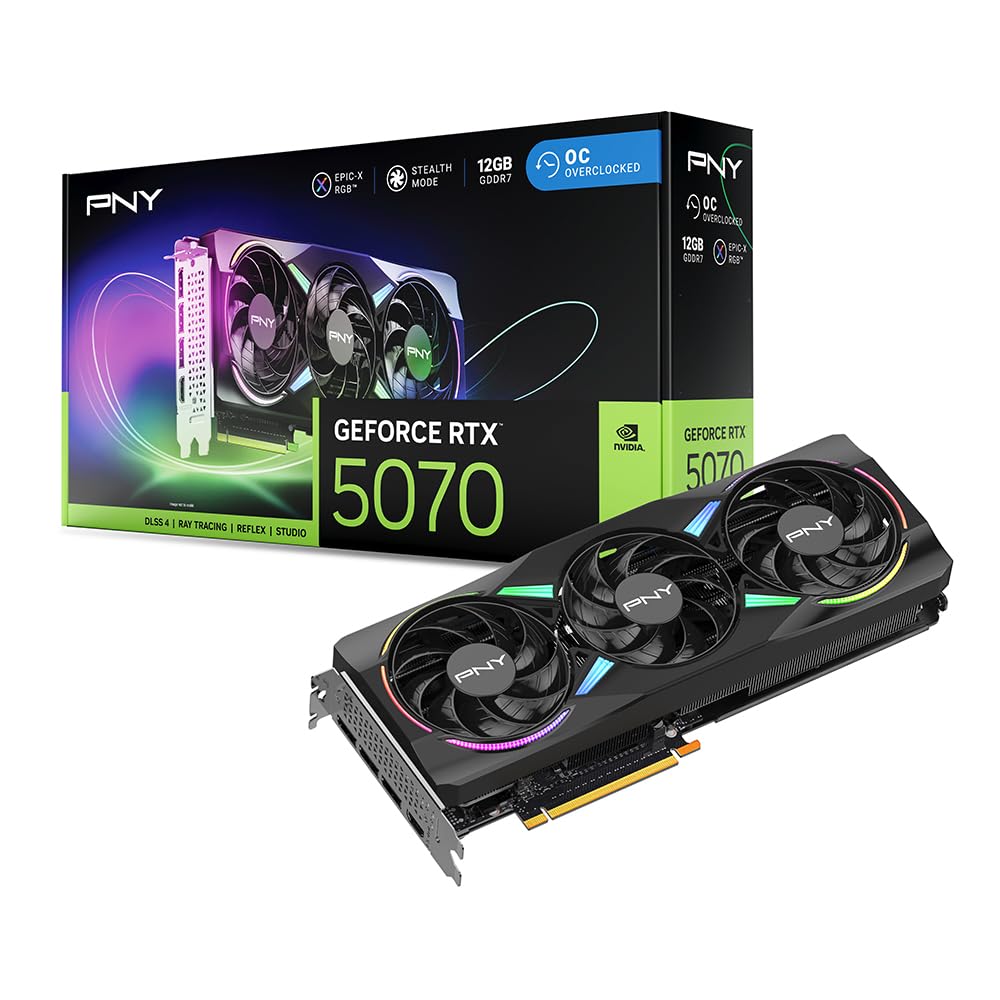
The PNY RTX 5070 Epic-X ARGB OC delivers compelling 1440p performance with solid 4K capability for those willing to use DLSS. With 12GB of GDDR7 memory and a 192-bit bus, it handles 4K in less demanding or well-optimized titles natively, while DLSS 4 upscaling makes heavier AAA releases playable. The 8% factory overclock gives it a meaningful edge over reference 5070 models, with additional headroom for manual tuning.
PNY’s triple-fan cooling solution is exceptional in this form factor. Users report that the card runs very quietly even under maximum load, and the cooling performance actually lowered overall case temperatures in some builds. The compact footprint makes it compatible with a wider range of cases compared to bulkier premium cards. The included dual 8-pin to 12-pin power adapter ensures compatibility with most 750W modular PSUs.
In terms of raw performance at 4K, the 5070 sits in a comfortable middle ground. It outperforms the RTX 4070 Super without relying on frame generation, and DLSS 4 provides further headroom for future titles. The 12GB VRAM buffer may become a limitation for modded games or future demanding titles, but for current-generation 4K gaming with high settings, it remains a strong contender. The subtle ARGB adds a touch of style without being overwhelming.
Why it’s great
- Factory overclocked with extra tuning headroom for better 4K performance
- DLSS 4 makes 4K gaming viable even in demanding titles
- Exceptionally quiet triple-fan cooling with low case impact
- Compact footprint fits in most mid-tower builds
Good to know
- 12GB VRAM may be limiting for future 4K AAA titles
- 192-bit bus is narrower than optimal for 4K
- Power adapter may be tight in smaller PSU compartments
6. ASUS Prime RTX 5070

The ASUS Prime RTX 5070 is purpose-built for small-form-factor builds that don’t compromise on 4K capability. The SFF-Ready designation means this 2.5-slot card fits in compact cases that traditional premium cards cannot, while the Phase-change GPU thermal pad ensures optimal heat transfer from the die to the heatsink — a critical feature when airflow is limited. Users report that the card runs at 60–65°C under full load even in ITX enclosures.
ASUS has equipped the Prime RTX 5070 with Axial-tech fans featuring a reduced hub size that allows for longer blades, increasing downward air pressure while maintaining acoustic efficiency. The Dual BIOS switch lets users toggle between a Quiet profile for low-noise scenarios and a Performance profile for maximum thermal headroom. User benchmarks show that the card, paired with a 7800X3D, achieves excellent 1440p competitive performance with room to handle 4K gaming at respectable settings.
The jet black aesthetic is minimal and clean, making it a natural fit for dark-themed builds without RGB distraction. One important installation note: users strongly recommend using a native 16-pin PSU cable rather than the included splitters to ensure stable power delivery. For builders seeking a compact card that can still drive a 4K display with DLSS 4 assistance, the ASUS Prime RTX 5070 is the most space-efficient choice on this list.
Why it’s great
- SFF-Ready 2.5-slot design fits compact ITX cases
- Phase-change thermal pad ensures excellent heat transfer in tight spaces
- Dual BIOS for flexible performance/noise tuning
- Quiet operation even under full 4K load
Good to know
- 12GB VRAM may be limiting for future 4K titles
- Native 16-pin PSU cable recommended over splitters
- No RGB for users who prefer lighting effects
7. ASUS Dual RX 9060 XT 16GB
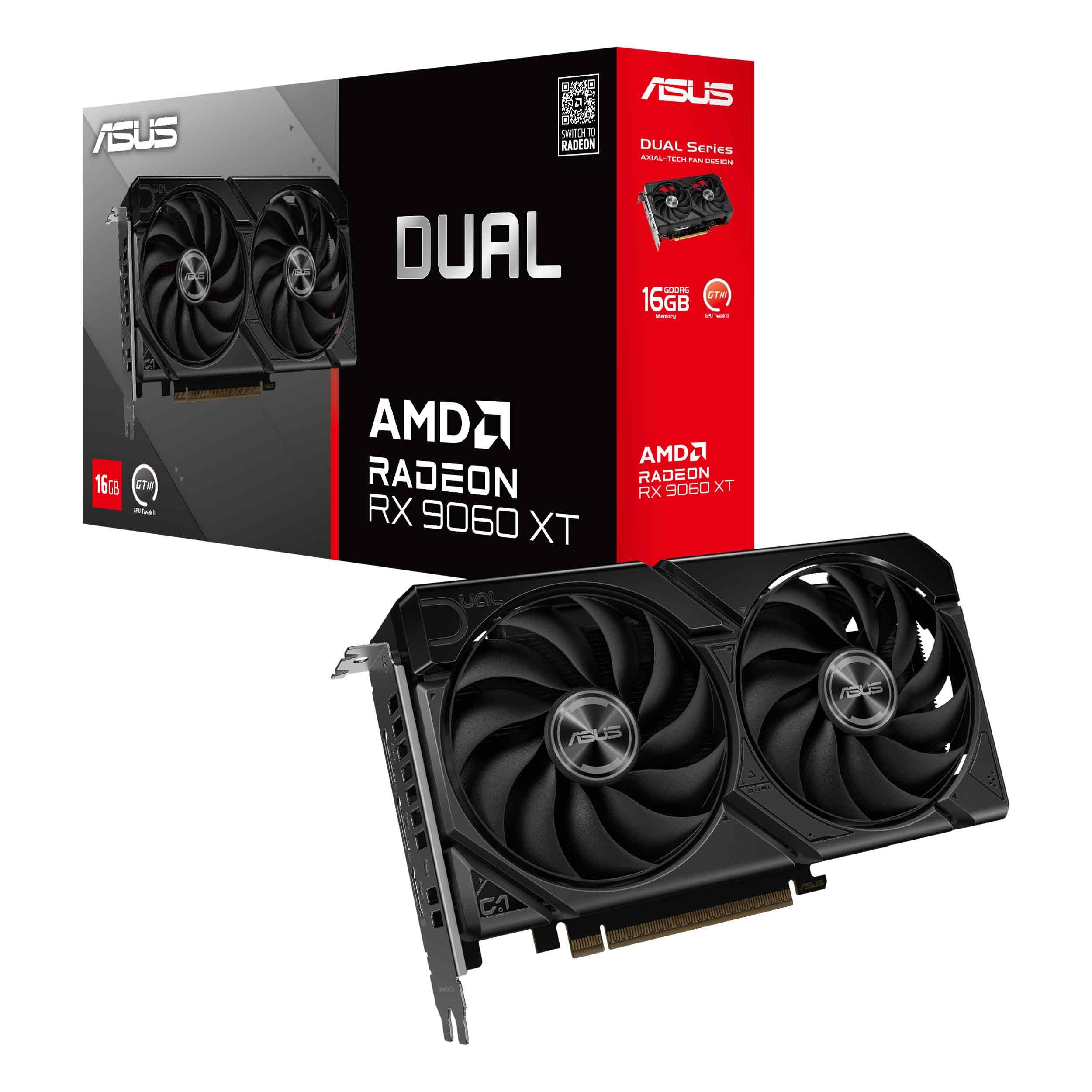
The ASUS Dual RX 9060 XT offers compelling 4K entry-level performance with 16GB of GDDR6 memory at a very accessible price point. The boost clock of 3250 MHz is among the highest at this tier, and the 256-bit memory bus provides sufficient bandwidth for 4K textures in less demanding titles. It excels at 1440p gaming where user reports show smooth ultra settings performance across a wide range of games, while providing a solid 4K experience in optimized or older titles.
The 2.5-slot design with Axial-tech fans keeps thermals well under control while maintaining build compatibility. ASUS uses dual ball fan bearings rated for twice the lifespan of sleeve bearings, a detail that matters for longevity. 0dB technology stops the fans entirely during light loads, making the card completely silent for desktop work or media consumption — a nice touch for users who keep their PCs in living spaces.
With 16GB of VRAM, this card offers better future-proofing than many comparably priced alternatives when considering 4K texture loads. The dual BIOS switch lets users toggle between Quiet and Performance modes, and AMD’s Adrenaline software provides excellent tuning flexibility. The compact size and low power draw make it ideal for budget-oriented 4K builds where power supply headroom is limited. It handles indie 4K titles at 100+ FPS while targeting 1440p for more demanding releases.
Why it’s great
- 16GB VRAM at a budget-friendly price point for 4K textures
- 3250 MHz boost clock provides excellent 1440p performance
- 0dB technology makes fans silent during light desktop use
- Compact design with high-build-quality ball bearing fans
Good to know
- 4K performance in demanding AAA titles requires FSR upscaling
- Plastic backplate may feel less premium than metal alternatives
- No RGB lighting for aesthetic customization
8. GIGABYTE RTX 5060 Windforce OC

The GIGABYTE RTX 5060 Windforce OC is the entry point into the Blackwell architecture and provides a surprisingly capable 4K experience when paired with DLSS 4. The 8GB GDDR7 on a 128-bit bus is the primary limitation for native 4K gaming, but the card leverages NVIDIA’s neural rendering technologies to deliver playable frame rates in many modern titles. Users report over 250 FPS in games like Cyberpunk and DOOM at 1080p/1440p, with solid 4K performance in less demanding or older games.
The WINDFORCE cooling system keeps the card quiet and cool even under sustained loads. User reviews highlight that the dual-fan design is effective enough for the card’s moderate thermal output, and the compact form factor makes it an easy fit for smaller cases. The card is also well-suited for productivity workloads — users have reported excellent results in photo/video editing and music production, where the CUDA acceleration provides tangible benefits over integrated graphics.
Installation caution: several users recommend running DDU (Display Driver Uninstaller) in Safe Mode before swapping from an older GPU to avoid driver conflicts. Once properly set up, the card runs stably under both Windows 10 and Windows 11. The 8GB VRAM buffer means settings management is required for heavy 4K textures, but for budget-conscious builders who want to experience 4K gaming with the help of DLSS 4, this is the most accessible path.
Why it’s great
- DLSS 4 makes 4K gaming viable on a budget-friendly platform
- Excellent 1080p/1440p performance with high frame rates
- Compact and quiet dual-fan design
- Great for productivity workloads like video editing
Good to know
- 8GB VRAM requires aggressive settings management at 4K
- 128-bit memory bus is a bottleneck for native 4K
- DDU recommended before installation for stable drivers
9. VIPERA RTX 4090 Founders Edition

The VIPERA RTX 4090 Founders Edition sits at the absolute pinnacle of consumer graphics card performance. With 24GB of GDDR6X memory on a massive 384-bit bus and a boost clock of 2520 MHz, it offers 1.5x the VRAM and wider bandwidth than any other card on this list. This translates to uncompromised 4K gaming at Ultra settings with ray tracing enabled, and performance that extends into 8K resolution territory for users with the display hardware to match.
The Ada Lovelace architecture brings third-generation Ray Tracing Cores and fourth-generation Tensor Cores that enable DLSS 3 Frame Generation, providing massive FPS boosts in supported titles. For creative professionals, the 24GB VRAM buffer is transformative for 3D rendering, video production, and local AI model inference. Users running ComfyUI and LLMs report excellent performance, and the card handles demanding workloads like Blender and Unreal Engine 5.4 with ease when paired with a high-end CPU.
At this performance tier, the premium cost reflects the absolute best available. The card runs cool and quiet under load, with users noting that it uses less power and produces less heat than previous-gen high-end cards while delivering significantly more performance. The Founders Edition’s dual-flow-through cooler design is remarkably efficient. For users who need the absolute highest 4K frame rates, work with massive textures, or want to future-proof for years to come, the RTX 4090 remains in a class of its own.
Why it’s great
- 24GB VRAM on a 384-bit bus handles any 4K workload without compromise
- Unmatched performance for 4K Ultra with ray tracing enabled
- Excellent for professional rendering and AI model inference
- Runs cool and quiet despite class-leading performance
Good to know
- Premium price places it in a very high investment tier
- Requires a high-wattage PSU and adequate case airflow
- Overkill for users who primarily game at 1440p
FAQ
Is 12GB of VRAM enough for 4K gaming in 2025?
Should I choose DLSS 4 or FSR for 4K upscaling?
What power supply do I need for a 4K graphics card?
Can a 1440p-focused card run 4K well with DLSS?
Final Thoughts: The Verdict
For most users, the best 4k graphics card winner is the MSI RTX 5070 Ti because it delivers true 4K performance with 16GB of GDDR7 and a 256-bit bus at a price that doesn’t require sacrificing the rest of your build budget. If you want the rawest rasterized 4K frame rates and prefer AMD’s ecosystem, grab the Sapphire Nitro+ RX 9070 XT. And for uncompromised 4K gaming, professional workloads, and the absolute highest performance ceiling, nothing beats the VIPERA RTX 4090 FE.