
Reliable live IPTV delivery at 4K resolution demands an encoder that balances ultra-low latency with robust error-correction, and the growing dominance of SRT (Secure Reliable Transport) over traditional RTMP has shifted what professionals look for in a hardware box. Whether you are feeding a CDN for a multi-platform simulcast or sending a private SRT stream back to a studio, the encoder’s ability to maintain sub-second glass-to-glass delay while handling HEVC compression determines whether your stream looks like a broadcast or a buffer-fest.
I’m Min — the co-founder and writer behind Gadgets Feed. I spend my time analyzing encoder chipset generations, SRT handshake behavior, and multi-stream mapping capabilities so you don’t have to decode the data sheets yourself. (And Homer 🐱 oversees every firmware update from his perch on the UPS box.)
After comparing seven hardware engines across HEVC/H.264 codec paths, SRT fallback behavior, multi-channel output limits, and real-world latency ceilings, this guide surfaces the strongest contenders. Every recommendation here serves one purpose: helping you identify the best 4k hevc hdmi encoder low latency srt for iptv that matches your specific production workflow without guesswork.
How To Choose The Best 4K HEVC HDMI Encoder Low Latency SRT For IPTV
Four factors separate a flexible broadcast-ready encoder from a box that fights you on every stream change. Start with the chipset’s native codec support, move to SRT reliability under packet loss, check how many simultaneous output streams the hardware can push, and finally confirm the latency figure at your target resolution and frame rate.
SRT Implementation and Packet‑Loss Resilience
Not all SRT implementations are equal. A good encoder handles SRT with AES-128/256 encryption while maintaining a configurable latency buffer (typically 120 ms to 2000 ms). For IPTV crossing public internet or noisy Wi-Fi links, look for an encoder that exposes the SRT latency setting in its admin panel so you can tune the trade-off between delay and drop-out recovery.
HEVC Encoding at 4K
HEVC (H.265) at 4K cuts bitrate roughly in half versus H.264 for the same perceptual quality, which matters when your upstream bandwidth is capped. However, 4Kp30 or 4Kp60 encoding requires a chipset with enough processing headroom — confirm whether the encoder can do 4K HEVC on every channel simultaneously if you are running a multi-input unit.
Multi‑Protocol and Multi‑Stream Flexibility
IPTV workflows often demand sending one feed as SRT to a private studio, another as RTMP to a CDN, and a third as HLS for archive. Multi-stream hardware encoders allow each output to use a different protocol and destination without adding external splitters. Count the encoder’s advertised simultaneous stream limit and verify it can sustain all streams at your chosen resolution and bitrate.
Quick Comparison
On smaller screens, swipe sideways to see the full table.
| Model | Category | Best For | Key Spec | Amazon |
|---|---|---|---|---|
| URayCoder UHE265-4-4K | Multi‑Protocol | Multi‑platform simulcast + WebRTC | 4 streams, 4Kp30, HEVC, WebRTC | Amazon |
| Blackmagic ATEM Mini Pro ISO | Switcher / Encoder | Multi‑camera live production | 4 x HDMI in, 5‑stream ISO recording | Amazon |
| URayCoder UHE265-8 | Multi‑Channel | 8‑input IPTV head‑end | 8 x HDMI in, dual stream per input | Amazon |
| URayCoder USE265-1L | SDI + HDMI | Camera‑to‑IP with SDI workflow | 3G‑SDI input, 4 streams, SRT | Amazon |
| URayCoder UHSCVD265-1-4K | Decoder / Encoder | Monitoring or decode‑and‑display | 4K decode, SDI+HDMI+VGA+CVBS out | Amazon |
| Magewell Pro Convert NDI to HDMI | NDI Decoder | NDI‑to‑HDMI display chain | 4Kp60 decode, PoE, near‑zero latency | Amazon |
| Blackmagic UltraStudio 4K Mini | Capture / Encoder | Desktop 4K capture + DaVinci Resolve | Thunderbolt 3, 12G‑SDI, HDMI 2.0 | Amazon |
In‑Depth Reviews
1. URayCoder UHE265-4-4K
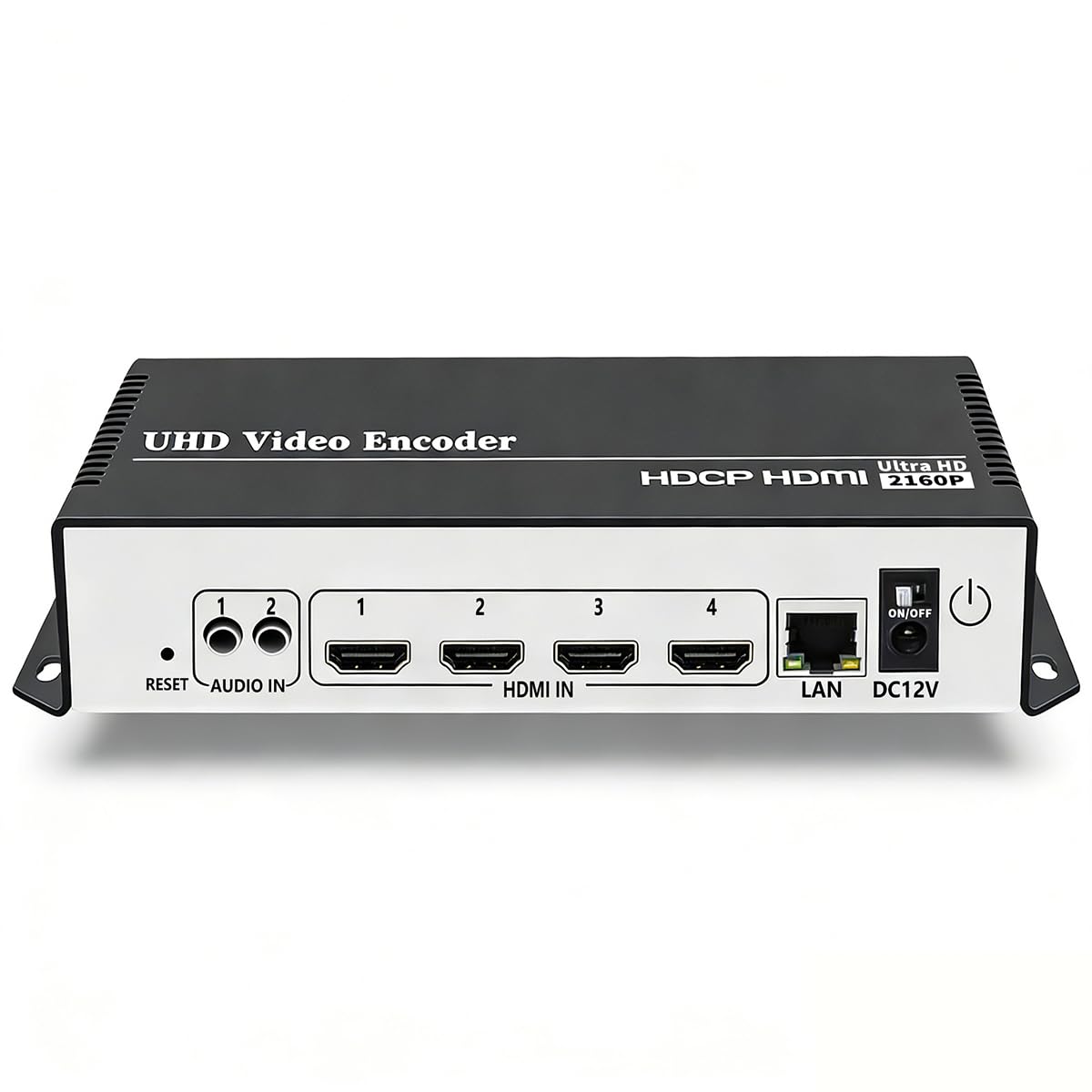
The UHE265-4-4K is the most versatile single‑box encoder in the mid‑range tier. Its H.265/H.264 dual chip pushes 4K at 30 fps while outputting up to four independent video streams, each using a different protocol — SRT to a private server, RTMP to YouTube, WebRTC for browser viewers, and HLS for archive. That kind of multi‑protocol flexibility usually requires separate encoders daisy‑chained together.
Latency at 4Kp30 over SRT sits comfortably under 500 ms with the buffer tuned, and the inclusion of WebRTC opens low‑delay browser viewing without plug‑ins. The HDMI input handles HDCP 1.4 decryption, so sources like cable boxes or game consoles feed in without a separate stripper. Setup does assume basic networking knowledge — the default DHCP‑off state means plugging into a router with a static address unless you reconfigure via the web UI first.
Customer support from the URayCoder team (Linda and Allen are mentioned repeatedly in reviews) is responsive, often providing firmware updates within 24 hours. The main trade‑off is the utilitarian web interface: it is functional but not polished, and changing stream destinations on the fly requires browser access rather than a hardware button. For 24/7 IPTV head‑ends and multi‑platform simulcasts, this encoder delivers unmatched value per dollar.
Why it’s great
- Four simultaneous outputs with independent protocols (SRT, RTMP, HLS, WebRTC)
- HEVC at 4Kp30 cuts bandwidth without sacrificing sharpness
- Lifetime firmware support and responsive technical team
Good to know
- No dedicated hardware stop/start — stream begins on power‑up
- DHCP disabled by default, requiring a static IP on first boot
2. Blackmagic Design ATEM Mini Pro ISO

The ATEM Mini Pro ISO is a studio‑grade hardware switcher that also encodes H.264 streams for live output, but it approaches IPTV differently than a dedicated encoder. It accepts four HDMI inputs, mixes them with transitions, upstream/downstream keys, and an internal audio mixer, then outputs the program feed as a USB webcam source or as an H.264 stream over Ethernet. The ISO model additionally records each camera’s feed separately to a USB drive, which is invaluable for post‑production.
Latency through the ATEM is impressively low in direct HDMI‑to‑HDMI pass‑through, but the outgoing IP stream over Ethernet typically adds 1–2 seconds — fine for live‑switched events but not sub‑500 ms SRT delivery. The absence of a headphone jack and a second HDMI output are common regrets, and some users outgrow the four‑input limit within months. For multi‑camera worship services, esports, or training where switching is the primary need, this box is a powerhouse. As a pure low‑latency SRT encoder, it is a different tool than the URayCoder units.
Blackmagic’s software control panel unlocks a full audio mixer, color correction, and media pool for titles. The bundled HDMI cable, Cat5e patch cable, and cable ties are a thoughtful touch. Just recognize that this is a production mixer first and an IP encoder second — if your core requirement is SRT-based 4K IPTV distribution with minimal delay, a dedicated encoder is the cleaner path.
Why it’s great
- Integrated 4‑input switching, keying, and audio mixing in one device
- ISO recording captures each camera feed separately for editing
- USB output functions as a high‑quality webcam source
Good to know
- IP stream latency is higher than dedicated encoder options
- No hardware button to stop/start streaming without software
3. URayCoder UHE265-8

When your IPTV distribution spans eight camera or source feeds, the UHE265-8 is the purpose‑built multi‑channel encoder that consolidates the entire rack. Each of its eight HDMI inputs encodes independently in H.265 or H.264 and can output two simultaneous streams with different protocols — for example, SRT to a private studio on one output and RTMP to a public CDN on the second. That is up to sixteen concurrent streams from a single 1U chassis.
The unit delivers 1080p at 60 fps with outstanding clarity at modest bitrates (around 6–8 Mbps), and at 4K it handles 30 fps per channel. Latency over SRT is configurable, and real‑world reports indicate reliable sub‑1‑second delay when the buffer is set appropriately. Users integrating with ffmpeg or GStreamer report the RTSP implementation works cleanly for custom ingest pipelines. The HDMI loop‑through on each input allows local monitoring without adding distribution amplifiers.
A known variable is chipset revision: some units shipped in late 2023 contained an older chipset requiring a “field to frame” toggle for handling 480i sources. Tech support from URayCoder (often Linda) addresses this by providing firmware updates. For a head‑end encoder that replaces a shelf of single‑channel boxes, the UHE265-8’s density and protocol flexibility justify its premium position.
Why it’s great
- Eight independent HDMI inputs each with dual‑protocol output
- Clean 1080p60 encoding at low bitrates reduces bandwidth cost
- HDMI loop‑through preserves local monitoring
Good to know
- Chipset revision variability may require firmware updates
- Heavier than single‑channel alternatives (0.66 kg)
4. URayCoder USE265-1L
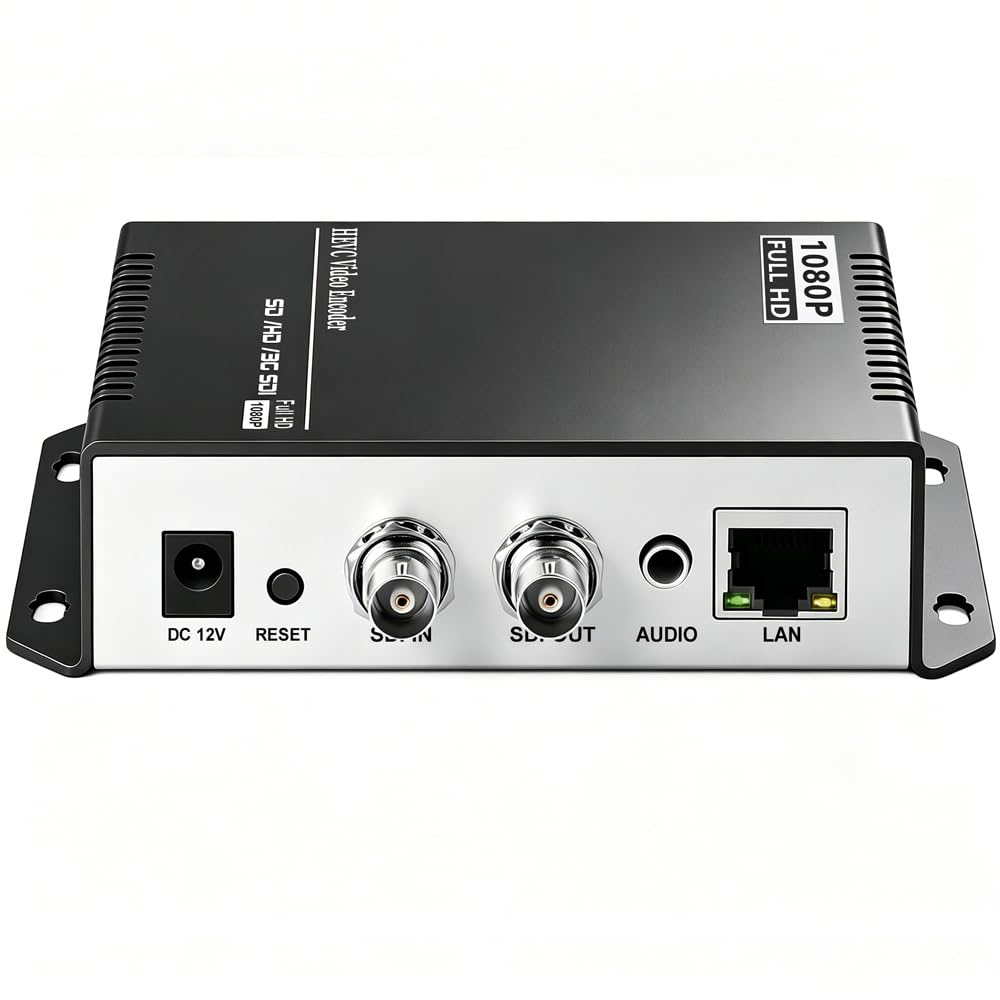
Broadcast and cinema cameras output SDI by default, and the USE265-1L accepts a 3G‑SDI signal and encodes it to IP with the same multi‑protocol engine used in the HDMI‑only URayCoder line. That makes it the natural pick for workflows where a Blackmagic Pocket Cinema Camera or a Sony FS series needs to stream via SRT without an external SDI‑to‑HDMI converter. The encoder supports H.265 and H.264 and can push up to four simultaneous streams at different destinations.
Build quality is solid — an aluminum shell with a matte finish that dissipates heat well during 24/7 operation. The web GUI is straightforward, though audio routing requires attention if the SDI signal carries embedded audio on specific channels; early reviewers noted that audio mapping can be tricky until you spend time with the settings. Once configured, however, the unit runs without intervention, and the SDI loop‑out is convenient for local monitoring on a production switcher or monitor.
Several church tech teams and remote monitoring users report using these units for years without a single dropout. The utility GUI is not pretty, but it exposes every parameter you need — resolution, frame rate, bitrate, SRT latency buffer, GOP structure, and overlay text/logo. If your source is SDI rather than HDMI, this encoder eliminates the need for a intermediate conversion step.
Why it’s great
- Native 3G‑SDI input integrates directly with broadcast cameras
- Four simultaneous output streams with independent protocol selection
- SDI loop‑out enables local monitoring without a splitter
Good to know
- Audio channel mapping can be confusing during initial setup
- Chassis uses Australian/Chinese power plug; may need adapter
5. URayCoder UHSCVD265-1-4K

The UHSCVD265-1-4K is primarily a 4K video decoder, but its inclusion here matters because an IPTV chain often needs both encoding and decoding endpoints. This unit takes in SRT, RTMP, HLS, or RTSP streams and outputs simultaneously over SDI, HDMI, VGA, and CVBS — covering modern 4K displays, legacy projectors, and analog monitors from a single box. For control rooms, digital signage, or church campuses that need to display an encoded stream on multiple display types, this decoder is the cleanest solution.
It supports 4K UHD at 30 fps decoding, with automatic resolution scaling for each output independently. The SRT decode path is stable and reconnects quickly after network interruptions, which is critical for remote monitoring. Setup is simple: paste the stream URL into the web interface, and the decoder locks onto it. Users report using it to view remote security camera feeds, Slingbox replacement streams, and NDI sources via the network.
Note that this box does not encode — it decodes. If you need a device that both captures HDMI and generates an IP stream, pair it with one of the URayCoder encoders from this list. For the back end of your IPTV distribution, however, the UHSCVD265-1-4K’s quad‑output versatility and SRT reliability make it a worthwhile companion.
Why it’s great
- Decodes SRT, RTMP, HLS, RTSP and outputs via four simultaneous video interfaces
- 4K UHD decode with automatic resolution scaling per output
- Clean, simple setup — paste URL and it connects
Good to know
- Decode‑only — does not capture or encode HDMI sources
- Power plug type varies; may need an adapter depending on region
6. Magewell Pro Convert NDI to HDMI
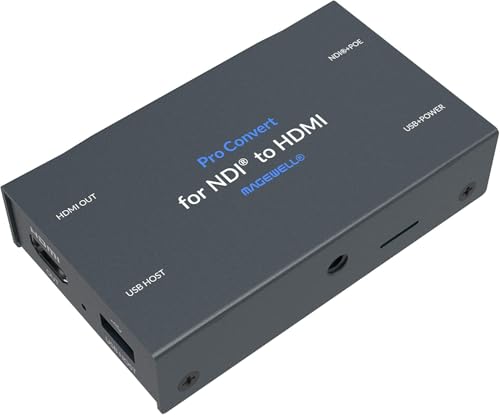
The Magewell Pro Convert NDI to HDMI is a decoder dedicated to the NDI ecosystem, not a general‑purpose SRT encoder. It converts full‑bandwidth NDI and NDI|HX streams to HDMI at up to 4Kp60 with near‑zero decoding latency, making it ideal for feed monitoring, confidence displays, and IMAG (image magnification) in live production. The metal housing is rack‑mountable and designed for 24/7 operation.
Network feed reliability sets Magewell apart: multiple users who migrated from Birddog report that the Pro Convert never drops stream or loses sync, even on networks with moderate congestion. It supports Power over Ethernet (PoE) and USB power, so deployment is cable‑efficient. The web‑based control panel handles EDID management, resolution scaling, de‑interlacing, and color space conversion automatically, which reduces display‑compatibility headaches.
The catch for the IPTV buyer is scope: this box only decodes NDI. It does not encode HDMI to IP, nor does it natively handle SRT, RTMP, or HLS streams. If your distribution is NDI‑based (common in multi‑camera live venues using NewTek or compatible software), this decoder is the gold standard. For pure SRT‑to‑IPTV encoding, the URayCoder units above are more directly relevant. Consider the Magewell as the reliable display endpoint in a broader NDI production network.
Why it’s great
- Near‑zero latency NDI decode at 4Kp60 with automatic scaling
- PoE and USB power simplify cable management
- Rock‑solid stream sync, out‑performs Birddog in reliability
Good to know
- NDI‑only — no SRT, RTMP, or HLS input support
- Warranty response has been inconsistent for some users
7. Blackmagic Design UltraStudio 4K Mini

The UltraStudio 4K Mini is a desktop capture and playback device that connects via Thunderbolt 3, not a standalone network encoder. It brings 12G‑SDI and HDMI 2.0 into a computer with 40 Gb/s bandwidth, enabling uncompressed 4K DCI capture for post‑production in DaVinci Resolve, Premiere Pro, or OBS Studio. For live IPTV workflows, it acts as the ingest point before software encoding (e.g. OBS or vMix) handles the SRT or RTMP output — meaning the UltraStudio replaces a PCIe capture card rather than a dedicated encoder box.
Capture quality is reference‑grade: the 12G‑SDI input handles 2160p60 with 10‑bit 4:2:2 color depth, and HDMI 2.0 supports the same. Latency through the Thunderbolt pipeline is negligible, but the overall glass‑to‑glass delay depends entirely on the software encoder and network buffer settings you use afterward. The unit is bus‑powered via Thunderbolt 3, but the included power supply is recommended for stable operation with long cable runs.
Several users reported DOA units or connectivity issues caused by using a standard USB‑C cable instead of an actual Thunderbolt 3 cable — a simple but easy mistake. For a studio that already runs a software encoding stack and needs lossless 4K capture without PCIe installation, the UltraStudio 4K Mini is the cleanest bridge. It does not fit the “self‑contained SRT encoder” mold, but for high‑end post‑production capture it is unmatched at its tier.
Why it’s great
- Uncompressed 12G‑SDI and HDMI 2.0 capture at 2160p60 10‑bit
- Thunderbolt 3 provides 40 Gb/s without internal PCIe card
- Works with multi‑platform software (Mac, Windows, Linux)
Good to know
- Requires a Thunderbolt 3 cable — USB‑C cables will not work
- Not a standalone IP encoder; needs a host computer for streaming
FAQ
What SRT latency setting should I use for IPTV over the public internet?
Can a single HDMI encoder push both SRT and RTMP at the same time?
Final Thoughts: The Verdict
For most users, the 4k hevc hdmi encoder low latency srt for iptv winner is the URayCoder UHE265-4-4K because it delivers four simultaneous protocol outputs, reliable WebRTC support, and HEVC 4Kp30 encoding at a mid‑range price point. If you need eight channels of independent encoding for a large‑scale head‑end, grab the URayCoder UHE265-8. And for a dedicated SDI‑to‑IP workflow without extra converters, the URayCoder USE265-1L is the cleanest choice.