
Forget everything you know about the living room screen. The shift from simple LED to Mini-LED backlighting, quantum dot color, and AI-driven processors has turned the 4K LED Smart TV into a sophisticated hub for gaming, sports, and cinematic streaming. Every pixel is now a battlefield for contrast, motion clarity, and color accuracy — and choosing wrong means living with washed-out blacks and stuttering action for the next five years.
I’m Min — the co-founder and writer behind Gadgets Feed. I’ve spent hundreds of hours mapping the 4K LED Smart TV landscape, cross-referencing panel technologies, dimming zone counts, and real-world gaming performance across the to range to find the sets that actually deliver on their spec sheets.
This guide isolates the televisions that survive real-world scrutiny. Whether you prioritize a native 144Hz refresh rate for competitive console play or Dolby Vision IQ for darkened home theaters, you need a 4k led smart tv that matches your specific needs — not just the one with the most marketing hype.
How To Choose The Best 4K LED Smart TV
Shopping for a 4K LED Smart TV means navigating a maze of marketing acronyms — QLED, Mini-LED, HDR10+, Dolby Vision, native 120Hz vs. 60Hz. The real differentiators lie in the panel technology and the processing brain behind it. Skip past the screen size first and focus on what will matter daily: the backlight, the refresh rate, and the operating system that dictates how you browse content.
Backlight Technology: Standard LED vs. Mini-LED vs. QLED
A standard LED-backlit LCD uses edge lighting or basic direct-lit zones, which often results in cloudiness in dark scenes — commonly called “blooming.” Mini-LED shrinks the individual LEDs, packing hundreds or even thousands of dimming zones behind the screen. This granular control pushes black levels much deeper and highlights much brighter, narrowing the gap to OLED without the burn-in risk. QLED is not a separate backlight; it’s a quantum dot filter layered over the LED backlight to expand color volume, hitting higher percentages of the DCI-P3 color space. A true high-end contender pairs Mini-LED with QLED and a high zone count.
Refresh Rate: 60Hz, 120Hz, or 144Hz
This spec alone separates casual viewers from gamers and sports enthusiasts. A 60Hz panel refreshes the image 60 times per second — fine for soap operas and news, but motion blur becomes visible during fast camera pans. A native 120Hz (or 144Hz) panel doubles or more the smoothness, critical for console titles running at 120 frames per second on the PlayStation 5 or Xbox Series X. Beware of “effective” or “motion rate” numbers like 240 or 480 — those are marketing multipliers, not native panel refresh. Check the specs for “Native Refresh Rate” explicitly.
Operating System Ecosystem
Your choice of OS determines your daily interaction speed, app availability, and ad exposure. Google TV offers deep integration with Android apps, Chromecast, and Google Assistant — ideal for users invested in the Google ecosystem. Fire TV is Amazon’s walled garden, prioritizing Prime Video and Alexa but can feel bloated with ads. Roku remains the cleanest, fastest, and most user-friendly interface, with a simple grid layout and no account sign-in required for basic operation. Tizen (Samsung) is polished but carries Samsung-exclusive apps. Choose the OS before the brand — you will interact with it every single day.
Quick Comparison
On smaller screens, swipe sideways to see the full table.
| Model | Category | Best For | Key Spec | Amazon |
|---|---|---|---|---|
| Sony BRAVIA 5 65″ | Mini-LED | Cinema & PS5 | XR Processor with AI | Amazon |
| Samsung Neo QLED QN70F 65″ | Mini-LED | Upscaling & Brightness | NQ4 AI Gen2 20-Networks | Amazon |
| Hisense U7 55″ | Mini-LED | Competitive Gaming | Native 165Hz, VRR 330 | Amazon |
| Toshiba Z670R 55″ | Mini-LED | Japanese Tuning & Audio | REGZA Engine ZRi Gen3 | Amazon |
| Amazon Ember Mini-LED 55″ | Mini-LED | Alexa Ecosystem | 512 Dimming Zones, 1400 nits | Amazon |
| TCL T7 55″ | QLED | 120Hz Gaming Value | 120Hz-144Hz Panel | Amazon |
| Panasonic W70 65″ | LED | Fire TV Simplicity | HDR Bright Panel, MEMC | Amazon |
| Sony BRAVIA 2 II 43″ | LED | PS5 Dedicated Display | 4K Processor X1 | Amazon |
| Roku Plus Series 55″ | Mini-LED | Roku OS Perfection | Mini-LED, QLED, Dolby Vision | Amazon |
| Roku Select Series 65″ | QLED | Large Screen, Clean OS | 65″ QLED, HDR10 | Amazon |
| Samsung Crystal UHD 55″ | LED | Budget-Conscious User | Crystal Processor 4K | Amazon |
In‑Depth Reviews
1. Sony BRAVIA 5 65″ (K-65XR50)

The Sony BRAVIA 5 redefines what a Mini-LED television can achieve. Its XR Backlight Master Drive controls thousands of individual Mini-LEDs with surgical precision, producing near-OLED black levels without the blooming that plagues lesser local dimming implementations. The XR Processor with AI analyzes every scene in real-time, upscaling HD content to a 4K image that retains facial texture and fine grain — noticeably better than the software-based upscaling found on sets like the Samsung Crystal UHD.
For PlayStation 5 owners, this set is the definitive match: Auto HDR Tone Mapping and Auto Genre Picture Mode communicate directly with the console, eliminating the need to manually toggle picture presets between games and streaming. The Google TV interface runs smoothly with zero perceptible lag on app launches, and the inclusion of Dolby Vision and Atmos alongside IMAX Enhanced makes it a home theater powerhouse. The built-in speakers are adequate for dialog clarity, but the set’s real audio value comes from passing Dolby Atmos signals to a soundbar via eARC.
Two caveats: only two of the four HDMI ports support HDMI 2.1 at 120Hz, which limits multi-console setups, and the remote lacks backlighting — a small but noticeable oversight in a darkened room. The Sony BRAVIA 5 justifies its price through processing excellence and PS5 optimization that competitors cannot replicate.
Why it’s great
- XR Backlight Master Drive delivers exceptional Mini-LED contrast with minimal blooming
- Exclusive PS5 features auto-optimize HDR and picture mode
- AI 4K upscaling is the best in this price tier
Good to know
- Only 2 of 4 HDMI ports are HDMI 2.1
- Remote has no backlight for low-light use
2. Samsung Neo QLED QN70F 65″ (2025)

The Samsung Neo QLED QN70F employs the NQ4 AI Gen2 processor, a 20-neural-network chip that upscales lower-resolution content to near-4K with a sharpness that rivals Sony’s XR silicon. The Quantum Matrix Technology uses a more tightly packed array of Mini-LEDs than standard QLED sets, minimizing halo artifacts around subtitles and bright objects against dark backgrounds. Peak brightness is aggressively high, making this set a strong choice for rooms with large windows or ambient daylight — it outperforms the Hisense U7 in raw luminance output.
Motion Xcelerator pushes the panel to a native 144Hz, and VRR support at 4K 144Hz makes it a serious option for PC gamers who own high-refresh-rate graphics cards. The Tizen OS is fast and logically organized, though it lacks the sheer app volume of Google TV. Samsung TV Plus offers over 2,700 free channels without a subscription, a genuine value-add for cord-cutters. The built-in speakers produce enough volume and clarity that many users report no immediate need for a soundbar — you can hear dialog clearly even at low volume levels.
Potential drawbacks: the solar-powered remote is small and minimalist, which some older users find difficult to handle, and Samsung’s ecosystem pushes its own services (Samsung Gaming Hub, Samsung TV Plus) more aggressively than neutral platforms like Roku. The 65-inch model requires careful handling during shipping — reports of torque damage to the frame exist. This is a premium LED set that prioritizes brightness and processing speed over absolute black depth.
Why it’s great
- NQ4 AI Gen2 processor delivers superb 4K upscaling
- Native 144Hz panel with VRR for high-frame-rate gaming
- High peak brightness ideal for bright rooms
Good to know
- Small remote may be difficult for some users
- Requires careful handling during shipping
3. Hisense U7 55″ (55U7SG, 2026)
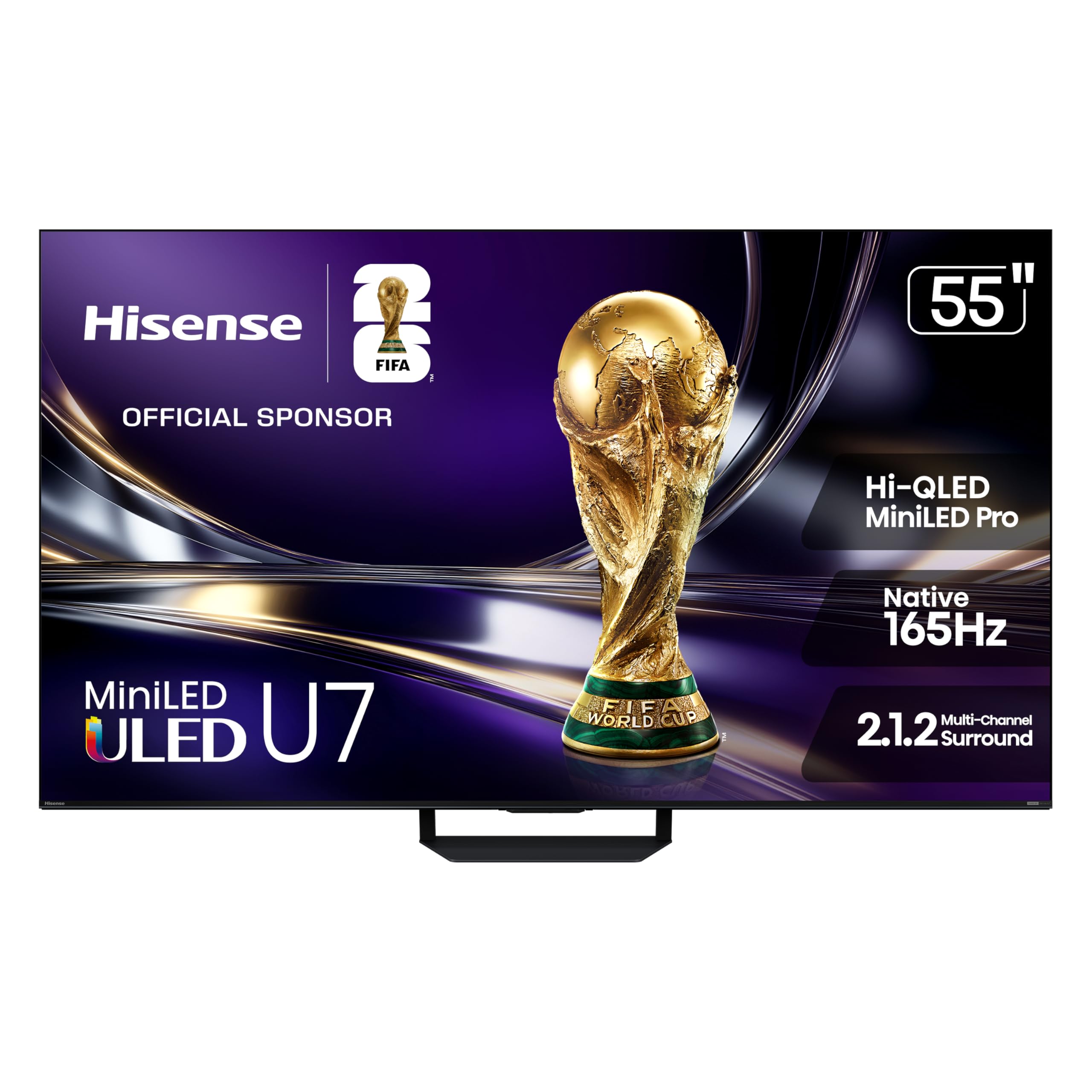
Hisense has weaponized value with the U7, packing a native 165Hz refresh rate and a VRR up to 330Hz into a Mini-LED package that undercuts rivals by hundreds of dollars. The Hi-View AI Engine Pro constantly analyzes on-screen content to adjust color, contrast, and detail — and it works impressively well for a processor at this price point. The Hi-QLED Mini-LED Pro system delivers up to 3,000 dimming zones on larger sizes, though the 55-inch model offers fewer zones, the per-zone control is still far tighter than a standard edge-lit LED set.
The anti-reflection coating is genuinely effective. In a brightly lit room with overhead lights and a window, the screen remains legible without washing out shadow detail. Dolby Vision IQ and Atmos support, combined with IMAX Enhanced certification, make this a legitimate movie-watching machine. The 2.1.2 channel speaker system produces decent depth, though purists will still want a dedicated subwoofer for bass-heavy scenes. Google TV runs responsively, and the Filmmaker Mode preserves the intended color temperature and frame rate without processing artifacts.
One consistent observation: the TV’s peak brightness, while excellent, can cause slight blooming around bright subtitles in a fully dark room — a trade-off of the aggressive backlight. Also, the stand is wide and requires a furniture surface that can accommodate its full footprint. For gamers who want the highest possible refresh rate without jumping to a premium brand, the Hisense U7 is the clear winner.
Why it’s great
- Native 165Hz panel outpaces every competitor at this price
- Anti-reflection coating works better than most mid-range sets
- Dolby Vision IQ, Atmos, and IMAX Enhanced included
Good to know
- Some blooming visible with bright subtitles in dark rooms
- Wide stand requires ample furniture space
4. Toshiba Z670R 55″ (55Z670R, 2026)
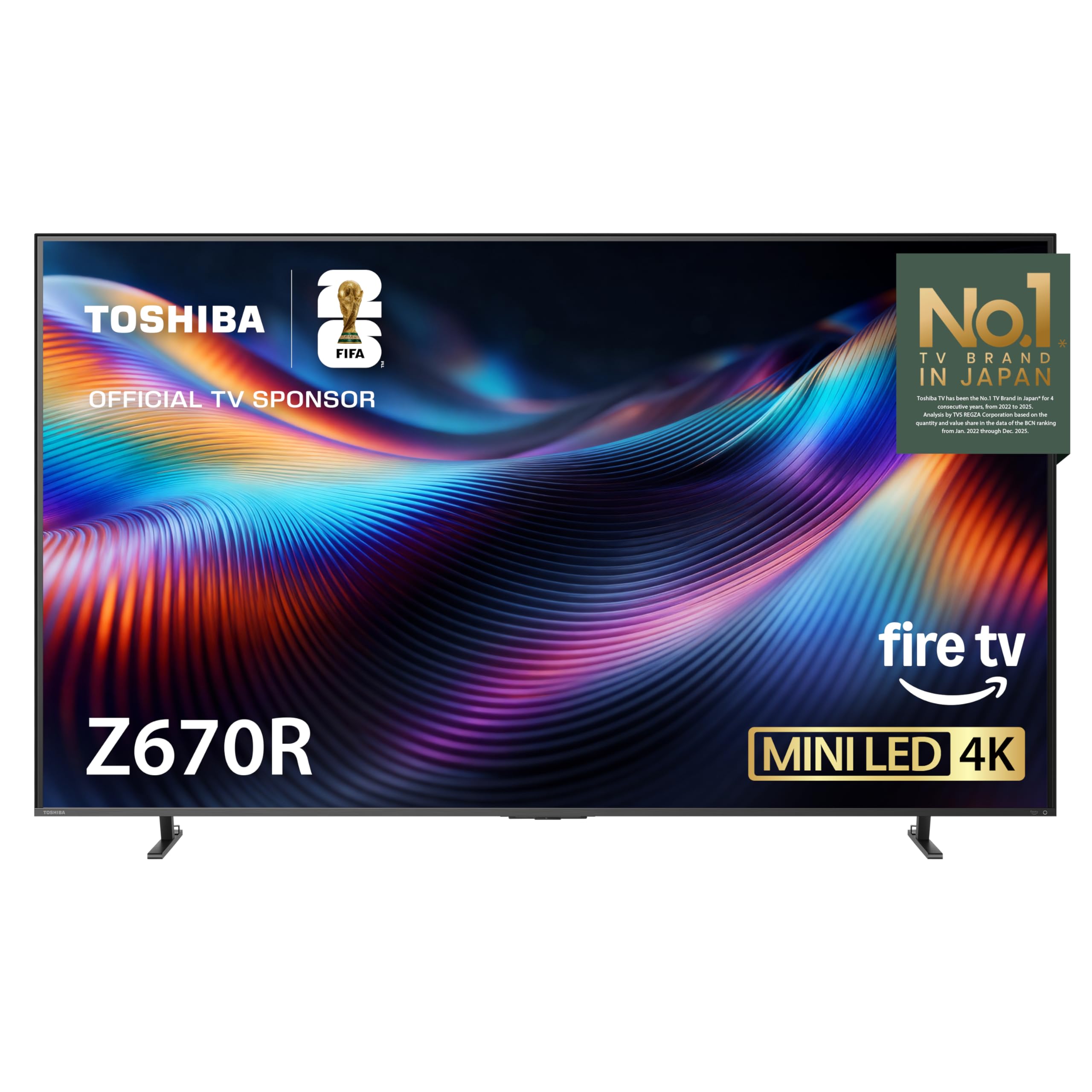
Toshiba’s return to relevance is built on the Z670R, a Mini-LED television tuned by engineers in Japan. The REGZA Engine ZRi Gen3 is the standout component — it processes picture and audio simultaneously, adjusting backlight intensity, color temperature, and even dialog EQ based on scene content. The result is a natural, refined image that avoids the over-sharpened look some brands force. Full Array Local Dimming with Mini-LED reaches deep black levels that make the Amazon Ember and TCL T7 look slightly washed in comparison.
The REGZA Power Audio Pro system includes a dedicated bass woofer that adds genuine low-end weight — explosions in action movies have physical impact rather than just buzz. At a native 144Hz with AMD FreeSync Premium and VRR, the panel handles racing games and first-person shooters without tearing. Fire TV integration with Alexa built-in is seamless, and the AI Light Sensor Pro adjusts brightness based on ambient light without user intervention, reducing eye strain during late-night viewing.
The main downside is the software: Fire TV can become sluggish over time as the cache fills, and the interface pushes Amazon content promotions prominently. Some units have reported random reboots, though firmware updates appear to have mitigated the issue on newer batches. The Z670R is for the buyer who values tonal accuracy and audio performance over raw feature count.
Why it’s great
- REGZA Engine ZRi Gen3 provides scene-by-scene AI optimization
- Integrated bass woofer delivers room-filling sound without a soundbar
- Native 144Hz panel with FreeSync Premium for smooth gaming
Good to know
- Fire TV interface can slow down over extended use
- Some units experienced random reboots initially
5. Amazon Ember 55″ Mini-LED Series (2026)
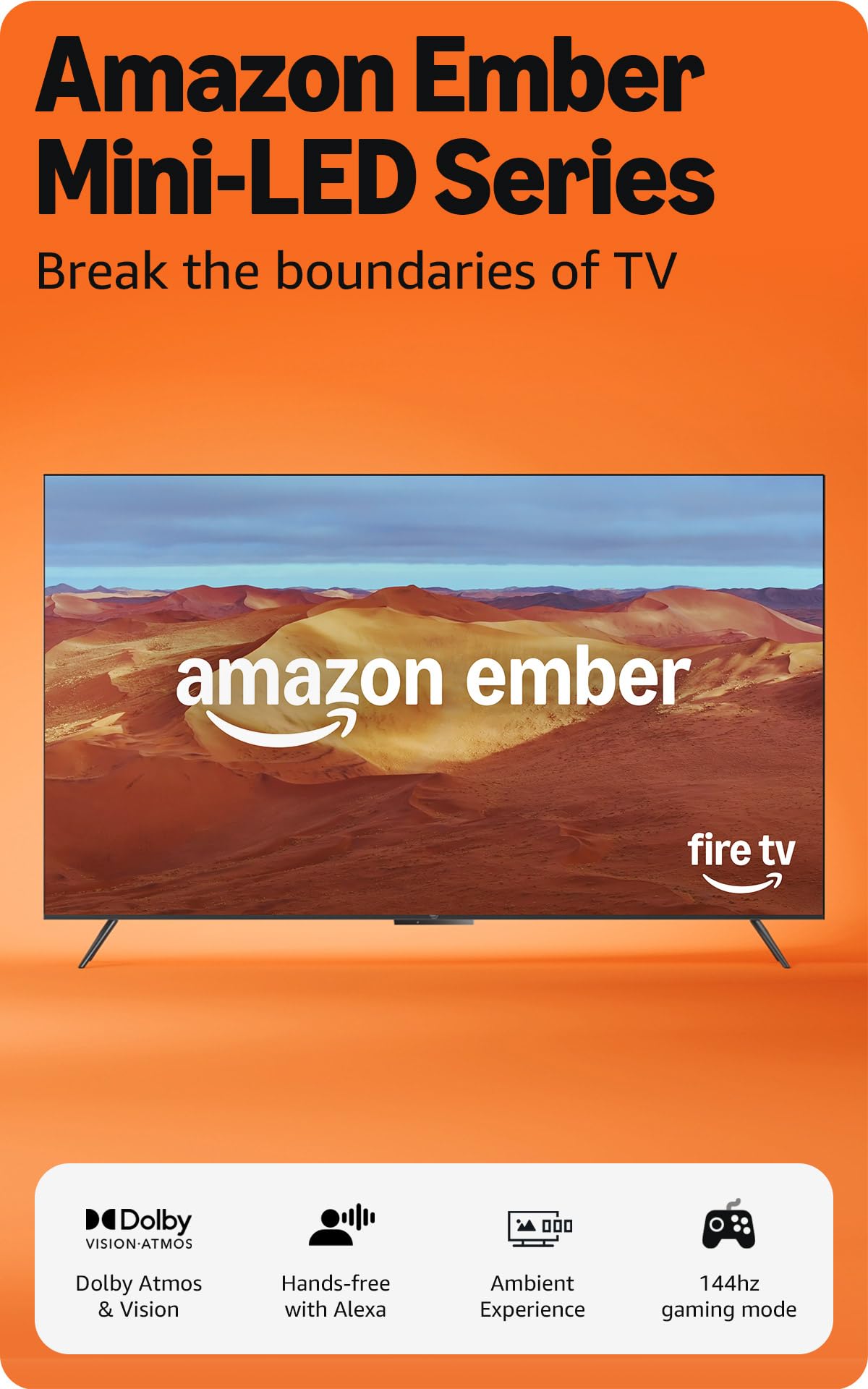
The Amazon Ember Mini-LED Series represents Amazon’s most aggressive push into premium television hardware. The 512 dimming zones on the 55-inch model produce contrast that rivals some OLEDs in a pitch-black room, and the peak brightness of around 1,400 nits makes HDR content truly pop — notably brighter than the TCL T7 and Panasonic W70. The Fire TV Intelligent Picture engine automatically adjusts scene-to-scene, and the Ambient Experience mode uses built-in Omnisense sensors to wake the display as you enter the room, showing artwork or information without needing to touch a remote.
Gamers benefit from a 144Hz panel that is AMD FreeSync Premium Pro-certified, meaning smooth, tear-free gameplay at high frame rates. The 2.1 Dolby Atmos audio system includes a subwoofer that produces surprisingly deep bass for a television’s built-in speakers — you can feel the rumble in action sequences without an external sub. The new Alexa+ integration allows natural-language search across streaming services, and the hands-free microphone array means you can control playback without the remote.
However, the Fire TV operating system has a reputation for becoming sluggish over time. Multiple reviews note that the menu can feel laggy after several months of use, and the home screen is dense with Amazon advertisements. Some users report random reboots. If you are deeply embedded in the Amazon ecosystem (Prime Video, Alexa, Blink cameras), the Ember Series is compelling; otherwise, the bloat may frustrate you.
Why it’s great
- 512 dimming zones produce near-OLED black levels
- 144Hz with AMD FreeSync Premium Pro for tear-free gaming
- Omnisense ambient wake sensor is a unique convenience feature
Good to know
- Fire TV software can become slow with extended use
- Home screen is heavily loaded with Amazon ads
6. TCL T7 55″ (2025)

The TCL T7 is a focused gaming television that undercuts much of the competition on price while delivering a panel that runs at up to 144Hz. The QLED quantum dot layer covers nearly the entire DCI-P3 color space, producing vibrant, saturated colors that rival the Samsung QN70F in side-by-side gaming comparisons. The AIPQ Pro processor handles motion handling competently, and the Motion Rate 480 combined with MEMC frame insertion reduces judder during fast sports and racing game camera pans.
Google TV runs smoothly on this set, and the interface is clean and responsive with no noticeable lag when switching between apps. The four HDMI inputs (one with eARC) provide enough connectivity for multiple consoles and a soundbar. Dolby Vision, HDR10+, and HLG are all supported, so you are not locked out of any HDR format. The direct LED backlight is not as refined as Mini-LED, but for the price, the contrast is acceptable — black levels are decent in a dark room, with only minor blooming around bright objects.
A critical point for PC users: the TV does not always wake properly from power-saving mode when used as a monitor, sometimes requiring the HDMI cable to be unplugged and reconnected. The built-in speakers are merely adequate — serviceable for casual viewing but notably thin compared to the Toshiba Z670R’s bass woofer. The TCL T7 is for budget-conscious gamers who want high refresh rates and are willing to add a soundbar later.
Why it’s great
- Up to 144Hz panel at a budget-friendly price point
- QLED color gamut covers nearly full DCI-P3
- Four HDMI inputs with eARC for multi-device setups
Good to know
- PC monitor mode has wake-from-sleep issues
- Built-in speakers lack bass and mid-range depth
7. Panasonic W70 65″ (2025)

The Panasonic W70 brings the reliability of a legacy TV brand into the Fire TV ecosystem. The HDR Bright Panel, powered by a 4K Studio Color Engine, delivers solid 4K UHD resolution with support for HDR10+, HDR10, and HLG. The MEMC technology smooths motion well enough for sports and general viewing, though it lacks the razor-sharp edge of the Sony or Hisense sets in fast-paced action. The LED panel is standard — no local dimming zones, so black levels are grayish in a dark room — but for a brightly lit living room, the image holds up well.
Fire TV integration with Alexa is the headline feature: the voice remote allows you to launch apps, search across services, and control smart home devices. The four HDMI ports include one HDMI 2.1 port, which is a welcome addition at this price. Bluetooth 5.0 allows pairing of wireless headphones for private listening, a useful feature for late-night viewing. The metal stands add a touch of stability and feel more premium than the plastic stands on cheaper sets.
The W70’s weaknesses are performance-related: the processor is noticeably slower than the TCL T7 and Hisense U7, with app switching feeling laggy over time. The Fire TV software locks you into Amazon’s ecosystem, and some users report that the TV becomes unresponsive after months of use, requiring a full reset. If you want a large 65-inch screen at a reasonable price and plan to use an external streaming device like a Fire Stick, the W70 works well as a dumb display.
Why it’s great
- 65-inch screen at a competitive mid-range price
- HDMI 2.1 port for next-gen console connectivity
- Bluetooth headphone mode for private listening
Good to know
- Standard LED panel lacks deep black levels in dark rooms
- Processor is sluggish, leading to laggy Fire TV performance
8. Sony BRAVIA 2 II 43″ (K-43S20M2)
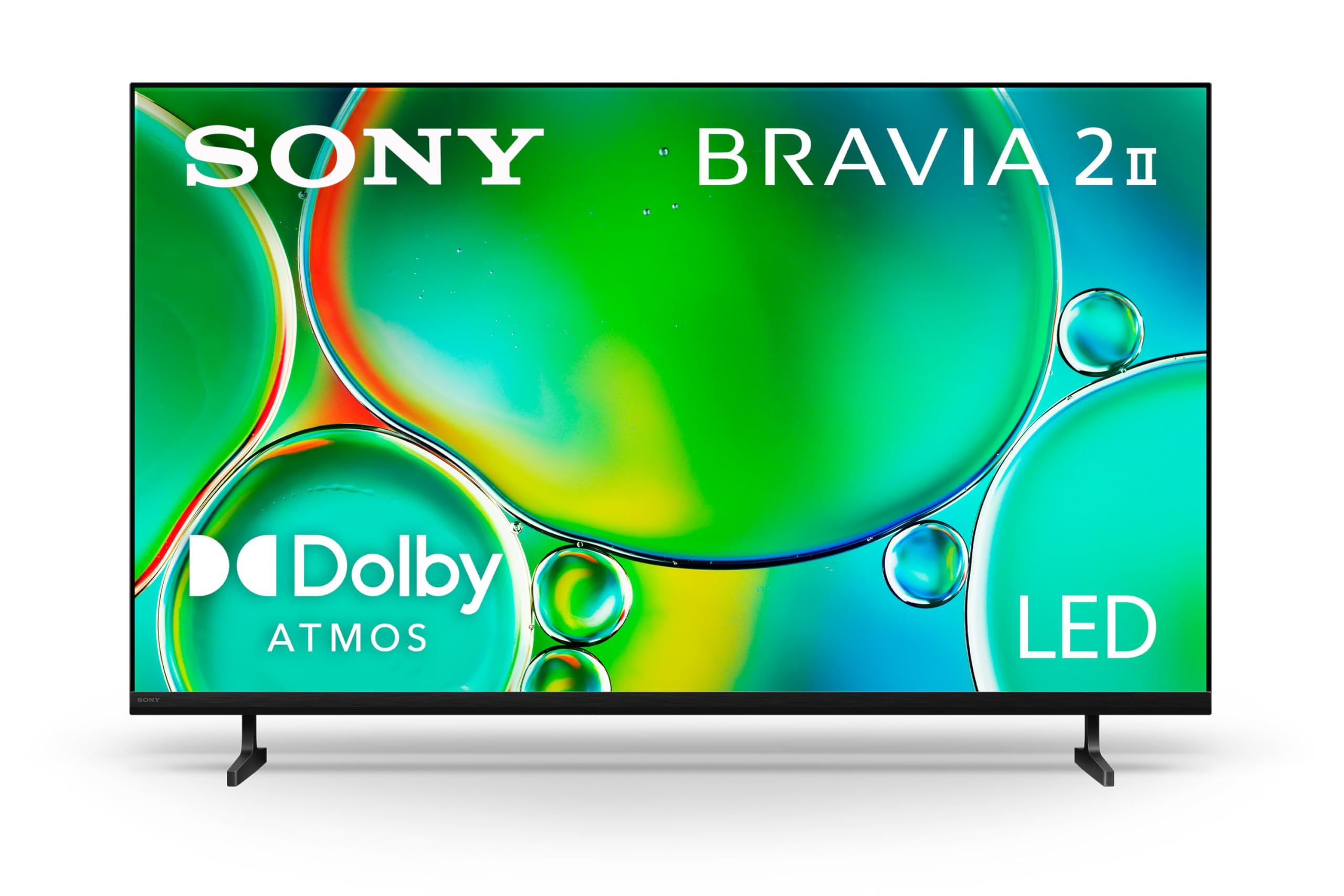
The Sony BRAVIA 2 II is engineered for one purpose: delivering Sony’s legendary processing in a compact 43-inch form factor. The 4K Processor X1 handles upscaling with the same care as the more expensive XR line, bringing texture and detail back to compressed streaming content. The Motionflow XR technology reduces blur during sports and action movies, making this small screen feel fast even though its native refresh rate is 60Hz. For a bedroom, home office, or dedicated PS5 display, this is an excellent fit.
The exclusive PlayStation 5 features — Auto HDR Tone Mapping and Auto Genre Picture Mode — work instantly, removing the hassle of manual picture adjustments. Google TV with built-in Chromecast and Apple AirPlay 2 provides dual-ecosystem casting support. The Eco Dashboard keeps all power-saving settings in one place. The Sony Pictures CORE app gives access to a library of included movies with IMAX Enhanced versions, a genuine perk for movie collectors.
The 60Hz refresh rate is the most obvious limitation for gamers: you cannot achieve 120fps playback on PS5 or Xbox Series X. The remote, while responsive, is long and thin, lacking the tactile feedback of larger remotes. Some units have reported persistent WiFi disconnection issues, though this appears to be less common in recent production batches. This is a premium compact set for those who prioritize picture processing over raw refresh rate.
Why it’s great
- Sony’s 4K Processor X1 provides excellent upscaling in a small package
- Auto PS5 HDR optimization works flawlessly
- Google TV with Chromecast and AirPlay 2 built-in
Good to know
- 60Hz panel cannot display 120fps content
- Some units experienced WiFi disconnection issues
9. Roku Plus Series 55″
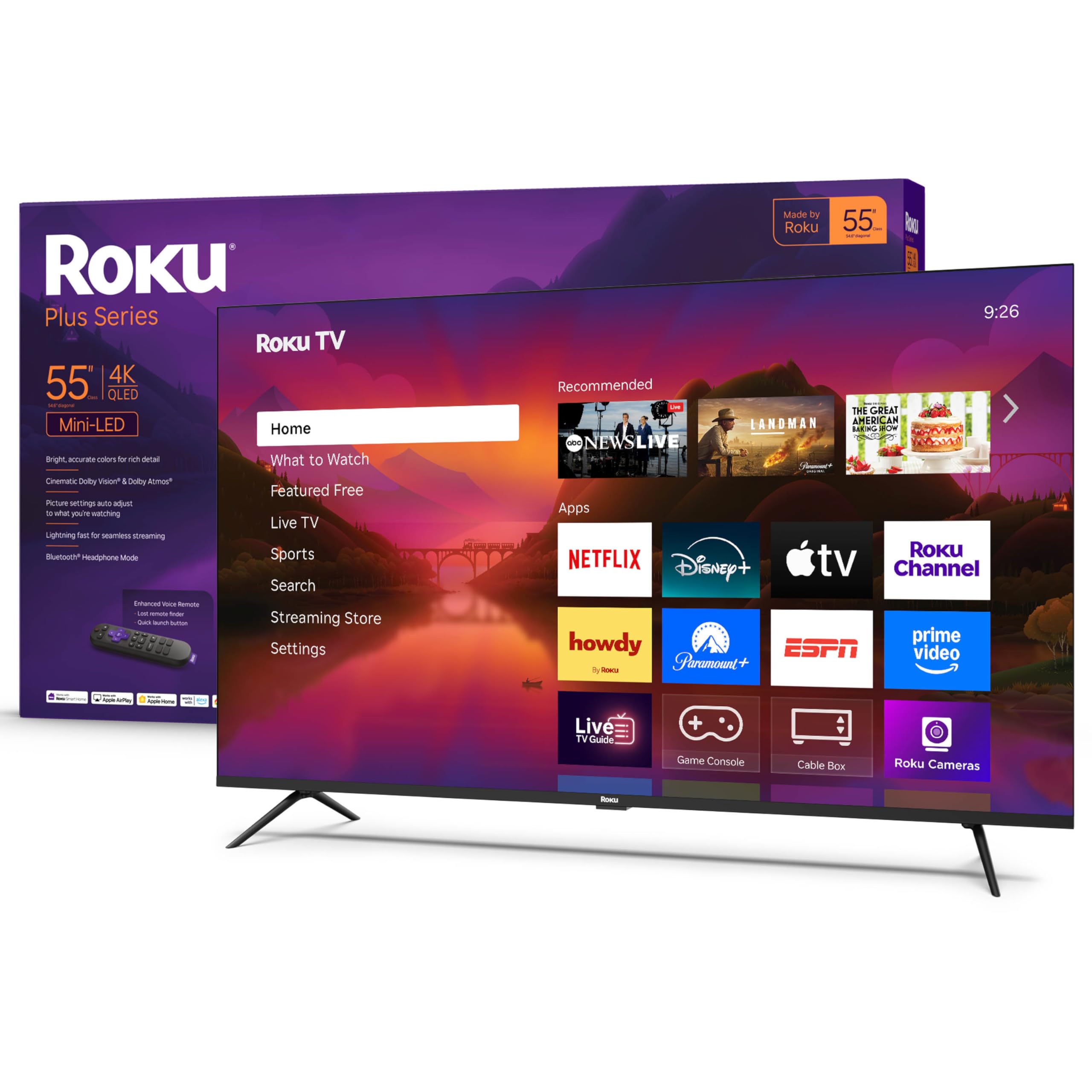
Roku’s Plus Series is the first Mini-LED television backed by the Roku operating system, combining high-end hardware with the cleanest TV interface available. The QLED panel with Mini-LED backlighting and Dolby Vision delivers deep blacks and vibrant highlights that surpass standard LED sets like the Panasonic W70 by a wide margin. The Roku Smart Picture Max uses AI to clean up incoming signals and automatically select the optimal picture mode for each scene, removing the guesswork from calibration.
The built-in subwoofer is a genuine surprise: it produces enough low-end to make action movies feel immersive without an external sound system, outperforming the speakers on the Samsung Crystal UHD and Sony BRAVIA 2 II. Bluetooth headphone mode is a standout feature for late-night viewers — you can pair wireless headphones directly to the TV without an adapter. The Enhanced Voice Remote includes a lost remote finder button, a small touch that saves real frustration.
The Roku OS is the star: it is fast, uncluttered, and receives automatic software updates. There are no account sign-in hurdles to start watching. The main downside is that the settings menu is relatively basic compared to Google TV or Tizen, lacking fine-grained controls for advanced users. The USB-C port is also a minor inconvenience for users with legacy USB-A cables. For anyone who values ease of use above all else, this is the best option.
Why it’s great
- Mini-LED backlight with QLED and Dolby Vision produces excellent contrast
- Roku OS is the fastest and cleanest smart TV interface
- Built-in subwoofer and Bluetooth headphone mode
Good to know
- Settings menu lacks advanced calibration options
- USB-C port may require an adapter for older devices
10. Roku Select Series 65″ (2026)
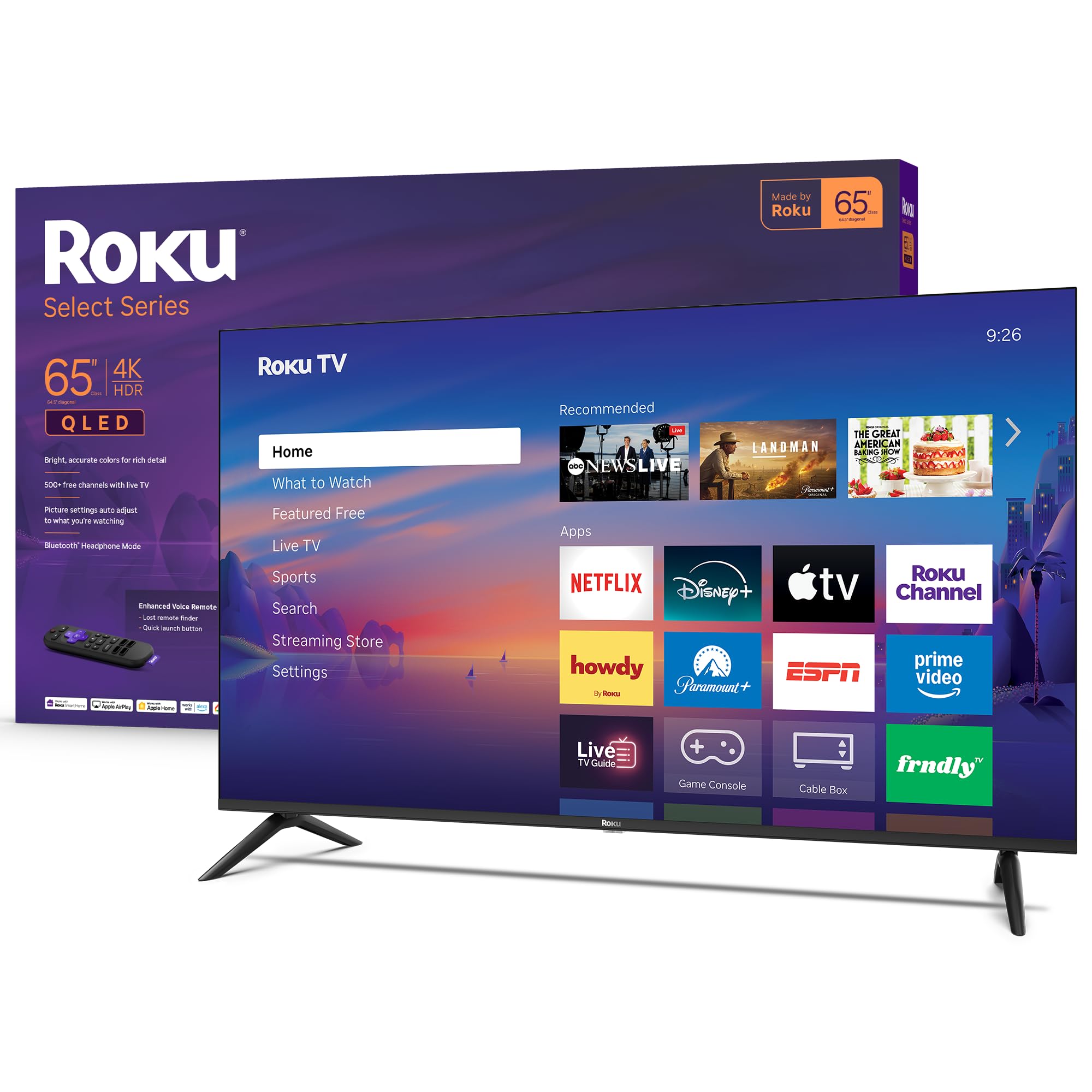
The Roku Select Series brings a 65-inch QLED 4K screen into a tightly controlled price bracket without the software clutter of other budget sets. The QLED layer and HDR10 support produce bright, accurate colors that look significantly punchier than the standard LED panel on the Samsung Crystal UHD. The Roku Smart Picture feature optimizes incoming signals and applies the correct picture mode automatically, which is helpful for less tech-savvy users. The direct LED backlight is not as refined as Mini-LED, but the sheer screen size compensates for the lack of deep black levels.
Roku’s OS remains the easiest interface to navigate. App launch times are snappy, and the home screen is a simple grid with no forced content. The Enhanced Voice Remote supports voice search across thousands of channels, and the lost remote finder is included. Bluetooth headphone mode lets you listen without disturbing others. The sleek, frameless design gives the set a more expensive appearance than its price suggests.
Two compromises stand out: the lack of Dolby Vision support means HDR performance is limited to HDR10, which is a step down in dynamic range compared to the Roku Plus Series or Hisense U7. The built-in speakers are decent for dialog but lack bass — a soundbar is a worthwhile addition. The Select Series is for buyers who prioritize a large screen with a frictionless OS over ultimate picture fidelity.
Why it’s great
- 65-inch QLED screen at a budget-conscious price
- Roku OS is fast, simple, and ad-light
- Frameless design looks more premium than price suggests
Good to know
- No Dolby Vision support limits HDR potential
- Speakers lack bass for an immersive experience
11. Samsung Crystal UHD 55″ (55U8000H, 2026)
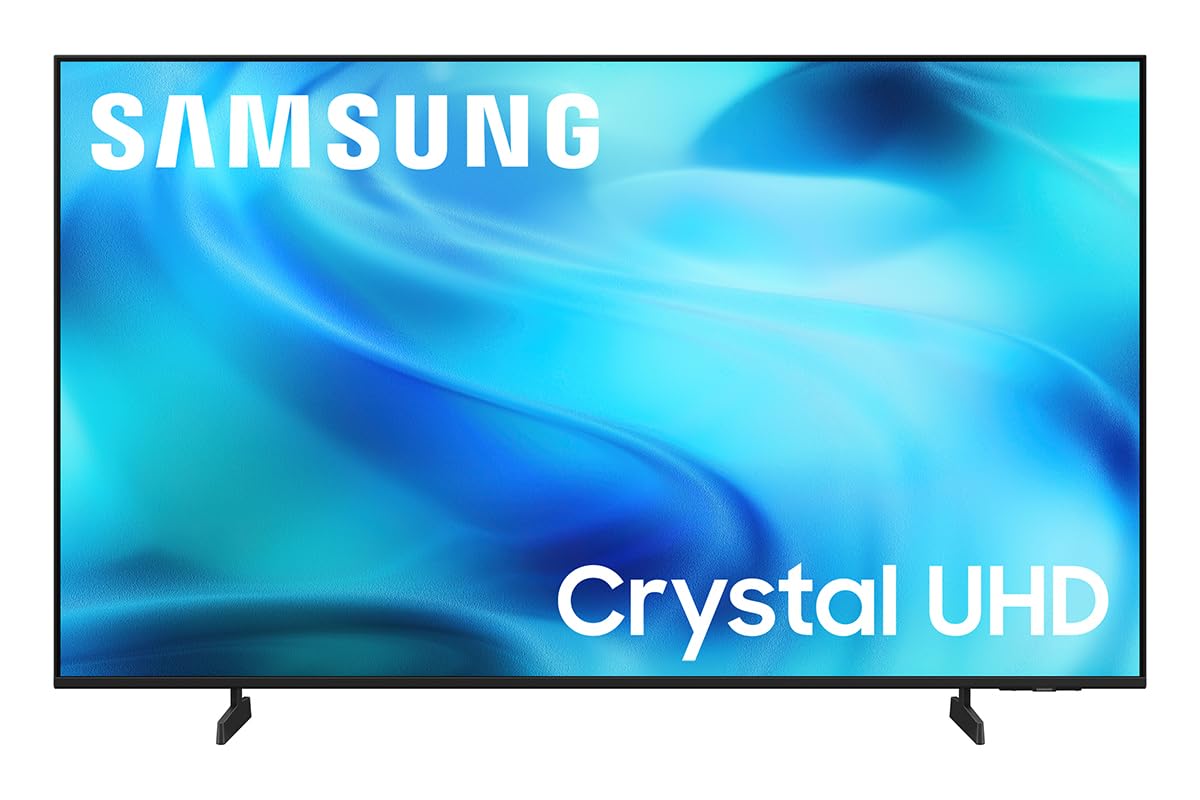
The Samsung Crystal UHD is the most accessible entry point into 4K LED Smart TV ownership without sacrificing brand reliability. The Crystal Processor 4K handles upscaling of HD content to 4K with reasonable sharpness, though it cannot match the detail recovery of Sony’s XR or Samsung’s own NQ4 silicon. The Color Booster technology pushes color saturation beyond standard LED panels, making cartoons and sports broadcasts look vivid. Motion Xcelerator estimates frame transitions to smooth motion at 60Hz, and while it is not a true 120Hz panel, the processing reduces noticeable judder in sports.
Samsung TV Plus provides over 2,700 free channels covering news, movies, and reality TV without requiring a subscription — a strong feature for cord-cutters. The Tizen OS is well-organized and responsive for basic tasks like app switching and input selection. At 22.5 pounds, this is one of the lightest 55-inch televisions, making wall-mounting significantly easier. The included remote is solar-powered, eliminating battery changes.
The LED panel has inherent limitations: black levels are grayish in a dark room, and there is visible edge blooming. The 60Hz native refresh rate means no 120fps gaming support, and the minimalist remote can be frustrating for older users due to its small buttons and lack of labeling. Setup requires an internet connection and Samsung account creation, which may annoy privacy-conscious buyers. The Crystal UHD is for the buyer who wants a recognizable brand with a decent picture at the lowest possible cost.
Why it’s great
- Brand reliability at the most accessible cost
- 2,700+ free channels via Samsung TV Plus with no subscription
- Lightweight design simplifies wall-mounting
Good to know
- 60Hz panel cannot display 120fps content
- Minimalist remote is difficult for some users to navigate
FAQ
What is the practical difference between a 60Hz and 120Hz panel for watching movies?
Does a QLED panel actually improve the picture over a standard LED panel?
Why does my 4K TV look blurry when watching standard HD content?
Final Thoughts: The Verdict
For most users, the 4k led smart tv winner is the Sony BRAVIA 5 because its XR processor, Mini-LED precision, and PS5 integration create a complete entertainment package with minimal compromise. If you want the highest native refresh rate for competitive gaming at a lower price, grab the Hisense U7. And for a large screen with the cleanest possible smart interface, nothing beats the Roku Select Series 65″.