
The moment an OLED panel lights up in a curved monitor, it delivers a sensory shift that’s hard to unsee. Pure blacks against blazing highlights create a depth that flat IPS panels, even the best ones, simply cannot reach. The curve wraps this contrast around your field of view, drawing you into the scene rather than leaving you looking at a glass window.
I’m Rikta — the co-founder and writer behind Gadgets Feed. I’ve spent years analyzing monitor panel technologies, tracking luminance measurements, pixel response data, and burn-in mitigation algorithms to separate genuine breakthroughs from marketing noise. (And Homer 🐱 supervised the cable routing from under the desk, unimpressed by the 1800R curve).
The goal is to identify which panels justify their position in your setup without hype or blind brand loyalty. After poring over thousands of real owner experiences and spec sheets, this guide offers a clear path through the best 4k oled curved monitor options currently available, from high-value entries to uncompromising flagship screens.
How To Choose The Best 4K OLED Curved Monitor
Four key decisions separate a satisfying long-term purchase from a return. Pixel density, panel generation, refresh rate targets, and curvature preference each shape the real-world experience more than brand logos do.
Panel Generation: QD-OLED vs WOLED
Quantum Dot OLED panels use a blue OLED layer with quantum dots to convert light into red and green, achieving higher color volume and peak brightness than traditional WOLED panels. WOLED uses a white subpixel to boost luminance, sometimes reducing color saturation in bright highlights. For a 4K curved monitor, QD-OLED generally delivers superior HDR impact, while WOLED’s subpixel layout often yields sharper text for productivity use.
Curvature and Your Viewing Distance
Monitor curvature is measured in radius — 1800R is a gentle curve suitable for typical 60-80cm desk depth, 1000R wraps more aggressively to match the human visual field, and 800R is steep, found mostly on ultrawide panels. The right choice depends on whether you use the monitor primarily for immersive gaming (tighter curve helps) or mixed productivity (gentler curve reduces distortion on spreadsheets).
Refresh Rate and GPU Pairing
4K at 240Hz demands substantial GPU horsepower, particularly in modern titles. A 165Hz panel is easier to drive and often costs less, while 240Hz panels offer future-proofing for the next GPU upgrade cycle. Variable refresh rate support (FreeSync Premium Pro or G-Sync Compatible) is standard on OLEDs and eliminates tearing without the penalty of V-Sync input lag.
Burn-In Mitigation Features
OLED burn-in from static UI elements is the primary longevity concern. Look for panels with pixel refresh cycles, logo detection, and taskbar dimming. Most premium models from the last two years include automatic compensation routines that run in standby, and manufacturers like Alienware and ASUS now explicitly cover burn-in under warranty.
Quick Comparison
On smaller screens, swipe sideways to see the full table.
| Model | Category | Best For | Key Spec | Amazon |
|---|---|---|---|---|
| ASUS ROG Swift PG32UCDM | Premium 4K QD-OLED | Uncompromising gaming & media | 4K 240Hz QD-OLED | Amazon |
| MSI MPG 321URX QD-OLED | High-End Gaming 4K | High-refresh 4K gaming & productivity | 4K 240Hz QD-OLED | Amazon |
| LG 45GX950A-B | Flagship 5K2K OLED | Wide immersive gaming & dual-mode | 5K2K 165Hz/330Hz Dual-Mode | Amazon |
| Alienware AW3425DW | Ultrawide QD-OLED | Immersive ultrawide gaming | WQHD 240Hz QD-OLED | Amazon |
| Acer Predator X32 | Curved 4K Gaming | Competitive 4K console/PC gaming | 4K 240Hz QD-OLED | Amazon |
| Alienware AW3423DWF | Ultrawide QD-OLED | HDR gaming & creator work | WQHD 165Hz QD-OLED | Amazon |
| LG 39GX90SA-W | Smart OLED Ultrawide | Streaming & cloud gaming | WQHD 240Hz OLED | Amazon |
| Samsung Odyssey G9 G91SD | Super Ultrawide QD-OLED | Multi-tasking & racing simulations | Dual QHD 144Hz | Amazon |
| INNOCN 49Q1S | Budget Super Ultrawide | Wide real estate for a lower cost | Dual QHD 240Hz OLED | Amazon |
| Philips Evnia 34M2C6500 | Mid-Range Ultrawide | Entry-level OLED immersion | WQHD 175Hz QD-OLED | Amazon |
| AOC Agon PRO AG346UCD | Mid-Range QD-OLED | Reliable ultrawide performance | WQHD 175Hz QD-OLED | Amazon |
| Samsung Odyssey G7 G75F | Mid-Range Curved Gaming | Productivity & immersive gaming | 4K 165Hz VA (not OLED) | Amazon |
| Dell UltraSharp U4025QW | Professional Ultrawide | Professional productivity & color work | 5K2K 120Hz IPS Black | Amazon |
In‑Depth Reviews
1. ASUS ROG Swift PG32UCDM

The ASUS PG32UCDM combines a 32-inch 4K QD-OLED panel with a robust custom heatsink and graphene film layer to manage thermals and reduce burn-in risk. Its 240Hz refresh rate and 0.03ms GtG response time make it one of the fastest 4K gaming monitors available, while true 10-bit color and 99% DCI-P3 coverage deliver reference-level HDR.
The glossy display enhances perceived clarity and contrast, eliminating the haze common on matte coatings. Owners consistently report that reflections are minimal in normal room lighting, and the high 140 PPI allows 1440p gaming to look nearly as sharp as native 4K, reducing GPU load without a visible quality penalty.
ASUS backs the panel with a 3-year warranty that explicitly covers burn-in, addressing the main hesitation around OLED longevity. The uniform brightness setting and OLED Care suite give users fine control over pixel refresh cycles, making this a safe long-term purchase for mixed-use scenarios.
Why it’s great
- Top-tier HDR performance with 1000 nits peak on small highlights
- Burn-in coverage included in the standard warranty
- Glossy screen delivers exceptional perceived contrast and clarity
Good to know
- No built-in speakers for console or casual use
- Requires a powerful GPU to drive 4K at 240Hz consistently
2. MSI MPG 321URX QD-OLED

The MSI MPG 321URX delivers the same 32-inch 4K QD-OLED panel as the ASUS PG32UCDM but at a more accessible price point, with only minor omissions. It runs the same 240Hz refresh rate and 0.03ms response time, with VESA DisplayHDR True Black 400 certification and a 90W USB-C port for laptop charging.
MSI includes its OLED Care 2.0 suite with pixel shift, panel protect, and taskbar detection to prevent burn-in. The KVM switch works seamlessly, allowing users to control two devices with a single keyboard and mouse. Owners highlight the crisp text rendering and color accuracy right out of the box, with Delta E ≤2.
Connectivity covers HDMI 2.1, DisplayPort 1.4a, and USB-C, making it compatible with PC, PS5, and Xbox Series X at full bandwidth. The stand supports tilt and height adjustment but lacks swivel, though VESA 100×100 compatibility solves that for custom arm setups.
Why it’s great
- Near-identical panel performance to the ASUS at a lower cost
- 90W USB-C power delivery simplifies laptop desk setups
- Excellent text clarity for an OLED panel
Good to know
- Stand lacks swivel adjustment
- Peak brightness during HDR is limited compared to premium-tier rivals
3. LG 45GX950A-B
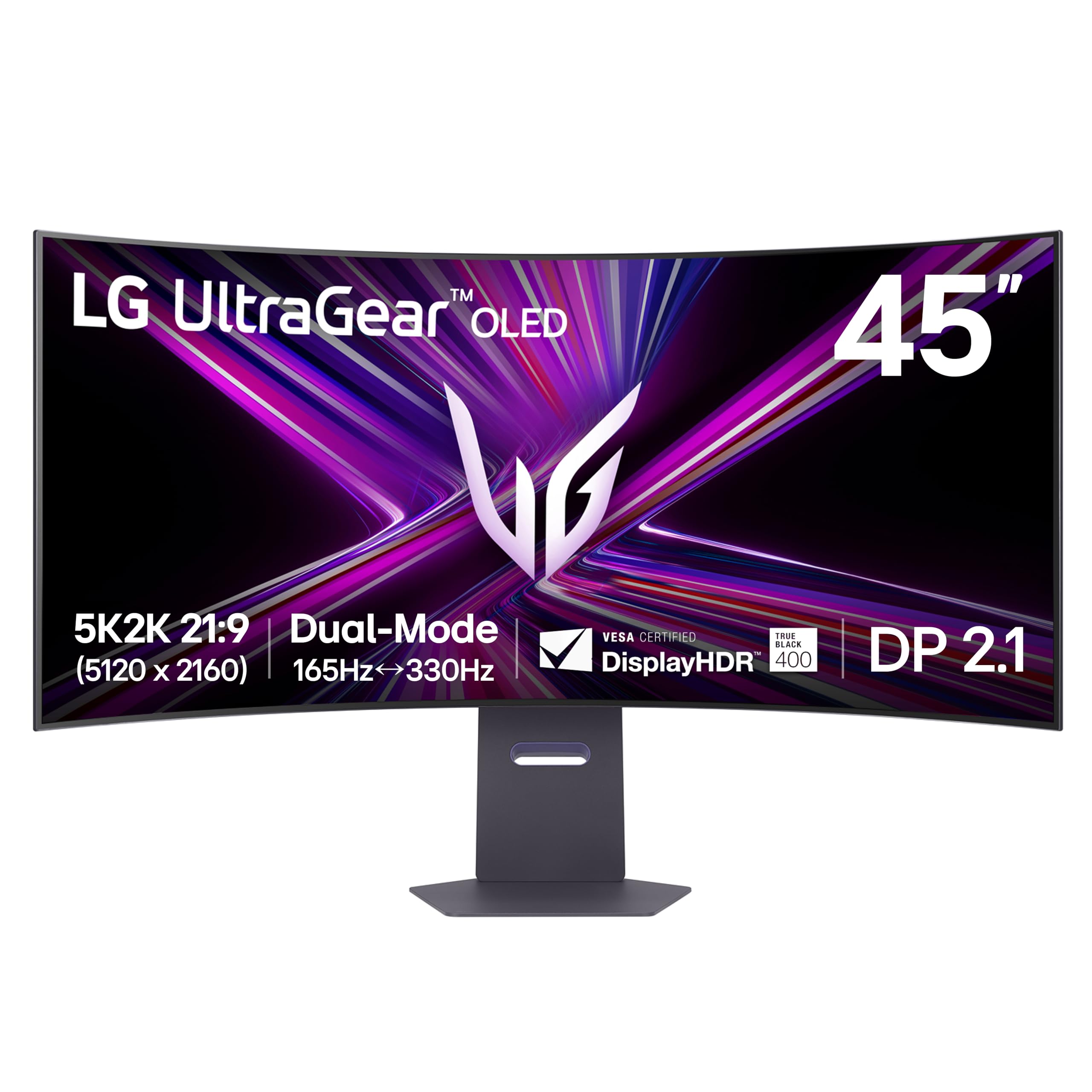
The LG 45GX950A-B is the first 5K2K WUHD OLED gaming monitor, offering 5120×2160 resolution on a 45-inch 800R curved panel. This pixel density reaches 125 PPI, significantly reducing text color fringing compared to earlier OLED ultrawides, making it viable for productivity without sacrificing gaming immersion.
Dual-Mode allows switching between 5K2K at 165Hz and Wide FHD at 330Hz, catering to graphically demanding RPGs and competitive shooters on the same display. DisplayPort 2.1 ensures bandwidth for the full 165Hz refresh rate without compression, while HDMI 2.1 covers console connectivity.
The 800R curve is aggressive, pulling the edges into your peripheral vision for a deeply immersive effect in racing and flight sims. Owners note that the anti-glare coating effectively reduces reflections, and the built-in speakers deliver reasonable audio for casual use, though dedicated speakers remain recommended.
Why it’s great
- 5K2K resolution with Dual-Mode flexibility for gaming and work
- DisplayPort 2.1 supports full bandwidth without compression
- Excellent text clarity with reduced color fringing
Good to know
- Aggressive curve may take adjustment for productivity tasks
- Premium price point places it in the highest tier
4. Alienware AW3425DW

The Alienware AW3425DW is the latest iteration of Dell’s popular 34-inch QD-OLED ultrawide, now pushing 240Hz compared to the previous 165Hz. The 1800R curvature, WQHD 3440×1440 resolution, and DCI-P3 99.3% coverage create an immersive canvas for single-player games and media consumption.
G-Sync Compatible and FreeSync Premium Pro support ensure smooth gameplay across variable frame rates. The Creator Mode gives color-accurate sRGB and DCI-P3 presets for photo editing, while Delta E < 2 accuracy out of the box makes it suitable for reference work.
Alienware includes a 3-year warranty covering burn-in, and pixel refresh runs automatically while the monitor is in standby. Owners consistently praise the deep blacks and vibrant highlights, with some noting that the glossy screen handles reflections well enough for typical room lighting conditions.
Why it’s great
- 240Hz refresh rate on a proven QD-OLED ultrawide platform
- 3-year warranty covers burn-in
- Creator Mode provides accurate color spaces out of the box
Good to know
- Not true 4K — WQHD resolution means 110 PPI
- Brightness measured at 250 nits typical; HDR highlights peak higher
5. Acer Predator X32
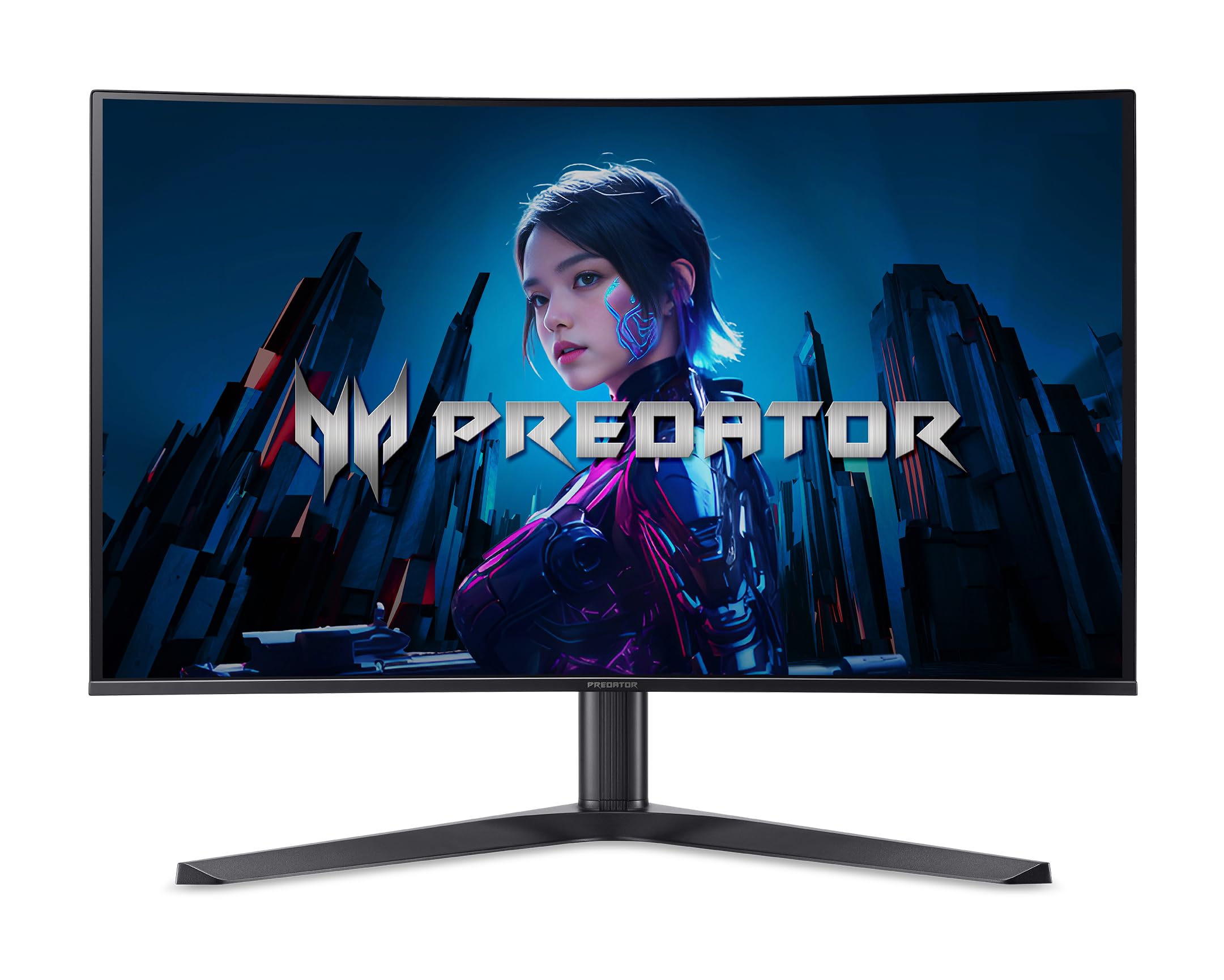
The Acer Predator X32 brings a 31.5-inch 4K QD-OLED panel with 240Hz and a 1700R curve to the table at a compelling price. It targets gamers who want native 4K resolution without stepping up to premium-tier pricing, with HDMI 2.1, DisplayPort 1.4, and USB-C connectivity covering modern console and PC hardware.
VESA DisplayHDR True Black 400 certification ensures accurate HDR with deep blacks and bright highlights. The built-in speakers are a rare addition for OLED monitors, though they serve more as convenience than a primary audio solution.
Most owners report excellent image quality and smooth gaming performance, noting the 1700R curve is subtle enough to not interfere with productivity. The stand offers tilt, swivel, and height adjustment, and the VESA mount supports arm setups for deeper desks.
Why it’s great
- Native 4K resolution at 240Hz with QD-OLED contrast
- Includes built-in speakers for convenience
- Subtle 1700R curve suits gaming and productivity
Good to know
- Menu system can be restrictive until updated
- Monitor prompts may require occasional user intervention
6. Alienware AW3423DWF

The Alienware AW3423DWF is the monitor that popularized QD-OLED in the gaming space, and it remains a strong contender. The 34-inch 1800R ultrawide at WQHD 3440×1440 with 165Hz and 0.1ms response time delivers smooth motion and infinite contrast that still impresses owners years after launch.
FreeSync Premium Pro and VESA AdaptiveSync certification ensure tear-free performance. The 3-year warranty with burn-in coverage was industry-leading when launched and continues to provide peace of mind for long-term ownership.
The Creator Mode allows switching between DCI-P3 and sRGB gamuts with adjustable gamma, making it a viable secondary monitor for color-critical work. Owners note that the aggressive pixel refresh cycle every 4 hours can interrupt workflow, but the panel’s image quality more than compensates.
Why it’s great
- Proven QD-OLED panel with excellent HDR and color accuracy
- Creator Mode supports sRGB and DCI-P3 with gamma adjustment
- 3-year warranty covers burn-in
Good to know
- 165Hz is lower than newer 240Hz alternatives
- Pixel refresh cycle runs every 4 hours, interrupting use briefly
7. LG 39GX90SA-W
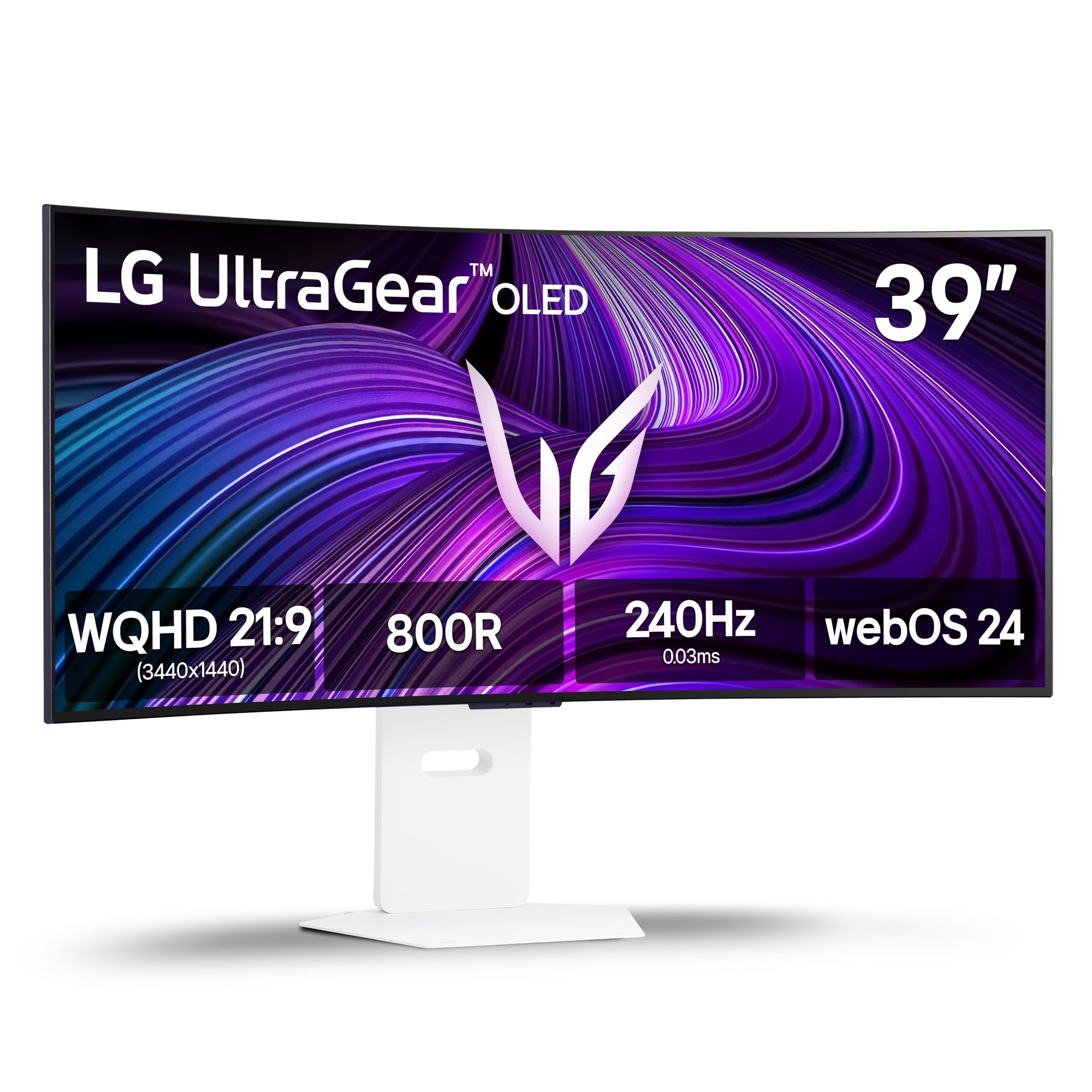
The LG 39GX90SA-W is an OLED smart gaming monitor with webOS built in, allowing access to Netflix, Prime Video, and cloud gaming services directly without a PC. The 39-inch WQHD panel uses an 800R curvature that severely wraps the image around your periphery, creating an intense sense of presence in supported titles.
The 240Hz refresh rate and 0.03ms response time match dedicated gaming panels, while AMD FreeSync Premium and G-Sync Compatibility ensure smooth variable refresh. USB-C with 90W power delivery charges a laptop while passing video signal, simplifying single-cable setups.
At 1300 nits peak brightness, HDR highlights punch well above other WOLED panels in this class. Owners appreciate the built-in streaming apps for quick media playback, though the white chassis and steep curve may not suit every desk aesthetic.
Why it’s great
- webOS platform for built-in streaming and cloud gaming
- 1300 nits peak brightness for impactful HDR
- USB-C 90W for laptop charging
Good to know
- 800R curve is very steep and not suited for productivity
- WQHD resolution at 39 inches results in lower pixel density
8. Samsung Odyssey G9 G91SD

The Samsung Odyssey G9 G91SD is a 49-inch Dual QHD (5120×1440) QD-OLED monitor with a 32:9 aspect ratio and 144Hz refresh rate. Effectively two 27-inch 1440p panels fused with no bezel, it provides massive horizontal real estate for flight simulations, strategy games, and professional multitasking.
The OLED contrast delivers true blacks that standard VA and IPS super ultrawides cannot match, making HDR content in supported titles a genuinely transformative experience. G-Sync Compatibility and FreeSync Premium Pro keep motion smooth across the wide panel.
Samsung includes logo detection and taskbar dimming to reduce burn-in risk on static elements, and a thermal modulation system controls brightness based on surface temperature to manage heat. The 1800R curve is gentle enough for the width, wrapping the image naturally around the user.
Why it’s great
- Massive 32:9 screen ideal for racing and flight simulators
- QD-OLED contrast and colors surpass all LCD super ultrawides
- Built-in burn-in mitigation features
Good to know
- 144Hz refresh rate is lower than 240Hz competitors
- Two fused panels may show slight brightness mismatch across the screen
9. INNOCN 49Q1S

The INNOCN 49Q1S offers a 49-inch Dual QHD (5120×1440) OLED panel at 240Hz, making it one of the more accessible entry points into super ultrawide OLED gaming. The 1800R curve and 32:9 aspect ratio provide the same broad canvas as Samsung’s G9 but at a more accessible price tier.
Connectivity includes DisplayPort 1.4, HDMI 2.1, and USB-C with 90W power delivery, alongside a USB hub and RJ45 Ethernet port for docking station functionality. The built-in speakers are a practical addition for desk setups with limited external audio.
PIP/PBP split-screen allows showing two input sources simultaneously, useful for running work and gaming on the same screen. Some owners note that certain apps struggle with the 32:9 aspect ratio, but supported titles look fantastic with OLED contrast and 240Hz smoothness.
Why it’s great
- Affordable super ultrawide OLED with 240Hz refresh rate
- USB-C 90W and RJ45 for hub functionality
- Built-in speakers reduce desk clutter
Good to know
- Some reliability concerns reported after extended use
- App compatibility with 32:9 resolution varies
10. Philips Evnia 34M2C6500
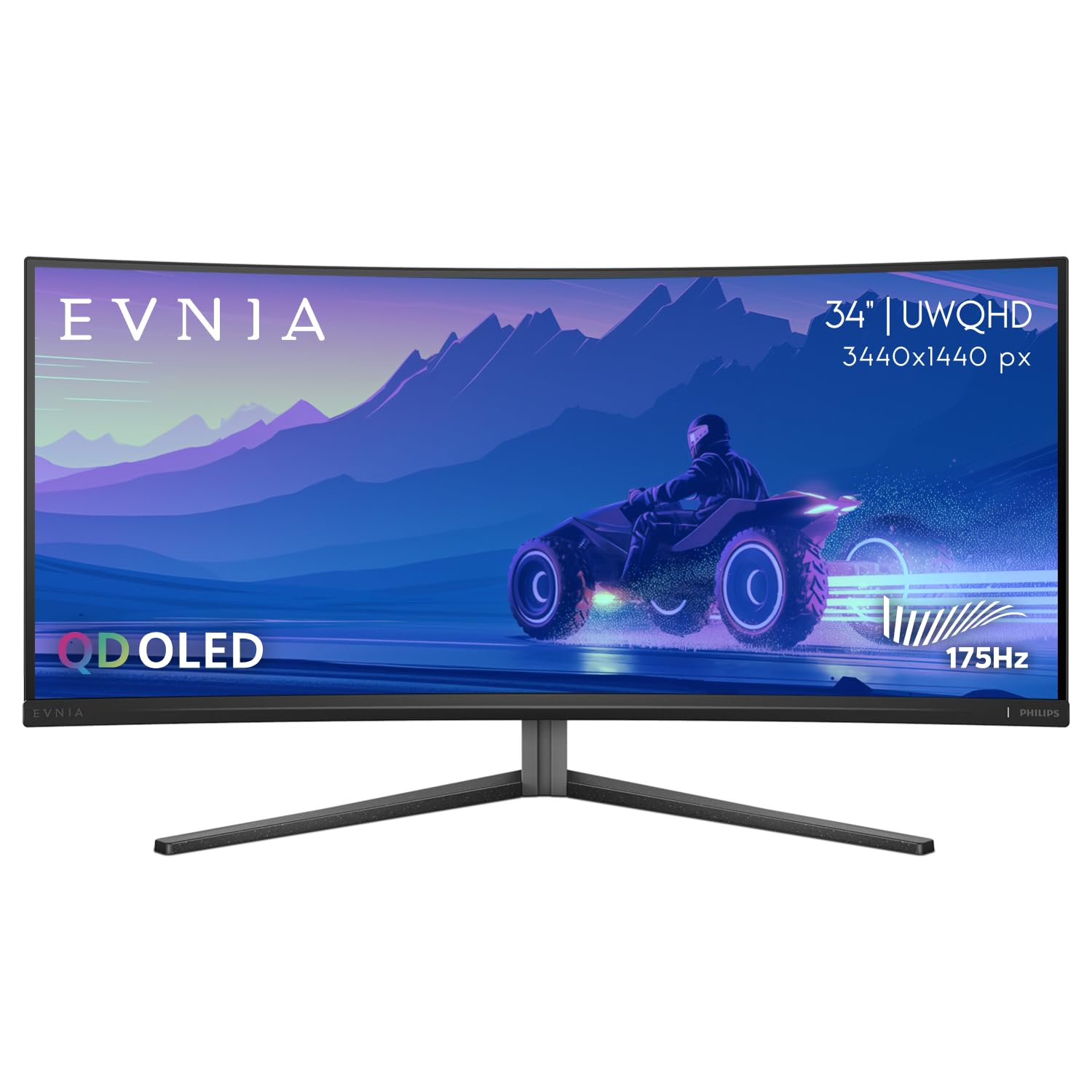
The Philips Evnia 34M2C6500 is a 34-inch WQHD QD-OLED with a 175Hz refresh rate and 1800R curve, targeting gamers who want OLED contrast without the 4K premium. VESA DisplayHDR TrueBlack 400 certification ensures proper HDR handling with deep blacks and bright highlights.
FreeSync compatibility and the 0.03ms response time eliminate motion blur during fast-paced gaming. Philips includes a 4-year Advance Replacement warranty, which is unusually long for an OLED monitor and provides significant long-term value.
Connectivity covers HDMI 2.0 and DisplayPort 1.4 — note that HDMI 2.0 limits bandwidth to 100Hz at WQHD, so DisplayPort is required for the full 175Hz. Owners consistently praise the OLED blacks and color saturation, with the Ambiglow lighting adding ambient immersion to the desktop.
Why it’s great
- 4-year Advance Replacement warranty surpasses most competitors
- QD-OLED contrast and colors at a budget-friendly price
- Ambiglow rear lighting enhances desk ambiance
Good to know
- HDMI 2.0 caps bandwidth at WQHD 100Hz
- Ambiglow lighting can feel delayed and not fully responsive
11. AOC Agon PRO AG346UCD

The AOC Agon PRO AG346UCD is a 34-inch WQHD QD-OLED with 175Hz, 0.03ms response time, and G-Sync Compatibility. It offers nearly identical specs to the Philips Evnia, with slightly more refined ergonomics including tilt, swivel, and 150mm height adjustment.
HDR400 True Black certification delivers the expected OLED contrast, with deep blacks and vibrant highlights that make SDR content look excellent by default. The build quality receives consistent praise, and the RGB backlight adds a subtle gaming aesthetic.
Owners highlight the difficulty of removing the screen protector, which can leave sticky residue if not handled carefully. Once set up, the image quality is universally praised, with users calling the upgrade from LCD to OLED a transformative experience for gaming and media consumption.
Why it’s great
- G-Sync Compatible and FreeSync support for tear-free gaming
- Full ergonomic adjustment with 150mm height range
- Excellent QD-OLED colors and contrast out of the box
Good to know
- Screen protector can be difficult to remove cleanly
- No 4K resolution at this price tier
12. Samsung Odyssey G7 G75F
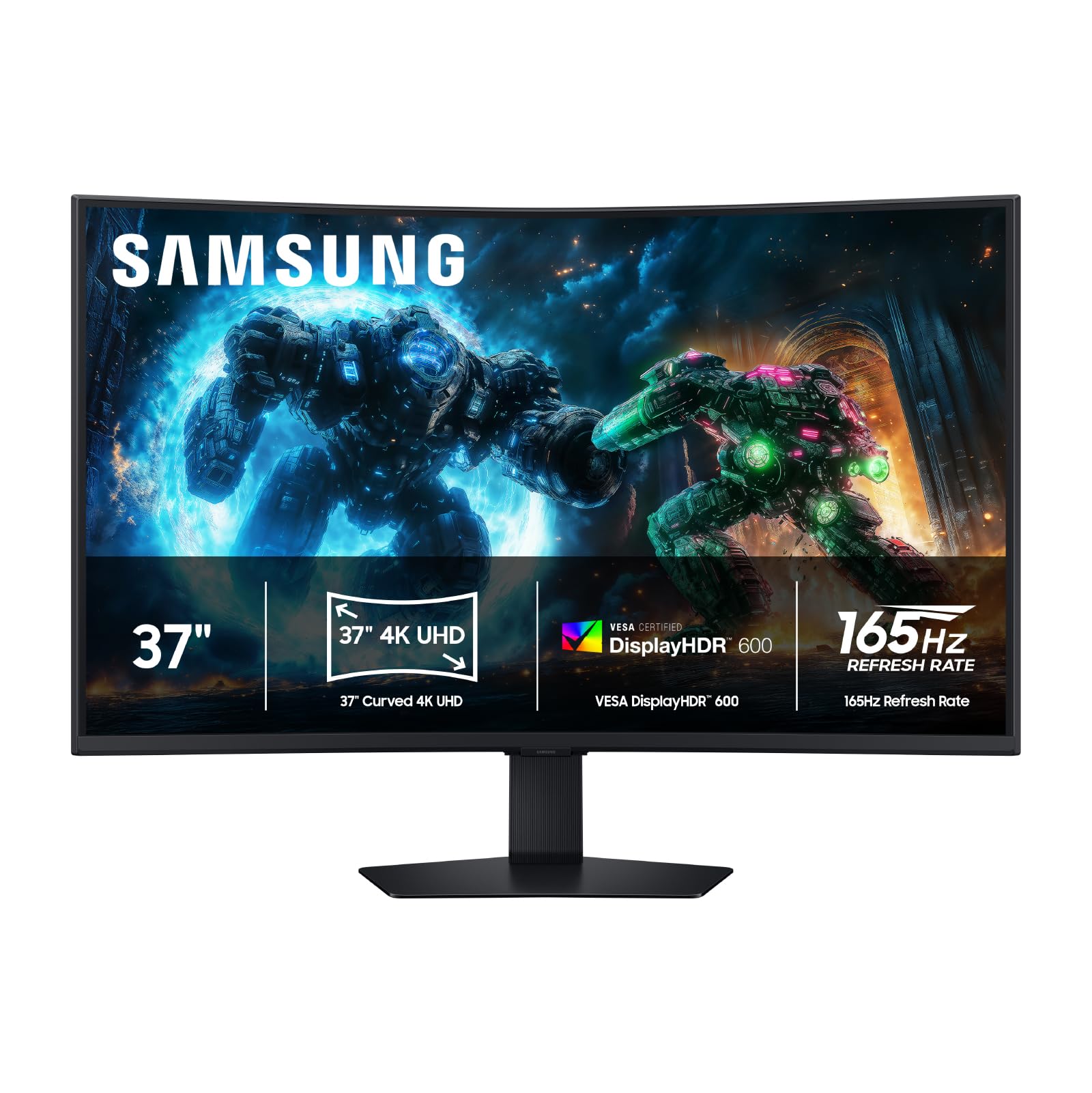
The Samsung Odyssey G7 G75F is a 37-inch VA panel with 4K UHD resolution, a 1000R curve, and 165Hz refresh rate. While not an OLED, it earns mention here for its aggressive curvature and high pixel density that appeals to users who prioritize deep desk immersion and crisp productivity text over perfect blacks.
VESA DisplayHDR 600 certification means brighter highlights than most VA panels, though contrast is still far from OLED levels. The 1ms GtG response time keeps motion blur minimal for competitive gaming, and FreeSync Premium Pro supports smooth variable refresh.
Owners describe it as an ideal single monitor for software development, offering enough resolution for four windows side by side. The 1000R curve creates an almost tunnel-like viewing experience that some love and others find aggressive for non-gaming tasks.
Why it’s great
- 1000R curve provides the most immersive curvature available
- 4K resolution on a 37-inch panel offers high pixel density
- HDR 600 delivers brighter highlights than standard VA panels
Good to know
- VA panel cannot match OLED contrast or black levels
- Aggressive curvature may not suit all productivity users
13. Dell UltraSharp U4025QW

The Dell UltraSharp U4025QW is a 40-inch IPS Black panel with 5K2K (5120×2160) resolution and 120Hz refresh rate, designed for professionals who demand color accuracy and dense pixel counts. While not OLED, IPS Black technology delivers 2000:1 contrast — significantly better than standard IPS — with deep blacks and minimal glow.
The factory-calibrated Delta E < 2 accuracy, 99% DCI-P3 coverage, and Thunderbolt 4 hub with 140W charging make it a complete docking station in one cable. The 5K2K resolution at 120Hz is ideal for video editing timelines, code editors, and spreadsheet work requiring maximum horizontal space.
Owners praise the crisp text rendering and generous screen real estate, noting that the built-in KVM switch handles seamless transitions between Mac and PC. The gentle curve enhances immersion without distorting spreadsheet lines or design grids.
Why it’s great
- 5K2K resolution with Thunderbolt 4 and 140W charging
- IPS Black technology improves contrast over standard IPS
- Factory-calibrated color accuracy for professional work
Good to know
- IPS Black cannot match OLED black levels
- Premium price reflects professional-grade features
FAQ
Is QD-OLED or WOLED better for a curved 4K gaming monitor?
Does a 4K OLED curved monitor work for competitive esports gaming?
How long do OLED monitors last before burn-in becomes visible?
Final Thoughts: The Verdict
For most users, the best 4k oled curved monitor winner is the ASUS ROG Swift PG32UCDM because it delivers reference-level HDR, 240Hz smoothness, and burn-in warranty coverage in a single 32-inch package. If you want native 4K at a more accessible price, grab the MSI MPG 321URX QD-OLED. And for the widest immersive experience with Dual-Mode flexibility, nothing beats the LG 45GX950A-B.