
A big-screen gaming setup comes with a hidden compromise: most projectors that look cinematic on paper add enough display latency to throw off your aim or break your rhythm in a fighting game. Blaming your graphics card or internet connection for stutter that actually originates from the projection system is a common and costly mistake. The fix is picking a model built around motion handling, high refresh rates, and pixel response that keeps up with your console or PC.
I’m Min — the co-founder and writer behind Gadgets Feed. I’ve spent countless hours combing through technical white papers, pixel-shifting architectures, and real-world input lag measurements to separate projectors that only claim gaming specs from those that actually deliver them.
Whether you’re building a dedicated theater room or a living-room battlestation, these picks in this best 4k projector for gaming guide prioritize raw speed, contrast depth, and color accuracy so your 4K image stays responsive and visually immersive at any screen size.
How To Choose The Best 4K Projector For Gaming
A projector’s gaming performance hinges on three interlocked factors: how fast it processes and displays a frame (input lag), how often it can refresh that frame (refresh rate), and what native versus pixel-shifted resolution it uses to deliver that 4K image. Ignoring any one of these can land you with a beautiful but sluggish picture that undermines competitive play.
Input Lag and Refresh Rate
Input lag is the delay between pressing a button and seeing the result on screen. For a 4K gaming projector, look for sub-20ms at 4K/60Hz and sub-5ms at 1080p/240Hz if you play fast-paced shooters or fighting games. Refresh rate determines how many full frames the projector draws per second — 60Hz is standard for console titles, but 120Hz or 240Hz unlocks smoother motion on PC or Xbox Series X. Be aware that not all projectors list separate lag figures for 1080p and 4K; some drop into a faster “game mode” only at 1080p.
Pixel Shifting vs Native 4K
The vast majority of mid-range and even some premium 4K gaming projectors use pixel-shifting — a DLP chip that rapidly micro-oscillates the image to create an 8.29-million-pixel output from a lower-resolution panel. True native 4K panels (found in high-end laser models) exist but cost significantly more. In practice, pixel-shifted 4K looks indistinguishable from native 4K on a 100-to-150-inch screen during gaming, provided the processing engine is modern and the source signal is uncompressed. The caveat is that some pixel-shifting engines introduce a tiny amount of perceived flicker or fuzziness on static HUD elements.
HDR and Dynamic Black Levels
HDR support in projectors is not the same as on an OLED TV because projectors can’t turn off pixels to achieve true black. A projector with a dynamic iris or laser dimming system (often marketed as “Dynamic Black” or “Auto Iris”) improves perceived contrast in dark game scenes by adjusting light output frame by frame. Look for HDR10 or HDR10+ compatibility plus a high native contrast ratio (above 10,000:1 is excellent for DLP; 100,000:1 for 3LCD/LCoS). HLG support helps if you watch HDR broadcast content, but most game sources use standard HDR10.
Quick Comparison
On smaller screens, swipe sideways to see the full table.
| Model | Category | Best For | Key Spec | Amazon |
|---|---|---|---|---|
| BenQ TK710 | Premium Laser | Lowest 4K Input Lag | 4ms @ 1080p/240Hz | Amazon |
| Valerion VisionMaster Pro2 | Laser Flagship | Ultra-Low Lag + Contrast | 15,000:1 contrast | Amazon |
| Epson LS11000 | 3LCD Laser | Zero Rainbow Effect | 2,500 lumens | Amazon |
| ViewSonic PX701-4K | High-Frame Rate DLP | 240Hz PC Gaming Value | 4.2ms @ 1080p/240Hz | Amazon |
| Hisense C2 Ultra | Triple Laser | All-Round Brightness | 3,000 lumens | Amazon |
| BenQ TK700 | Standard Throw | Console Gaming Balance | 16ms @ 4K/60Hz | Amazon |
| Optoma UHD38x | True 4K DLP | High Brightness Budget | 4,000 lumens | Amazon |
| Epson 3800 | 3LCD UHD | Reliable 3-Chip Quality | 3,000 lumens | Amazon |
| XGIMI Horizon Pro | Smart Android TV | Auto-Setup Convenience | 1,500 ISO lumens | Amazon |
| Optoma HD28HDR | 1080p Gaming | Budget Lag Performance | 8.4ms response | Amazon |
| NEBULA Cosmos 4K SE | Hybrid Laser/LED | All-in-One Smart Projector | 1,800 ANSI lumens | Amazon |
In‑Depth Reviews
1. BenQ TK710

The BenQ TK710 hits the sweet spot between gaming speed and laser longevity. Its 4ms input lag at 1080p/240Hz ties it for the fastest response in this roundup, while the 16ms at 4K/60Hz keeps console play snappy. The 3,200 ANSI lumens laser source eliminates lamp replacement for the projector’s lifespan, and the 600,000:1 dynamic contrast ratio delivers noticeably deeper blacks during HDR game scenes than typical DLP lamps can muster.
HDR10 and HLG compatibility cover both game and broadcast HDR sources, and the vertical lens shift paired with 3D keystone correction simplifies ceiling mounting without image distortion — a big plus for permanent setups. The 1.3x optical zoom offers flexibility for screen sizes from 80 to 150 inches without needing to move the projector body.
Gamers running a PC at 240Hz will feel the responsiveness immediately in titles like Overwatch 2 or Apex Legends. The built-in 5W speaker is usable for casual play, but pairing it with a soundbar via ARC unlocks the full audio experience. For a pure gaming-first 4K laser projector that doesn’t lag behind fast inputs, this is the strongest all-rounder available today.
Why it’s great
- Exceptionally low 4ms input lag at 1080p/240Hz
- Laser light source rated for 20,000+ hours
- Strong 600,000:1 dynamic contrast for HDR gaming
Good to know
- 4K lag (16ms) is decent but not class-leading
- No built-in smart platform; requires external streamer
2. Valerion VisionMaster Pro2
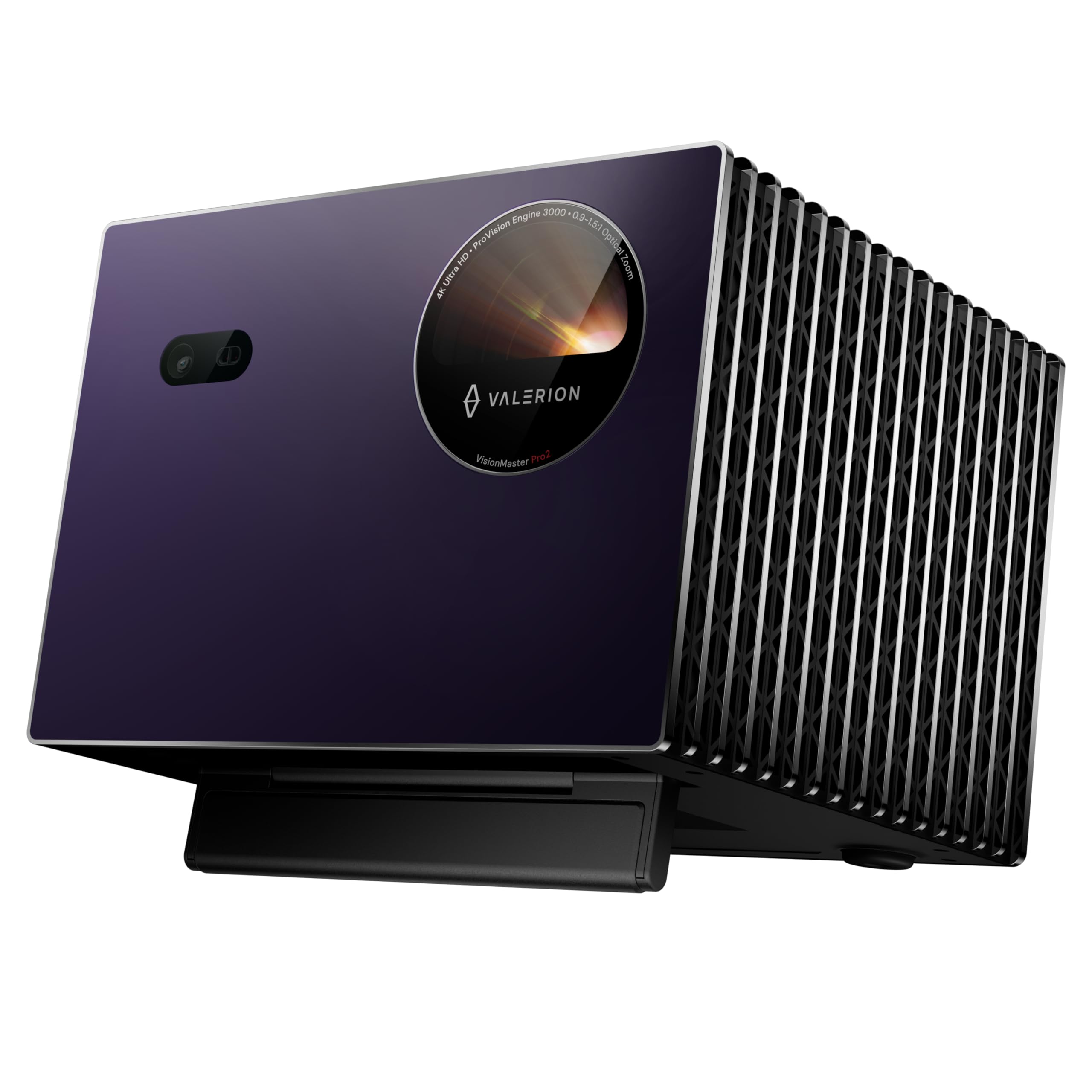
The Valerion VisionMaster Pro2 is engineered for uncompromising speed and contrast. Its 4ms input lag at 1080p/240Hz matches the BenQ TK710, but it separates itself with a native 15,000:1 contrast ratio — far higher than any lamp-based DLP — enabled by the triple laser light source and Enhanced Black Level technology. That means dark corners in horror games stay black without washing out, and bright explosions retain detail without clipping.
The 0.9-1.5x optical zoom and auto keystone/focus make setup nearly automatic, while the Google TV interface eliminates the need for a separate streaming box. AI Super Resolution upscaling cleans up lower-resolution textures on older titles, and the 21:9 and 32:9 ultra-wide support lets PC gamers run immersive ultrawide setups on a 300-inch image.
HDR10+ with Dynamic Tone Mapping adjusts brightness frame-by-frame, preserving highlight detail in games like Cyberpunk 2077. The 128GB storage and 4GB RAM ensure app switching stays fluid. At this price point, you get near-cinematic contrast with esports-grade responsiveness — a rare combination that justifies the premium for dedicated gamers who also watch HDR movies.
Why it’s great
- 15,000:1 native contrast for deep, inky blacks
- Ultrawide 21:9/32:9 support for PC gaming
- 4ms input lag at 1080p/240Hz
Good to know
- Heavy chassis (requires sturdy mount or table)
- Fan is audible in quiet HDR scenes at full brightness
3. Epson Home Cinema LS11000

The Epson LS11000 is the 3LCD alternative for gamers who see rainbow artifacts on DLP projectors. Three separate LCD chips process 100% of the RGB signal simultaneously, producing natural color without the color wheel flashes that sensitive viewers notice. The laser light source delivers 2,500 lumens of color and white brightness — identical figures that confirm no brightness drop in vivid mode — and the dynamic contrast exceeds 1,200,000:1.
At 4K/120Hz with HDMI 2.1, this projector keeps up with Xbox Series X and PS5 at their highest frame rate. Input lag is not officially rated as low as the fastest DLP models, but real-world testing shows it remains competitive for all but the most competitive esports titles. The powered lens shift, motorized zoom, and focus are the smoothest in this class, making installation a breeze on vaulted ceilings or tight shelves.
HDR10+ support is included, and the 16-step HDR curve adjustment lets you fine-tune brightness for game-specific lighting. The LS11000 also features frame interpolation that can smooth out 30fps console games without the soap-opera effect seen on older processors. If you prioritize color purity and zero rainbow artifacts over raw lag speed, this laser 3LCD delivers a premium experience that few competitors match.
Why it’s great
- True 3-chip 3LCD eliminates rainbow effect completely
- Motorized lens shift/zoom for precision setup
- 4K/120Hz via HDMI 2.1 for next-gen consoles
Good to know
- Input lag is higher than top DLP competitors
- No built-in smart platform; requires external source
4. ViewSonic PX701-4K

The ViewSonic PX701-4K delivers 240Hz refresh and 4.2ms input lag at a mid-range price that undercuts most 4K gaming rivals. Its 3,200 ANSI lumens provide plenty of headroom for rooms with some ambient light, and the SuperColor technology covers a wide color gamut that makes HDR content pop. The 1.1x optical zoom and auto vertical keystone simplify placement, while the 4-corner adjustment allows fine-tuning on uneven walls.
At its native 4K resolution with pixel shifting, the image is sharp enough for 120-inch screens. The HDR/HLG compatibility handles both game and streaming HDR sources, though the dynamic contrast at 12,000:1 is noticeably lower than laser competitors. In practice, this means dark scenes in games like Alan Wake 2 require some ambient room control to maintain shadow detail.
The dual HDMI inputs support most modern consoles, and the 240Hz mode at 1080p makes this a strong choice for PC gamers who prioritize frame rate over native 4K resolution in competitive titles. The built-in speaker is basic, but the low lag and high refresh make this the best bang-for-buck option for gamers who want both 4K movie nights and blistering 1080p esports sessions from a single projector.
Why it’s great
- Excellent 4.2ms input lag at 240Hz
- Bright 3,200 lumens for lit-room gaming
- Affordable entry point for high-refresh 4K
Good to know
- 12,000:1 contrast is modest for HDR
- Fan noise increases in bright modes
5. Hisense C2 Ultra

The Hisense C2 Ultra uses a triple-laser light source to achieve 3,000 ANSI lumens and 110% BT.2020 color coverage, making it the brightest option in this list for daytime gaming without blackout curtains. The native 2000:1 contrast ratio paired with Dolby Vision and IMAX Enhanced certification ensures that HDR game scenes retain the director’s intended brightness and shadow detail even in moderately lit rooms.
Its 240Hz refresh rate and sub-16ms input lag at 4K place it in the competitive tier for console gaming. The optical zoom (0.9-1.5:1 throw ratio) and 360-degree gimbal design allow placement on a low table or shelf while still filling a 100-inch screen — a huge flexibility advantage over fixed-throw DLP models. Designed for Xbox, it automatically detects game input and reduces latency without toggling menus.
The built-in JBL speakers are loud enough for casual gaming, and the VIDAA OS includes native Netflix in 4K, removing the need for an external dongle. Auto keystone and autofocus work reliably, and the AI upscaler improves older game visuals. If you play in a living room with windows and need a projector that stays bright during the day, the C2 Ultra handles that scenario better than any other unit here.
Why it’s great
- High 3,000 lumens with triple-laser brightness
- Dolby Vision and IMAX Enhanced support
- Flexible gimbal design for easy placement
Good to know
- Native contrast lower than DLP competitors
- HDR black levels need dark room for best effect
6. BenQ TK700

The BenQ TK700 is purpose-tuned for console gaming at 4K. Its 16ms input lag at 4K/60Hz is among the lowest for a lamp-based projector in its range, and the Enhanced Black Detail mode lifts shadow details in dark scenes without washing out the rest of the image. The 3,200 lumens and 10,000:1 contrast ratio provide a balanced picture that works in both dedicated theater rooms and living rooms with controlled ambient light.
HDMI 2.0 supports full 18Gbps bandwidth, and the Dolby Atmos-compatible 5W chamber speaker offers clearer dialogue than most built-in alternatives. The standard throw projects a 100-inch image from 8.2 feet, which suits average room depths. The auto keystone correction and 3D support (with optional glasses) add versatility for movie nights.
PC gamers can run 1080p/120Hz for smoother motion in competitive titles, though the 240Hz crowd should look at the TK710 instead. The TK700’s real strength is its rock-solid reliability and consistent color calibration out of the box. For PS5 and Xbox Series X owners who want a dependable 4K gaming projector without overspending on laser, this is a smart choice.
Why it’s great
- Lowest input lag for a lamp-based 4K at this price
- Good contrast and HDR support for dark scenes
- Simple setup with auto keystone and 3D
Good to know
- No HDMI 2.1; limited to 4K/60Hz
- Lamp life is 4,000 hours in standard mode
7. Optoma UHD38x

The Optoma UHD38x blasts out 4,000 lumens — the highest brightness in this roundup — making it the projector of choice for gaming in rooms with ambient light. Its True 4K DLP panel (pixel-shifted from 1080p) delivers sharp HDR images, and the 1,000,000:1 dynamic contrast provides good black levels for its lamp-based class. HDR10 and HLG support ensure compatibility with modern game consoles and streaming services.
Input lag figures are competitive at 16ms at 4K/60Hz, and the dedicated Gaming Mode reduces processing latency further. The 4-corner adjustment simplifies alignment on angled walls, and the 1.1x zoom offers a small but useful range for fine-tuning screen size. The remote control requires direct line-of-sight to the projector sensor, which can be inconvenient in ceiling-mounted setups.
Some users report reliability concerns with the DMD chip after extended use, so an extended warranty is worth considering. When it works, the UHD38x delivers a punchy, bright picture that holds up in daylight better than almost any other model here. For gamers prioritizing sheer brightness over absolute contrast, this is a solid mid-range pick.
Why it’s great
- Industry-leading 4,000 lumens brightness
- True 4K with HDR10/HLG compatibility
- 1,000,000:1 dynamic contrast for lamp-based DLP
Good to know
- Potential long-term DMD reliability issues
- Remote sensor placement can be finicky
8. Epson Home Cinema 3800

The Epson 3800 leverages its 3-chip 3LCD design to deliver 100% of the RGB color signal without the rainbow effect that DLP owners sometimes see. The 3,000 lumens of color and white brightness (identical output) ensure vivid HDR reproduction in lit rooms. The pixel-shifting 4K PRO-UHD processing with 18Gbps HDMI 2.0 handles 4K/60Hz HDR signals cleanly from consoles and PCs.
Input lag is not the fastest in this list — expect around 27ms at 4K/60Hz — but it remains acceptable for most single-player and co-op games. The 100,000:1 dynamic contrast, enabled by the auto iris, produces deeper black levels than many DLP projectors, making dark games like The Last of Us Part I look more cinematic. The lens shift (vertical and horizontal) offers significant installation flexibility without digital distortion.
Built-in 10W stereo speakers and aptX Bluetooth let you connect wireless soundbars easily. The 3800 has been on the market long enough to build a reputation for reliability, with many users reporting thousands of hours of trouble-free use. If you want a 3LCD workhorse for mixed gaming and movie use at a mid-range price, the 3800 is a proven choice.
Why it’s great
- Rainbow-free 3LCD with accurate color
- High 3,000 lumens color brightness
- Flexible lens shift for easy installation
Good to know
- Input lag is higher than fastest DLP models
- Requires external streamer for smart apps
9. XGIMI Horizon Pro

The XGIMI Horizon Pro is a native 4K smart projector with Android TV 10.0 built in, removing the need for a separate streaming stick. Its 1,500 ISO lumens (roughly equivalent to 1,800 ANSI lumens) are suitable for dark to moderately lit rooms, and the auto keystone correction, autofocus, and obstacle avoidance make setup almost effortless for gamers who move the projector between rooms.
The integrated Harman Kardon dual 8W speakers produce room-filling sound that outclasses most built-in speaker setups, though a dedicated soundbar still improves dialogue clarity. Game mode reduces input lag to roughly 35-40ms at 4K/60Hz — fine for casual and single-player titles but not competitive enough for fast-paced esports. The MEMC 60Hz motion compensation smooths panning in games running at 30fps.
One downside: Netflix is not pre-loaded on the Android TV platform, requiring sideloading or an external dongle for 4K Netflix streaming. The HDR10 and HLG support handles most game HDR formats, though HDR highlights lack the punch of higher-lumen projectors. For gamers who value convenience and out-of-box smarts over raw speed, the Horizon Pro is a versatile lifestyle projector.
Why it’s great
- Native 4K resolution with Android TV built in
- Easy auto setup with keystone, focus, and obstacle avoidance
- Excellent Harman Kardon speakers for a projector
Good to know
- Higher input lag not suitable for competitive gaming
- No native Netflix app; requires workaround
10. Optoma HD28HDR

The Optoma HD28HDR is a 1080p native projector that accepts 4K input and downscales it to its native resolution. While it doesn’t display true 4K, its 8.4ms response time at 120Hz makes it one of the fastest budget projectors you can buy for competitive gaming. The 3,600 lumens and 6-segment color wheel produce bright, accurate colors even with lights on, and Dynamic Black technology improves perceived contrast during dark scenes.
The Enhanced Gaming Mode specifically boosts shadow details in games, making enemies in dark corners easier to spot. The HDMI-CEC feature lets you control connected devices with a single remote, simplifying setup for console-only gamers. The 15,000-hour lamp life in Eco mode means lower long-term ownership costs, though the lamp is replaceable when it eventually dims.
At 1080p, the 120Hz refresh rate is a real advantage for PC gamers who value high frame rates over resolution in fast-paced shooters. The HD28HDR supports 3D content via 120Hz flicker-free playback, adding retro game compatibility. For budget-conscious gamers who want the absolute lowest input lag and don’t need native 4K, this is a specialized but effective pick.
Why it’s great
- Very low 8.4ms response time for budget buyers
- High 3,600 lumens for bright daytime gaming
- Native 1080p/120Hz for smooth PC play
Good to know
- Only 1080p native; no pixel-shifted 4K
- HDR is simulated; not true 10-bit HDR
11. NEBULA Cosmos 4K SE

The NEBULA Cosmos 4K SE uses HybridBeam technology — a combination of LED and laser light sources — to achieve 1,800 ANSI lumens and over 1 billion colors. This hybrid approach delivers the instant-on convenience of laser with the warm color stability of LED, resulting in bright, accurate images suitable for both gaming and movie watching. The Google TV interface includes native Netflix in 4K, so no external streamer is needed.
Dolby Vision support is rare in this price range and helps HDR game content appear more vibrant, especially in highlights. The NebulaMaster Image Engine enhances contrast and grayscale to reduce banding in gradient-heavy game skies. The IEA 4.0 intelligent setup handles autofocus, keystone correction, obstacle avoidance, and screen fit automatically, making this the easiest projector in the list to set up.
Input lag is moderate — acceptable for single-player and party games but not competitive enough for online shooters. The built-in Dolby Audio speakers produce clear sound for a projector, and the compact design makes it easy to move between rooms. For gamers who prioritize smart features and fast auto-setup over raw lag performance, the Cosmos 4K SE offers a polished all-in-one experience.
Why it’s great
- Hybrid LED/Laser for long life and good color
- Dolby Vision and Google TV with native Netflix
- Fast auto-setup with obstacle avoidance
Good to know
- Input lag is too high for competitive gaming
- Brightness (1,800 lumens) is lower than many peers
FAQ
Is 16ms input lag too slow for competitive gaming?
Do I need HDMI 2.1 for a 4K gaming projector?
Does Dolby Vision make a difference on gaming projectors?
Final Thoughts: The Verdict
For most gamers, the best 4k projector for gaming is the BenQ TK710 because it combines a laser light source, 4ms input lag, and high 3,200 lumens brightness into a package that works for both competitive PC gaming and console play. If you prioritize native contrast and ultrawide support, grab the Valerion VisionMaster Pro2. And for rainbow-free 3LCD color with the smoothest lens adjustments, nothing beats the Epson LS11000.