
Our readers keep the lights on and my morning glass full of iced black tea. As an Amazon Associate, I earn from qualifying purchases.
Specs are compiled from manufacturer listings and verified buyer reviews and can change over time — please confirm the key details on the product page before buying.
Ditching cable starts with one honest question: can an antenna actually pull in the channels you watch, without pixelating every five seconds? The answer depends less on the “4K” label and far more on where you live, where you mount the antenna, and how far you are from the broadcast towers. This guide cuts through the range claims to help you pick the right one for your roof, attic, or living room.
I’m Min — the founder and writer behind Gadgets Feed. This guide is built by comparing the manufacturers’ published specifications and the patterns across verified customer reviews, so you get each pick’s real strengths and trade-offs instead of marketing spin.
Ready to cut the cord? Here is the practical breakdown of the best 4K TV antenna options for every home setup, from attic installs to motorized rotators.
Our Picks at a Glance

How To Choose The Best 4K TV Antenna
The most important thing to understand is that an antenna doesn’t “broadcast” in 4K — it just captures the signal. Your TV does the heavy lifting of decoding it. What the antenna actually determines is how many channels you can pull in and how stable that picture stays when the wind blows.
Range vs. Reality
Manufacturers love big numbers like “200 miles.” That figure assumes a perfect, unobstructed line of sight from your roof to the tower at maximum broadcast power. In real life, hills, trees, and even your neighbor’s metal siding eat into that range. Real-world tests show the GE’s 80-mile claim holds at 35 miles, while the Five Star’s 200-mile promise delivers 75-90 miles for most users.
Indoor vs. Outdoor vs. Attic
Indoor flat antennas are for apartments and rental-friendly setups where you’re within 40 miles of towers. Outdoor Yagi antennas, with their long horizontal elements, are for homes where you need maximum range and stability. The attic is the hidden gem — you get outdoor performance without the rooftop installation hassle, as long as you don’t have a metal roof or foil-backed insulation blocking the signal.
Quick Comparison
| Model | Best For | Range | Channels | Design | Amazon |
|---|---|---|---|---|---|
| GE Outdoor Yagi★ Best Overall | Attic & roof installs | 80 miles | 200 | Yagi (Outdoor) | Amazon |
| Mornixol OutdoorEasiest Setup | No-tools setup | 70 miles | — | Yagi (Outdoor) | Amazon |
| RCA Amplified Flat | Apartments & rentals | 40 miles | 82 | Flat (Indoor) | Amazon |
| CeKay Outdoor Yagi | Budget attic value | 70 miles | 100 | Yagi (Outdoor) | Amazon |
| Yeceny Motorized | Multi-directional towers | 150 miles | 69 | Yagi (Motorized) | Amazon |
| PIBIDI Outdoor | Rural long-range | 200 miles | 100 | Yagi (Outdoor) | Amazon |
| Five Star Outdoor | Whole-home 4 TVs | 200 miles | 100 | Yagi (Outdoor) | Amazon |
In‑Depth Reviews
1. GE Outdoor HD Digital TV Antenna | Yagi Style (33685)
Our pick — over 4★ from 650+ verified ratings; the strongest balance of quality and price.
The attic workhorse that turns a concrete tile roof into a non-issue.
Start here if you want reliable reception without fuss. The GE Yagi is rated for 80 miles and up to 200 channels, and buyers report crisp reception without pixelation — even in bad weather — at a real-world distance of 35 miles from four different towers. That’s honest range: the spec sheet says 80, but an attic install under a concrete tile roof handles 35 with zero drops.
The defining feature here is the included J-mount and weather-resistant bracket, plus the rugged build that stands up to tough outdoor conditions. Assembly is the one consistent gripe — the instructions are poor and you’ll need patience to slot the elements together. The crowd favorite aspect is channel reception, and the story is consistent: this is a cord-cutter’s prize that pulls in free primetime and local sports.
It’s also NEXTGEN TV (ATSC 3.0) compatible, so you’re ready for the next broadcast standard with richer color and faster refresh rates when it arrives in your area. GE backs it with a limited-lifetime replacement pledge, which takes the sting out of the fiddly build.
What wins people over
- crisp reception even in storms, per multiple owner experiences
- Handles tricky attic installs, including under concrete tile roofs
- Supports 4K and 1080p, and is ATSC 3.0 ready for the future
The honest trade-off
- Assembly is genuinely difficult and the instructions are weak
- Large Yagi footprint takes up serious attic or roof space
Reach for this if: you want the most reliable all-around outdoor or attic antenna and don’t mind a harder build for better long-term reception.
Look elsewhere if: you need a five-minute, no-tools install — the assembly here requires real effort.
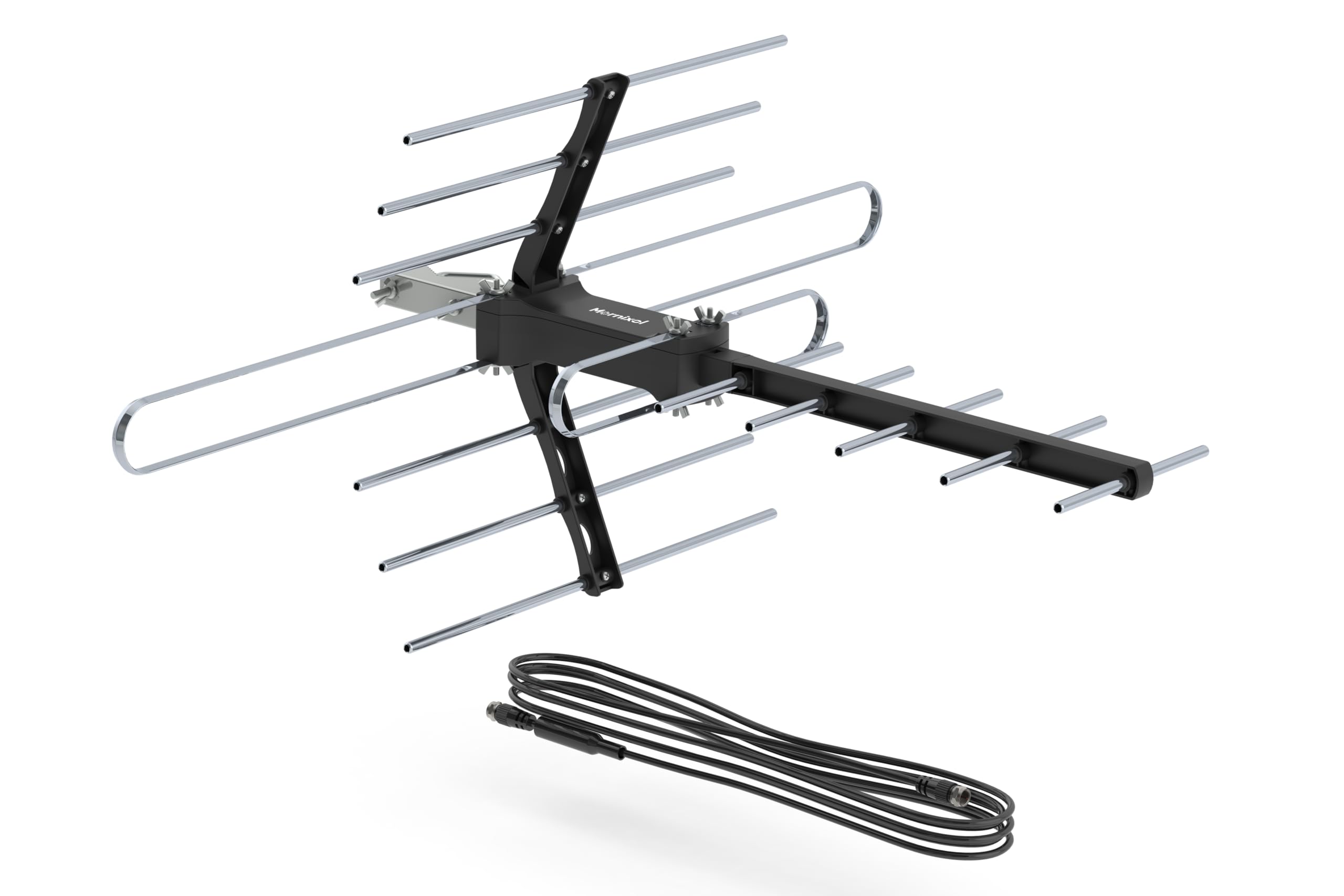
2. Mornixol Outdoor TV Antenna
Four steps, zero tools, and your fingers are all you need.
If the GE’s assembly scared you off, this is the antidote. The Mornixol is rated for 70 miles and sets up in minutes — owners describe loosening wingnuts, swinging out the main elements, attaching three parts, and mounting it to a pole. No drills, no wrenches, no swearing at poorly translated instructions. One buyer pulled in 60 Portland stations from an attic under 20 miles away, and another got usable channels 50 miles out despite aluminum siding.
The all-weather build uses IPX5 waterproof materials (a rating that means it resists water jets, so rain and snow are handled) and anti-UV components for year-round reliability. It ships with a 40ft coaxial cable, which is plenty for routing from a roof peak down to a living room TV.
The catch is quality control. The spec sheet lists 75 ohm impedance (the standard for TV antennas), and 4K/8K compatibility comes via gold-plated connectors that prevent signal loss. But feedback on build quality is mixed — one owner’s unit broke in the first week, so it’s worth handling gently during install.
Best for beginners: the no-tools design is genuinely simple to use for a first-time antenna buyer — you won’t need a drill or a ladder.
The honest caveat: quality is inconsistent, so inspect it carefully on arrival and consider the 1-year warranty your safety net.
Choose this for: a quick attic or balcony install where you value speed over ruggedness.
Think twice if: you need a bombproof unit for extreme weather exposure — the plastic feel won’t inspire confidence.
3. RCA Amplified Indoor Flat HDTV Antenna (ANT1360E)
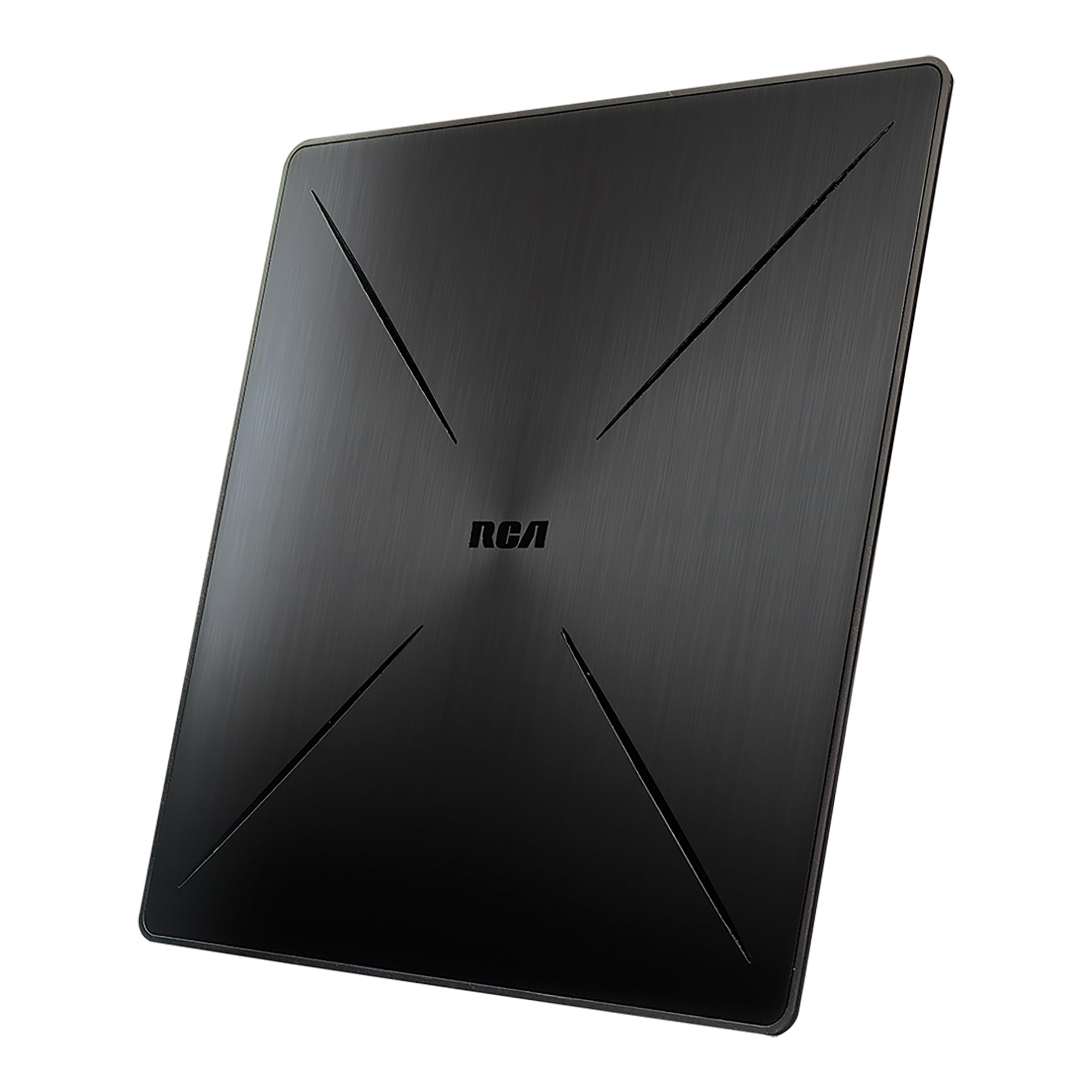
The paintable flat panel that hides on a wall and pulls in the locals.
This is the renters’ and apartment-dwellers’ pick, and it’s the only true indoor option on this list. The RCA is rated for 40 miles (half the GE’s 80-mile reach) and up to 82 channels, with a patented 360° multi-directional design that captures signals from every direction. That means you don’t have to aim it like a rifle — you just hang it, lay it flat, or stand it on the included easel stand.
The key spec here is the amplifier. RCA’s Dual-Stage Amplification with Auto Gain Control boosts weak signals to grab the most channels possible, and it’s powered by a 3-inch USB cable with adapter. It also works as the perfect backup when a storm knocks out cable or satellite — just switch inputs and you’re watching local news again.
The flat profile is paintable, so it blends into the wall, and the included 15-foot coax cable means placement flexibility without an extension. The honest trade-off is that indoor reception is inherently more variable — some owners mention great reception, others struggle, so this is best for homes within a reasonable distance of towers.
Why it fits apartments
- Flat, paint-friendly design hangs discreetly on a wall or lays on a shelf
- Amplified design plus 360° capture removes the need for precise aiming
- Easel stand and 15-foot coax cable are included in the box
Who it frustrates
- Weak-signal areas will see the amplifier struggle — indoor is indoor
- 50 ohm impedance, not the standard 75 ohm, which some setups notice
Grab this for: a clean, rental-friendly install where you want local channels without drilling into walls.
Skip this if: you’re in a rural area beyond 40 miles — you need an outdoor Yagi for that.
4. CeKay Outdoor Yagi HD Antenna

The budget Yagi that outperforms amplified sticks from a basement.
The CeKay is the sleeper hit of this list — a 70-mile, 100-channel Yagi that buyers consistently report works better than its price tag suggests. One owner got 90-100% signal in a basement test, then 100% on all channels plus 30 extra after moving it to the attic. That’s the kind of performance that makes you question why pricier antennas exist.
The all-metal build is designed to withstand heat, rain, wind, and snow, making it genuinely outdoor-rated despite the budget price. It’s NEXTGEN TV (ATSC 3.0) compatible, works across 170-860MHz (the range covering both VHF and UHF broadcast bands), and supports up to 8K resolution for future-proofing. Assembly is mostly pre-done — no tools required — though the arms fit tightly into rubber holders, so a small rubber mallet or hammer helps.
The honest catch is the included RG6 coax cable, which buyers describe as kinked and cheap. It works fine for short runs, but long distances or outdoor exposure may warrant swapping it for a better cable. There’s also a note that the pole connections benefit from a dab of glue for outdoor security.
What impresses owners
- Pulls in over 90 channels with crisp reception, even in a basement test
- All-metal construction rated for extreme weather at a budget price
- ATSC 3.0 ready for next-gen broadcasts
What to plan for
- Included RG6 coaxial cable is low quality — budget for an upgrade
- Outdoor mounting needs extra glue or sealant on the pole connections
Pick this for: a budget-conscious attic install where you want Yagi-grade performance without the premium price.
Reconsider if: you’re doing a permanent outdoor roof mount with extreme wind exposure — the metal is sturdy but not the thickest.
5. Yeceny Digital Outdoor Amplified HD TV Antenna

The motorized rotator that chases channels across the sky from your couch.
If your local towers are scattered in different directions, this is the pick that saves you from climbing a ladder twice. The Yeceny has a built-in 360-degree motor controlled by a wireless remote, so you can point the antenna at one tower cluster, then rotate it toward another from inside your home. Customers note doing exactly that — One owner scanned 12 channels facing one way, rotated southwest, and rescanned to get 80 channels..
The 150-mile range claim is aggressive, but real-world reports of 70+ miles are solid. It also supports dual TV output without a splitter, so you can feed two televisions simultaneously without buying extra hardware. The built-in low-noise amplifier (a device that boosts weak signals) and 40ft RG6 coax cable (a standard TV cable) round out the package, and there’s a lightning protection system for outdoor confidence.
Here’s the honest trade-off: the rotator gets mixed feedback. Some units rotate perfectly, but a notable share of reviewers point out the motor won’t rotate properly, and there are occasional complaints about missing screws in the mounting kit. Buyers also note that the rotation is “blind” — you can’t see which direction the antenna is pointing, so it takes trial-and-error channel scans. It’s a value pick that requires a bit of luck on quality control.
What makes it unique
- Motorized 360° rotation from a wireless remote — no ladder climbing
- Dual TV output without a splitter saves hardware costs
- Strong real-world reception at 70+ miles and 80+ channels
What to watch
- Rotator reliability is inconsistent — some units fail to rotate properly
- Mounting hardware may lack screws, and the mount hole is non-US standard
Ideal for: homes where towers sit in different directions and you want to grab them all without manual adjustments.
Be cautious if: you need a set-and-forget install — the rotator quality variance makes this a gamble.
6. PIBIDI Outdoor TV Antenna (UHD-8903)

The lightweight long-ranger that reaches 80 miles with a booster attached.
For rural viewers, the PIBIDI is the one that beats the distance odds. It’s rated for a huge 200-mile range and 100 channels, with extended-length receiving elements designed for stable, strong signal capture. Buyers in rural areas report pulling in stations about 80 miles away with clear picture quality, and One owner replaced a larger, pricier 15-year-old antenna and saw superior performance on stations 40-100 miles out..
The working frequency split is VHF 170-230MHz and UHF 470-790MHz, covering both broadcast bands, and it’s lightning-protected with grounding done for outdoor installs. Assembly is mostly pre-done — “no tools inquired,” per the listing — and it’s lightweight enough to carry up a ladder single-handed. That ease of installation is a consistent theme in the feedback.
Here’s the honest reality check: the 200-mile rating typically requires an amplifier. One buyer got 3 channels without a booster and 28 with one, showing the 200-mile claim needs amplification. So budget for a separate amplifier if you’re truly in the sticks. And the size gets mixed opinions — some find it too compact, but that small footprint is precisely why it’s so easy to handle.
What rural owners love
- Strong performance at 80 miles out with clear picture quality
- Lightweight design makes ladder work and roof mounting easy
- Covers both VHF and UHF bands for maximum channel compatibility
The honest catch
- The 200-mile range realistically needs an optional signal booster attached
- Compact size surprises some, though it aids handling
Reach for this if: you’re rural, want a lightweight antenna you can manage solo, and are okay adding a booster for full range.
Look elsewhere if: you expect 200 miles straight from the start with zero extra hardware.
7. Five Star Outdoor HDTV Antenna

The multi-TV powerhouse that feeds a whole house from one mount.
This is the biggest, most complete package on the list, designed for homes where multiple TVs need free channels. The Five Star is rated for 200 miles and 100 channels, and it ships with the antenna, mounting bracket, J-pole, and a TV splitter — everything you need to feed up to 4 televisions. Shoppers say up to 128 channels from over 45 miles away, even with mountain obstructions.
It’s ATSC 3.0 ready for next-gen broadcasts, works across both VHF and UHF, and features extended-length elements for stable signal capture. The spec sheet lists the same 75 ohm impedance as the GE, and the larger 46″L x 28″W x 25″H footprint means more surface area for catching weak signals. One owner at 7,300 feet elevation, 46 miles from towers, received 90 channels, 72 crisp.
The honest trade-off is the range reality check: the 200-mile claim is optimistic. Most real-world reports land between 75-90 miles maximum, and a long coax run can degrade a low-power station. But for a whole-home setup where you need to replace satellite, the included splitter and sturdy construction make this the most complete value — just keep the cable run short.
Why it’s the whole-home king
- Included TV splitter feeds up to 4 TVs without extra purchases
- Handles mountain obstructions and delivers 128 channels in real-world tests
- ATSC 3.0 ready with extended-length elements for stable signal
What to know
- Real-world range is 75-90 miles, not the advertised 200
- VHF section alignment is unclear during assembly — screw heads must face the same way
Choose this for: a whole-house install where multiple TVs need reliable free channels from one antenna.
Skip if: you’re in a tight attic with limited space — this footprint is the largest here.
Understanding the Specs
VHF vs. UHF
These are the two broadcast bands. UHF (channels 14-51) is where most stations live today, and VHF (channels 2-13) covers the older, larger channels. The best antennas capture both, so look for “VHF and UHF” explicitly stated — the GE, CeKay, PIBIDI, and Five Star all do.
Range vs. Reality
The “miles” spec assumes perfect line of sight. Trees, hills, and buildings all reduce it. A 200-mile antenna realistically delivers 75-90 miles for most buyers, so use the spec to compare antennas, not as a guarantee of what you’ll get.
FAQ
Do I need a special TV for a 4K antenna?
What does ATSC 3.0 mean for me?
Will a 200-mile antenna work better than an 80-mile one?
Where should I mount my antenna for the best reception?
What is the difference between a Yagi and a flat antenna?
Do I need an amplifier or signal booster?
Why do channels disappear sometimes?
Can one antenna feed multiple TVs?
Final Thoughts: The Verdict
For most buyers, the 4k tv antenna winner is the GE Outdoor Yagi because it pairs a realistic 80-mile range with the most consistent real-world reception across attics and rooftops. If you want the easiest possible setup, grab the Mornixol for its no-tools design. And for a whole-home setup feeding multiple TVs, the Five Star is the one to reach for — the included splitter makes it the most complete package here.
How We Picked
We do not accept paid placement. Every pick is matched to a real buyer and a real use-case; we do not hands-on test units.
Sources & Methodology
Specifications: manufacturer listings and product documentation. Review insights: verified customer reviews, as of August 2026. Pricing: not shown on this page (it changes often); check the current price via the retailer link.
As an Amazon Associate, Gadgets Feed earns from qualifying purchases. This does not affect which products we feature.