
The jump to a 4K Ultrawide OLED monitor is less an upgrade and more a redefinition of what you expect from a display. The inky blacks and per-pixel lighting of OLED eliminate the need for local dimming zones entirely, while the ultrawide 21:9 or 32:9 format replaces multi-monitor setups with a single seamless canvas. The real challenge isn’t finding one — it’s decoding which panel technology, refresh rate, and connectivity stack actually fits your specific workflow or gaming habit.
I’m Min — the co-founder and writer behind Gadgets Feed. After analyzing dozens of OLED panels across price tiers, from QD-OLED color volume to WOLED brightness characteristics and heat management systems, this guide distills what truly separates a smart buy from an expensive mistake.
Whether you prioritize competitive frame rates, professional color accuracy, or cinematic immersion, finding the ideal 4k ultrawide oled monitor means matching the panel’s native strengths to your daily use case without overpaying for features you won’t use.
How To Choose The Best 4K Ultrawide OLED Monitor
Not all OLED monitors are created equal. The panel chemistry, resolution scaling, and heat management directly impact longevity, image quality, and your experience across different content types.
QD-OLED vs. WOLED: Color Volume vs. Brightness
QD-OLED panels use a blue OLED layer with quantum dots to produce red and green, resulting in wider color gamut coverage (often 99% DCI-P3) and higher peak brightness in small highlights. WOLED panels, like those from LG Display, use a white OLED with color filters, which typically offers better sustained full-screen brightness and more robust black levels in bright rooms. For a mixed-use scenario with both gaming and productivity, consider which trade-off matters more to your environment.
Refresh Rate and Response Time
OLED’s inherent 0.03ms response time eliminates motion blur at any refresh rate, but the ceiling matters for competitive titles. A 240Hz panel is already buttery smooth, while Dual-Mode monitors can switch to 480Hz at a lower resolution for esports. For story-driven games and media consumption, 144Hz to 240Hz is more than sufficient and often allows for sharper image quality at native resolution.
Burn-In Mitigation and Warranty
OLED burn-in from static UI elements is a real concern. Look for features like custom heatsinks (ASUS ROG Swift), graphene films, pulsating heat pipes (Samsung Odyssey G8), pixel refresh cycles, and logo/taskbar detection. A warranty that explicitly covers burn-in, often 3 years, provides critical long-term peace of mind.
Quick Comparison
On smaller screens, swipe sideways to see the full table.
| Model | Category | Best For | Key Spec | Amazon |
|---|---|---|---|---|
| ASUS ROG Swift PG32UCDM | Premium | Burn-in resistant gaming | Custom heatsink + graphene, 240Hz | Amazon |
| MSI MPG 321URX QD-OLED | Mid-Range | Best overall 32-inch 4K | 0.03ms GtG, 240Hz, ΔE ≤2 | Amazon |
| Samsung Odyssey G8 (G81SF) | Premium | Glare-free experience | Pulsating Heat Pipe, 240Hz | Amazon |
| LG 34GX90SA-W | Mid-Range | Immersive 21:9 800R curve | 3440×1440, 240Hz, webOS | Amazon |
| LG 32GX870A-B | Premium | Dual-mode 4K/480Hz | MLA+ technology, 1300 nits peak | Amazon |
| LG 39GX90SA-W | Mid-Range | Large curved 39-inch screen | 39″, 3440×1440, 800R curve | Amazon |
| INNOCN 49Q1S | Premium | Super ultrawide 32:9 workhorse | 5120×1440, 240Hz, 90W USB-C | Amazon |
| Alienware AW3225QF | Premium | Iconic QD-OLED design | 32″, 4K, Dolby Vision support | Amazon |
| ASUS ROG Strix OLED XG32UCWMG | Premium | Glossy TrueBlack clarity | 4K@240Hz, FHD@480Hz Dual Mode | Amazon |
| Dell UltraSharp U4025QW | Premium | Professional productivity | 5K2K, 120Hz, IPS Black | Amazon |
| Gigabyte AORUS CO49DQ | Premium | High-end 49-inch ultrawide | 5120×1440, 144Hz, DP2.1 | Amazon |
| Samsung Odyssey Ark Gen 2 | Premium | Massive 55-inch cockpit mode | 55″, 165Hz, QLED, Multi View | Amazon |
In‑Depth Reviews
1. ASUS ROG Swift 32” 4K OLED Gaming Monitor (PG32UCDM)

The ASUS ROG Swift PG32UCDM integrates a custom heatsink with advanced airflow design and graphene film, directly addressing OLED burn-in by managing heat more effectively than standard panels. This 32-inch QD-OLED hits 240Hz at 4K with a 0.03ms response time, and the VESA DisplayHDR True Black 400 certification ensures HDR content retains deep blacks without compromising highlight detail. The Delta E < 2 color accuracy out of the box is exceptional for both gaming and color-sensitive creative work.
Connectivity includes HDMI 2.1, DisplayPort 1.4, and a 90W USB-C port that can power a laptop while carrying video signal. The uniform brightness setting prevents luminance fluctuation in static scenes, which is a common complaint on earlier OLED monitors. DisplayWidget Center lets you tweak OLED Care settings and switch profiles with a mouse, bypassing the clunky on-screen display joystick entirely.
G-Sync Compatible and AMD FreeSync Premium Pro support means tear-free gameplay across both NVIDIA and AMD ecosystems. The 3-year warranty explicitly covers burn-in, removing the anxiety that typically shadows OLED ownership. The glossy screen finish enhances perceived contrast and clarity in controlled lighting, though reflective environments may require careful placement.
Why it’s great
- Custom heatsink + graphene film reduces burn-in risk
- Delta E < 2 color accuracy out of the box
- 90W USB-C PD for laptop charging
- 3-year warranty with burn-in coverage
Good to know
- Glossy finish may reflect ambient light in bright rooms
- Peak brightness varies due to pre-calibration
2. MSI MPG 321URX QD-OLED

The MPG 321URX delivers a 31.5-inch UHD QD-OLED panel with a 240Hz refresh rate and 0.03ms GtG response time, matching the performance of flagships at a more accessible price point. The 10-bit panel covers 99% DCI-P3 with a Delta E ≤ 2, making it equally capable for HDR gaming and photo editing. VESA DisplayHDR True Black 400 certification ensures the per-pixel black levels OLED is known for, without the blooming artifacts of edge-lit LCDs.
OLED Care 2.0 includes pixel refresh, panel protect, and taskbar detection, while MSI Gaming Intelligence AI provides crosshair overlays and Smart Brightness adjustments. KVM support with Picture-in-Picture and Picture-by-Picture means you can control two systems from one keyboard and mouse setup—handy for switching between a gaming PC and a work laptop. The HDMI 2.1 port supports 4K at 120Hz for consoles, and the 90W USB-C port handles both data and charging.
The stand is 4-way adjustable but lacks the premium metal build of pricier competitors. Owners of Mac setups note that running dual monitors requires disabling DSC and locking to DP input at 120Hz for stable operation. The anti-burn-in features and 3-year warranty provide solid peace of mind, making this one of the most balanced OLED options in its class.
Why it’s great
- Excellent price-to-performance ratio for QD-OLED
- KVM with PiP/PbP for dual-PC setups
- 90W USB-C with full video and charging
- 3-year warranty included
Good to know
- Stand build feels less premium than ASUS ROG
- Dual-Monitor setup on Mac requires specific config
3. Samsung 32” Odyssey QD-OLED G8 (G81SF)
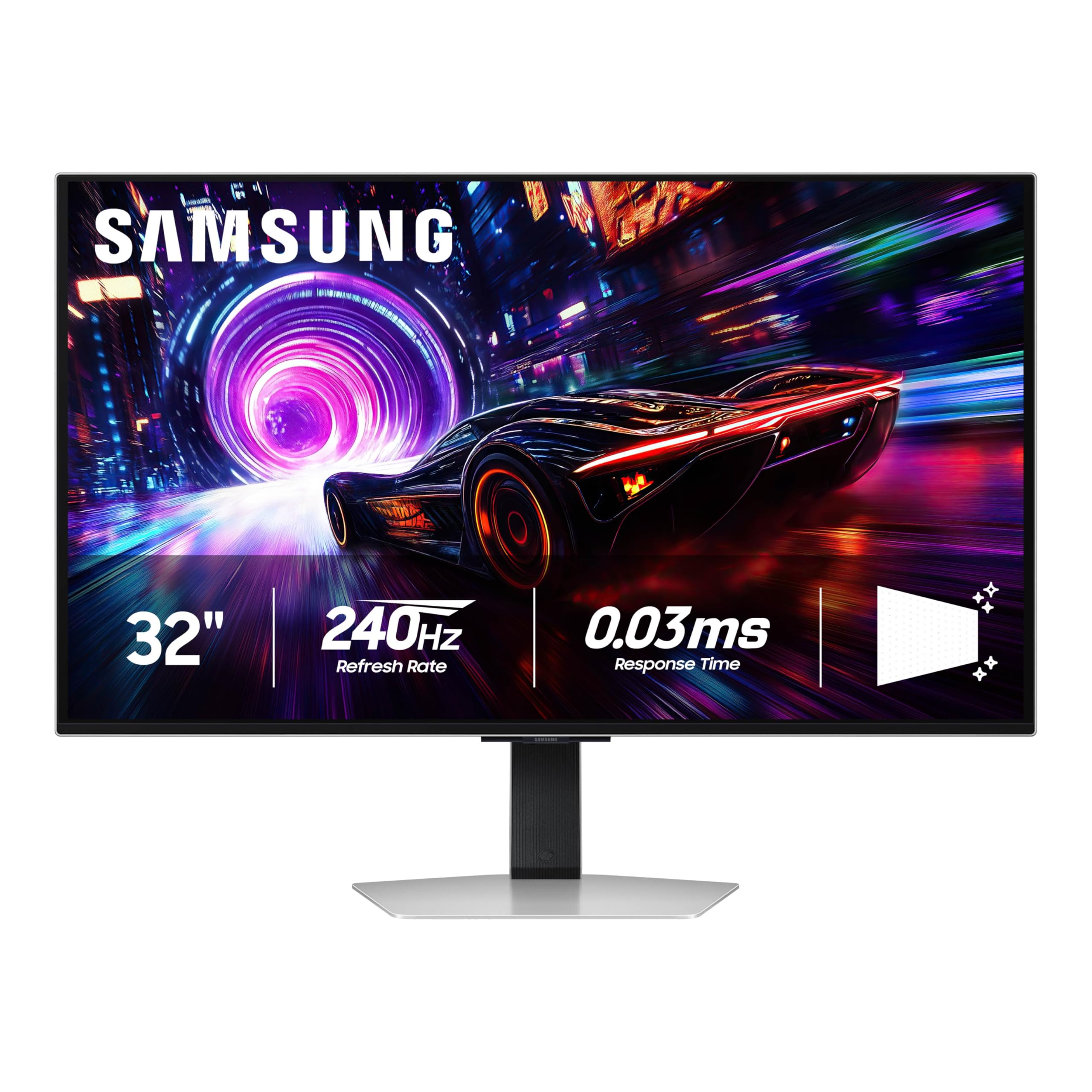
The Odyssey G8 G81SF (2025 model) introduces Samsung’s Glare Free technology, which reduces screen reflections by 54% compared to conventional anti-reflection films, making it one of the best choices for brightly lit rooms. The 32-inch QD-OLED panel runs at 4K with a 240Hz refresh rate and 0.03ms response time, with VESA DisplayHDR True Black 400 guaranteeing rich black levels. The 99% DCI-P3 color gamut ensures vibrant HDR highlights without oversaturation.
Thermal management is handled by a Pulsating Heat Pipe—an industry first for monitors—that diffuses heat five times faster than graphite sheets to reduce the risk of burn-in. A Thermal Modulation System algorithmically controls brightness to prevent overheating, while Logo and Taskbar Detection automatically dims static UI elements. The Dynamic Cooling System is quiet and effective, maintaining consistent brightness during long gaming sessions.
CoreSync and CoreLighting+ project on-screen colors to compatible lighting, and the ergonomic stand offers height, tilt, and swivel adjustments. Some owners report dead pixels within the first few months, though Samsung’s 3-year warranty covers panel defects. The matte finish may appear too aggressive for users who prefer the sharpness of glossy screens, but in bright environments, it’s a net positive.
Why it’s great
- Glare Free coating reduces reflections significantly
- Pulsating Heat Pipe for superior thermal management
- Automatic brightness modulation prevents overheating
- 3-year warranty
Good to know
- Matte finish reduces perceived sharpness vs. glossy
- Some early units reported dead pixels
4. LG 34GX90SA-W 34-inch Ultragear WQHD OLED
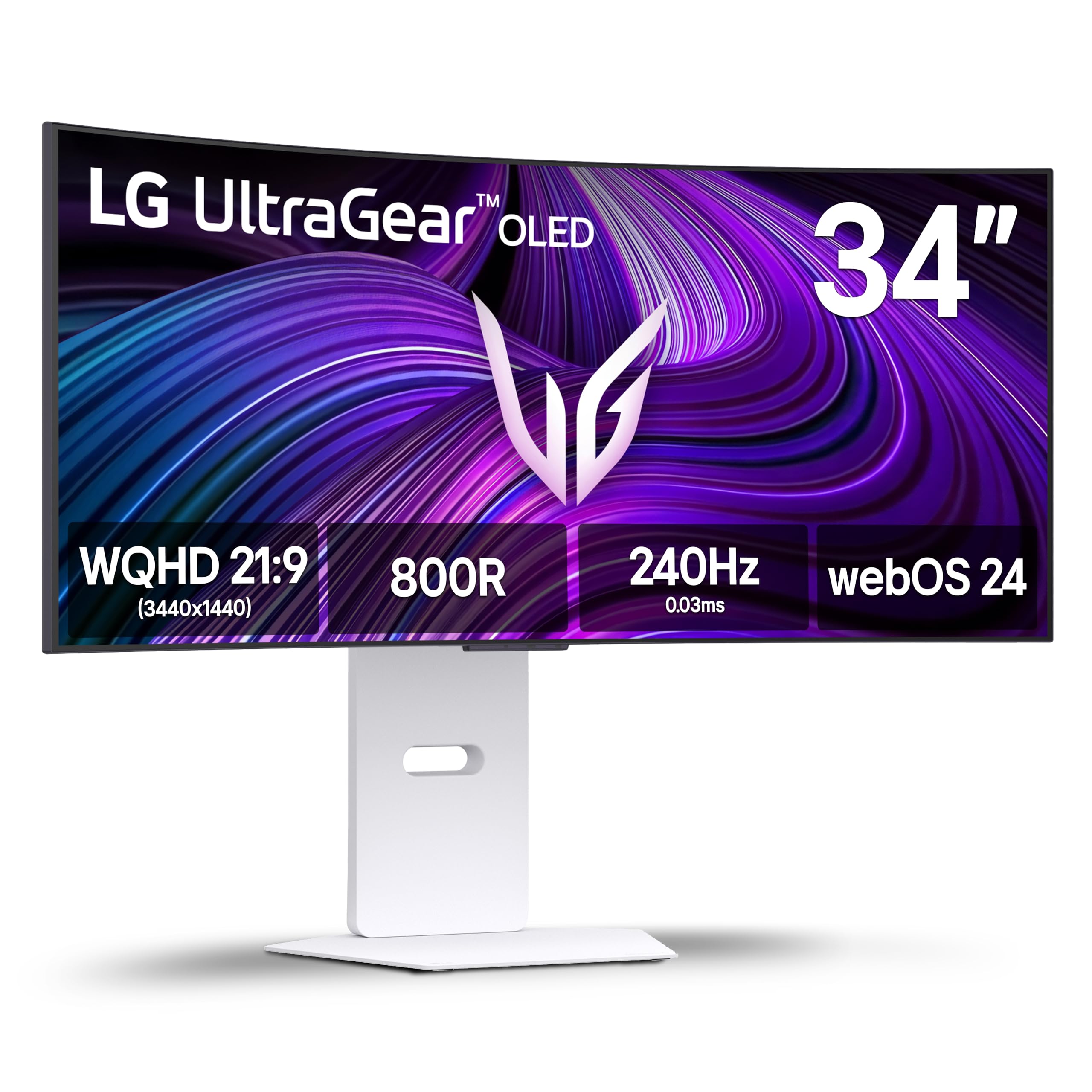
The LG 34GX90SA-W uses a 34-inch WOLED panel with a steep 800R curvature that wraps around your peripheral vision, creating a genuinely immersive field of view for racing sims, flight games, and open-world titles. The native resolution is 3440×1440 (WQHD), which is not true 4K UHD, but the 240Hz refresh rate and 0.03ms response time deliver exceptionally smooth motion. Peak brightness reaches 1300 nits locally, with a 1.5M:1 contrast ratio that makes HDR content pop.
Integrated webOS24 provides direct access to Netflix, Prime Video, Apple TV+, and cloud gaming services like NVIDIA GeForce NOW without needing a connected PC. Dynamic Action Sync reduces input lag, while Black Stabilizer brightens dark scenes for competitive advantage. AMD FreeSync Premium and G-Sync Compatible support ensure tear-free gameplay across console and PC.
Connectivity includes two HDMI 2.1 ports, DisplayPort 1.4, and a USB-C port with 65W power delivery. The anti-glare surface minimizes reflections for darker room setups. Some owners report sleep-mode quirks that require disabling deep sleep in the OSD, and the on-screen interface joystick input switching can feel clunky. The 2-year limited warranty covers the OLED panel but not burn-in explicitly.
Why it’s great
- 800R curve provides extreme peripheral immersion
- webOS24 eliminates need for external streaming devices
- 1300-nit peak brightness for impactful HDR
- 65W USB-C power delivery
Good to know
- WQHD resolution, not 4K UHD
- Sleep-mode issues require firmware/O SD tweaks
5. LG 32GX870A-B 32-inch Ultragear Dual-Mode OLED
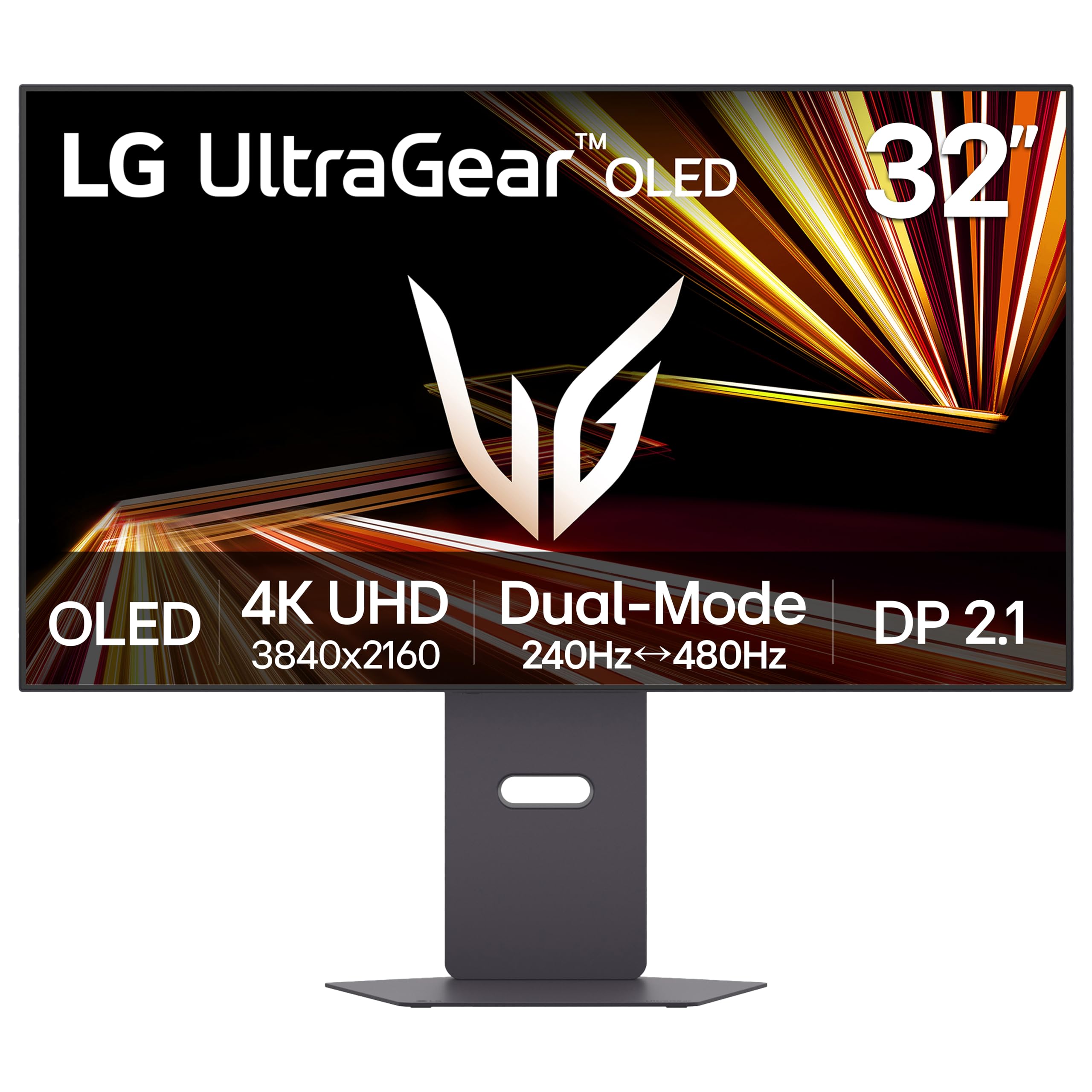
The LG 32GX870A-B is a VESA Certified Dual-Mode gaming monitor that switches between native 4K UHD at 240Hz and Full HD at 480Hz with a simple hotkey, allowing you to prioritize resolution in story-driven titles and frame rate in fast-paced shooters. The WOLED panel uses Micro Lens Array+ (MLA+) technology to push typical brightness to 275 nits and peak brightness to 1300 nits, addressing the common complaint of OLED dimness in bright scenes. VESA DisplayHDR True Black 400 and a 1.5M:1 contrast ratio ensure deep blacks with bright specular highlights.
The 0.03ms response time eliminates ghosting at any refresh rate, and the monitor is officially validated as G-Sync Compatible with AMD FreeSync Premium Pro for tear-free variable refresh support. The anti-glare / low reflection coating works well in moderately lit rooms without the haze of heavy matte finishes. Built-in speakers are loud and clear for a monitor, with DTS Headphone:X for immersive 3D audio over the 4-pole headphone jack.
Connectivity includes HDMI 2.1 and DisplayPort 2.1, the latter providing enough bandwidth for full 4K 240Hz without display stream compression. The Switch app allows splitting the screen into up to 6 sections for multitasking. Some users report initial vertical banding that clears after a few heat cycles, and the matte coating appears slightly grainy on solid white backgrounds. The 2-year warranty covers the OLED panel.
Why it’s great
- Dual-Mode: 4K@240Hz or FHD@480Hz instantly
- MLA+ technology boosts peak brightness to 1300 nits
- DisplayPort 2.1 for uncompressed 4K 240Hz
- Excellent built-in speakers with DTS Headphone:X
Good to know
- Matte coating can look grainy on white backgrounds
- Initial vertical banding may appear
6. LG 39GX90SA-W 39-inch Ultragear WQHD OLED
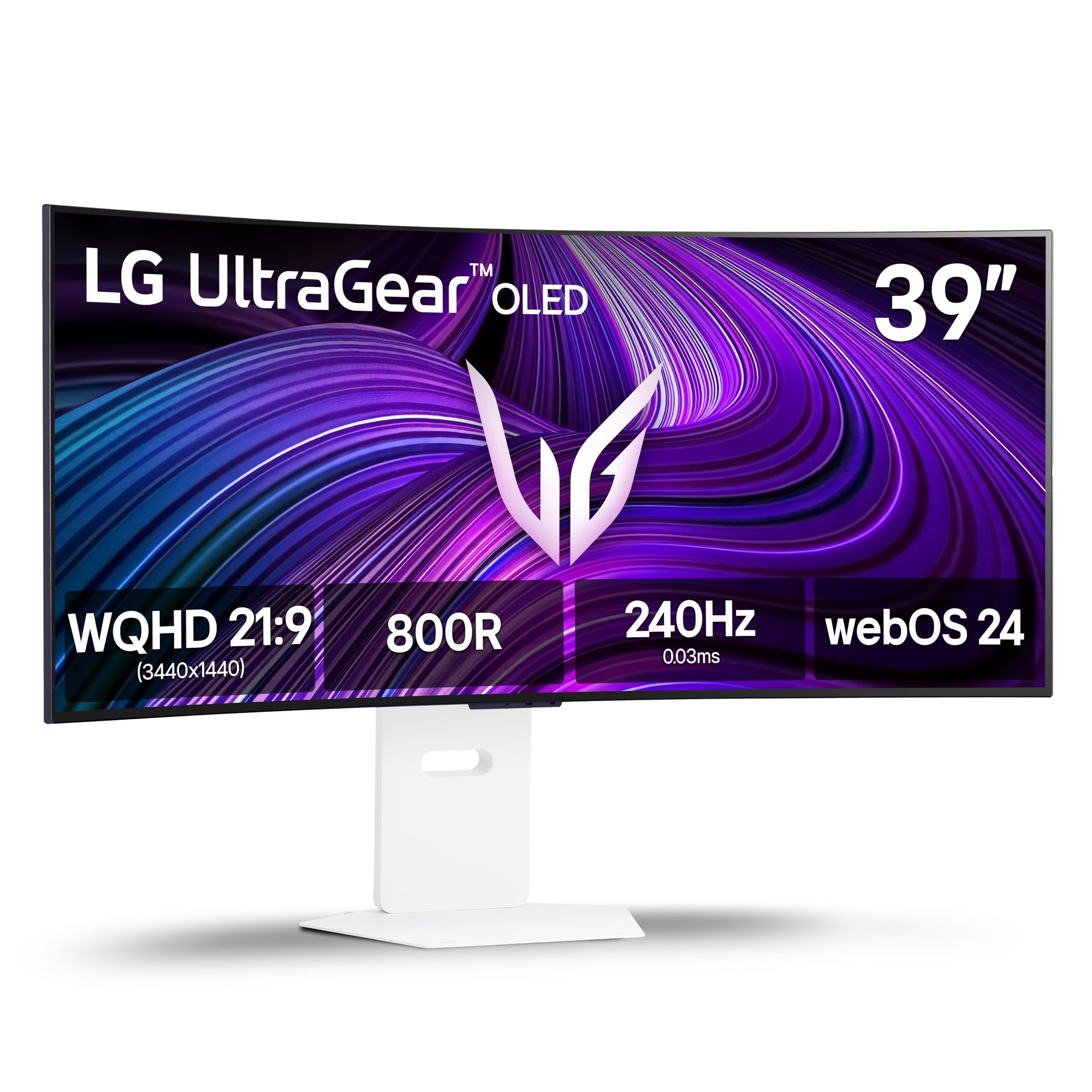
The LG 39GX90SA-W is the bigger sibling of the 34-inch model, offering a 39-inch WOLED display with the same 800R curvature and WQHD (3440×1440) resolution. The larger size stretches immersion further into your periphery while maintaining the same 240Hz refresh rate, 0.03ms response time, and 1300-nit peak brightness. The 1.5M:1 contrast ratio and 98.5% DCI-P3 coverage make it superb for both gaming and cinematic content.
webOS24 integration gives you built-in streaming and cloud gaming, with AI Picture and AI Sound optimization tools that automatically adjust settings based on content. Dynamic Tone Mapping and AI Personalized Picture Wizard fine-tune brightness and color without manual calibration. The USB-C port delivers 65W charging to a connected laptop, and the anti-glare surface handles ambient light reasonably well for a curved panel.
Some owners note that the aggressive curve can take a day or two to adjust to for desktop productivity, and the joystick-controlled input switching remains clunky across LG’s firmware. Sleep-mode issues require disabling deep sleep on some systems. The 2-year limited warranty covers the panel, making it a solid pick for large-screen immersive gaming without jumping to 49-inch super ultrawide territory.
Why it’s great
- 39-inch panel is huge without being unmanageable
- Deep 800R curve for unmatched immersion
- AI-powered picture and sound optimization via webOS
- 65W USB-C power delivery
Good to know
- Aggressive curve may feel unnatural for desktop work
- Sleep-mode issues persist across LG OLED monitors
7. INNOCN 49Q1S 49-inch OLED Curved Gaming Monitor

The INNOCN 49Q1S is a 49-inch super ultrawide with a 32:9 aspect ratio and 5120×1440 resolution, effectively replacing two 27-inch monitors without a bezel gap. The OLED panel delivers a 240Hz refresh rate and 0.03ms response time for fluid gaming. DisplayHDR 400 and a 1,000,000:1 contrast ratio ensure deep blacks and bright highlights, while the 1800R curvature reduces eye strain during long sessions by allowing the eyes to maintain a consistent focal distance.
Connectivity is a standout feature: two DisplayPort 1.4, one HDMI 2.1, USB-C with 90W power delivery, a USB hub with two USB-A ports, USB-B upstream, RJ45 ethernet, and a 3.5mm audio jack. The PiP/PbP mode allows displaying content from two separate sources simultaneously, which is ideal for streaming while gaming or running a Mac and PC side by side. The built-in 2x10W speakers are adequate for casual use.
Some owners report app compatibility issues where certain programs display tiny or misaligned text, and a small number of units fail within the first few months. The glossy screen finish delivers excellent image depth but may require careful placement to avoid reflections. INNOCN’s customer service has been noted as responsive for replacement requests.
Why it’s great
- 32:9 49-inch replaces dual monitors seamlessly
- 90W USB-C with RJ45 for dock-like connectivity
- PiP/PbP for dual-PC and streaming setups
- 240Hz OLED at a competitive super ultrawide price
Good to know
- Some apps have scaling and alignment issues
- Long-term reliability reports are mixed
8. Alienware AW3225QF 32-inch 4K QD-OLED
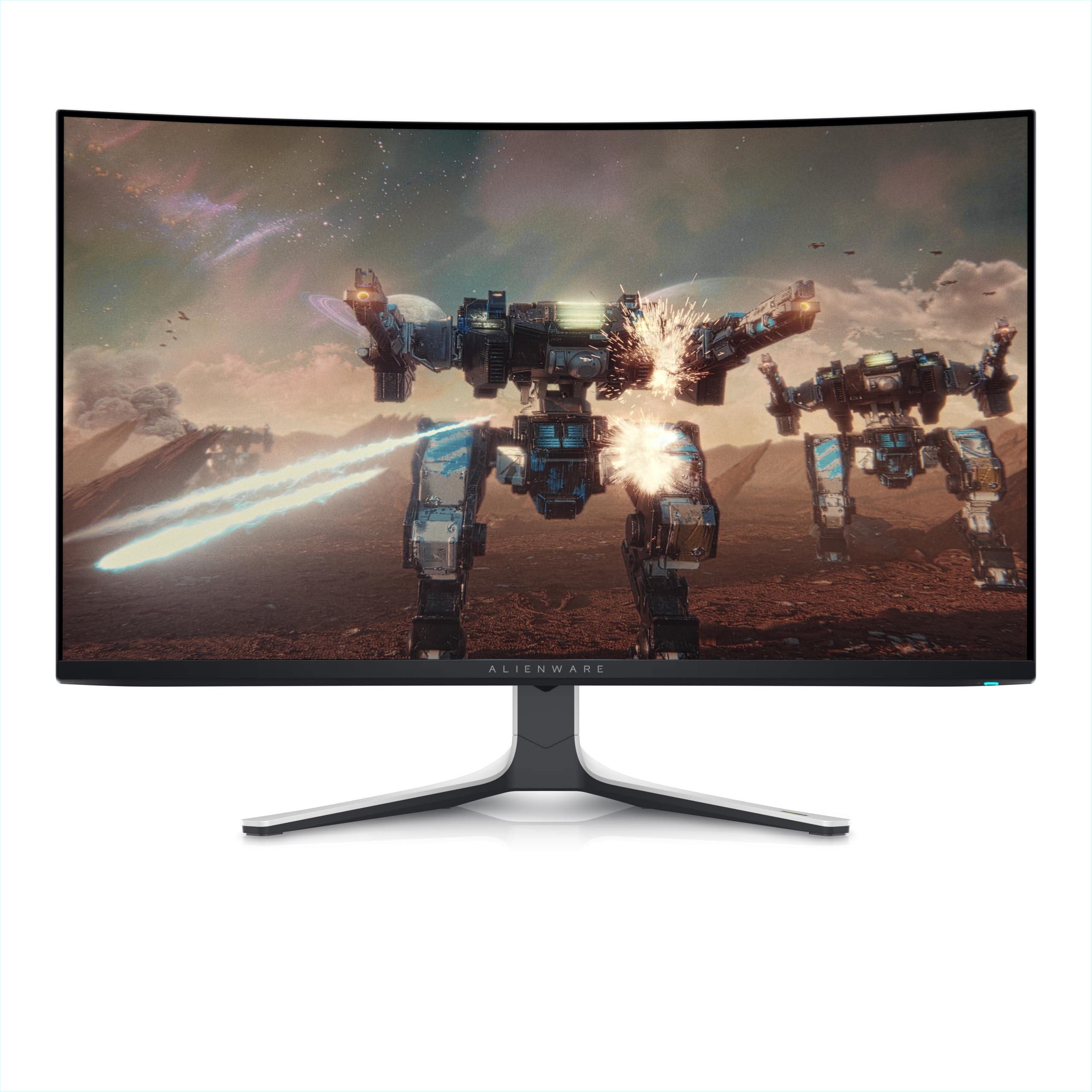
The Alienware AW3225QF brings Dell’s industrial design to a 32-inch QD-OLED panel with 4K resolution and a 240Hz refresh rate. The standout feature is Dolby Vision support, which provides superior dynamic metadata for HDR movies and games, ensuring each scene is optimally tone-mapped. The 12-bit color processing (via 10-bit + FRC) pushes over a billion colors, making this a strong contender for both gaming and high-end media consumption.
Connectivity includes DisplayPort 1.4 with DSC, HDMI 2.1, and USB 3.2 Gen 1 ports. The stand offers tilt, swivel, and height adjustment with the distinctive Alienware aesthetic. Anti-burn-in features include pixel refresh and panel conditioning, automatically triggered during standby. The 3-year warranty covers burn-in, which is a critical differentiator for buyers concerned about longevity.
Owners universally praise the image quality and infinite contrast, with some noting that HDR on this monitor is among the best they’ve experienced for both games and movies. The main limitation is the lack of a built-in KVM or USB-C with high power delivery, so laptop users will need a separate hub. The design is polarizing, but the performance is undeniable for those who prioritize color accuracy and HDR impact.
Why it’s great
- Dolby Vision support for superior HDR tone mapping
- 12-bit color processing for rich gradients
- 3-year burn-in warranty included
- Exceptional build quality and design
Good to know
- No USB-C PD for laptop charging
- No built-in KVM for multi-PC setups
9. ASUS ROG Strix OLED XG32UCWMG
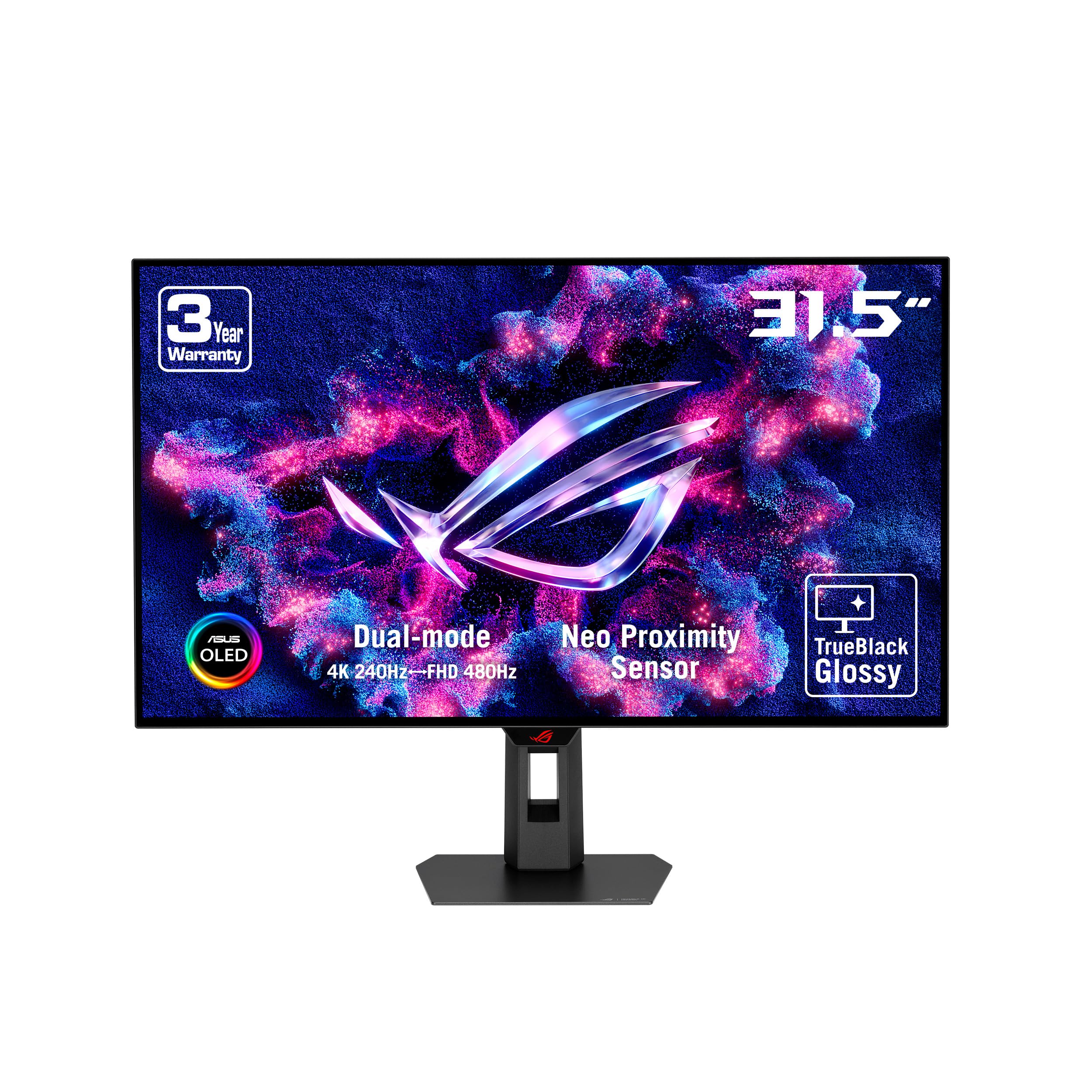
The ASUS ROG Strix OLED XG32UCWMG adopts a glossy TrueBlack WOLED panel that delivers a veil-free surface with exceptional sharpness and contrast, avoiding the haze that plagues matte OLED coatings. The Dual-Mode functionality allows switching from 4K at 240Hz to Full HD at 480Hz, giving you flexibility between single-player visuals and competitive esports responsiveness. The 0.03ms response time ensures no perceivable motion blur at any refresh rate.
ASUS OLED Care Pro includes a Neo proximity sensor that detects when the user walks away and automatically switches to a black screen to reduce static burn-in risk. DisplayWidget Center allows mouse-based adjustments for OLED Care features, saving you from navigating the OSD. Connectivity includes DisplayPort 1.4 with DSC, HDMI 2.1, and USB-C with 15W charging.
The glossy coating significantly enhances perceived contrast in moderate lighting, though reflections can be distracting in direct light. Some owners report that the NEO-Proximity sensor takes up to 3 minutes to trigger standby when you leave, limiting its practical value. The firmware update process requires a USB-B cable and is reportedly finicky, requiring multiple attempts.
Why it’s great
- Glossy TrueBlack panel delivers best-in-class contrast
- Dual-Mode: 4K@240Hz or FHD@480Hz
- Neo proximity sensor for automatic burn-in protection
- VESA DisplayHDR True Black 400 certified
Good to know
- Firmware updates require a finicky USB-B cable
- Proximity sensor trigger time is long (3 minutes)
10. Dell UltraSharp U4025QW 40-inch 5K2K

The Dell UltraSharp U4025QW is a 40-inch 5K2K (5120×2160) ultrawide with a 21:9 aspect ratio, but it uses IPS Black technology rather than OLED. While it doesn’t achieve the per-pixel blacks of OLED, its 2000:1 contrast ratio is twice that of standard IPS panels, delivering far better shadow detail for professional color-grading and spreadsheet work. The 120Hz refresh rate and 5ms response time make it usable for light gaming but not competitive esports.
The primary appeal is the built-in KVM hub with Thunderbolt 4, Ethernet, multiple USB, HDMI, and DisplayPort connections, allowing seamless switching between two PCs. The 600-nit brightness provides excellent visibility in bright offices, and the anti-glare coating is effective. The 99% DCI-P3 and 99% sRGB coverage deliver professional-grade color accuracy.
Dell’s premium build includes height, tilt, swivel, and pivot adjustments, along with a compact footprint despite the large screen. Some owners note the plastic chassis feels less premium at this price point than the metal construction of competing professional monitors. The lack of OLED’s infinite contrast is evident in dark room scenes, but in a well-lit office environment, the IPS Black panel is more practical than any OLED.
Why it’s great
- Native 5K2K resolution provides massive screen real estate
- Integrated Thunderbolt 4 hub with KVM switching
- IPS Black technology for 2000:1 contrast without burn-in risk
- 600-nit brightness for bright office environments
Good to know
- Not true OLED; contrast is good but not infinite
- Plastic chassis feels less premium at this price
11. Gigabyte AORUS CO49DQ 49-inch OLED

The Gigabyte AORUS CO49DQ is a 49-inch QD-OLED ultrawide with a 32:9 aspect ratio and 5120×1440 resolution, offering the massive screen real estate of two 27-inch monitors. The 144Hz refresh rate is lower than the 240Hz options on this list, but for simulation games and productivity, the broader field of view often outweighs the need for higher frame rates. The 0.03ms response time still eliminates motion blur at any frame rate.
AMD FreeSync Premium Pro and G-Sync Compatible support ensure tear-free gameplay. The 250-nit typical brightness is on the lower side for OLED, but the 1,500,000:1 dynamic contrast ratio ensures deep blacks. Connectivity includes DisplayPort 1.4, HDMI 2.1, and a USB hub. The Gigabyte Control Center software allows easy settings adjustments from the desktop, including split-screen profiles for multitasking.
Some owners report flickering on black backgrounds with white text, and the brightness level is noticeably lower than newer OLED panels. The stand offers limited height adjustment and no rotation, so a monitor arm is recommended for optimal ergonomics. The fanless design means zero noise, but thermal management relies on the monitor’s passive cooling fins.
Why it’s great
- 49-inch QD-OLED is ideal for simulations and productivity
- FreeSync Premium Pro and G-Sync Compatible
- Gigabyte Control Center for easy settings management
- Zero fan noise with passive thermal design
Good to know
- 144Hz refresh rate is lower than competitors
- 250-nit typical brightness is relatively dim
12. Samsung 55″ Odyssey Ark 2nd Gen

The Samsung Odyssey Ark 2nd Gen redefines what a monitor can be: a 55-inch 1000R curved display that rotates into Cockpit Mode (vertical orientation) for a completely different gaming perspective. However, it uses Quantum Mini-LED (QLED) rather than OLED, so it lacks the per-pixel black levels of true OLED. The 4K resolution at 165Hz with a 1ms response time is respectable, but the mini-LED backlight has local dimming zones (rather than infinite contrast) that can still produce blooming in extreme scenes.
The 4-Input Multi View system can display up to four sources simultaneously on a single screen, including consoles, PCs, and built-in apps. The 60W 2.2.2-channel speaker system with Dolby Atmos delivers immersive audio with 45Hz bass extension, eliminating the need for a separate soundbar. The Neural Quantum Processor Ultra upscales lower-resolution content to 4K quality via 20 neural networks.
The sheer weight (~100 lbs) and assembly complexity mean this is a permanent fixture, not something you rearrange. Connectivity includes one DisplayPort, multiple HDMI 2.1 ports, and a USB hub. Some owners report One Connect Box reliability issues and Samsung’s warranty support as inconsistent. For users who can manage the size and weight, the immersive experience is unmatched by any other monitor, but it is not a pure OLED.
Why it’s great
- 55-inch 1000R curve with Cockpit Mode rotation
- 4-Input Multi View for multiple devices
- Powerful 60W Dolby Atmos speaker system
- Neural Quantum Processor for upscaling
Good to know
- QLED mini-LED, not true OLED — blooms in high contrast
- Extremely heavy (~100 lbs) and difficult to assemble
FAQ
How can I reduce burn-in risk on my 4K OLED gaming monitor?
Is a glossy OLED screen better than a matte one for gaming?
What is the real-world difference between 240Hz and 480Hz on an OLED?
Why do some ultrawide monitors have a 3440×1440 resolution instead of 3840×2160?
Can I use a 4K OLED monitor for professional photo and video editing?
Final Thoughts: The Verdict
For most users, the 4k ultrawide oled monitor winner is the MSI MPG 321URX QD-OLED because it delivers flagship 240Hz performance and QD-OLED color volume at a price that doesn’t punish the wallet. If you want top-tier burn-in protection with a custom heatsink and graphene film, grab the ASUS ROG Swift PG32UCDM. And for a massive ultra-immersive super ultrawide that replaces a multi-monitor setup, nothing beats the INNOCN 49Q1S.