
Choosing a 4K video camera today means navigating a maze of sensor sizes, codecs, stabilization systems, and lens mounts, where a bad decision can lock you into subpar footage for years. The difference between a camera that delivers cinematic depth and one that produces flat, noisy video often comes down to a single spec sheet number most beginners overlook: the physical size of the image sensor.
I’m Min — the co-founder and writer behind Gadgets Feed. I’ve spent hundreds of hours analyzing technical specifications, cross-referencing real-world sample footage, and verifying performance claims across every major 4K camera release to identify which models genuinely deliver professional-grade results versus those that rely on marketing hype.
After thoroughly reviewing the sensor performance, autofocus reliability, stabilization effectiveness, and codec options of the top contenders, I’ve curated this definitive guide to help you confidently select the ideal best 4k video camera for your specific shooting needs and budget.
How To Choose The Best 4K Video Camera
Selecting a 4K video camera requires balancing sensor technology, codec quality, stabilization, and autofocus against your specific shooting environment, whether that’s controlled studio work, unpredictable outdoor events, or fast-moving vlogging.
Sensor Size and Low-Light Performance
The physical dimensions of the sensor — from the 1/2.5-inch chips found in traditional camcorders to the 1-inch sensors in pocket cameras and the larger APS-C or Micro Four Thirds sensors in mirrorless bodies — dictate how much light the camera can capture. A larger sensor generally produces cleaner footage at higher ISO settings, smoother bokeh transitions, and better dynamic range, making it essential for serious filmmaking or dimly lit environments.
Codec and Color Depth
Recording formats such as 4:2:0 8-bit versus 4:2:2 10-bit determine how much color information is retained and how much flexibility you have in post-production. Higher bit depths prevent banding in skies or gradients and allow for aggressive color grading without introducing artifacts. Cameras offering 10-bit internal recording or raw output are preferred for professional workflows.
Stabilization Technology: Mechanical vs Digital
Optical or mechanical image stabilization (OIS/IBIS) physically moves the lens or sensor to counteract shake, preserving sharpness without cropping the frame. Digital stabilization applies a software crop and can introduce jitter or resolution loss. For handheld shooting without a gimbal, cameras with effective optical or in-body stabilization drastically improve usable footage.
Autofocus System: Phase Detection vs Contrast Detection
Phase detection autofocus (PDAF) points cover more of the frame and respond faster to moving subjects, making it critical for tracking faces, animals, or objects during video recording. Contrast detection systems often hunt and pulse in video mode, leading to distracting focus pulls. Cameras with robust PDAF capabilities provide reliable focus in challenging scenarios.
Quick Comparison
On smaller screens, swipe sideways to see the full table.
| Model | Category | Best For | Key Spec | Amazon |
|---|---|---|---|---|
| DJI Osmo Pocket 3 Creator Combo | Handheld Gimbal | Vloggers & Travelers | 1″ CMOS, 4K/120fps, 3-Axis Stabilization | Amazon |
| Sony Alpha ZV-E10 | Mirrorless | Vloggers & Creators | APS-C 24.2MP, 4K Oversampled from 6K | Amazon |
| Sony FDR-AX43 Handycam | Camcorder | Family Events & Travel | Balanced OIS, 20x Optical Zoom | Amazon |
| Blackmagic Pocket Cinema Camera 4K | Cinema Camera | Indie Filmmakers | MFT Sensor, 13 Stops DR, Raw Internal | Amazon |
| Canon VIXIA HF G70 | Camcorder | Live Streaming & Events | UVC Livestreaming, 20x Optical Zoom | Amazon |
| Blackmagic Studio Camera 4K Plus G2 | Studio Camera | Live Production | 12G-SDI, 7″ LCD, Dual Native ISO | Amazon |
| Panasonic HC-X2 | Professional Camcorder | News & Documentary | 1″ Sensor, 20x Zoom, 4K 60p 10-bit | Amazon |
| OBSBOT Tail Air | PTZ Camera | Streaming & Worship | AI Tracking, NDI, 320° Pan | Amazon |
| FoMaKo K600N | PTZ Camera | Multi-Camera Broadcast | 4K 60fps NDI HX3, 20x Zoom | Amazon |
| Canon EOS R100 | Mirrorless | Beginner Photography | APS-C 24.1MP, 4K 24fps, Dual Pixel AF | Amazon |
| Panasonic LUMIX FZ80D | Bridge Camera | Long-Range Shooting | 60x Optical Zoom, 20-1200mm Lens | Amazon |
In‑Depth Reviews
1. DJI Osmo Pocket 3 Creator Combo

The DJI Osmo Pocket 3 redefines pocketable filmmaking with its 1-inch CMOS sensor that records 4K resolution at up to 120 frames per second, delivering slow-motion capability and superior low-light performance that typical action cameras cannot match. Its 3-axis mechanical stabilization system physically isolates the camera module from hand shake, eliminating the need for an external gimbal and producing gimbal-smooth footage directly out of the box.
The 2-inch rotatable touchscreen enables seamless switching between horizontal and vertical framing for social media content, while ActiveTrack 6.0 keeps subjects centered during dynamic movement. The Creator Combo bundles the DJI Mic 2 transmitter, a wide-angle lens, battery handle, mini tripod, and carrying bag, providing everything a mobile creator needs for all-day shooting.
With D-Log M and 10-bit color depth support, the Pocket 3 captures over one billion colors for professional-grade grading in post-production. The integrated stereo microphone captures immersive audio, and the device connects directly to DJI Mic 2 transmitters for wireless voice capture up to 250 meters away, making it the most complete compact 4K video solution available.
Why it’s great
- Exceptional 3-axis mechanical stabilization rivals dedicated gimbals
- 1-inch sensor provides clean low-light footage and natural bokeh
- Rotatable screen enables instant vertical video without cropping
Good to know
- Battery is internal and not user-swappable without power bank
- Digital zoom limited to 2x before quality degrades
2. Sony Alpha ZV-E10
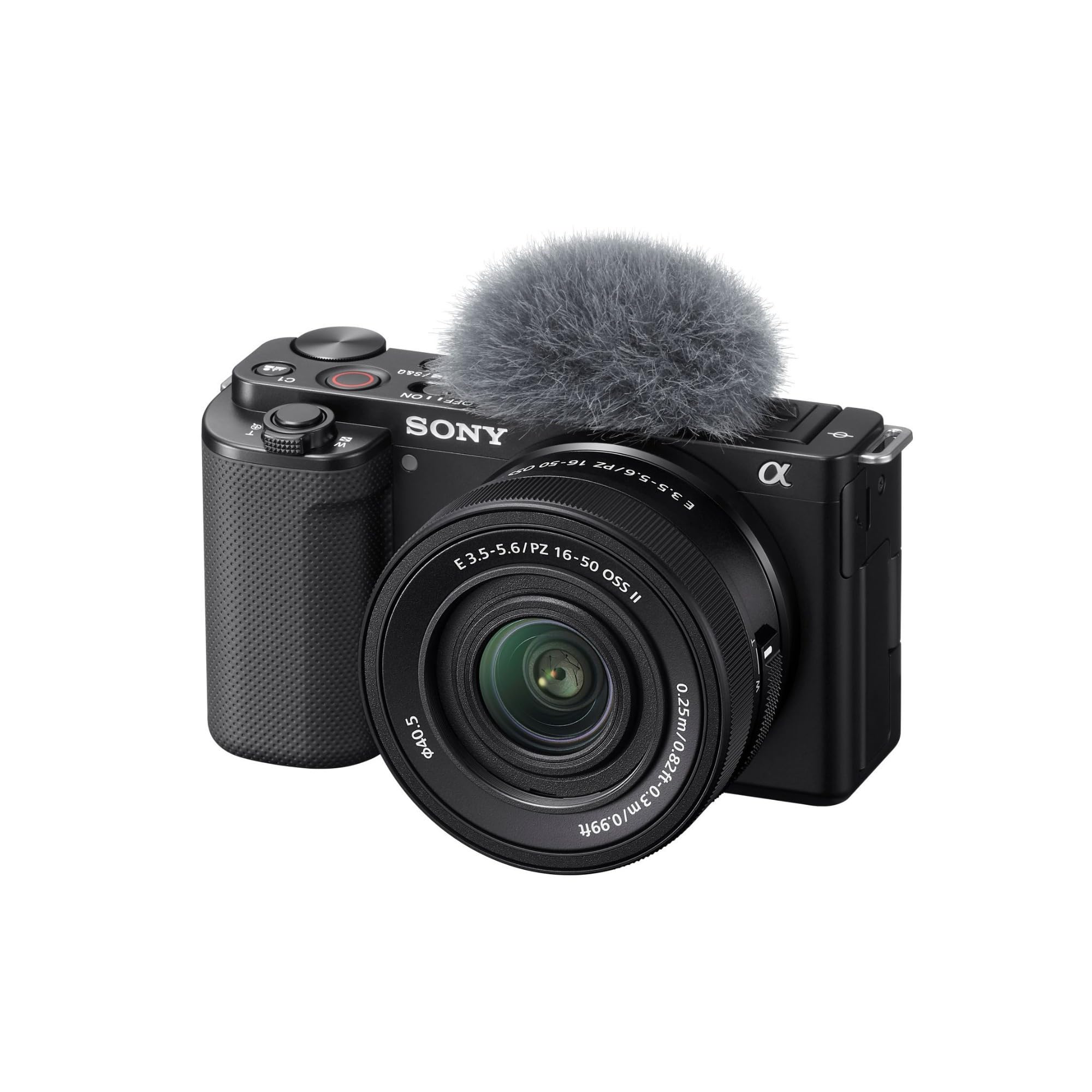
The Sony ZV-E10 leverages a 24.2-megapixel APS-C Exmor CMOS sensor paired with the BIONZ X processor to capture 4K video oversampled from a 6K full-pixel readout, resulting in exceptional sharpness and reduced moiré artifacts without pixel binning. This oversampling technique ensures that every 4K frame retains maximum detail from the larger sensor area, giving videographers a noticeable advantage over cameras using traditional line-skipping methods.
Designed specifically for content creators, the ZV-E10 features a Product Showcase Setting that smoothly transitions focus from a face to a held object, and a Background Defocus button that instantly toggles between a shallow depth-of-field effect and a fully sharp background. The 425-point phase detection autofocus system delivers reliable human eye and face tracking during video, making it ideal for solo vloggers who cannot monitor focus manually.
The kit includes the Sony E PZ 16-50mm F3.5-5.6 OSS II power zoom lens, which provides optical stabilization and a versatile focal range for everyday shooting. USB streaming capability allows the camera to function as a high-quality webcam without additional capture hardware, bridging the gap between traditional video production and live content delivery.
Why it’s great
- Oversampled 4K from 6K readout produces exceptionally sharp video
- 425-point phase detection AF ensures reliable subject tracking
- Product showcase mode simplifies focus transitions for demonstrations
Good to know
- Kit lens aperture range limited to F3.5-5.6 for low-light work
- No in-body image stabilization; relies on lens OIS
3. Sony FDR-AX43 UHD 4K Handycam

The Sony FDR-AX43 is a dedicated camcorder built around a 1/2.5-inch Exmor R CMOS sensor optimized for 4K video, and it sets itself apart with its Balanced Optical SteadyShot image stabilization system that physically floats the lens and sensor assembly to counteract shake without digital cropping. This gimbal-like mechanism operates silently and effectively, producing stabilized handheld footage at full optical zoom ranges where typical mirrorless cameras would struggle.
The 20x optical zoom extends to 30x Clear Image Zoom in 4K and 40x in HD, giving videographers significant reach for events, wildlife, or sports without sacrificing resolution. Fast Intelligent AF tracks subjects continuously during recording, while the 26.8mm wide-angle ZEISS Vario-Sonnar T lens captures expansive establishing shots before zooming into the action.
Built-in Wi-Fi and NFC enable wireless remote control via smartphone, and the Highlight Movie Maker automatically compiles short clips into shareable segments. The large battery supports extended recording sessions, and the camcorder body includes a mic input for external audio, making it a practical all-in-one solution for family events and travel documentation.
Why it’s great
- Balanced Optical SteadyShot delivers gimbal-like stabilization at full zoom
- 20x optical zoom provides massive reach for distant subjects
- Dedicated camcorder form factor optimized for extended handheld recording
Good to know
- 1/2.5-inch sensor limits low-light performance compared to larger sensors
- Date and time settings reset quickly after battery removal
4. Blackmagic Pocket Cinema Camera 4K Power Bundle

The Blackmagic Pocket Cinema Camera 4K (BMPCC 4K) is a purpose-built cinema camera featuring a 4/3-inch image sensor with a native 4096×2160 resolution that captures 13 stops of dynamic range, enabling filmmakers to retain detail in shadows and highlights simultaneously. Its dual native ISO of 400 and 3200, expandable to 25,600, minimizes noise across a wide sensitivity range, making it viable for shooting in challenging lighting conditions without excessive grain.
This camera records internally in Blackmagic RAW and Apple ProRes formats up to 4K DCI, with 12-bit color depth that provides extreme flexibility for color grading in post-production. The active Micro Four Thirds lens mount supports a vast ecosystem of affordable and vintage glass via adapters, while the built-in 5-inch LCD touchscreen offers precise focus peaking and monitoring without requiring an external display.
The Power Bundle includes three LP-E6 batteries, a dual charger, and a microfiber cloth, ensuring extended shooting sessions are feasible. Recording options span SD/UHS-II, CFast 2.0, and external USB-C SSD storage, giving cinematographers redundant backup paths during critical productions. The included DaVinci Resolve Studio activation key unlocks professional editing and color grading tools out of the box.
Why it’s great
- 13 stops of dynamic range and 12-bit raw capture for cinema-grade grading
- Dual native ISO up to 25,600 ensures clean low-light performance
- Active MFT mount adapts to nearly any lens system
Good to know
- Battery life is short; external power solutions are recommended for all-day shoots
- No in-body stabilization; relies on gimbals or tripods for smooth footage
5. Canon VIXIA HF G70 Camcorder

The Canon VIXIA HF G70 combines a 1/2.3-inch 4K UHD CMOS sensor with the DIGIC DV 6 image processor to deliver sharp 4K video at 30fps, supported by a powerful 20x optical zoom lens that extends to 800x digital zoom for extreme reach. The 8-blade aperture creates cinema-style circular out-of-focus highlights, adding aesthetic depth to interview backgrounds and event coverage that typical camcorders lack.
UVC (USB Video Class) livestreaming capability allows the HF G70 to function as a plug-and-play webcam over USB, streaming HD video directly to a PC or Mac without capture cards or additional software. This feature, combined with the Hybrid AF system and face detection, makes it exceptionally practical for church services, corporate events, and educational live streams where simplicity and reliability are paramount.
On-Screen Display (OSD) time stamp recording embeds date, time, and timecode data directly into the original camera files, a critical feature for evidence, documentation, or archival purposes. The dual SD card slots provide hot-swappable redundancy, and the adjustable focusing speeds give operators precise control over pull-focus transitions during recording.
Why it’s great
- UVC streaming enables direct HD livestreaming without capture hardware
- 20x optical zoom with Hybrid AF ensures sharp tracking at range
- Dual SD slots and OSD time stamp features suit professional documentation
Good to know
- Low-light performance degrades noticeably above ISO gain of 4
- HDMI output limited to 1080p, not 4K pass-through
6. Blackmagic Studio Camera 4K Plus G2

The Blackmagic Studio Camera 4K Plus G2 is engineered for live production environments, featuring a cinematic 4K sensor with dual native ISO of 400 and 3200 for clean low-light performance up to 25,600 ISO. Its 12G-SDI and HDMI 2.0 outputs enable uncompressed 4K signal transmission over long cable runs directly to vision mixers or switchers, and the 3.5mm talkback port allows director-to-camera-operator communication without separate intercom systems.
The 7-inch LCD monitor with integrated sunshade provides bright, focus-assist visuals in studio lighting, eliminating the need for external monitors in most setups. Built-in color corrector and Blackmagic RAW recording to USB disks give operators the ability to adjust image parameters in real-time and archive high-quality master recordings simultaneously.
The active Micro Four Thirds lens mount supports a wide range of broadcast and cinema glass, and the LWS tripod mount ensures compatibility with standard studio fluid heads. The lightweight carbon composite body makes it feasible to mount on smaller jibs or robotic heads, while the tally indicator and remote camera control via 12G-SDI integrate seamlessly into multi-camera production workflows.
Why it’s great
- 12G-SDI and HDMI 2.0 outputs deliver uncompressed 4K signals for live switching
- 7-inch display with sunshade eliminates need for external monitor
- Dual native ISO ensures clean studio and low-light performance
Good to know
- Battery not included; requires external power or V-lock solution
- MFT mount limits powered zoom lens options for broadcast use
7. Panasonic HC-X2 Professional 4K Camcorder

The Panasonic HC-X2 is a professional camcorder built around a 1-inch 15-megapixel MOS sensor that records 4K 60p video in 4:2:2 10-bit color depth internally, providing the color fidelity and dynamic range required for broadcast and corporate productions. The HEVC codec efficiently compresses high-bitrate footage without sacrificing quality, enabling extended recording on affordable SDXC cards while maintaining professional-grade image integrity.
The integrated 24.5mm wide-angle Leica Dicomar lens offers 20x optical zoom that extends to 32x i.Zoom in Full HD and 24x in UHD, with a triple manual control ring for independent focus, zoom, and iris adjustments. The 5-Axis HYBRID O.I.S. combines optical and electronic stabilization to compensate for hand shake, walking vibration, and low-frequency rolling motion, producing usable handheld footage even at maximum telephoto reach.
Ethernet and dual XLR audio inputs with phantom power support professional news-gathering and documentary workflows, while simultaneous SDI and HDMI outputs allow monitoring and recording on separate devices. Built-in Wi-Fi and live streaming protocols enable direct broadcast to content delivery networks, making the HC-X2 a complete production solution for one-person crews and small news teams.
Why it’s great
- 4:2:2 10-bit 4K 60p internal recording meets broadcast specifications
- 1-inch sensor with 20x zoom maintains quality throughout the range
- Ethernet, dual XLR, and SDI/HDMI outputs suit professional workflows
Good to know
- Premium price reflects broadcast-level features and construction
- Auto white balance can darken image in strong sunlight
8. OBSBOT Tail Air NDI Streaming Camera

The OBSBOT Tail Air is a compact PTZ streaming camera that packs AI-driven auto-tracking for humans, animals, and objects into a body smaller than a soda can, making it the most portable professional tracking solution for live production. Its 23mm f/1.8 lens captures 4K video at 30fps, and the camera supports 320-degree horizontal and 180-degree vertical rotation, providing extensive coverage without physical repositioning.
Connectivity options include Micro HDMI, USB-C, Ethernet, and Wi-Fi, and the camera supports NDI, RTMP, RTSP, and VISCA protocols for integration into existing streaming ecosystems. The companion Obsbot Start app provides AI Director framing, preset positions, and full manual control over ISO, shutter, and white balance, giving operators precise image adjustment without touching the camera.
Gesture control enables the presenter to trigger tracking or framing changes from a distance, and the camera can function as a plug-and-play UVC webcam in direct mode. Multi-camera setups are supported for multi-angle productions, and Stream Deck integration allows hardware-based control, making the Tail Air a versatile tool for churches, classrooms, and content creators who need automated camera movement.
Why it’s great
- AI tracking for humans, animals, and objects with high accuracy
- Multiple connectivity options including NDI and USB-C for flexible streaming
- Compact size enables portable multi-camera setups
Good to know
- NDI license requires additional purchase
- Internal battery degradation can brick the device over time
9. FoMaKo 4K 60fps NDI PTZ Camera Bundle
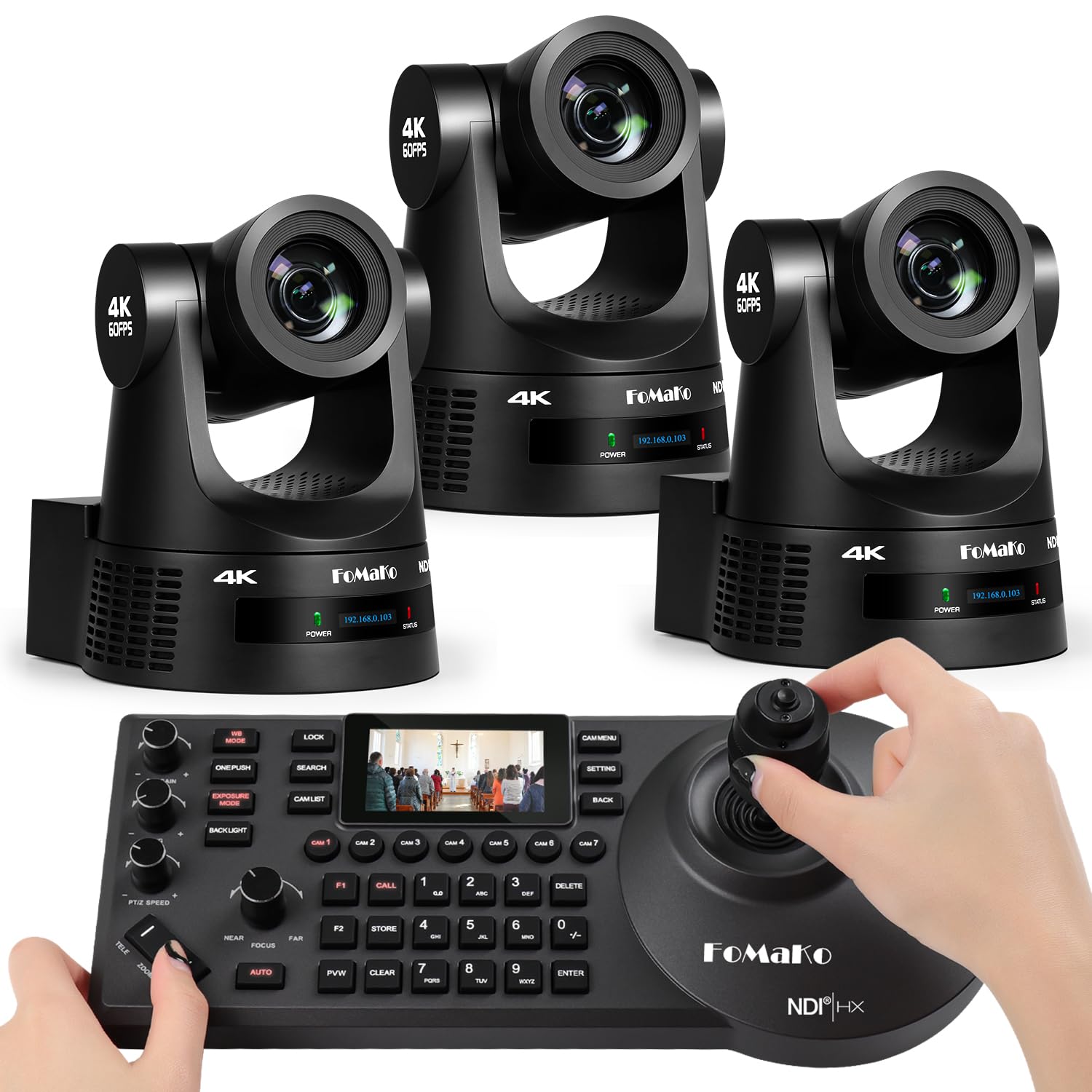
The FoMaKo K600N NDI PTZ camera bundle delivers 4K 60fps output via NDI HX3, HDMI, and 3G-SDI simultaneously, with a 20x optical zoom lens that maintains clarity across the full range. The bundled three-camera package is engineered for church worship services, live studio broadcasts, and corporate multi-camera productions where budget-conscious buyers need professional-grade tracking and image quality.
Gen 3 AI auto-tracking supports real-time and regional tracking modes with adjustable sensitivity, figure size, and lost-target behavior, allowing operators to fine-tune how the camera follows presenters during movement. The remote control enables up to 255 presets, and compatibility with vMix, OBS, and PTZ controllers ensures seamless integration into existing production software.
Power over Ethernet (PoE) simplifies cabling by combining power, video, and control over a single Ethernet cable, reducing installation complexity. The FoMaKo bundle includes IR remote controllers, wall mounts, and power adapters for each camera, and lifetime technical support with 24-hour response provides ongoing assistance for production teams without dedicated engineering staff.
Why it’s great
- NDI HX3 support with included license for professional IP video workflows
- Gen 3 AI tracking with customizable sensitivity and regional modes
- Three-camera bundle provides a complete multi-camera solution
Good to know
- Setup documentation has translation quirks that require patience
- Pan/tilt movement can exhibit minor jerks during slow operation
10. Canon EOS R100 Mirrorless Camera Kit

The Canon EOS R100 is an entry-level mirrorless camera that brings 4K video capability to the EOS R system at a price point that makes it accessible for beginners and budget-conscious creators. Its 24.1-megapixel APS-C CMOS sensor paired with the DIGIC 8 processor delivers 4K video at up to 24fps, and the Dual Pixel CMOS AF system covers 143 zones with human face and eye detection for reliable autofocus during recording.
The kit includes the RF-S18-45mm F4.5-6.3 IS STM lens, which provides optical image stabilization and a versatile zoom range equivalent to 29-72mm in full-frame terms. The compact body is the lightest in the EOS R series, making it portable for daily carry, and the guided user interface makes settings accessible for photographers transitioning from smartphones or point-and-shoot cameras.
High-speed shooting captures Full HD at up to 120fps for slow-motion playback, and wireless connectivity via Wi-Fi and Bluetooth enables instant photo transfer to smartphones. While video features are limited to 4K 24fps without log profiles, the R100 provides an affordable on-ramp to the Canon RF lens ecosystem for creators who plan to upgrade over time.
Why it’s great
- Accessible entry point into the Canon RF mirrorless system
- Dual Pixel CMOS AF provides reliable subject tracking for video
- Lightweight design makes it ideal for travel and everyday carry
Good to know
- 4K video limited to 24fps with no 10-bit or log recording
- No charger included with the kit; charges via USB-C
11. Panasonic LUMIX FZ80D Point and Shoot

The Panasonic LUMIX FZ80D is a bridge camera that packs a 60x optical zoom lens covering a 35mm-equivalent range of 20-1200mm, making it the most powerful zoom-per-dollar option for wildlife, sports, and distance shooting. The POWER O.I.S. (Optical Image Stabilizer) suppresses hand-shake vibration at the telephoto end, enabling sharp handheld shots at maximum zoom where smaller-sensor cameras would produce blurred results.
4K video and 4K Photo modes allow users to record 4K footage at up to 30fps and extract 8-megapixel still frames from video clips, providing a practical backup for capturing decisive moments. The Post Focus feature lets users select the in-focus point after the shot is taken, a versatile tool for macro and product photography where focus precision is critical.
The 2,360K-dot Live View Finder maintains visibility in bright sunlight where rear LCD screens wash out, and the camera remains lightweight at approximately 1.4 pounds despite the massive zoom range. While the small sensor struggles in low light and produces grain above base ISO, the FZ80D delivers exceptional reach and stabilization for its price tier, making it a competent tool for daytime outdoor documentation.
Why it’s great
- 60x optical zoom (20-1200mm equivalent) provides unbeatable reach for the price
- POWER O.I.S. enables sharp handheld shots at maximum telephoto
- Post Focus allows reframing in-focus area after the shot
Good to know
- Small sensor produces grainy images in low-light conditions
- Battery drains quickly with extensive zoom use; carry spares
FAQ
Should I buy a dedicated camcorder or a mirrorless camera for 4K video?
What is the real-world difference between 8-bit and 10-bit 4K video?
How important is mechanical versus digital image stabilization for 4K video?
Final Thoughts: The Verdict
For most users, the best 4k video camera winner is the DJI Osmo Pocket 3 Creator Combo because it combines a 1-inch sensor, exceptional 3-axis mechanical stabilization, and a complete accessory kit into a pocket-sized form factor that delivers professional-grade footage without a learning curve. If you want interchangeable lenses and a larger APS-C sensor for vlogging and content creation, grab the Sony Alpha ZV-E10. And for professional live production with simultaneous SDI and HDMI output, nothing beats the Panasonic HC-X2.