
The difference between a viral vlog and a forgettable one often comes down to two things: how stable your footage is and whether your audio sounds like you are standing in a wind tunnel. A 4K vlogging camera is not just about resolution—it is about capturing usable, cinematic clips reliably, time after time, without the overheating, rolling shutter, or poor low-light performance that plague smartphone video.
I’m Min — the co-founder and writer behind Gadgets Feed. I’ve spent hundreds of hours analyzing technical specifications, reading verified buyer experiences, and comparing sensor sizes, stabilization systems, and codec support across the most popular vlogging cameras on the market to build this guide.
Whether you are shooting YouTube tutorials, travel diaries, or product reviews, this guide breaks down the exact features that separate a frustrating shooting experience from a professional one. The best 4k vlogging camera depends on your style, but I have ranked every option here by real-world usability and image quality.
How To Choose The Best 4K Vlogging Camera
Choosing a 4K vlogging camera is not just about finding the cheapest 4K spec sheet. You need to weigh stabilization, lens versatility, audio quality, battery endurance, and whether the camera can actually record 4K for more than a few minutes without overheating or draining its battery. Here are the key decision points.
Sensor Size and Low-Light Performance
A 1-inch sensor (like the Sony ZV-1 or Canon PowerShot V1) offers a massive jump in light gathering over a smartphone sensor, giving you cleaner footage at dusk or indoors with regular room lighting. An APS-C sensor (Sony ZV-E10, Sony a6700) goes even further, allowing for more natural background blur and better shadow detail. The trade-off is physical size—APS-C bodies with a zoom lens are heavier and less pocketable.
Stabilization: Gimbal vs. Electronic IBIS
If you walk and talk, mechanical gimbal stabilization (DJI Osmo Pocket 3, Insta360 Luna) is transformative—it literally floats the camera on motors to cancel out footsteps. Electronic stabilization (in-body IBIS or lens-based OSS) is effective but introduces a crop and can struggle with larger, more jarring movements. For tripod-based or desk-vlogging, stabilization matters far less than lens sharpness.
Microphone Input and Audio Quality
On-camera microphones in compact 4K vlogging cameras range from usable to terrible. The Sony ZV-1 and ZV-E10 feature a directional 3-capsule mic and a windscreen, which is decent for quiet indoor use. If you plan to vlog outdoors or in echoey rooms, prioritize a camera with a 3.5mm mic jack (or USB-C audio support) so you can connect a wireless lavalier or a shotgun mic. The DJI Osmo Pocket 3 Creator Combo includes a wireless transmitter, which is a huge convenience.
Recording Limits, Overheating, and Bitrate
Not all 4K is equal. A camera recording 4K at 150 Mbps with 10-bit color (like the Sony a6700 or Insta360 Luna) will give you far more latitude for color grading than an 8-bit 4K recording at 50 Mbps. Also, look for cameras with active cooling (Canon PowerShot V1 has a fan) or proven long-duration recording—many compact cameras automatically stop after 29 minutes or overheat in warm rooms after 30 minutes of continuous 4K.
Quick Comparison
On smaller screens, swipe sideways to see the full table.
| Model | Category | Best For | Key Spec | Amazon |
|---|---|---|---|---|
| DJI Osmo Pocket 3 Creator Combo | Gimbal Camera | Walk-and-talk vlogging, solo creators | 1-inch CMOS, 4K 120fps | Amazon |
| Insta360 Luna Ultra Creator Bundle | Gimbal Camera | High-end vlogging, zoom versatility | Dual Leica, 8K HDR | Amazon |
| Sony Alpha 6700 w/ 18-135mm | Mirrorless APS-C | Hybrid photo/video, professional vlogs | 26MP APS-C, 4K 120p | Amazon |
| Sony ZV-E10 II w/ 16-50mm | Mirrorless APS-C | Serious content creation, interchangeable lenses | 26MP APS-C, 4K 60fps | Amazon |
| Canon PowerShot V1 | Compact Fixed Lens | Streaming, desk vlogs, travel vlogs | 1.4-type sensor, built-in fan | Amazon |
| Sony ZV-1 II | Compact Fixed Lens | Ultra-wide selfie vlogging, pocket carry | 1-inch, 18-50mm f/1.8-4.0 | Amazon |
| Sony ZV-1 Vlogging Camera Bundle | Compact Fixed Lens | Beginner vloggers, social media content | 1-inch, 24-70mm f/1.8-2.8 | Amazon |
| Sony ZV-E10 Bundles (Black/White) | Mirrorless APS-C | Value-oriented vlogging, interchangeable lenses | 24.2MP APS-C, 4K 30fps | Amazon |
| DJI Osmo Nano Standard Combo | Action Camera | Compact sports vlogs, magnetic mounting | 1/1.3-inch, 4K 60fps | Amazon |
In‑Depth Reviews
1. DJI Osmo Pocket 3 Creator Combo

The DJI Osmo Pocket 3 remains the gold standard for solo vloggers who want gimbal-smooth footage without bulky gear. Its 1-inch CMOS sensor captures excellent 4K footage at up to 120fps, and the 2-inch rotatable touchscreen makes framing simple whether you shoot horizontally or vertically. The mechanical 3-axis stabilization is dramatically better than any electronic image stabilization system on a mirrorless camera—footage from walking down a street looks like it was shot on a dolly.
The Creator Combo sweetens the deal with a DJI Mic 2 transmitter, a wide-angle lens, a battery handle, and a mini tripod. The active tracking (ActiveTrack 6.0) keeps you centered even when you spin or walk sideways, and the D-Log M 10-bit color profile gives you room to grade footage in post. Battery life hits about 166 minutes in ideal conditions, and you can charge the camera while recording via USB-C PD.
The main compromise is the fixed-lens design—you cannot swap optics for different focal lengths. Also, the gimbal head is delicate; you will want the included protective cover whenever it is in a bag. For creators who prioritize stabilization and portability above all else, this is the most refined all-in-one vlogging system available.
Why it’s great
- Mechanical gimbal eliminates the need for post-production stabilization and heavy rigs.
- Included DJI Mic 2 transmitter delivers broadcast-quality audio right out of the box.
- Rotatable touchscreen and ActiveTrack 6.0 make solo shooting effortless.
Good to know
- Fixed lens limits your creative reach—no telephoto or ultra-wide options without attachments.
- Gimbal is fragile and requires careful handling and storage; not as rugged as an action camera.
2. Insta360 Luna Ultra Creator Bundle
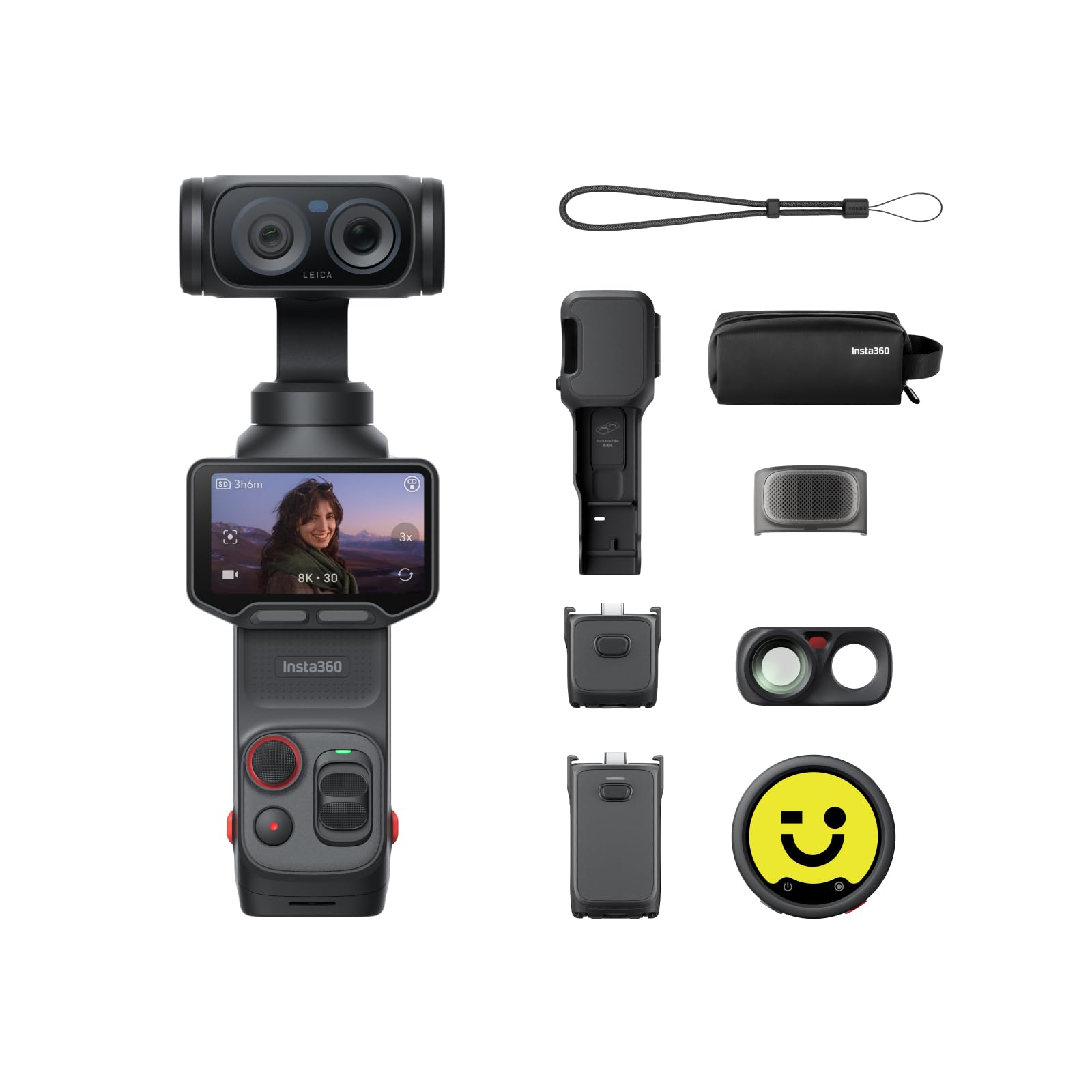
The Insta360 Luna pushes the vlogging camera category into new territory with its dual Leica lens system. The main lens uses a 1-inch sensor, while the telephoto lens packs a 1/1.3-inch sensor with an F2.0 aperture, enabling up to 6x lossless zoom and a 12x total zoom range. This is the first pocket gimbal camera that lets you optically zoom into a subject without destroying image quality, making it ideal for travel vloggers who need both wide selfie shots and tight portraits.
Video quality is superb: 8K 30fps with Dolby Vision HDR, 10-bit I-Log for professional color grading, and up to 14 stops of dynamic range. The detachable 2-inch OLED touchscreen can be used wirelessly up to 20 meters away, which is a game-changer for solo creators framing themselves from a distance. Battery life reaches 4 hours, and fast charging hits 80% in 23 minutes. The Leica color profiles deliver rich, natural tones straight out of camera.
There are some trade-offs: the gimbal hits its rotation endpoints faster than the Pocket 3, the detached screen introduces noticeable latency, and it only works with Insta360 microphones—third-party wireless mics are not compatible without a separate transmitter. It is also pricier than most competitors. If you want the ultimate zoom range and color science in a pocketable form, this is it.
Why it’s great
- Dual Leica lenses provide genuine optical zoom and natural bokeh, unmatched in this size class.
- Detachable touchscreen allows for creative self-framing and remote control up to 20m away.
- 8K HDR and 10-bit I-Log give professionals enormous flexibility in post-production.
Good to know
- Third-party wireless microphones are not supported; you must use Insta360’s proprietary audio system.
- Detached screen introduces latency and the gimbal rotation range is narrower than the Pocket 3.
3. Sony Alpha 6700 w/ 18-135mm Lens

The Sony a6700 is the most capable vlogging camera here if you need hybrid photo and video performance. Its 26MP APS-C Exmor R sensor is paired with the powerful BIONZ XR processor, and it shoots 4K 120p in 10-bit 4:2:2 with a 6K oversample. The dedicated AI processing unit delivers near-perfect Real-time Eye AF for humans, animals, and even birds—a massive leap over the earlier ZV-E10 series. The in-body image stabilization (IBIS) is good enough for handheld walk-and-talk without a gimbal, though you will still see some micro-jitters.
The included 18-135mm f/3.5-5.6 zoom lens is a versatile general-purpose range, covering wide-angle vlogs to tight close-ups. The 759-point phase-detection autofocus system locks onto eyes instantly, and the S-Log and S-Cinetone color profiles allow serious color grading. It supports USB-C streaming and charges via USB-C PD, making it a strong choice for live streaming as well.
The downsides are notable: the single SD card slot and small electronic viewfinder frustrate some users, and the camera can overheat after about 40 minutes of continuous 4K 60fps recording in warm environments. The kit lens is sharp but relatively slow (f/3.5-5.6), meaning indoor shooting benefits from an external light. For creators who want one camera for photography and serious video work, this is the most future-proof option.
Why it’s great
- AI-based Real-time Eye AF tracks subjects with uncanny reliability, freeing you to focus on framing.
- 10-bit 4K 120p from a 6K oversample leaves huge room for cropping and color grading.
- IBIS plus a versatile 18-135mm zoom covers nearly every vlogging scenario in one lens.
Good to know
- Single SD card slot and small EVF are unfortunate compromises on an otherwise premium body.
- Continuous 4K 60fps recording can cause overheating after 40 minutes in moderate temperatures.
4. Sony ZV-E10 II w/ 16-50mm Lens

The ZV-E10 II is a meaningful upgrade over the original ZV-E10, now featuring a 26MP back-illuminated APS-C sensor and the BIONZ XR processor. It shoots oversampled 4K 60fps with full pixel readout, and the Creative Look presets let you dial in a specific aesthetic in-camera—great for vloggers who want to avoid heavy editing. The E PZ 16-50mm kit lens is compact and power-zoom, which helps keep the overall package lightweight for travel.
Product Showcase mode and Background Defocus buttons are still here, making it extremely easy to transition from a face shot to a product in your hand. Real-time Eye AF works for humans, animals, and birds, and the 759-point phase-detection autofocus is fast and sticky. USB-C streaming is supported, so you can use it as a high-quality webcam with zero hassle.
Battery life is average for an APS-C mirrorless camera—expect about 60-80 minutes of continuous 4K recording on a single charge, so spare batteries are necessary for long days. The built-in microphone is usable but benefits greatly from an external mic via the 3.5mm jack. If you want the flexibility of interchangeable lenses in a vlogging-focused body without stepping up to the a6700, this is the best fit.
Why it’s great
- 26MP APS-C sensor provides superior low-light performance and shallow depth of field compared to 1-inch compacts.
- One-touch Product Showcase and Background Defocus buttons simplify common vlogging transitions.
- E-mount compatibility gives you access to hundreds of lenses as your skills grow.
Good to know
- Battery life is mediocre for 4K vlogging; plan to carry 2-3 spare NP-FZ100 batteries.
- No in-body stabilization—you must rely on the lens’s OSS or post-production stabilization software.
5. Canon PowerShot V1

Canon’s PowerShot V1 addresses two of the biggest pain points in compact vlogging: overheating and lens sharpness. It features an active cooling fan that allows for extended 4K recording sessions without thermal shutdown—a rare feature in a pocket-sized camera. The 1.4-type sensor (roughly 22.3MP for stills, 18.7MP for video) is larger than a standard 1-inch sensor, giving it slightly better dynamic range and noise performance.
The built-in 16-50mm f/2.8-4.5 wide-angle zoom lens (35mm equivalent) is sharp and versatile. It supports Canon Log 3 10-bit recording, which vloggers who grade their footage will appreciate. The 3.5mm mic jack and headphone jack give you full audio control. The camera is designed with streaming in mind—plug it into a computer via USB-C and it functions as a high-quality webcam instantly.
There is no optical image stabilization in the lens, and the electronic stabilization imposes a significant crop that degrades the effective wide-angle. The SD card slot sits under the battery door, which is inconvenient if you use a quick-release tripod plate. If you record long videos indoors without walking, the V1’s cooling system and Canon color science make it a compelling choice.
Why it’s great
- Active cooling fan enables unlimited 4K recording without overheating—rare in compact cameras.
- Canon Log 3 with 10-bit color gives professional-grade grading flexibility in post-production.
- Ultra-wide 16-50mm lens (f/2.8-4.5) is excellent for indoor and close-quarters vlogging.
Good to know
- No optical image stabilization; electronic stabilization crops heavily into the sensor.
- SD card slot under the battery door is awkward when using a tripod plate or grip.
6. Sony ZV-1 II

The Sony ZV-1 II is the sequel that fixes the biggest complaint about the original: the lens. It now starts at an ultra-wide 18mm (35mm equivalent), making it much easier to fit yourself and a background into the frame when vlogging at arm’s length. The 1-inch stacked sensor delivers 20.1MP stills and 4K video with the same excellent color science and Real-time Eye AF from the larger ZV series.
The f/1.8-4.0 aperture is reasonably bright at the wide end, giving you decent background blur for product showcases or portrait-style vlogs. The directional 3-capsule microphone has been improved over the original ZV-1, and the included windscreen reduces outdoor wind noise noticeably. It also includes a touchscreen—a welcome upgrade from the non-touch screen on the first model.
Battery life remains a weak point, with real-world 4K recording time around 30-40 minutes before a swap is needed. It also lacks Optical SteadyShot, relying entirely on digital stabilization, which introduces a noticeable crop. If you need an ultra-wide selfie-friendly compact that fits in a jacket pocket, the ZV-1 II is the right choice.
Why it’s great
- Ultra-wide 18mm lens at f/1.8 is perfect for arm’s-length selfie vlogging with background context.
- Improved directional microphone and windscreen deliver cleaner audio than the original ZV-1.
- Touchscreen compatibility and USB-C streaming make it a versatile creator tool.
Good to know
- No Optical SteadyShot; digital stabilization crops the field of view significantly.
- Battery life is short for continuous 4K shooting; pack multiple spares for a full day of vlogging.
7. Sony ZV-1 Vlogging Camera Bundle (White)
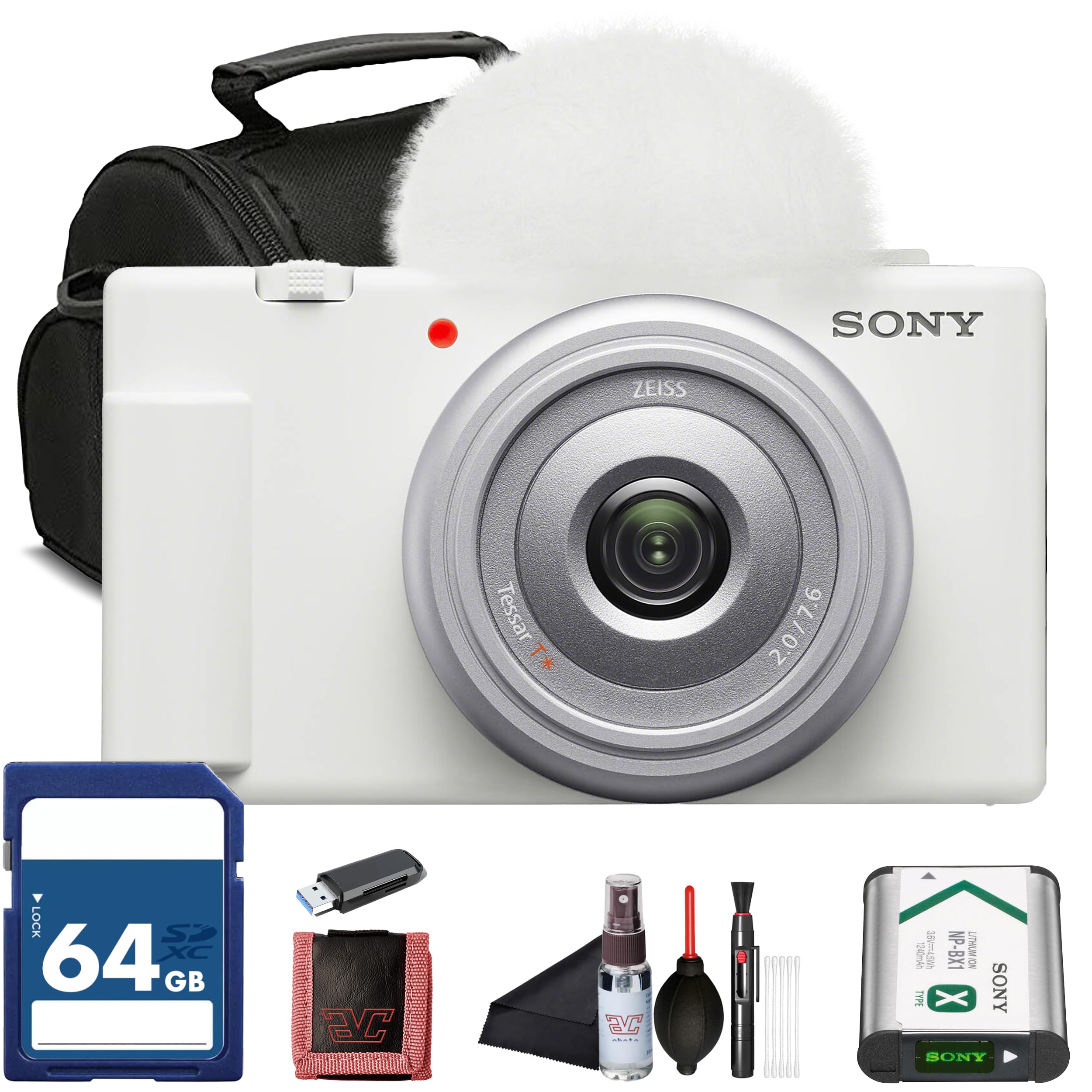
The original Sony ZV-1 remains a strong entry point for vloggers who want a 1-inch sensor in a compact body. The ZEISS 24-70mm f/1.8-2.8 lens is fast and sharp, and the 20.1MP stacked Exmor RS sensor provides solid 4K HDR video quality. The built-in 3-capsule directional microphone with windscreen is among the best on-camera audio systems in this size category, making it a great pick for vloggers who do not want to mess with external mics.
This bundle includes a 64GB SD card, card reader, soft bag, flexible tripod, and cleaning kit—everything a beginner needs to start shooting immediately. Background Defocus and Product Showcase buttons are present, and the camera streams over USB-C without extra hardware. The flip-up vari-angle LCD screen makes self-framing straightforward.
The camera is now a few generations old, and the lack of a touchscreen (yes, even on this model) feels outdated. The battery life is also below average, and the 24mm wide end is not wide enough for comfortable arm’s-length vlogging for most users. It is a solid starter kit for social media content, but the ZV-1 II or an APS-C option may serve you better long-term.
Why it’s great
- Fast f/1.8-2.8 ZEISS lens is excellent for low-light and background blur in a compact package.
- Included bundle provides all essential accessories, making it ready to vlog out of the box.
- Directional 3-capsule mic delivers above-average audio for a camera this size.
Good to know
- No touchscreen and only a 24mm wide end makes selfie framing tighter than ideal.
- Battery life is short; the technology is aging relative to newer vlogging-centric rivals.
8. Sony ZV-E10 Mirrorless Bundles (Black/White)

The Sony ZV-E10 bundles (both the 40-piece renewed kit and the white authorized kit) represent the best value in interchangeable-lens vlogging. The camera itself has a 24.2MP APS-C sensor, oversampled 4K 30fps from a 6K readout, and the classic vlogging features: Background Defocus button, Product Showcase mode, and a vari-angle touchscreen. The E PZ 16-50mm f/3.5-5.6 OSS lens provides optical stabilization and a versatile zoom range.
The bundle variety is the real story here. The renewed kit includes two 64GB cards, LED video light, tripod, filters, macro kit, telephoto lens, wide-angle adapter, and a sturdy bag. The white authorized kit includes a 64GB Extreme PRO card, soft bag, flexible tripod, and cleaning kit. Both give you a complete shooting setup for a very accessible total investment.
The ZV-E10 lacks in-body stabilization, so handheld walking footage requires a gimbal or post stabilization. The 4K recording is limited to 30fps with a ~30-minute continuous limit in standard mode. The kit lens is decent but dim at the telephoto end. For the price of a compact camera, you get an APS-C system with lens interchangeability—an unbeatable value proposition for budget-conscious vloggers.
Why it’s great
- APS-C sensor and interchangeable E-mount lenses provide a massive upgrade path from compact cameras.
- 40-piece renewed bundle includes essentially every accessory a beginner could need, saving hundreds.
- Product Showcase and Background Defocus buttons make complex transitions simple with one touch.
Good to know
- No in-body stabilization—walking vlogs will appear shaky without a gimbal or tripod.
- 4K is capped at 30fps, and the continuous recording limit is approximately 30 minutes per clip.
9. DJI Osmo Nano Standard Combo (128GB)
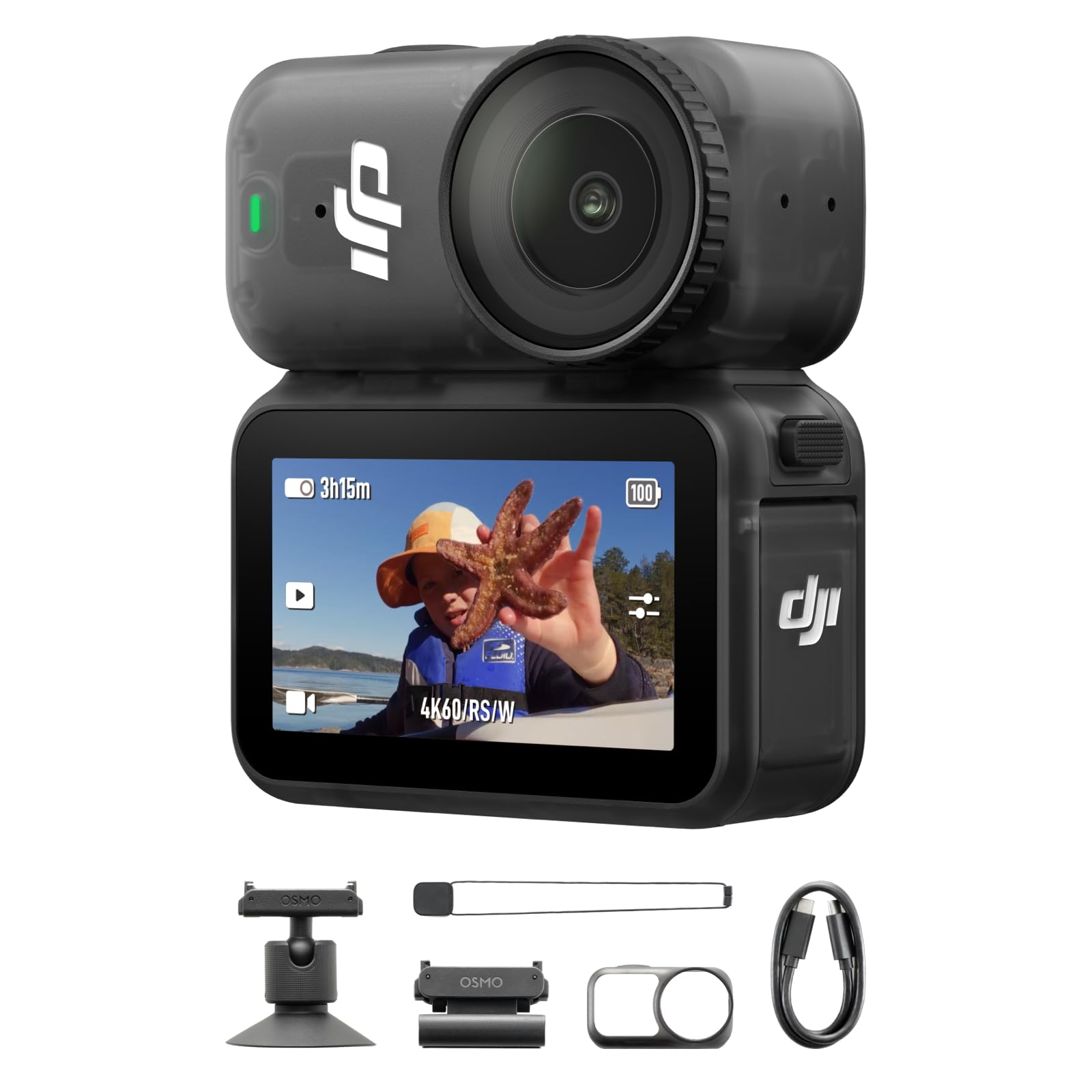
The DJI Osmo Nano is a tiny magnetic action camera that packs a surprising amount of vlogging capability into a ridiculously small form factor. The 1/1.3-inch sensor captures 4K 60fps with a 143° ultra-wide field of view, and the 10-bit D-Log M color profile gives you room to adjust in post. The magnetic mounting system (hat clip, lanyard, ball-joint adapter) makes it incredibly easy to attach to anything for unique POV shots.
The biggest advantage is the 128GB of built-in storage—you can start recording immediately without buying a memory card. Battery life reaches up to 200 minutes in ideal conditions, and fast charging via USB-C gets you back up quickly. It is waterproof to 10 meters, making it a solid companion for outdoor adventure vlogging. The OsmoAudio system supports direct connection to two DJI microphones for clear, wind-free audio.
The trade-offs are significant for traditional vloggers: no built-in screen for framing shots (you must use the DJI Mimo app), and the ultra-wide lens introduces noticeable fisheye distortion. The app compatibility situation (removed from Google Play) adds friction. It is best suited for sports vloggers and action-oriented creators who want a rugged, tiny camera that stays out of the way.
Why it’s great
- Magnetic mounting accessories enable creative hands-free POV shots that no other vlogging camera can match.
- 128GB built-in storage eliminates the need for an immediate SD card purchase.
- 200-minute battery life and waterproofing make it ideal for outdoor and action vlogging.
Good to know
- No built-in viewfinder or screen forces reliance on a smartphone app for framing and monitoring.
- Ultra-wide lens introduces barrel distortion that may not suit traditional talking-head vlogs.
FAQ
What is the difference between 4K 30fps and 4K 60fps for vlogging?
Should I choose a camera with a flip screen or a gimbal camera for vlogging?
How important is a microphone jack on a 4K vlogging camera?
Will a vlogging camera overheat if I record 4K for more than 30 minutes?
Final Thoughts: The Verdict
For most users, the best 4k vlogging camera winner is the DJI Osmo Pocket 3 Creator Combo because it combines a 1-inch sensor with mechanical gimbal stabilization and an included wireless microphone in a pocketable package that works immediately. If you want interchangeable lenses and APS-C image quality, grab the Sony ZV-E10 II. And for maximum zoom range and Leica color science, nothing beats the Insta360 Luna Ultra Creator Bundle.