
An RC buggy that merely rolls over a patch of grass is no longer impressive. The modern 4×4 RC buggy segment is defined by raw brushless torque, oil-filled suspension, and true all-terrain dominance — machines that drift on pavement, claw through gravel, and launch off dirt jumps without disintegrating. This guide separates the genuine hobby-grade performers from the toy-grade pretenders.
I’m Min — the co-founder and writer behind Gadgets Feed. I’ve sifted through dozens of drivetrain specs, battery chemistries, and customer durability reports to find the 4×4 RC buggies that actually deliver on their speed claims without breaking after the first tumble.
Whether you are a weekend basher or a speed junkie chasing top-end throttle, the best 4×4 rc buggy balances a powerful motor platform, metal-gear drivetrain resilience, and a suspension that keeps all four tires planted at high velocity.
How To Choose The Best 4×4 RC Buggy
Every 4×4 RC buggy on this list claims to be fast. The difference between a buggy that lasts a season and one that survives years of abuse comes down to three critical areas: the motor type, the drivetrain materials, and the battery system. Beginners often over-index on top speed while ignoring the structural components that make that speed usable.
Brushless vs. Brushed Motors
The motor is the heart of any RC buggy. Brushed 380 or 390 motors are common on entry-level models — they are affordable and provide adequate torque for grass and gravel, but they generate more heat and wear down over time. Brushless motors (e.g., 2835 3600KV or 2845 3600KV) deliver higher RPM, better thermal efficiency, and much longer lifespan. If you plan to run the buggy on 3S Li-Po batteries, a brushless platform is mandatory to handle the sustained voltage without failure.
Drivetrain Durability: Plastic vs. Metal
The weakest link in any RC buggy is the drivetrain. Budget models use plastic differentials and dog bones that strip or crack under high-torque acceleration. Look for sintered metal or CNC metal differentials, steel CVD drive shafts, and metal gear servos. Oil-filled shocks (metal-bodied) are also essential — they dampen chassis slap on landings and prevent the buggy from bouncing uncontrollably at speed.
Battery and Charger Ecosystem
Most 4×4 RC buggies ship with Li-Po batteries. The voltage (2S at 7.4V or 3S at 11.1V) directly dictates top speed. A 3S battery can push a buggy beyond 60 km/h, but it also requires a charger that supports balance charging. Many units include two batteries for extended runtime, but the included USB chargers are slow (3-4 hours). Factor in the cost of a proper balance charger to reduce charge times and extend battery lifespan.
Quick Comparison
On smaller screens, swipe sideways to see the full table.
| Model | Category | Best For | Key Spec | Amazon |
|---|---|---|---|---|
| DEERC H16R | Premium | Hobby speed junkies | Brushless 52 km/h | Amazon |
| DIKAVEY BX12 | Premium | 42 mph brushless power | Brushless 42 mph / 3S 2200mAh | Amazon |
| ZD Racing 1:12 | Premium | High-speed hobby racers | Brushless 42 mph / metal diff | Amazon |
| HAIBOXING 2995 | Mid-Range | All-round basher | 550 brushed / 42 km/h | Amazon |
| Jetwood JC16W | Mid-Range | Family / beginner basher | Brushed 38 km/h / 1500mAh 2P | Amazon |
| X-TMAGA HS14323 | Mid-Range | Sand / snow / mud | Brushed 40 km/h / 1300mAh 2P | Amazon |
| KGF 1:18 Scale | Budget | Value-first / kids | Brushed 40 km/h / 2x Li-Po | Amazon |
In‑Depth Reviews
1. DEERC H16R Brushless RC Car

The DEERC H16R is the benchmark for what a sub- brushless buggy should be. Its 2835 3550KV motor hits a verified 52 km/h (32+ mph) on 2S, and the separate 35A waterproof ESC keeps the electronics safe in wet grass or puddles. The metal differentials and metal dog bones form a drivetrain that laughs at full-throttle landings.
Oil-filled metal shocks eliminate the high-speed wobble that plagues cheaper buggies. The 2.4 GHz remote includes a throttle limiter switch (70% or 100%), making it safe for beginners while still delivering full speed for experienced drivers. The two hard-shell 1500mAh Li-Po batteries provide roughly 40 minutes of drive time when rotated.
Customer reports confirm the H16R survives skate park abuse and rough terrain, though a few units experienced motor overheating after extended runs. DEERC’s customer service is responsive, often replacing entire cars for motor issues. For the price, the combination of brushless torque and metal drivetrain parts is unmatched.
Why it’s great
- Genuine brushless 52 km/h speed with metal drivetrain
- Oil-filled metal shocks for excellent high-speed stability
- Throttle limiter makes it beginner-friendly
Good to know
- Overheating risk on extended full-throttle runs; allow cool-down breaks
- Body shell can crack in cold weather impacts
2. DIKAVEY BX12 Brushless RC Buggy
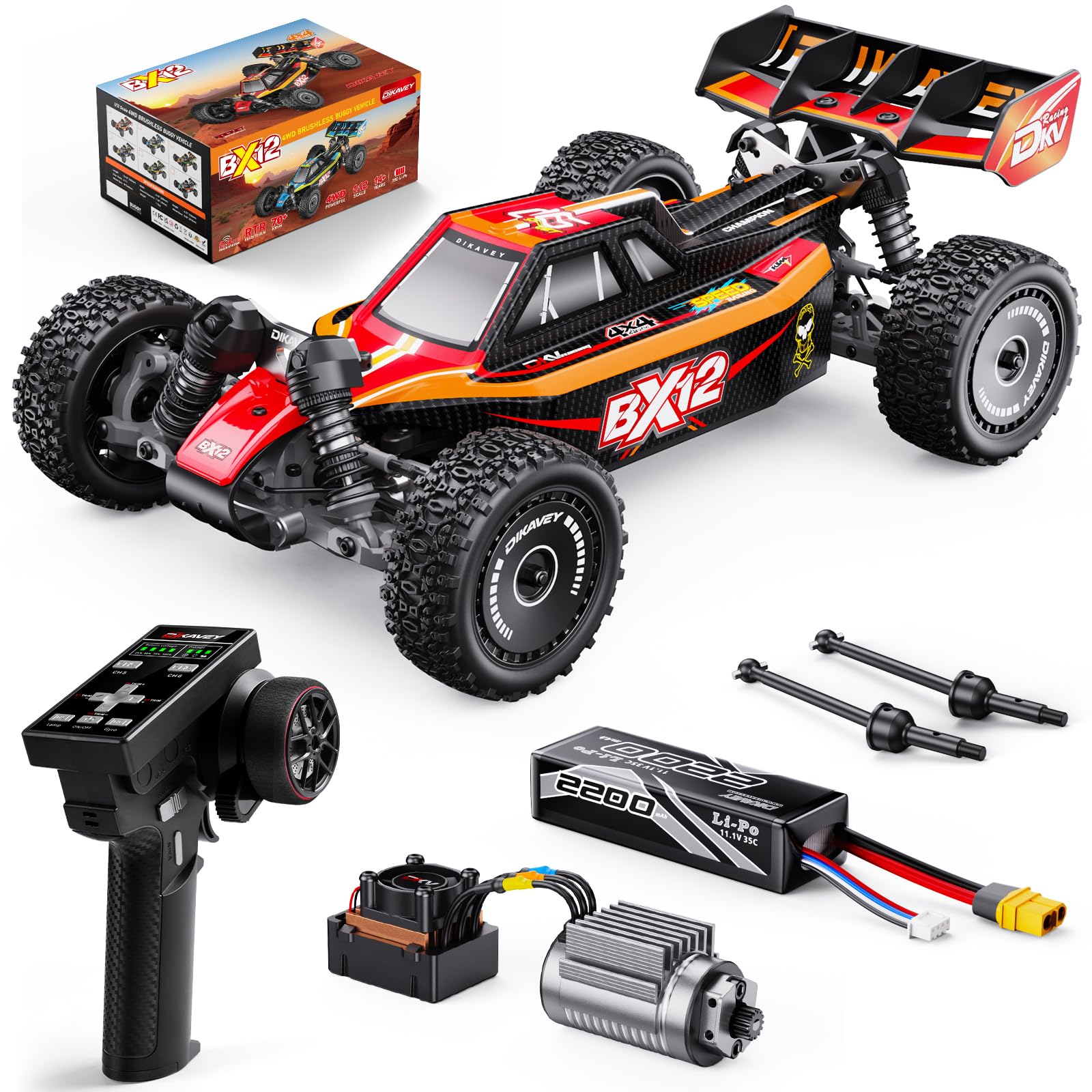
The DIKAVEY BX12 brings brushless 3S performance to a wider audience without the Rlaarlo price premium. Its 2845 3600KV motor and 35A ESC are 2S/3S compatible, and swapping the included motor gear unlocks a verified 42 mph (72 km/h). The 2mm-thick PVC shell and front anti-collision bumper absorb impacts that would shatter toy-grade bodies.
Natural rubber tires with an aggressive tread pattern provide confidence on mud, grass, and loose gravel. The 16x71mm oil-filled metal hydraulic shocks reduce bouncing on rough terrain, and the 3-channel 2.4 GHz remote offers three throttle limit settings (35%, 60%, 100%) — ideal for skill progression. The 2200mAh 3S Li-Po delivers higher voltage for extended top-speed runs.
Buyers praise its durability against dog attacks and hard crashes, and the included spare parts (C-hubs, motor gear) add value. Charging the battery with the stock USB cable takes about four hours; owners recommend upgrading to a balance charger for faster cycles. A well-built 42 mph buggy at a price that undercuts the competition.
Why it’s great
- True 42 mph achievable with included motor gear swap
- Three-position throttle limiter for beginners
- Durable 2mm shell and crash-resistant bumper
Good to know
- Stock charger takes ~4 hours to fully charge 3S battery
- Remote control requires 4 AA batteries (not included)
3. ZD Racing 1:12 Brushless RC Buggy
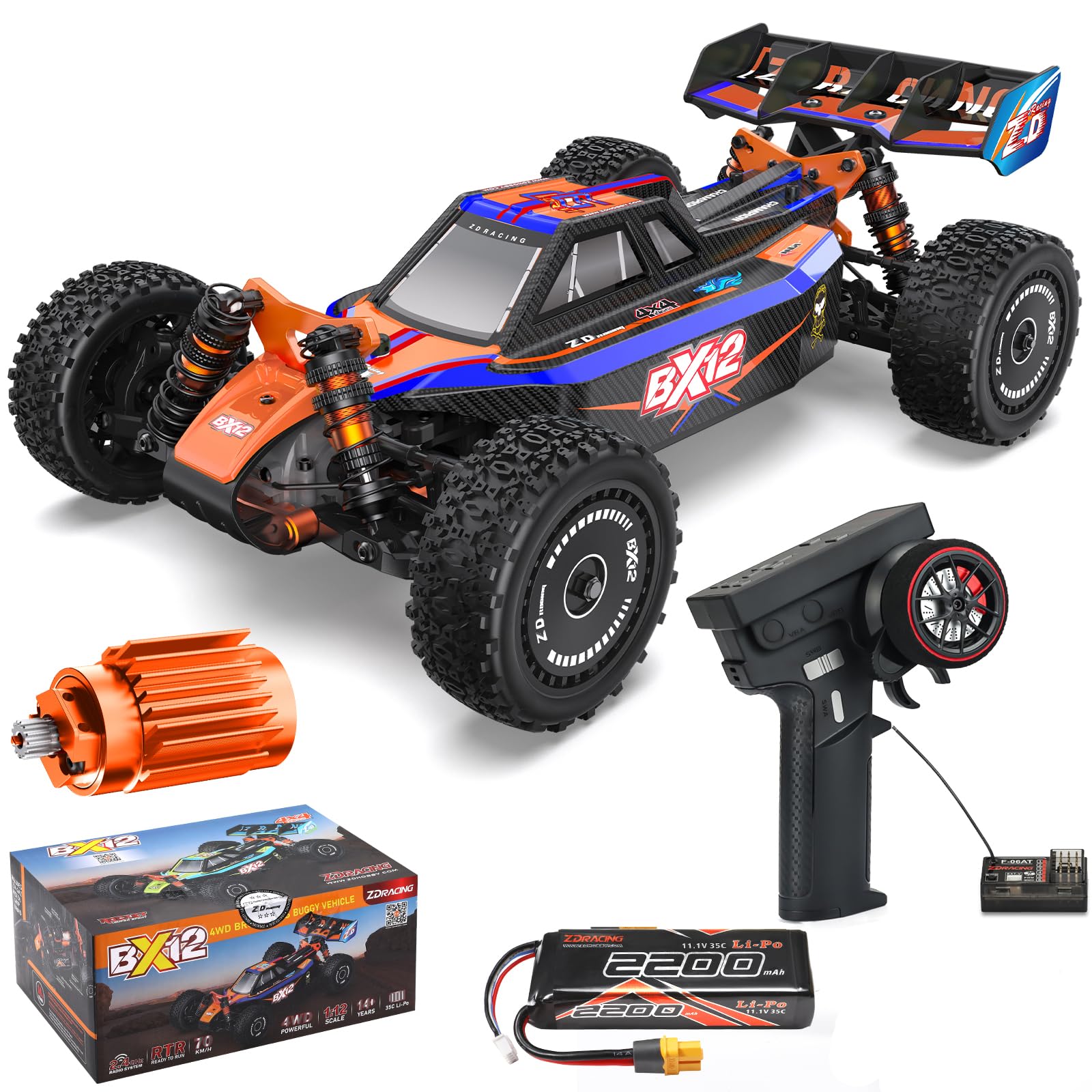
The ZD Racing buggy shares the same drivetrain architecture as the DIKAVEY BX12 but distinguishes itself with a full metal differential featuring 59T CNC high-carbon steel teeth and overload-limited slip. This diff design reduces power loss during high-torque acceleration and prevents wheel slip on loose surfaces. The Rocket 2845 3600KV brushless motor and 3S 2200mAh battery deliver a verified 42 mph with smooth, linear throttle response.
The 2.4 GHz remote includes TH.D/R knobs for speed adjustment, and the ESC provides intelligent alerts for overheating and low-voltage cutoff. Owners report the buggy survives skate park abuse with no broken parts after multiple hard sessions. The 1:12 scale provides a stable wheelbase that handles jumps better than shorter 1:16 buggies.
Some units arrived missing the advertised second battery, and the tiny remote lacks a transmitter stand. The shock setup requires minor tuning out of the box to prevent excessive bounce. For the price, the combination of CNC metal diff, 3S brushless power, and spare C-hubs makes it a compelling choice for serious bashers.
Why it’s great
- CNC metal differential with overload-limited slip for durability
- 42 mph top speed with Rocket brushless motor
- Included spare parts (C-hubs, motor gear)
Good to know
- May be missing advertised extra battery; verify packing
- Remote is compact with no transmitter stand
4. HAIBOXING 2995 RC Buggy 1:12

The HAIBOXING 2995 proves that a well-engineered brushed buggy can still compete in a brushless world. Its 550 motor pushes the 1:12 scale chassis to a consistent 42 km/h, and the full sintered metal gear differentials (front, center, rear) provide a drivetrain toughness that many brushless buggies at this price lack. The center differential significantly reduces side sliding during cornering.
The IPX4 splash-proof ESC handles damp grass and light rain, and the independent suspension with spring-tension adjustable shocks keeps the chassis planted across rough terrain. The 2.4 GHz radio offers a 280-foot range with a speed knob that adjusts throttle from 40% to 100%. Two 1600mAh Li-Po batteries deliver over 40 minutes of combined runtime.
Customer reports note the shell can crack on the first hard roll if not reinforced with tape. USB chargers are slow, and some units arrived with a broken steering horn. Despite these minor quirks, the metal drivetrain and smooth handling make it a favorite among returning hobbyists seeking a reliable basher without breaking the bank.
Why it’s great
- Full sintered metal gear differentials for exceptional durability
- Center differential reduces side sliding for better handling
- IPX4 splash-proof ESC for wet conditions
Good to know
- Body shell may crack on heavy impacts; reinforce with tape
- Included USB chargers are slow; invest in a balance charger
5. Jetwood 1/16 RC Car (JC16W)
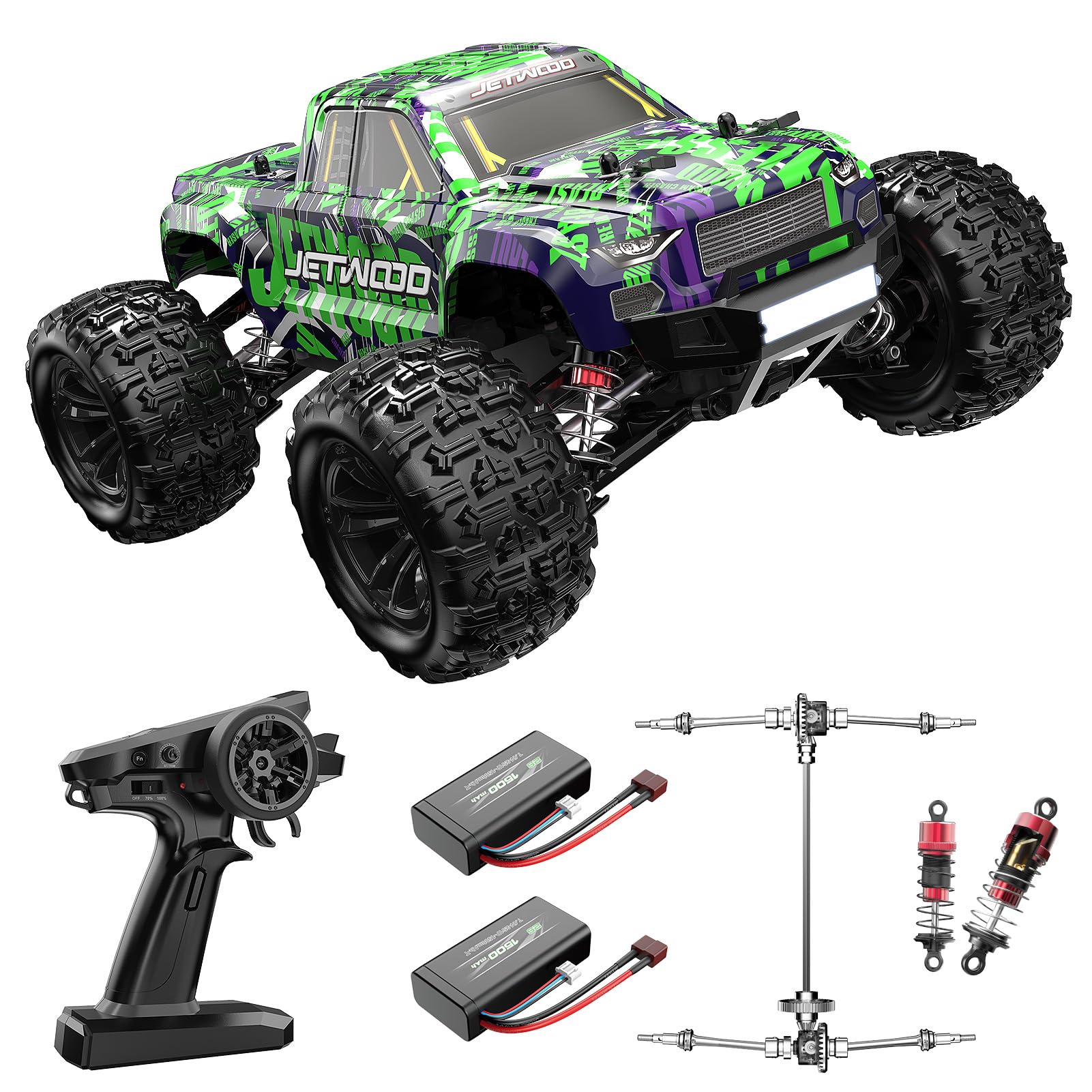
The Jetwood JC16W fills the gap between entry-level toys and full hobby-grade rigs. Its 390 brushed motor reaches 38 km/h (24 mph) — modest compared to brushless models, but the metal differentials, oil-filled shocks, and reinforced chassis give it a build quality that survives backyard bashing. The 1.6-inch ground clearance and 3.54-inch rubber tires handle grass, gravel, and packed dirt without hesitation.
The 2.4 GHz remote includes steering and throttle trim for precise control, and the 250-foot range ensures interference-free racing. Two 1500mAh batteries provide over 40 minutes of runtime. The splash-resistant design survives puddles and wet grass. Enthusiasts have successfully converted the JC16W to brushless/3S using 1/14 scale parts, turning it into a pocket rocket that outpaces 1/10 scale trucks.
Stock charging is slow with the included USB cable, and some owners note the plastic components feel less robust than the metal drivetrain. The 1/16 scale is noticeably smaller than 1/12 buggies, which may disappoint those expecting a larger footprint. For families or beginners who want a durable, upgradeable platform, this is a strong contender.
Why it’s great
- Metal differentials and oil-filled shocks in a compact package
- Easily upgradeable to brushless/3S with 1/14 scale parts
- Long 40+ minute runtime with two batteries
Good to know
- Smaller 1/16 scale may not suit drivers wanting a larger buggy
- Stock USB charger is slow for the 1500mAh batteries
6. X-TMAGA 1:14 All Terrain RC Truck (HS14323)

The X-TMAGA HS14323 is purpose-built for loose and deep terrain — snow, sand, and mud are its natural habitat. The 390 brushed motor delivers 40 km/h with excellent throttle linearity, making it easier to control on unstable surfaces compared to a punchy brushless motor. The 90mm all-terrain airless tires provide flotation on sand and grip in wet mud.
Adjustable alloy spring shocks reduce high-speed chassis wobble and allow tuning for different surface conditions. The 2.4 GHz remote includes TRIM and speed knobs, and the 1300mAh batteries (two included) provide roughly 50 minutes of total runtime. The modular battery design makes swapping quick, and the BMS prevents overcharge and over-discharge.
Owners praise its speed and grip on grass, dirt, and mulch, though the 1:14 scale is smaller than 1:12 buggies, which limits its presence on rough terrain. The USB charging system is adequate but slow. For drivers who regularly run on loose surfaces and want a dedicated terrain machine, the X-TMAGA delivers focused performance.
Why it’s great
- 90mm airless tires excel on sand, snow, and mud
- Adjustable alloy shocks for terrain-specific tuning
- 50-minute runtime with modular battery swapping
Good to know
- Smaller 1/14 scale sits lower to the ground than 1/12 buggies
- USB charger is slow; a faster charger recommended for heavy use
7. KGF 1:18 Scale All Terrain RC Buggy
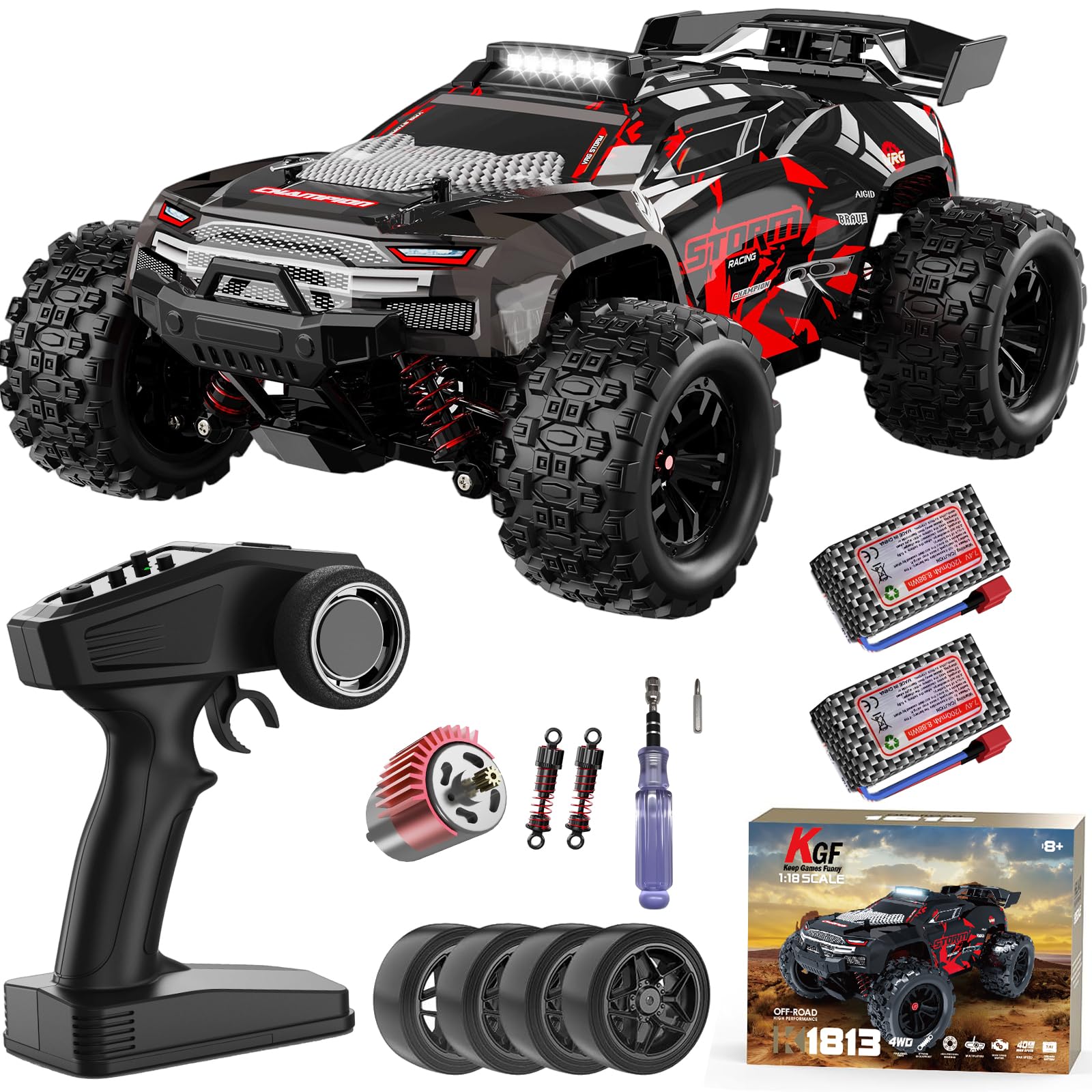
The KGF 1:18 scale buggy is the most accessible entry point to 4×4 RC bashing. Its 380 brushed motor hits 40 km/h, and the full metal drive shaft and metal shock absorbers provide durability that surpasses typical toy-grade offerings. The BMS-equipped Li-Po batteries prevent overcharge and short circuits, addressing a common safety concern for younger users.
The buggy ships with both high-grip off-road tires and hard plastic drift tires, offering two driving experiences in one box. The 2.4 GHz remote has a 280-foot range and features TRIM/SPEED knobs. Built-in LED headlights enable low-light visibility and add visual flair. The 1:18 scale makes it highly portable — easy to toss in a backpack for park trips.
Customer reviews note the tight battery compartment makes swaps slightly fiddly, and the drift tires are hard plastic with limited grip. The USB charger takes 3-4 hours for a full charge. For a first-time buyer or a gift for a child aged 6-12, the KGF offers surprising speed and durability without the hobby-grade price tag.
Why it’s great
- Metal drive shaft and shocks at an entry-level price
- Includes both off-road and drift tire sets
- BMS battery system improves safety for kids
Good to know
- 1:18 scale is noticeably smaller; less stable on very rough terrain
- Battery compartment is tight, making swaps slightly difficult
FAQ
What is the difference between a brushed and brushless RC buggy motor?
How fast should a beginner 4×4 RC buggy be?
Can I run a 3S Li-Po battery in a brushed RC buggy?
How do I choose the right scale for my RC buggy?
What maintenance does a 4×4 RC buggy require?
Final Thoughts: The Verdict
For most users, the best 4×4 rc buggy winner is the DEERC H16R because it delivers genuine brushless performance, a metal drivetrain, and oil-filled shocks at an affordable price that undercuts most competitors. If you want blistering 42 mph brushless speed and 3S compatibility, grab the DIKAVEY BX12. And for a durable, upgradeable family basher that won’t break the bank, nothing beats the Jetwood JC16W.