
Digitizing a shoebox of old 4×6 prints is a soul-crushing slog with a flatbed scanner—lift the lid, press the glass, wait, save, repeat. That mechanical rhythm breaks any archiving motivation. A dedicated 4×6 photo scanner changes the game: it feeds or inserts prints in under three seconds, auto-crops the edges, and lets you burn through a hundred photos during a single coffee break.
I’m Min — the co-founder and writer behind Gadgets Feed. I’ve spent countless hours analyzing the throughput speeds, sensor technologies, and software ecosystems of the current photo scanner market to find the machines that actually deliver on their speed promises without sacrificing image fidelity.
This guide ranks the top performers based on real-world scan speed, image quality, and workflow efficiency to help you pick the best 4×6 photo scanner that turns your archiving project from a weekend chore into a single afternoon.
How To Choose The Best 4×6 Photo Scanner
Most people grab a multi-function printer for photo scanning, only to discover it takes 15 seconds per print after lifting the document feeder. Dedicated photo scanners prioritize one thing: moving prints through the sensor as fast as possible while preserving color accuracy. Three factors separate the fast machines from the frustrating ones.
Scan Speed and Throughput
The headline number—2 seconds per 4×6 at 300 dpi—tells you the raw mechanical speed. But real throughput includes how long the software takes to process, save, and display each scan. Look for scanners that save directly to an SD card or have a dedicated software pipeline that doesn’t pause between scans. Models with batch modes that group scans into folders of 50 or 100 images save hours in post-processing.
Sensor Quality and Resolution
A CCD (charge-coupled device) sensor captures richer color depth and better dynamic range than a CIS (contact image sensor) for old faded prints. For 4×6 photos, 300 dpi optical is sufficient for digital sharing and small prints, while 600 dpi lets you crop a section or make enlarged reprints. Interpolated resolutions above 1200 dpi add no real detail—they just guess between pixels.
Auto-Crop and Image Enhancement
The best photo scanners automatically detect the edges of the print, crop out the white border, and rotate the image to the correct orientation. Faded photo restoration tools that adjust contrast and saturation with one click can turn a washed-out 1970s print into a vibrant digital file without needing Photoshop.
Quick Comparison
On smaller screens, swipe sideways to see the full table.
| Model | Category | Best For | Key Spec | Amazon |
|---|---|---|---|---|
| Plustek ePhoto Z300 | Photo Feed | High-volume 4×6 archiving | 2 sec/photo at 300 dpi | Amazon |
| ClearClick QuickConvert 2.0 | Standalone | No-computer scanning | 5″ preview LCD screen | Amazon |
| Flip-Pal Mobile Scanner | Portable Flatbed | Fragile or framed photos | 7 sec/4×6 at 300 dpi | Amazon |
| Canon PIXMA TS7720 | All-in-One | Occasional scanning + printing | Flatbed 4×6 scan | Amazon |
| HPPS100 Portable Scanner | Sheet-fed | Portable document and photo | 4 sec/page at 300 dpi | Amazon |
| Plustek S410 Plus | Document Feed | Paper and photo digitizing | 600 dpi optical resolution | Amazon |
| ScanSnap iX2500 | High-Speed Doc | Mixed document + photo batches | 45 ppm double-sided | Amazon |
In‑Depth Reviews
1. Plustek ePhoto Z300

The Plustek ePhoto Z300 is purpose-built for exactly this task: feed a 4×6 photo into the slot, and two seconds later the 300 dpi scan lands in your computer with auto-crop and deskew already applied. Its CCD sensor delivers noticeably better color depth than the CIS sensors found on cheaper portable scanners, especially for faded prints from the 1970s and 80s. The foot pedal-sized footprint occupies a sliver of desk space compared to a flatbed all-in-one.
Users report scanning more than 12,000 photos over a year without a single paper jam. The software groups scans into batches of 50, which saves the re-naming headache after a long archiving session. It handles 3×5, 5×7, and 8×10 sizes too, but its core strength remains the blistering 4×6 throughput that flatbeds simply cannot match. At 600 dpi the speed drops to about 8 seconds per photo, but most users find 300 dpi perfectly adequate for digital sharing.
The main workflow limitation is the lack of an edge guide—you have to align the photo straight by feel as you feed it. Some users note that the roller feed mechanism can attract dust and needs occasional cleaning with an optical wipe. It does not scan books or fragile items, and it cannot scan negatives or slides. For a pure 4×6 photo pipeline, though, nothing in its class approaches its speed-to-quality ratio.
Why it’s great
- True 2-second scan speed at 300 dpi transforms archiving from hours to minutes
- CCD sensor captures richer color and better shadow detail than CIS alternatives
- Auto-crop and deskew eliminate manual post-processing for straight edges
Good to know
- No guide edge to align photo straight before feeding
- Rollers cannot handle thick cardboard or fragile prints
- Only supports 300 dpi and 600 dpi—no intermediate resolution
2. ClearClick QuickConvert 2.0

The ClearClick QuickConvert 2.0 eliminates the computer entirely. Turn it on, insert a 4×6 photo into the front slot, and the 22-megapixel interpolated scan saves directly to a 32GB SD card within 2-3 seconds. The 5-inch color LCD lets you preview and delete low-quality scans on the spot, so you only transfer the keepers to your computer later. This standalone workflow is a lifesaver for non-tech-savvy family members tackling their own archives.
It also scans 35mm slides and 110/126 film negatives, making it a three-in-one solution for mixed-media digitization. The built-in rechargeable battery supports cord-free operation for about two hours of continuous scanning. Removing the base plate lets you scan photos still inside fragile albums from the 1920s through 1960s without pulling them out—a huge advantage for preserving delicate original bindings.
The trade-off is color accuracy. Some users report a bluish tint in the default scan mode, and the white balance struggles with strongly faded images. The scanner only supports fixed size settings (4×6, 3.5×5, 4×4) and will crop the edges of a 4×6 print slightly if not perfectly centered. The 22-megapixel claim is interpolated from a lower native sensor resolution, so don’t expect true 600 dpi-level detail in the final file.
Why it’s great
- Computer-free operation with instant preview on 5-inch LCD screen
- Removable base plate lets you scan photos still inside old albums
- Scans slides and film negatives in addition to 4×6 prints
Good to know
- Interpolated 22MP resolution doesn’t match true optical detail
- Default color balance leans slightly blue or yellow-green on certain prints
- Fixed size settings crop edges; no custom scan area
3. Flip-Pal Mobile Scanner

The Flip-Pal uses a completely different approach: instead of feeding the photo through rollers, you remove the lid, flip the scanner over, and place it directly on top of the print. This flat-over-photo method eliminates any risk of bending, creasing, or tearing fragile 40-year-old prints. At 7 seconds per 4×6 scan at 300 dpi, it’s slower than feed-style scanners, but it compensates with unmatched safety for valuable originals.
The scanner runs on AA batteries and stores scans to an SD card, so it operates entirely untethered from a computer. The included EasyStitch software automatically reassembles overlapping scans into one large file—perfect for scanning a panoramic photo or a full-page clipping that won’t fit on a flatbed. The StoryScans software adds an audio narration layer, which genealogy enthusiasts love for recording who is in the photo and when it was taken.
The 600 dpi claim appears slightly optimistic—real-world tests suggest around 250-300 dpi effective resolution, which is fine for web sharing and small prints but not for high-quality enlargements. Batteries drain after approximately 50 scans, so rechargeable NiMH cells are mandatory for any batch larger than a single stack. There is no auto-crop or auto-rotation, so every scan needs manual orientation in post-processing software.
Why it’s great
- Flip-and-scan design protects fragile prints from roller damage
- Battery-powered, computer-free operation with SD card storage
- EasyStitch software seamlessly merges overlapping scans for large items
Good to know
- Effective resolution is closer to 300 dpi than the advertised 600 dpi
- No auto-crop or auto-rotation—every scan needs manual post-processing
- AA batteries drain after about 50 scans; rechargeable cells are essential
4. Canon PIXMA TS7720

The Canon PIXMA TS7720 is not a dedicated photo scanner—it’s an all-in-one color inkjet printer with a flatbed scanner on top. For households that need occasional photo digitizing alongside regular document printing and copying, this single device replaces three machines. The 2.7-inch LCD touchscreen makes navigation intuitive, and the auto-duplex printing halves paper usage for two-sided documents.
Scanning a 4×6 photo on the flatbed takes about 10-15 seconds per scan, which is usable for a dozen photos but painful for a full shoebox. The flatbed quality is solid, with good color reproduction from the CIS sensor, and the software offers basic image enhancement. Setup is straightforward once you connect to your router, though some users report that the initial wireless pairing requires a manual intervention step that isn’t clearly documented.
The deal-breaker for photo-heavy users is the ink cost. The two-cartridge system (PG-285 black and CL-286 color) drains ink quickly during photo printing, and some users report the color output is less vivid than Canon’s five-ink models. The scanner has no automatic document feeder, so you must lift the lid for every single photo. If your primary goal is digitizing 500 4×6 prints, the slow flatbed pace will drive you to a dedicated feed scanner.
Why it’s great
- Print, scan, and copy in one compact unit for mixed household needs
- 2.7-inch touchscreen simplifies operation without a computer
- Auto-duplex printing cuts paper consumption for double-sided documents
Good to know
- Flatbed scanner requires 10-15 seconds per photo with manual lid lifting
- Two-cartridge system is less vibrant than five-ink Canon photo printers
- Wireless setup sometimes needs manual router connection steps
5. HPPS100 Portable Scanner

At just 3 ounces and smaller than a tablet, the HPPS100 fits into any laptop bag pocket. It scans a 4×6 photo in about 4 seconds at its default 300 dpi resolution, which matches the Plustek Z300’s speed for a single scan but without the dedicated photo-specific software pipeline. The simplex single-sided feed works fine for standard prints, and the USB bus power means no wall adapter or batteries needed—just plug into your laptop and go.
The HP WorkScan software provides basic auto-crop, edge detection, and image optimization. For home offices that occasionally digitize receipts, business cards, and family photos, the versatility across media types is appealing. The scanner accepts paper sizes from 2×2.9 inches up to 8.5×14 inches, so it handles everything from a passport photo to a legal document. The 1200 dpi interpolated resolution setting exists, but at that level scan times increase noticeably and the sensor’s native limit becomes visible.
The software is the weak link. The resolution appears locked at 300 dpi in the default driver, and some users report that the software feels limited compared to third-party scanning applications. The simplex feed means you must manually flip each photo for double-sided scanning—though that’s irrelevant for 4×6 prints. The maximum batch feed capacity is 10 sheets, so you cannot load a stack and walk away. For a traveler who needs a quick digitizing tool, it’s fine; for a dedicated archivist, the Plustek Z300 is faster and more photo-focused.
Why it’s great
- Ultra-light 3-ounce design slips into any laptop bag pocket
- USB bus-powered with no external adapter for true portable operation
- Versatile paper size handling from 2×2.9 inches up to legal documents
Good to know
- Software defaults to 300 dpi with limited resolution control in some setups
- 10-sheet feeder requires manual reloading for large photo batches
- Simplex feed means you must manually flip each photo for double-sided scans
6. Plustek S410 Plus

The Plustek S410 Plus is a sheet-fed document scanner first, with photo scanning as a secondary capability. Its 600 dpi optical resolution and CIS sensor produce clean scans of receipts, business cards, and standard paper documents. The button-free automatic scanning—simply insert a paper and it starts scanning without pressing anything—is genuinely convenient for high-volume digitizing of mixed media. The ultra-compact 1.6×11.7×1.9-inch body and under-1-pound weight make it highly portable.
For 4×6 photos specifically, the S410 Plus works well for prints that are flat and in good condition. The straight paper path minimizes jams compared to U-turn feed scanners. The included DocAction OCR software converts scanned text into editable Word or Excel files, which is a bonus for users scanning recipe cards or handwritten notes alongside photos. The USB bus power eliminates the need for batteries or a power brick—works from any standard USB port.
The photo scanning limitation is that the S410 Plus lacks any dedicated photo software features like auto-color restoration, dust removal, or fade correction. Scans come out as-is, requiring manual correction in separate editing software. The 600 dpi maximum resolution is fine for document OCR but middle-tier for photo detail—users wanting to capture fine grain detail in old prints will want a dedicated photo scanner. The wireless connectivity is also absent; it relies solely on a USB cable connection to a Windows or Mac computer.
Why it’s great
- Button-free automatic scanning starts instantly when paper is inserted
- Bus-powered via USB with no external power adapter needed
- OCR software converts scanned text into editable documents
Good to know
- No wireless connectivity—USB cable required to computer
- Lacks dedicated photo enhancement or color restoration features
- 600 dpi maximum is adequate but not exceptional for fine photo detail
7. ScanSnap iX2500
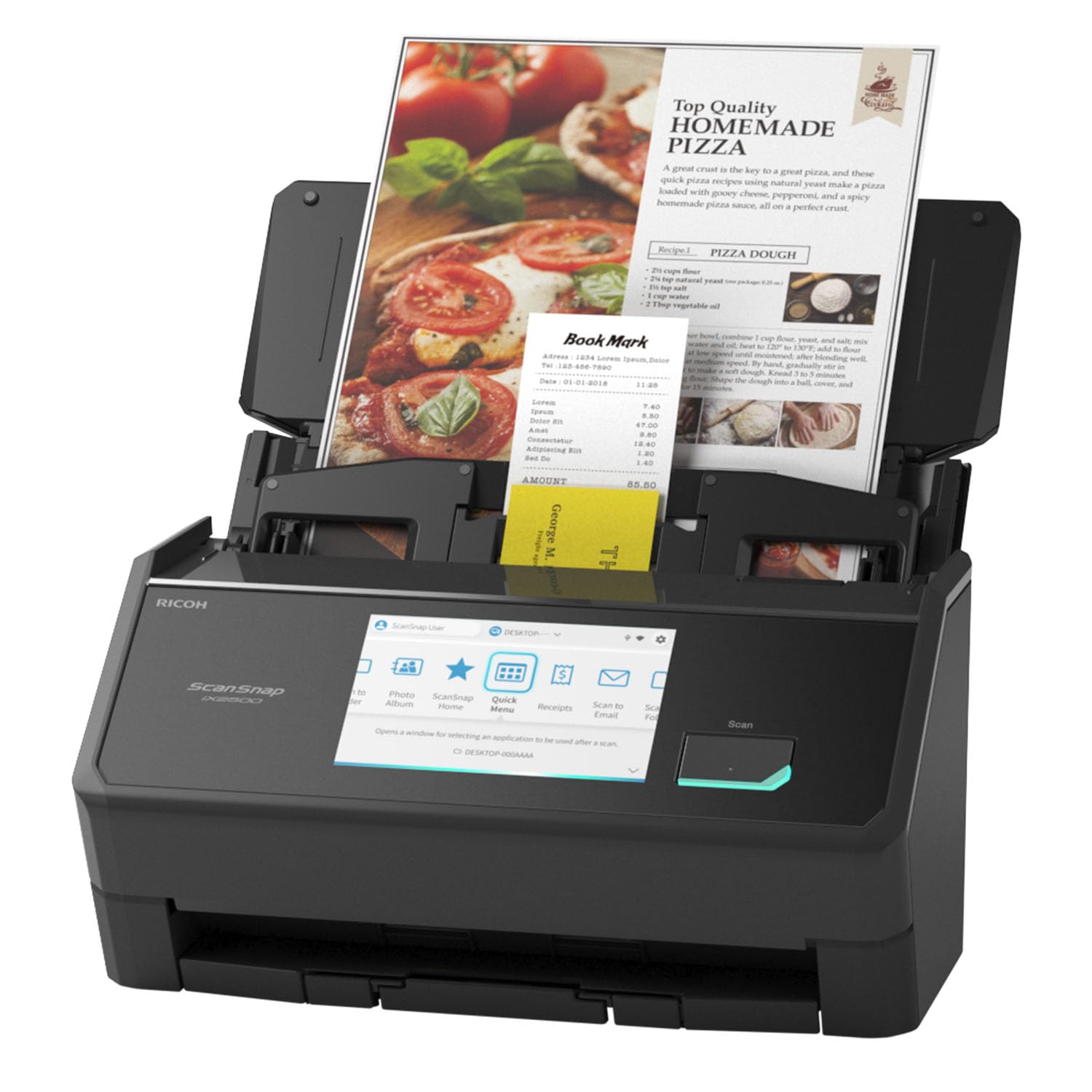
The ScanSnap iX2500 is a business-grade document scanner that happens to handle photos. Its 45-page-per-minute duplex speed and 100-sheet auto document feeder make it the fastest physical scanner on this list, but it’s overkill for 4×6 prints unless you are digitizing thousands of them in mixed batches with documents. The large 5-inch touchscreen lets you select custom scan profiles for photos versus documents, and the Wi-Fi 6 connection streams scans directly to cloud services or mobile devices without a computer.
The iX2500’s CCD-equivalent CIS sensor produces crisp 600 dpi scans with automatic detection of paper size, skew correction, and blank page removal. The brake roller system and multi-feed sensor prevent jams even with glossy photo paper, which tends to stick together in standard document feeders. Users scanning tax documents alongside family photos appreciate the automatic file naming and sorting. The PDF compression is efficient—a four-page color document compresses to about 1.2 MB.
The photo scanning limitations are non-trivial. The scanner cannot handle photos thinner than standard 20-pound paper without feeding assistance, and it will not scan photos that are already curled from age—curved prints jam in the feed path. There is no photo-specific color restoration or dust removal software built into the driver. For a pure photo archiving project, the Plustek Z300 is faster per image and better suited to the task. The iX2500 shines for mixed batches where speed across multiple media types matters more than photo-specific image processing.
Why it’s great
- 45 ppm duplex speed with 100-sheet feeder for massive batch jobs
- Wi-Fi 6 and 5-inch touchscreen for wireless scan-to-cloud workflows
- Brake roller and multi-feed sensors prevent jams with glossy paper
Good to know
- Curled or thin photos jam; not designed for fragile photo handling
- No dedicated photo color restoration or fade correction software
- Premium investment best justified for mixed document/photo batches
FAQ
Will a feed-style photo scanner damage my original prints?
What is the real resolution needed for archiving 4×6 photos?
Can I scan photos without removing them from sticky album pages?
Final Thoughts: The Verdict
For most users, the 4×6 photo scanner winner is the Plustek ePhoto Z300 because it delivers the fastest dedicated photo feed speed with genuine CCD image quality and auto-processing software that minimizes manual cleanup. If you want to scan slides and albums without a computer, grab the ClearClick QuickConvert 2.0. And for fragile, framed, or oversize items that cannot be fed through rollers, nothing beats the Flip-Pal Mobile Scanner.