
Our readers keep the lights on and my morning glass full of iced black tea. As an Amazon Associate, I earn from qualifying purchases.
Specs are compiled from manufacturer listings and verified buyer reviews and can change over time — please confirm the key details on the product page before buying.
When you buy a 4×8 plexiglass sheet, you often face a trade-off: a thin, flexible roll that may curl, or a thicker, pricier panel that stays flat. The biggest frustration buyers report is a sheet that refuses to lay flat after shipping. Here are the three real contenders, what the thickness numbers mean for your project, and which one is worth your money before you wrestle with a stubborn roll.
I’m Min — the founder and writer behind Gadgets Feed. This guide is built by comparing the manufacturers’ published specifications and the patterns across verified customer reviews, so you get each pick’s real strengths and trade-offs instead of marketing spin.
Your 4×8 plexiglass sheet choice depends on the job: crisp PETG (a glass-like plastic) suits crafting and framing, while impact-resistant polycarbonate (a tough, shatter-resistant plastic) handles outdoor barriers.
Our Picks at a Glance

How To Choose The Best 4×8 Plexiglass Sheet
Before you click buy, note that this list uses flexible matching for the exact 4×8 feet (48 x 96 inches) size — so not every pick is the exact number searched, but the nearest same-type size serves the same purpose. Double-check the thickness and material, because those two specs change everything about how your project turns out.
Thickness: The Number That Decides Everything
Thickness controls how the sheet behaves in your hands. A 0.03-inch sheet is thin and flexible — great for wrapping around frames or cutting with a utility knife — while a 0.06-inch polycarbonate panel is thicker, at 0.06 inches versus the 0.03-inch sheet, and much stiffer, which is the right call for a storm window or a barrier that needs to hold its shape. The trade-off is real: thinner means easier to work with, but thicker means more rigidity and durability.
PETG vs Polycarbonate: Know Your Material
PETG (polyethylene terephthalate glycol-modified, a clear plastic) is prized for crystal clarity that looks like glass, making it the go-to for displays, framing, and crafts. Polycarbonate is the heavy hitter for impact resistance — the material used for greenhouse panels and outdoor window replacements — but it’s also the one that gives owners the most trouble with cutting and curling. Decide if you need optical clarity or brute strength first.
Quick Comparison
In-Depth Reviews
1. PETG Clear Plexiglass Plastic Sheet (48 Inches X 96 Inches) 30mil
Our pick — over 4★ from 200+ verified ratings; the strongest balance of quality and price.
The crowd favorite for projects that demand crystal clarity with easy cutting
This PETG sheet comes rolled but unrolls fine and arrives in excellent shape, per buyers — a sharp contrast to the polycarbonate pick below that arrives curly and stays curly. At 0.03 inches (0.762mm), it’s the thinnest of the three, which is exactly why it works so well for home framing. The material is what wins people over — owners mention it’s perfect for framing cowboy poets posters and genealogy certificates with weathered cedar boards, and the protective film peels off easily and cleanly.
Beyond framing, owners have used it as a secondary pane for a Victorian arched window to stop drafts and reduce street noise, and as a shield for a fabric cat tree on a catio. It’s also thin enough to work as a dry-erase overlay — easy to hole-punch and lightweight enough for 3M hooks, with markers wiping clean. The functionality is a close second praise point, with the ease of cutting right behind it; a sheet rock knife or a square with a razor knife gets the job done.
The one honest caveat: at this thinness, the thickness gets mixed feedback — some find it thinner than expected. That’s not a defect; it’s the nature of a 0.03-inch sheet that prioritizes flexibility over rigidity. If your project needs a stiff panel that stands upright on its own, this one isn’t it.
Why crafters reach for it
- Optically clear PETG that sees through “with optical clarity” — close to glass and acrylic look
- Easy to cut with a sheet rock knife or razor knife, per multiple owner accounts
- Protective film peels off easily and cleanly, saving setup time
Who should think twice
- At 0.03″ it’s thin — owners note it’s thinner than expected
- Flexible, so it’s not for rigid self-standing panels
Reach for this if: you’re framing prints, building displays, or overlaying dry-erase art where clarity and easy cutting matter more than stiffness.
Look elsewhere if: you need a rigid barrier that holds its shape — a thicker PETG or polycarbonate fits better.
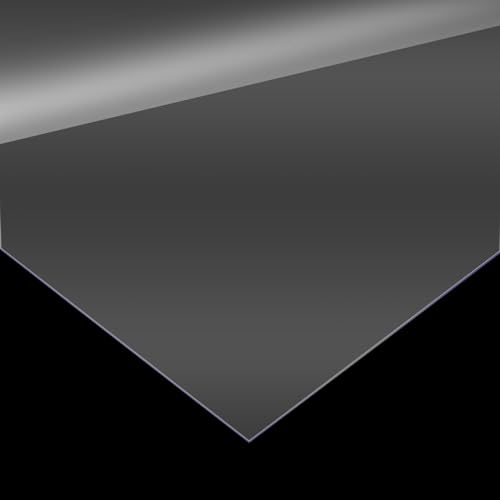
2. Beeveer Clear Polycarbonate Sheet 48 x 96 Inch Panel Roll
A bruiser of a sheet that shrugs off impacts but refuses to lay flat
At 0.06 inches (1/16″), this polycarbonate panel measures 0.06 inches thick, while the 30mil PETG above is 0.03 inches. Weighing 9.4 pounds, it’s the heavy-duty workhorse of the list, built from impact-resistant PC material with dual-sided UV coating that resists yellowing and weathering. Customers note it repelled raccoons coming through a screened porch and replaced vinyl as a stout barrier, and the dual-sided protective film keeps both faces safe in transit.
The durability is what owners praise most — it’s designed for households, workshops, car repairs, greenhouse panels, and VEX robot competitions, and it works with simple tools like scissors, a hacksaw, or a drill. The trade-off, and it’s a big one, is flatness: the recurring gripe is that this sheet arrives rolled and stays rolled. The maker’s own guidance says to lay it flat under weight for 24–72 hours or use a warm environment method, but some owners found even sun and heat wouldn’t tame it — one wrote, “THIS STUFF CANNOT BE STRAIGHTENED OUT, I HAD IT OUT SIDE IN THE SUN FOR 2 FAYS WITH WEIGHT ON IT, STILL ROLLES UP, HEATED IT UP STILL ROLLED UP.” That makes it genuinely hard to work with solo; you’ll want a second person for cutting and installing.
So who is this for? The person who needs a tough, weather-resistant panel and has the patience (and a helper) to flatten it. If your project is framing a precious print, this is the wrong tool — if it’s stopping a raccoon, it’s exactly right.
Impact hero, flatness villain: durable, UV-protected, and 0.06 inches thick versus 0.03 inches for the 30mil PETG — but the curled-roll problem is the single reason to hesitate.
Grab it for: outdoor barriers, window replacements, and greenhouse panels where impact resistance beats easy handling.
Pass if: you need a sheet that lays flat fast — this one demands weight, time, and ideally a second set of hands.
3. PETG Clear Plexiglass Sheets 48 x 96 inches – 40mil Pack of 2

Two sheets, one purchase — the smart buy when you need double coverage
This is the value play in a different sense: you get two 0.04-inch PETG sheets in one box, which changes the math for anyone covering two windows or building twin display cases. The difference versus the single 30mil sheet isn’t about thickness — it’s that this pack ships two panels where the other ships one, so you’re set up for a two-sided project from the start. At 0.040 inches, it splits the difference between the floppy 30mil and the stubborn 0.06-inch polycarbonate.
The material is PETG, giving it the same crystal clarity as the pick above — buyers sum it up simply: “As clear as glass.” Reviewers point out using them as winter storm panels on a screened porch, and the reviews are uniformly positive on quality and delivery speed, with “good quality, arrived on time, worked great for my project” as the typical take. This thickness is stiff enough for framing, shelving, and tabletop protection while still flexible enough to work with die-cutting machines for stencils and shaker cards, per the maker.
The catch is relative: at 0.04 inches it’s still not a rigid structural panel, and the buyer pool here is small, so there’s less collective wisdom on long-term quirks. But for anyone who values the efficiency of two sheets in one order — and the clarity of PETG — this is a confident pick.
The two-for-one logic: one shipment, two 0.04-inch sheets, glass-clear PETG — ideal when both sides of a job need covering or you simply want a spare.
Choose this when: you need two matching panels for storm windows, twin displays, or framing projects that benefit from a spare.
Not for: heavy outdoor abuse — that’s the polycarbonate’s job, not a 0.04-inch PETG sheet’s.
Understanding the Specs
Thickness in Inches vs Mils
A sheet’s thickness is written two ways: in inches (0.03″, 0.04″, 0.06″) or in mils, where 1 mil equals 1/1000th of an inch. So a 30mil sheet is 0.03 inches, and a 40mil sheet is 0.04 inches. Thicker means stiffer and more durable but harder to bend and cut — while thinner means easier to trim but floppier in your hands.
PETG vs Polycarbonate
PETG (polyethylene terephthalate glycol-modified) is chosen for its optical clarity that mimics glass, making it ideal for framing, displays, and crafts. Polycarbonate trades some clarity for serious impact resistance and UV protection, which is why it’s used for outdoor panels and barriers — but it’s tougher to cut and tends to hold a curl from shipping.
FAQ
Will a 4×8 plexiglass sheet fit through my door or in my car?
What is the difference between 30mil and 40mil PETG sheets?
Can I cut a 4×8 plexiglass sheet with scissors or a knife?
Why does my new plexiglass sheet arrive rolled up and curled?
Is PETG or polycarbonate better for outdoor use?
How heavy is a full 4×8 sheet of polycarbonate?
Can I use a plexiglass sheet to frame art and photographs?
What projects are these 4×8 sheets actually used for?
Does a 4×8 plexiglass sheet come with a protective film?
Final Thoughts: The Verdict
For most people, the 4×8 plexiglass sheet winner is the PETG 30mil Sheet because it delivers the optical clarity most projects need, cuts easily with a simple knife, and arrives in good shape — with the strongest owner sentiment in the group. If you want a stiffer option for framing or shelving, grab the PETG 40mil 2-Pack and get two panels in one shipment. And for outdoor barriers where impacts are a real risk, the Beeveer Polycarbonate is the one to reach for — just budget time and a helper to tame that shipping curl.
How We Picked
We do not accept paid placement. Every pick is matched to a real buyer and a real use-case; we do not hands-on test units.
Sources & Methodology
Specifications: manufacturer listings and product documentation. Review insights: verified customer reviews, as of August 2026. Pricing: not shown on this page (it changes often); check the current price via the retailer link.
As an Amazon Associate, Gadgets Feed earns from qualifying purchases. This does not affect which products we feature.