
Our readers keep the lights on and my morning glass full of iced black tea. As an Amazon Associate, I earn from qualifying purchases.
Specs are compiled from manufacturer listings and verified buyer reviews and can change over time — please confirm the key details on the product page before buying.
A fuel line that fails at the wrong moment leaves you stranded, smelling gas, or staring at a puddle under your car. The real question is not which hose fits — it is which one holds up under pressure, resists fuel blends, and survives engine heat year after year.
I’m Min — the founder and writer behind Gadgets Feed. This guide is built by comparing the manufacturers’ published specifications and the patterns across verified customer reviews, so you get each pick’s real strengths and trade-offs instead of marketing spin.
Whether you are replacing a rotted line on a classic car, a lawn mower, or a boat, picking the right 5/16 fuel line depends on working pressure (the pressure it can handle every day), fuel compatibility, and wall thickness — three numbers that tell you if the hose will last or leak.
Quick Picks
- Jeemiter 5/16″ ID Fuel Line Hose Kit – 25FT Professional Grade NBR Rubber with 10 Clamps — Best Value
- Gates 27348 Barricade Fuel Injection Hose-15′ Length, Inner Diameter 5/16″ — Pro Grade
- Continental 65127 5/16″ ID Fuel Hose – 50 psi – SAE 30R7-25′ Length — Classic Fit
- 5/16″ ID Fuel Line Hose SAE 30R7, 150 psi 25′ Length Fuel Hose (CMOOD) — Tough Wall
- 5/16 Inch ID Fuel Line Hose – 20FT Marine Grade Fuel Line with 10PCS Hose Clamps (ALLWIN) — Budget Champion
- EVIL ENERGY 5/16 Fuel Hose Line Push Lock NBR Rubber SAE 30R7 5FT 300PSI — Race Ready
How To Choose The Best 5/16 Fuel Line
A 5/16-inch inner diameter (the measurement across the hole in the hose) is a common size for small engines, classic cars, and marine fuel systems. But not every hose with that ID is built the same. Here are the three specs that separate a fuel line you install once from one you replace again next season.
Working Pressure vs. Burst Pressure
Working pressure (or maximum working pressure) is the pressure the hose can handle continuously during normal operation — think of it as the safe daily limit. Burst pressure is the extreme point where the hose would rupture. A higher working pressure usually means a thicker, tougher hose. For low-pressure systems like lawn mowers and older cars, a 50-psi working pressure is often enough. For fuel-injection setups (systems that spray fuel under high pressure) or high-performance builds, you want at least 150-300 psi working pressure and burst pressure well over 1000 psi for a safety margin, so a sudden spike does not blow a hole in the line.
SAE Rating and Fuel Compatibility
SAE 30R7 (a standard from the Society of Automotive Engineers for low-pressure fuel hoses) is the standard for low-pressure fuel lines — it resists gasoline, diesel, ethanol blends (including E-85, a fuel with up to 85% ethanol), and oil. SAE 30R14 is a higher standard for fuel-injection systems, with a much lower permeation rate (meaning less fuel vapor escapes through the hose wall) and better resistance to heat and pressure spikes. If you are working on a modern fuel-injected engine or care about emissions, a 30R14 hose like the Gates Barricade is worth the jump. For carbureted engines (engines that mix fuel and air in a carburetor instead of spraying it) and general replacement, 30R7 is reliable and far more affordable.
Nominal Wall Thickness and Kink Resistance
A hose with a thicker wall is less likely to kink (fold and pinch shut) when you bend it around tight corners in your engine bay. Thinner walls are more flexible and easier to route in straight runs, but they collapse more easily under sharp bends. Check the nominal wall thickness (the average measurement of the rubber wall itself) in the specs — a thicker wall (around 0.15 to 0.24 inches) gives you better kink resistance, while a thinner wall (around 0.125 inches) is softer and more pliable but needs careful routing to avoid pinch points.
Quick Comparison
On smaller screens, swipe sideways to see the full table.
| Model | Best For | Working Pressure | Burst Pressure | Wall Thickness | Amazon |
|---|---|---|---|---|---|
| Jeemiter 25FT Kit | Complete kit value | 300 psi | 1160 psi | 0.15625 in | $29.99Amazon |
| Gates Barricade 27348 | Fuel injection safety | 225 psi | — | — | $60.19Amazon |
| Continental 65127 | Classic car & TDI | 50 psi | 250 psi | 0.125 in | $26.42Amazon |
| CMOOD 25FT | Thick-walled durability | 150 psi | 500 psi | 0.2375 in | $23.98Amazon |
| ALLWIN 20FT Kit | Budget marine/lawn | 300 psi | 1160 psi | — | $18.89Amazon |
| EVIL ENERGY 5FT | Short race repair | 300 psi | 1200 psi | 3 mm | $14.99Amazon |
In‑Depth Reviews
1. Jeemiter 5/16″ ID Fuel Line Hose Kit – 25FT Professional Grade NBR Rubber with 10 Clamps
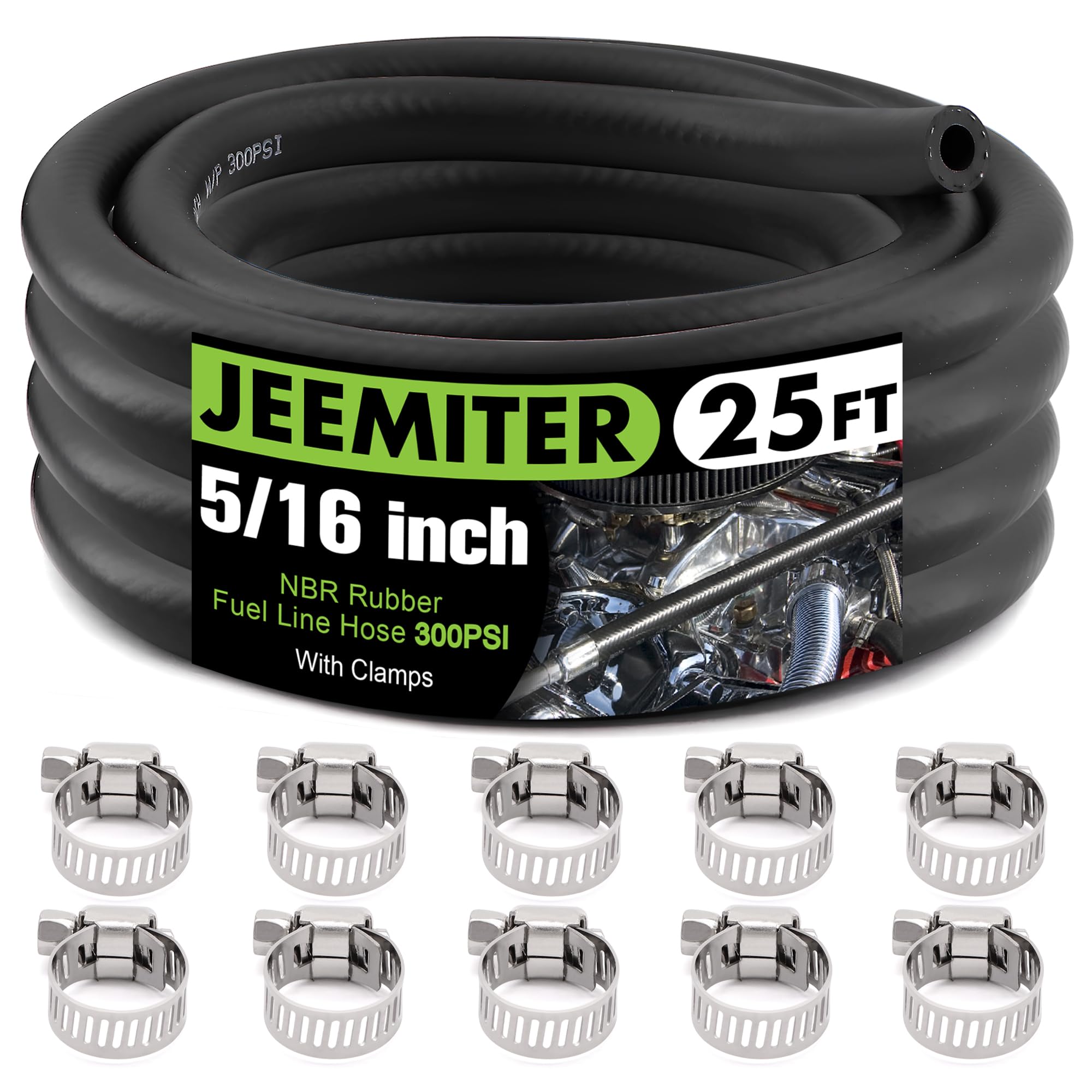
A complete 25-foot kit with clamps that punches far above its price tier in pressure ratings.
You get 25 feet of SAE 30R7 certified hose and ten matching clamps in one box, so you do not have to make a second trip to the store. The NBR rubber (nitrile butadiene rubber, a synthetic rubber that resists oil and fuel) construction delivers a 300 psi working pressure and a 1160 psi burst resistance — meaning it handles diesel, gasoline, biodiesel, hydraulic fluids, water, and air with a big safety margin for most engines, so you do not have to worry about a sudden rupture. Buyers report the hose is “tough” and proper size, though one noted “the included clamps are poor — OK for light duty work” and that a 5.5mm nut (not a common size) fits them best, so you might need to supply your own clamps.
A 300 psi working pressure is six times higher than the Continental 65127’s 50 psi rating, which matters if you ever upgrade to a fuel-injection system or want serious overhead protection. The nominal wall thickness sits at 0.15625 inches — thicker than the Continental, thinner than the CMOOD, giving it a solid middle ground between kink resistance and flexibility. For the money, this is the kit that covers the most ground for cars, trucks, boats, and lawn mowers right from the start.
What Stands Out
- 300 psi working pressure and 1160 psi burst resistance provide a large safety buffer
- 10 clamps included eliminate extra shopping
- Multi-fuel compatible (gasoline, diesel, oil, biodiesel, water, air)
What to Watch
- Included hose clamps are light-duty and use an uncommon 5.5mm nut
- Long-term durability not yet proven in reviews
Reach for this if: You want a full 25-foot kit with high pressure ratings for multiple vehicles and do not mind swapping the clamps for better ones later. It is a confident first pick for anyone from lawn mower owners to classic car enthusiasts.
2. Gates 27348 Barricade Fuel Injection Hose-15′ Length, Inner Diameter 5/16″
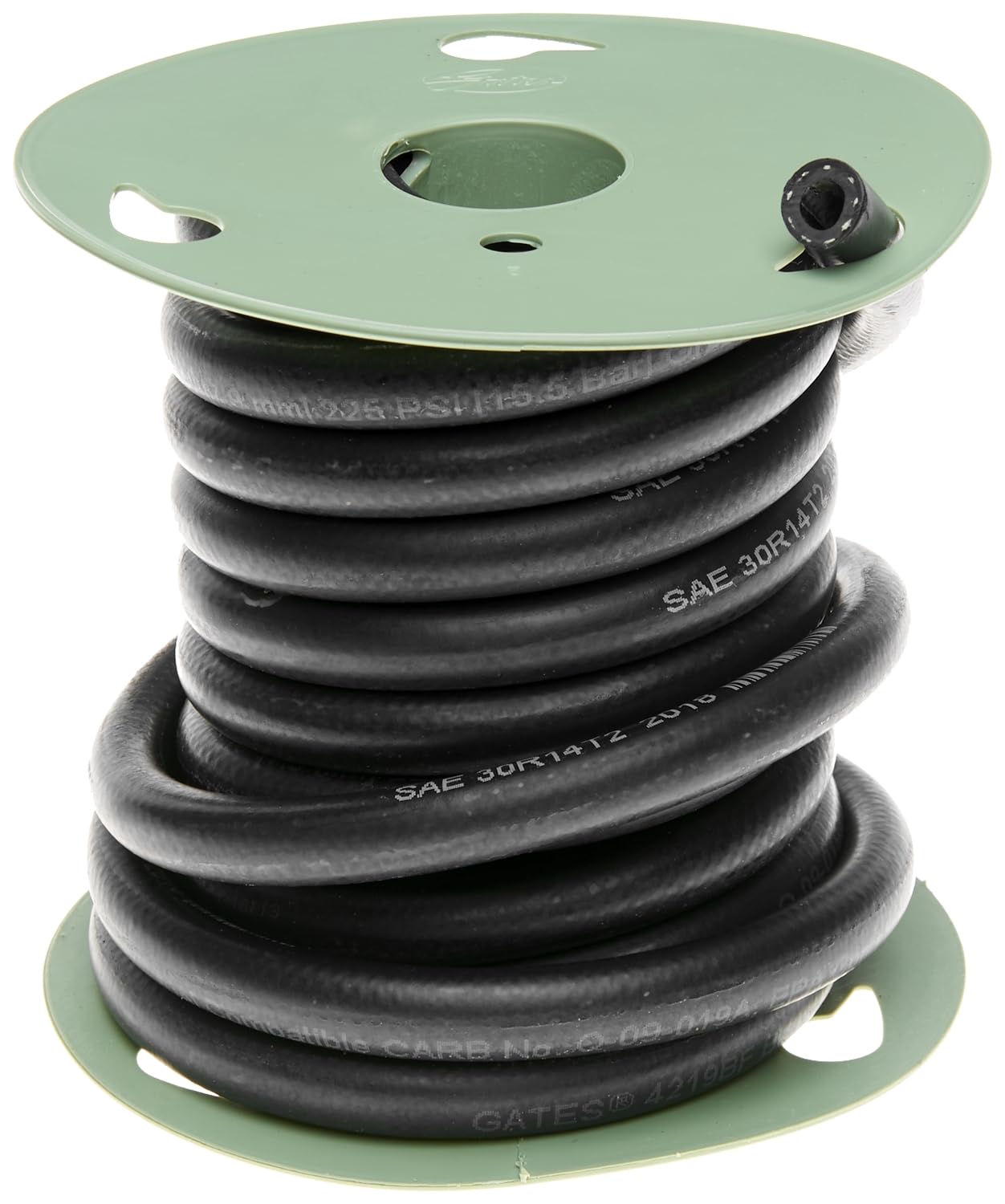
The gold standard for ethanol resistance and fuel-injection safety in a premium 15-foot hose.
This hose uses an HNBR tube (hydrogenated nitrile butadiene rubber, which resists heat and chemicals better than standard rubber) with a thermoplastic barrier, aramid fiber reinforcement (a strong synthetic fiber used in body armor), and a CPE cover (chlorinated polyethylene, a tough outer layer) — a material stack that gives it an extremely low permeation rate, meaning very little fuel vapor escapes through the hose wall. That matters for modern fuel-injected engines where vapor loss can trigger smell, waste fuel, or fail emissions checks. It meets SAE 30R14 T2 (a strict standard for fuel injection hoses, except for kink resistance), CARB (California Air Resources Board, a strict emissions standard), and EPA non-road fuel line standards, which is a step above the standard 30R7 ratings. At 225 psi maximum pressure, it handles fuel injection pressures with room to spare, so high-pressure fuel does not force a leak.
Unlike the Continental 65127 at 25 feet, this Gates hose is 15 feet long — 67% less length, but built for a higher-performance job. One buyer replaced deteriorated, hardened lines on a pressure washer and vintage motorcycle, calling it “high quality, ethanol-compatible replacement” that prevented a fire hazard from the old non-ethanol-compatible line. Another reviewer noted it worked perfectly on a 1991 VW Vanagon, saying it is “recommended to do every seven years.” The trade-off is the price — this is the premium option, and you pay for that multi-layer construction and certification.
Why It Wins
- Extremely low permeation rate seals in fuel vapors
- Aramid fiber reinforcement for high-pressure fuel injection
- Meets SAE 30R14, CARB, and EPA standards
Trade-Offs
- 15 feet is shorter than bulk hose options at the same price
- Not rated for kink resistance in tight bends
Pick this for: Fuel-injected engines, ethanol-heavy fuel blends, or any installation where vapor emissions and safety are your top concern. Its multi-layer build justifies the premium price for safety-minded buyers.
3. Continental 65127 5/16″ ID Fuel Hose – 50 psi – SAE 30R7-25′ Length

Soft, pliable nitrile hose that vintage car owners and TDI fans swear by for simple replacements.
Continental’s 25-foot, 50 psi working pressure hose is built for low-pressure systems like classic cars, lawn tractors, and VW TDIs (turbocharged direct injection diesel engines). Owners mention it is a “perfect fit to replace hoses on a VW TDI” and “quality domestically produced” with a current year date code and USA sourcing. The nitrile material is soft and easy to route around engine compartments — but that softness is also its biggest weakness. One reviewer noted it “kinks easily” and said the “outer jacket too soft, lacks cut/abrasion/kink protection,” warning it is not for high-vibration environments, meaning it may flatten in tight bends.
With a burst pressure of 250 psi and a nominal wall thickness of 0.125 inches, this hose is the thinnest wall in the lineup — the CMOOD hose, by contrast, has a wall thickness of 0.2375 inches, which is roughly 1.9 times thicker and far more resistant to kinking. For an old pickup, a 1980s Mercedes, or a VW that needs factory-style routing, this is the hose to grab. For a high-vibration engine bay or sharp 90-degree bends, consider a thicker wall.
Strengths
- 25-foot length gives you plenty of slack for long runs
- Soft nitrile material is easy to route and connect
- USA-sourced with current date code per buyers
Weaknesses
- Kinks easily due to thin 0.125-inch wall and soft jacket
- 50 psi working pressure limits use to low-pressure systems only
Best for: Classic cars, TDIs, and low-pressure applications where original-like flexibility matters more than brute strength. If you are restoring a vintage VW, this is the closest to factory spec.
4. 5/16″ ID Fuel Line Hose SAE 30R7, 150 psi 25′ Length Fuel Hose (CMOOD)

Thicker wall than any other hose here, making it the go-to for kink-prone routes and medium-pressure jobs.
At 0.2375 inches of nominal wall thickness, this CMOOD hose is the thickest in the group — it measures about 1.9 times thicker than the Continental 65127. That extra rubber means it resists kinking when you bend it around tight corners in a mower deck or engine bay, so you do not cut off fuel flow. The working pressure is 150 psi and burst pressure is 500 psi, putting it in a comfortable middle zone between basic low-pressure hoses and high-end fuel injection lines. It handles unleaded gasoline, diesel, ethanol (E-10), E-85, and sour gas blends, making it flexible for different fuel types.
Buyers are straightforward about it: “Good quality and a good price,” “Worked perfectly to replace the fuel line on the mower,” and “It’s a fuel line. Works fine.” No one is calling it exotic — it just does the job. If you are replacing a rotted hose on a lawn tractor or routing a new line in a classic car and you want the wall thickness to fight pinch points, this is the one to reach for. The 25-foot length gives you enough to do a whole vehicle plus have leftovers. Unlike the Jeemiter kit, you will need to buy clamps and fittings separately.
Why Choose It
- Thickest wall at 0.2375 inches resists kinking in tight bends
- 150 psi working pressure covers most carbureted and some injected systems
- E-85 compatible for ethanol-heavy fuels
Considerations
- No included clamps or fittings — buy separately
- Less flexible than thinner-wall hoses for straight, long runs
Grab this for: Any installation with sharp bends or where you want a hose that will not collapse under a tight clamp. It is the practical choice for mower replacements where kinking is the main headache.
5. 5/16 Inch ID Fuel Line Hose – 20FT Marine Grade Fuel Line with 10PCS Hose Clamps (ALLWIN)
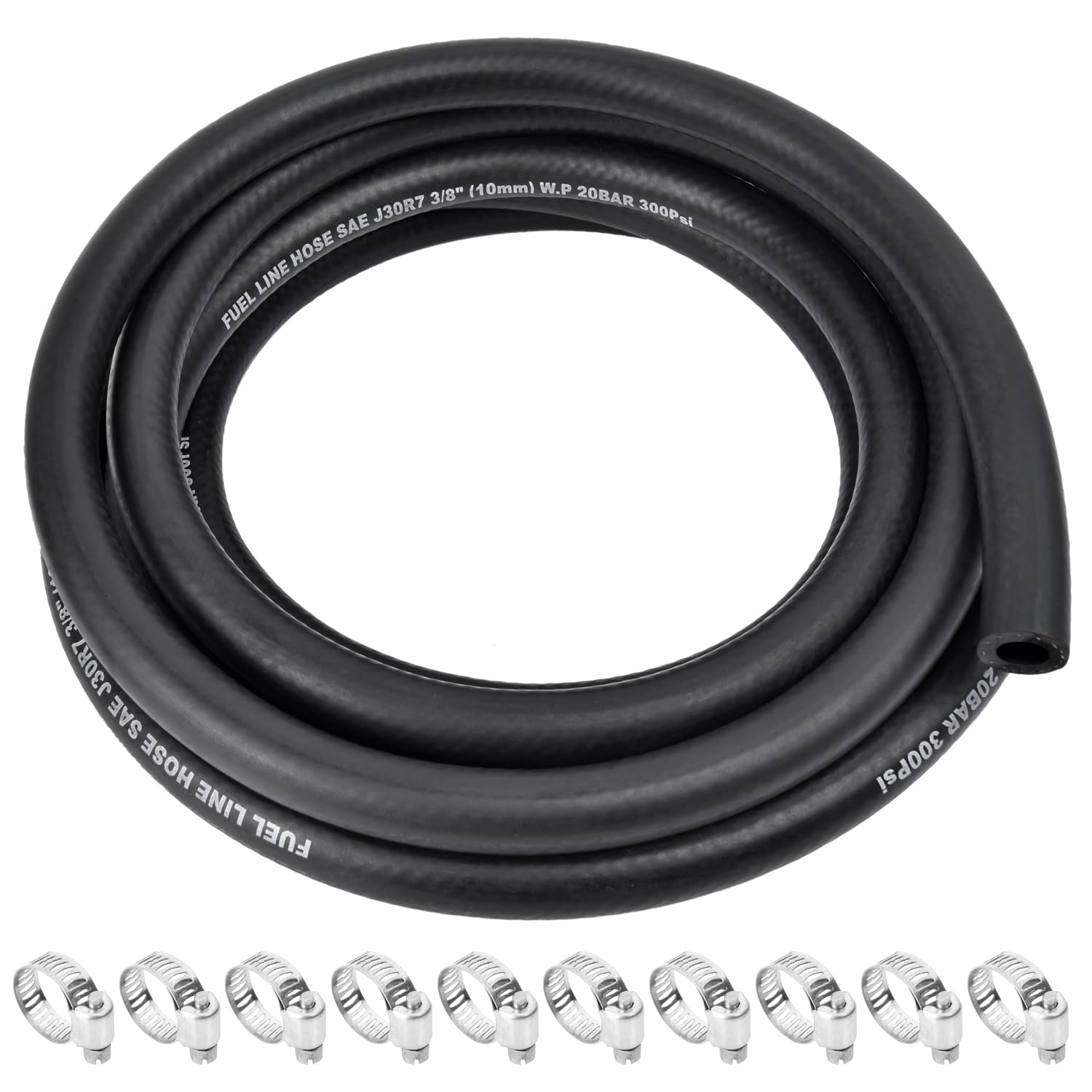
A budget-friendly 20-foot kit with marine-grade pressure ratings that undercuts auto parts store prices dramatically.
The ALLWIN hose delivers a 300 psi working pressure and 1160 psi burst pressure — the same headline numbers as the Jeemiter kit, but with 20 feet of hose instead of 25 and a slightly lower entry price. It is made from NBR material with oil resistance, heat resistance, and flame resistance built in. The working temperature range is -40°F to 257°F, so it holds up in both freezing winters and hot engine bays, meaning it won’t crack in the cold or soften in the heat. One buyer put it to use replacing a fuel line on a push mower, noting it “works perfectly with the new valve” and that the included clamps were an unexpected bonus. Another called it “far cheaper than auto parts store (/ft),” confirming the value proposition.
A minor caveat: one package arrived with a hole in the bag, and one clamp was missing. Another reviewer pointed out “there was no documentation printed on the hose,” which made them question the quality despite the decent feel. The hose weighs 1.7 pounds, making it 53% lighter than the Continental 65127’s 2.6 pounds — partly because it is five feet shorter and partly because of material differences. For a lawn tractor, boat, or small engine where high-pressure ratings are nice but not critical, this kit saves real money.
What Impresses
- 300 psi working pressure at a budget-friendly price
- 10 clamps included for a complete installation
- Marine-grade material with heat and oil resistance
What Gives Pause
- No markings printed on the hose for identification
- Packaging can let clamps escape during shipping
Go with this if: You need a quick, cheap replacement for a push mower, boat, or small engine and want clamps in the box. The price-per-foot is the lowest here, making it the budget champion for light-duty repairs.
6. EVIL ENERGY 5/16 Fuel Hose Line Push Lock NBR Rubber SAE 30R7 5FT 300PSI
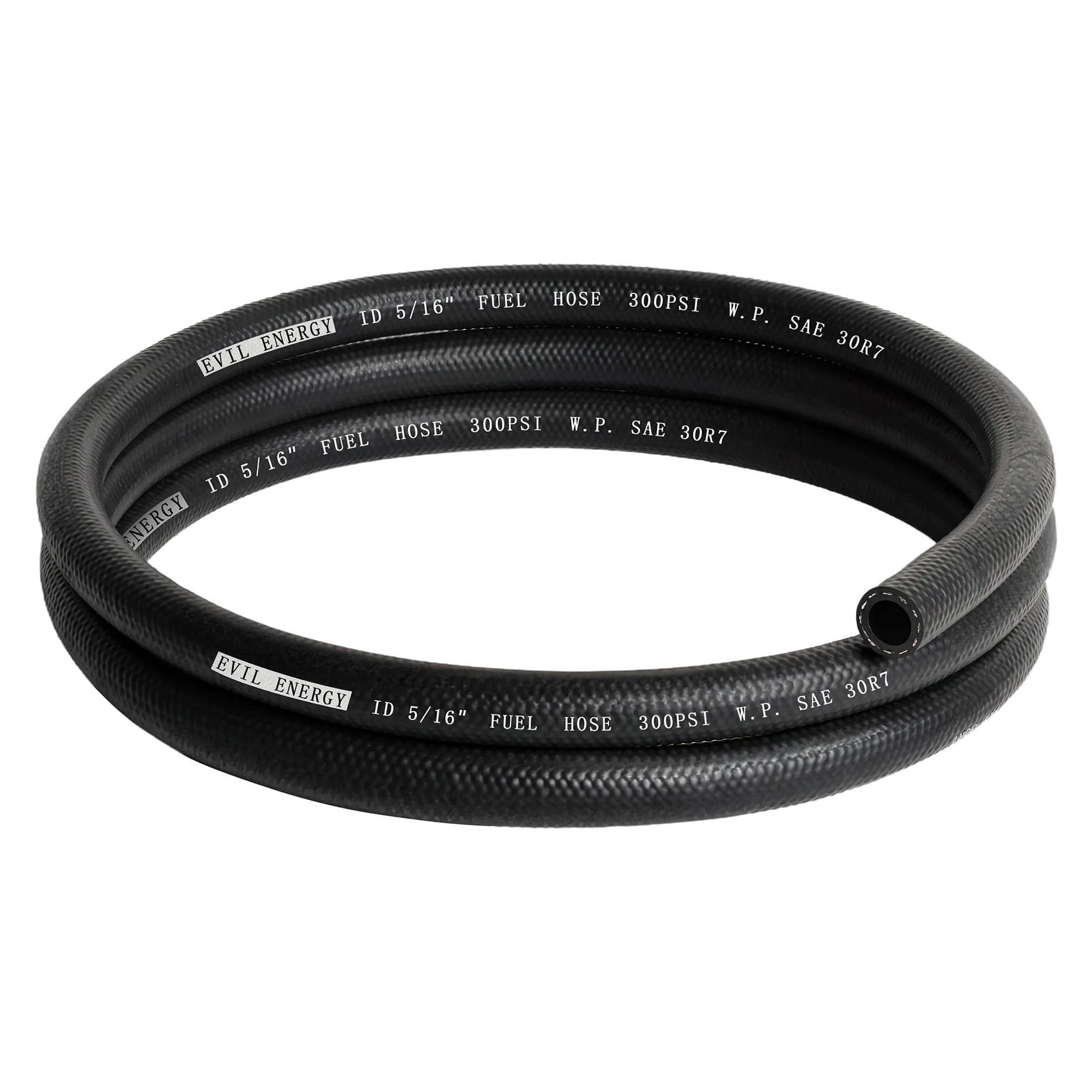
Short, tough 5-foot section built for race car push-lock fittings and critical low-pressure replacements.
With a 300 psi working pressure and a 1200 psi burst pressure, this EVIL ENERGY hose has the highest burst rating in the entire lineup — 4.8 times higher than the Continental 65127’s 250 psi burst pressure. That extra headroom matters when you are pushing a fuel system hard on a track car or heavy equipment, so an unexpected spike does not cause a failure. The NBR rubber and braided polyester fiber construction complies with SAE 30R7 standards and is compatible with diesel, oil, gasoline, biodiesel, and grease. Buyers on race cars report “we use Evil Energy fittings on all our race cars and have never had any issues with fitment, quality or longevity,” and one specifically called it a “perfect low-pressure replacement for t680” PACCAR line — spot-on fit with no leaks.
The trade-off is the length: at 5 feet, you are not covering a whole vehicle run. This is a repair section or a short jumper hose, not a full replacement roll. One buyer mentioned the packaging “was more like something for high end electronics,” which speaks to the care in shipping. The nominal wall thickness is 3 millimeters, and the outside diameter is 14 millimeters. If you only need a short piece and want the highest burst safety margin, this is the one.
High Points
- 1200 psi burst pressure — highest in the group
- Proven on race cars and heavy truck low-pressure lines
- Works with push-lock fittings for quick installation
Limitations
- Only 5 feet long — not enough for a full vehicle run
- Higher price per foot compared to bulk 25-foot options
Ideal for: Race car fuel system repairs, short PACCAR line replacements, or any job needing a short, ultra-strong hose with push-lock compatibility. The highest burst rating makes it a no-brainer for safety-critical short sections.
Understanding the Specs
SAE 30R7 vs. SAE 30R14
SAE 30R7 is the standard rating for low-pressure fuel lines used in carbureted engines, lawn mowers, and older cars. It handles gasoline, diesel, ethanol blends, and oil at working pressures typically up to 300 psi. SAE 30R14 is a stricter standard for fuel-injection systems — it demands an extremely low permeation rate (meaning far less fuel vapor escapes through the hose wall) and higher heat resistance, so your engine bay stays fume-free and emissions-compliant. If you are working on a modern fuel-injected car or care about emissions compliance, look for 30R14. For everything else, 30R7 is perfectly reliable and more affordable.
Working Pressure and Burst Pressure
Working pressure (sometimes called maximum working pressure) is the pressure the hose can handle continuously during normal operation without failing. Burst pressure is the point at which the hose would rupture under extreme conditions — it is usually a safety margin above the working pressure, ensuring you have a buffer if something spikes. For a lawn mower or classic car with a mechanical fuel pump, a working pressure of 50 to 150 psi is plenty. For a fuel-injected engine or a high-performance build, a working pressure of 225 to 300 psi with a burst pressure over 1000 psi gives you a comfortable safety buffer.
FAQ
Can I use a 5/16 fuel line for diesel fuel?
What is the difference between 5/16 fuel line and 5/16 fuel injection hose?
How do I know if a 5/16 fuel line will fit my car?
Does a thicker wall mean a better fuel line?
Can I use 5/16 fuel line for E-85 ethanol fuel?
How long does a 5/16 fuel line last before needing replacement?
What is the best 5/16 fuel line for a lawn mower?
Can I cut a 5/16 fuel line to any length I need?
Are the hose clamps included with kits any good?
What does SAE 30R7 mean on a fuel hose?
Final Thoughts: The Verdict
For most buyers, the 5/16 fuel line winner is the Jeemiter 25FT Kit because it delivers the highest working pressure (300 psi) and burst resistance (1160 psi) in a complete kit with ten clamps for a mid-range price, covering lawn mowers, cars, trucks, and boats in one box. If you want maximum ethanol and vapor protection for a fuel-injected engine, grab the Gates Barricade 27348 — its SAE 30R14 rating and aramid fiber reinforcement make it the safety-first choice for emissions-conscious builders. And for a budget-friendly quick repair on a small engine or boat, the standout is the ALLWIN 20FT Kit with its 300 psi rating and included clamps at an entry-level price.
How We Picked
We do not accept paid placement, and we did not hands-on test every unit. Instead, we match each pick to a real buyer and use-case by comparing the manufacturers’ published specifications against the patterns in verified customer reviews — so you get each pick’s real strengths and trade-offs instead of marketing copy.
Sources & Methodology
Specifications: manufacturer listings and product documentation. Review insights: verified customer reviews, as of July 2026. Pricing: not shown on this page (it changes often); check the current price via the retailer link.
As an Amazon Associate, Gadgets Feed earns from qualifying purchases. This does not affect which products we feature.
Product prices and availability are accurate as of the date/time indicated and are subject to change. Any price and availability information displayed on Amazon at the time of purchase will apply to the purchase of this product. As an Amazon Associate I earn from qualifying purchases.
CERTAIN CONTENT THAT APPEARS ON THIS SITE COMES FROM AMAZON. THIS CONTENT IS PROVIDED "AS IS" AND IS SUBJECT TO CHANGE OR REMOVAL AT ANY TIME.
Amazon and the Amazon logo are trademarks of Amazon.com, Inc. or its affiliates.