
Five lenses on a single device sounds like a specification brag, but the real question is whether each sensor earns its place on the back of your phone or simply pads a bullet list. A dedicated macro sensor is useless if the main sensor cannot hold detail in low light, and a telephoto lens without optical image stabilization turns distant subjects into smudges. The best builds in this category balance focal length coverage, sensor size, and computational photography so that every lens serves a distinct purpose.
I’m Min — the co-founder and writer behind Gadgets Feed. I spend my days dissecting spec sheets and analyzing how multi-camera architectures perform under real-world lighting, motion, and zoom scenarios so you can separate genuinely useful hardware from marketing noise.
Whether you prioritize optical zoom range, megapixel count per sensor, or the quality of the software pipeline stitching those images together, this breakdown of the best 5 camera phone options will help you match a multi-lens system to your actual shooting habits.
How To Choose The Best 5 Camera Phone
Five lenses offer more focal length flexibility than a standard triple-camera setup, but not every system is built the same. The three factors below will help you evaluate whether a multi-lens array truly upgrades your photography or just adds redundant hardware.
Focal Length Coverage and Sensor Specialization
A well-designed 5 camera phone covers ultrawide, wide, telephoto, and macro fields of view without significant overlap. Look for a periscope telephoto lens offering at least 5x optical zoom with OIS, a dedicated ultrawide sensor with a minimum 120-degree field of view, and a macro lens that focuses closer than 5 cm. Avoid phones where the fifth lens is a 2-megapixel depth sensor that adds nothing to image quality.
Computational Photography and Sensor Size
Five lenses generate massive amounts of data, so the on-board image signal processor and AI engine must fuse frames efficiently. A phone with a 1.4-micron or larger main sensor will produce cleaner low-light shots regardless of lens count. Pixel binning technology that combines four pixels into one is also critical for reducing noise in dim environments, especially when using telephoto and ultrawide sensors with smaller pixels.
Stabilization and Video Recording Capabilities
Optical image stabilization on both the main and telephoto lenses is non-negotiable for handheld zoom shots. For video, confirm that the phone supports stabilized 4K at 60 fps across at least two lenses and that sensor-shift or gimbal-type stabilization is present on the primary camera. Without robust stabilization, the versatility of multiple lenses is lost the moment you record while walking.
Quick Comparison
On smaller screens, swipe sideways to see the full table.
| Model | Category | Best For | Key Spec | Amazon |
|---|---|---|---|---|
| Nothing Phone (3) | Quad 50MP | Balanced imaging and clean software | 4x 50MP sensors + 50MP front | Amazon |
| Apple iPhone 16 Pro Max | Triple Pro | Professional-grade video and color | 48MP main + 12MP telephoto 5x | Amazon |
| Xiaomi 14T Pro | Leica Optics | Leica-tuned color science | 50MP triple Leica + 32MP selfie | Amazon |
| Google Pixel 10 | Triple AI | Computational photography and AI editing | 50MP main + 48MP telephoto 5x | Amazon |
| Samsung Galaxy Z Fold7 | Foldable Flagship | 200MP main and tablet-sized screen | 200MP main + 12MP ultrawide + 10MP telephoto | Amazon |
| Samsung Galaxy S21 Ultra | Quad Zoom | Extreme optical zoom range | 108MP main + 10x optical periscope | Amazon |
| Motorola Razr+ (2023) | Flip Foldable | Compact foldable with flex selfie mode | 12MP main + 13MP ultrawide + 32MP front | Amazon |
| 8849 Tank X | Rugged Projector | Outdoor durability and built-in projector | 64MP night vision + 50MP main + 8MP tele | Amazon |
| AGM G3 Pro | Thermal Rugged | Thermal imaging and heavy-duty build | 64MP main + 50MP wide + 25fps thermal | Amazon |
| Ulefone Armor 34 Pro Plus | Rugged Projector | Massive battery and 150-lumen projector | 64MP night vision + 50MP main + 150lm projector | Amazon |
| Fujifilm X100VI | Dedicated Camera | True photographic quality over phone convenience | 40MP APS-C sensor + 23mm f/2 fixed lens | Amazon |
In‑Depth Reviews
1. Nothing Phone (3)

The Nothing Phone (3) delivers a rare combination: four 50MP sensors that actually serve distinct roles rather than padding a spec sheet. The main, periscope telephoto, and ultrawide lenses each use the same 50MP resolution, which means consistent color science and detail levels when switching focal lengths — something most multi-camera systems fail to achieve. The 50MP front camera also matches the rear resolution, making self-portraits as sharp as rear shots.
Under the hood, the Snapdragon 8s Gen4 chip powers the AI engine that organizes captures through the Essential Space feature. The 6.67-inch 1.5K AMOLED LTPO display hits 4500 nits peak brightness and 460 PPI, so reviewing images in direct sunlight is easy. The 5150mAh battery supports wireless charging, and the Glyph Interface adds a practical notification layer without draining the camera optics budget.
The only real compromise is network compatibility: Verizon requires a manual IMEI whitelist, so T-Mobile or AT&T users will have the smoothest experience. Case and screen protector availability is also slim due to the unique rear design, but for pure photographic balance across four lenses, this phone leads the list.
Why it’s great
- All four rear sensors are 50MP with consistent color science
- Periscope telephoto lens offers true optical zoom
- Clean Nothing OS with minimal bloat and fast updates
Good to know
- Verizon compatibility requires manual IMEI whitelist
- Limited third-party case and screen protector selection
- AI button cannot be fully remapped
2. Apple iPhone 16 Pro Max
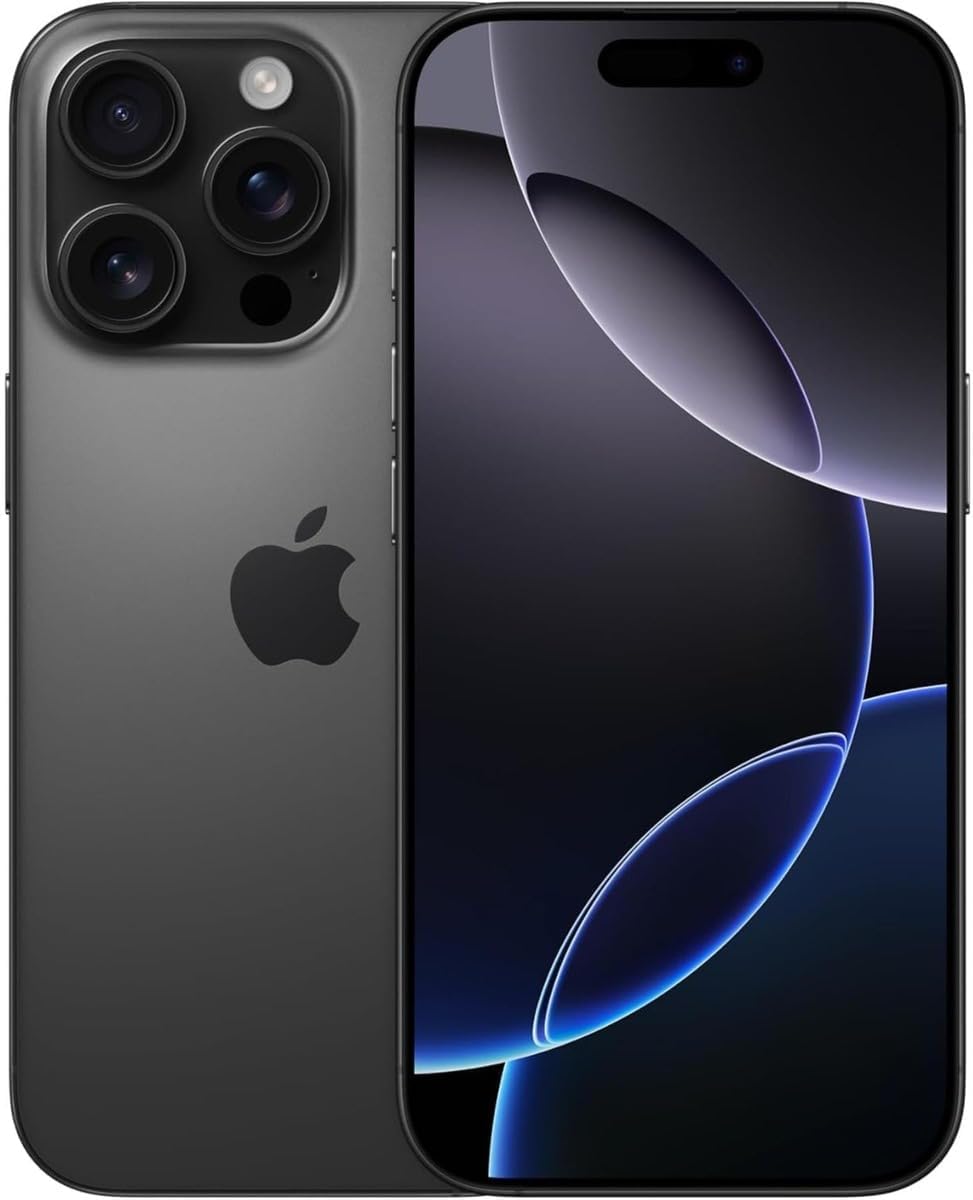
The iPhone 16 Pro Max approaches multi-lens photography from a computational angle rather than raw lens count. Its 48MP main sensor uses a quad-pixel architecture to capture detailed 24MP images by default, while the 12MP telephoto lens with 5x optical zoom relies on the A18 Pro chip’s image pipeline to stabilize distant subjects. The Action button provides a hardware shortcut to launch the camera or start recording, which speeds up spontaneous capture.
The 6.9-inch ProMotion OLED display at 120Hz makes framing and reviewing shots fluid, and the titanium frame keeps the phone lighter than previous stainless steel models — a practical benefit during long handheld recording sessions. Spatial audio and improved microphones make this the strongest video platform among premium devices, especially for creators who shoot on the go.
Battery life reaches 33 hours of video playback, and the 4685mAh cell supports MagSafe wireless charging. The renewed units often arrive with cosmetic grade condition and battery capacities above 95%, but buyers should verify the side camera button is functional on arrival, as some units have shipped with non-responsive buttons.
Why it’s great
- Best-in-class video stabilization and spatial audio recording
- 5x optical telephoto with excellent low-light processing
- Action button provides instant camera access
Good to know
- Limited to 12MP telephoto sensor compared to Android competitors
- Renewed units may have non-functional side camera button
- No physical SIM slot on US models
3. Xiaomi 14T Pro

The Xiaomi 14T Pro brings Leica’s optical philosophy to a 50MP triple-camera system. The main sensor uses the Light Fusion 900 sensor with a 2.4-micron super pixel after binning, and the telephoto lens provides 60mm equivalent focal length at f/2.0 with OIS. The Leica Authentic and Vibrant looks apply real-time color grading, and the Master-lens system offers four simulated styles — 35mm documentary, 50mm swirly bokeh, 75mm portrait, and 90mm soft focus.
The 6.67-inch AMOLED display reaches 144Hz refresh rate and 4000 nits peak brightness, making camera gallery browsing exceptionally smooth. The MediaTek Dimensity 9300+ processor handles the Leica image pipeline without lag, and the 5000mAh battery charges at 120W wired — a full charge takes about 20 minutes. Storage options include a 1TB variant, which is generous for 50MP RAW files.
Network compatibility is the primary limitation: this global model works reliably only on T-Mobile and its MVNOs in the US. AT&T, Verizon, and Cricket are not supported. The telephoto lens also lacks OIS at the hardware level, relying on electronic stabilization which can introduce jitter in lower light.
Why it’s great
- Leica optical tuning delivers distinct color profiles not found on other phones
- 120W wired charging provides a full charge in 20 minutes
- 1TB storage option accommodates high-resolution RAW files
Good to know
- Compatible only with T-Mobile and its MVNOs in the US
- Telephoto lens lacks hardware OIS
- No warranty support in the US
4. Google Pixel 10
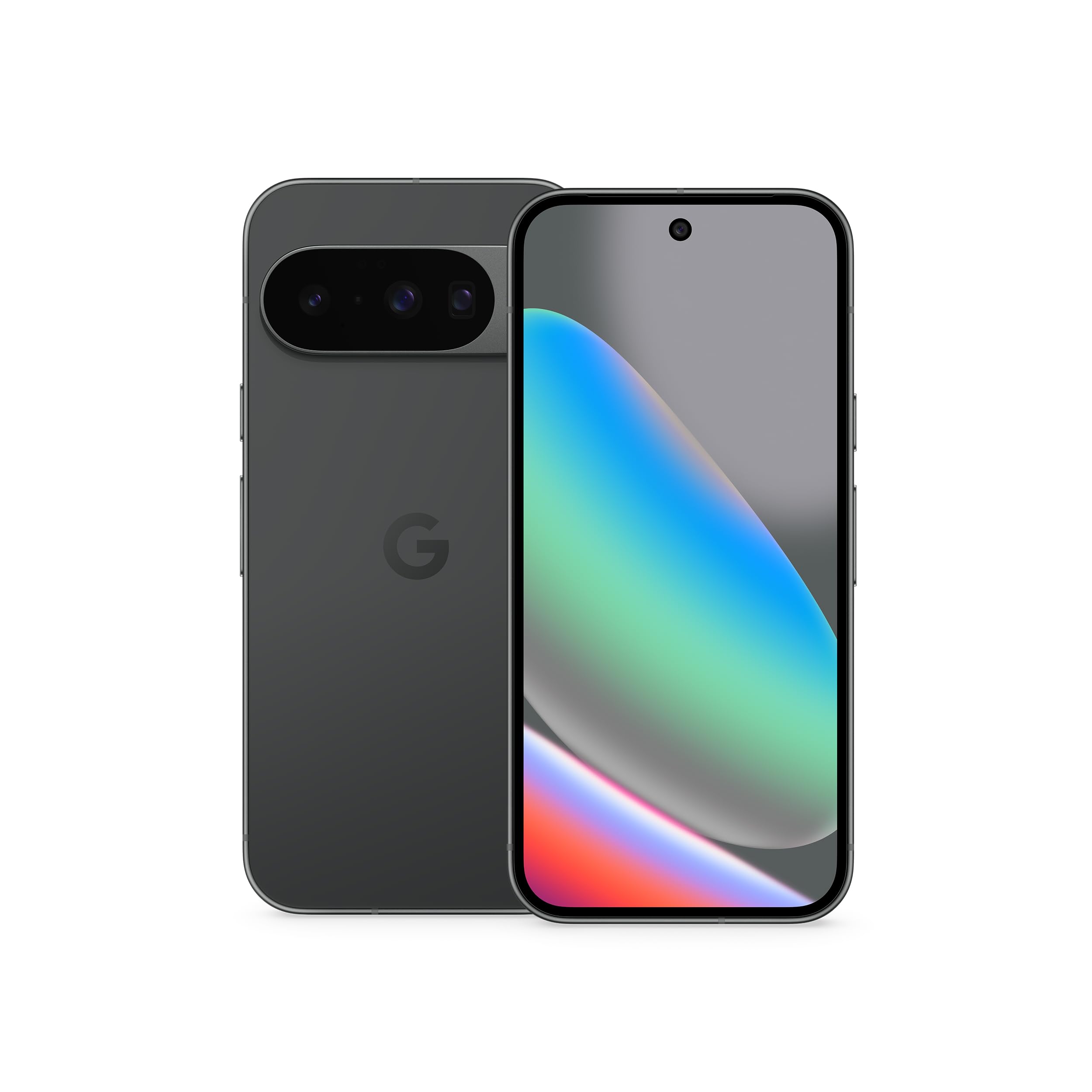
The Google Pixel 10 proves that a triple-camera system can outperform many quad-camera rivals when the computational photography pipeline is this refined. The 50MP main sensor is paired with a new 5x telephoto lens that delivers up to 20x Super Res Zoom, while the Tensor G5 chip handles real-time HDR fusion and Night Sight processing that recovers detail in near-dark conditions. The Camera Coach feature analyzes the scene and suggests optimal settings, which is useful for less experienced shooters.
The 6.3-inch Actua display hits 3000 nits peak brightness, and the Corning Gorilla Glass Victus 2 resists scratches from daily pocket carry. The 4970mAh battery comfortably exceeds the advertised 24-hour life, and the unlocked variant supports all major US carriers including AT&T, Verizon, and T-Mobile. The eSIM-only configuration on some models eliminates the physical SIM tray entirely.
Ai features like Magic Eraser, Photo Unblur, and the new Gemini integration are tightly woven into the camera app, but the phone lacks a dedicated macro lens — close-up shots rely on the ultrawide sensor’s autofocus. The boot time is slower than competing flagships, though a post-launch update has improved boot speed substantially.
Why it’s great
- Best-in-class computational photography for low-light and zoom
- Full carrier compatibility in the US with all major networks
- Reliable software updates directly from Google
Good to know
- No dedicated macro lens for close-up shots
- eSIM-only configuration on some models
- Boot time initially slower than competing flagships
5. Samsung Galaxy Z Fold7
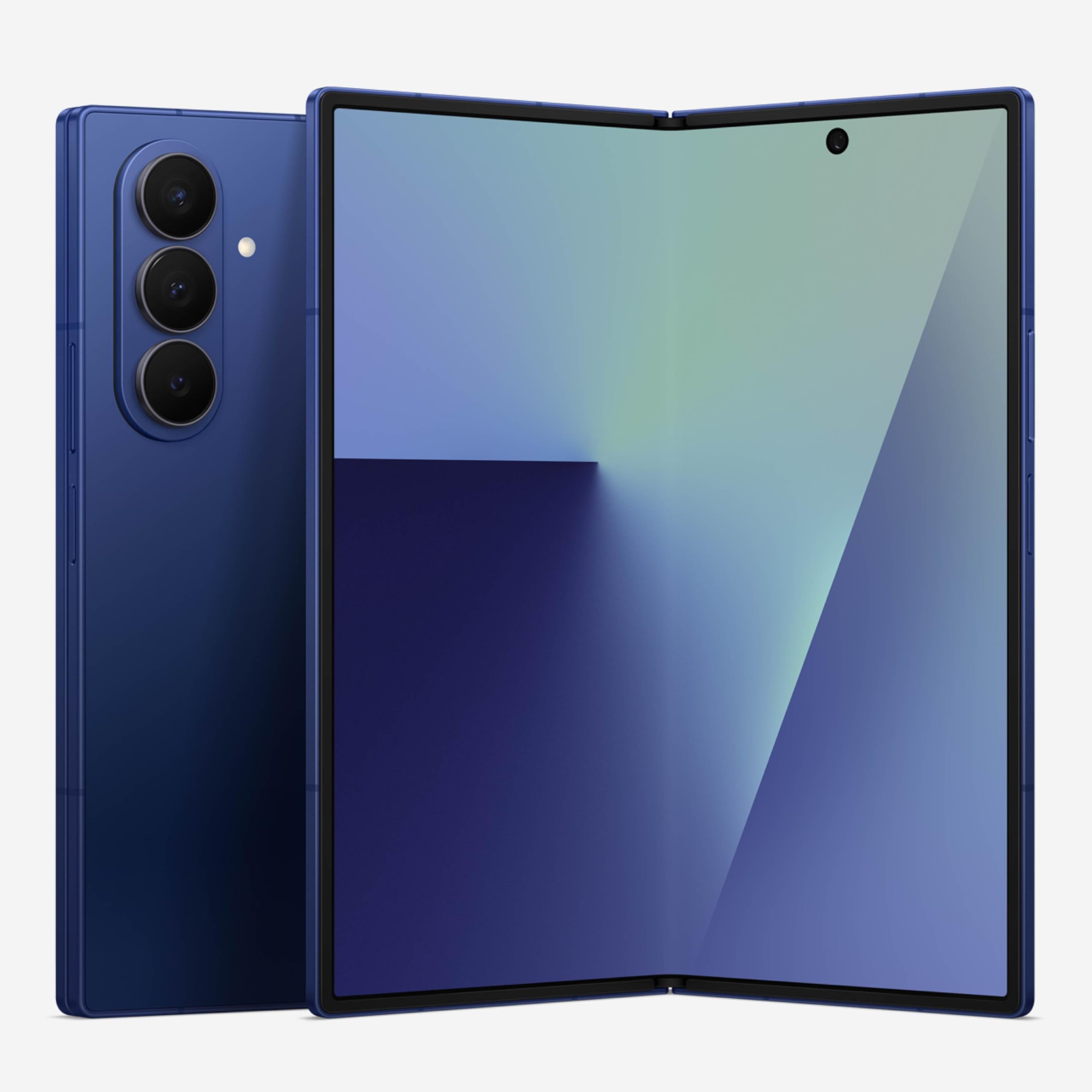
The Galaxy Z Fold7 brings a 200MP main sensor to the foldable form factor, marking a significant upgrade over previous Fold cameras. The Pro-Visual Engine processes the high-resolution sensor to produce detailed 12.5MP binned images, while the 10MP telephoto lens with 3x optical zoom provides decent reach. The large 8-inch internal display doubles as a massive viewfinder, making it easier to frame complex shots or review edits in real time.
The Snapdragon 8 Elite processor and 4400mAh battery handle multitasking across up to three windows, and the thinner, lighter design compared to the Fold6 makes it more comfortable for extended photo sessions. The 200MP sensor captures enough detail for cropping without losing quality, which partially compensates for the lack of a periscope zoom lens. The cover display is now wider, making quick single-handed shots more practical.
The foldable mechanism remains a concern for long-term durability despite the improved Armor Aluminum frame. Users report that the crease becomes more visible over time, and the hinge adds noticeable thickness when folded. The telephoto zoom is limited to 3x optical, which falls short of the 5x or 10x periscope lenses found on standard flagship slab phones.
Why it’s great
- 200MP main sensor enables extensive cropping without quality loss
- 8-inch internal display serves as a huge viewfinder
- Multi-window capability for editing and comparing shots
Good to know
- Telephoto zoom limited to 3x optical, no periscope lens
- Visible screen crease develops over time
- Hinge adds bulk when folded compared to slab phones
6. Samsung Galaxy S21 Ultra

The Galaxy S21 Ultra remains a reference point for optical zoom range in the multi-camera phone category. Its quad-lens setup includes a 108MP main sensor and two telephoto lenses — one at 3x and one at 10x optical — combined with a periscope mechanism that reaches 100x Space Zoom. At 20x zoom, the image quality rivals binocular-level sharpness, though the digital 100x setting is usable primarily for recognition rather than publication.
The 6.8-inch Dynamic AMOLED display runs at 120Hz with a 3200×1440 resolution, providing a sharp viewfinder. The 5000mAh battery supports wireless charging and reverse wireless power sharing, which can top up Galaxy Buds or a smartwatch. The Snapdragon 888 processor handles 8K video recording at 24fps, and the multi-cam recording feature captures from multiple lenses simultaneously.
Being a 2021 model, the S21 Ultra lacks the latest computational photography tricks like real-time object erasure or AI-driven portrait lighting. The 108MP sensor produces large file sizes that consume storage quickly, and the phone is noticeably heavy at 229 grams. Some units sold as renewed may ship without a charging adapter in the box.
Why it’s great
- 10x optical periscope zoom with 100x digital reach
- 108MP sensor delivers high-resolution images for cropping
- Wireless power sharing for charging accessories
Good to know
- Heavier than most modern phones at 229 grams
- Older processor lacks latest AI camera features
- Renewed units may omit the charging adapter
7. Motorola Razr+ (2023)

The Motorola Razr+ proves a flip phone can include a versatile multi-camera system without sacrificing the compact form factor. The 12MP main sensor with OIS is paired with a 13MP ultrawide lens that doubles as a macro camera thanks to close-focus autofocus. The 32MP front camera uses the 3.6-inch external display as a viewfinder, enabling high-quality selfies with the rear lenses — a trick that makes the most of both camera arrays.
Flex View allows the phone to stand at multiple angles on its hinge, which is ideal for hands-free video calls or group shots. The Snapdragon 8+ Gen1 processor keeps the camera app responsive, and the TurboPower 30W charging refills the 3800mAh battery quickly. The external display supports full app interaction without flipping open, so you can take quick shots with the rear camera using hand gestures.
The main camera resolution is lower than many competitors, and the telephoto capability is absent — the Razr+ relies entirely on digital zoom. The folding mechanism also introduces a visible crease that becomes more pronounced over months of use, and some units develop display lines along the fold after roughly four months. Battery life is below average for a premium device, lasting about a full day with moderate photography use.
Why it’s great
- Foldable design with Flex View enables hands-free shooting
- External display acts as viewfinder for rear camera selfies
- Compact when folded, fits easily in small bags
Good to know
- No optical telephoto lens for distant subjects
- Screen crease becomes visible after extended use
- Battery capacity is modest at 3800mAh
8. 8849 Tank X
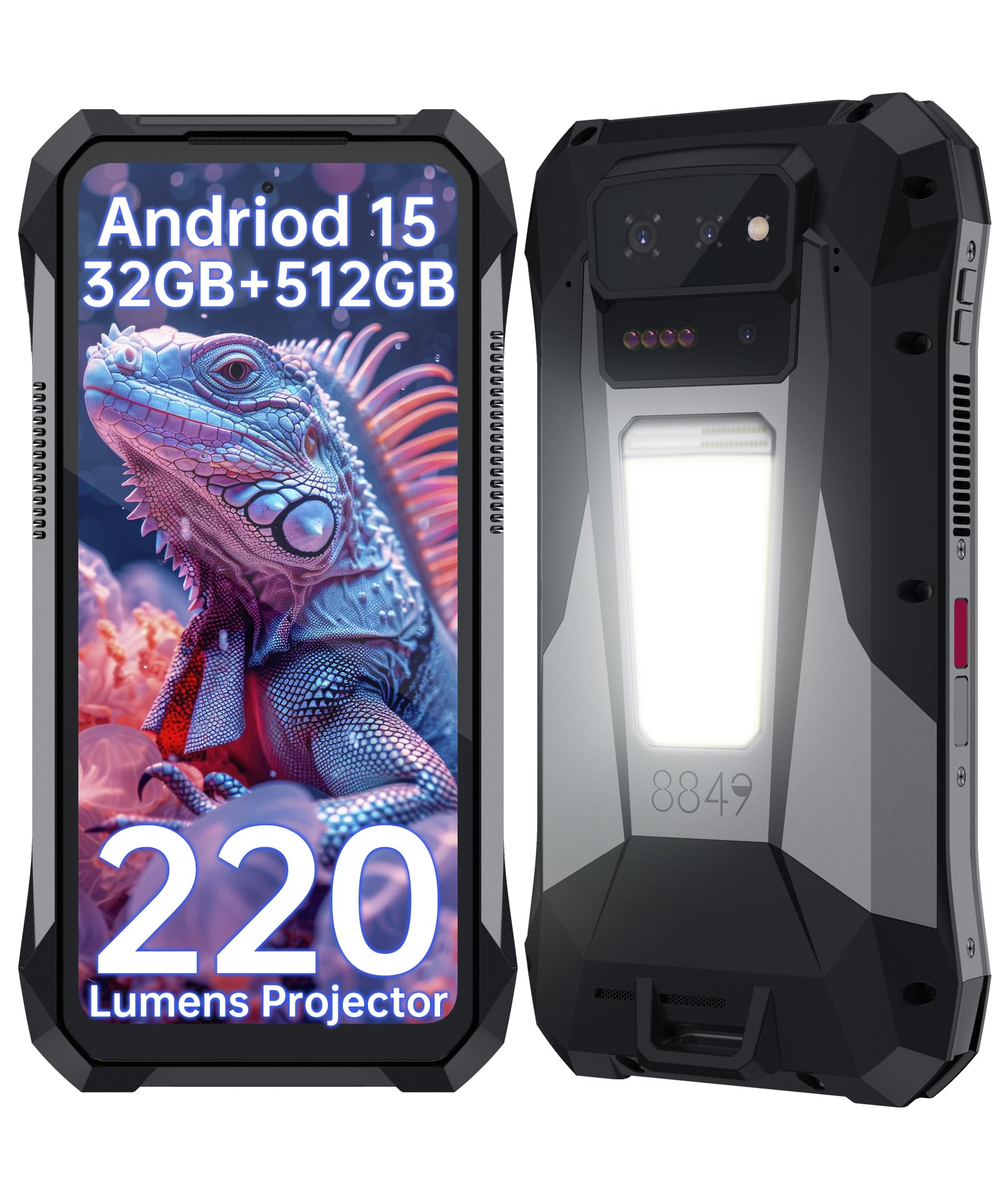
The 8849 Tank X combines a 220-lumen DLP projector with a rugged smartphone chassis and a four-camera system. The primary lens is a 50MP sensor, supported by a 64MP night vision camera with infrared capability for pitch-black environments and an 8MP telephoto lens with 3x optical zoom. The underwater camera mode allows photo capture while submerged, though video recording is not supported underwater.
The 17600mAh battery is the standout spec, lasting several days of mixed use, and the 120W charging brings it to full in roughly 70 minutes. The 6.78-inch LCD display runs at 120Hz with 1080×2460 resolution, and the IP68 rating ensures survival in mud, rain, and shallow submersion. The 1200-lumen camping light includes SOS and strobe modes for emergency signaling.
At nearly 1.8 pounds, the Tank X is dramatically heavier than standard smartphones, making extended one-handed photography sessions tiring. The MediaTek Dimensity 8200 processor provides adequate performance, but the software has occasional bugs with the thumbprint scanner and keyboard, though disabling virtual RAM resolves most of these issues. The phone supports T-Mobile and Verizon but is not fully compatible with Visible or AT&T.
Why it’s great
- Infrared night vision camera captures detail in total darkness
- 220-lumen DLP projector for on-site presentations
- 17600mAh battery lasts multiple days on a single charge
Good to know
- Extremely heavy at approximately 1.8 pounds
- Software bugs require disabling virtual RAM
- AT&T and Visible compatibility is limited
9. AGM G3 Pro
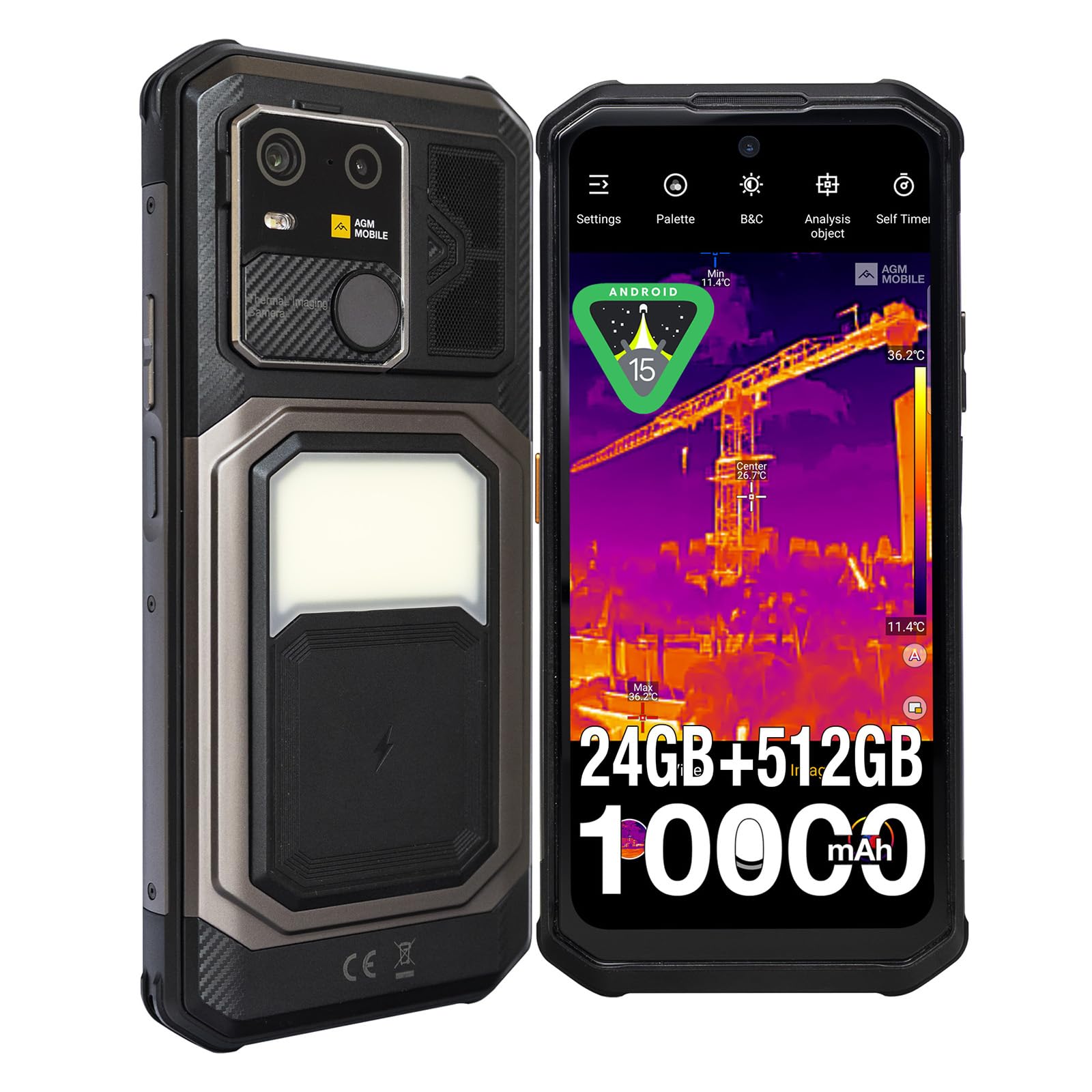
The AGM G3 Pro is built for professionals who need a thermal camera integrated into their daily driver. Its 512×384 HD thermal sensor captures 25fps heat imagery, making it useful for HVAC inspections, electrical diagnostics, and nighttime wildlife observation. The primary 64MP main sensor and 50MP ultrawide lens provide standard photography capability, while the 2MP macro lens handles close-up examination of small components.
The IP68/IP69K certification and MIL-STD-810H compliance mean the G3 Pro survives drops, mud, and submersion that would destroy standard phones. The 10000mAh battery delivers multi-day runtime, with 33W PD fast charging and wireless charging as backup options. The 6.72-inch FHD+ 120Hz LCD display maintains 450 nits brightness for outdoor visibility, and the 116dB 5W speaker ensures you hear calls in loud worksite environments.
Network compatibility is limited to T-Mobile in the US — the phone does not support AT&T or Verizon effectively. The thermal camera resolution is lower than dedicated thermal units, and the user reviews indicate that 5G data speeds are slower than a five-year-old phone in the same location. The phone body is bulky, making it less comfortable for casual all-day carry.
Why it’s great
- Integrated 25fps thermal camera for field diagnostics
- IP68/IP69K and MIL-STD-810H for extreme durability
- Multi-day battery with fast and wireless charging
Good to know
- 5G data speeds may be slower than older phones on T-Mobile
- Only compatible with T-Mobile and its MVNOs
- Bulky form factor not ideal for everyday casual carry
10. Ulefone Armor 34 Pro Plus
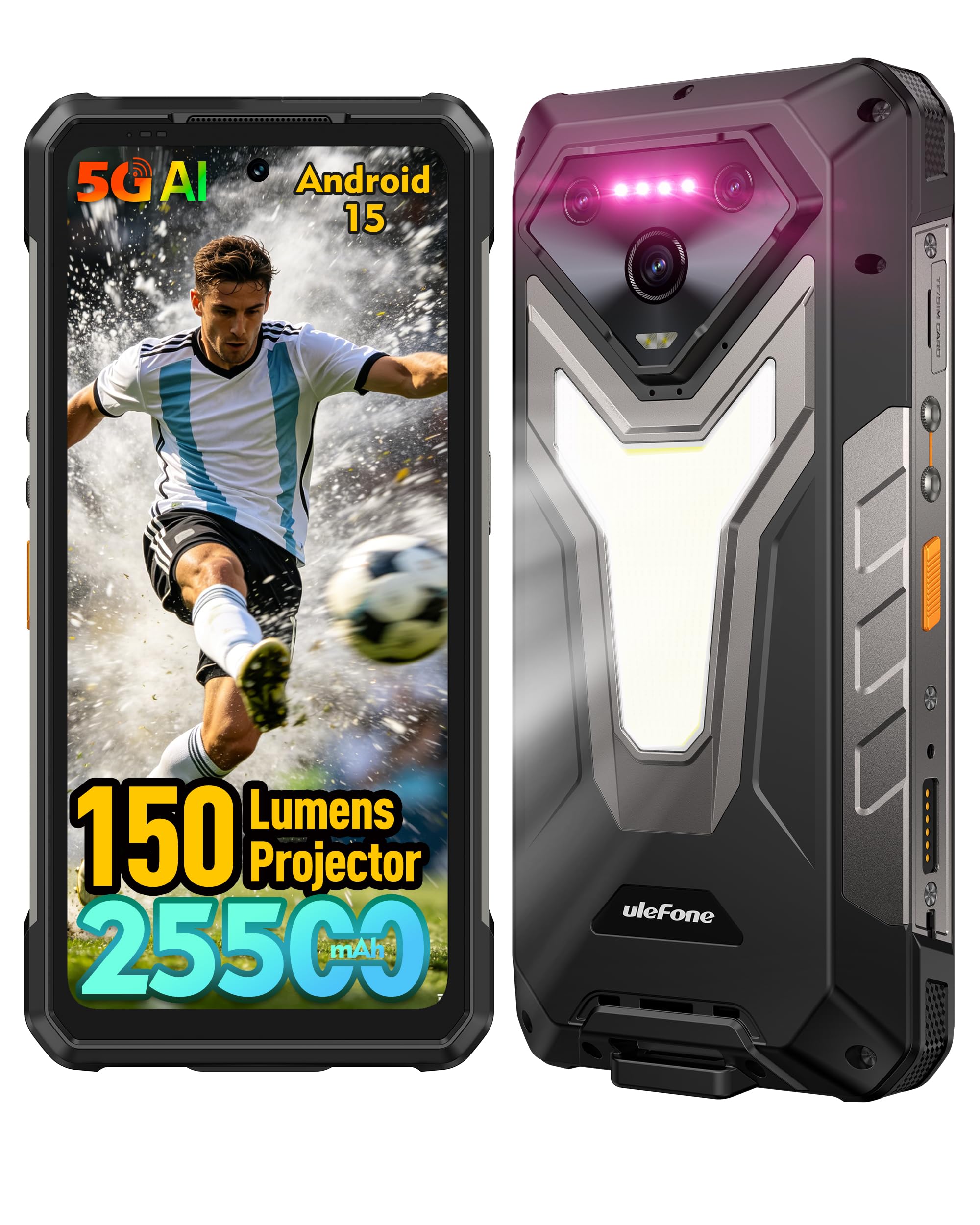
The Ulefone Armor 34 Pro Plus is defined by its 25500mAh battery, which delivers up to 10 days of standby and multiple days of heavy use. The 64MP night vision camera uses four infrared LEDs and the NightEye Ultra 3.0 algorithm to capture detail in complete darkness, while the 50MP main sensor and 50MP ultrawide lens cover standard photography needs. The 150-lumen DLP projector with auto-focus and keystone correction projects up to 100 inches at 3 meters.
The 32GB of RAM (16GB physical plus 16GB virtual) paired with 512GB internal storage and expandability up to 2TB provides ample space for video files and large photo collections. The 6.95-inch Gorilla Glass 5 screen runs at 120Hz with FHD+ resolution, and the MIL-STD-810H certification covers drops and environmental extremes. The 1100-lumen camping light includes red and blue warning lights for emergency signaling.
Weighing 1.8 pounds, the Armor 34 Pro Plus is too heavy for comfortable extended photography and can strain the wrist during one-handed texting. Some software glitches persist — apps may crash unexpectedly, and the gallery app is missing basic features. The 150-lumen projector is dimmer than the Tank X’s 220-lumen unit, and the phone is not compatible with AT&T or Cricket networks.
Why it’s great
- Massive 25500mAh battery offers best-in-class endurance
- Infrared night vision with four LEDs for zero-light photography
- Built-in projector and 1100-lumen camping light for outdoor use
Good to know
- Very heavy at 1.8 pounds, impractical for casual carry
- Incompatible with AT&T and Cricket networks
- Software bugs with app stability and missing basic apps
11. Fujifilm X100VI

The Fujifilm X100VI is included in this guide because it represents the ultimate alternative for buyers who prioritize image quality over phone convenience. Its 40MP APS-C X-Trans CMOS 5 HR sensor is significantly larger than any smartphone sensor, producing vastly superior dynamic range, color depth, and low-light performance. The fixed 23mm f/2 lens offers a 35mm equivalent field of view, matching the perspective of a classic street photography lens.
The in-body image stabilization provides 6 stops of correction, allowing handheld shooting in light conditions that would ruin a phone shot. The hybrid viewfinder switches between optical and electronic preview, and the X-Processor 5 supports 6.2K video recording at 30fps in 10-bit 4:2:2 color. The Fujifilm film simulation modes — including Provia, Velvia, and Acros — produce JPEG images that require minimal post-processing.
The X100VI does not make phone calls, does not run apps, and cannot replace your smartphone. Its autofocus is slower than modern flagship phones, especially in tracking moving subjects, and the fixed lens limits compositional variety without cropping. This camera is a specialist tool for photographers who are willing to carry a separate device for the sake of image quality that no phone can match.
Why it’s great
- 40MP APS-C sensor produces image quality no phone can match
- In-body stabilization with 6 stops of correction
- Fujifilm film simulations create stunning JPEGs out of camera
Good to know
- Cannot make calls, run apps, or replace a smartphone
- Fixed 23mm lens limits focal length versatility
- Autofocus is slower than current-gen flagship phones
FAQ
Do I really need five camera lenses on a phone?
Why do some 5-camera phones have worse low-light performance than triple-camera phones?
What does pixel binning do in a multi-camera phone?
Final Thoughts: The Verdict
For most users, the best 5 camera phone is the Nothing Phone (3) because its four 50MP sensors deliver consistent color and detail across all focal lengths without forcing you to compromise on software cleanliness. If you want premium video stabilization and the Apple ecosystem, grab the iPhone 16 Pro Max. And for extreme optical zoom that no other phone matches, nothing beats the Samsung Galaxy S21 Ultra.