
A boat’s electrical system is a hostile environment — voltage swings, salt spray, engine noise, and constant vibration kill a standard car amplifier fast. A dedicated 5 channel marine amp solves all of that by wrapping corrosive-resistant internals, conformal-coated circuit boards, and weather-sealed terminals into a single chassis that powers your entire audio system: four cabin speakers and a dedicated subwoofer channel. Without one, you are either spending on multiple enclosures or risking failure a few seasons in.
I’m Min — the co-founder and writer behind Gadgets Feed. My research process involves cross-referencing real RMS ratings against CEA-2006 compliance, tracking heat dissipation strategies in IP-rated enclosures, and analyzing hundreds of verified buyer reports on marine-specific durability to separate the true waterproof performers from the pretenders.
After comparing nine models across marine-specific builds, Class-D efficiency, subwoofer channel output, and owner-verified reliability data, The best 5 channel marine amp needs to survive direct UV exposure, deliver clean bass at speed, and fit into tight helm compartments without overheating.
How To Choose The Best 5 Channel Marine Amp
Buying a marine amplifier is not the same as picking one for a car. The salt, moisture, and temperature swings inside a boat’s interior corrode unprotected electronics quickly. The three decisions below will determine whether your system sounds clean for one season or five.
Marine-Grade Protection vs Standard Car Amp
A true marine amp uses a conformal-coated circuit board — a thin acrylic layer that blocks salt spray and condensation from shorting traces. The outer shell should be UV-stabilized and sealed at the end panels. Look for “Element Ready” or explicit IP rating language. Standard car amplifiers lack this treatment and often fail within months on a boat.
Power Architecture: Class-D vs Hybrid
Full Class-D designs run cooler and draw less current at idle — critical for boats with limited battery capacity. Some premium units use Class-AB on the front/rear channels for warmer midrange and Class-BD on the sub channel for high-efficiency bass. Hybrid topologies weigh more and run hotter but can sound sweeter on the speakers.
Subwoofer Channel Output Matching
The fifth channel is the hardest-working in a marine amp. You need to match its 4-ohm or 2-ohm RMS rating to your subwoofer’s voice coil configuration. A 200W x 1 at 4-ohm channel works for a single 10-inch, but if you want a pair of 12s, you need at least 500W x 1 at 2-ohm. Running the sub channel at too low an impedance triggers thermal protection.
Quick Comparison
On smaller screens, swipe sideways to see the full table.
| Model | Category | Best For | Key Spec | Amazon |
|---|---|---|---|---|
| Rockford Fosgate PM1000X5 | Premium Hybrid | Brute power with AB warmth | 1000W, 75Wx4+300Wx1 @ 2-ohm | Amazon |
| Fusion Signature Series 010-01968-00 | Premium Full-Class D | Ecosystem integration | 1600W, 10Hz-50kHz FR | Amazon |
| Alpine R-A90S | Premium Staggered | 3-way active setups | 75Wx4+150Wx2 @ 4-ohm | Amazon |
| Rockford Fosgate M2-750X5 | Premium Marine | Element Ready durability | 750W, 50Wx4+200Wx1 @ 4-ohm | Amazon |
| NVX VAD11005 v2 | Mid-Range Marine | High power in compact chassis | 1100W RMS, 80Wx4+350Wx1 @ 4-ohm | Amazon |
| AudioControl EPICFIVE | Mid-Range Digital | Bass control & tuning | 1100W, 91dB S/N ratio | Amazon |
| Soundstream MR5.2000D | Mid-Range Marine | White marine aesthetic | 2000W peak, Class-D | Amazon |
| Orion CEA1000.5D | Budget Value | Compact all-in-one system | 1000W, 4x75W+1x300W @ 4-ohm | Amazon |
| MB Quart NA3-1000.5 | Budget Marine | Salt-spray toughness on a budget | 560W, IPX rated, 4-channel | Amazon |
In‑Depth Reviews
1. Rockford Fosgate PM1000X5 Punch Marine

The PM1000X5 combines Class-AB front/rear channels for vocal warmth with a Class-BD sub channel that delivers 300W x 1 at 2-ohm and peaks at 500W x 1 at 1-ohm. That hybrid topology is rare in a marine amp and gives you the tube-like midrange of a traditional punch amp with the bass efficiency of a digital sub stage. The tri-stage protection covers thermal, over-current, and short circuits — all critical when a bilge pump splashes saltwater near the mounting board.
Owner reports consistently mention five-year-plus service lives in open bow boats and center consoles. The built-in Punch EQ adds up to +18dB boost at 45Hz, which compensates for the cabin loss you get at cruising speeds. The 12dB/octave Butterworth crossover keeps the sub channel isolated from the mids, minimizing phasing issues. At 16 pounds, it is the heaviest unit in this roundup — that mass comes from a thick extruded heatsink that sheds heat into moving air.
The only trade-off is physical space: at 15.03 inches long, it requires careful placement under a helm seat or in a dedicated equipment locker. Installation is straightforward for anyone comfortable with 4-gauge power wire and RCA routing. The Auto Turn-On circuit senses signal from high-level inputs, so you can skip a remote wire if your head unit lacks one.
Why it’s great
- Hybrid topology gives warm mids and efficient bass
- Tri-stage protection extends service life in salt conditions
- Punch EQ adds +18dB bass boost for on-water presence
Good to know
- Long chassis requires substantial mounting space
- 16-pound weight may stress thin fiberglass panels
2. Fusion Signature Series 010-01968-00

The Fusion Signature Series delivers 1600W of full Class-D power in a one-piece die-cast chassis that is built to survive bilge-level abuse. The 5-way protection circuitry guards against reversed polarity, DC offset, thermal runaway, and high/low voltage events — every failure mode that sinks a lesser amp. The frequency response stretches from 10Hz to 50kHz, covering subsonic foundation notes and airy tweeter detail without rolling off.
Integration with the Fusion ecosystem is seamless: the amp can drive up to four pairs of Fusion speakers in parallel on the full-range channels and power the MS-SW10 subwoofer on the fifth channel without an external crossover. Real-world owners report this unit lasting three years in heavy saltwater environments before replacement — a respectable lifespan for marine electronics. The included manual covers zone-level bass tuning when paired with a Fusion RA-series head unit.
At 7.9 pounds and 11.8 inches long, it is compact enough to fit under a small helm bench. The plastic outer shell is UV-stabilized and resists fading in direct sunlight. The only downside is the plastic construction — while tough, it does not dissipate heat as efficiently as an aluminum shell, so ensure at least an inch of open air around the chassis.
Why it’s great
- 5-way protection handles every marine electrical fault
- Drives 4 pairs of speakers plus a sub from one chassis
- Compact footprint for tight helm compartments
Good to know
- Plastic chassis runs warmer than aluminum alternatives
- Best results require Fusion head unit and speakers
3. Alpine R-A90S R-Series

The Alpine R-A90S breaks the mold with six channels and staggered power output — 75W RMS x 4 on the main channels plus 150W RMS x 2 on the high-power pair. This architecture is ideal for a 3-way active front stage where you need separate channels for tweeters, midranges, and midbass woofers without a dedicated subwoofer amp. The GTO (Great Turn-On) signal sensing automatically wakes the amp from speaker-level inputs, saving a remote wire run.
Sound quality is the standout here: the adjustable crossovers on every channel pair allow bandpass configurations on the midrange channels, enabling true active bi-amping or tri-amping without an external DSP. Bridging the rear channels at 4 ohms delivers 500W x 1 for a subwoofer, so you can still run a 5-channel layout if you bridge accordingly. The heatsink is generous, but multiple verified reports note overheating in 5/6-channel mode during hot weather at high volume — adequate ventilation is mandatory.
At 7 pounds and roughly 13 inches long, the footprint is moderate. The build quality is classic Alpine: clean PCB layout, gold-plated terminals, and a brushed aluminum cover. This amp does not carry an official marine-grade conformal coating, so it is best suited for enclosed cabin boats where direct moisture exposure is minimal.
Why it’s great
- Staggered 6-channel layout enables 3-way active setups
- GTO auto-turn-on eliminates remote wire needed
- Bandpass crossover capability on midrange pair
Good to know
- Overheats in 5/6-channel mode without ventilation
- Lacks conformal coating for direct marine exposure
4. Rockford Fosgate M2-750X5

The M2-750X5 is Rockford’s dedicated marine 5-channel, built with UV-resistant housings, stainless steel mounting hardware, and a fully conformal coated PCB. It delivers 50W x 4 at 4 ohms on the full-range channels and 200W x 1 at 4 ohms on the sub channel, stepping to 100W x 4 plus 350W x 1 at 2 ohms. The C.L.E.A.N. (Clipping Level Error Averaging Network) circuitry helps you set gain precisely without distortion — a critical feature when tuning by ear on a boat at anchor.
The integrated Punch EQ delivers up to three times the bass output at 45Hz, which gives you tactile kick without cranking the sub channel into clipping. The P.O.W.E.R. supply automatically increases output as battery voltage rises, meaning you get more headroom when the engine is running. At 7.5 pounds and 11.2 inches long, it is compact enough to mount under a small helm seat or inside a waterproof locker.
One verified report shows a unit failing after two months in an exposed pontoon installation — while that is an outlier, it underscores the importance of keeping the amp out of direct spray. The two-year warranty covers defects, but moisture ingress through unterminated RCA ports is a common failure point: seal unused jacks with dielectric grease.
Why it’s great
- Element Ready with full conformal coating for marine survival
- C.L.E.A.N. gain setup eliminates guesswork
- P.O.W.E.R. supply adapts output to battery voltage
Good to know
- Unsealed RCA jack cover can let moisture in
- Some early failures reported in exposed pontoon installs
5. NVX VAD11005 v2
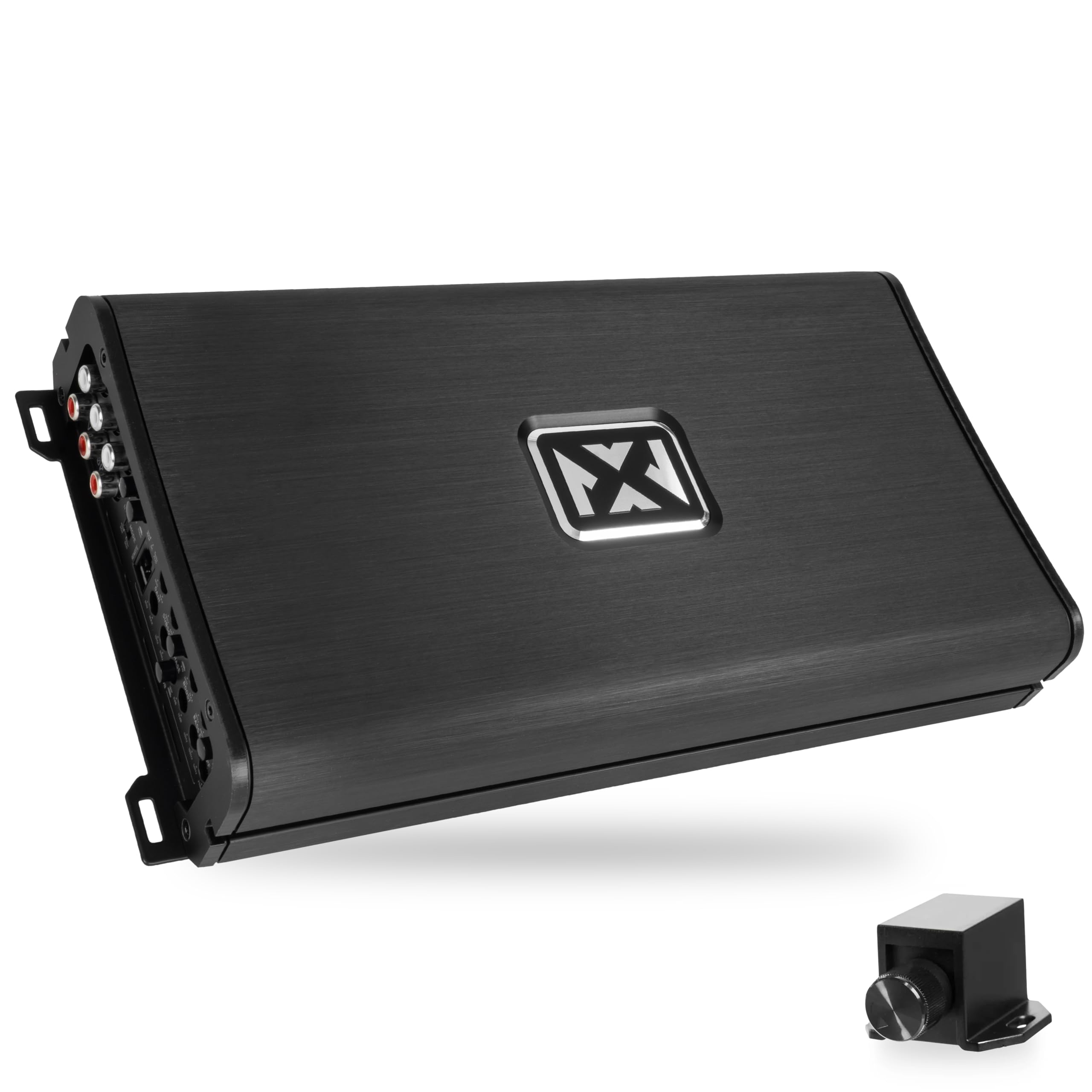
The NVX VAD11005 v2 delivers serious marine-grade value with a conformal coated circuit board, 1100W RMS total output, and a subwoofer channel that pushes 350W x 1 at 4 ohms and 600W x 1 at 2 ohms. That is enough grunt to drive a single 12-inch sub into chest-thumping territory or two 10-inch shallow mounts at 4 ohms each. The variable subsonic filter (15-40Hz) prevents the sub from wasting power on frequencies it cannot reproduce.
Owner feedback consistently rates the sound quality above Pioneer and entry-level Alpine units, with a noticeably warmer midbass and smoother high-frequency roll-off. The variable Bass Boost offers up to +18dB at 45Hz, and the 3-way protection circuitry covers thermal, overload, and speaker short faults. The platinum-plated RCA inputs resist corrosion — a meaningful detail for coastal boaters. The heatsink is a heavy-duty aluminum extrusion that keeps the unit stable even under sustained hard use.
Size is the main consideration: this amp is physically larger than most competitors, with a footprint that can be challenging to fit under a small helm seat. The power and ground terminals are designed for 4 AWG wiring, and the included remote bass knob adds convenience. For the watt-per-dollar ratio, this is the strongest all-round performer in the mid-range tier.
Why it’s great
- Conformal coated marine PCB at a mid-range price point
- 600W sub channel at 2 ohms drives serious bass
- Variable subsonic filter protects the sub from over-excursion
Good to know
- Larger chassis requires spacious mounting area
- Power/ground wire access is tight with thick 4 AWG
6. AudioControl EPICFIVE
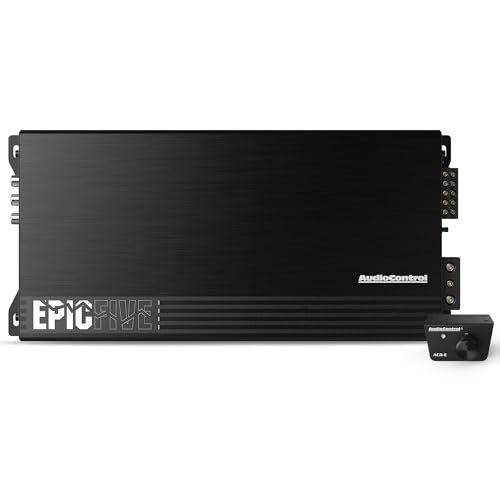
The EPICFIVE from AudioControl is a 1100W Class-D powerhouse built on a low-profile chassis (6.1 x 13.35 x 2.01 inches) that fits where most 5-channel amps do not. The 12dB/octave Linkwitz-Riley crossovers give you high-pass, low-pass, and subsonic filtering with zero phase shift at the crossover point — a noticeable upgrade over standard Butterworth designs. The variable Epic Bass Boost adds up to 12dB of boost at user-selectable frequencies.
The included ACR-E remote level control lets you dial the subwoofer volume from the driver’s seat, and the EPICENTER Link port can connect directly to AudioControl’s bass restoration processor for non-linear bass shaping. The ultra-efficient idle draw prevents battery drain during long days on the water — a meaningful advantage for boats with a single starting battery. Multiple verified buyers note that the amp sounds better after a break-in period of 10-15 hours.
The subwoofer channel receives a tiny bit of power in non-5-channel modes, which is a quirk rather than a flaw. At just over 2 inches tall, this is one of the easiest amps to slot into tight spaces. The direct wire terminals with hex screws use 4 GA power and 8 GA speaker wire connections, and a 150A fuse is recommended.
Why it’s great
- Linkwitz-Riley crossovers deliver clean frequency separation
- Ultra-low idle draw prevents battery drain
- EPICENTER Link port adds bass restoration capability
Good to know
- Sub channel leaks low power in non-5-channel mode
- Break-in period needed for full sound quality
7. Soundstream MR5.2000D Rubicon Nano

Soundstream’s Rubicon Nano MR5.2000D packs Class-D efficiency into a compact white chassis that blends visually with marine gel coat — a rare aesthetic advantage for boat installations where white-on-white looks clean. The hybrid aluminum alloy heatsink manages thermal dissipation surprisingly well for a 6-pound chassis, and the MOSFET power supply uses audiophile-grade IR transistors for clean voltage regulation. The 12dB bass boost increases low-octave harmonics without distorting the midrange.
Reviewers consistently praise its ability to drive six 6.5-inch marine speakers and two 10-inch subwoofers at 4 ohms without entering protect mode, even after washing the hull. The white finish resists UV yellowing better than painted black units. Installation is straightforward with the surface-mount tabs, and the overall footprint (16.5 inches long) fits under most bench seats.
The peak power rating of 2000W is marketing-speak — the real-world RMS output is lower, but adequate for a wakeboard boat or pontoon setup. One note: the manual provides minimal guidance on gain setting, so a multimeter is recommended for proper calibration. Powering a full system with one amp and maintaining clean sound is its core strength.
Why it’s great
- White chassis matches marine interiors perfectly
- Compact and lightweight at 6 pounds
- Drives full system — up to 6 speakers plus subs
Good to know
- Peak power rating is inflated; set expectations around RMS
- Manual lacks detailed gain-setting guide
8. Orion CEA1000.5D Cobalt Elite
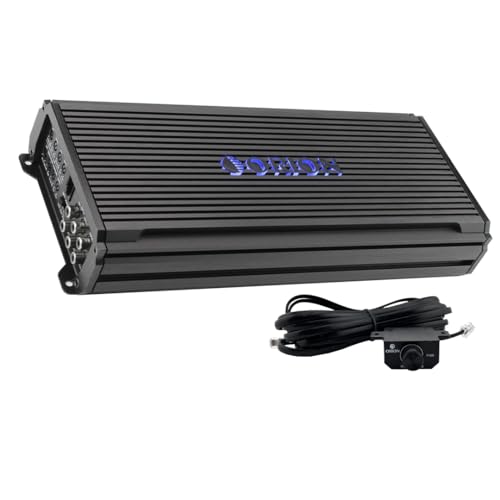
The Orion Cobalt Elite CEA1000.5D is a compact 5-channel Class-D amplifier delivering 75W RMS x 4 at 4 ohms for speakers plus 300W RMS x 1 at 4 ohms for the subwoofer channel, stepping to 125W x 4 + 500W x 1 at 2 ohms. The independent high-pass and low-pass filters on the full-range section and a dedicated variable low-pass filter on the sub channel give you solid tuning flexibility without an external processor. The included bass knob adds convenient sub level control from the driver’s position.
Owner feedback highlights clean and clear sound across all channels, with enough headroom to drive a set of 6.5-inch components and 6×9 coaxial speakers loudly without clipping. The subwoofer channel performs well with a single 10-inch or 12-inch sub, though users pairing it with shallow-mount low-impedance subs note that it could use more grunt for bass-heavy genres. The Class-D architecture keeps the amp cool and compact, with easy fitment in a C6 Corvette trunk or under a boat helm.
The sub channel is not designed to drive a pair of 12-inch subs with authority — buyers looking for serious low-end should plan on using it with a single moderate-power sub. The included hardware is basic, but the FCC certification and 1-year warranty provide baseline confidence. For a budget-conscious boater building a first system, this is the most accessible entry point.
Why it’s great
- Independent filtering on all channels for precise tuning
- Compact footprint fits tight boat helms and car trunks
- Class-D efficiency keeps heat low
Good to know
- Sub channel lacks power for dual-sub setups
- Not marine-conformal coated; avoid direct moisture
9. MB Quart NA3-1000.5
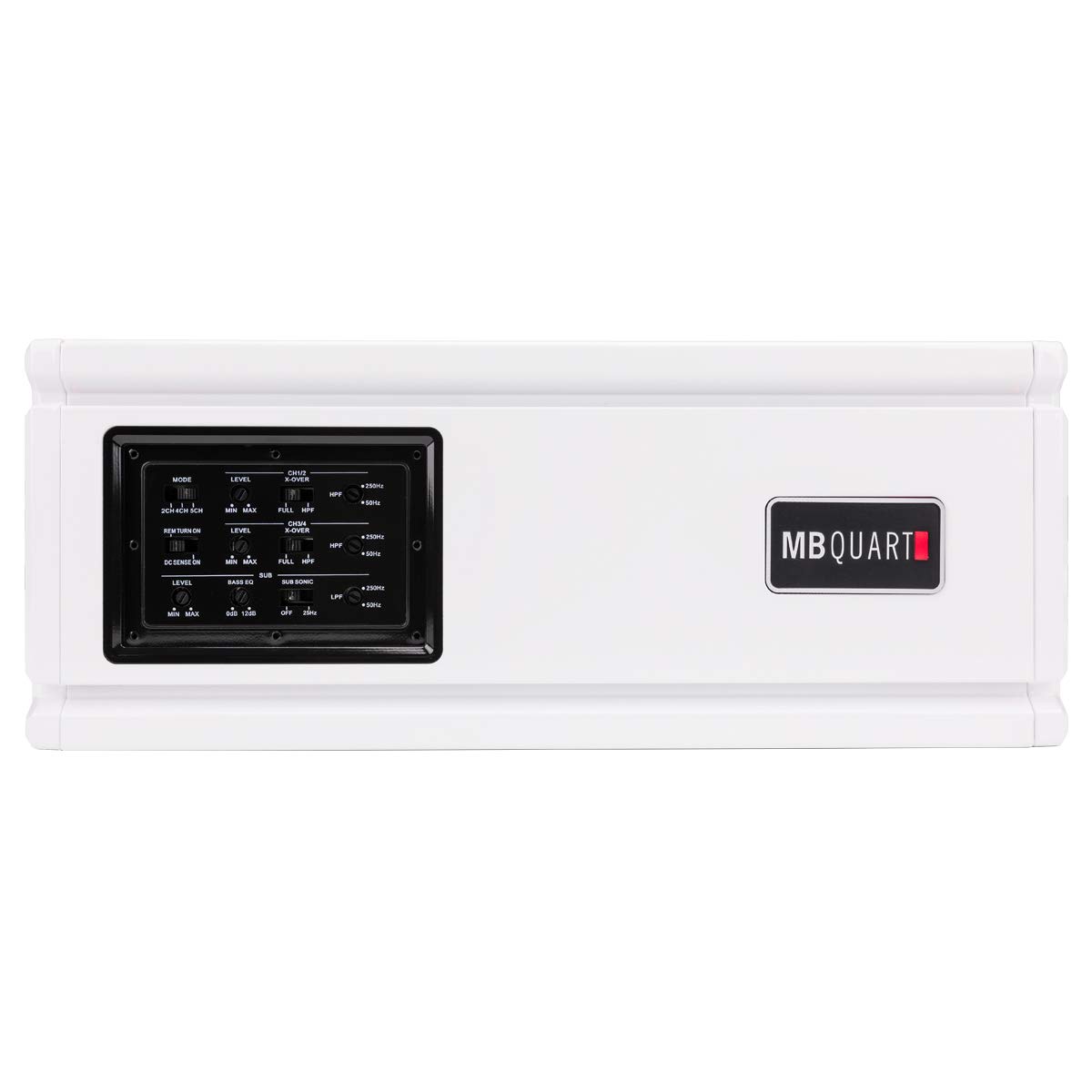
The MB Quart NA3-1000.5 is built specifically for marine environments with an IPX-rated waterproof housing, a nautical white glossy epoxy finish that rejects heat, and a low-noise preamplifier circuit that minimizes electrical distortion from the source unit. Rated at 4 x 120W channels plus a dedicated fifth channel for subwoofer duty, this 560W total output amp is designed to survive extreme salt spray and UV exposure without missing a beat. The Fluid FET output devices are hand-selected for sonic consistency.
One verified buyer replaced a failed Rockford Fosgate marine amp with this unit and reported superior build quality — solid aluminum chassis, excellent fit and finish, and noticeably cleaner sound. The RCA inputs are directly soldered to the PC board for vibration resistance, and unused RCA jacks come with protective covers. The temperature-controlled design uses the epoxy coating to reject heat across the surface, extending lifespan even under direct sun.
The unit is listed as a 4-channel amp but functions as a 5-channel via the subwoofer output, so confirm your wiring plan before purchase. At 6 pounds and 25 inches long, it requires significant mounting length. The CEA-2006 compliance assures rated output is real, not inflated. For a saltwater-ready amp at a budget price point, it delivers surprising reliability.
Why it’s great
- IPX-rated housing handles direct salt spray exposure
- Epoxy-coated heatsink rejects heat in direct sun
- Fluid FET output devices mimic high-end home audio quality
Good to know
- Listed as 4-channel; sub channel is a dedicated mono output
- Long chassis (25 inches) requires substantial mounting space
FAQ
Can I use a regular car 5-channel amp on my boat?
How do I wire a 5-channel marine amp to four speakers and a sub?
Why does my marine amp keep going into protect mode at high volume?
Should I choose Class-D or Class-AB for a marine audio system?
What gauge power wire does a 5-channel marine amp need?
Final Thoughts: The Verdict
For most users, the best 5 channel marine amp winner is the Rockford Fosgate PM1000X5 because its hybrid Class-AB/BD topology delivers the warmest midrange of any marine 5-channel while still providing 300W x 1 at 2 ohms for the sub — a combination that survives years in saltwater. If you want pure Class-D efficiency and Fusion ecosystem integration, grab the Fusion Signature Series. And for the best watt-per-dollar value in a true marine-conformal-coated chassis, nothing beats the NVX VAD11005 v2.