
The 5 GHz band is where your router earns its keep. Unlike the crowded 2.4 GHz channel, 5 GHz offers cleaner air for high-bandwidth tasks—4K streaming, competitive gaming, large file transfers—but only if the hardware is built to handle its shorter range and higher attenuation through walls. The wrong choice leaves you hunting for a signal in your own home.
I’m Min — the co-founder and writer behind Gadgets Feed. I’ve spent countless hours cross-referencing chipset generations, antenna gain figures, throughput benchmarks, and real-world user reports to isolate which 5 GHz WiFi routers actually deliver stable, high-speed connections without constant buffering or dropouts.
This guide breaks down the top contenders across every price tier, from purpose-built outdoor bridges to flagship quad-band gaming behemoths, so you can confidently pick the best 5 ghz wifi router for your home or business.
How To Choose The Best 5 GHz WiFi Router
Selecting the right router for the 5 GHz band isn’t about picking the most expensive model. It’s about matching the hardware’s radio characteristics—antenna gain, spatial streams, channel width support—to your physical environment and device load. A high-gain outdoor bridge will outperform a premium gaming router in a point-to-point field scenario, while a tri-band unit with OFDMA is essential for homes packed with smart devices.
Antenna Gain and Beamforming
5 GHz signals attenuate faster through walls and obstacles than 2.4 GHz. Higher dBi antennas concentrate the signal in a specific direction, increasing effective range and throughput. External antennas with active beamforming dynamically steer the signal toward connected clients, which is critical for large or oddly shaped spaces. For outdoor PtP links, a 23 dBi directional antenna like the one on the TP-Link CPE710 is the only way to bridge hundreds of feet reliably.
WiFi Generation and Channel Width
WiFi 5 (802.11ac) peaks at 80 MHz channel width on the 5 GHz band. WiFi 6 (802.11ax) unlocks 160 MHz channels, effectively doubling peak throughput per stream. WiFi 7 (802.11be) introduces 320 MHz channels and Multi-Link Operation (MLO), which bonds across bands for lower latency and higher reliability. If you own WiFi 6E or WiFi 7 clients, a router that supports the full 5 GHz spectrum with 160 MHz or 320 MHz channels is essential to avoid bottlenecking your connection.
Port Configuration and Backhaul
A fast 5 GHz radio is useless if the wired ports can’t feed it. Look for at least one 1 Gbps Ethernet WAN port as a baseline; models with a 2.5 Gbps WAN/LAN port ensure your ISP’s multi-gig plan isn’t squandered. For NAS or gaming setups, multiple 2.5 Gbps LAN ports prevent internal bottlenecks when multiple wired clients are transferring data simultaneously.
Quick Comparison
On smaller screens, swipe sideways to see the full table.
| Model | Category | Best For | Key Spec | Amazon |
|---|---|---|---|---|
| GL.iNet GL-BE9300 (Flint 3) | WiFi 7 Tri-Band | High-speed fiber homes & VPN users | 5 x 2.5GbE ports + WireGuard 680 Mbps | Amazon |
| ASUS RT-BE58U | WiFi 7 Dual-Band | Future-proofing with mesh support | 3.6 Gbps aggregate + AiProtection Pro | Amazon |
| TP-Link Archer AX80 (AX6000) | WiFi 6 Dual-Band | Large homes needing max range | 4804 Mbps on 5 GHz + 8 antennas | Amazon |
| NETGEAR Nighthawk R6700AX | WiFi 6 Dual-Band | Compact spaces & easy app setup | 1.8 Gbps aggregate, 4x Gigabit LAN | Amazon |
| TP-Link CPE710 | Outdoor PtP Bridge | Long-range outdoor point-to-point | 23 dBi directional, 867 Mbps, IP65 | Amazon |
| NETGEAR Nighthawk RS500 | WiFi 7 Tri-Band | Whole-home coverage (3,000 sq. ft.) | 12 Gbps aggregate + 2.5G WAN | Amazon |
| ASUS ROG Rapture GT-BE98 PRO | WiFi 7 Quad-Band Gaming | Enthusiast gaming with dual 10G | 30 Gbps aggregate, dual 10G ports | Amazon |
In‑Depth Reviews
1. GL.iNet GL-BE9300 (Flint 3)

The GL.iNet GL-BE9300 is the rare router that marries WiFi 7’s 320 MHz channel support on the 5 GHz band with a genuinely open platform. Its quad-core ARM processor and 1 GB DDR4 RAM handle MLO across tri-band frequencies without stuttering, and the five 2.5 Gbps Ethernet ports ensure wired backhaul keeps pace with wireless throughput. Users report real-world Wireguard VPN speeds around 680 Mbps, which is exceptional for encrypted tunneling.
Setup is refreshingly app-free—the web admin panel offers granular control over channel width, transmit power, and DNS filtering via built-in AdGuard Home. The retractable antennas cover roughly 2,000 square feet effectively, though some users note the 5 GHz range is about half that of a standard ISP router due to its compact form factor. USB 3.0 NAS performance hovers around 30 MB/s, adequate for document access but not heavy media streaming.
Firmware updates are frequent and the community around OpenWRT-like interfaces means long-term support is strong. For users with gigabit+ fiber who need a VPN-capable, future-proof router with multi-gig wired ports, the Flint 3 delivers category-leading value without the walled-garden approach of mainstream brands.
Why it’s great
- Five 2.5 Gbps ports for wired flexibility
- Built-in AdGuard Home ad/tracker blocking
- Wireguard VPN speeds up to 680 Mbps
Good to know
- 5 GHz range is moderate at ~1,000 sq ft
- USB 3.0 NAS speeds are below 40 MB/s
- Setup requires web interface, no mobile app
2. ASUS RT-BE58U

The RT-BE58U is the entry point into WiFi 7 without sacrificing 5 GHz performance. Its dual-band design aggregates up to 3.6 Gbps across 2.4 GHz and 5 GHz, supporting 160 MHz channels on the 5 GHz band for clients that support it. The inclusion of MLO allows simultaneous connection to both bands, significantly reducing latency jitter during video calls and cloud gaming. Internal antennas keep the footprint clean, though coverage is best in spaces under 2,000 square feet.
ASUS bundles AiProtection Pro powered by Trend Micro, which provides real-time network threat detection and parental controls without a subscription—a rare feature at this price tier. Dual-WAN support with USB tethering for 4G/5G failover adds resilience. Early firmware releases had some parental control quirks, but recent updates have stabilized the 5 GHz radio behavior.
For users looking to adopt WiFi 7 on a budget while still maintaining a strong 5 GHz backbone for existing devices, the RT-BE58U is a smart investment. The three-year warranty also signals confidence in the hardware’s longevity.
Why it’s great
- Free lifetime AiProtection Pro security
- MLO support for lower latency
- Dual-WAN with USB 4G/5G failover
Good to know
- Dual-band only, no dedicated backhaul radio
- Parental controls were buggy at launch
- Coverage best suited for apartments or small homes
3. TP-Link Archer AX80 (AX6000)

The Archer AX80 is a WiFi 6 beast that prioritizes 5 GHz coverage above all else. Its eight fixed external antennas—each with active beamforming—deliver the most consistent 5 GHz signal across large homes of any router in this list. On the 5 GHz band alone, it pushes 4,804 Mbps via 160 MHz channels and 4×4 MU-MIMO. Users consistently report eliminating dead zones in garages and backyards without needing mesh satellites.
The 2.5 Gbps WAN/LAN port is a practical touch for fiber plans above 1 Gbps, and the USB 3.0 port supports external drive sharing. TP-Link’s HomeShield offers baseline security and parental controls, though the advanced features require a subscription. OneMesh compatibility lets you add a range extender later without breaking the single SSID experience.
Setup is straightforward via the Tether app, and the web interface is clean for advanced tweaking. Some users note that QoS can cause drops if left on default settings, so manual tuning is recommended. For anyone whose top priority is 5 GHz range and raw throughput, the Archer AX80 is hard to beat at its price point.
Why it’s great
- Exceptional 5 GHz range with 8 beamforming antennas
- 2.5 Gbps WAN/LAN for multi-gig ISPs
- OneMesh support for seamless expansion
Good to know
- QoS can cause instability if enabled
- Advanced security features require subscription
- No WiFi 7 support for future-proofing
4. NETGEAR Nighthawk R6700AX
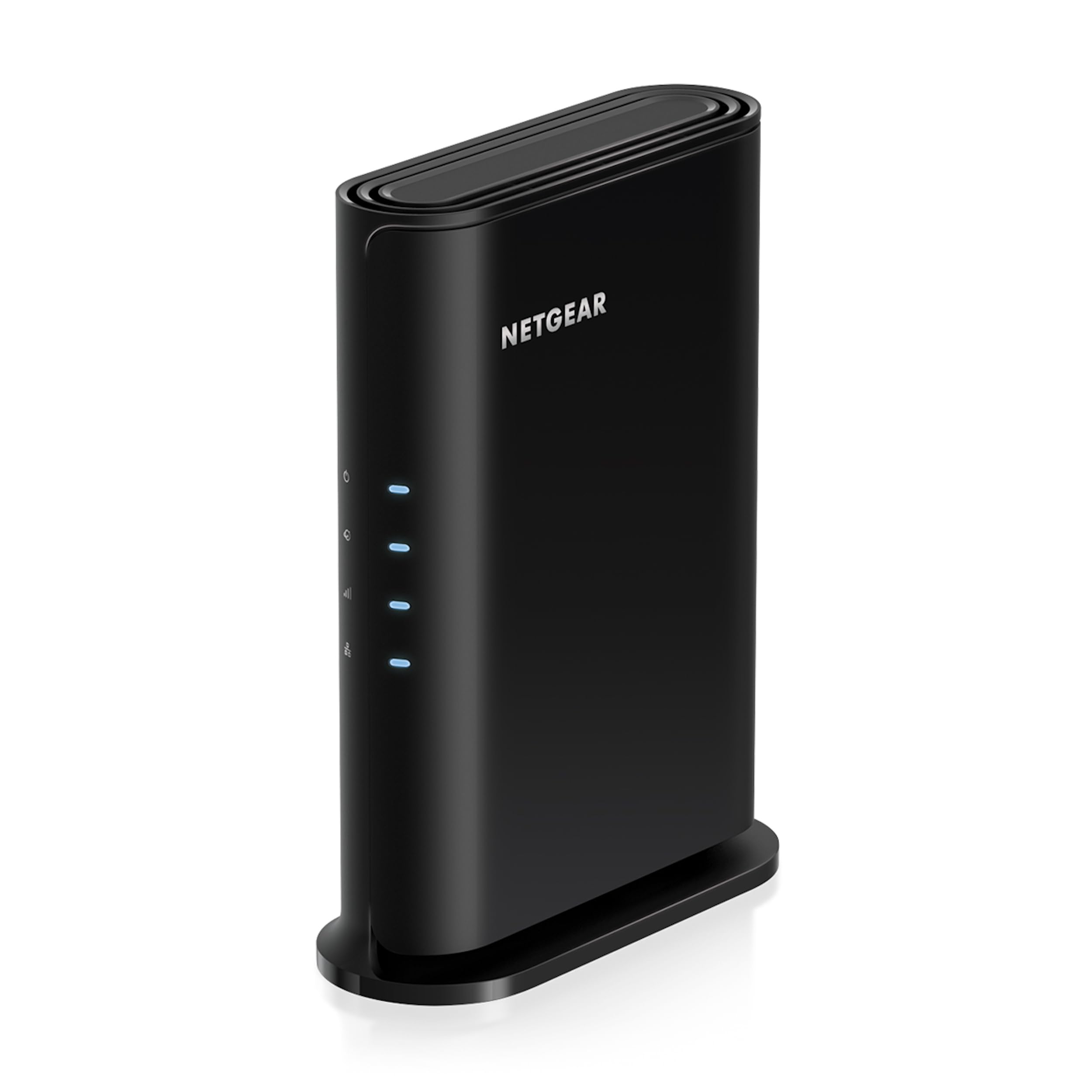
The R6700AX is NETGEAR’s streamlined approach to WiFi 6: a compact dual-band router covering up to 1,500 square feet with an aggregate 1.8 Gbps. The 5 GHz radio uses 2×2 MU-MIMO on 80 MHz channels, which is adequate for moderate use—streaming in 4K, video calls, and light gaming—but won’t saturate a gigabit fiber plan. The primary appeal is simplicity: setup via the Nighthawk app takes under 10 minutes, and the router automatically manages band steering.
It’s designed for small-to-medium homes with up to 20 devices. The four Gigabit LAN ports are basic but sufficient for a console, PC, and a couple of smart hubs. WPA3 security is included, and NETGEAR Armor (subscription) adds optional endpoint protection. A few users have reported reliability issues after a year, and NETGEAR’s paid support is a notable downside.
For renters or those in apartments who want a reliable 5 GHz connection without complexity, the R6700AX is a solid, budget-conscious choice. It’s not a speed demon, but it solves the “why does my video keep buffering” problem cleanly.
Why it’s great
- Very easy setup via Nighthawk app
- Compact, unobtrusive design
- WPA3 encryption included
Good to know
- Only 2×2 MU-MIMO on 5 GHz
- Limited to 80 MHz channel width
- Paid tech support after initial period
5. TP-Link CPE710

The CPE710 is not a home router in the traditional sense—it’s an outdoor point-to-point bridge with a 23 dBi directional antenna that can beam a 5 GHz signal over 450 feet through trees and foil roofing. It operates on the 802.11ac standard with 2×2 MIMO and 80 MHz channels, delivering up to 867 Mbps over that link. The IP65 weatherproof enclosure handles snow, rain, and temperatures from -0°F to 90°F without issue.
Pharos Control software allows centralized management of multiple units for larger deployments, and the passive PoE injector powers the unit over Ethernet, simplifying installation. Users have reported rock-solid uptime of three months without reboot, using it to backhaul Starlink internet to outbuildings. The adjustable three-axis mount makes fine-tuning the alignment straightforward.
This is a specialist tool, not a general-purpose router. It lacks a traditional LAN switch and is designed purely for bridging two locations on the 5 GHz band. If your need is connecting a detached garage, workshop, or remote security cameras to your main network, the CPE710 is the most cost-effective solution available.
Why it’s great
- 23 dBi directional antenna for extreme range
- IP65 weatherproof for outdoor use
- Passive PoE for single-cable installation
Good to know
- Not a standard home router—no built-in switch
- Requires precise alignment for peak performance
- Limited to 80 MHz channel width
6. NETGEAR Nighthawk RS500

The Nighthawk RS500 is NETGEAR’s high-volume WiFi 7 solution, rated for BE12000 aggregate speeds across tri-band (2.4 GHz, 5 GHz, 6 GHz). On the 5 GHz band, it supports 320 MHz channels via WiFi 7, pushing real-world throughput to over 700 Mbps from a third floor to a basement without repeaters. The 2.5 Gbps WAN port and a dedicated 2.5 Gbps LAN port handle multi-gig fiber plans without bottlenecking the wireless side.
Setup via the Nighthawk app is intuitive, and the router supports up to 120 devices—ideal for smart home-heavy households. The physical design is sleeker than previous Nighthawks, with internal antennas that keep the footprint smaller while still covering 3,000 square feet. Users upgrading from WiFi 5 or early WiFi 6 routers report immediate speed jumps of 200-300 Mbps on the 5 GHz band alone.
One notable drawback is the lack of a dedicated 6 GHz backhaul radio; the tri-band design shares the 6 GHz band between clients and backhaul if used in a mesh configuration. For single-router setups, this is a non-issue. The RS500 is a polished, future-ready router for users who want WiFi 7 coverage across a large home without configuring VLANs or VPN policies.
Why it’s great
- 3,000 sq ft coverage from a single unit
- 2.5 Gbps WAN and LAN ports
- WiFi 7 with 320 MHz channel support
Good to know
- No dedicated wireless backhaul band
- Premium price for the NETGEAR brand
- Third-party refurb units sometimes sold as new
7. ASUS ROG Rapture GT-BE98 PRO

The ROG Rapture GT-BE98 PRO is the apex predator of consumer routers. It’s a quad-band WiFi 7 monster with dual 10 Gbps ports and quad 2.5 Gbps ports, pushing an aggregate 30 Gbps. The 5 GHz band alone has two dedicated radios—one for standard clients and one for gaming traffic—allowing true link aggregation and latency isolation. Triple-Level Game Acceleration prioritizes traffic from the PC gaming port all the way to the game server, reducing ping by 2 ms in competitive titles.
Hardware is equally impressive: a 2.6 GHz quad-core Broadcom CPU, 2 GB RAM, and external dual-feeding antennas that deliver exceptional signal strength on all bands. Users report 5 GHz throughput of 1,100 Mbps at 25 feet with consistent stability across 90+ connected devices. The Guestnet Pro feature creates isolated IoT subnets without additional switches.
The catch is twofold: the setup complexity is significant, and early firmware had 2.4 GHz IoT compatibility issues (since resolved on HW 3.0). The physical size is massive—it demands shelf space. For enthusiasts running gigabit+ fiber, multi-NAS environments, and competitive gaming rigs, the GT-BE98 PRO eliminates every possible network bottleneck on the 5 GHz band.
Why it’s great
- Dual 10 Gbps ports for max wired throughput
- Quad-band with dedicated gaming radio on 5 GHz
- Supports 90+ devices without slowdown
Good to know
- Extremely large physical footprint
- Complex setup and advanced features
- Early firmware had 2.4 GHz IoT bugs
FAQ
Does a 5 GHz WiFi router need line of sight to work well indoors?
Can I use an older WiFi 5 device on a WiFi 6 or WiFi 7 5 GHz router?
Why does my 5 GHz connection drop when I move one room away?
Final Thoughts: The Verdict
For most users, the best 5 ghz wifi router winner is the TP-Link Archer AX80 because its eight beamforming antennas and 160 MHz channel support deliver unmatched 5 GHz range and throughput at a mid-range price. If you need advanced VPN capabilities and multi-gig wired ports, grab the GL.iNet GL-BE9300 (Flint 3). And for outdoor long-range bridging, nothing beats the TP-Link CPE710.