
True 5.1 surround sound is the difference between watching a movie and living inside it. A genuine system – with five discrete satellite channels and a dedicated subwoofer – places engines behind you, rainfall above, and whispers directly beside your ear, transforming your living room into a precision audio chamber. The challenge isn’t finding sound; it’s finding sound that doesn’t collapse into a muddy stereo mess at the first explosion.
I’m Min — the co-founder and writer behind Gadgets Feed. I’ve spent hundreds of hours dissecting frequency response curves, amplifier topologies, and the real-world performance of 5.1 channel systems to separate the genuinely immersive from the merely loud.
Whether you are building from scratch or upgrading your TV’s anemic speakers, this guide delivers the definitive list of best 5-in-1 surround sound systems across every meaningful price and performance tier.
How To Choose The Best 5-In-1 Surround Sound
A 5.1 system is only as good as its weakest driver. Before you click “buy,” you need to understand the three pillars that define real performance: driver architecture, amplifier power integrity, and room acoustics. Ignore the marketing wattage numbers and focus on what actually moves air.
Discrete Channels vs. Virtual Processing
The “5” in 5.1 means five physically separate speaker channels. True systems use distinct drivers for front left/right, center, and rear left/right. Virtual processing that tries to synthesize surround from a single soundbar or two speakers is fundamentally incapable of creating the same spatial separation. If you want rear effects that sound like they originate behind your head, you need physical rear speakers with their own amplification path.
Subwoofer Size, Amp Power, and Room Volume
The “.1” channel handles low frequencies below 80–120 Hz. A subwoofer’s ability to pressurize a room scales with cone surface area and amplifier headroom, not peak wattage claims. An 8-inch driver in a sealed enclosure works well for smaller rooms (under 1,500 cubic feet), while a 10-inch or 12-inch ported subwoofer is required for medium to large open-concept spaces. Look for RMS (continuous) power ratings, not peak numbers.
Codec Compatibility and Connection Standards
Your content source dictates which codecs matter. Physical Blu-rays and streaming services like Netflix and Apple TV+ use Dolby Digital Plus (streaming) or Dolby TrueHD/DTS-HD Master Audio (physical discs). Ensure your system or AV receiver supports eARC over HDMI, not just optical, to handle lossless high-bitrate audio. Dolby Atmos adds object-based height metadata, but only if the system includes up-firing or ceiling-mounted drivers—without those, Atmos metadata is folded into the standard 5.1 bed.
Quick Comparison
On smaller screens, swipe sideways to see the full table.
| Model | Category | Best For | Key Spec | Amazon |
|---|---|---|---|---|
| ULTIMEA Skywave F40 | Soundbar + Surrounds | All-in-one Atmos with app control | 5.1.2ch with up-firing drivers | Amazon |
| Amazon Fire TV Soundbar Plus | Soundbar + Surrounds | Plug-and-play with Fire TV ecosystem | Dedicated center channel dialogue | Amazon |
| Logitech Z906 | Computer/Gaming | THX-certified desktop 5.1 | 500W RMS (1000W peak) | Amazon |
| Sony BRAVIA HT-S60 | Soundbar + Surrounds | Seamless BRAVIA TV pairing | Dolby Atmos / DTS:X support | Amazon |
| Yamaha YHT-5960U | AV Receiver + Speakers | Expandable home theater with 8K | 125W per channel, 5.1ch | Amazon |
| Fluance Elite SX51BR | Passive Speaker Set | High-fidelity music and movies | 3-way floorstanding towers | Amazon |
| Definitive ProCinema 6D | Compact Passive Set | Bass radiators in compact satellites | 250W powered subwoofer | Amazon |
| Polk Audio T-Series 5.1 | Passive Speaker Set | Budget audiophile with towers | 10-inch powered subwoofer (100W) | Amazon |
| Klipsch Reference 5.1 Pack | High-Efficiency Passive | High sensitivity (96dB) for impact | 12-inch 400W subwoofer | Amazon |
In‑Depth Reviews
1. ULTIMEA Skywave F40
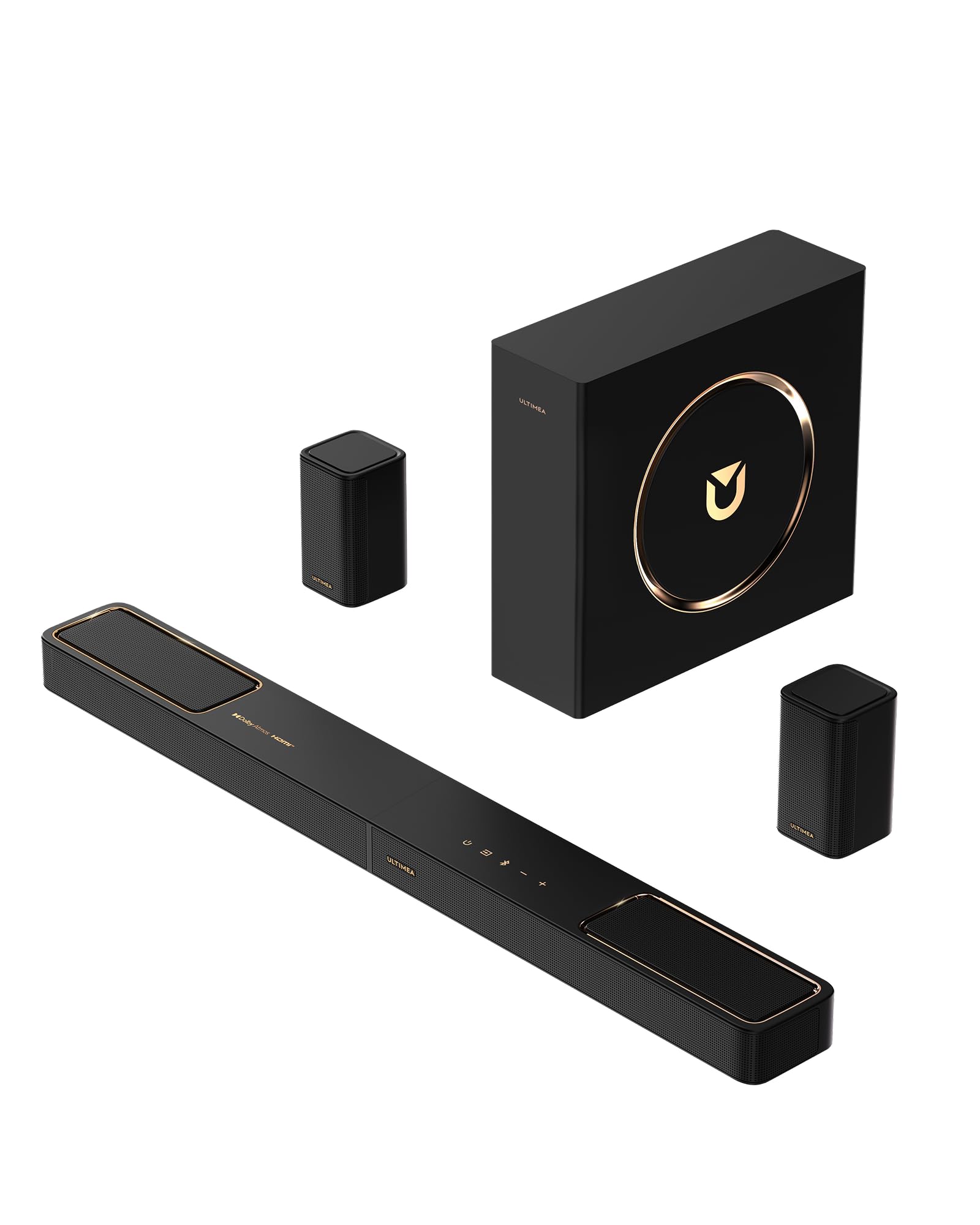
The ULTIMEA Skywave F40 delivers the full 5.1.2-channel package — soundbar, dual rear surrounds, and a 5.25-inch wired subwoofer — adding two up-firing drivers for Dolby Atmos height effects. Unlike standard 5.1 bars that simulate height, the F40’s neodymium-core upward-firing drivers physically bounce sound off the ceiling, creating audible overhead rain and helicopter pans that cheaper systems lose entirely. The SurroundX algorithm is aggressive but effective: rear channels feel distinct and wide, not like a thin stereo reverb.
HDMI eARC handles up to 37 Mbps for lossless 5.1.2 audio from Dolby TrueHD sources, and the Ultimea App provides granular control with 13-step per-channel level adjustment and a 10-band graphic EQ. The 121 preset sound modes may seem excessive, but the ability to dial in exact tonal balance per content type (movies vs. music vs. news) is a genuine differentiator at this level. Bluetooth 5.4 keeps wireless latency low for casual phone streaming. Note this system does not support DTS, so Xbox or Blu-ray users relying on DTS codecs will need to decode through their TV.
Voice clarity from the bar is slightly recessed out of the box — the center channel is good but not great — though the app’s 13-step level adjustment lets you boost the center driver by +3 to +5, resolving the issue. For buyers who want genuine physical Dolby Atmos in a single-box-plus-satellite form factor without spending four figures, the F40 is the clear anchor of this list.
Why it’s great
- True 5.1.2 with physical up-firing Atmos drivers
- Comprehensive app EQ with per-channel tuning
- Lossless eARC support for high-bitrate Dolby content
Good to know
- No DTS decoding support
- Dialogue needs center level boost via app
2. Amazon Fire TV Soundbar Plus

The Fire TV Soundbar Plus takes the hassle out of home theater setup: wireless subwoofer and wireless rear speakers pair automatically to the soundbar via dedicated radio, not Bluetooth, so there is no syncing or audio delay. The inclusion of a physically discrete center channel driver with five levels of dialogue boost makes this system a standout for anyone who struggles to hear spoken word over background music or effects. Reviewers consistently note that movie vocals are “crystal clear” without sounding artificial or tinny.
Dolby Atmos and DTS:X are both supported, a rare combination at this tier. The system decodes 3D object-based metadata from streaming and physical sources, though without up-firing drivers, height effects are entirely virtualized. The subwoofer placement requires at least 12 inches of clearance from the wall to avoid port chuffing, but the bass remains tight and punchy for a sealed 6.5-inch driver. Stereo separation from the soundbar alone is mediocre; the rear satellites are essential for proper surround width.
HDMI-ARC/CEC integration with modern TVs is seamless — power, volume, and input switch together with your TV remote. Music, Movie, Sports, and Night modes adjust the DSP tuning per genre, and Bluetooth streaming from a phone is reliable. The main compromise is the lack of lossless TrueHD support over eARC: this system decodes Dolby Digital Plus for streaming, meaning physical Blu-ray users lose some bit-depth. For pure streaming households, however, the Fire TV Soundbar Plus delivers the most cohesive plug-and-play 5.1 experience at a mid-range cost.
Why it’s great
- Wireless sub and rear speakers with instant pairing
- Dolby Atmos and DTS:X dual codec support
- Five-level dialogue boost with dedicated center driver
Good to know
- Height effects are virtual, not physical up-firing
- Subwoofer needs 12-inch wall clearance for clean bass
3. Logitech Z906

The Logitech Z906 is a THX-certified 5.1 satellite system designed primarily for desktop PC gaming, though it works well with game consoles and TVs via optical input. Its 500-watt continuous RMS power (1,000 watts peak) drives four 67-watt satellite speakers and a 165-watt subwoofer through a 6.5-inch driver. The control console accepts up to six devices simultaneously — 3.5mm, RCA, two digital optical, and one digital coaxial — making it the most versatile input hub for multi-platform setups.
Sound quality is punchy and aggressive: mid-bass from the subwoofer is room-shaking at 40% volume, and satellite speakers produce crisp detail up to 15 kHz. The high-frequency roll-off above 15 kHz is noticeable to critical listeners, but for gaming sound effects (gunshots, footsteps, explosions) and Dolby Digital soundtracks, the Z906 performs with authority. The amplifier module is housed inside the subwoofer, which runs hot even at idle — ventilation is essential to avoid thermal stress over years of use.
Setup is straightforward: color-coded wires connect to spring-clip terminals on the subwoofer’s rear panel. The included infrared remote requires direct line-of-sight to the control console, which can be awkward if the console is tucked under a desk. The supplied speaker wire is thin 20 AWG; many users swap it for 16 AWG to reduce resistance over longer rear-channel runs. For gamers who want true discrete 5.1 without relying on virtualized headphone modes, the Z906 remains an enduring, THX-certified standard.
Why it’s great
- THX certification guarantees cinema-grade accuracy
- Six-input hub with dual optical for multi-device setups
- Independent per-speaker level adjustment
Good to know
- Amp inside sub runs very hot; needs ventilation space
- Remote requires direct line-of-sight to console
4. Sony BRAVIA Theater System 6 HT-S60

Sony’s HT-S60 delivers a complete 5.1-channel soundbar package with three front-firing drivers, two physical wireless rear speakers, and a wired subwoofer. Dolby Atmos and DTS:X are both onboard, and when paired with a compatible BRAVIA TV, the system unlocks Voice Zoom 3 — Sony’s dialogue enhancement algorithm that uses AI to isolate and boost vocal frequencies without affecting the rest of the mix. This is one of the few systems where dialogue clarity is genuinely parametric, not just a static EQ boost.
The subwoofer is the central wired hub, meaning it must sit near the TV console, and the rear speakers connect to it via thin included wires. This is a design trade-off: the sub acts as the amplifier and connection hub, so there is no separate AV receiver to hide. The system supports Multi Stereo mode, which plays the same content through all five speakers for room-filling music, and the BRAVIA Connect app gives full control over EQ, volume, and sound profile presets.
Bass output is powerful and clean down to 20 Hz, enough to shake a medium-sized living room at moderate volumes. Some users report HDMI handshake issues with non-Sony TVs, particularly audio dropouts on YouTube content, though switching to optical resolves the issue. The shiny soundbar top reflects TV light, which is a minor aesthetic annoyance. For BRAVIA TV owners who want seamless integration and excellent voice processing, the HT-S60 is a near-perfect match.
Why it’s great
- Voice Zoom 3 for parametric dialogue enhancement
- Dolby Atmos and DTS:X dual codec support
- BRAVIA TV integration with on-screen control
Good to know
- Subwoofer is wired hub, limiting placement flexibility
- Occasional HDMI handshake dropouts with non-Sony TVs
5. Yamaha YHT-5960U
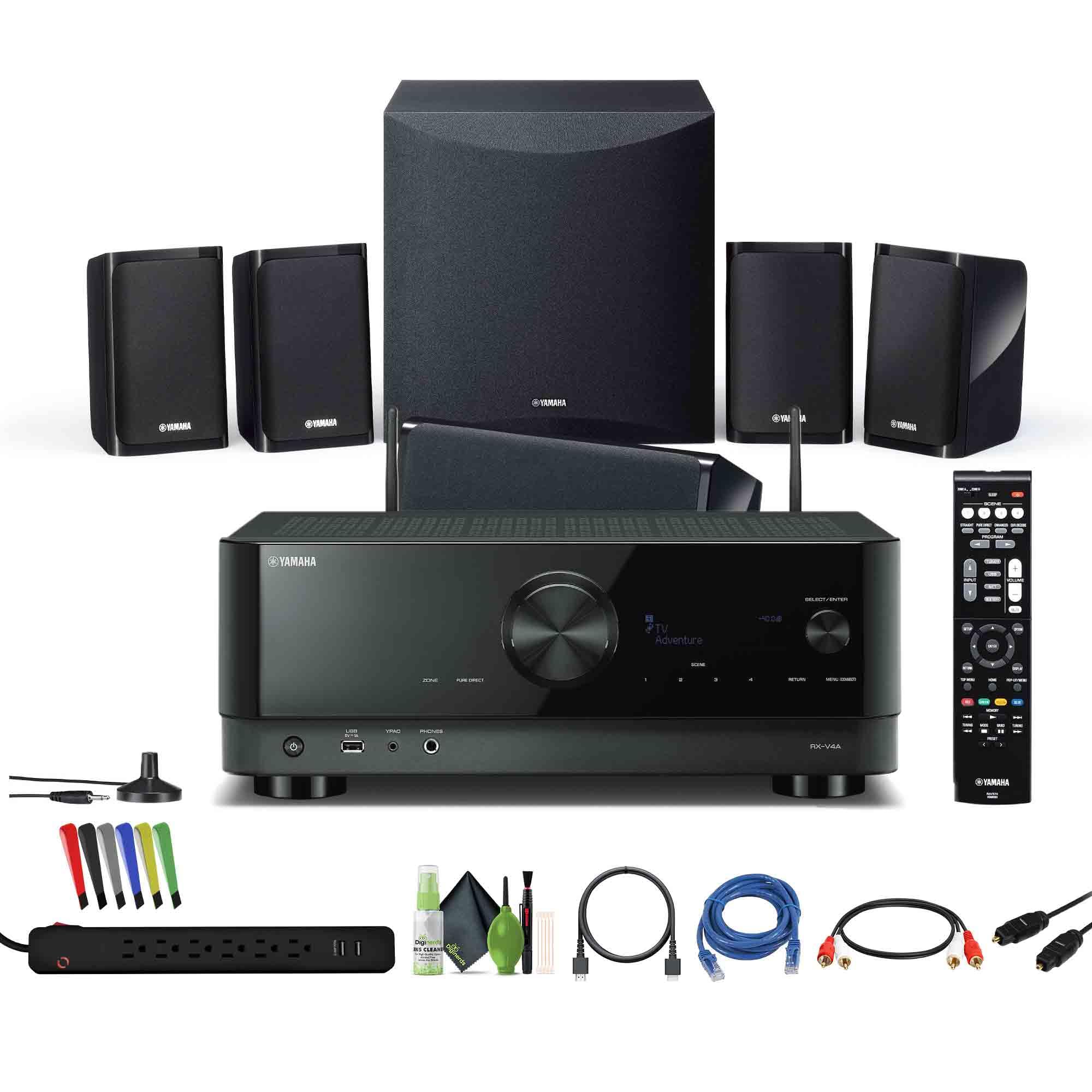
The Yamaha YHT-5960U is a complete 5.1-channel system built around an AV receiver, not a soundbar. The RX-V4A or equivalent receiver delivers 125 watts per channel into 5 ohms, driving two compact front/center speakers and rear satellites, plus an 8-inch 100-watt powered subwoofer. This is the system to buy if you plan to expand later: the receiver supports 7.2-channel configurations, so adding two more surround speakers or height channels for a 5.1.2 or 7.1 setup is straightforward.
HDMI 2.1 inputs (4 in, 1 eARC out) support 8K/60Hz and 4K/120Hz pass-through with ALLM, VRR, and QMS — critical for PS5 and Xbox Series X gamers who need low-latency 4K 120Hz video without swapping cables. Dolby TrueHD and DTS-HD Master Audio decoding are onboard, and YPAO automatic room calibration uses a supplied microphone to measure speaker distances, levels, and crossover frequencies. The MusicCast platform enables multiroom audio streaming via Wi-Fi and AirPlay 2, with Google Assistant voice control.
The bundled speakers are entry-level but timbre-matched, and the subwoofer is adequate for rooms up to 2,000 cubic feet. The wired rear speakers require running speaker wire from the receiver location, which may be a deal-breaker for renters or those who cannot cable across a room. YPAO calibration significantly improves tonal balance, especially for voices, but requires manual tweaking of the crossover (generally set to 80 Hz) for best results. For buyers who value upgradeability and modern gaming features, the YHT-5960U is the most future-proof package here.
Why it’s great
- 8K/60Hz and 4K/120Hz HDMI 2.1 for modern gaming
- Expandable to 7.2 channels with separate amplifier
- YPAO automatic room calibration for precise sound
Good to know
- Rear speakers require wired connection to receiver
- Bundled speaker wire is thin; upgrade recommended
6. Fluance Elite SX51BR

The Fluance Elite SX51BR is a passive 5.1 speaker system that requires a separate AV receiver, but the payoff is genuine high-fidelity sound. The two floorstanding towers use a three-way driver configuration: a 1-inch silk-dome tweeter, a 4-inch midrange driver, and a 6.5-inch woofer, all housed in a 0.75-inch MDF cabinet with a woodgrain veneer. This design produces a much wider dispersion pattern and smoother frequency response than satellite-based systems, with bass extension down to 40 Hz from the towers alone before the subwoofer engages.
The DB10 powered subwoofer uses a 10-inch front-firing driver with a 150-watt RMS amplifier. It delivers tight, musical bass rather than boomy one-note thud — ideal for both movie LFE tracks and stereo music listening. The rear surrounds are two-way sealed speakers with a 5-inch woofer, and the center channel uses dual 5-inch drivers for dialogue reproduction. After a 20-hour break-in period, the tweeters smooth out and the midrange opens up significantly, revealing detail that soundbar-based systems cannot match.
Fluance backs the system with a full lifetime warranty on parts and labor for the speakers (two years on the subwoofer), a confidence level that reflects their build quality. The main considerations are the need for a separate receiver (you can budget for a – model) and physical size: the towers are 36 inches tall and need floor space on either side of the TV. For listeners who prioritize stereo imaging, vocal clarity, and sub-bass extension over convenience, the Elite SX51BR is the most musically capable system at its price tier.
Why it’s great
- Three-way floorstanding towers for wide dispersion
- Lifetime warranty on speakers (parts and labor)
- Musical, accurate subwoofer without boominess
Good to know
- Requires separate AV receiver to power the speakers
- Tower speakers need dedicated floor space
7. Definitive Technology ProCinema 6D

The ProCinema 6D solves the compact speaker paradox: satellites that vanish visually but fill a room with authoritative sound. Each satellite speaker uses a 1-inch aluminum dome tweeter and a 3.25-inch BDSS (Balanced Double Surround System) mid/woofer coupled with a 3.25-inch passive bass radiator. The bass radiator extends low-frequency output beyond what a sealed 3.25-inch driver could achieve alone, giving the satellites surprising warmth and weight for their 5-inch footprints.
The 250-watt powered subwoofer uses a forward-firing 8-inch driver and a 10-inch passive radiator, which lowers the system’s effective tuning frequency without requiring a larger cabinet. The result is clean, articulate bass that hits 30 Hz in-room with authority. The center channel mirrors the satellite driver array — two 3.25-inch BDSS woofers and a 1-inch tweeter — producing exceptionally clear dialogue that cuts through complex action scenes. All speakers are magnetically shielded for placement near CRTs or older displays.
Setup is traditional passive speaker wiring to any 5.1-capable AV receiver. The compact dimensions make the ProCinema 6D ideal for wall-mounted surrounds in tight living rooms or media rooms where floor-standing towers are impractical. The subwoofer lacks automatic room EQ, so careful placement (typically near a corner for boundary gain) is needed to avoid standing waves. For buyers who want premium driver technology and room-filling bass from a discreet, modern-looking package, Definitive Technology’s ProCinema 6D is an engineering marvel of the “small speaker, big sound” philosophy.
Why it’s great
- Bass radiators in satellites for surprisingly deep output
- 250W subwoofer with dual radiator for tight 30 Hz bass
- Ultra-compact form fits small rooms and wall mounts
Good to know
- Requires separate AV receiver for amplification
- Subwoofer lacks automatic room EQ calibration
8. Polk Audio T-Series 5.1

The Polk Audio T-Series 5.1 system is the most comprehensive speaker count in the mid-range: two T50 floorstanding towers, two T15 bookshelf surrounds, one T30 center channel, and a PSW10 subwoofer — 15 drivers total. The T50 towers are a 2.5-way design with a 6.5-inch dynamic balance woofer, a 1-inch silk dome tweeter, and two 6.5-inch passive bass radiators. The passive radiators extend mid-bass output via air pressure from the powered woofer, creating a fuller low-end than sealed two-way towers of similar size, but they are true passive radiators, not powered drivers.
The PSW10 subwoofer uses a 10-inch driver with a downward-firing port and a 50-watt RMS amplifier (100 watts peak). It provides accurate, not overwhelming, bass — enough to pressurize a small-to-medium room but not to shake a large open-concept space. The center channel is a sealed three-driver design with two 5.25-inch woofers flanking a 1-inch tweeter, delivering articulate dialogue with wide horizontal dispersion across a sectional sofa. Dynamic Balance technology minimizes distortion by optimizing cone and motor geometry, keeping the sound clean at moderate volumes.
Compatibility with any AV receiver makes this a flexible foundation: you can start with 5.1 and upgrade to a 7.1 or 9.1 system by adding extra T15 bookshelves or a second subwoofer. The T50 towers are 35 inches tall and visually understated with black woodgrain vinyl. The main limitation is the subwoofer’s 50-watt RMS amplifier, which runs out of headroom on demanding LFE tracks — a future subwoofer upgrade to a 200-watt+ model transforms the system. For buyers wanting a real tower-and-subwoofer experience at a very accessible cost, the Polk T-Series is the best entry point to separates-based home theater.
Why it’s great
- Floorstanding towers with passive bass radiators
- Excellent center channel dialogue for wide seating
- Expandable to 7.1/9.1 with standard AV receiver
Good to know
- Subwoofer amp is only 50W RMS — limited headroom
- Passive radiators require subwoofer for deep bass
9. Klipsch Reference 5.1 Home Theater Pack

The Klipsch Reference 5.1 Pack embodies the “high sensitivity, low distortion” philosophy. Every speaker in this set — two R-620F floorstanding towers, R-52C center, two R-41M bookshelves, and the R-12SW subwoofer — uses Klipsch’s proprietary Tractrix horn-loaded tweeter, which couples the high-frequency driver to the air more efficiently than standard dome tweeters. The result is 96 dB sensitivity at 2.83V/1m, meaning this system produces cinema-scale loudness with far less amplifier power than comparable passive sets.
The R-12SW subwoofer is the star: a 12-inch copper-spun IMG (Injection Molded Graphite) woofer driven by a 400-watt peak amplifier (200W RMS continuous) in a front-firing, bass-reflex enclosure. It produces authoritative, physical bass that pressurizes medium-to-large rooms effortlessly, with sub-30 Hz extension for LFE effects that shake the couch. The R-620F towers use dual 6.5-inch IMG woofers alongside the 1-inch Tractrix tweeter, delivering dynamic, articulate mid-bass and crisp highs without sibilance. The R-41M bookshelf surrounds and R-52C center complete the system with matching horn-loaded drivers for seamless timbre matching across all five channels.
Klipsch’s signature sound is forward and energetic — some listeners may find the high frequencies slightly aggressive for extended music listening, though room placement and toe-in angle tame the treble significantly. The included plastic base screws for the floorstanding speakers are prone to snapping during assembly; a simple upgrade to standard M6 bolts from a hardware store resolves the issue permanently. For home theater enthusiasts who crave dynamic impact, chest-punching bass, and the ability to drive the system with a modest 50W–100W per channel receiver, the Klipsch Reference Pack is the definitive high-performance powerhouse of this list.
Why it’s great
- 96 dB sensitivity for cinema-level volume with low power
- 12-inch 400W subwoofer with deep, physical bass output
- Tractrix horn tweeters for crisp, energetic highs
Good to know
- Forward high-frequency sound may feel aggressive to some
- Base cone screws are weak; replace with M6 hardware
FAQ
Do I need Dolby Atmos for a good 5.1 surround system?
Can I use a 5.1 system with my gaming console?
What is the ideal subwoofer crossover frequency for a 5.1 system?
Final Thoughts: The Verdict
For most users, the best 5-in-1 surround sound winner is the ULTIMEA Skywave F40 because it packs genuine 5.1.2 Dolby Atmos with physical up-firing drivers, comprehensive app EQ, and HDMI eARC into a single-box-plus-satellite package that beats soundbars double its price. If you want reference-class efficiency and chest-thumping bass from a passive speaker system, grab the Klipsch Reference 5.1 Pack. And for plug-and-play simplicity with the deepest dialogue enhancement on the market, nothing beats the Amazon Fire TV Soundbar Plus.