
Our readers keep the lights on and my morning glass full of iced black tea. As an Amazon Associate, I earn from qualifying purchases.
Specs are compiled from manufacturer listings and verified buyer reviews and can change over time — please confirm the key details on the product page before buying.
Before you buy a 5 mile walkie talkie, you need to know if two people can actually hear each other when a hill, a building, or a few trees get in the way. Range claims are measured in perfect open fields, and real life is rarely that flat. This guide cuts through the marketing to show you which radios hold a signal where you actually plan to use them, and which ones quietly give up at the first ridge.
I’m Min — the founder and writer behind Gadgets Feed. This guide is built by comparing the manufacturers’ published specifications and the patterns across verified customer reviews, so you get each pick’s real strengths and trade-offs instead of marketing spin.
For a highway convoy, neighborhood kids, or a job site, the right 5 mile walkie talkie depends on power, battery, and how honestly the range claim survives real terrain.
Our Picks at a Glance

How To Choose The Best 5 Mile Walkie Talkie
Before you compare channel counts and battery hours, understand the single most important truth: every radio’s range depends on the terrain between you and the other person. Open water and flat fields give you the advertised miles; hills, forests, and concrete buildings shrink that number dramatically. A radio that claims 35 miles in ideal conditions might only reach 3 miles in the Rockies — and that’s exactly what real buyers report.
Power Output and Licensing
Power is measured in watts, and it’s the biggest factor in how far your signal travels. FRS radios, like the Rocky Talkie, transmit at 2 watts and need no license at all. GMRS radios can push more power but require a license from the FCC. Some professional radios, like the SAMCOM, put out a full 5 watts to punch through concrete and steel — but they also demand a license, so you’re trading convenience for reach.
Battery Life and Real-World Drain
Battery life is measured in hours, but how you use the radio changes everything. Transmitting at high power drains the battery much faster than listening or standby. A 1200mAh battery might last days with light use, while a 3000mAh pack could still die in a single shift if you’re talking constantly. Look for radios with switchable high/low power so you can save juice when you’re close and boost range when you’re not.
Quick Comparison
| Model | Best For | Max Range | Channels | Battery Life | Amazon |
|---|---|---|---|---|---|
| Rocky Talkie Mountain Radio★ Best Overall | Backcountry expeditions | 35 miles | 128 | 4 days | Amazon |
| Midd Kacy MK108Best Value | Road trips & weather alerts | 6 miles | 60 | 120 hours | Amazon |
| JIANUA Walkie Talkies (4 Pack Black)Crew Standard | Business & job sites | 5 miles | 22 | 96 hours | Amazon |
| JIANUA Walkie Talkies (4 Pack Colorful) | Family outdoor fun | 5 miles | 22 | 96 hours | Amazon |
| NXGKET Walkie Talkies | Family trips & NOAA alerts | 5 miles | 22 | — | Amazon |
| Gaswei G1Pro+ | Waterproof outdoor use | 6 miles | 22 | 100 hours | Amazon |
| Gaswei G2pro+ | Heavy-duty floating radios | 6 miles | 22 | 120 hours | Amazon |
| KaYoTom 4G LTE Radios | Nationwide unlimited range | — | 200 | 72 hours | Amazon |
| SAMCOM FPCN30A | Professional job sites | — | 20 | 8+ hours | Amazon |
In‑Depth Reviews
1. Rocky Talkie Mountain Radio
Our pick — over 4.5★ from 150+ verified ratings; the strongest balance of quality and price.
The expedition-grade radio that shrugs off cold, drops, and a week in the mountains
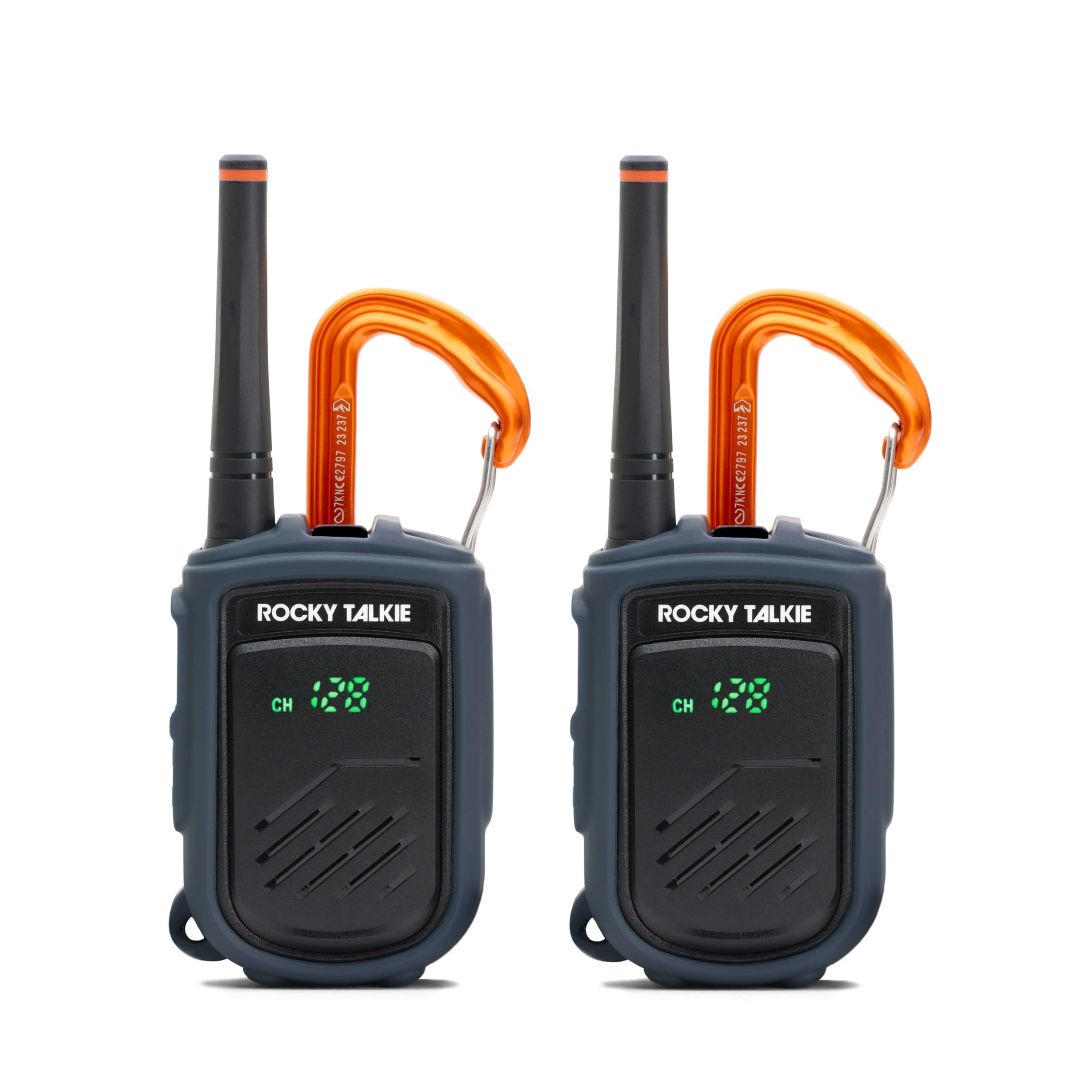
For summit pushes, not parking lots, the Rocky Talkie pushes the legal maximum of 2 watts without needing a license. The spec sheet claims a 35-mile maximum, but the makers are refreshingly honest that 1 to 5 miles is far more typical in actual backcountry terrain. Owners confirm the truth of that: road-tripping through the Rockies, they held clear contact between vehicles for miles, and one group reported “Batteries lasted for 4 days” on a single charge.
That battery endurance comes from a specialized rechargeable lithium-ion pack engineered to keep working even in very cold conditions — the kind of cold that kills ordinary phone batteries in minutes. The body is built to survive what you throw at it: a shatterproof LED screen, a thermoplastic protective covering, and no fragile plastic clips that snap off on the trail. Instead, it secures to your pack with an ultra-light climbing-rated carabiner and a metal-reinforced backup leash.
What wins people over is the sheer functionality — owners consistently praise how it works, with quality close behind. Unlike the Midd Kacy’s 60 channels, this one carries a huge 128-channel bank, giving you far more room to dodge interference. Setup is genuinely zero-configuration: there are just 5 easy buttons, so a 4-year-old in the group can use it without a tutorial. The one honest trade-off is that the carabiner attachment is the only option — no traditional belt clip — and the premium price tag reflects the go-anywhere build.
Built for the wild: A 4-day battery, IP56 splash-and-snow resistance, and a climbing-rated carabiner make this the one you trust when you’re miles from the trailhead.
The honest limits: Range shrinks to 1-5 miles in real terrain (not the 35-mile ideal), and you’ll attach it to a pack — not a belt.
Reach for this if: you live on trails, ski slopes, or hilly property where a dropped call means a real problem.
Look elsewhere if: you want a cheap multi-pack for casual neighborhood play — this is an investment, not a toy.
2. Midd Kacy MK108
The road-trip companion with a bold screen and a 6-mile open-air reach
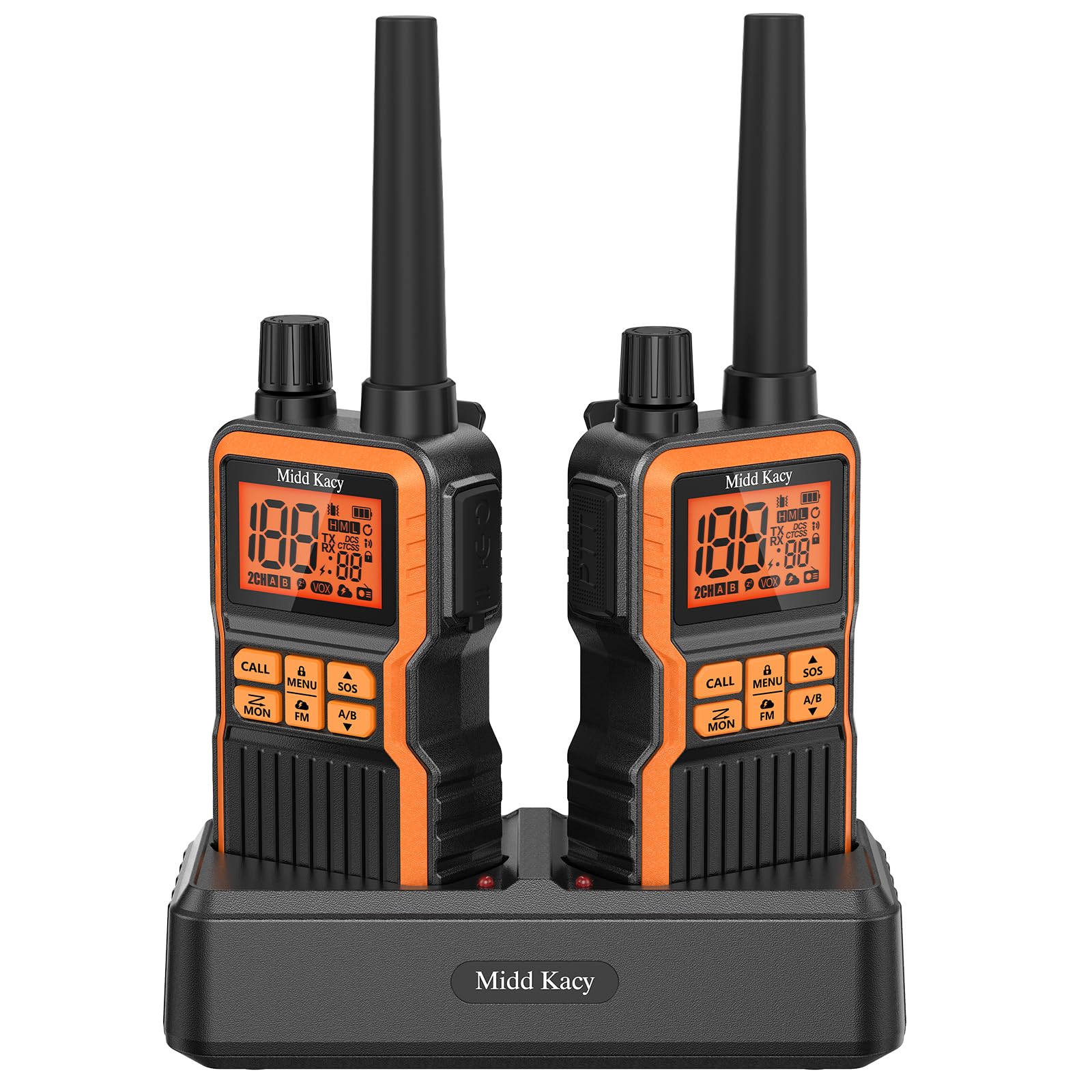
For families and convoys who want a feature-packed radio without the mountain-grade price, the Midd Kacy reaches a claimed 6 miles in open areas — a full mile past the 5-mile mark most of this list targets — and drops to 3-5 miles in towns. Owners mention exactly that on cross-country trips: “Got these for a 2 car road trip, lasted the whole way and was still at 2 bars.” They also found the range in moving vehicles to be about a football field before sound degraded — a fair reminder that cars are metal cages for radio waves.
Battery life is the quiet superstar here, rated at a huge 120 hours on the included 1800mAh rechargeable packs. The orange back-lit LCD screen stays readable in the dark, and a bold 60-channel bank with 121 privacy codes gives you plenty of room to find clear air. It even pulls in NOAA weather channels 24/7, so you’ll get a heads-up if a storm is rolling your way on the highway.
Quality is the thing owners praise most, and the sound quality follows close behind — two cars’ worth of chatter stayed clear with almost no interference on a coast-to-coast drive. The catch is the wrist straps, which buyers found flimsy and prone to breaking after a few uses; the belt clips, thankfully, held up fine.
Why it wins
- 120-hour battery lasts an entire trip
- NOAA weather alerts on board
- Bold orange back-lit screen for night use
Where it slips
- Range in cars drops fast — treat it as a short-range convoy tool
- Wrist straps break after a few uses
Grab it when: you want strong battery life and weather alerts for a highway trip, without spending premium money.
Think twice if: you need consistent range in dense city streets or heavy forest — the open-air number won’t hold there.
3. JIANUA Walkie Talkies (4 Pack Black)
The four-pack workhorse that keeps a crew talking all shift, charge after charge
Built for the daily grind, this 4-pack from JIANUA is aimed squarely at construction crews, retail stores, schools, and any team that needs to stay in touch without pulling out phones. It claims a 5-mile range in open rural areas, with the honest caveat that city and forest conditions cut that down to 0.6-1.2 miles. It runs on 22 FRS channels with 99 privacy codes — a continuous tone-coded squelch system (a filter that blocks other users’ chatter) giving up to 2178 combinations to keep your conversations private.
The money-saving angle is the battery: a full charge runs 72-96 hours of normal use, and a 1-hour top-up takes it from empty to full. It charges over USB-C, which owners love because replacement cables are everywhere. One business owner found the USB-C port the deciding feature: “since it’s a USB C charger, easily able to find a charger to charge them” when one goes missing.
Functionality and quality tie as the most-praised aspects, and the pocket-size, lightweight body is smaller than a cellphone — easy to clip to a belt for hands-free work. Buyers do note the sound quality is decent rather than spectacular, and the 5-mile number only shows up in wide-open spaces. One owner learned the hard way that a cruise ship’s metal walls kill the signal entirely, while the same radios performed great on land.
Best for: businesses and families that want four radios that charge from any USB-C cable and run for days.
Not for: anyone expecting the full 5 miles in a city, store, or ship — expect 0.6-1.2 miles in built-up areas.
4. JIANUA Walkie Talkies (4 Pack Colorful)

The cheerful four-pack that keeps kids within earshot and batteries charged for days
This sibling to the black JIANUA pack above shares the same 22 FRS channels, 99 privacy codes, and 2178 squelch combinations — but in brighter colors that make it easy to tell whose radio is whose on a family outing. The target buyer is different too: parents buying for kids to roam the neighborhood, or hunters splitting up between deer stands. One owner sums up the family use case perfectly: bought for sons to play outside while staying in reach, and the “distance in which they can still hear me is impressive.”
Battery life is the headline, and it’s the second most-praised aspect after value for money. The 1200mAh lithium battery delivers up to 96 hours on a charge, with owners reporting it lasts a couple of days even with regular household use — like calling from the basement to the upstairs rather than climbing two staircases. It recharges via USB-C in about an hour from empty.
The honest reality, shared by owners and echoed by the mixed range feedback, is that the 5-mile claim only materializes in open terrain; expect 0.6-1.2 miles in towns and forests. A cruise-ship user found range varied wildly by deck — clear on deck 11, static at deck 7. For most family scenarios, that’s plenty. The built-in LED flashlight is a handy bonus for evening walks home.
Easy choice for parents: long battery, simple operation, and colorful bodies that kids can keep track of easily.
Set expectations: range in neighborhoods is solid but far short of 5 miles — that number needs open space.
Reach for it when: you want a low-stress, long-lasting family radio that kids can use without help.
Look past it if: you need true long-distance range across valleys or dense woods — this one lives for close-to-home.
5. NXGKET Walkie Talkies
The four-pack that pairs loud NOAA alerts with a battery that outlasts the weekend
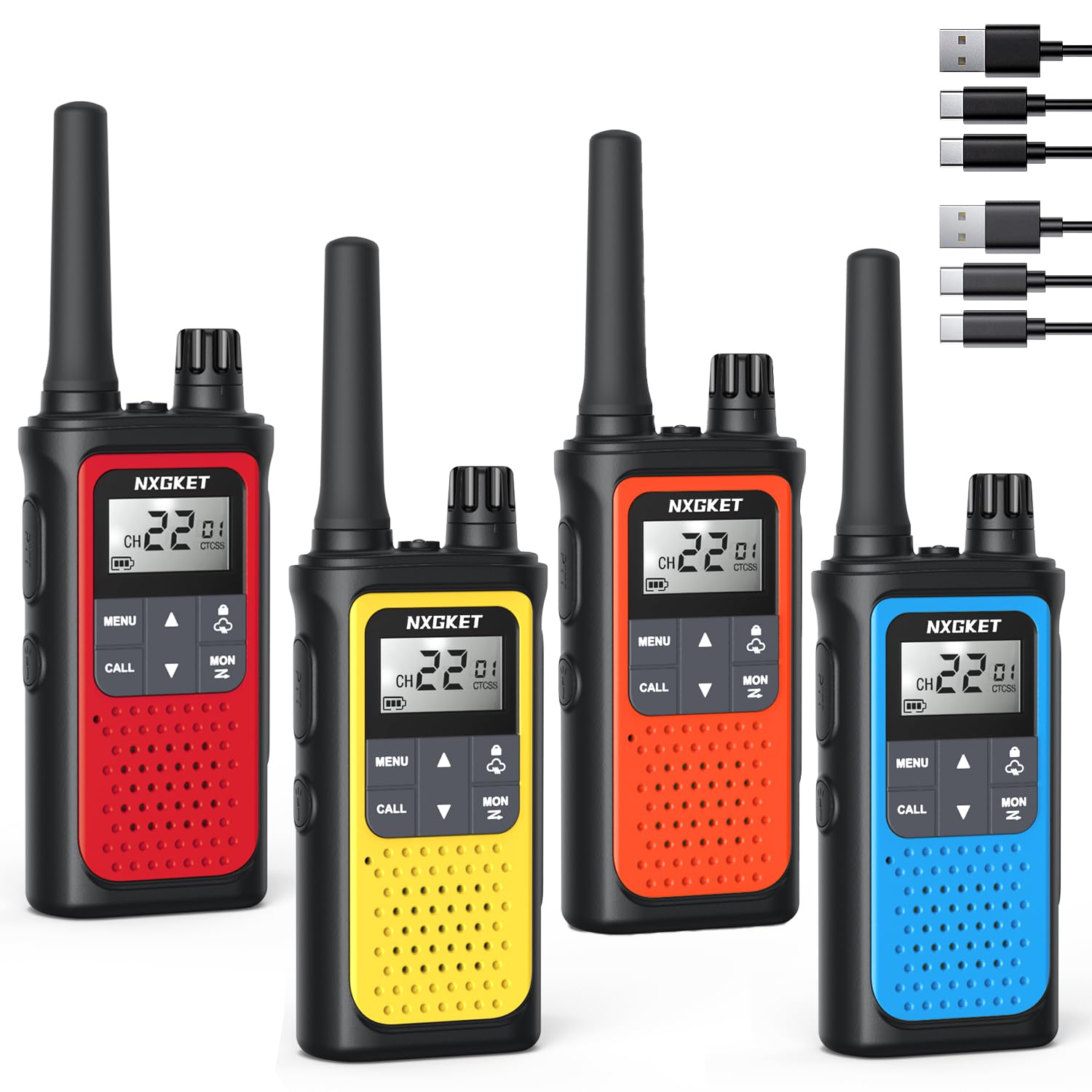
The NXGKET brings a genuinely useful twist to the 5-mile category: it scans 10 NOAA weather channels and alerts you to severe weather automatically, so a sudden storm on a hike doesn’t catch you flat-footed. The speaker is built louder too — the maker claims maximum volume is increased by 150% — which owners confirm helps in noisy environments. It’s a 22-channel FRS radio with 121 privacy codes totaling 2,662 combinations, so finding clear air is rarely a fight.
Inside sits a built-in 1800mAh lithium battery, meaning no disposable AAs to buy and replace. Customers note it holds a charge for up to 3 days of normal use, and the included 2-in-1 USB-C cable charges two radios at once. The four bright colors — red, orange, yellow, and blue — make it easy to assign one to each family member and spot it in a bag.
Quality is the runaway most-praised aspect, with functionality close behind; owners use them at football camps, on cruises across decks, and around the yard. The range feedback is mixed, which is honest: excellent within a mile or two in open areas, but poor in mountains — one owner saw static at just an eighth of a mile around a bend. There’s also a low battery alert and keypad lock, small touches that prevent surprises mid-trip.
Choose it for: family trips, camps, and any outing where weather awareness and a long-lasting 1800mAh charge matter.
skip it if: your use is deep mountain terrain — the range drops hard around ridges and bends.
6. Gaswei G1Pro+
A rugged radio that survives 2-meter drops and keeps talking through the rain
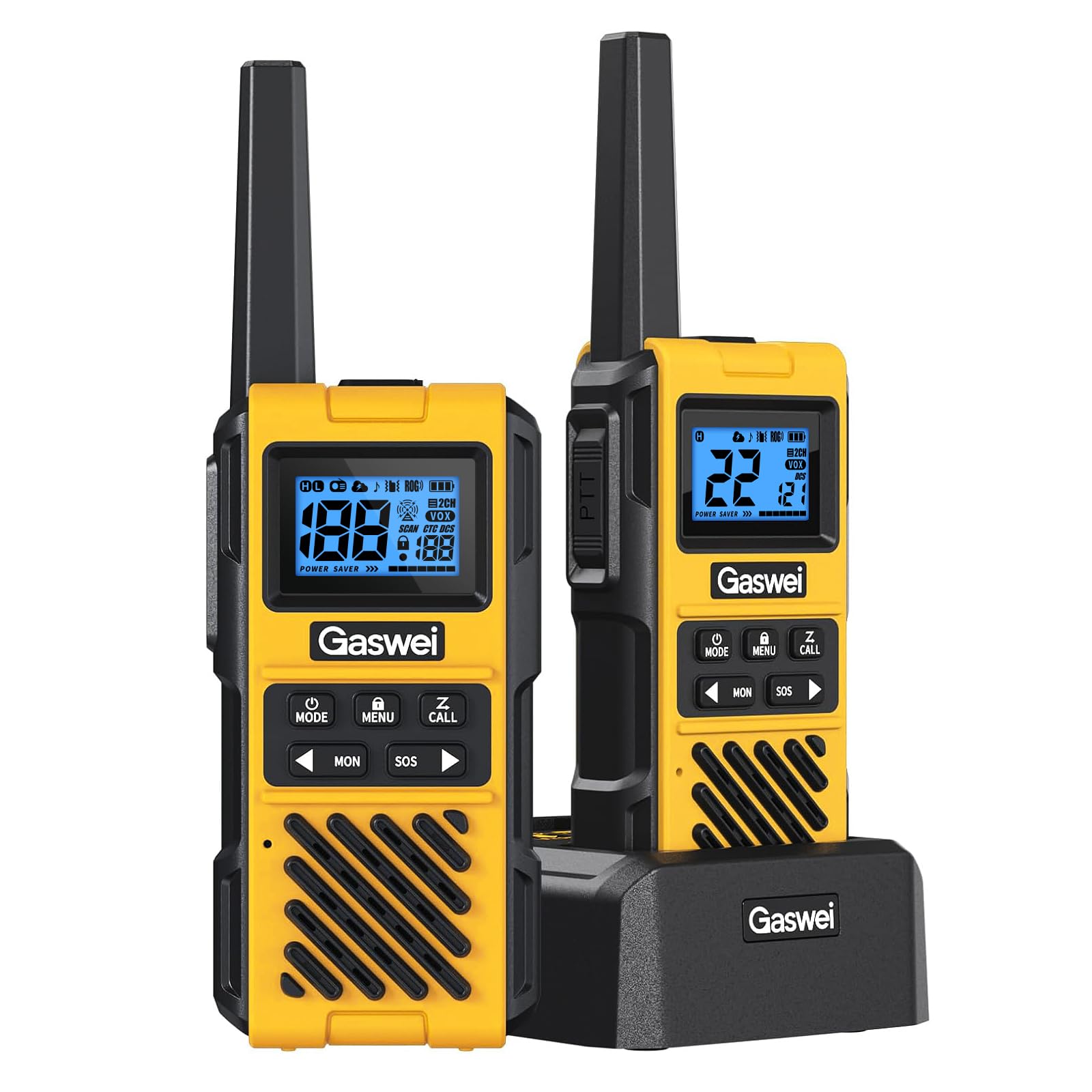
For people who treat their gear rough, the Gaswei G1Pro+ has an IP67 waterproof and dustproof rating (fully sealed against dust and can sit in a meter of water for 30 minutes) plus shock-resistant construction that survives 2-meter drops. Owners call the case “very rugged” and love that it floats, making it a natural companion for kayaking, fishing, and poolside supervision. It even doubles as an FM radio and pulls in 10 NOAA weather channels.
Range gets a real boost from switchable power: flip to 2W high mode and it reaches up to 6 miles over open water, 2-3 miles in open areas, and 1-2 miles in neighborhoods. On 0.5W low mode, you save battery for close-quarters work. The 1800mAh lithium battery delivers up to 24 hours of continuous use and a 100-hour standby (the time it lasts just sitting on, waiting for a call).
Quality is what wins owners over, with range as the second-most praised aspect. It outperforms Motorola radios in clarity and battery life, according to buyers, and holds up to its specs in real camping and water use. The durability feedback is genuinely mixed though — one unit arrived dead and needed an Amazon replacement, which was handled without hassle. Reliability is the trade-off to be aware of, even if the build quality is excellent when you get a good one.
Built tough
- IP67 floats, survives 2-meter drops
- Switchable 0.5W/2W power saves battery
- 100-hour standby
Watch for
- The occasional unit ships dead — check yours early
- Range in mountains falls well short of the 6-mile ideal
Best for: boating, camping, and wet, rough environments where waterproofing is non-negotiable.
Not for: anyone who can’t tolerate the small risk of a defective unit on arrival — though replacement is easy.
7. Gaswei G2pro+
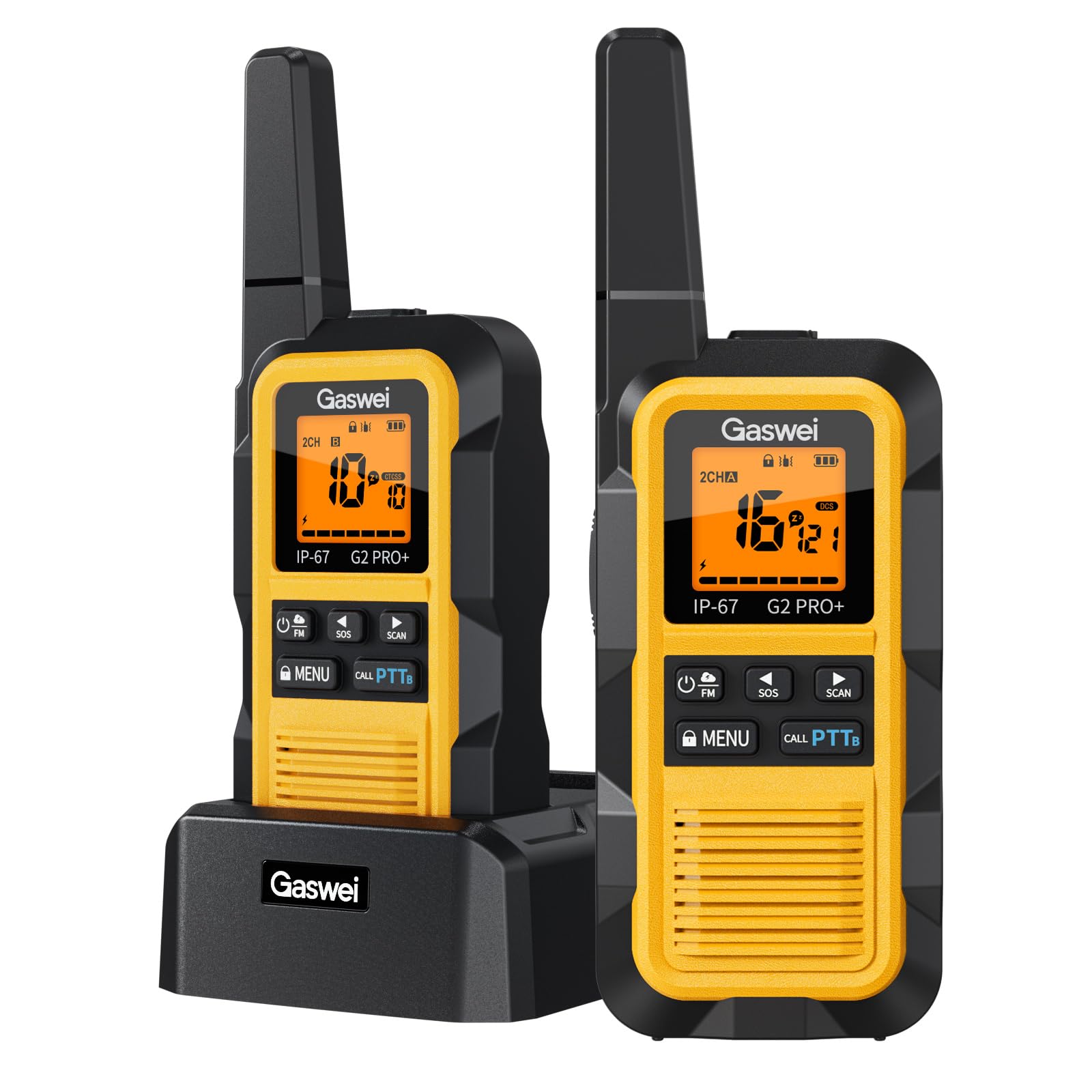
The floating flag-ship that adds dual-channel scanning to an already rugged frame
The G2pro+ takes everything rugged about the G1Pro+ and adds a genuinely useful feature: Dual Watch mode, which scans two channels at once so you can monitor a main channel and a secondary group simultaneously. That’s invaluable for team activities where one channel carries base camp and another carries the action. It also adds whisper mode — you can transmit at full volume even when speaking softly, which owners in sensitive environments appreciate. The floating IP67 waterproof design keeps it safe if it goes overboard.
On the 2-watt high power setting, range reaches up to 6 miles over open water, 2-4 miles in open areas, and 1-3 miles in neighborhoods — a shade better than the G1Pro+ in mid-range terrain. The 22 FRS channels plus 121 privacy codes keep nearby hikers and hunters out of your conversations. The body weighs just 195 grams, light enough to clip on a belt and forget.
Quality and reliability lead the praise, with battery life close behind; the included dual-port charger tops up both radios at once, and the 120-hour battery life means days between charges. Owners have submerged it, dropped it, and left it in the sun, and it keeps working. The waterproof plugs famously pop off easily — a minor flaw that doesn’t stop the radio from working but is worth knowing before you rely on the seals.
The upgrade pick: dual-channel watch, whisper mode, and a floating IP67 body make it the most versatile of the rugged bunch.
Minor annoyance: the waterproof plugs come off too easily; treat them gently and the radio is excellent.
Reach for it when: you coordinate groups across two channels and need a radio that floats, survives drops, and lasts.
Look elsewhere if: you want the cheapest way to talk at 5 miles — premium waterproof engineering costs more.
8. KaYoTom 4G LTE Walkie Talkies
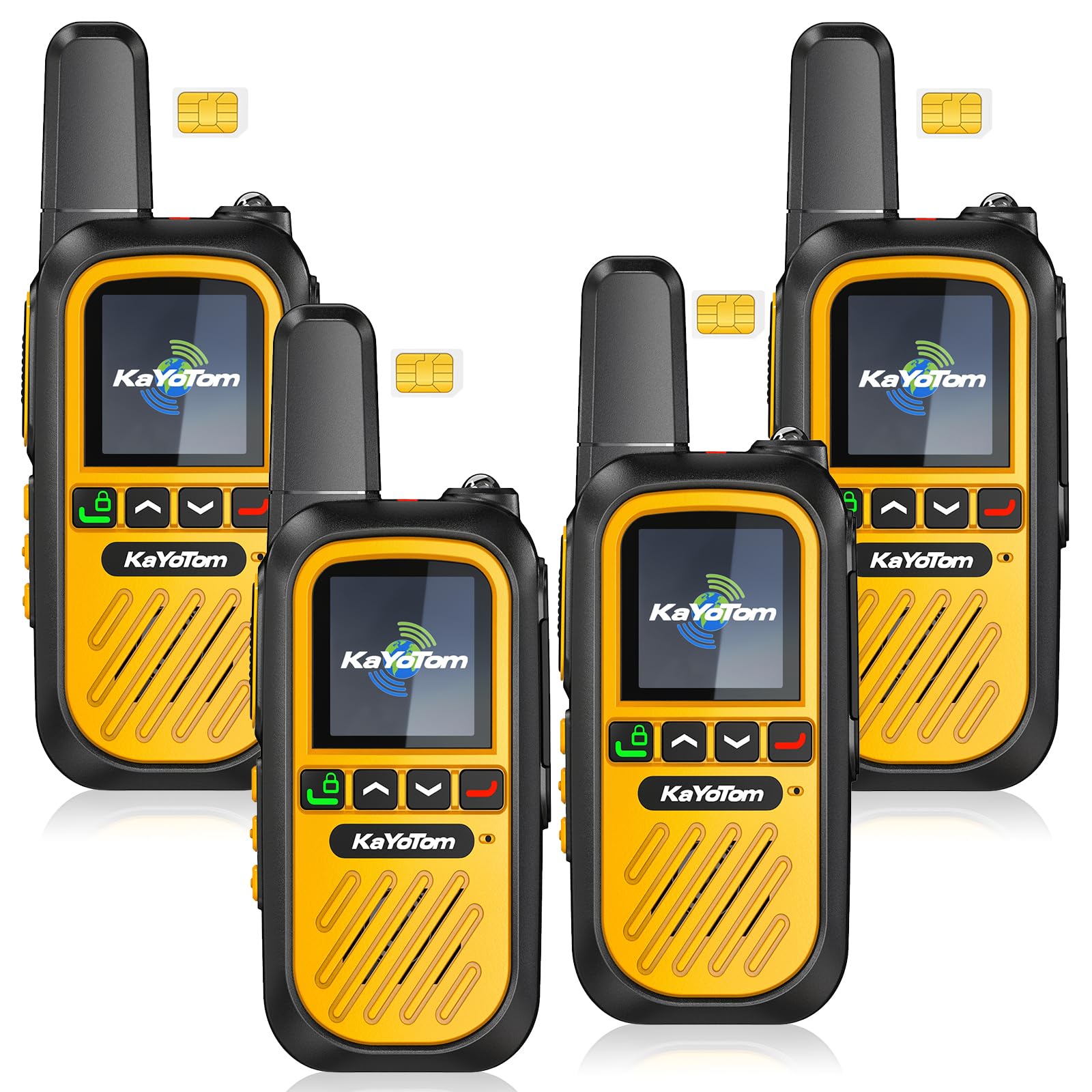
The walkie-talkie that talks across states, not just acres, with no subscription ever
This is a completely different animal from the FRS radios on this list. Instead of radio waves bouncing off terrain, the KaYoTom uses a pre-installed 4G LTE SIM card to carry your voice over the cellular network — which is why it claims 5000+ miles of range. It works anywhere your phone gets a signal, coast to coast, and there’s no activation and no subscription because lifetime data is included. Reviewers point out talking 20 miles apart for work, and some have used it state-to-state for personal calls.
The battery is a big 3000mAh pack that delivers over 80 hours of use and 15 days of standby, and USB-C charging restores 50% power in just 20 minutes — ideal for long shifts. A noise-filtering microphone claims to eliminate 95% of environmental noise, so construction sites and truck cabs stay clear. It’s built to withstand 2-meter drops and seals against dust down to 0.1μm (a particle size fine enough to be invisible to the eye).
Performance is the most-praised aspect, with sound quality close behind — owners who expected to need a subscription found “NO subscription needed, turn it on and it works.” The catch is the PTT (push-to-talk) button placement, which some find finicky, and the range is only as good as your cellular coverage. If you’re planning a trip to a dead zone with no cell service, this radio won’t help where a traditional FRS radio would.
Unlimited reach
- Works across states via 4G LTE
- Lifetime data, no subscription
- 3000mAh with 20-minute quick charge
Reality check
- Range dies in no-cell zones
- PTT button placement is finicky
Choose it for: truck fleets, cross-state family calls, and anyone who needs range that laughs at mountains — as long as there’s a cell tower nearby.
pass on it if: you’re heading deep into wilderness with zero coverage; that’s the Rocky Talkie’s job.
9. SAMCOM FPCN30A

The 5-watt professional that punches through concrete walls and steel beams
When your job site has concrete walls, steel beams, and basements between you and your crew, you need more than 2 watts. The SAMCOM FPCN30A pushes a full 5 watts of power to reach 3-5 miles in open areas and cover 300,000+ sq ft inside buildings — enough to get through the dense packing of a warehouse or construction site. It’s an FCC Part 90 certified Land Mobile Radio (a professional-grade transceiver built for commercial use), and the package includes a loud 2-pin speaker mic plus a 6.7-inch long antenna to boost reach.
Organization is the theme here. The 20 UHF channels let you split crews into separate groups so no one steps on each other’s conversations, and a one-key GROUP button instantly broadcasts to all teams at once — perfect for site-wide safety alerts. The 1500mAh battery delivers 12+ hours of standby and 8+ hours of continuous use, which covers a full shift plus overtime.
Quality and value for money are the most-praised aspects; owners call it a sturdy, well-priced alternative to pricier Motorola pro radios, with clear audio for daily maintenance coordination. The honest range feedback is typical of UHF radios: flawless in flat or open areas, but only about a quarter mile in mountainous forest — a repeater is needed for true long-distance coverage in rough terrain. The lack of a programming cable and USB-C charging are noted omissions for a professional tool.
The pro tool: 5 watts, GROUP call, speaker mic, and 300,000+ sq ft coverage make it a real workhorse for busy sites.
Know your terrain: in mountains it drops to a quarter mile, and it needs a license plus a programming cable you’ll buy separately.
Best for: construction, warehouses, event security, and any crew that needs signals through walls and organized team channels.
Not for: casual family hiking — licensing, programming, and the price point suit professionals only.
Understanding the Specs
Range: The Truth Behind the Miles
The advertised range on any walkie-talkie box is measured in perfect open conditions — flat ground, no trees, no buildings. Real-world range depends on what’s between you and the other radio. A 5-mile claim can become 1 mile in a neighborhood or a quarter mile in mountains. Look for radios that tell you their range across different environments, like the Gaswei models which list separate numbers for open water, open areas, neighborhoods, and urban streets. That honesty is worth more than a big bold number.
Power and Licensing
Power is measured in watts, and more watts generally means more reach. FRS radios like the Rocky Talkie and JIANUA models transmit at 2 watts maximum and need no license at all — you can use them the day they arrive. GMRS radios can push more power but require an FCC license. Professional radios like the SAMCOM output a full 5 watts but demand both a license and, often, programming. If you want zero paperwork, stick with FRS.
Channels and Privacy Codes
Channels are the frequencies you talk on; privacy codes (also called CTCSS tones) are filters that block other users on the same channel. More channels and codes mean more ways to find clear air in crowded areas. A radio with 22 channels and 99 codes gives you up to 2178 combinations — plenty for a busy campground. Check what your family or crew already uses, since all FRS radios can talk to each other if set to the same channel and code.
Battery Life and Charging
Battery life is quoted in hours, but those hours depend on how you use the radio. Transmitting at high power, using the flashlight, and keeping the volume up all drain the battery faster. A 1200mAh battery might last 96 hours with light use, while a 3000mAh pack could still die in a single shift with constant talking. USB-C charging is a huge convenience — it means you can top up from the same cable you use for your phone, and a quick 20-minute charge can restore half a battery.
FAQ
Do I need a license to use a 5 mile walkie talkie?
Will a 5 mile walkie talkie actually reach 5 miles?
Can different brands of walkie talkies talk to each other?
What is VOX and why would I use it?
What does an IP67 waterproof rating mean for a walkie talkie?
How long does the battery last on a typical 5 mile walkie talkie?
What are privacy codes and do I need them?
Will a walkie talkie work inside a building or on a cruise ship?
What is the difference between FRS and GMRS walkie talkies?
How do NOAA weather alerts help me?
Final Thoughts: The Verdict
If you want one dependable pick, the 5 mile walkie talkie winner is the Rocky Talkie Mountain Radio because its honest range claims, 4-day battery, and climb-proof build make it the one radio you can truly trust when the signal matters. If you want the best value for highway trips with weather alerts and a 120-hour battery, grab the Midd Kacy MK108. And for crews working through concrete walls on a job site, the SAMCOM FPCN30A is the professional choice that handles 300,000+ sq ft of coverage. The Rock Talkie also leads the list in owner satisfaction, with a 4.6-star average across 100+ verified reviews.
How We Picked
We do not accept paid placement. Every pick is matched to a real buyer and a real use-case; we do not hands-on test units.
Sources & Methodology
Specifications: manufacturer listings and product documentation. Review insights: verified customer reviews, as of August 2026. Pricing: not shown on this page (it changes often); check the current price via the retailer link.
As an Amazon Associate, Gadgets Feed earns from qualifying purchases. This does not affect which products we feature.