
Our readers keep the lights on and my morning glass full of iced black tea. As an Amazon Associate, I earn from qualifying purchases.
Specs are compiled from manufacturer listings and verified buyer reviews and can change over time — please confirm the key details on the product page before buying.
Here is the short answer: if you want a MIDI cable that works and keeps working, buy one with a 5-pin DIN connector (the round plug with five little metal pins, keyed so it only goes in one way) built for the job you actually do. For two keyboards that sit far apart, a dual 9.9-foot cable saves you from untangling separate leads. For nightly stage use, a heavy-duty Roland holds up. For a packed pedalboard, a four-pack of low-profile right-angle cables fits where straight plugs will not. Your setup decides the pick, not the marketing badges.
I’m Min — the founder and writer behind Gadgets Feed. This guide is built by comparing the manufacturers’ published specifications and the patterns across verified customer reviews, so you get each pick’s real strengths and trade-offs instead of marketing spin.
You do not need to spend much to get a reliable connection, but you do need the right plug shape, the right length, and all five pins wired. That is what separates a keeper from a drawer filler, and the picks below cover every real use of a 5 pin midi din cable.
Our Picks at a Glance

How To Choose The Best 5 Pin MIDI Din Cable
A MIDI cable carries digital note messages between devices, not audio. So what matters most is that the plug seats firmly, the pins stay wired end to end, and the jacket survives being coiled and uncoiled a hundred times. Here is what to weigh before you buy.
Connector Type: 5-Pin DIN Is Not USB
Every cable in this guide uses a 5-pin DIN plug, the standard round connector on keyboards, synths, and pedals. Some listings describe their connector loosely, but what counts is the physical plug: five pins, 180-degree keyed orientation, male on both ends so it links two female ports. Before you order, confirm your device actually has a 5-pin DIN In, Out, or Thru port.
Length: Match the Run, Not the Spare Cable Bin
A 2-foot cable for a pedalboard or a stacked synth desk keeps wiring tight and out of the way. A 9.9-foot or 20-foot cable belongs in a rack or a live rig where keyboards sit far apart. An over-long cable on a pedalboard becomes a coil you trip over; an over-short cable forces your gear into awkward positions.
Plug Shape: Straight, Right-Angle, or Mirrored Angle
Straight plugs are the default and offer the most strain relief. Low-profile right-angle plugs let you tuck cable flush against a synth or pedal so you can pack gear closer. Mirrored-angle plugs put the two ends in opposite orientations, which helps when two ports on one unit are jammed side by side and you need both cables to exit without crossing.
Wiring and Shielding: The Invisible Quality
Good cables run all five pins straight through — pin 1 to pin 1, and so on — so no data path is missing. Oxygen-free copper conductors and shielding keep electromagnetic and radio interference (stray signal noise from nearby gear) from degrading the digital stream. Nickel-plated or gold-plated contacts both resist corrosion; the choice matters less than solid strain relief at the plug.
Quick Comparison
| Model | Best For | Length | Connector | Pack Count | Amazon |
|---|---|---|---|---|---|
| Hosa MID203 Dual MIDI Cable★ Best Overall | Two keyboards, one tidy pair | 9.9 feet | Dual 5-pin DIN, male-to-male | 1 (dual pair) | Amazon |
| EMK Premium 5-Pin MIDI CableBuilt to Bend | Braided single cable for a rack run | 3 feet (1 meter) | 5-pin DIN, male-to-male | 1 | Amazon |
| Heams 3 Pack Premium 3FT MIDI Cable | Spares for a small home rig | 3 feet | 5-pin DIN, male-to-male | 3 | Amazon |
| Hosa MIDI20 MIDI Cable | Long runs across a stage or rack | 20 feet | 5-pin DIN, male-to-male | 1 | Amazon |
| Heams 4 Pack Right Angle MIDI Cable | Tight pedalboards and desktop synths | 2 feet | 5-pin DIN right-angle, male-to-male | 4 | Amazon |
| Roland Gold Series RMIDI-G3 | Stage rigs that need a lifetime guarantee | 3 feet | 5-pin DIN, male-to-male | 1 | Amazon |
| CME MIDI Cable 4-Pack | Pedalboards with jammed ports | 2 feet (24 inches) | 5-pin DIN, mirrored 45-degree angle | 4 | Amazon |
In‑Depth Reviews
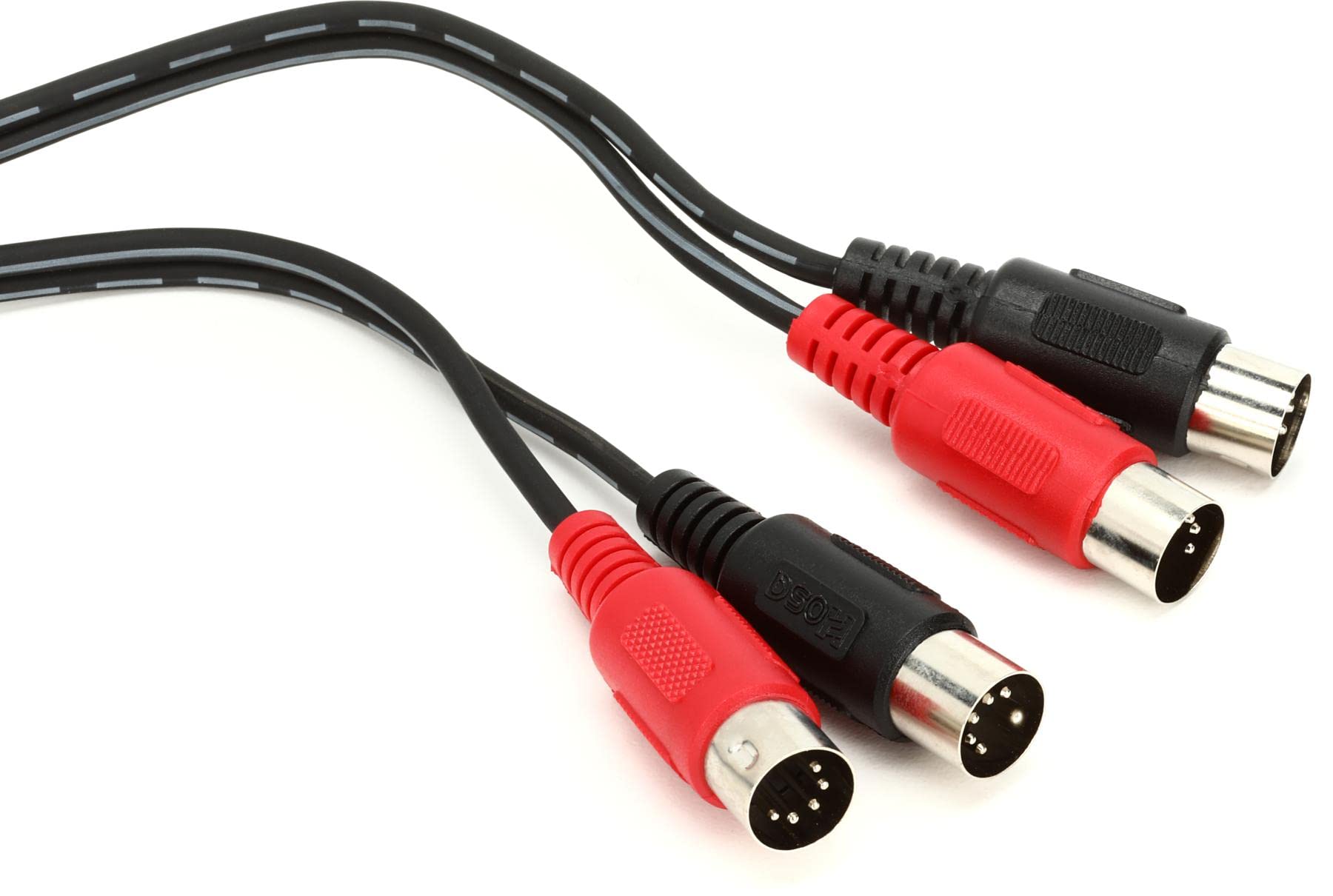
1. Hosa MID203 Dual MIDI Cable – 9.9 Feet, 3 Meter
Our pick — over 4.5★ from 550+ verified ratings; the strongest balance of quality and price.
One cable, two runs — the pair that ends the dropped-keyboard-key tangle.
Two 5-pin DIN cables fused into a single jacket means you run In and Out between two keyboards in one motion, not two tangled spools. That bundled build is exactly what buyers here keep praising: the pair design kills the fiddle of fetching two separate cables every time you set up. The 9.9-foot length covers a two-tier rack without a coil of slack spilling onto the floor.
What actually matters here is how the ends behave. They pull apart cleanly to sit on the wider In and Out sockets on some keyboards, and the individual leads are the same medium-grade build Hosa has sold for years. One honest caveat: you are buying convenience, not boutique cable. The pair also carries the color-coating the maker applies, which is genuinely useful on a dim stage — just remember the colors are swapped between the two ends, so In on one end is Out on the other.
Where the Hosa MID203 leads on the numbers: one purchase yields two functional cables, matching the CME and Heams 4-packs on pack logic but giving you 9.9 feet instead of 2 feet for gear that sits far apart. That is the deciding factor for a two-keyboard live rig.
What wins players over
- One dual cable replaces two loose MIDI runs between stacked keyboards.
- 9.9-foot length reaches from a bottom keybed to a top tier without strain.
- Ends separate to seat on the wider In and Out sockets found on some boards.
- Color coating makes In and Out easier to trace in a dark rack.
Where it asks you to look closer
- The two ends are mirrored, so In on one end faces Out on the other — easy to wire backwards on a fast setup.
- No labeled In and Out markers, so you learn to check the pins rather than the color.
- Medium-grade build, not the heavy-duty feel of a stage-first cable.
Settle here if: you gig or rehearse with two keyboards and want one cable pair that carries both runs.
Move along if: your rig is a single keyboard and a single 3-foot run — a cheaper single cable covers that.
2. EMK Premium 5-Pin MIDI Cable (1 PCS, 3Ft/1M) – Nylon Braided Durable MIDI to MIDI Cord for Keyboard, Synthesizer, Guitar Pedal, Sampler, Audio Interface, Mixer – Gold-Plated Connectors
The braided single cable that feels heavier than its size suggests.
The EMK’s nylon braided jacket is rated by the maker for military-grade shielding and 10,000+ bends. That is a wear-resistance figure the maker publishes, not one per verified buyer reviews — treat it as EMK’s own claim. What you feel in the hand is a beefier cable than the mundane plastic-jacketed options, and its 3-foot length suits a rack shelf or a desktop synth stack. The gold-plated connector finish resists corrosion, though one buyer’s honest note is worth relaying: “connectors on the ends are not metal….they are shiny coated plastic, yet the photos suggest they are metal.”
Functionality holds up. The 5-pin DIN male-to-male format fits standard MIDI In, Out, and Thru ports, and the cable runs all five pins end-to-end so no channel is dropped. What wins people over is the build quality for the price — the braided cover and the strain relief at the plug do a real job. It is a single cable, though, not a multi-pack, so if you need spares you look to the Heams or CME bundles instead.
The braided build, honestly: the nylon cover and the strain relief at each plug are the two things EMK got right — they survive repeated plug and unplug better than a cheap plastic-jacketed cable.
What to know before you order: the connector housing looks metallic but is coated plastic, so if you are matching a metal-bodied synth finish, that is a cosmetic gap. One owner’s unit also arrived with a defective splitter, though that is a single report out of a solid batch.
Order this one if: you want a single braided cable for a permanent install where bending is frequent and durability matters.
Look elsewhere if: you need spares in one purchase — a multi-pack serves a pedalboard better.
3. 3 Pack Premium 3FT MIDI Cable, Stable & Fast Signal Transmission

Three 3-foot runs for a small home rig, built on twice the copper of a typical cable.
Three cables in one bag is the story here, and that is exactly the value buyers keep returning for. This 3-pack carries more than double the Hosa MID203’s cable count by unit, turning a 1-pack into a 3-pack for the same shelf space. Its spec edge is double the oxygen-free copper cores of a standard cable, which the maker says keeps signal transmission stable and fast. For a small home studio feeding a keyboard, a drum machine, and an external sound card, three cables cover the whole chain.
The nickel-plated connectors survive repeated plugging and unplugging, and the keyed 180-degree pin configuration keeps the plug from going in backward. One thing to know before ordering: this model has no USB interface — it is pure 5-pin DIN, so confirm your gear’s port before you buy. The recurring gripe among owners is the plug fit, which one buyer described as loose compared to most DIN5 connectors even though all five wires are wired correctly.
Where the Heams 3-pack beats the EMK single is raw count — three cables versus one — though it falls short of the EMK’s braided jacket on feel alone. On a home desk situation, the count wins.
What makes the pack work: three cables in one order means a full chain — keyboard to drum machine to interface — is set up without a second purchase. The packaging arrives in reusable protective cases, which keeps them tidy between sessions.
The honest caveat: the plug grip is looser than the firmest DIN5 connectors on the market, so if your boards get nudged during performance, seat them carefully. It is not a wire fault — all five pins connect correctly.
Neat fit for: a home studio or small rehearsal rig that needs three short MIDI runs without hunting for spares.
Less of a fit for: stage use where the loose plug grip could work itself free underfoot.
4. Hosa MIDI20 MIDI Cable – 20 Feet Black

The 20-foot single run for when your keyboards are in different rooms.
Twenty feet is the number that defines this pick — more than double the CME 4-pack’s 2-foot reach and twice the Hosa MID203’s 9.9 feet. If your master keyboard sits at the desk and your synth rack is a full room away, this is the cable that spans the gap without a coupler. Buyers describe it as flexible and easy to store, and the thickness of the jacket suggests a long service life.
The connector is the standard 5-pin DIN male-to-male, and it runs all pins end to end for uninterrupted data. What wins owners over is the functionality — it simply works, on everything from band equipment to a MIDI drum kit. One thing to watch: this long cable arrives folded — not coiled — in the package, and the folding can leave kinks that need working out. A buyer suggested warming the cable with a hair dryer and wrapping it around a can to straighten it, which is worth knowing before you unbox.
This is also a premium-tier Hosa, and it shows in the strain relief and molded connectors. On the count front it loses to the Heams 3-pack and the CME 4-pack, but you are buying one long cable, not three short ones.
What it does best
- 20 feet of reach covers the widest keyboard-to-rack gap in a home or band setup.
- Molded connectors and good strain relief hold up to repeated plugging.
- Flexible enough to coil and store without cracking the jacket.
- Shielded build keeps the long run clean of stray interference across the extra distance.
The catch to note
- It ships folded, not coiled, so it can arrive with kinks you need to work out.
- A single cable, so it does not add spares the way a 3-pack or 4-pack does.
Pick this for: the long run — a keyboard at one end of the room, a rack at the other, and no drape of excess cable between them.
Skip it for: pedalboards and desktop rigs where 20 feet of slack becomes the problem.
5. 4 Pack Premium Right Angle MIDI Cable 2FT, Low Profile, Stable Signal

Bends flush against the back of your synth so the cable never sticks out.
Right-angle plugs are the reason to reach for this set. Where a straight DIN5 plug juts out 6 inches behind a desktop synth, the mirrored right-angle ends here hug the rear panel so you can push the unit against a desk or rack wall. That same design detail is what buyers describe as the star of the show, and the low-profile body keeps the wiring tight on a crowded board.
Four 2-foot cables in one order is the practical advantage. The 4-pack count matches the CME 4-pack and beats the Heams 3-pack by one cable, but the Heams 3-pack offers 3-foot runs where these are strictly 2-foot. The spec that decides it is fit: this is a 2-foot, right-angle, low-profile cable, so a pedalboard with tight port spacing gets exactly the reach it needs with no slack to trip over.
The trade-off is real but narrow — the wire between the connectors is thinner than on a heavy-duty cable. A buyer noted it is thin while the rubber casing still feels secure, so for a stationary pedalboard or desktop synth it holds up. For a rig that gets set up and torn down every night, that thin wire is the part to keep an eye on.
The fit advantage: mirrored right-angle ends and a super-thin plug take up minimal space, so two MIDI ports pressed close together on a desktop synth both stay usable.
Where it asks you to take care: the connecting wire is on the thin side compared to a molded stage cable — fine for a rack or pedalboard that stays put, but worth watching if you move gear nightly.
Reach for this when: your pedalboard or desktop synth has rear-panel ports crying out for a low-profile, right-angle cable that stays out of the way.
Think twice if: you leave long runs between gear — 2 feet will not cross a room.
6. Roland Gold Series RMIDI-G3 MIDI Cable, 3-Feet

Heavy-duty connectors, gold contacts, and a lifetime guarantee — the stage-first pick.
The Roland Gold Series carries the one spec almost nobody else in this round lists: a lifetime guarantee. That is a commitment from the maker, not from us, and it tells you the cable is built to stay. The 3-foot length runs from a controller to a synth sitting right beside it, and the heavy-duty connectors with gold contacts resist corrosion even after years of plugging in and out.
Inside, a four-conductor configuration and heavy-duty polyethylene insulation give it a low-noise design. That means less hum and interference on the run — useful in a studio packed with gear. Owners treat it as the benchmark they compare other cables against, with one review calling it “the best quality” cables that last.
What it does not do is save space. The straight, heavy-duty plug juts straight back from a synth — the exact problem the CME 4-pack and Heams 4-pack solve with right-angle ends. And it is a single cable, so a multi-device rig will want a pack alongside it for spares.
Why it earns its spot
- Lifetime guarantee from Roland — a rare, real durability commitment in this category.
- Gold contacts and heavy-duty connectors resist corrosion over a long life.
- Four-conductor, low-noise design keeps long runs clean of interference.
- The 3-foot length is the studio-friendly standard for two devices sitting side by side.
What to plan around
- Straight bulky plug juts out — not the tucked-away look a low-profile option gives.
- One cable, so a multi-device stage setup needs spares bought separately.
Go with this if: you play out regularly and want the one cable you never have to think about again — the lifetime guarantee is the whole argument.
Pass on it if: your gear is packed tight and you need the flush, low-profile orientation instead.
7. CME MIDI Cable 4-Pack – 2FT / 60cm, 5-pin DIN, Low-Profile – Mirrored 45-Degree Angled Ultra-Thin Plugs for Compact Spaces – Ideal for MIDI Interface, Pedalboard, Keyboard

The mirrored 45-degree plug that frees two jammed ports at once.
Four 2-foot cables with mirrored 45-degree angled plugs — that mirrored exit is the detail that makes this set a pedalboard favourite. Where a straight plug forces one cable to cross another, the mirrored orientation sends the two plugs out opposite ways so close-set MIDI In and Thru ports both stay usable. The ultra-thin, low-profile body keeps cable routing tidy on a cramped board, and the four-cable count covers a full pedal chain in one order.
Under the jacket, nickel-plated connectors and an oxygen-free copper core handle the repeated plug and unplug of pedalboard life, and the integrated shielding keeps the data clean of interference. CME designed these with input from its music enthusiasts community, and buyers confirm the fit in cramped spaces — one praised how well it works with the CME U6MIDI PRO and its ability to slip into tight spots. Its 16-gauge wire is thicker than most low-profile cable in this round.
The honest trade-off is durability under heavy setup-and-teardown. The thin profile that makes these convenient also makes some buyers cautious about long-term wear — one owner noted they would trust them in a fixed studio but not for nightly tear-down sessions. For a pedalboard that stays mostly assembled, they are a strong fit.
Why pedalboard players love it: the mirrored 45-degree angle and low-profile body free up packed ports, so two 5-pin DIN sockets pressed together both get a cable without crossing.
Where to be thoughtful: the thin build that saves space is the same reason some owners keep them for fixed setups — nightly tearing down and rebuilding is where the wear risk lives.
Built for you if: your synth or pedalboard has ports jammed too close together for a straight DIN plug.
Not the pick if: you need long, heavy-duty cables for a touring rig that gets packed every night.
Understanding the Specs
Connector Type and Pin Configuration
A 5-pin DIN connector is the standard round MIDI plug with five metal pins arranged in an arc. It is keyed in a 180-degree layout, so there is only one way to seat it. Male-to-male means both ends have pins, which is what you need to link two female MIDI In, Out, or Thru sockets.
Length and Routing
Length decides the job. A 2-foot cable suits a pedalboard or stacked synth desk where routing has to stay tight. A 9.9-foot or 20-foot cable belongs in a rack or a live rig where the keyboard and the rack are far apart. Choose the shortest cable that reaches, so you avoid a coil of slack.
Plug Shape: Straight vs Right-Angle
A straight plug is the default and offers the most strain relief. A right-angle plug bends the cable flush against the gear, which saves space behind a synth or pedal. A mirrored right-angle or 45-degree plug sends the two ends out in opposite orientations, which keeps two close-set ports usable without the cables crossing.
Wiring, Shielding, and Contact Plating
Pin-to-pin wiring runs all five pins straight through — nothing gets dropped. Oxygen-free copper conductors carry the data, and shielding blocks electromagnetic and radio interference from nearby gear. Nickel-plated and gold-plated contacts both resist corrosion; the plating choice matters less than solid strain relief where the cable meets the plug.
FAQ
Will a 5-pin DIN MIDI cable work with my keyboard or synth?
Can I use a 5-pin MIDI cable for audio or a footswitch?
Do all five pins need to be wired for MIDI to work?
How long can a MIDI Din cable run before the signal degrades?
Is a right-angle MIDI cable better than a straight one?
What does a mirrored-angle plug do that a normal right-angle does not?
Will a MIDI cable fit a 5-pin port that has a different arrangement of pins?
Why do some MIDI cables feel loose in the socket and others grip tight?
How many MIDI cables do I need for a two-keyboard setup?
Does the connector material affect whether my MIDI signal stays clean?
Final Thoughts: The Verdict
For most players, the 5 pin midi din cable winner is the Hosa MID203 Dual MIDI Cable because it bundles two 9.9-foot runs into one cable pair — an ideal setup for someone playing two keyboards who is tired of untangling separate cables on stage. If you want a single heavy-duty cable built to survive years of stage use, go with the Roland Gold Series RMIDI-G3 and its lifetime guarantee. And if your pedalboard is packed tight and the ports are jammed, the CME MIDI Cable 4-Pack with its mirrored 45-degree plugs is the one to reach for.
How We Picked
We do not accept paid placement. Every pick is matched to a real buyer and a real use-case; we do not hands-on test units.
Sources & Methodology
Specifications: manufacturer listings and product documentation. Review insights: verified customer reviews, as of September 2026. Pricing: not shown on this page (it changes often); check the current price via the retailer link.
As an Amazon Associate, Gadgets Feed earns from qualifying purchases. This does not affect which products we feature.