
Our readers keep the lights on and my morning glass full of iced black tea. As an Amazon Associate, I earn from qualifying purchases.
Specs are compiled from manufacturer listings and verified buyer reviews and can change over time — please confirm the key details on the product page before buying.
Your low B string sits around 30.87 Hz — a frequency so deep that many standard guitar tuners simply refuse to lock onto it, leaving you guessing. That is the real test of any 5 string bass guitar tuner: not how it handles the A string, but whether it can hear that massive low B without flinching. This guide cuts through the noise to find the clip-ons, pedals, and standalone units that genuinely track the full bass range.
I’m Min — the founder and writer behind Gadgets Feed. This guide is built by comparing the manufacturers’ published specifications and the patterns across verified customer reviews, so you get each pick’s real strengths and trade-offs instead of marketing spin.
You need a tuner that locks onto the low B string without lag, whether you’re on stage or at home. These picks all handle that reliably, and you’ll find your match in this roundup of the best 5 string bass guitar tuner options on Amazon today.
Our Picks at a Glance

How To Choose The Best 5 String Bass Guitar Tuner
Before you buy, understand that a standard guitar tuner often can’t hear below 40 Hz. A dedicated bass tuner or one with a wide chromatic range is essential for that low B. Here’s what actually separates a good one from a frustrating one.
Check the Tuning Range and Accuracy
The most crucial spec is the frequency range. To tune a low B on a 5-string, you need a tuner that recognizes down to at least 30.87 Hz. Look for specs like “B0-C8” or “A0-C8” — these explicitly cover the low B. Accuracy matters too: ±1 cent is fine for quick tuning, but ±0.5 cent or strobe mode is better for precise intonation.
Clip-On vs. Pedal vs. Standalone
Clip-on tuners use a piezo sensor to read the instrument’s vibration, making them ideal for quiet home practice — though they can struggle in loud environments because they pick up ambient noise. Pedal tuners sit in your signal chain on stage, letting you mute the amp while you tune silently. Standalone automatic tuners physically turn the tuning pegs for you, which is a different beast entirely for players who retune often.
Power Source and Portability
Clip-ons are moving toward built-in rechargeable batteries with USB-C charging, saving you from buying CR2032 or AAA button cells. Pedals usually require a 9V adapter, which is rarely included — factor that into your setup. For gigging musicians, battery life and how quickly the display is readable in sunlight are just as important as raw accuracy.
Quick Comparison
| Model | Best For | Accuracy | Detection Range | Power | Amazon |
|---|---|---|---|---|---|
| Aroma AT-790★ Best Overall | Everyday clip-on value | ±0.5 cent | Chromatic (Guitar/Bass) | USB-C Rechargeable | Amazon |
| Donner DT-10Magnetic Pick | Magnetic attachment flexibility | — | A0-C8 | CR2032 Battery | Amazon |
| EX ET-10Big Screen Value | Large screen on a budget | ±1 cent | Chromatic (Guitar/Bass) | USB-C Rechargeable | Amazon |
| LEKATO 3-in-1 | Practice tool with metronome | — | A0-C8 | USB Rechargeable | Amazon |
| LEKATO Tuner Pedal | Stage performance with mute | 0.499% tolerance | Chromatic | DC 9V (not incl.) | Amazon |
| STRICH Tuner Pedal | Budget pedal with big screen | ±0.5 cent | B0-C8 | DC 9V (not incl.) | Amazon |
| Korg AW-LT100B | Bass-specific accuracy | ±0.1 cent (Strobe) | Below 100 Hz | AAA Battery | Amazon |
| StroboClip HDC | Pro intonation and setup | 0.1 cent (True Strobe) | Chromatic | USB-C Rechargeable | Amazon |
| Roadie Bass | Automatic hands-free tuning | — | Vibration-Based | USB-C Rechargeable | Amazon |
In‑Depth Reviews
1. Aroma AT-790 Rechargeable Tuner
Our pick — over 4.5★ from 300+ verified ratings; the strongest balance of quality and price.
The pocket-size clip-on that locks onto notes with studio-grade precision.
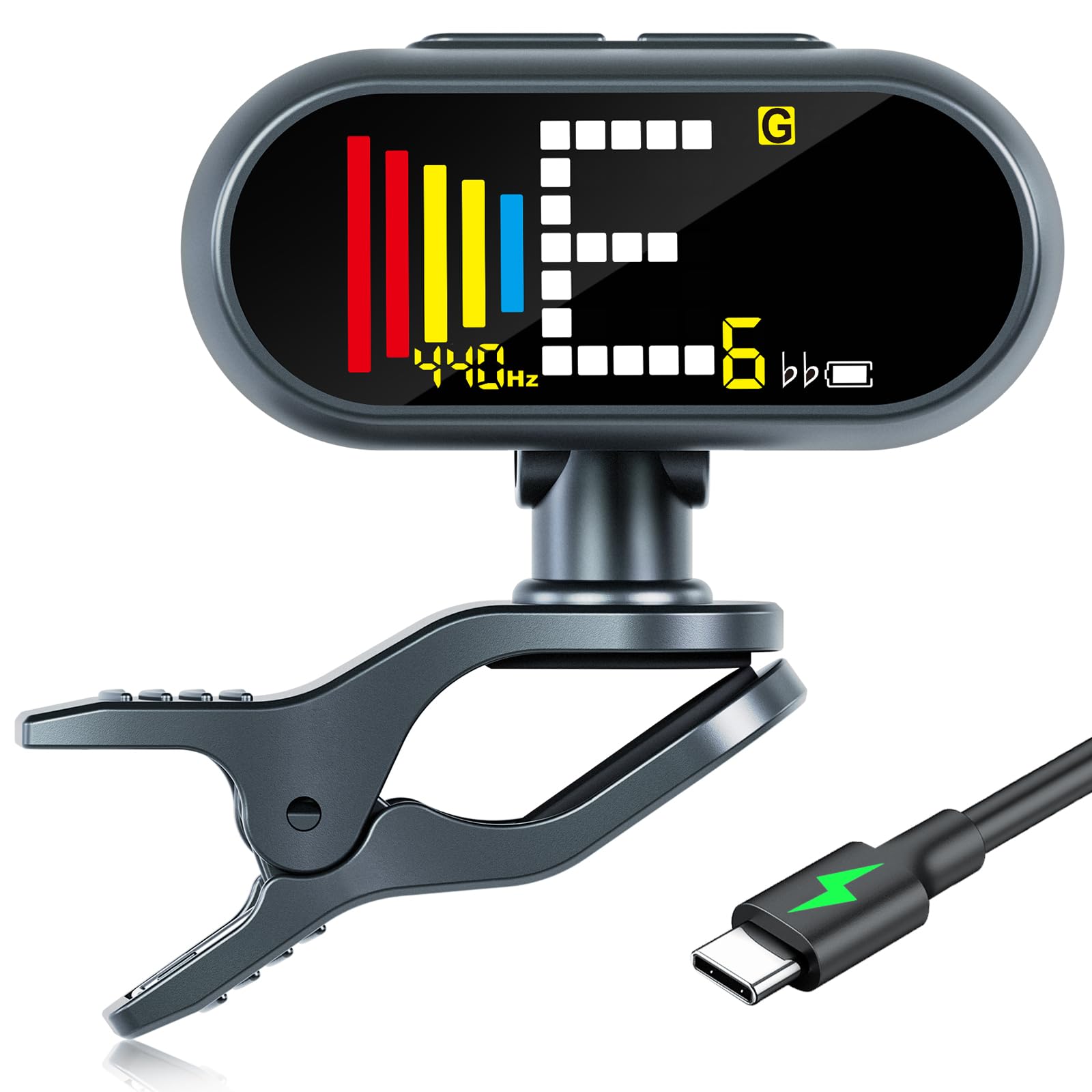
The Aroma earns its 4.6-star rating with a piezo sensor that detects pitch deviations as small as ±0.5 cent. That means when you pluck that low B, the display is honest about exactly how many cents off you are, rather than pretending you are in tune. Its full-color TFT screen stays readable under harsh stage lights or direct sun.
It is built around five dedicated modes—Guitar, Bass, Violin, Ukulele, and Chromatic—with an adjustable A4 pitch range from 410Hz to 460Hz. For a 5-string player, the Bass mode plus Chromatic covers everything from drop tunings to standard BEADG. The 360° rotatable clip with soft silicone pads holds firm without scratching your headstock, and the whole unit weighs just 1.41 ounces so it disappears on the instrument.
Owners call it cheap, convenient, and among the most satisfying tuning experiences at this price. As buyers report: “Excellent tuner. Better price than others; great color screen; charges quickly; locks on notes / strings with precision.” It requires a USB-A to USB-C cable, not USB-C to USB-C, so keep the included one handy.
What Wins Players Over
- ±0.5 cent accuracy with a dial showing real pitch deviation
- Rechargeable battery via USB-C, no button cells to replace
- Sunlight-readable TFT screen with five tuning modes
Honest Trade-offs
- Requires a USB-A to USB-C cable, not the modern USB-C to USB-C standard
- Clip is secure but some may find the dual-axis positioning takes a moment to master
Reach for this if: you want one reliable, accurate clip-on that handles bass, guitar, and ukulele while staying affordable.
Look elsewhere if: you need a stage pedal with a footswitch mute, since this is strictly a clip-on design.
2. Donner DT-10 Magnetic Tuner
The magnet-adhesion tuner that works beautifully with headless basses.
Donner’s DT-10 is different from nearly every other clip-on because it uses a magnetic adsorption design. Instead of relying only on the clip, you can snap the tuner onto any metal part of your instrument — a standout for headless basses where there is no traditional headstock. It includes a metal patch so you can leave the tuner stored on the guitar, and the magnetic structure reduces structural wear over time.
The tuning range is broad—from A0 (27.5Hz) all the way to C8 (4186.0Hz)—which easily captures that low B string. It supports 12-TET, guitar, bass, violin, ukulele, and banjo modes, so it is as versatile as any budget clip. The vivid color LCD makes the tuning status readable in low light, and the silicone-wrapped inner ring protects your guitar while keeping the unit stable.
Owners note it works well with headless instruments and offers easy viewing-angle adjustment. On the flip side, a few owners mention the tuning tolerance has “way too much play” — one said you could be off by 5 cents either way and it still shows in tune. If you demand professional strobe-level exactness, this is not that; but for stage tuning and quick work, the magnetic flexibility is a genuine win.
The Magnetic Edge
- Magnetic adhesion works on headless and metal-body instruments
- Wide A0-C8 range covers low B with ease
- Auto power-off after 3 minutes saves the CR2032 battery
Know Before You Buy
- Some units show noticeable tuning tolerance — not for precision intonation work
- CR2032 battery, not rechargeable
Best when: you play a headless bass or want the freedom to stick the tuner anywhere metallic.
skip it if: you are setting intonation and need a tuner that shows every tiny cent of deviation.
3. EX Rechargeable Clip-On Tuner
A generous 1.97-inch display on a tuner that charges via USB-C.
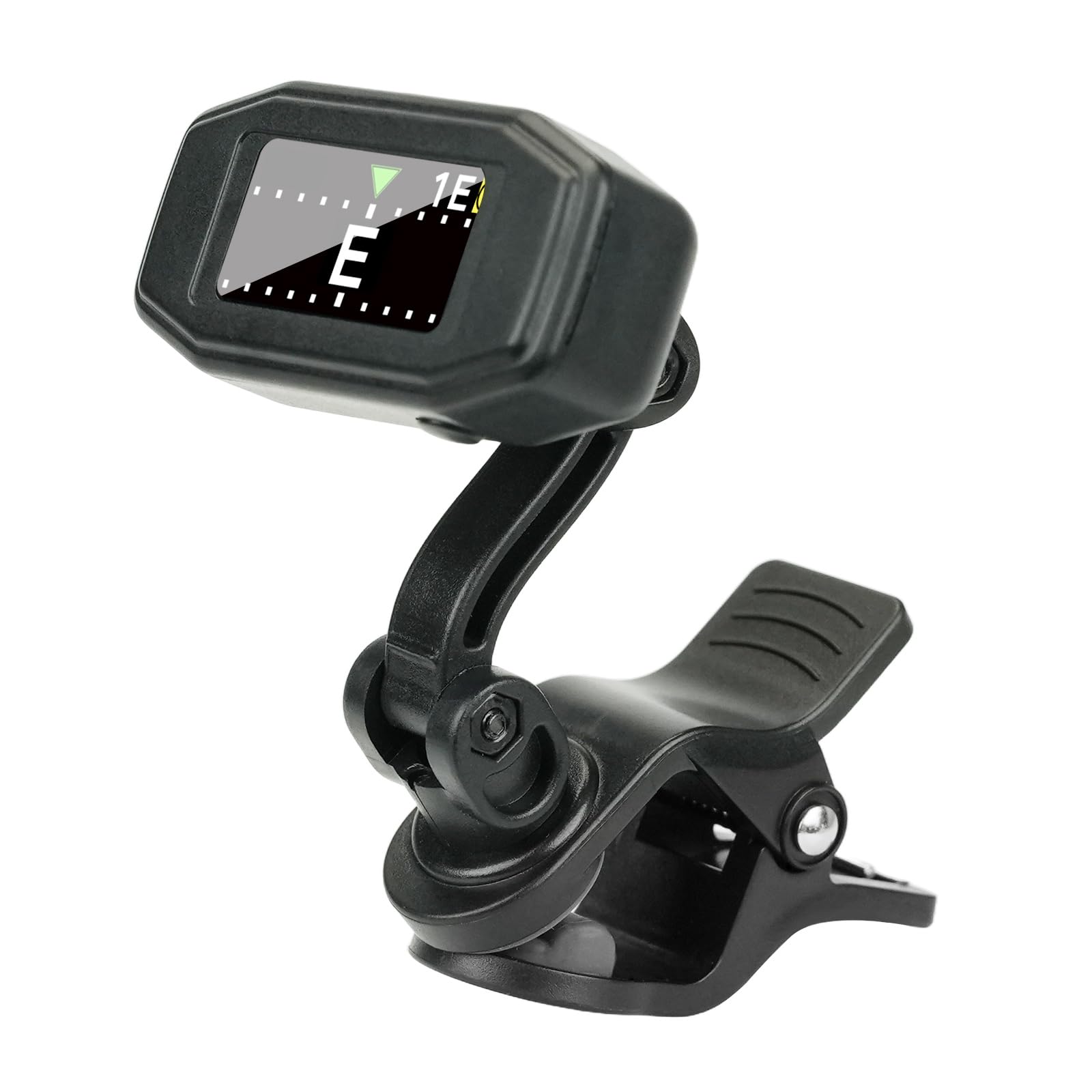
The EX tuner sets itself apart with a 1.97-inch full-color LCD screen — noticeably larger than typical clip-ons, making it easy for beginners to read the needle indicator even in dark practice rooms. It delivers ±1 cent accuracy with an ultra-fast piezo vibration sensor, so it locks onto notes quickly even in noisy rehearsal spaces. When you hit that low B, the large needle swings visibly rather than hiding in a tiny corner.
Rechargeability is the other headline feature: a built-in lithium-ion battery gives you up to 10 hours of continuous use on a single USB-C charge, which beats carrying spare button cells around. It supports five tuning modes — Guitar, Bass, Ukulele, Violin, and Chromatic — with adjustable A4 calibration from 430Hz to 450Hz. The 360° rotating clip turns horizontally and 135° vertically, so you can always find a clear view of the screen.
The honest caveat here is consistency. While many owners praise the bright display and rechargeable convenience, a notable number report that unit-to-unit quality varies — some units worked perfectly after a replacement, while others found the display hard to read in daylight. It is still a solid budget-friendly pick, especially if you want the largest screen for the least money.
Screen & Charge Wins
- 1.97-inch display is among the largest on a clip-on tuner
- 10-hour battery life per USB-C charge
- Five tuning modes with adjustable A4 calibration
Consider This
- Mixed reports on daylight visibility and unit consistency
- Guitar mode is locked to standard EADGBE — use Chromatic for alternate tunings
Go for it if: you want a budget clip-on with a huge, beginner-friendly display.
Think twice if: you mainly play outdoors — screen visibility in full sun is a recurring complaint.
4. LEKATO 3-in-1 Metronome Tuner
Three essential practice tools fused into one pocket-sized device.
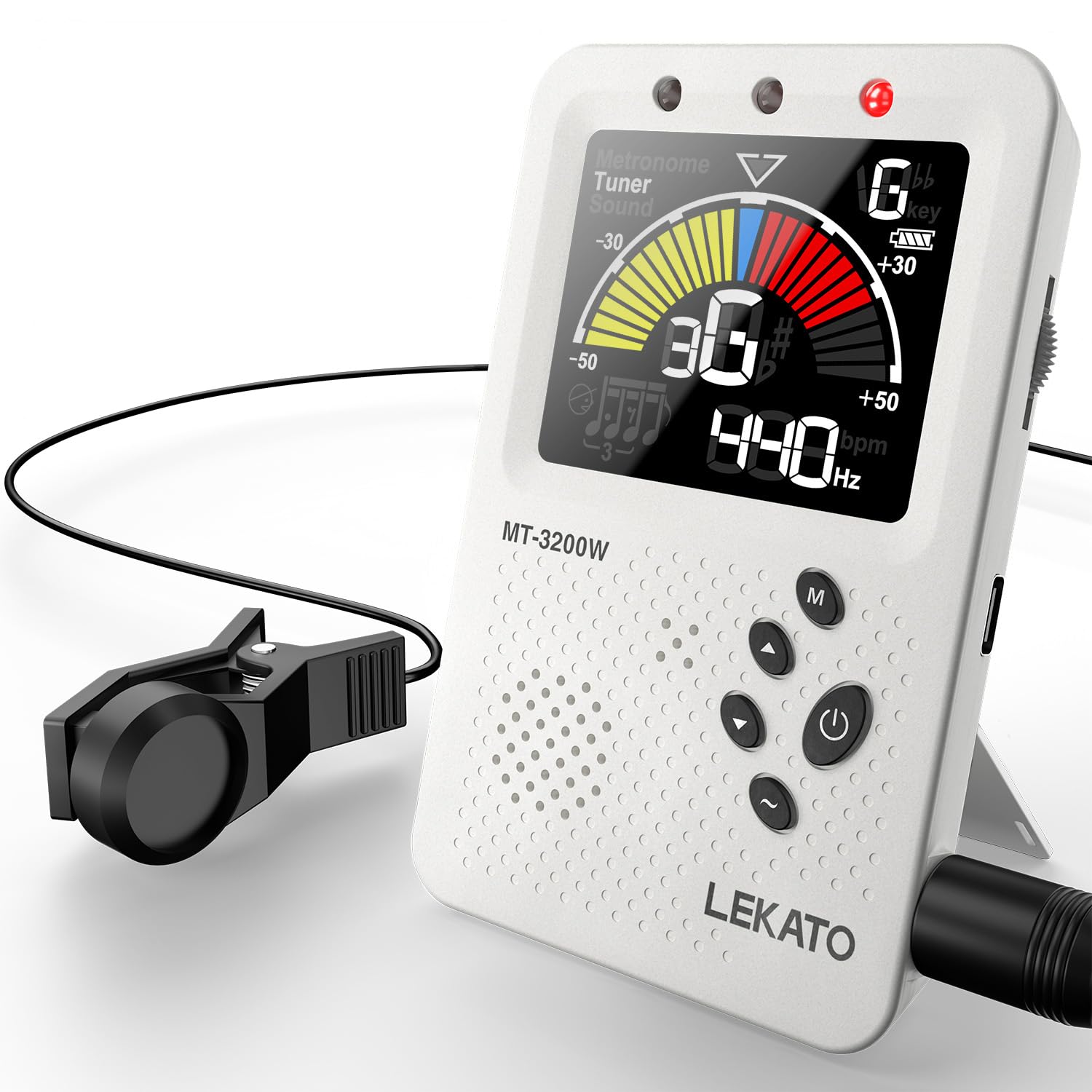
The LEKATO 3-in-1 is not just a tuner — it packs a chromatic tuner, a digital metronome, and a tone generator into a single rechargeable unit. For a bass player, that means you can tune your low B, set a click at 120 BPM, and generate a reference tone all from one device sitting on your desk. The metronome ranges from 30 to 250 beats per minute with 0-6 beats per measure, plus a tap tempo function and human voice beat counting.
As a tuner, it covers a wide A0-C8 range with various modes and transposition settings. Detection works via a built-in mic, an input jack, or the included external clip pickup — giving you flexibility depending on whether you are at home or on stage. The folding kickstand props it up on a music stand, and the headphone output with adjustable volume lets you practice without disturbing anyone.
Owners highlight the strong battery life and the rechargeable lithium cell that saves you from buying batteries constantly, and the voice counting is a hit for timing practice. There is a minor trade-off: the external headstock clip pickup is lower quality than the internal microphone, so you will likely rely on the built-in detection most of the time. At 5.3 ounces it is the heaviest pick here, but it earns that bulk by replacing three separate gadgets.
Multi-Tool Value
- Tuner, metronome, and tone generator in one rechargeable unit
- Human voice beat counting aids timing practice
- Headphone output for silent practice
Keep in Mind
- External clip pickup is weaker than the internal mic
- Bulkier than simple clip-on tuners at 5.3 ounces
Choose this if: you are a student or home player who wants one device to handle tuning and timing.
Pass if: you only need a small clip-on to leave attached to your bass headstock.
5. LEKATO Guitar Tuner Pedal

A rugged pedal that mutes your amp silently while tuning on a dark stage.
When you are on stage, the last thing you want is audible tuning noise bleeding through the PA. This LEKATO pedal solves that with a bypass mode that routes your original signal directly to the amp with no distortion, pop, or hum when the pedal is off, and mutes your signal entirely while you tune. The rugged aluminum shell is shock and drop resistant, built to survive years of gigging and rehearsals.
It offers about 0.499% tuning tolerance for fast, accurate results, plus half-flat options down to four steps (♭, ♭♭, ♭♭♭, ♭♭♭♭) for alternate and drop tunings — useful when you play in Eb or lower. The A4 pitch calibration adjusts from 430Hz to 450Hz to match different ensemble standards. At just 2.48 x 2.36 x 4.72 inches, it leaves plenty of room on your pedalboard for other effects.
The color LCD is bright enough to read in dim stage lighting or bright outdoor conditions, a point owners repeatedly praise. The recurring frustration is that no power supply is included — you must supply a DC 9V adapter yourself. If you already have a daisy chain or 9V supply, this is a no-brainer for gigging bassists.
Built for the Gig
- True bypass keeps your signal clean when tuning is off
- Rugged aluminum construction survives the road
- Four half-flat steps for drop and alternate tunings
Stage Gotcha
- No power supply included — plan for a 9V adapter
- Pedal format means it stays on your board, not clipped to the bass
Ideal for: electric bassists who gig regularly and want silent, muted tuning between songs.
Not for: acoustic players who never run through an amp.
6. STRICH Tuner Pedal

A tank-like zinc alloy pedal with a 2-inch screen made for serious bassists.
The STRICH pedal differentiates itself with a 2-inch color screen — bigger than the LEKATO pedal — and a solid zinc alloy casing that feels genuinely tank-like. It handles a broad tuning range from B0-C8 (30.868-4186.00Hz), which starts exactly at your low B string, making it a natural fit for 5-string players. The ±0.5 cent error margin is accurate enough for both live performance and setup work.
A4 pitch calibration adjusts from 430-450Hz so you can match your band’s tuning standard, and true bypass keeps your tone clean when the pedal is disengaged. Owners specifically note that when you step on it, the tuner cuts the feed to the amp while you tune — silent and professional. The display is frequently described as huge and bright, easy to read even from a standing position.
The honest caveat is split feedback on accuracy. While functionality and display earn consistent praise, a decent number of customers note the tuning precision is not as reliable as they hoped, and one documented unit failed to recognize a plugged-in instrument entirely.
Pedalboard Presence
- 2-inch color screen is the biggest in this pedal group
- Zinc alloy casing is rugged and drop-resistant
- B0-C8 range starts right at the low B string
The Accuracy Caveat
- Mixed owner reports on tuning precision and unit consistency
- Requires a DC 9V adapter with negative inside, positive outside — not included
Best suited for: players who want a visually impressive, affordable pedal with a massive display.
Shop elsewhere if: you need strobe-level accuracy for intonation or recording work.
7. Korg AW-LT100B Clip-On Bass Tuner
The Korg bass specialist that hears frequencies other tuners simply miss.
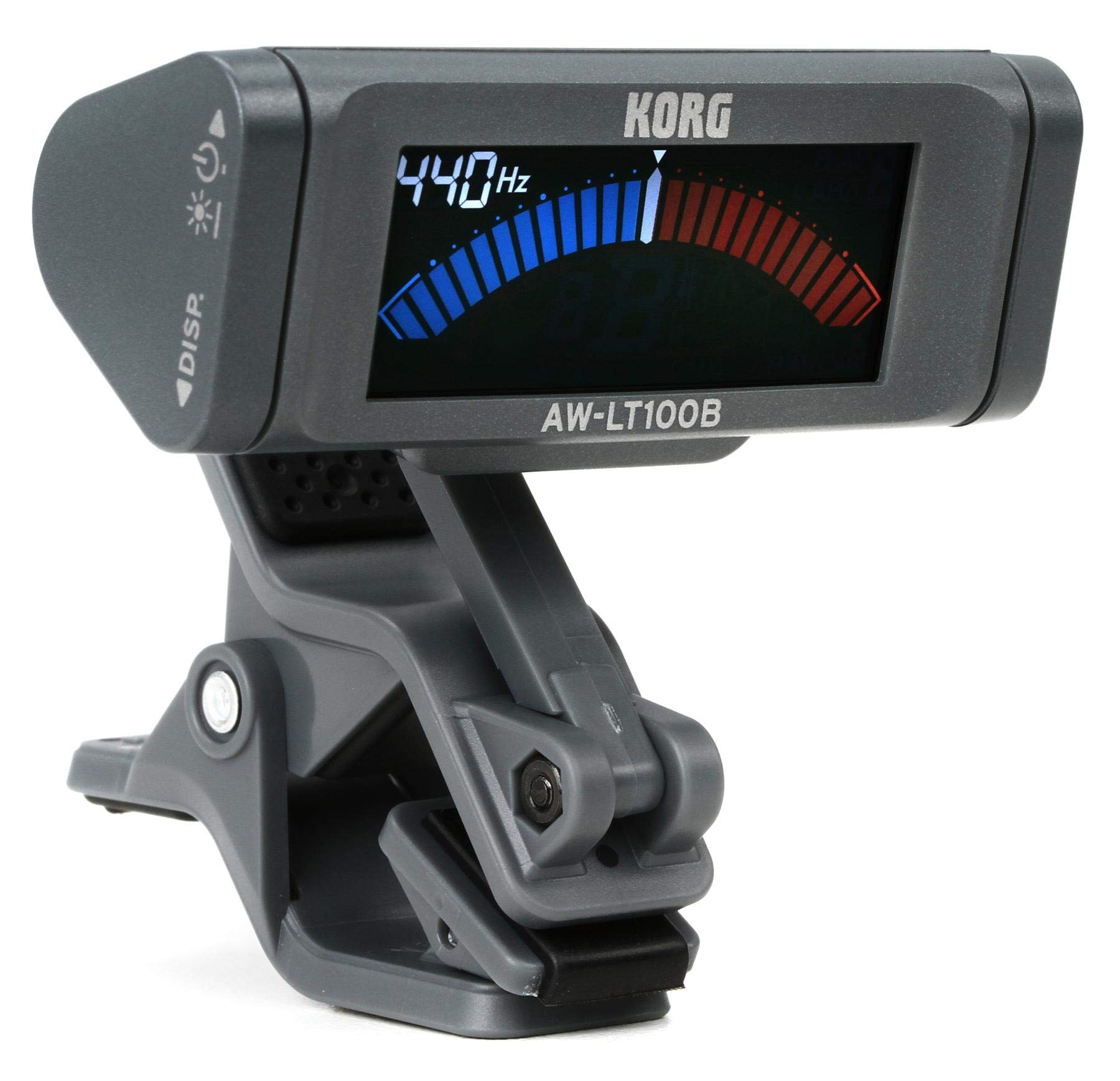
Korg built this tuner specifically for bass, with a special circuit designed to accurately detect ultra-low frequencies below 100 Hz — the exact territory where most guitar tuners go blind. That makes it ideal for 5- and 6-string basses. But what really separates it is the strobe mode, which achieves tuning accuracy up to ±0.1 cent. That is precision normally reserved for rack-mount studio tuners, packed into a 1.13-ounce clip.
The VA color LCD with white backlight offers high contrast and a wide viewing angle, so you can read it from any position on stage. The intuitive triangular shuttle switch lets you control power, mode, and calibration with one hand — fast and stress-free mid-song. It runs on a single AAA battery, which owners appreciate because a normal-sized battery is easy to find anywhere.
Owners call it the only tuner that worked on their bass when guitar-focused units failed, praising its small size and reliability. The single recurring gripe is the display brightness — a few owners wish it were brighter in direct sunlight. It may not have the rechargeable convenience of newer models, but for pure bass-specific accuracy, this is the clip-on to trust.
Why Bassists Love It
- Strobe mode offers up to ±0.1 cent accuracy
- Special circuit detects frequencies below 100 Hz
- Runs on a standard AAA battery
Minor Quirks
- Display could be brighter in full daylight
- Not rechargeable — replacement AAAs required over time
Reach for this if: you want the most accurate clip-on specifically engineered for low bass frequencies.
Consider a USB-C model if: you prefer to avoid disposable batteries entirely.
8. StroboClip HDC Clip-On Strobe Tuner

True strobe accuracy in a clip-on that reads even in direct sunlight.
This is the tuner that professionals reach for when standard clip-ons are not enough. The StroboClip HDC delivers TRUE STROBE 0.1 CENT ACCURACY — accurate to 1/1000th of a semitone — so it can display the smallest pitch deviations. That makes it the go-to tool for setting intonation at the bridge, adjusting the nut, or fine-tuning a fretless bass where even a few cents of error is audible. Owners use it to solve intonation and buzz issues that other tuners missed.
It automatically displays the note and deviation from center pitch, and supports drop tuning and capo settings. There are over 50 enhanced tuning offsets for stringed, woodwind, and brass instruments, making it useful far beyond just bass. The LED color display is visible in direct sunlight — a rarity among clip-ons — and the assignable colors let you customize the display per tuning. The rechargeable battery lasts for at least a couple of weeks per charge via USB-C.
The trade-off is the price and the learning curve. But owners who make the leap rarely go back, with several noting they bought a second unit immediately. As the review pages sum it up: “Nothing is better.”
The Pro Toolkit
- 0.1 cent strobe accuracy for intonation and setup work
- Visible in direct sunlight, unlike most clip-ons
- 50+ tuning offsets for many instruments
The Investment
- Premium price — several times a basic clip-on
- Interface less intuitive; alternate tuning modes take time to learn
Worth it for: gigging and recording bassists who need true strobe precision for intonation work.
Overkill if: you just need a quick, accurate read on stage and never touch your bridge setup.
9. Roadie Bass Automatic Tuner

The motorized tuner that turns your tuning pegs for you — hands-free.
The Roadie Bass is unlike anything else on this list: it is a standalone automatic tuner that physically turns your tuning pegs for you. You attach it to the peg, and its internal motor adjusts the string until it is perfectly in tune, using vibration sensing rather than a microphone. That makes it quick and accurate in any environment, including noisy rooms where a microphone-based tuner would fail.
It works with anything that has guitar-like machine heads — electric, acoustic, classical, steel, and bass guitars, plus ukuleles, mandolins, and banjos. With over 40 preset alternate and open tunings, you can switch from standard BEADG to a drop tuning in seconds without touching the pegs yourself. The built-in screen and selection wheel keep it fully standalone, though you can also create custom tunings via the Roadie app.
Owners praise it for tuning multiple instruments easily, with audio and vibration alerts when in tune. The main caveats: it sometimes struggles with mandolins and 12-string guitars — including broken strings on those instruments — and some users found the low B string challenging on certain basses. It is a premium, specialized tool, best suited to players who retune frequently or need accessible assistance.
Hands-Free Tuning
- Motor automatically turns tuning pegs to the correct pitch
- Over 40 preset alternate and open tunings
- Vibration sensing works in any environment
Specialized Limits
- Struggles with mandolins and 12-string guitars
- Premium price for a niche automatic tool
Made for: players who frequently switch tunings and want it done automatically, plus musicians who benefit from audio alerts.
Skip if: you prefer the tactile control of turning your own pegs or play only standard tuning.
Understanding the Specs
Accuracy: Cent Deviation
A “cent” is a unit of musical pitch — one hundredth of a semitone. A tuner with ±1 cent accuracy is fine for everyday practice, while ±0.5 cent or ±0.1 cent models are better for intonation work. Strobe tuners, like the Korg and StroboClip here, display fractional deviations that standard needle displays hide. For a 5-string bass, the low B string is so deep that small cent errors are very audible, so tighter accuracy genuinely matters.
Detection Range: The Low B
Your low B string sits around 30.87 Hz. Many standard guitar tuners only read down to about 40 Hz and simply refuse to show a pitch for that string. Check for ranges like “A0-C8,” “B0-C8,” or a stated “below 100 Hz” capability. The Korg AW-LT100B explicitly advertises detection below 100 Hz, while the STRICH pedal starts at B0 (30.868 Hz). Clip-ons with wide chromatic modes also handle the low B fine.
FAQ
Will a regular guitar tuner work for a 5 string bass?
What is the difference between a clip-on tuner and a pedal tuner?
How accurate do I need for the low B string?
Do bass tuners work for both 4-string and 5-string basses?
What is strobe mode and do I need it?
Is a rechargeable tuner better than one with disposable batteries?
Can an automatic tuner like the Roadie Bass damage my instrument?
How does a tuner pedal mute my sound while tuning?
What does a wider A4 calibration range do for me?
Final Thoughts: The Verdict
For most players, the 5 string bass guitar tuner winner is the Aroma AT-790 because it pairs ±0.5 cent accuracy with a sunlight-readable screen and USB-C convenience at a budget-friendly price. If you head out to gigs and want silent tuning through your rig, grab the LEKATO Tuner Pedal. And for professional intonation work where every fraction of a cent counts, the StroboClip HDC is the one to reach for.
How We Picked
We do not accept paid placement. Every pick is matched to a real buyer and a real use-case; we do not hands-on test units.
Sources & Methodology
Specifications: manufacturer listings and product documentation. Review insights: verified customer reviews, as of August 2026. Pricing: not shown on this page (it changes often); check the current price via the retailer link.
As an Amazon Associate, Gadgets Feed earns from qualifying purchases. This does not affect which products we feature.