
Our readers keep the lights on and my morning glass full of iced black tea. As an Amazon Associate, I earn from qualifying purchases.
Specs are compiled from manufacturer listings and verified buyer reviews and can change over time — please confirm the key details on the product page before buying.
Here is the short answer: if you want one radio that does everything well on a mixed job site or trail crew, the SAMCOM FPCN30A three-pack is the pick that holds up. If you need waterproofing and weather alerts for backcountry work, the Rocky Talkie Expedition is the one. The rest of this list sorts the nine strongest 5-watt handhelds by who they actually suit. First, a honesty note on the numbers: this list uses flexible, human-like matching around the 5-watt transmit class. That means it covers the 4-to-5-watt handheld family — not every pick is stamped with the exact number you searched, but the nearest same-type radio serves the same real purpose.
I’m Min — the founder and writer behind Gadgets Feed. This guide is built by comparing the manufacturers’ published specifications and the patterns across verified customer reviews, so you get each pick’s real strengths and trade-offs instead of marketing spin.
Watts alone never tells the whole story — channels, licensing, battery capacity and weather sealing decide whether a radio actually works for your crew. That is exactly what the picks below weigh up, and it is why this breakdown of the best 5 watt walkie talkie covers both coverage and the small print.
Our Picks at a Glance


How To Choose The Best 5 Watt Walkie Talkie
Five watts is roughly the ceiling for a handheld radio you can legally carry and use without a base station. That cap matters because it means most of these radios are playing on a level field for raw output. What separates them is everything around the transmitter: which frequencies they run on, how long the battery lasts, and whether the casing survives a real shift.
Watts versus terrain: what actually limits your range
Handheld-to-handheld range on GMRS radios is typically about 1 to 2 miles in ordinary conditions. Buildings, trees, hills, being indoors or sitting in a vehicle all shorten that. Open terrain and height extend it, and a well-placed GMRS repeater can reach 20 miles or more. Range is never guaranteed, so treat any “up to X miles” figure as a best case in open air.
The licensing question comes first
GMRS radios in the United States require an FCC license to transmit, and business-band UHF radios like the SAMCOM units carry FCC Part 90 certification that also requires licensing. A ham radio such as the Baofeng BF-F9 V2+ expects an operator license for transmit use on its bands. If your crew is not licensed, that changes which radios you should be looking at — check before you buy a whole fleet.
Battery capacity and charging docks for shift work
A radio that dies at hour six is a paperweight for the back half of a shift. Look at the battery capacity in mAh and, just as important, at how the radios recharge. A multi-radio charging dock refills a full crew overnight without a tangle of individual cables, which matters on a job site where six or more radios go out every morning.
Quick Comparison
All nine picks sit in the same handheld power class, so the trade-offs show up in channels, battery capacity and weather sealing. Scan the columns to find the spec that matches your day.
| Model | Best For | Channels | Battery | Weather Rating | Amazon |
|---|---|---|---|---|---|
| SAMCOM FPCN30A 3 Pack★ Best Overall | Crews and job sites | 20 UHF | 1500mAh | — | Amazon |
| KSUN GZ20 2 PackPocket Pick | Pocket carry on long shifts | — | 4000mAh | — | Amazon |
| Baofeng BF-F9 V2+Ham Choice | Ham operators and scanners | 200 | — | — | Amazon |
| BTECH GMRS-V2 | Repeater-capable everyday GMRS | 200 | 1800mAh | IP54 | Amazon |
| Radioddity GM-30 2 Pack | Off-road groups on a budget | 250 | — | — | Amazon |
| BTECH GMRS-PRO | App, GPS and text messaging | — | 2600mAh | IP67 | Amazon |
| Midland GXT67 PRO | Vehicle spotting and trails | 99 | 4 day life | IP67 | Amazon |
| SAMCOM FPCN30A 6 Pack | Large facilities and fleets | 20 UHF | 1500mAh | — | Amazon |
| Rocky Talkie Expedition 2 Pack | Backcountry and weather | 22 | 1800mAh | IP67 | Amazon |
In‑Depth Reviews
1. SAMCOM FPCN30A 3 Pack Commercial 5W UHF Walkie Talkie
Our pick — 4.5+★ from 350+ verified ratings; the strongest balance of quality and price.
Three radios, one dock, zero fiddling — the crew pack that just works.
If you run a warehouse floor, a security patrol or a school campus, this is the set that covers three people out of one box. Each radio is a 5W UHF unit (UHF is the higher-frequency band that pushes through walls better than old-style radios) tuned to 20 channels, so you can give each team its own line and keep chatter from bleeding across the building. The published reach is about 1 to 2 miles through buildings and 3 miles line of sight — enough to keep a full crew talking without a repeater most days.
What wins people over is the range, and it is the thing buyers talk about more than anything else on this radio. The 1500mAh battery is rated for a full 10-hour shift, and the charging base refills all three radios overnight on one outlet. There is an earpiece in every box, which quietly matters on a site where a radio squawking on a belt is either a safety issue or just annoying. The electronics brand has put a lifetime warranty behind it and offers US tech support, which is a real answer for a crew depending on these daily.
The honest catch sits in the dimensions. At 1.5″D x 1.8″W x 6.2″H, this is a taller, chunkier radio than the slim KSUN in this list — the SAMCOM body is 1.5 inches deep versus the KSUN’s 0.7″D. That extra bulk is the price of the rugged, glove-friendly build, and it means it lives better on a belt clip than in a pocket. These are also FCC Part 90-certified business radios that need licensing, so check that before rolling out a fleet.
Where It Pulls Ahead
- Range is the standout — about 1 to 2 miles through buildings, 3 miles line of sight
- 1500mAh battery rated for a full 10-hour shift on one charge
- Programmable frequencies let you match radios your crew already carries
- Charging base refills all three units overnight from one dock
Worth Weighing First
- Bulkier body than pocket-sized rivals — belt clip territory, not jeans
- Requires FCC Part 90 licensing for legal transmit use
Reach for it if: you need three reliable radios out of one box and one overnight dock for a job site, warehouse or campus.
Look elsewhere if: you need a radio that disappears into a shirt pocket — the slim KSUN below is the pocket pick.
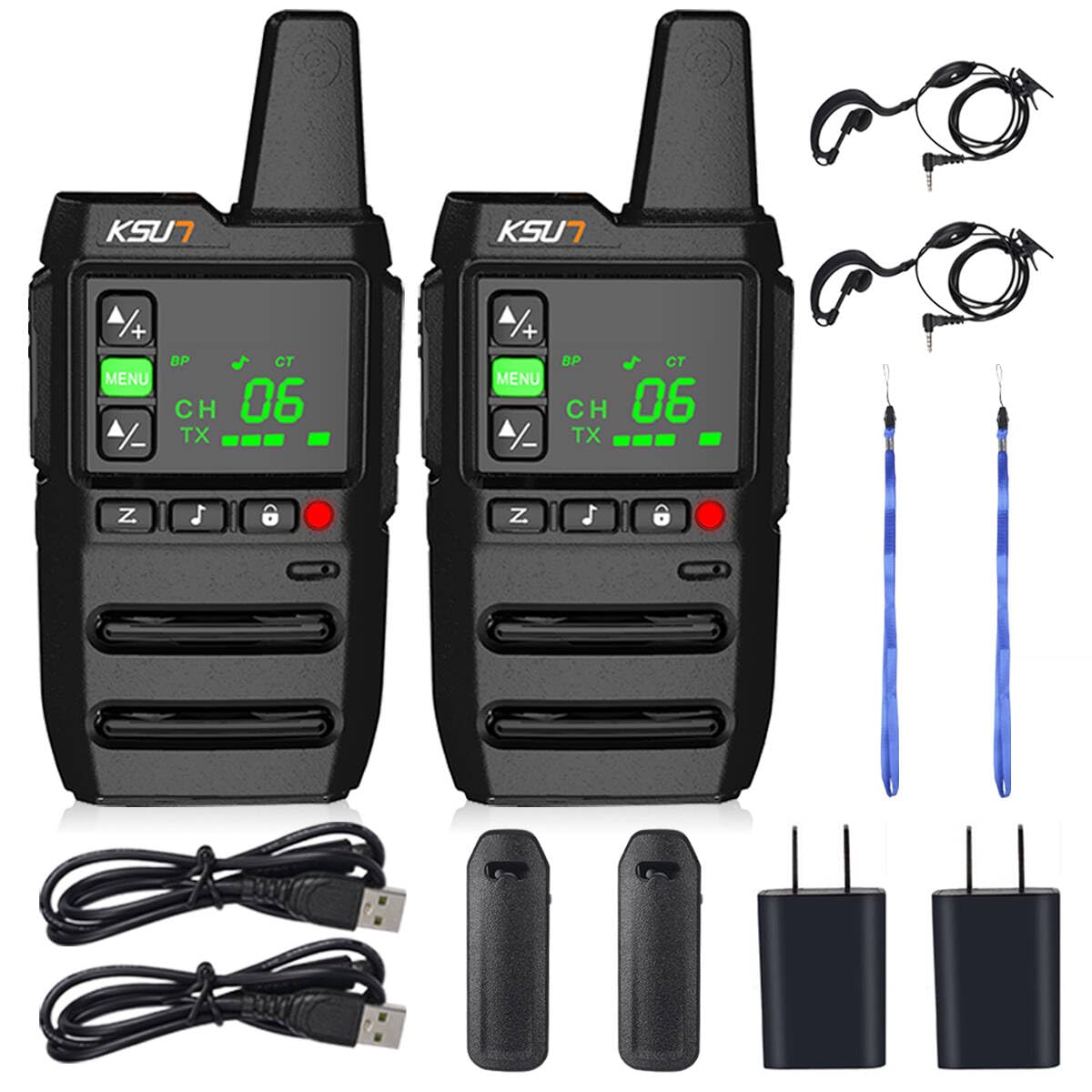
2. KSUN GZ20 5W Two Way Radio with 4000mAh Battery (2 Pack)
Battery for days in a body you genuinely forget you clipped on.
Start with the battery, because it is the number that sets this radio apart. The GZ20 carries a 4000mAh pack, compared with the 1500mAh inside the SAMCOM pack at the top of this list — the kind of reserve that gets a restaurant floor or a hotel shift through a long day without a recharge stop. KSUN rates it for up to 5 days between charges. It recharges through a USB split dock with a Type-C port, so a power bank or a car charger can top it up in the field.
Where the GZ20 shines for its size is portability. At 96g and 18mm thin, it is a genuinely pocket-sized radio, and it comes with a detachable belt clip so you can wear it on a chest or waist. The versatility is what buyers respond to most — it gets used on backcountry trips as readily as in a retail backroom. There is a ring alert that gets your team’s attention in a loud kitchen or shop floor, and an LED flashlight on the bottom for night patrols. A clear LCD shows channel, battery and signal at a glance.
The fit note here is range and durability. KSUN advertises penetration up to 20 floors and coverage of 60 rooms or an 8000-square-meter area, but the feedback on range, durability and charging is genuinely mixed — this is a radio that thrives in line-of-sight and in-building use rather than out in deep terrain. If you need waterproofing or backwoods reach, look elsewhere in this list. For a slim, huge-battery radio around a restaurant or hotel, it earns its place.
Battery-to-weight ratio: a 4000mAh pack inside a 96g body is the reason to pick this pair over almost anything in its class.
Mind the reach: strong in buildings, weaker in hard terrain — the mixed range feedback points to keeping this one for indoor or line-of-sight work.
The sweet fit: staff on their feet all day who want a light radio with huge battery reserves.
Skip the gamble on: long-distance outdoor use where waterproofing and serious range matter.
3. Baofeng BF-F9 V2+ 5-Watt Dual-Band Ham Radio
The tinkerer’s radio: 200 channels, three power tiers, and a hobby inside the box.
You get three power settings here — 1, 4 and 5 watts — so you can drop to low power when you just need to talk across a camp and save the battery. The BF-F9 V2+ tunes across 145-155MHz and 400-520MHz for transmit and receive, and it also pulls in FM broadcast from 65-108MHz. That combination is why it doubles as an emergency-prep radio: it can scan way beyond the two-way bands most handhelds live on.
Reception is the thing that earns this radio its place. Buyers report clear reception past the advertised five-mile maximum when line of sight cooperates, which is why it turns up in emergency kits and on work sites. The dual-watch feature lets you monitor two bands at once, and it keeps full backward compatibility with UV-5R accessories — so spare batteries and antennas you already own will fit. A bright tri-color LCD and noise reduction round out the everyday package.
Here is the honest caveat, and it is a real one for beginners. A 200-channel ham radio is not plug-and-play the way a fixed GMRS set is — the programmability draws a lot of mixed feedback, and some find the manual and the accuracy of the stated performance less than ideal. Transmitting on ham bands also requires a license, and the manufacturer warns clearly about restricted frequencies. Buy this one if you are willing to learn it.
The Draw For Radio People
- 200 channels with 1/4/5-watt selectable power
- Dual-band 145-155MHz and 400-520MHz transmit and receive
- Backward compatible with all UV-5R accessories
The Learning Curve
- Programming it takes patience — expect to read up before you’re fluent
- Ham band transmit requires an operator license
Made for: ham operators, scanners and preppers who want one radio to cover far more than two-way chat.
Not your pick if: you want to hand a radio to a non-technical staffer and have it just work.
4. BTECH GMRS-V2 5W GMRS Radio, 200 Channels, USB-C, IP54

A neutral, well-mannered GMRS handheld that does the everyday job without drama.
For most people who just want a solid GMRS radio for travel, camping and events, this is the well-rounded choice. You get 200 programmable channels you can rename and arrange to match how you actually work, plus NOAA weather receive and VHF/UHF scanning on top of the GMRS band. Repeater capability is built in, so a well-placed GMRS repeater can extend your reach to 20 miles or more. Handheld-to-handheld it’s still the usual 1-2 miles, and buildings, trees and vehicles will shorten that.
Charging is where this radio does something practical: true USB-C, so a common cable tops it up from a car or a power bank, plus a desktop charger in the box for home use. Dual watch lets you keep two channels live, and a second PTT button lets you switch fast between team traffic and a priority channel. The sound quality is what gets the most praise here — it is clear and consistent, and that matters more than any single feature when you are trying to hear someone over engine noise.
The trade-offs are honest ones. The IP54 seal handles dust and splashes but is not built for submersion, so this is a fair-weather and light-rain radio rather than a monsoon-proof one. And like every GMRS radio, it needs an FCC license to transmit — the frequency range serves well in town but expectations should be set for the normal 1-2 mile handheld reality. The rest of the package is quietly complete: VOX, SOS alarm, FM radio, flashlight, tone scan and busy channel lockout.
What earns the pick: 200 programmable channels, USB-C charging and a desktop charger, plus repeater support for extended reach.
Set your expectations: IP54 covers splashes, not submersion, and typical handheld range stays 1-2 miles without a repeater.
Right for you if: you want a flexible, easy-to-live-with GMRS radio and don’t need full waterproofing.
Go waterproof if: your radio will see rain, trails or a wet jobsite — the GMRS-PRO and Expedition below seal against that.
5. Radioddity GM-30 GMRS Handheld Radio (2 Pack)
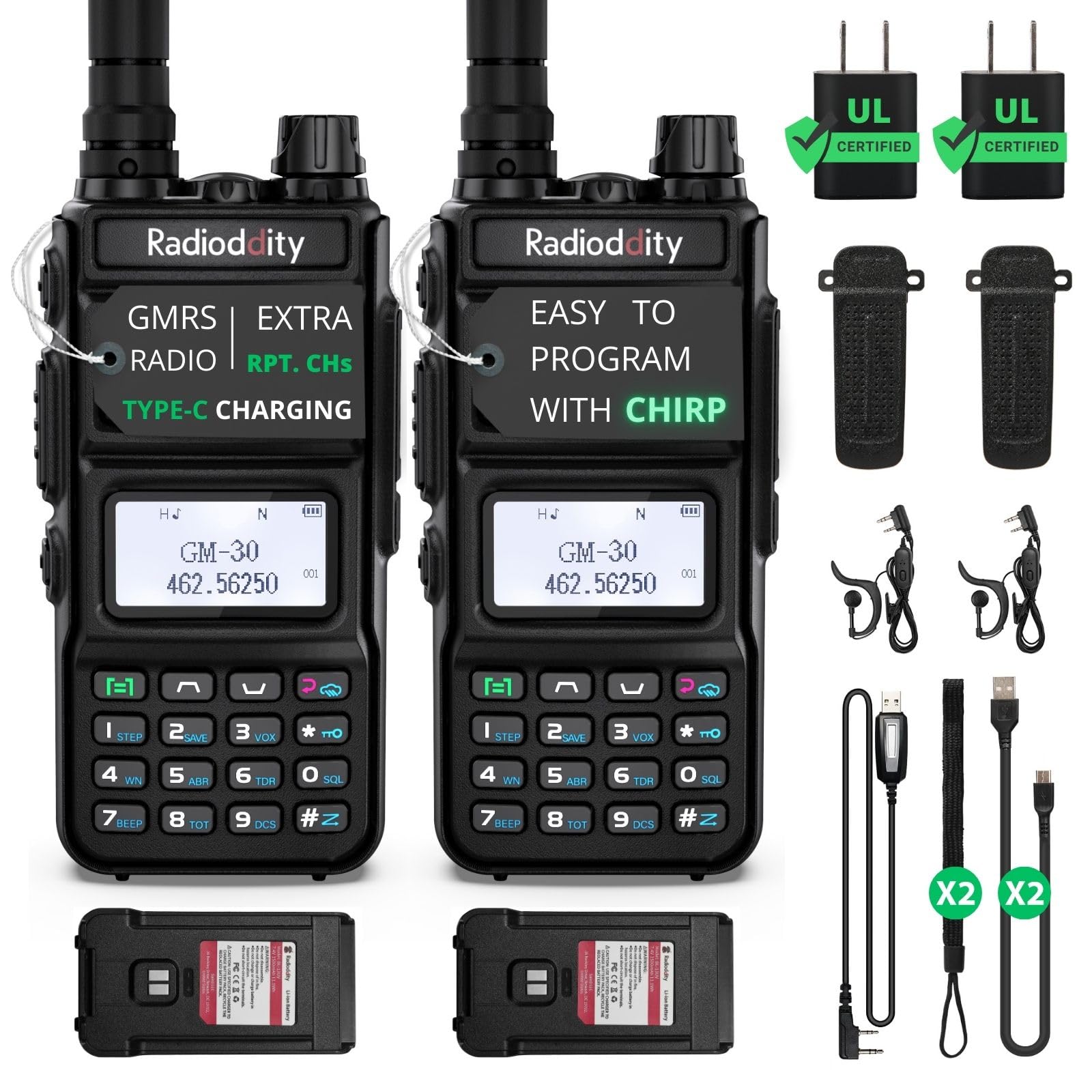
Two radios built for trailheads, with a repeater-friendly 250-channel setup.
Radioddity sets this pair up so you can use it almost immediately: 30 default channels cover 22 for talking to other GMRS radios right from the start and 8 set aside for GMRS repeaters. Behind that sits room for 250 channels in total, programmable from a PC or straight from the keypad, so an off-road group can add frequencies and tweak settings on the go. It is CHIRP compatible and repeater capable, so range opens up fast wherever a repeater is nearby.
Reception here is clear and the sound quality is what stands out — the feature that draws the most praise. Dual-band scanning and receiving let you scan UHF and VHF in either channel or frequency mode, with CTCSS/DCS scanning and an editable scan list. Two power levels (0.5W and 5W) let you save battery on close-range chatter and push the 5W when you need to reach a repeater up to 5 miles off. The USB Type-C port will charge the radio or the battery on its own, which is handy when you’re rotating spares.
The trade-off sits in the battery and programming. Battery life and programming both get mixed feedback — this is a radio you will need to learn rather than one that runs a long shift hands-off like the SAMCOM pack. For its size it pairs well with an FRS/GMRS group and comes with the programming cable that many radios charge extra for. But the 2-pack format and mixed battery notes point to trail and event use more than all-day industrial shifts.
Pick this for: off-road and camping groups who want a repeater-ready GMRS pair with plenty of programmable headroom.
Think twice if: the radios need to run a full industrial shift unattended — battery life here is a use-it-and-top-it-up situation.
6. BTECH GMRS-PRO 5W GMRS Radio, IP67, Bluetooth, GPS

A GMRS radio with a phone’s brain: text, GPS and a Bluetooth connection.
This is the one for someone who wants more than voice. The GMRS-PRO pairs with the BTECH app for setup and channel management, supports Bluetooth for compatible audio accessories and hands-free use, and can send text messages and share GPS location and contacts straight from the radio. Built-in GPS and a digital compass show coordinates, heading, speed and altitude — useful when you are coordinating off-road or off-grid. It is a genuinely different tool in this class, and the features are why buyers are drawn to it.
Build quality backs up the electronics: IP67 means dust-tight and protected against temporary immersion, so rain, mud and a dunking at the campsite are within its comfort zone. A 2600mAh battery feeds the smart features. The radio still talks to standard GMRS and FRS handhelds, so it slots neatly into a mixed group where half the crew runs basic radios. It is repeater capable like the other GMRS picks, so range extends beyond the usual 1-2 miles handheld reality when a repeater is in reach.
Where this radio asks for patience is in the value equation. Range and battery life both draw mixed feedback — the extended features work well, but some find real-world reception and runtime short of expectations for the outlay, and the smart features add learning overhead. One spec to know before you buy: the antenna is permanently attached and does not unscrew, so aftermarket screw-on antennas are out. If you want the smartest GMRS handheld and will use the app and GPS, it earns the price. If you just need clear voice, the GMRS-V2 does that for far less.
Why It Stands Out
- App-connected setup, Bluetooth audio and text messaging
- Built-in GPS and digital compass for location sharing
- IP67 dust-tight and protected against temporary immersion
Real Limits
- Smart features add a learning curve and menu time
- The built-in antenna is fixed — aftermarket screw-on antennas won’t fit
Built for: off-gridders and off-roaders who want GPS, text and app control in one rugged GMRS handheld.
Overkill if: you only need clear voice — a simpler GMRS radio handles that without the smart-radio premium.
7. Midland GXT67 PRO 5W GMRS Two-Way Radio

No programming, no manual, no fuss — just full 5-watt GMRS on the trail.
Midland leans into simplicity here, and it is the feature that draws the most praise from owners. The GXT67 Pro comes pre-programmed with 22 channels plus 28 privacy codes, so it is ready to rock the second you switch it on. A high-visibility backlit display and oversized buttons work fine with gloves on, which is exactly what you want when you are spotting a driver on a technical trail or handling it from the cab of a Jeep, Bronco or Tacoma.
This is a full 5-watt GMRS handheld with a quoted 4-day battery on a Li-Ion pack, and it pairs with Midland MicroMobiles for vehicle use. The kit is complete from the start: heavy-duty travel case, desktop charger, AC and DC adapters so you can charge in the car, belt clip and battery. The 462-467MHz frequency range covers standard GMRS and FRS, and the IP67 rating plus dustproof and weather alert features mean rain and trail grime are not a problem. Range on open country and repeaters is the second thing owners rave about.
The honest note is money and battery consistency. Value draws mixed feedback — this is a premium single radio, and if you want a pair you are buying twice. Battery life also splits opinion, with most getting the promised trail performance and a few hitting charging hiccups. Those are fair limitations to weigh rather than dealbreakers, and the 4-day rating is the realistic expectation for a typical trip.
The simplicity win: pre-programmed 22 channels plus 28 privacy codes and glove-friendly buttons make it the least fiddly radio here.
The cost trade-off: a premium single-radio buy — budget for a second unit if you’re pairing up, and expect battery charging to be the occasional weak point.
Made for: trail riders and vehicle spotters who value a radio that works from the start over one you program.
Not your first pick if: you need two radios in the box or want app and GPS smarts — the GMRS-PRO or Expedition pair fit better.
8. SAMCOM FPCN30A 5W Walkie Talkies with Earpiece, 6 Pcs
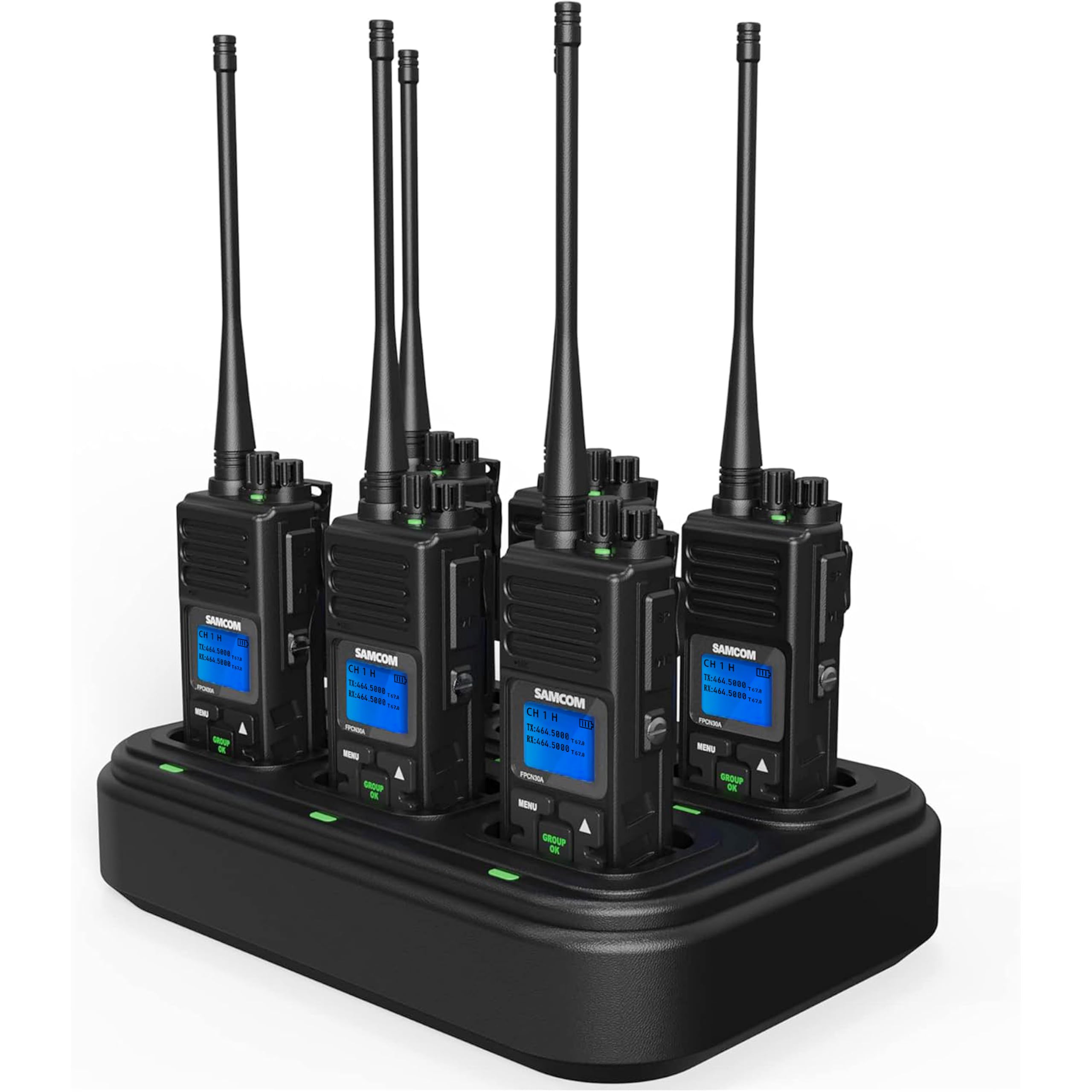
Six radios, one dock, one group button — the whole building on one call.
Scale is the whole point of this set. Six radios ship in the box, each with a 1500mAh battery rated for 8+ hours of talk time and 12+ hours of standby — a full shift for most teams. The 6-way multi-charger dock refills all six radios, or six spare batteries, from one power point. A dual PTT setup lets you make one-to-one calls with the left-side button or press the Group key to reach every radio on the net at once, which is how you handle site announcements and emergencies cleanly.
Where it earns the pick is on tough ground: 5W high-power with the long antenna reaches 3-5 miles in open areas and covers 300,000+ square feet indoors, punching through concrete, steel and basements. The build is rugged and rated to run from -20°C to 55°C. This is qaulity hardware that holds up in rain and rough handling — quality and reliability lead the feedback. You can switch to low power for lighter shifts, and the radios can be reprogrammed to match frequencies of other UHF radios your crew already runs, so your existing fleet investment stays intact.
Two things to weigh honestly. These are FCC Part 90-certified business radios that need licensing, and the range feedback is mixed — through dense forest land it does what you ask, but a few find the reach not what they expected in tough cover. The body is also bulky and the 6-pack is the priciest single entry on this list, so it’s a fleet purchase rather than a one-person radio. If you’re outfitting a warehouse, school or hotel staff, the multi-charger and group call justify the outlay.
The fleet case: six radios with 8+ hours of talk time and a 6-way dock are built for a shift to end without a dead radio.
The size of the buy: it’s a bulk commitment for licensed business use — if you need one or two radios, the 3-pack at the top of the list covers that.
Right fit: warehouses, hotels, schools and event teams that need a large crew charged and connected from day one.
Wrong fit: a solo buyer or small pair who won’t use six radios and the group-call feature.
9. Rocky Talkie Expedition 5W GMRS Radio, IP67, 2 Pack
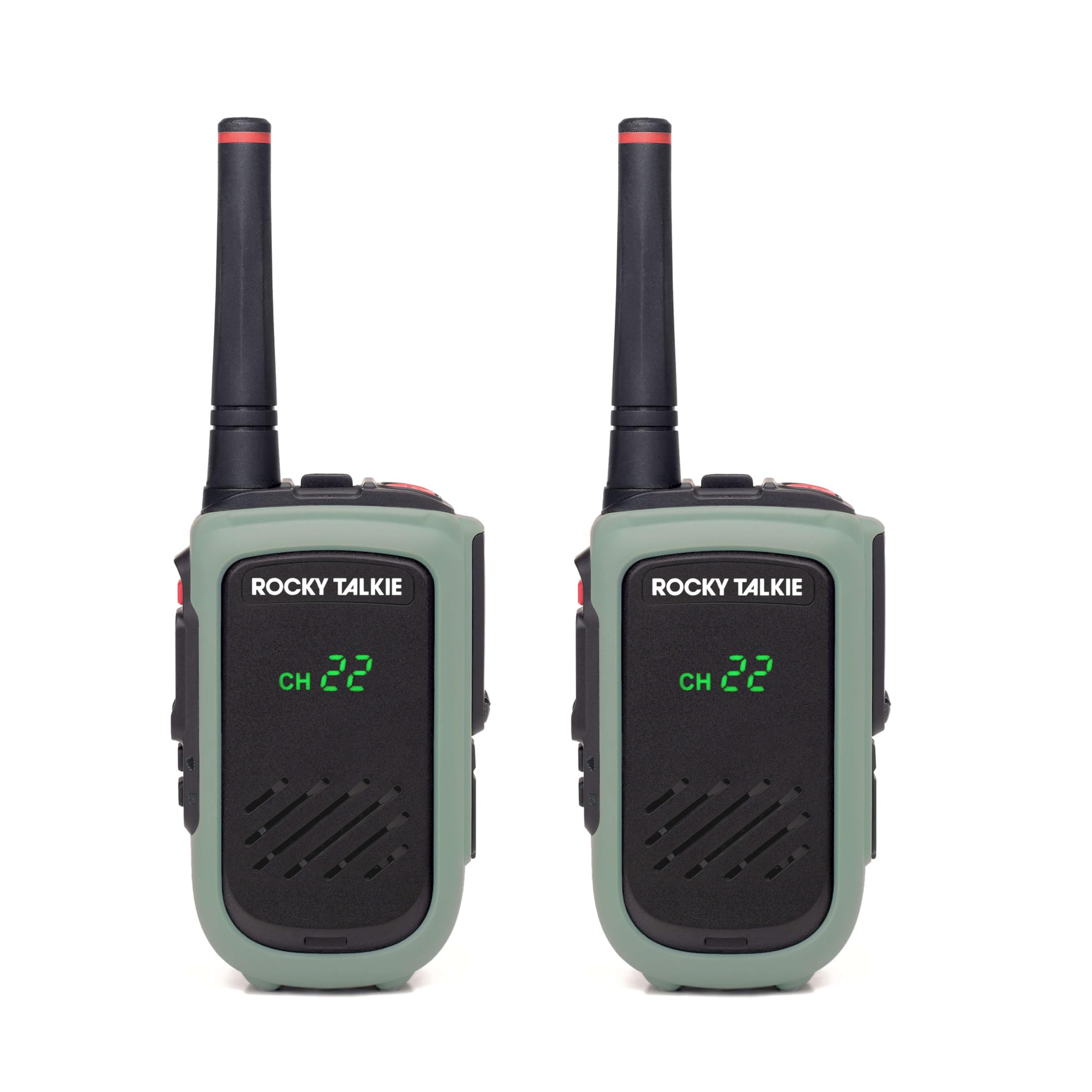
Built for the trip where rain, ridge lines and a dead battery can’t happen.
This is the most weather-hardened radio here. IP67 means it survives submersion up to 1 meter, so creek crossings, rain and a fumbled drop stay within spec. The included 1800mAh battery averages 5 days per charge even in frigid conditions, which suits backcountry, hunting and ski trips where charging is a luxury. It ships as a 2-pack with shatterproof screens, steel Gator Clips, metal-reinforced backup leashes, USB-C cables and both 7.5cm pre-installed and 17cm option antennas.
Rocky Talkie quotes over 35 miles maximum, but 2 to 8 miles is the realistic backcountry figure to plan a route around. You get 8 repeater channels to relay and extend transmissions, a removable antenna so you can add a better one, 11 NOAA weather channels with weather alerts, and dual-channel monitoring. Quality and reliability lead the praise, and it is simple enough to hand to anyone in the group. The 22-channel count is modest next to the BTECH and Baofeng options, but it covers everything a normal GMRS user needs.
Expect value to be the one point of contention — this is the priciest pick on the list, and the 2-pack format means you’re committing to two. But for the person relying on a radio above the tree line in bad weather, deep waterproofing and a battery that lasts days are the two specs worth the outlay.
Hard-Weather Strengths
- IP67 rated for submersion up to 1 meter
- 1800mAh battery averages 5 days per charge in frigid conditions
- Removable antenna and 8 repeater channels for extra reach
Where It Asks More
- Priciest pair on the list — a bigger up-front commitment
- 22 channels is modest next to the 200-250 channel radios here
Best for: backcountry, hunting and winter trips where rain and distance are the day’s conditions.
Overkill for: a warehouse or retail floor — the SAMCOM packs cover that for less, without the weather premium.
Understanding the Specs
Five-watt handhelds look similar on paper. These are the four specs that change how a radio actually behaves in your hand and out in the field.
Transmit Power (Watts)
Watts measure how hard the radio pushes its signal. Five watts is the top of the handheld scale for legal GMRS use, and most picks here run at that ceiling. Some, like the Baofeng BF-F9 V2+, let you step down to 4W or 1W to save battery when you’re talking across a camp rather than across a valley. More watts help, but terrain almost always decides the final story.
Channels and Programmability
Channels are the separate lines you can talk on, and more channels mean more teams can stay separate. The Radioddity GM-30 offers 250 and the BTECH GMRS-V2 offers 200 programmable channels, while fixed sets like the Midland open with 22 channels pre-loaded. Programmability via PC or keypad lets you match frequencies with radios you already own — but a fixed, pre-programmed radio is far easier to hand to someone unfamiliar with radios.
Battery Capacity and Charging
Battery capacity in mAh measures stored energy — a bigger number stretches the time between charges, though features such as a bright LCD and smart radio sensors drain it faster. The KSUN GZ20 leads here with 4000mAh, while the SAMCOM sets use 1500mAh packs that still manage full shifts. Look at how the radios charge, too: a multi-way dock like the SAMCOM lines keeps a whole crew topped up from one cable run.
IP Ratings and Weather Sealing
IP ratings tell you how sealed a radio is. The first digit covers dust and the second covers water — an IP54 handles dust and splashes, while an IP67 survives dust-tight conditions and temporary immersion up to 1 meter. The GMRS-PRO, Midland GXT67 Pro and Rocky Talkie Expedition all carry IP67, making them the right picks for rain, trails and wet job sites. An IP54 radio is fine indoors or in light weather, but is not built for a dunking.
FAQ
Do I need a license to use a 5 watt GMRS walkie talkie?
How far will a 5 watt walkie talkie actually reach?
What is the difference between GMRS and a business UHF radio?
How long does the battery last on a 5 watt radio?
Will an IP54 radio survive rain on a job site?
Can I use these radios with an existing fleet from another brand?
Do the smart features on the BTECH GMRS-PRO use more battery?
Is a ham radio like the Baofeng BF-F9 V2+ better than a GMRS radio?
Can I replace the antenna on a 5 watt GMRS handheld?
Which 5 watt walkie talkie is best for a warehouse or job site?
Final Thoughts: The Verdict
If you want the easiest decision on this list, take the SAMCOM FPCN30A 3 Pack. Three radios, a charging base, programmable frequencies and a 10-hour rated battery are exactly what a working crew needs, and it is the set most people will never have to think about again. For a water-hostile trail or backcountry trip, reach for the Rocky Talkie Expedition 2 Pack — IP67 sealing and a battery rated to average 5 days are the two specs that matter above the tree line. And if you only need a slim, everyday-around-the-building radio with enormous battery headroom, the pocket-sized KSUN GZ20 2 Pack with its 4000mAh pack is the honest bargain here. Whatever you pick, confirm licensing and expected range before you commit a whole team — those two facts shape more of your day than the wattage ever will.
How We Picked
We do not accept paid placement. Every pick is matched to a real buyer and a real use-case; we do not hands-on test units.
Sources & Methodology
Specifications: manufacturer listings and product documentation. Review insights: verified customer reviews, as of November 2026. Pricing: not shown on this page (it changes often); check the current price via the retailer link.
As an Amazon Associate, Gadgets Feed earns from qualifying purchases. This does not affect which products we feature.