
That scratchy crackle when you roll from the bridge to the neck pickup isn’t just annoying — it’s a sign your current blade switch is losing its silver-contact grip, bleeding high-end frequencies and introducing noise into your signal chain. Upgrading to a proper 4-pole 5-way switch is the single most cost-effective mod you can make to unlock series wiring, phase cancellation, and coil-split tones from your humbuckers or single-coils.
I’m Min — the co-founder and writer behind Gadgets Feed. I’ve spent hundreds of hours cross-referencing OEM specs, contact materials, wafer counts, and real owner reports to separate the switches that actually deliver reliable detent action from the ones that develop sloppy play after a few months of gigging.
Whether you’re rewiring a Squier Affinity or restoring a vintage American Standard, this guide delivers every critical spec and real-world nuance you need to choose the best 5 way switch for your next build.
How To Choose The Best 5 Way Switch
A 5-way switch isn’t just a mechanical selector — it’s the nerve center that routes your pickups to the output jack. Choosing the wrong one can lock you into a standard 2-pole wiring scheme or require you to carve out precious body wood. Here’s exactly what to check before you buy.
Poles: 2-Pole vs 4-Pole Super Switch
A standard Fender-style 5-way switch uses 2 poles and only 3 actual throws (positions 2 and 4 are shared connections). A 4-pole “super switch” uses 24 individual contacts so each of the 5 positions is a fully independent throw. You need 4 poles if you plan to wire coil splits, series links, or out-of-phase combinations — essential for HSS or HSH pickup configurations running 4-conductor humbuckers.
Cavity Depth and Mounting Screw Spacing
Every switch on this list requires a minimum cavity depth of 1 3/8 inches and mounting screws spaced 1 5/8 inches apart center-to-center. Super switches with dual wafers are physically wider — some Telecaster cavities need a little wood routing. Always measure your current cavity before buying; a switch that’s too deep or too wide won’t fit without modification.
Contact Material and Detent Feel
Silver-plated brass contacts offer the best conductivity and resist oxidation that causes scratchy noise. CRL and Oak Grigsby switches are known for their firm, positive detent feel with an audible click. Budget switches use nickel-plated steel that wears faster, developing unwanted play between positions over time — that “sloppy middle position” feel that ruins the precision of a performance.
Quick Comparison
On smaller screens, swipe sideways to see the full table.
| Model | Category | Best For | Key Spec | Amazon |
|---|---|---|---|---|
| CRL 5-Way Blade Switch | Premium | USA Strat restoration & heavy gigging | Spring-loaded silver contacts, 0.5A rating | Amazon |
| Fender 5-Position Super Switch | Premium | Nashville Tele & advanced wiring | 4-pole, 24-contact, dual wafer | Amazon |
| DiMarzio EP1112 | Premium | Bass HH & multi-pickup combos | 4-pole, 15g, quick-connect tabs | Amazon |
| All Parts EP 0076-000 | Mid-Range | CRL-equivalent aftermarket drop-in | Open-frame CRL design, 27g weight | Amazon |
| Electroswitch 51993 | Mid-Range | Bulletproof OEM replacement | Patented T-slug contacts, metal housing | Amazon |
| KAISH Super Switch K1407-3 | Value | Budget super-switch with 3 free tips | 4-pole, 1.13oz, soldering lugs | Amazon |
| EMG 5 Position Solderless | Specialty | Plug-and-play EMG pickup systems | Solderless quick-connect, H-S-S config | Amazon |
In‑Depth Reviews
1. CRL 5-Way Blade Switch for Stratocaster/Telecaster
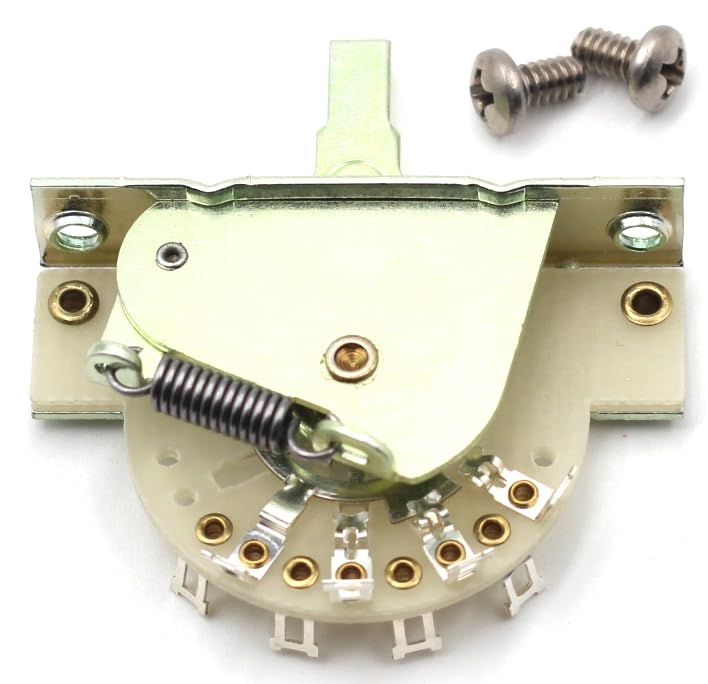
The CRL 5-way is the gold standard for USA Fender Strats — the same switch that shipped in American Standard and Vintage models for decades. Its key differentiator is the spring-loaded detent mechanism, which applies constant pressure to the silver-plated contacts, eliminating the sloppy play that develops in cheaper switches after a year of use. Owners consistently report flawless performance after 2+ years of heavy gigging, with contact oxidation virtually absent thanks to the silver surface.
Installation requires a 1 5/8-inch mounting screw spacing and a minimum 1 3/8-inch cavity depth — both standard USA specs. The switch tip is sold separately, so you’ll need a Fender-style tip (barrel or Strat). It’s a 2-pole design, which means standard 5-way operation (positions 2 and 4 are the shared in-between tones). If you need 4 poles for complex wiring, this isn’t the switch; but for pure, reliable Stratocaster switching that feels solid under your thumb, nothing in this price range matches it.
One caveat: some Squier bodies have shallower cavities, and the CRL switch is slightly taller than the imported box switches. Check your cavity depth before buying — a few owners had to rout a small channel to fit. That effort is worth it for a switch that feels better than Fender OEM units from the same era.
Why it’s great
- Silver-plated contacts resist oxidation and preserve high-end frequencies
- Spring-loaded mechanism provides precise, audible detent action
- Proven 2+ year heavy-use reliability in owner reviews
Good to know
- Switch tip not included — must purchase separately
- May require cavity deepening on import guitars
2. Fender 5-Position Strat/Tele Super Switch

This is the genuine Fender super switch — a 4-pole, 5-throw design with 24 independent contacts that give each position its own copper trace. Unlike a standard 2-pole 5-way (which only has 3 actual throws with shared positions 2 and 4), this switch lets you wire series humbucking combos, out-of-phase tones, and coil splits without needing extra toggles. It’s the exact part used on American-made Fat Strat and Nashville Tele models for a reason.
The dual-wafer construction makes this switch physically wider than a standard 5-way — about 1.3 inches across the body. In a Telecaster cavity, this creates a tight fit that may require you to remove some wood or skip copper shielding. Reviewers who installed it in Nashville Teles reported needing to enlarge the cavity slightly, but the resulting wiring freedom (bridge+neck parallel, full series, bridge+middle in series) was worth the extra routing work.
Fender includes both a white Strat switch tip and a black barrel-style Tele tip, so you don’t need to hunt for separate caps. The brass contact material provides reliable signal transfer, though it’s not silver-plated like the CRL. The action is smooth but firm — some users found it slightly stiff initially and noted it could break a fingernail on fast changes. Break it in for a week and it settles perfectly.
Why it’s great
- True 4-pole design with 24 isolated contacts for complex wiring
- Includes both Strat and Tele switch tips
- Genuine Fender part used on American production models
Good to know
- Wider than standard switches — tight fit in some Tele cavities
- Stiff action until break-in period
3. DiMarzio EP1112 Five Way Switch Multipole
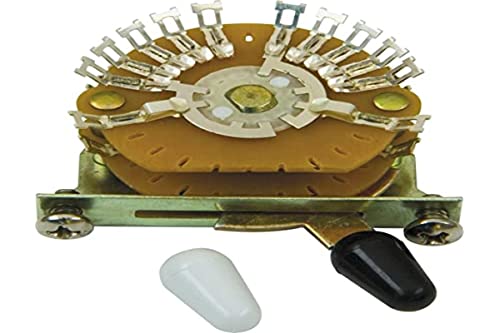
DiMarzio’s EP1112 is another 4-pole super switch, but with a 5-amp current rating that makes it uniquely suited for active electronics or bass applications — most guitar switches top out at 0.5 amps. Owners have successfully used it to replace the faulty stock switch in Sterling Ray5HH bass guitars, eliminating popping and interference that plagued the original. The dual wafer offers every series and parallel combination imaginable.
The switch uses brass contacts and a chrome housing finish. It’s light — just 15 grams — and comes with both a white and black switch tip. The quick-connect tabs are compatible with standard 4-conductor pickup wires, but the soldering lugs are small and closely spaced, so a fine-tip iron is recommended. One reviewer found that one pole’s contact wasn’t crimped properly from the factory, requiring a small solder bridge to fix, suggesting that DiMarzio’s quality control can be inconsistent for this price tier.
Installation on an Ibanez RG320EX required elongating the slot in the pickguard for the longer throw of the super switch compared to the original 3-way. This is common to all 4-pole swaps — the throw arc is longer because of the extra contact positions. The trade-off is enormous wiring flexibility: you can get bridge+neck series, bridge+middle parallel, and middle+neck series with no extra on-board switches.
Why it’s great
- 5-amp rating supports bass and active electronics
- Eliminated popping and interference in Sterling bass swaps
- Dual wafer enables advanced series and phase wiring
Good to know
- Occasional QA issues with contact crimping
- Small soldering lugs require precision work
4. All Parts EP 0076-000 5-Way Switch for Strat

The All Parts EP 0076-000 is essentially a CRL switch sold under Allparts’ branding — same open-frame design, same reliable 2-pole 5-way operation, same 1 5/8-inch mounting screw spacing. It’s the perfect drop-in replacement for a Squier Strat that came with a cheap box-style import switch, and it’s an upgrade from the OEM Fender switch on many Modern Player models. One owner replaced a defective switch on a Fender Modern Player Telecaster and found it significantly better than the factory part.
The nickel-plated exterior has a slightly smaller taper than some vintage Japanese Strat switches, meaning your existing switch tip may not fit. The solution is to buy a genuine Fender Strat tip (white or black) which snaps on perfectly. There are no instructions included and no ground wire attachment point — you’ll need to solder a ground to the metal body yourself, which is standard for open-frame switches but worth noting if you’re a beginner.
At 27 grams, it’s heavier than the DiMarzio but feels substantial in the hand. The detent action is crisp with an audible click, and the switch passes the “shake test” — no rattling or loose components. Owners report it’s lasted years in heavily played Strats without developing the scratchy oxidation that plagues nickel-plated imports. The 30-day parts-only warranty from Allparts is minimal, but the actual build durability exceeds that warranty period by a wide margin.
Why it’s great
- CRL design at a lower price point
- Crisp, audible detent action with no play
- Proven upgrade for Squier and Modern Player Fenders
Good to know
- Switch tip not included and may need Fender-specific cap
- No instructions or ground wire attachment point
5. Electroswitch 51993 5-Way Blade Switch
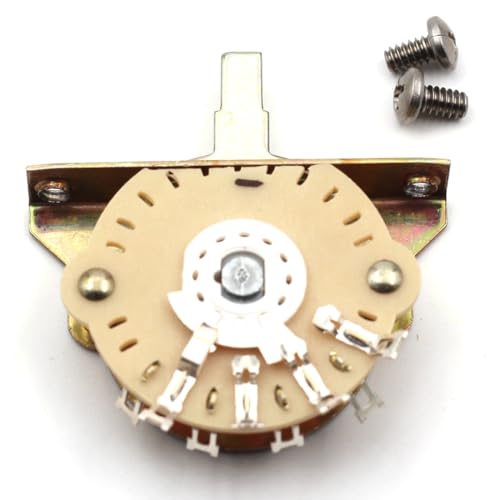
Electroswitch’s 51993 is the same switch known in the guitar community as the Oak Grigsby — the manufacturer that’s been building Fender-style switches for decades. The defining feature here is the patented “T” slug contact design, which uses wider silver-plated contact surfaces than standard bullet contacts. This translates to lower resistance and more reliable contact over the life of the switch, even with heavy use.
The metal housing mount gives this switch a tank-like build quality — one reviewer called it “built like a tank” and noted that vintage examples still work perfectly after 20+ years. It requires a 1 3/8-inch minimum cavity depth and 1 5/8-inch screw spacing, identical to all USA Fender specs. The switch comes with two stainless steel mounting screws, so you don’t need to source hardware separately. The blade width is standard 3/8-inch, compatible with any aftermarket switch tip (tip not included).
The one real catch: this switch is physically larger than import box switches. Some thin-body Strats (especially Squier Bullet series) may need a small amount of wood routing to fit the depth of the metal housing. One reviewer noted they had to “remove some wood” to get it seated. If you’re working with a standard MIM or USA Strat body, the depth is fine. Measure your cavity first — if it’s close, this switch is worth the extra effort for the longevity alone.
Why it’s great
- Oak Grigsby manufacturing with patented T-slug contacts
- Wider silver-plated contacts for lower resistance
- Incredible long-term durability — 20+ year lifespan reported
Good to know
- Physical size may require cavity deepening on thin-body guitars
- No switch tip included
6. KAISH Guitar 5-way Super Switch K1407-3
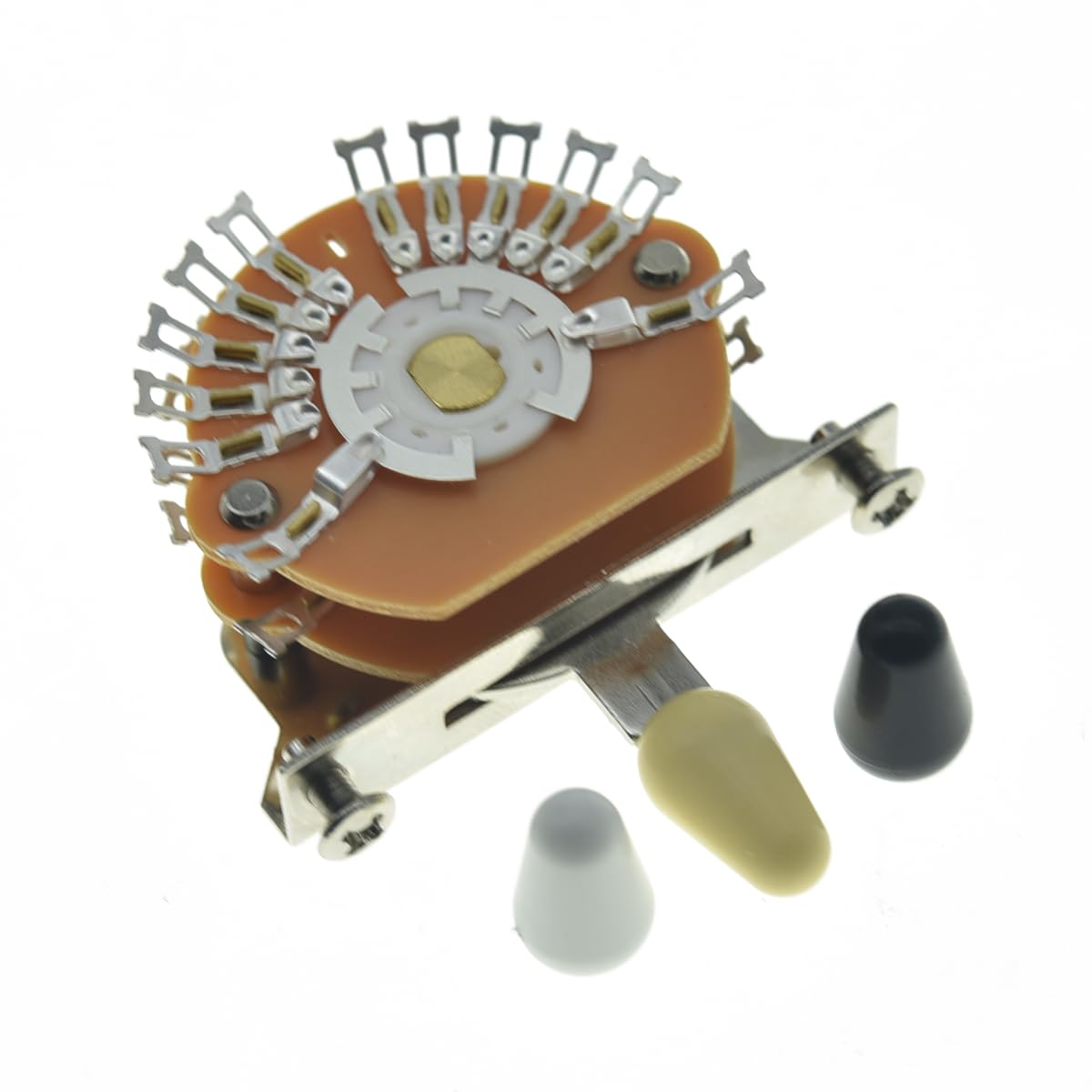
The KAISH K1407-3 is a budget 4-pole super switch that punches far above its price point by including three free switch tips (black, white, and ivory) — normally an -10 value. The plastic body and soldering lugs are functional but lack the solid feel of the metal-housed Electroswitch or CRL. Still, for the price, you get genuine 4-pole 5-throw functionality with 24 contacts, enabling series wiring, out-of-phase sounds, and extra pickup combinations that a standard 2-pole switch can’t deliver.
Owners report that the switch works well for wiring homemade pickups and creating versatile switching configurations. One owner wired it with a mini toggle and three push-pull pots for massive sonic flexibility. However, after a few months of regular use, some owners noted “unwanted play between the five positions” — the plastic detent mechanism wears faster than metal alternatives. The mounting screws use standard #6-32 threads, and the required cavity depth is 35mm (about 1.38 inches), which matches standard specs.
Compared to the Seymour Duncan 4-pole super switch, this KAISH unit feels less sturdy but costs significantly less. For a project guitar that doesn’t get heavy stage use, or for a first-time wiring experiment, it’s hard to beat the value. If you’re building a daily player or a gigging instrument, the extra money for a CRL or Fender super switch buys substantially better long-term detent feel.
Why it’s great
- True 4-pole functionality at a budget-friendly price
- Three switch tips included in the package
- Enables series and phase wiring options for 4-conductor pickups
Good to know
- Plastic detent wears faster than metal — sloppy feel after months
- Not as sturdy as metal-housed alternatives
7. EMG 5 Position Stratocaster Selector Switch

The EMG 5-position selector switch is a fully solderless, plug-and-play unit designed exclusively for EMG active pickup systems. It comes with pre-attached wires that connect directly to EMG’s quick-connect harness — no soldering iron required. This is the only switch on this list that’s locked to a specific ecosystem; you cannot use it with passive pickups from Fender, Seymour Duncan, or DiMarzio without heavy modification.
The switch is physically larger than standard switches — one owner noted it made the back cover of his Ibanez RG “snug” after installation. A few units arrived with bent pins from shipping, though the switch body itself is solidly built. The H-S-S configuration supports humbucker-single-single pickup arrangements, which is the most common active Strat setup. One owner reported persistent noise and scratchiness — an outlier given that most users report clean, noise-free operation once properly connected to the EMG harness.
If you’re installing EMG 81/85 or 60/81 sets, this switch makes the wiring process trivial. The black plastic body and included alder-wood backing material are unique to EMG’s construction. For non-EMG users, this switch offers no advantages — you’re paying for solderless convenience that only works within one brand’s ecosystem. If you’re building an EMG-loaded guitar from scratch, this switch is the cleanest path to a reliable 5-way setup.
Why it’s great
- Fully solderless installation with EMG quick-connect system
- Pre-wired for H-S-S pickup configuration
- Eliminates wiring errors for first-time EMG installs
Good to know
- Only compatible with EMG active pickup systems
- Larger body may cause fitment issues in some cavities
FAQ
Can I use a 4-pole super switch for standard Strat wiring?
Why does my new switch feel stiffer than the original?
Final Thoughts: The Verdict
For most users, the 5 way switch winner is the Fender 5-Position Super Switch because it offers genuine 4-pole 24-contact wiring freedom with the brand reliability of an OEM Fender part, plus it includes both switch tips. If you want the proven gigging durability of spring-loaded silver contacts, grab the CRL 5-Way Blade Switch. And for a seamless solderless build with EMG pickups, nothing beats the EMG 5 Position Solderless Switch.