
The moment your trailer lights flicker and die on a dark highway isn’t a mystery — it’s the sound of cheap copper-clad aluminum wire corroding inside thin PVC jacket. The 5-wire flat connector is the industry standard for pulling brake, turn, tail, ground, and electric brake circuits through a single compact plug, but the real test isn’t the connector — it’s the conductor gauge, the wire insulation quality, and how the harness handles the constant vibration and road salt of real towing. Most rewiring projects fail because the wire strands break internally or moisture wicks up the insulation, and the only fix is running a harness built from the start to survive the elements.
I’m Min — the co-founder and writer behind Gadgets Feed. I’ve spent hundreds of hours cross-referencing wire gauge specifications, insulation material data sheets, and real-world corrosion reports from boat and utility trailer owners to isolate which 5-wire harnesses actually deliver on their rated durability.
The options below represent the narrow set of harnesses that use full-copper conductors, bonded or braided jacketing, and color-coded wiring that matches the SAE J1128 standard — the essentials that separate a weekend-reliable install from another season of splicing. This breakdown of the best 5 wire trailer wiring focuses on conductor purity, protective sheathing, and the subtle differences in Y-harness geometry that save you an hour of crawling under the trailer frame.
How To Choose The Best 5 Wire Trailer Wiring
A 5-wire trailer harness looks simple — five colored wires inside a flat male plug. But the difference between a harness that lasts five seasons and one that corrodes in five months is buried in the material specs. You are choosing between three interdependent variables: conductor type and gauge, outer protection layer, and the physical layout of the Y-split.
Pure copper vs. copper-clad aluminum (CCA) conductors
The conductor metal is the single most impactful spec. 18 AWG pure copper strands deliver lower electrical resistance and far higher fatigue life under vibration compared to copper-clad aluminum (CCA), which is common in budget spools. Pure copper wire bends without cracking the aluminum core; CCA wires develop micro-fractures after repeated flexing, causing intermittent light failure that is nearly impossible to trace. If the product description says “copper clad aluminum” or “CCA,” you are buying a corrosion time bomb, especially in saltwater marine environments.
Outer sheathing: braided nylon mesh vs. bonded PVC jacket
Most 5-wire flat harnesses use a black PVC outer jacket. That is acceptable for enclosed trailers, but for open utility or boat trailers exposed to road spray, a braided nylon mesh tube over the PVC adds a critical abrasion layer. The nylon mesh prevents the PVC from splitting when wires rub against trailer frame edges or suspension components. Bonded wire (five conductors fused into a single flat ribbon) is easier to pull through frame channels and prevents individual wires from snagging, but it does not offer the same abrasion resistance as a separate mesh sleeve.
Y-harness geometry and ground wire length
A proper 5-wire Y-harness splits the brown tail-light circuit into two branches at the front of the trailer, not at the rear axle. This eliminates the need to run a single wire across the axle and splice it on the other side, which is a common failure point. Look for a harness with at least 2.5 feet of ground wire (white) — too short of a ground forces you to attach it near the tongue where the frame grounding plane is weak, leading to dim lights and flickering turn signals.
Quick Comparison
On smaller screens, swipe sideways to see the full table.
| Model | Category | Best For | Key Spec | Amazon |
|---|---|---|---|---|
| Malictele 50FT 16AWG | Premium | Max length & gauge | 16 AWG pure copper, 50 ft | Amazon |
| Aufind 40FT 18AWG | Premium | Long run + tinned ends | 18 AWG copper, 40 ft, tinned | Amazon |
| Aufind 35FT 18AWG | Premium | Full rewiring + accessories | 18 AWG copper, 35 ft, tinned | Amazon |
| Aufind 30FT 18AWG | Mid-Range | Boat trailers & utility | 18 AWG copper, 30 ft, tinned | Amazon |
| WALSIO 26FT 18AWG | Mid-Range | Standard rewiring project | 18 AWG copper, 26 ft, 5-wire | Amazon |
| Oyviny 22FT 4 Pin 5 Wire | Mid-Range | Compact trailer rebuild | 18 AWG copper, 22 ft | Amazon |
| LIMICAR 100FT 5-Way Spool | Budget | Custom length & brake wire | 18 AWG bonded, 100 ft | Amazon |
In‑Depth Reviews
1. Malictele 50FT 16AWG 4 Pin 5 Wire Trailer Wiring Harness Kit
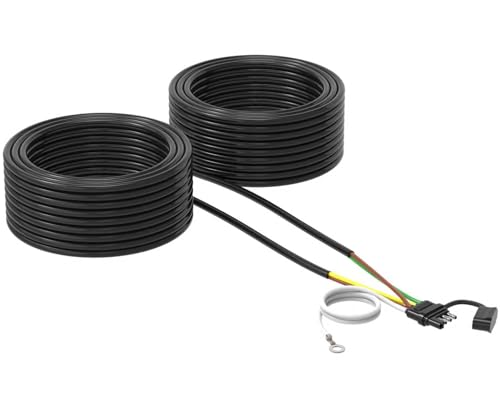
This harness steps up the conductor gauge to 16 AWG — a full two-gauge jump over the standard 18 AWG — delivering lower voltage drop over the 50-foot run. That difference matters when you are powering LED lights at the rear of a 30-foot boat trailer where even 0.5V of drop can dim the clearance markers. The outer layer uses a thick black PVC cable sheathing (not braided nylon, but noticeably stiffer than budget harnesses), and the Y-split is positioned at the plug end to keep the brown wires running independently to each taillight without crossing the axle.
The included 3.9-foot ground wire is the longest in this lineup, allowing you to terminate the white wire directly to the trailer frame near the rear crossmember where the ground plane is strongest. The 16 AWG strands resist the saltwater corrosion that eats through 18 AWG conductors in marine environments, and the PVC jacket is UV-stabilized for continuous outdoor exposure. At 50 feet, there is enough slack to route the wire through the frame rail and still have leftover length for future repairs.
Installers familiar with compact utility trailers will appreciate that the 16 AWG wire is slightly stiffer to bend around tight corners, but the trade-off is a harness that will not fail from internal strand breakage under normal vibration. The kit includes solder seal connectors and frame clips, so you do not need to buy extra hardware for a complete rewire. This is the harness to choose when you want to wire a long trailer once and never think about it again.
Why it’s great
- 16 AWG pure copper conductor minimizes voltage drop over long runs
- 3.9 ft ground wire enables proper frame grounding
- Heavy-duty PVC jacket resists salt spray and UV damage
Good to know
- Thicker wire is stiffer to bend around tight frame corners
- No braided nylon mesh outer layer for abrasion protection
2. Aufind 40FT 18AWG 4 Pin 5 Wire Trailer Wiring Harness Kit
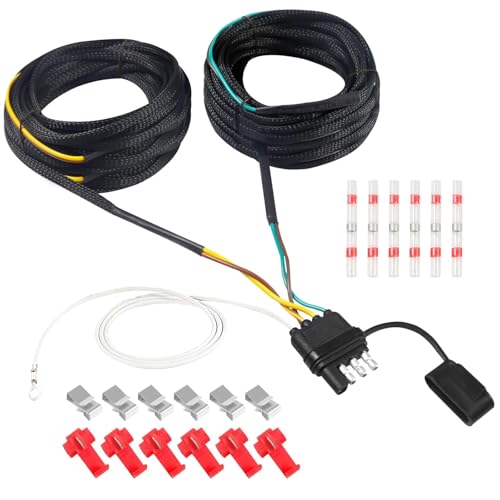
The defining feature of this 40-foot harness is the tinned ends on every conductor — a thin layer of solder coating the exposed copper strands at each termination point. Tinning prevents the copper from oxidizing at the splice joints where water intrusion is most common, and it also keeps the wire strands from splaying apart when you insert them into a butt connector or a 4-way flat plug. Combined with the black braided nylon mesh tubing over the PVC jacket, this harness is built for open trailers that see direct rain and road debris.
At 40 feet, this covers most tandem-axle utility and boat trailers with enough excess to route the wire through the frame without straining. The 18 AWG pure copper core is standard gauge but benefits from the mesh outer layer that prevents the PVC from splitting against sharp metal edges — a failure mode that sends owners back under the trailer after one season. The Y-harness wishbone design splits at the male 4-pin plug, keeping the left and right brown wires separate from the start for a cleaner install.
The kit includes six solder seal wire connectors, six frame clips, and six plastic wire connectors, which cover a full rewire without extra purchases. The ground wire is a standard 2.5 feet, adequate for terminating on a crossmember near the rear. For a long run with maximum corrosion protection at the connection points, this Aufind harness delivers the highest reliability margin without stepping up to the thicker 16 AWG gauge.
Why it’s great
- Tinned copper ends prevent corrosion at every splice point
- Braided nylon mesh protects PVC from abrasion damage
- Includes solder seal connectors and frame clips
Good to know
- 18 AWG gauge is standard — not for very long runs over 40 ft
- Mesh can fray slightly at cut ends if not taped
3. Aufind 35FT 18AWG 4 Pin 5 Wire Trailer Wiring Harness
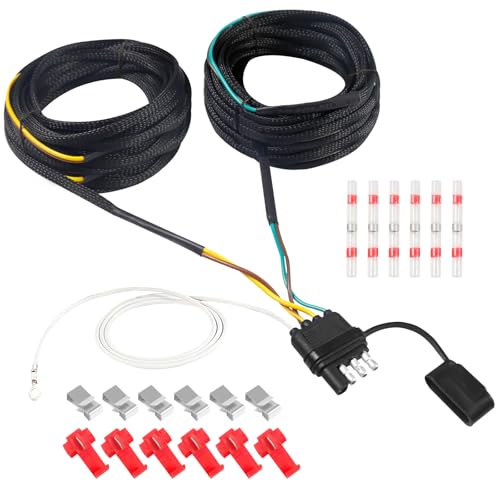
This 35-foot Aufind harness mirrors the material quality of its longer sibling — 18 AWG pure copper conductors, tinned ends, and a braided nylon mesh outer tube — but at a length that is more practical for single-axle boat trailers and 5×8 utility trailers. The 35-foot run gives you enough wire to route from the tongue connector around the side rails and back to the rear lights without excessive coiling, which can trap moisture inside the jacket over time.
The wishbone Y-split is positioned at the plug end, eliminating the need to splice a single brown wire into two branches near the rear axle — a common point of failure in cheaper harnesses that use a single tail-light circuit. The color-coded conductors follow the standard SAE convention: white ground, brown tail, yellow left turn/stop, green right turn/stop, and blue electric brake (though the 4-pin flat connector does not use the blue wire unless you adapt to a 5-pin round plug).
Installers working with a tape measure will appreciate that the 35-foot length removes the guesswork of whether 22 feet will cover a full frame loop. The included accessories (six solder seal connectors, six frame clips) are identical to the 40-foot variant, so the install experience is the same. This harness is the sweet spot for anyone rewiring a mid-size trailer who wants tinned ends and mesh protection without paying for 40 feet of unused wire.
Why it’s great
- Tinned ends on all conductor splices
- Braided mesh over PVC for abrasion resistance
- 35 ft length is ideal for single-axle and mid-size trailers
Good to know
- 18 AWG standard gauge; not for high-amperage brake setups
- Blue brake wire is unused with standard 4-pin flat connector
4. Aufind 30FT 18AWG 4 Pin 5 Wire Trailer Wiring Harness Kit
The 30-foot version from Aufind drops the price point while keeping the same core material stack: 18 AWG pure copper wires, braided nylon mesh outer tubing, and thickened PVC insulation. This is the shortest length in the Aufind lineup that still provides enough wire for a full rewire of a standard 4×6 or 5×8 utility trailer, with the Y-harness split at the plug to keep both sides independent.
The tinned ends are present on this variant, so the corrosion resistance at the splice points matches the more expensive longer versions. The braided mesh prevents the wire bundle from snagging on frame crossmembers during installation, and the 2.5-foot ground wire attaches neatly to a crossmember near the tongue or the rear frame rail. The included hardware kit (six solder seal connectors, six plastic connectors, six frame clips) covers a complete install with no extra trips to the hardware store.
For boat trailers under 18 feet or utility trailers under 10 feet, 30 feet is actually generous — you will have several feet of slack for routing around the tongue and spare tire mount. The main trade-off versus the 40-foot or 50-foot options is the shorter reach if you need to wire a trailer with a long tongue extension or a spare tire carrier positioned far forward. If your trailer length is under 16 feet, this is the most efficient length with no wasted coil.
Why it’s great
- Same pure copper and mesh materials as longer versions
- Tinned ends for corrosion resistance at splices
- Efficient 30 ft length for sub-16 ft trailers
Good to know
- 30 ft may not reach the rear on trailers with a long extended tongue
- No 16 AWG option for very long or high-power runs
5. WALSIO 26FT 18AWG 4 Pin 5 Wire Trailer Wiring Harness

WALSIO’s 26-foot harness uses 18 AWG pure copper with a braided nylon mesh tube, and it carries a 2.5-foot ground wire — the same configuration as the Aufind units but at a slightly shorter overall length. The Y-split is positioned at the plug end, which WALSIO explicitly states fits trailers up to 80 inches and over 80 inches wide, covering both standard-width boat trailers and wider landscape trailers.
The PVC insulation is thickened beyond standard automotive-grade wire, and the braided mesh is applied tightly enough to resist abrasion from zip ties and frame clips without splitting. The color coding matches the standard 4-way flat convention, and the male 4-pin connector includes a weatherproof cover that snaps over the plug when disconnected to keep debris out of the terminals. This is a detail that matters for boat launches where the plug may sit in the tow vehicle receiver while the trailer is submerged.
At 26 feet, this harness is best suited for trailers under 14 feet where you want a tight wire run without extra coil. The shorter ground wire (2.5 feet) is adequate but forces you to attach the ground closer to the tongue — on boats with aluminum frames, this can mean drilling an additional grounding hole if the frame’s paint layer is non-conductive. The lack of pre-tinned ends means you will want to solder or crimp with heat-shrink connectors at every splice to prevent strand corrosion.
Why it’s great
- Braided nylon mesh over thickened PVC for abrasion protection
- Weatherproof cover on the 4-pin connector keeps terminals clean
- Y-harness split at the plug eliminates cross-axle wiring
Good to know
- No pre-tinned ends — solder or heat-shrink every splice
- 26 ft length may be tight on trailers with extended tongue
6. Oyviny 22FT 4 Pin 5 Wire Trailer Wiring Harness

Oyviny’s 22-foot harness is the shortest in the lineup, but it is built with pure copper strands (not CCA) and a black nylon net tube outer layer. For small trailers — 4×6 landscape trailers, single-axle jet ski trailers, or compact utility trailers under 10 feet — 22 feet is precisely enough to run from the tongue connector around the frame rail to both rear lights without leaving a coil of excess wire that traps moisture.
The wishbone Y-split is at the plug end, and the color-coded wires follow the standard brown/yellow/green/white scheme. The PVC coating is thickened for anti-corrosion, and the nylon net tube adds a layer of abrasion protection. The 2.5-foot ground wire is standard length and terminates cleanly on the frame near the rear crossmember. Oyviny specifies that the wire diameter is 0.03 inches — roughly 20 AWG at the individual conductor level — which is slightly thinner than the 18 AWG standard, but for short runs with LED lights, the voltage drop is negligible.
Where this harness earns its spot is the value-to-length ratio for small-frame trailers. The pure copper core eliminates the corrosion risk of CCA wire, and the net tube prevents the PVC from splitting against frame edges. The main limitation is the 22-foot reach — measure your trailer’s total perimeter before buying, because if the wire does not reach both taillights, you will be splicing extensions, which defeats the purpose of a continuous harness.
Why it’s great
- Pure copper conductors with nylon net tube protection
- Perfect length for compact trailers under 10 ft
- Wishbone Y-split eliminates cross-axle wiring
Good to know
- 22 ft length is too short for standard tandem-axle trailers
- Individual conductor gauge is slightly thinner than 18 AWG
7. LIMICAR 100FT 5-Way Trailer Wiring Harness Kit
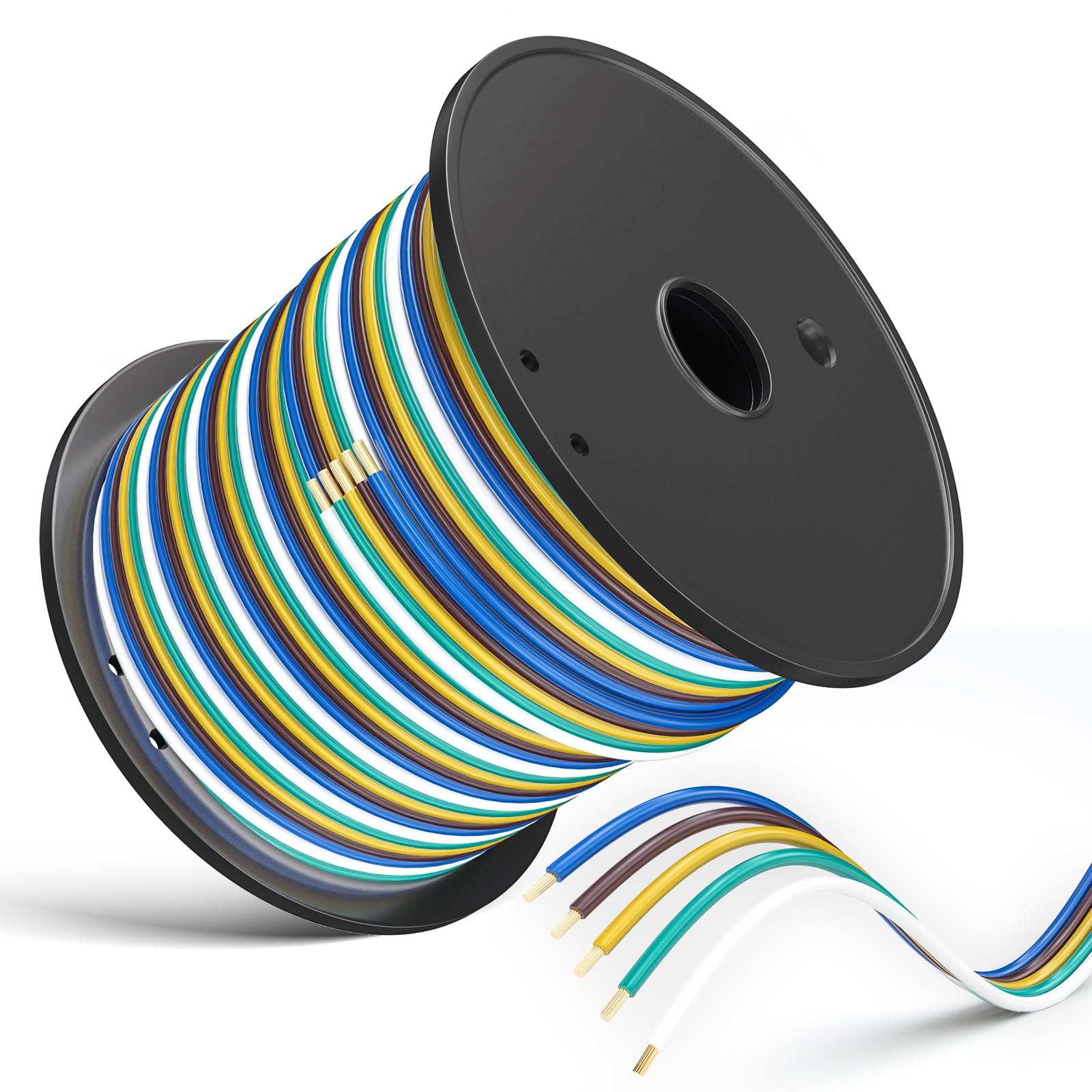
LIMICAR’s 100-foot spool is not a pre-terminated Y-harness — it is a continuous 5-conductor bonded wire roll (18 AWG) with a blue wire for electric brakes, making it the only option in this list that supports a full 5-pin round connector setup. The bonded design fuses all five colored wires into a single flat ribbon, which pulls cleanly through frame channels without individual wires tangling. The insulation is SAE J1128 rated to 60V with oil- and acid-resistant PVC, intended for continuous outdoor use.
The conductors are copper-clad aluminum (CCA), not pure copper — a material choice that drops the cost significantly but introduces the corrosion risk noted in several customer reports of wire failure after two months of use in wet conditions. The 100-foot length gives you enough wire to rewire a large horse trailer or an enclosed cargo trailer with spare wire for future repairs, and the blue brake wire is essential for trailers with electric brake systems that require a separate control circuit.
For DIYers who need a bulk spool to cut custom lengths and terminate with their own 5-pin round connectors, the LIMICAR roll is the only option on this list that provides that flexibility. The bonded wire is easy to split at connection points — peel the conductors apart at the desired length and crimp. The trade-off is the CCA core, which demands careful waterproofing at every splice (dipped in liquid electrical tape or sealed with adhesive heat-shrink) to prevent the corrosion that CCA is prone to in saltwater or high-humidity environments.
Why it’s great
- 100 ft spool provides enough wire for large trailers with brakes
- Blue conductor supports electric brake circuit
- Bonded wire pulls cleanly through frame channels
Good to know
- Copper-clad aluminum (CCA) is prone to corrosion in wet environments
- Requires a 5-pin round connector and custom termination
FAQ
Can I use a 5-wire harness with a 4-pin flat connector?
Why do my trailer lights flicker after a new harness install?
Do I need tinned ends on a trailer wiring harness?
Final Thoughts: The Verdict
For most users, the winner of the best 5 wire trailer wiring search is the Malictele 50FT 16AWG because the thicker 16 AWG conductor and generous 50-foot length eliminate voltage drop on long trailers and provide enough wire for any standard rewire project. If you want tinned ends and braided mesh protection for maximum corrosion resistance, grab the Aufind 40FT 18AWG. And for a compact, pure-copper harness that fits small trailers without excess coil, nothing beats the Oyviny 22FT 4 Pin 5 Wire for its targeted fit and nylon net tube protection.