
A five-year-old’s attention span is a moving target. One moment they’re laser-focused on a puzzle, the next they’ve abandoned it for a cardboard box. The best 5 year old games bridge that gap between fleeting focus and genuine engagement, turning play into a tool for social skills, motor development, and—most importantly—shared laughter. Without a solid selection, you end up with pieces scattered across the living room and a kid who’s already bored.
I’m Min — the co-founder and writer behind Gadgets Feed. I’ve spent extensive hours analyzing the play patterns, durability reports, and educational value of dozens of games to separate the lasting hits from the one-and-done distractions.
The goal is simple: find the best 5 year old games that actually hold up to repeated play, require zero reading ability, and encourage meaningful interaction without a screen in sight.
How To Choose The Best 5 Year Old Games
Not every box labeled “ages 5+” delivers the right experience. Some rely on reading skills that aren’t there yet. Others have rules too complex for a 5-year-old to follow independently. The key is understanding which mechanics and physical demands actually match a 5-year-old’s developmental stage. Here’s what separates the winners from the shelf-fillers.
Prioritize “No Reading Required” Mechanics
At five, most children are still building phonemic awareness. Games that force reading comprehension create frustration, not fun. Look for color-based movement, symbol matching, picture cues, or verbal instructions. The strongest games in this category—like Candy Land and Toss Across—use visual prompts so a child can play independently alongside older siblings or adults without needing someone to read every card.
Balance Gross Motor and Fine Motor Challenges
A 5-year-old’s fine motor control is rapidly developing, but it’s still imprecise. Games that require delicate stacking (like Don’t Rock the Boat) build hand-eye coordination and pincer grip. Conversely, games involving throwing, running, or full-body freezing (like the motion-sensing Red Light Green Light or the arcade basketball set) target gross motor development. The best rotation includes both types so a child builds dexterity without sitting still for too long.
Replayability Depends on Variable Outcomes
The fastest way to kill a game? Make every round feel the same. 5-year-olds thrive on unpredictability. Games with randomized card draws, dice rolls, or motion detection produce different outcomes each time, keeping the novelty alive. A game board that folds into a new layout or includes an advanced side (like Scrabble Junior’s two-sided board) extends the shelf life as the child’s skills grow.
Quick Comparison
On smaller screens, swipe sideways to see the full table.
| Model | Category | Best For | Key Spec | Amazon |
|---|---|---|---|---|
| Move2Play Red Light Green Light | Motion-Sensing | High-energy active play | 20+ ft motion detection range | Amazon |
| Clever Fox Play Number Hunter | Educational | Math skills through play | 2 number dice + 1 operation die | Amazon |
| Hasbro Gaming Scrabble Junior | Word-Building | Early spelling and reading | 2-sided board with progressive levels | Amazon |
| PlayMonster Don’t Rock the Boat | Balancing | Fine motor and patience | 16 penguin figures + rocking ship | Amazon |
| Mattel Games Toss Across | Physical Tic-Tac-Toe | Hand-eye coordination | 9 rotating target triangles | Amazon |
| Hasbro Gaming Candy Land Disney Princess | Classic Board Game | First game for toddlers | 44 cards, no reading required | Amazon |
| JOYIN Arcade Basketball | Active Sport | Competitive gross motor fun | Adjustable height: up to 55 inches | Amazon |
In‑Depth Reviews
1. Move2Play Red Light Green Light Game

This is the rare motion-sensing toy that actually works at a 5-year-old’s speed. The sensor detects movement up to 20+ feet away, so there’s plenty of room for running, sneaking, or dancing. Three game modes—Red Light Green Light, Sneaky Steps, and Stoplight Boogie—keep the format fresh, and the 30+ sound effects and three colored lights provide enough auditory and visual feedback to hold a child’s attention through multiple rounds.
What makes this a standout for 5-year-olds is the instant, unambiguous feedback. The device clearly calls out “red light” and “green light,” so no reading is required. If a child moves on red, the sensor catches them and sends them back to the start. This builds impulse control and listening skills without feeling like a lesson. The active, run-and-freeze mechanic also burns off the physical energy that makes sitting-still games tough for this age.
Setup is straightforward—pop in three AA batteries (not included) and place the unit on a flat surface. The toy is lightweight at 0.33 kg and compact enough for travel, though it’s best used in a hallway or living room with a clear run path. Parents report that kids as young as two and as old as ten all play together, making it a rare multi-age hit for birthday parties or rainy afternoons.
Why it’s great
- Three distinct game modes prevent boredom
- Motion sensor catches even slow sneaking
- Works for ages 2-10, great for mixed-age play
Good to know
- Requires 3 AA batteries not included
- Best results need a clear, open floor space
2. Clever Fox Play Number Hunter Math Board Game
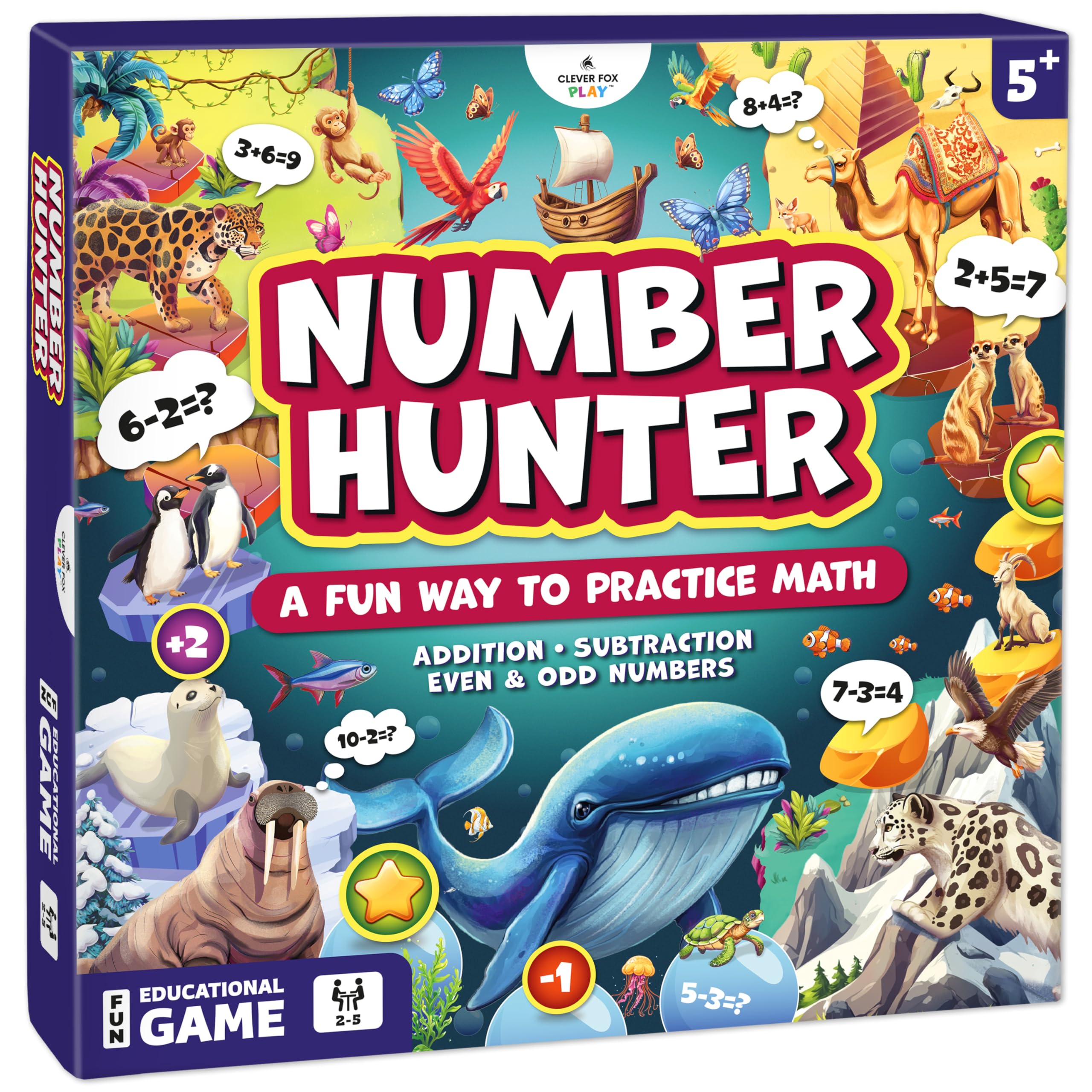
Number Hunter turns basic arithmetic into a race around the world. Players roll two number dice and one operation die (which determines addition or subtraction), solve the equation, and move their piece across the colorful game board. Land on a star tile and you draw a challenge card that might ask you to hop on one leg or solve a bonus math problem. It’s screen-free learning that feels like an adventure.
For a 5-year-old just beginning to count, the game works because it scaffolds naturally. The 50 challenge cards include actions that require physical movement, breaking up the sitting-and-thinking time that young children struggle with. The components are built from non-toxic, child-safe materials, and the game board’s 9.21-inch square footprint means it fits on small coffee tables without dominating the room.
The math difficulty is tuned for ages 5-7, meaning single-digit addition and subtraction. A child who can count to 20 will be able to participate with minimal adult assistance—though some challenge cards do require an adult to read them aloud. Parents of autistic children and kindergarteners report it strengthens quick math facts in a pressure-free way, making it a solid pick for homeschooling or after-school practice.
Why it’s great
- Combines math practice with physical activity
- Durable, non-toxic components for repeated play
- Quick setup and 15-20 minute rounds
Good to know
- Challenge cards require reading to the child
- Best for children already familiar with counting to 20
3. Hasbro Gaming Scrabble Junior Board Game

Scrabble Junior solves the classic “my kid can’t spell yet” problem with a two-sided board. On Side 1, words are pre-printed on the board—children simply match their letter tiles to the letters already on the grid. This builds letter recognition and basic left-to-right reading skills without any spelling pressure. On Side 2, the board flips to a traditional Scrabble-style format where players create their own words, offering a natural progression path as reading skills develop.
The game includes 105 letter tiles and four adorable character tokens for scorekeeping. The tile distribution is balanced for younger vocabulary—more vowels and common consonants appear than in adult Scrabble. The box indicates ages 5+, and reviews confirm that the beginner side works well for kindergarteners who know their alphabet, while the advanced side challenges first and second graders. The no-batteries, portable design means it travels easily to grandparents’ houses or classrooms.
One hidden strength: the scoring tokens double as a counting exercise. After each round, children count their points by adding up their character tokens, reinforcing basic addition. The game supports 2-4 players, making it a natural fit for family game night or small playgroups. The tiles are sturdy cardboard that holds up to frequent handling, though the box is standard-weight and may show wear after heavy use.
Why it’s great
- Grows with the child from letter-matching to free-form spelling
- No batteries required, fully portable
- Builds reading, spelling, and basic math in one game
Good to know
- Beginner side may feel too easy for advanced readers
- Box is not reinforced; tiles can get lost without storage bag
4. PlayMonster Don’t Rock the Boat Board Game

Don’t Rock the Boat is a balancing game disguised as pure silliness. The setup: a plastic pirate ship that rocks freely on a central fulcrum. Players take turns placing colorful penguin figures onto the ship without tipping it over. The tension builds with every placement—the ship wobbles, the penguins slide, and eventually, the whole thing topples into a cascade of giggles. The game ends when the ship tips, and the player who made it fall loses.
For a 5-year-old, this is stealth fine motor training. Placing a penguin requires a steady hand, controlled grip, and spatial awareness of where the ship is most stable. The game also teaches cause and effect in a visceral way: one bad placement sends everything flying. The 16 penguin figures are chunky enough for small hands but require enough precision that older players don’t dominate. Rounds last about 5-10 minutes, matching a 5-year-old’s natural attention cycle.
The components are all plastic, which means they wipe clean easily after spills. The ship base is 10.5 inches square, fitting neatly on a coffee table or carpet. The recommended age is 5+, though slightly younger siblings can participate with help on placement. One note: the penguins are small enough to be a choking hazard for children under 3, so this game is best for the 5+ target and not for mixed-age groups with toddlers.
Why it’s great
- Develops fine motor control and spatial reasoning
- Quick rounds keep short attention spans engaged
- Easy to clean plastic components
Good to know
- Small penguin figures are a choking hazard for under 3
- Does not fold flat for storage
5. Mattel Games Toss Across

Toss Across takes the familiar logic of tic-tac-toe and makes it physical. Instead of drawing X’s and O’s on paper, players stand a few feet away and toss beanbags at a vertical target containing nine rotating triangles. A direct hit flips the triangle to show either an X or an O. First to get three of their symbol in a row wins. The twist? A well-aimed toss can also flip your opponent’s symbol back to blank, adding a layer of defensive strategy.
For a 5-year-old, the game builds hand-eye coordination through an action they already love—throwing things. Each player gets three beanbags per round, which keeps the pace moving and prevents long waits between turns. The target is 16.5 inches tall and sits on the floor, so tosses are at a natural height for young children. The 2.9-pound weight makes it stable during play but light enough to slide under a bed for storage. Assembly involves applying stickers to the rotating triangles, which takes about five minutes.
The beanbags are the weakest link. Several parent reviews note that the included bags are small and lightweight, making it difficult for younger children to generate enough force to flip the triangles. Upgrading to slightly heavier beanbags solves this problem entirely. The plastic frame is durable enough for indoor and outdoor use, and the game supports 2-4 players by allowing team play. It’s a rare blend of strategy and physical activity that doesn’t require reading, rules memorization, or adult guidance after the first round.
Why it’s great
- Combines tic-tac-toe strategy with active throwing
- Flipping opponent’s symbols adds defensive depth
- Compact storage under beds or in closets
Good to know
- Light beanbags may not flip triangles for small children
- Assembly required for applying stickers
6. Hasbro Gaming Candy Land Disney Princess Edition

Candy Land is the gold standard for a child’s first board game, and this Disney Princess edition wraps the classic formula in character-driven appeal. Players draw colored cards and move their princess pawn—Cinderella, Rapunzel, or Ariel—along a rainbow path toward the enchanted castle. The first to arrive wins. There is zero reading, zero counting, and no strategy beyond luck of the draw. That simplicity is precisely why it works.
For 3-to-5-year-olds, the game teaches turn-taking, color recognition, and following a sequence of play from start to finish. The Disney Princess theme provides an immediate emotional hook—children who love the movies will engage with the gameboard featuring scenes from Aladdin, Snow White, The Little Mermaid, and The Princess and the Frog. The 44 cards are thick enough to survive enthusiastic shuffling, though several reviews note the board folds in quarters and could be thicker for durability.
The 1.09-pound package includes the gameboard, three movers, cards, and instructions. The 2-3 player limit is worth noting—if you have four children, someone will be waiting. This is best as a one-on-one or small-group activity. The age range listed is 3+, and feedback from parents confirms it’s an excellent bridge from toddler play to more structured family games. The classic Candy Land mechanics mean this edition plays identically to the original, so parents who grew up on Candy Land will find the rules instantly familiar.
Why it’s great
- Perfect first game with zero reading required
- Disney Princess theme boosts engagement for fans
- Teaches turn-taking and color recognition
Good to know
- Only supports 2-3 players
- Board durability is average; may show creases over time
7. JOYIN Arcade Basketball Game Set

The JOYIN Arcade Basketball set brings the arcade shooting experience home with an adjustable-height stand that ranges up to 55 inches. The frame is made from lightweight PVC plastic and assembles in about 10 minutes with no tools required—the included air pump inflates the four basketballs in under two minutes. The size (35″ L x 18″ W x 55″ H) fits comfortably in a corner of the playroom, garage, or backyard without overwhelming the space.
For a 5-year-old, the adjustable height is the defining feature. Set the rim low for confident shooting, then raise it as the child grows or wants a challenge. The set includes four balls, which means siblings or friends can shoot simultaneously, encouraging turn-taking and friendly competition. The backboard and rim are plastic, so they won’t rust outdoors, but the net is a thin woven material that can tear if children hang or climb on it—a common complaint in reviews.
The recommended age is 3+, and reviews confirm that 5-6 year olds hit the sweet spot: they can shoot accurately enough to feel successful but still need to work on aim, making the game challenging without being frustrating. The 5.22-pound total weight means it can be moved from room to room or packed into an SUV for park trips. The primary durability concern is the net and the thin PVC pipes—this is not a toy meant for rough, unsupervised play. For supervised active play, it delivers excellent value as a screen-free, gross-motor outlet.
Why it’s great
- Adjustable height grows with the child
- Easy tool-free assembly in under 10 minutes
- Four balls allow simultaneous play with friends
Good to know
- Net is fragile and can tear if climbed on
- Thin PVC pipes require adult supervision for durability
FAQ
Can a 5-year-old play these games without adult help?
How many players do these games support?
Are these games safe for a 5-year-old with younger siblings?
Final Thoughts: The Verdict
For most users, the best 5 year old games winner is the Move2Play Red Light Green Light because it uniquely combines active, screen-free play with three distinct game modes that hold a 5-year-old’s attention through multiple sessions. If you want a math-focused educational option, grab the Clever Fox Play Number Hunter. And for a classic no-reading-required entry point for a first-time gamer, nothing beats the Hasbro Gaming Candy Land Disney Princess Edition.