
A 50-amp generator isn’t just a bigger battery—it’s your entire home’s survival line when the grid goes silent. We’re talking about the ability to run your well pump, central AC, electric oven, and an RV’s full 50A shore power simultaneously without worrying about overload. But in a market flooded with peak-wattage claims and fuel-type promises, the wrong choice leaves you with a heavy, noisy paperweight that trips the breaker the moment your compressor kicks in.
I’m Rikta — the co-founder and writer behind Gadgets Feed. I’ve spent years analyzing the engineering trade-offs in portable generators, from copper-wound alternators and THD ratings to the real-world starting wattage demands of a 3-ton AC unit and a sump pump. (And Homer 🐱 supervised from atop the generator box, unimpressed by anything under 240V).
This guide breaks down the top contenders across fuel flexibility, inverter efficiency, and runtime so you can confidently choose the right 50 amp generator for your home, RV, or job site.
How To Choose The Best 50 Amp Generator
Picking a 50 amp generator means first confirming your home’s transfer switch or RV inlet expects a 14-50R plug—anything less and you’re shopping in the wrong category. Once that’s settled, your choice hinges on three pillars: peak versus running wattage, fuel type, and the technology under the hood (inverter vs. conventional). Ignore the marketing wattage and look at the continuous rating: a 12,000 peak watt unit may only sustain 9,500 watts, which could be tight for a home with a 4-ton AC, a well pump, and an electric range. Fuel flexibility matters because propane and natural gas store indefinitely, while gasoline degrades within months—critical for emergency preparedness. Finally, an inverter generator’s variable-speed engine and sub-3% THD (total harmonic distortion) protect sensitive electronics and sip fuel during light loads, whereas a conventional open-frame unit is louder, thirstier, but often cheaper per watt. Prioritize the features that match your specific use case: RV travel, whole-home backup, or construction site power.
Power Output and Real-World Loads
A 50-amp outlet delivers 12,000 watts at 240V, but you don’t need to max that out. List your essential appliances—refrigerator (700W), well pump (1,500W surge), furnace blower (1,000W), lights (500W), and a microwave (1,200W)—then add a 20% buffer for voltage dips. Most homes run comfortably on a 9,000 to 11,000 running-watt generator. The surge rating matters for motor startup: a central AC unit can draw 5,000 to 7,000 watts for the first few seconds. A generator with a strong surge headroom (12,000W or more) prevents the breaker from tripping when the compressor kicks on.
Fuel Type and Runtime
Gasoline is widely available and delivers the highest wattage, but its shelf life is limited and it’s often the first fuel to disappear during regional disasters. Propane burns cleaner, extends engine life, and stores indefinitely—but it reduces peak output by roughly 10% compared to gasoline. Natural gas offers unlimited runtime tied to your home’s gas line, but it lowers wattage further and depends on that utility staying active. Tri-fuel models give you the freedom to switch between all three, making them the top choice for serious home backup where fuel access is unpredictable.
Noise and Portability
A heavy generator with 50A output can easily exceed 200 pounds. Look for a built-in wheel kit with pneumatic tires and a folding handle—these make a 240-lb unit maneuverable across a yard. Noise levels range from 60 dBA (conversation-level, inverter) to 75+ dBA (open-frame). If you have close neighbors or run the generator overnight, an inverter model with a quiet enclosure is worth the premium. Also check for a remote start key fob: it lets you fire up the generator from inside the house without walking out into a storm.
Quick Comparison
On smaller screens, swipe sideways to see the full table.
| Model | Category | Best For | Key Spec | Amazon |
|---|---|---|---|---|
| Champion 11,000W Inverter | Inverter | Whole-home backup with sensitive electronics | 9,000W running, 64 dBA | Amazon |
| Westinghouse iGen8200TFc | Inverter, Tri-Fuel | Fuel flexibility + quiet power | 6,600W running, 60 dBA | Amazon |
| DuroMax XP13000HXT | Tri-Fuel, Open Frame | Maximum power for heavy loads | 13,000W peak, 500cc engine | Amazon |
| Westinghouse 12,500W Dual Fuel | Dual Fuel, Open Frame | High-power backup with remote start | 9,500W running, 12,500W peak | Amazon |
| AIVOLT 11,250W Inverter | Inverter, Dual Fuel | Quiet, high-power RV and home | 9,000W running, remote start | Amazon |
| Pulsar G12KBN-SG | Dual Fuel, Open Frame | Budget whole-house power on propane | 9,500W running, 12,000W peak | Amazon |
| AIVOLT 8,000W Inverter | Inverter, Dual Fuel | Mid-weight inverter with 50A outlet | 6,100W running, 62 dBA | Amazon |
| Anker SOLIX F3800 | Power Station | Silent, zero-emission whole-home | 3,840Wh, 6,000W AC | Amazon |
| Champion 4,000W Dual Fuel Inverter | Inverter, Dual Fuel | Compact RV and camping backup | 3,000W running, 64 dBA | Amazon |
| WEN 4800W Inverter | Inverter | Mid-range RV power with light home backup | 4,000W running, 4,800W peak | Amazon |
| WEN 3600W Dual Fuel Inverter | Inverter, Dual Fuel | Budget-friendly RV and essentials | 2,900W running, 3,600W peak | Amazon |
In‑Depth Reviews
1. Champion Power Equipment 11,000-Watt Wireless Remote Start Inverter Generator

The Champion 201407 delivers a rare combination of high continuous output and inverter-grade clean power. Its 459cc engine produces 11,000 starting watts and 9,000 running watts—enough to handle a 3-ton central AC, a well pump, a refrigerator, and home lighting simultaneously, all with less than 3% THD to protect your furnace control board and smart appliances. The wireless remote key fob works up to 80 feet away, letting you start the generator from the garage or inside the house during a storm.
At 64 dBA from 23 feet, this unit is remarkably quiet for its power class—quieter than many open-frame 7,000W competitors. The 5.5-gallon fuel tank delivers up to 15 hours of runtime at 25% load, and the CO Shield auto-shutdown system adds critical safety. The integrated wheel kit and 200-pound weight make it mobile but still a two-person lift onto a truck bed. Buyers report reliable cold-start performance and seamless integration with a home interlock kit.
One quirk to plan for: the CO sensor can be sensitive when the generator is placed too close to a wall or in a partially enclosed space—always keep it outdoors and well-ventilated per the manual. Also, no fuel hose or extension cables are included for the 50A outlet, so budget for a heavy-gauge 50-amp cord. For anyone seeking whole-home inverter backup with the convenience of remote start, this Champion is the benchmark.
Why it’s great
- Inverter-grade clean power for sensitive electronics
- Wireless remote start from 80 feet
- 64 dBA—remarkably quiet for 9kW output
Good to know
- CO sensor may trigger if not placed in open air
- No cables included for 50A outlet
- At 200 lbs, requires care to maneuver
2. Westinghouse iGen8200TFc Tri-Fuel Inverter Generator
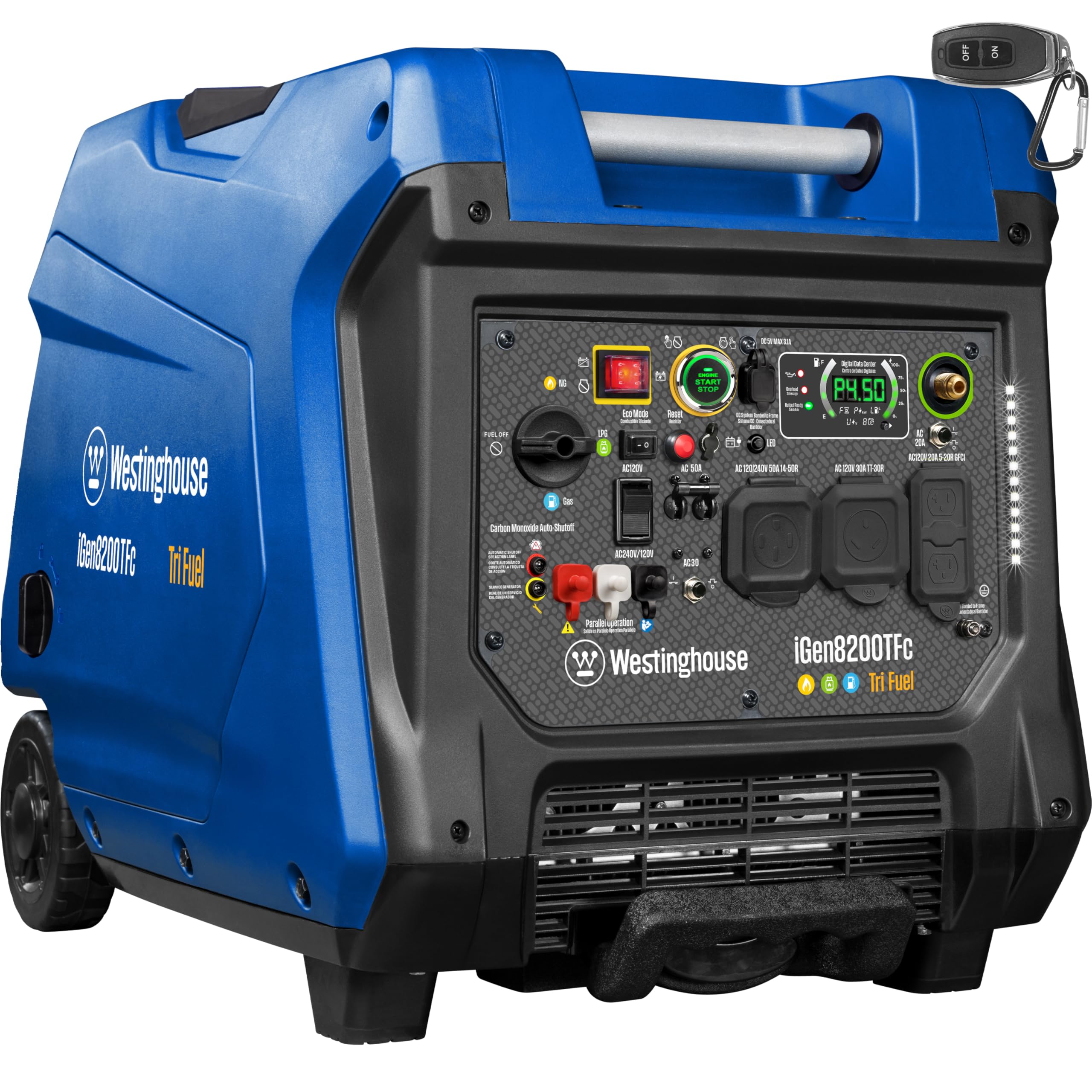
The iGen8200TFc is a tri-fuel inverter generator that runs on gasoline, propane, or natural gas, giving you the ultimate fuel-availability insurance. On gasoline, it delivers 6,600 running watts and 8,200 peak watts; on propane it drops to 5,940 running watts; and on natural gas it provides 5,280 running watts. The 298cc engine with copper windings keeps THD below 3%, making it safe for your home server, TV, and laptop. A 14-50R 50A outlet is included, so it connects directly to an RV or a home interlock kit without adapters.
Inverter technology adjusts the engine speed to the load, which means at 25% load it sips fuel and runs at only 60 dBA—about the volume of a normal conversation. The 3.9-gallon tank yields up to 17 hours of runtime at light loads. Remote key fob start and a push-button electric start add convenience, and the built-in CO sensor with auto-shutdown keeps your family safe. At 134.5 pounds with wheels and a telescoping handle, it’s far more mobile than the 200-pound open-frame units.
Owners praise the quiet operation and the ability to switch fuel sources mid-run without turning the generator off. The only downsides are that the 50A output is limited to the tri-fuel configuration—so you lose a bit of peak wattage compared to pure gasoline models—and the pull-start backup can be stiff if the battery ever dies. For someone who wants fuel flexibility, low noise, and 50A capability in a portable package, this Westinghouse is a standout.
Why it’s great
- Tri-fuel: gasoline, propane, or natural gas
- 60 dBA—very quiet for an inverter
- 50A outlet included for home/RV hookup
Good to know
- Peak wattage lower than open-frame rivals
- Pull start is tight if battery is depleted
- No parallel kit included
3. DuroMax XP13000HXT 13,000-Watt Tri-Fuel Generator
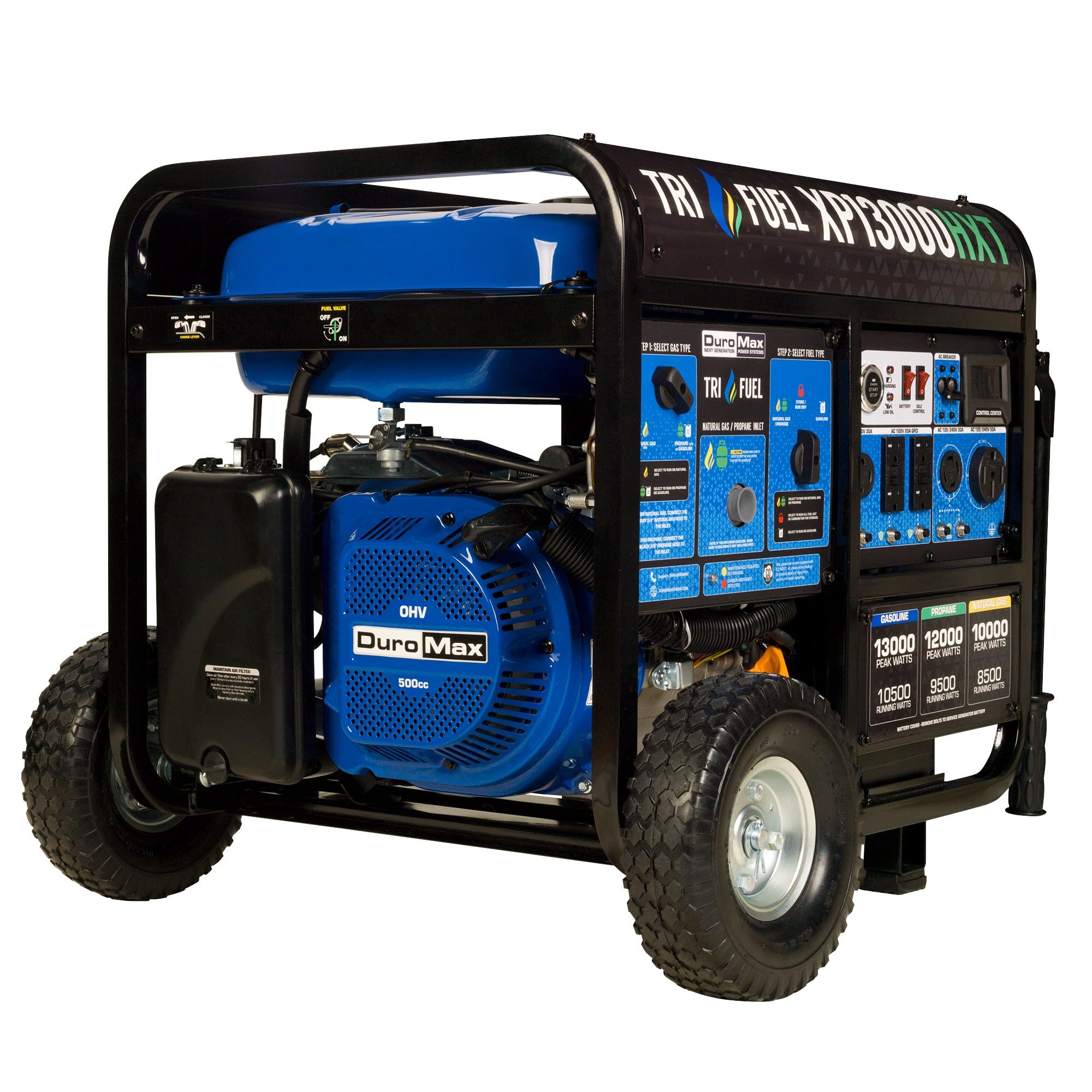
If raw wattage is your priority, the DuroMax XP13000HXT brings a massive 500cc engine that churns out 13,000 peak watts and 10,000 running watts on gasoline. It runs on gasoline, propane, or natural gas via its tri-fuel carburetor, and the front-facing interface lets you switch fuel types in seconds. The 50-amp outlet is transfer-switch ready, and the remote start key fob lets you fire it up from a distance—no need to brave the weather to pull a cord.
This is an open-frame generator, so expect higher noise levels than inverter models, but the power-to-price ratio is hard to beat. The 8-gallon fuel tank provides up to 17 hours of runtime at 25% load. The included wheel kit with heavy-duty tires makes the 240-pound unit mobile, though loading it into a truck requires two people. CO Alert technology automatically shuts the generator down if dangerous CO levels accumulate. Owners report reliable starting after proper break-in and noticeably better fuel efficiency on natural gas.
The downsides include a stiff fuel selector knob initially, and the battery may need charging after extended storage. Some units arrived with minor cosmetic damage from shipping; DuroMax’s customer support is responsive but requires patience during high-demand periods. For anyone who needs to power an entire house, including a large AC and multiple heavy appliances, the XP13000HXT delivers the headroom no inverter can match at this price point.
Why it’s great
- 13,000W peak—best in class for surge capacity
- Tri-fuel on gasoline, propane, and natural gas
- Remote start key fob included
Good to know
- Open-frame—noisier than inverter models
- Weighs 240 lbs; requires two people to lift
- Not inverter-grade THD—avoid for sensitive electronics without filter
4. Westinghouse 12,500 Watt Dual Fuel Generator

This Westinghouse model is a long-standing favorite for home backup thanks to its 457cc cast-iron-sleeve engine that delivers 12,500 peak watts and 9,500 running watts on gasoline (11,200 peak / 8,500 running on propane). The remote start key fob, electric start, and recoil backup give you three ways to get it running. A NEMA 14-50R 50A outlet is built in, along with a 30A twist-lock and two 20A GFCI household receptacles—all covered with rubber safety caps.
Runtime reaches 12 hours at half load on the 6.6-gallon fuel tank. The CO sensor and automatic low-oil shutdown provide essential safety layers. Assembly is minimal—attach the wheels, connect the battery, and add oil. Owners consistently mention it starts on the first or second pull even after months of storage, and that it easily powers an entire 2,600-square-foot home including AC, well pump, and kitchen appliances. At 212 pounds, the wheel kit makes yard placement manageable.
The main trade-offs are noise (open-frame design is audible from across the property) and the need for a high-altitude kit if you live above 2,000 feet. A few buyers noted that delivery can be rough—the box sometimes arrives damaged, though the generator inside is usually unscathed. For a reliable, no-nonsense high-wattage dual-fuel generator with proven long-term reviews, this Westinghouse is a consistent contender.
Why it’s great
- Proven 457cc cast-iron-sleeve engine
- Three start methods: remote, electric, recoil
- 50A outlet for direct home connection
Good to know
- Open-frame design is loud
- Requires high-altitude kit above 2,000 feet
- Delivery can be rough on packaging
5. AIVOLT 11,250W Dual Fuel Inverter Generator
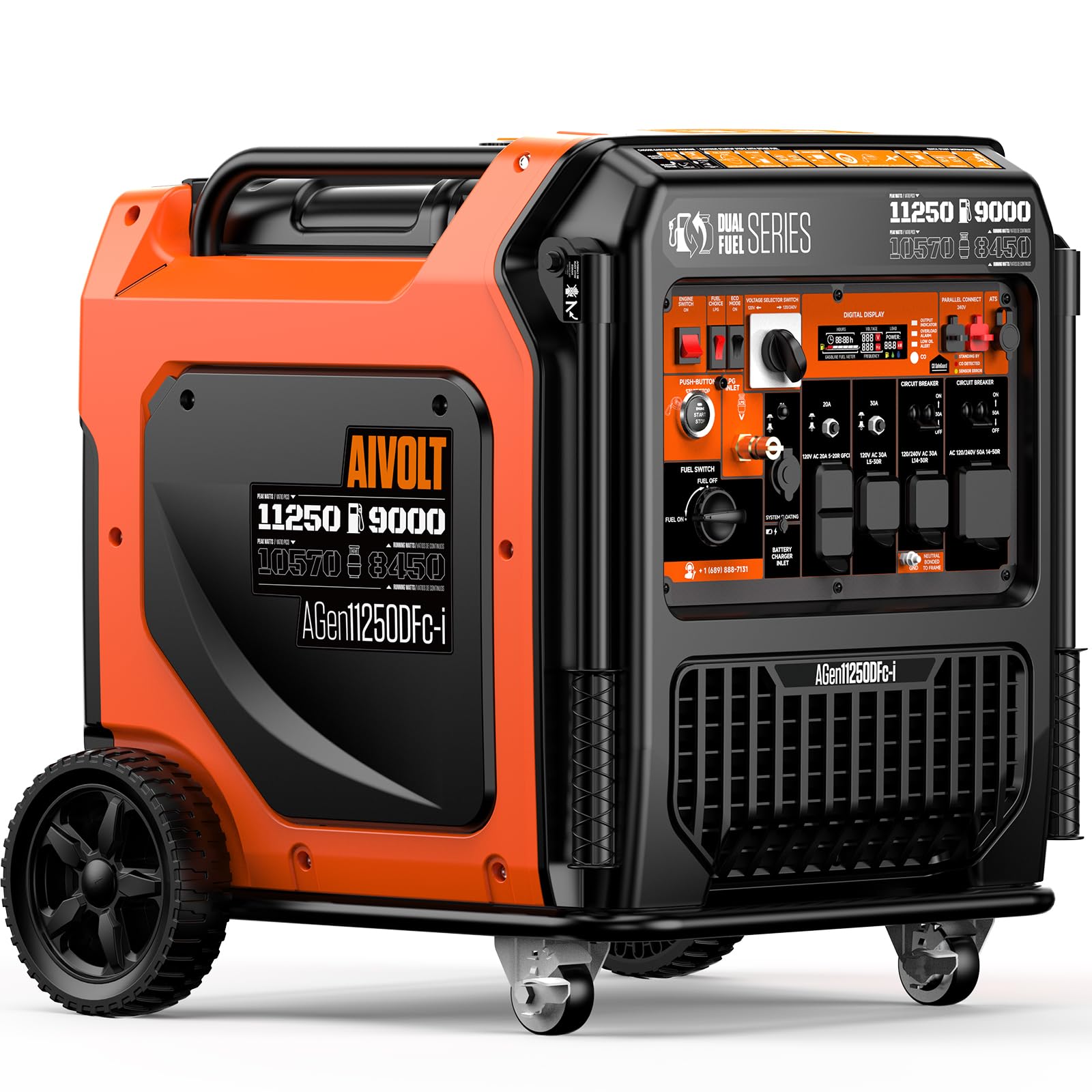
The AIVOLT VS12000411 is a dual-fuel inverter generator that punches above its weight class with 11,250 starting watts and 9,000 running watts on gasoline, and 10,570 starting / 8,540 running on propane. It features a 50-amp NEMA 14-50R outlet, making it fully compatible with RV shore power and home backup panels. The remote start, along with electric and recoil backup, gives you reliable starting options in any condition. Eco Mode adjusts engine speed to load, significantly reducing fuel consumption during lighter use.
At 62 dBA from 23 feet, it’s one of the quieter high-output inverters available—easily low enough for residential neighborhoods and overnight use. The fuel shutoff and low-oil protection are standard, and the CO Alert system adds a critical safety layer. The 5-in-1 LCD display shows voltage, frequency, runtime, load percentage, and fuel level. EPA and CARB compliance means it’s 50-state legal. Owners report that it handles a portable AC, refrigerator, and home electronics without a hiccup.
However, some buyers experienced failures within the first few hours, with customer support based overseas. A common theme is that the generator runs well initially but can enter a safety lockout if shut down while hot, requiring up to an hour to cool before restarting. The included accessories are generous, but reliability seems to vary by unit. For those willing to take a chance on a feature-packed inverter at this price, the AIVOLT offers tremendous value—but a 5-year warranty from a brand with US-based support may be worth considering for peace of mind.
Why it’s great
- High 9,000W running output with inverter clean power
- 62 dBA—very quiet for an 11kW generator
- 50A outlet and dual fuel built in
Good to know
- Reliability issues reported by some users
- Locks out if restarted while hot
- Customer support is overseas
6. Pulsar G12KBN-SG 12,000W Dual Fuel Generator

The Pulsar G12KBN-SG is a straightforward, no-frills dual-fuel generator that focuses on delivering high wattage at a budget-friendly price. Its 457cc OHV engine produces 12,000 peak watts and 9,500 running watts on gasoline, and 10,800 peak / 8,550 running on LPG. The 50-amp outlet is ready for direct home or RV connection, and the electric start with battery makes ignition simple. An 8-gallon fuel tank provides up to 12 hours of runtime at half load on gasoline.
The control panel includes four 120V 20A outlets, one 120/240V 30A twist-lock, the essential 50A outlet, and a 12V DC output. The powder-coated steel frame with included wheel kit makes it mobile despite the 214-pound weight. Owners report that it easily powers a 2,600-square-foot home including AC, well pump, and refrigerator, and that propane operation is smooth and reliable. The low-oil shutdown and CO protection add basic safety compliance.
Where it falls short is build quality consistency—some units arrived with dead batteries or minor issues from shipping, and warranty support can be slow. The engine is loud compared to inverter models, and cold-start performance can require priming or starting fluid in low temperatures. For the price, the Pulsar delivers impressive raw power and dual-fuel flexibility, making it a strong candidate for anyone on a tight budget who needs true 50-amp whole-home capability.
Why it’s great
- High 12,000W peak at a budget-friendly price
- 50A outlet and dual-fuel flexibility
- 12-hour runtime at half load
Good to know
- Loud—open-frame no inverter technology
- Occasional shipping damage and poor support
- Cold starts can be finicky without priming
7. AIVOLT 8,000W Dual Fuel Inverter Generator

The AIVOLT VS8000411 is a 322cc dual-fuel inverter generator that delivers 8,000 starting watts and 6,100 running watts on gasoline (slightly less on propane). It’s one of the lightest inverter generators in its class at 128 pounds, with a telescopic handle and 7-inch never-flat wheels that make it genuinely easy to roll over grass or gravel. The 50-amp industrial outlet is included alongside a 30A twist-lock and two 20A GFCI outlets, making it versatile for both home backup and RV use.
Noise levels are rated at 62 dBA from 23 feet, which is quiet enough for campsites and close neighbors. The 5-in-1 LCD shows voltage, frequency, runtime, fuel consumption, and load percentage—very helpful for load management. Eco Mode extends runtime past 10 hours at 25% load. The automatic fuel-switching technology lets you switch between gasoline and propane without any manual adjustments, a rare convenience at this price point. CO Alert and low-oil shutdown are standard safety features.
Some owners report a quirk where the generator must cool completely before restarting after a shutdown, or it enters a safety lockout that takes up to an hour to reset. A few units failed within the first few hours, and customer service is based overseas, which can complicate warranty claims. For the money, the AIVOLT offers an impressive inverter package with a 50A outlet and excellent portability—just be aware of the potential reliability curveball.
Why it’s great
- Lightest 50A inverter at 128 lbs with easy-roll wheels
- Automatic fuel switching between gas and propane
- 62 dBA—campsite-friendly noise level
Good to know
- Safety lockout can prevent hot restarts
- Inconsistent reliability across units
- Overseas customer support
8. Anker SOLIX F3800 Portable Power Station

The Anker SOLIX F3800 is a battery-powered power station that produces zero emissions and near-silent operation—a completely different approach to 50-amp home backup. With 3,840Wh of LiFePO4 battery capacity and a 6,000W AC output (120V/240V split-phase), it can run a well pump, refrigerator, lights, and even a window AC unit for a full day. The NEMA 14-50R port lets you plug directly into an RV inlet or a home transfer switch without any adapter.
The F3800 is expandable: you can add up to six extra battery packs for a total of 26.9kWh, or connect a second F3800 in parallel for 12,000W of output. It recharges from a standard wall outlet in under 2 hours, or via solar panels at up to 2,400W—though the MPPT is optimized for Anker’s own panels. The Anker app provides remote monitoring and control via Wi-Fi or Bluetooth. InfiniPower technology with EV-grade LFP batteries promises over a 10-year lifespan with daily use.
It also requires firmware updates for simultaneous AC and DC charging, and the 240V output is disabled while charging from a 120V outlet. For light whole-home backup, job sites requiring silent operation, or anyone who wants to avoid gasoline storage and engine maintenance, the Anker SOLIX F3800 is a forward-thinking alternative.
Why it’s great
- Zero emissions and near-silent operation
- 6,000W / 240V with 50A outlet
- Expandable up to 26.9kWh for longer runtime
Good to know
- High upfront cost for limited energy
- Cannot run central AC for extended periods
- 240V output disabled while charging from 120V
9. Champion 4,000-Watt Dual Fuel Inverter Generator

The Champion 201398 is a compact dual-fuel inverter generator that produces 4,000 starting watts and 3,000 running watts on gasoline (3,500 starting / 2,700 running on propane). It runs at just 64 dBA, which is quieter than a modern dishwasher, making it an excellent companion for RV trips, tailgating, or light home backup. The TT-30R outlet is perfect for RVs, while the 20A duplex outlet handles general appliances and electronics with its less than 3% THD clean power.
The CO Shield auto-shutdown system, Cold Start Technology, and a 149cc engine make it a reliable choice in any weather. Runtime extends to 10 hours on gasoline and up to 25 hours on a 20-pound propane tank at 25% load—a remarkable propane efficiency. The optional parallel kit lets you pair it with another Champion inverter to double your output. At 53 pounds, it’s easy to lift into a truck bed or carry to a campsite.
Some owners experienced defective units within the first few months, citing failed CO sensors or engine shutdown. Champion’s warranty support is available, but the process can involve long wait times. This generator lacks a 50-amp outlet—it’s designed for lighter loads, so you’ll need the parallel kit or a different model for whole-home 50A duty. For RV owners who want dual-fuel flexibility in a lightweight, quiet package, the Champion is a solid choice.
Why it’s great
- Ultra-light at 53 lbs—truly portable
- 64 dBA—quieter than a dishwasher
- 25-hour runtime on a 20-lb propane tank
Good to know
- No 50A outlet—not for whole-home backup
- Some units arrived with CO sensor issues
- Warranty process can be slow
10. WEN 4800W RV-Ready Inverter Generator

The WEN 56477i is a gasoline-powered inverter generator with a 224cc engine that produces 4,800 starting watts and 4,000 running watts. It features a TT-30R outlet for direct RV connection, along with four 20A household outlets, a 12V DC port, and dual USB ports. The CO Watchdog sensor and fuel shutoff are built-in safety features that protect both the user and the generator’s carburetor from stale fuel damage. At 72.7 pounds with a telescoping handle and onboard wheels, it’s easy to move around a garage or campsite.
This is an inverter generator, so it delivers clean power suitable for smartphones, laptops, and RV electronics. Owners report that it runs a refrigerator and a medium freezer without breaking a sweat, and that the fuel efficiency is excellent—lasting 8 hours per tank at moderate loads. The fully enclosed design keeps noise down to a reasonable level for neighborhood use, and the electric push-button start makes ignition effortless. The 3-year warranty provides solid long-term coverage.
The key limitation is the lack of a 50A outlet—this unit maxes out at 30 amps via the TT-30R, so it cannot power a 50A RV directly or connect to a whole-home transfer switch at full capacity. It also runs on gasoline only, so you lose the fuel flexibility of propane or natural gas. For RV owners with a 30A coach or for light home backup, the WEN 4800W is a reliable, portable inverter generator that punches above its weight.
Why it’s great
- Lightweight at 72.7 lbs with easy-roll wheels
- Inverter clean power for electronics
- CO Watchdog and fuel shutoff for safety
Good to know
- No 50A outlet—not for 50A systems
- Gasoline only—no dual fuel
- TT-30R maxes at 30 amps
11. WEN 3600W Dual Fuel Inverter Generator

The WEN DF360iX is a compact dual-fuel inverter generator that runs on gasoline (3,600 surge / 2,900 rated watts) or propane (3,500 surge / 2,600 rated watts). Despite the “3600W” in the name, it uses a 149cc engine and weighs just 49 pounds—the lightest generator on this list. It includes a TT-30R RV receptacle, two 20A 120V outlets, a 12V DC port, and dual USB ports. The CO Watchdog sensor and fuel shutoff are built in, and the tool-free LPG quick-connector makes propane setup effortless.
This generator is exceptionally quiet: according to the US Department of Health and Human Services, its noise level is comparable to a normal conversation. Clean inverter power protects your phone, laptop, and RV entertainment system. Owners report that it starts on the first or second pull, runs smoothly on propane for hours, and sips fuel efficiently. The hour meter and voltage display on the control panel help you manage loads precisely. The 3-year warranty adds peace of mind for a budget-friendly purchase.
This unit does not have a 50A outlet, so it cannot power a 50A RV or connect to a whole-home transfer switch at 50 amps. It’s best suited for tent camping, small RVs with 30A systems, or emergency essentials in an apartment. Some owners noted that the 20A outlets hold plugs loosely—standard for WEN but worth checking before use. For an entry-level dual-fuel inverter generator that’s truly portable, the WEN DF360iX is a strong value.
Why it’s great
- Ultra-light at 49 lbs—truly portable
- Dual-fuel (gas/propane) with tool-free LPG connector
- Conversation-level noise and clean inverter power
Good to know
- No 50A outlet—30A RV only
- Propane output drops to 2,600 rated watts
- Outlets may hold plugs loosely
FAQ
Can I connect a 50 amp generator directly to my home panel?
What is the difference between a 30 amp and a 50 amp generator for an RV?
How do I calculate the right generator size for my home?
Is natural gas or propane better for a 50 amp generator?
Why is an inverter generator quieter than an open-frame generator?
Final Thoughts: The Verdict
For most users, the 50 amp generator winner is the Champion Power Equipment 11,000‑Watt Inverter because it combines inverter‑grade clean power, wireless remote start, and a quiet 64 dBA footprint in a package that handles an entire home’s essential loads. If you want tri‑fuel flexibility and ultimate fuel security, grab the Westinghouse iGen8200TFc. And for maximum raw wattage where noise isn’t a concern, nothing beats the DuroMax XP13000HXT.