
Our readers keep the lights on and my morning glass full of iced black tea. As an Amazon Associate, I earn from qualifying purchases.
Specs are compiled from manufacturer listings and verified buyer reviews and can change over time — please confirm the key details on the product page before buying.
The cord behind your range is the one part of the install you never look at again — until the plug gets warm, the stove cuts out mid-bake, or you find out at the appliance store that your wall outlet has three slots and the cord in the box has four prongs. Get that match wrong and the range never comes on at all. Count the slots on your outlet before you buy. These 50-amp cords (the heavy-duty power cables rated for a full-size electric range) differ by prong count, length, and how they clamp onto your stove, so one check up front saves a second trip to the store.
I’m Min — the founder and writer behind Gadgets Feed. This guide is built by comparing the manufacturers’ published specifications and the patterns across verified customer reviews, so you get each pick’s real strengths and trade-offs instead of marketing spin.
Two things decide the whole purchase: the prong count on your wall outlet and the wire gauge the cord carries. Length and connector type come second. Below you’ll find the strongest 50 amp range cord options, matched to the outlet you actually have.
Our Picks at a Glance


How To Choose The Best 50 Amp Range Cord
Buy the cord that fits the outlet already in your wall. Matching the prong count to your outlet is what prevents returns. The stove end is flexible — most cords ship with either ring terminals or bare wires you clamp down yourself. The wall end is fixed by the outlet already in your wall.
Count the slots before you count anything else
Look at the outlet behind the range. Three slots means you need a 3-prong cord built for a NEMA 10-50 outlet (an older style plug still common in homes wired decades ago). Four slots means a 4-prong cord on a NEMA 14-50 outlet, which is what newer construction uses. A 3-prong cord will not plug into a 4-slot outlet, and the reverse is just as true.
Wire gauge is the safety number
A 50-amp cord carries serious current, so the copper inside has to be thick enough to move it without heating up. You will see gauge written as something like 6/2 and 8/1 — that means two 6-gauge wires and one 8-gauge wire. Lower numbers mean thicker copper. Stick to the gauge the cord is rated for and never swap in a thinner cord to save a few dollars.
Match the length to the room, not the box
A 4-foot cord suits a range pushed close to the wall. A 6-foot or 10-foot cord gives you room to pull the stove out for cleaning or slide it aside during a remodel. Too much slack is only a problem if it kinks, so measure the run from outlet to the terminal block before you order.
Flat plugs and strain relief save real installs
A flat plug lies against the wall instead of jutting out, which matters when a range sits in a tight alcove. Strain relief — a bracket that holds the cord where it enters the stove — keeps the weight of the cable off the terminal connections. Both decide whether the back of your range goes flush.
Quick Comparison
| Model | Best For | Prong Count | Length | Wire Gauge | Amazon |
|---|---|---|---|---|---|
| Supplying Demand 4 Foot 3 Prong 50 Amp Cord★ Best Overall | Older 3-slot outlets | 3 | 48 inches | 6/2 & 8/1 | Amazon |
| GoGreen Power GG-27206Longest Budget Reach | Long reach on a 4-wire outlet | 4 | 72 inches | 8 | Amazon |
| Southwire 9014SW8809Best on a Budget | Budget 3-prong replacement | 3 | 48 inches | 6/2-8/1 | Amazon |
| HiFind 4-Prong NEMA 14-50P | Outdoor and RV use | 4 | 4 feet | 6/2 + 8/2 AWG | Amazon |
| Iron Forge Cable 4 Prong | Tight spaces behind the range | 4 | 6 feet | 6/8 AWG STW | Amazon |
| GE WX09X10037 OEM | GE range owners | 4 | 48 inches | — | Amazon |
| Cable Matters 4 Prong to 4 Wire | Modern 4-slot kitchens | 4 | 48 inches | 6/8 AWG | Amazon |
| Certified Appliance Accessories 50-Amp 10 ft | Extra-long runs | 4 | 10 feet | 6 | Amazon |
In‑Depth Reviews
1. Supplying Demand 4 Foot Range Electrical Power Cord 3 Prong Wire 50 Amp 250 Volt
Our pick — 4.5+★ from 500+ verified ratings; the strongest balance of quality and price.
The three-slot fix that shows up with the strain relief already in the bag.
If your range outlet has three slots rather than four, this is the cord that ends the search. It is rated for 50 amps at 250 volts — the full load a standard electric range draws — and it is built on 6/2 and 8/1 gauge wire, meaning two thick 6-gauge conductors plus an 8-gauge ground. That is the heavy copper that keeps the cable cool under a full burner load, night after night.
what separates it from the Southwire 3-prong below is the little plastic bag in the box. Supplying Demand includes strain relief (a clamp that grips the cord where it enters the range), so the cord is properly held instead of hanging its own weight off the terminal screws. Buyers clearly reward that completeness — across 500+ ratings it holds 4.5+ stars, and quality is the trait that comes up most when owners describe it, with compatibility right behind. The 48 inches is a practical middle length too: enough slack to pull the stove out for a wipe-down, short enough not to coil up behind it.
The honest catch is that it is a 3-prong cord and nothing more. If your outlet is the newer four-slot type, this cord will physically not seat, and no adapter is a safe workaround. Also order the length deliberately — 48 inches is ideal for a kitchen wall but tight if your outlet sits far off to one side.
The case for it
- 6/2 and 8/1 gauge copper handles the full 50-amp, 250-volt load on a range
- Strain relief included, so the cord is supported at the range end
- Fits the older 3-slot NEMA 10-50 outlet still found in plenty of homes
- 48-inch length leaves slack for pulling the range out to clean
What to weigh first
- Won’t fit a modern 4-slot outlet, so check your wall plate before ordering
- Only one length offered here
Reach for it when: your outlet has three slots and your stove terminals use ring or clamp connections you want properly strain-relieved.
Look elsewhere if: the wall behind your range has four slots, which rules this cord out entirely.
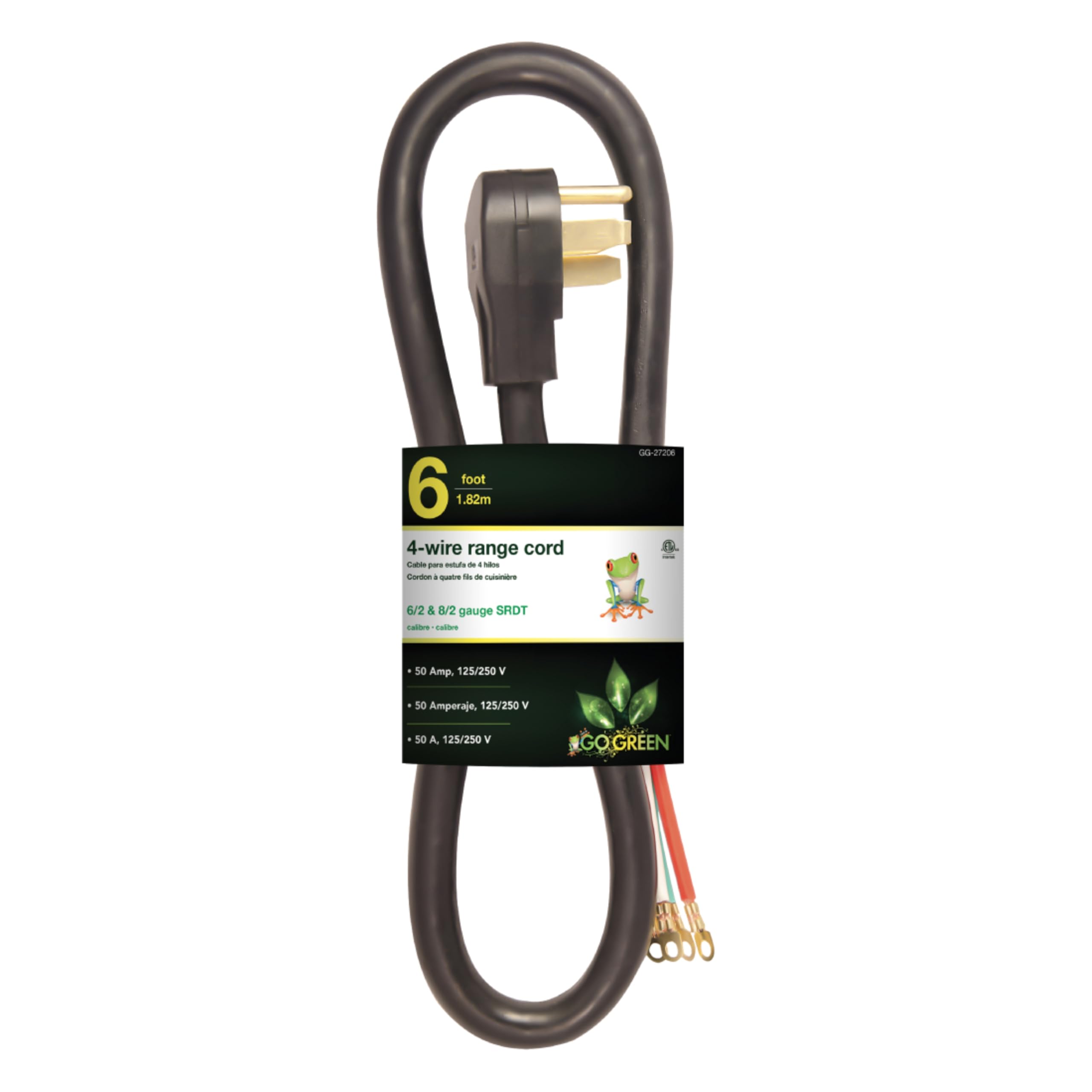
2. GoGreen Power (GG-27206) 6′ 4-Wire Range Cord, 50 Amp, 6 Ft.
Six feet of heavy 8-gauge cable for the range that sits far from the wall.
If your range sits at the end of a run, or your outlet is mounted off to one side of the stove rather than dead center, you get the slack you need: this cord runs 72 inches. Two extra feet means the cord reaches without stretching taut.
It is a 4-wire cord built on 8-gauge wire, rated 50 amps at 125/250 volts, and the maker positions it for heavy-duty equipment and kitchen ranges. Around 2 pounds of cable means it feels substantial without being a wrestling match behind the stove. The spec sheet is lean on extras, though — there is no mention of included strain relief or a flat plug, so plan on reusing the bracket from your old cord.
This is the buy when length is the deciding factor and you are comfortable installing a 4-prong cord yourself. The trade-off is that you are paying for cable length rather than accessories, so if you want the mounting hardware in the box, look at the Cable Matters pick further down instead.
Length first: a 72-inch run where most competitors stop at 48 inches, spelled out explicitly as 6 feet in the listing.
The plain-dollar read: bare-bones packaging and no listed strain relief, but the cable itself carries the full 50-amp, 125/250-volt rating.
Best fit: a kitchen where the outlet is offset or the range needs to pull out further than four feet allows.
Think twice if: you need the install hardware bundled, since this one is essentially the cord and nothing else.
3. Southwire 9014SW8809 Range Power Cord, 4-Foot, 3 Prong, 50 Amp
A plain, proven 3-prong workhorse that owners describe as easier than changing the outlet itself.
Southwire’s 4-foot cord is the value entry for three-slot kitchens, and it earns that spot on construction rather than extras. It is a 6/2-8/1 heavy-duty cord rated 50 amps at 125/250 volts, ending in a NEMA 10-50 plug — the standard three-prong range plug. The blades are reinforced to resist bending or breaking during the push into the outlet, and the cord carries a UL listing plus a limited lifetime warranty.
Owners gravitate to the value and the simplicity of the swap. Installation is the second-most-discussed strength in the reviews, and the recurring sentiment is that wiring the cord to the stove beats pulling the outlet apart any day of the week. The flat plug and 1/4-inch flanged terminals help it seat cleanly against the wall, and the molded connectors hold up to the heat and flex behind a range.
Here is the limit: it is a 3-prong, 4-foot cord, full stop. Four-slot outlets and long runs are simply outside what it does. If your setup is a standard older kitchen with the outlet directly behind the stove, though, this is the least fussy way to get the range powered and the kitchen back in order.
What owners keep coming back to: the value-per-dollar and the fact that fitting it is quicker than rewiring the wall outlet.
Set your expectation: 48 inches and three prongs only — a straightforward replacement, not an upgrade kit.
Go with this one if: your kitchen has the traditional 3-slot outlet and you want a UL-listed cord without paying for extras.
Not your cord if: the wall behind the range is a 4-slot NEMA 14-50 — move up to a four-prong model.
4. HiFind 4-Prong Replacement 50 Amp Range Power Cord 4 Ft, NEMA 14-50P

The one cord here built to shrug off rain, heat, and a generator sitting in the yard.
Most range cords are indoor parts. This one carries a temperature rating from -40°F to +140°F and a moisture-proof, high-temperature resistant jacket, so it suits an outdoor generator hookup or an RV pad as readily as a stove. It is ETL listed, runs 6/2 + 8/2 AWG wire, and handles 50 amps at 125/250 volts with a 12500W rating on the label. The NEMA 14-50P plug is the four-prong standard, and the wires are color-coded — black and red for hot, white for neutral, green for ground — which takes the guesswork out of the terminal block.
Build quality is what buyers talk about most with this cord, and the molded ring terminals back that up: they slip over the stove’s screws for a quick, secure clamp-down. The flat, right-angle connector lets the cable lie flush against a wall, which is a real advantage in a tight closet or a garage corner. HiFind also backs it with a 2-year refund-or-replace window, and offers the cord in lengths from 4 to 10 FT if this one is short for your run.
What you give up is compactness — a heavy-duty, weather-rated jacket is thicker and stiffer than a plain indoor cord, so routing it in a very tight cabinet takes a little patience. For a range in the kitchen it is more cord than you need, but for anything that lives outside, it is the clear choice on this list.
Where it shines
- Jacket rated from -40°F to +140°F for outdoor and generator duty
- Color-coded conductors make the terminal wiring straightforward
- Flat right-angle plug lies flush against the wall
- 2-year refund-or-replace coverage from the maker
Worth knowing
- Thicker, stiffer jacket is less forgiving in cramped spaces
- More cord than an indoor kitchen install calls for
Made for you if: the cord will live outdoors, feed a generator, or plug into an RV or EV setup rather than sit behind an indoor stove.
Overkill if: your range is inside and a plain 4-foot indoor cord would do the same job.
5. Iron Forge Cable 4 Prong Range Cord, 6 Ft – NEMA 14-50, Open End

A compact plug and six feet of cable for the range wedged into a narrow alcove.
When a range has to go flush, the plug is the problem — a bulky connector pushes the whole appliance out from the wall. Iron Forge solves that with a flat plug on this 4-prong cord, so the back of the stove can sit tight against the tile. It runs 6 feet of 6/8 AWG STW cable to a NEMA 14-50 plug, rated for 50 amps and meant for ranges and ovens. The 6-foot length versus the HiFind’s 4 feet gives you noticeably more working room at the terminal block.
The “open end” in the name means the stove side arrives as bare conductors you connect yourself, rather than finished ring terminals. That is normal for range cords and keeps the price down, but budget for a few minutes with a screwdriver and the range’s own installation instructions. It is an indoor-duty cord, so unlike the waterproof HiFind above, this one belongs in the kitchen and not on the patio.
Iron Forge is a U.S. veteran-owned business and says it stands behind its replacement cables. For a slide-in range in a tight slot, the combination of flat plug and six feet of cable is hard to argue with — just confirm the outlet is the four-prong NEMA 14-50 type before it ships.
Your pick if: the range needs to sit flush and you want six feet of cable to work with behind it.
skip it if: you would rather not wire bare conductors to the stove yourself or your cord needs to survive outdoors.
6. GE WX09X10037 Genuine OEM 4ft. Power Cord 50 AMP 4 Wire for GE Ranges
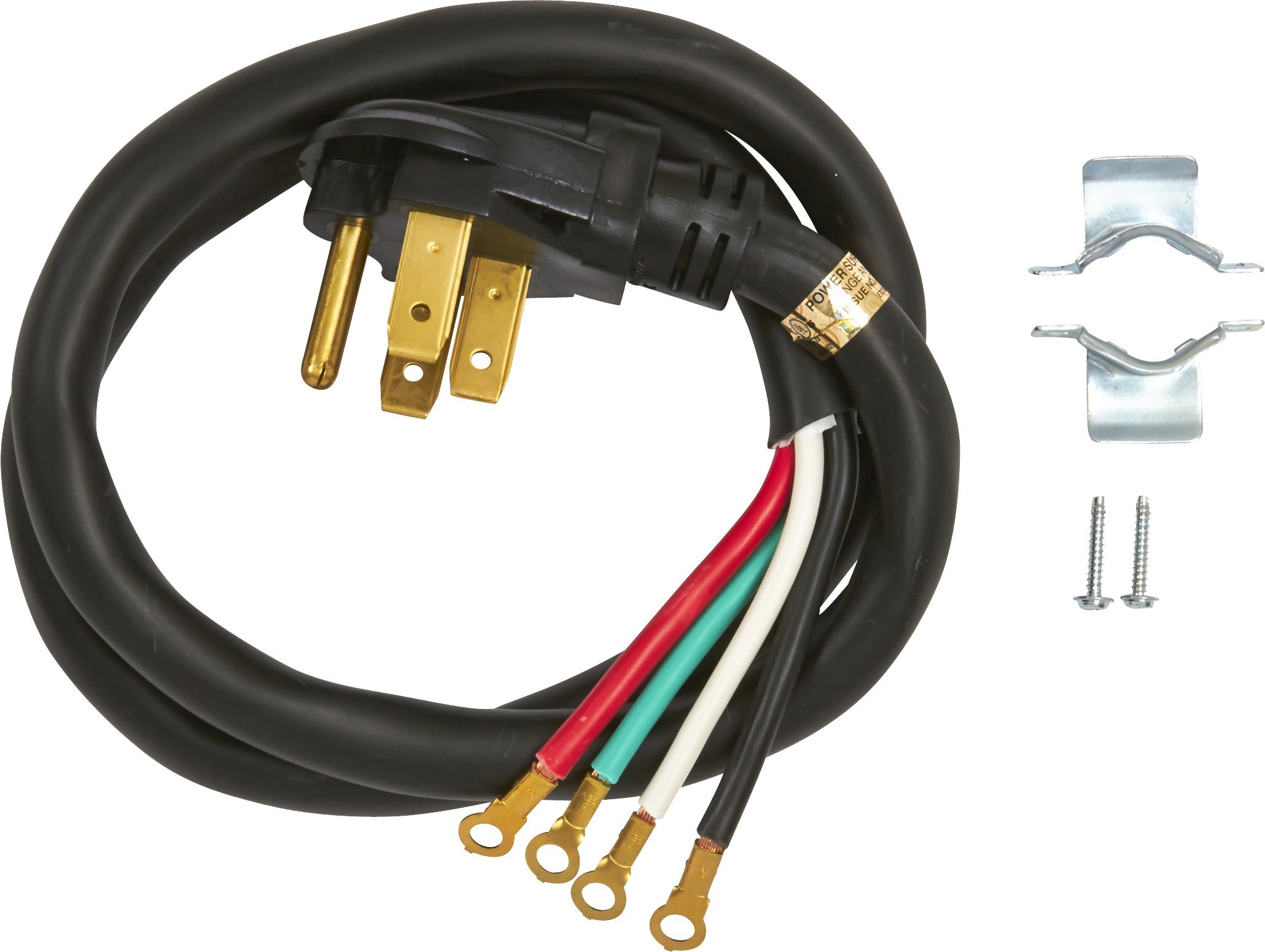
The factory part, for the buyer who wants their GE range matched screw-for-screw.
This is General Electric’s own cord — a 50-amp, 4-wire run at 4 feet, black, and made specifically for GE range models. If your stove is a GE and you want the part the manufacturer built for it rather than a universal fit, this is the box to reach for. The four conductors give you the modern configuration, so it plugs into a 4-slot outlet and gives the range a dedicated ground path.
What the crowds confirm is simple: it works. Functionality is the most-discussed trait here by a wide margin, and installation and value trail behind. Owners plug it into duty well beyond a stove, too — the cord sees use on Tesla chargers with the right adapter, which speaks to how standard the 4-wire layout really is.
There is one recurring note worth hearing: some ranges are a snug fit for this cord’s length and connector, and a handful of owners find the reach shorter than they hoped. Measure your outlet-to-terminal distance before you click buy. If you own a GE and the outlet is right behind the range, that concern mostly disappears.
The OEM advantage: built by GE for GE ranges, 50 amps, 4 conductors, in a light 1.5-pound package.
The one caveat: a few setups find the 4-foot length tight, so check the run to the terminal block first.
Ideal for: a GE range owner who wants the factory cord and has a four-slot outlet sitting close behind the stove.
Look past it if: you have a different brand or need more than four feet of slack behind the unit.
7. Cable Matters 4 Prong to 4 Wire Range Cord, 50 Amp, 6/8 AWG, 4ft
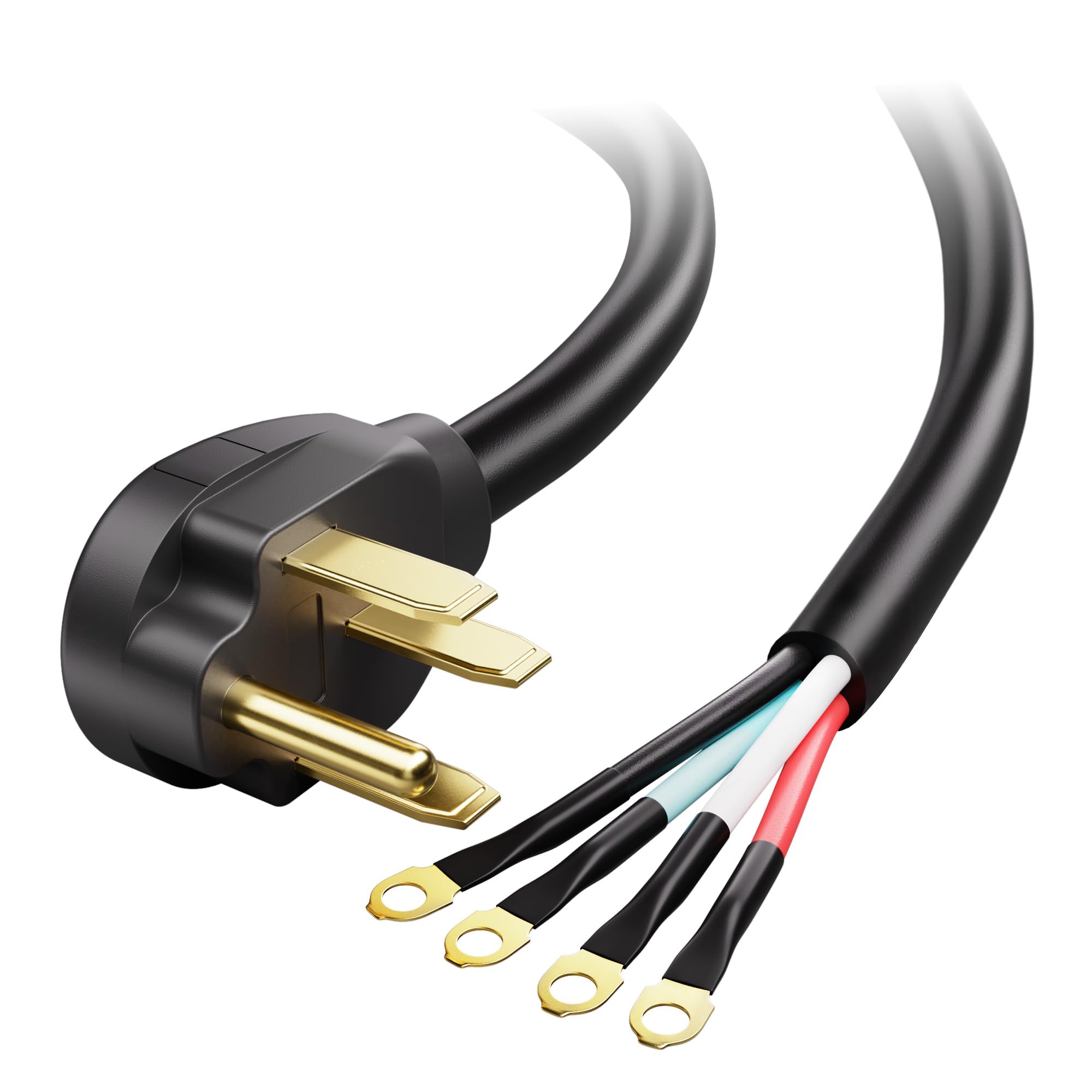
The four-slot cord that arrives with its own installation hardware and a UL listing.
For a modern kitchen with the standard four-slot outlet, this Cable Matters cord covers the bases cleanly. It is a NEMA 14-50 straight-blade plug mated to 4-wire cable built from two 6 AWG hot wires, an 8 AWG neutral, and an 8 AWG ground — thick copper sized for a 50-amp range. The SRDT jacket is rated up to 300V and 140°F (60°C), and the cord is UL listed. Note the plug type carefully: it does not fit an L14-30 twist-lock or a 3-prong 10-50 outlet.
What pushes it above the crowd is the included strain relief brackets, which carry the weight of the cord where it enters the range so the terminals aren’t doing that job. Ring terminals are on the stove end, so the connection is a matter of seating rings over the screws rather than threading bare wire. The two traits buyers appreciate most here are the value and the construction, with durability close behind — and the gauge is real, thick copper rather than nominal.
One honest note from the spec sheet: thickness is a mixed topic in the reviews, so if you are comparing it to an older cord remember this one carries serious 6-gauge copper and will feel heavier in hand. It is indoor/outdoor rated and fits ranges from GE, Whirlpool, KitchenAid, Samsung, Frigidaire, and Kenmore, which makes it the safe default when the outlet is the modern four-slot type.
Why it rises up the list
- Two 6 AWG hot wires plus 8 AWG neutral and ground for a full 50-amp range
- Strain relief brackets included to support the cord at the range end
- UL listed and jacketed for up to 300V and 140°F (60°C)
- Fits ranges from GE, Whirlpool, KitchenAid, Samsung, Frigidaire, and Kenmore
Read the fine print
- Not for L14-30 twist-lock or 3-prong 10-50 outlets
- Heavy 6-gauge copper makes it a substantial, less flexible cord
The right call when: your outlet is a modern four-slot NEMA 14-50 and you want quality hardware in the box.
Wrong turn if: you have a three-slot outlet or a twist-lock receptacle — this cord won’t seat.
8. 50-Amp Appliance Power Cord, 4 Prong Range Cord, 4 Wires with Eyelet Connectors, 10 Feet, Copper Wire

Ten feet of 6-gauge copper when the outlet is nowhere near the range.
Certified Appliance Accessories takes the long-run crown here: this is a 10-foot, 4-wire, 50-amp cord built on 6-gauge copper, and it ships with eyelet connectors on the stove end. Both of those details matter for a real install. The 10 feet versus the 4-foot cords gives you slack no other pick matches, so a range parked across the kitchen or a stove sitting off from a wall-mounted outlet still reaches. The eyelets let you seat the conductors over the stove’s screws and tighten down, no threading bare wire through cramped posts.
What owners praise most is the value and the way it simply works — the cord sees use connecting stoves and EVSE (electric-vehicle supply equipment, the charger box for an EV) to NEMA-14-50 outlets (the standard four-slot 240-volt outlet), and it handles a fifty-amp generator too, which tells you the copper and connectors are doing their job. The 4-wire configuration and 50-amp rating are standard, so it fits a modern four-slot outlet just like the Cable Matters above.
Installation is the mixed bag. Many people find it straightforward, but the four-prong plug end can take a little wrestling onto the terminal block if the range’s clearances are tight. That is a tight-clearance fit, not a defect. This is the cord to order when reach is the whole point of the purchase and you would rather have too much slack than too little.
Reach above all: 10 feet of 6-gauge, 4-wire cord with eyelet connectors, for the range that lives far from the wall.
Plan for it: the 4-prong plug end can demand some finesse to seat, so give yourself the time to do it right.
Buy it if: your outlet sits well away from the range and shorter cords simply won’t stretch.
Pass if: the outlet is directly behind the stove — a 4-foot cord is tidier and this much slack is unnecessary.
Understanding the Specs
Prong Count and the Outlet You Have
The prong count is the number of metal blades on the plug, and it has to match the slots in your wall outlet exactly. A 3-prong cord fits an older NEMA 10-50 outlet, which you’ll usually find in homes wired decades ago. A 4-prong cord fits the newer NEMA 14-50 outlet, common in recent construction. The 4-prong layout adds a dedicated ground wire, which is why modern ranges use it. Count the slots on the outlet before ordering and you’ll sidestep the most common return in this category.
Wire Gauge Explained in Plain Terms
Wire gauge is a number that describes how thick the copper conductors are — and here, lower numbers mean thicker wire. You’ll see it written like 6/2 and 8/1, which means two 6-gauge wires and one 8-gauge wire. A 50-amp range pulls a lot of current, so the gauge has to be heavy enough to carry it without the cord heating up. Never substitute a thinner cord to save money; the gauge is the safety margin built into the cable.
Cord Length and Usable Reach
Length is measured from plug to stove end, and it decides how far the range can sit from the wall. A 4-foot cord suits a stove pushed close to the outlet. A 6-foot or 10-foot cord gives you room to pull the appliance out for cleaning or to slide it around during a remodel. Measure the actual distance from the outlet to the range’s terminal block, then add a little for routing around corners and behind the unit.
Connector Ends and Strain Relief
On the stove side, cords end in either eyelet (ring) connectors or bare open wires you clamp down yourself. Eyelets are faster to seat over the terminal screws; open wires are standard and work fine with a screwdriver. Strain relief brackets hold the cord where it enters the range, so the cable’s weight doesn’t pull on the connections — look for cords that include them if you want a sturdier install.
FAQ
How do I know if I need a 3-prong or 4-prong range cord?
Can I use a 4-prong cord on a 3-slot outlet?
What does 6/2 and 8/1 wire gauge mean on a range cord?
How long a range cord do I need?
Is a 50-amp range cord different from a 40-amp cord?
Do range cords come with strain relief and connectors?
Can a 50-amp range cord be used outdoors or with a generator?
What is an open-end range cord?
Are these 50-amp cords safe to install myself?
Will a range cord fit my stove brand?
Final Thoughts: The Verdict
For most three-slot kitchens, the 50 amp range cord winner is the Supplying Demand 4 Foot 3 Prong Cord because it pairs full 50-amp, 250-volt 6/2 and 8/1 gauge copper (the wire thicknesses that carry the full load) with strain relief in the box — a complete install for an older outlet. If you have the modern four-slot outlet and want the best hardware on the bench, reach for the Cable Matters 4 Prong Cord, with its two 6 AWG hot wires (the two live conductors, at 6-gauge thickness) and included strain relief brackets. And for a range that sits far from the wall, the Certified Appliance Accessories 10-Foot Cord is the one to order. Whichever you pick, confirm the prong count on your outlet first — that single check is what separates a done install from a second trip to the store.
How We Picked
We do not accept paid placement. Every pick is matched to a real buyer and a real use-case; we do not hands-on test units.
Sources & Methodology
Specifications: manufacturer listings and product documentation. Review insights: verified customer reviews, as of November 2026. Pricing: not shown on this page (it changes often); check the current price via the retailer link.
As an Amazon Associate, Gadgets Feed earns from qualifying purchases. This does not affect which products we feature.