
Our readers keep the lights on and my morning glass full of iced black tea. As an Amazon Associate, I earn from qualifying purchases.
Specs are compiled from manufacturer listings and verified buyer reviews and can change over time — please confirm the key details on the product page before buying.
The $50 chef knife aisle is crowded with blades that look gorgeous in photos but dull after a week of home cooking. You want one knife that glides through a butternut squash, handles a weeknight onion marathon, and keeps its edge without a constant sharpening ritual — and you want it without paying boutique prices. This guide sorts through the real trade-offs — blade steel, handle comfort, weight, and how the grind actually behaves on food — so you pick the right workhorse, not just a pretty handle.
I’m Min — the founder and writer behind Gadgets Feed. This guide is built by comparing the manufacturers’ published specifications and the patterns across verified customer reviews, so you get each pick’s real strengths and trade-offs instead of marketing spin.
You want a knife that feels professional while staying affordable. Here is the honest breakdown of the $50 chef knife that truly earns its place on your cutting board.
Our Picks at a Glance

How To Choose The Best $50 Chef Knife
Before you buy, you need to match the blade’s personality to your cooking style. Here’s what actually separates a knife you’ll reach for daily from one you’ll resent.
Blade Steel & Hardness: The Key to Edge Retention
Steel quality is the #1 factor in how long your knife stays sharp. Look for high-carbon stainless steel — it resists stains better than plain carbon steel while holding an edge longer than cheap stainless. Hardness is measured on the Rockwell scale (HRC); most good knives sit between 55 and 60 HRC. A higher HRC means the edge holds longer, but it’s also harder to re-sharpen by hand. German-style steels (like 1.4116) tend to be softer, more forgiving, and easier to hone, while Japanese-style steels (like VG-10 or 440C) run harder and keep that razor edge for longer stretches between touch-ups.
Handle & Grip: Where Fatigue Shows Up
An 8-inch knife is an extension of your hand — comfort matters more than the specs suggest. You’ll grip it for 30-plus minutes at a time, so look for a textured, non-slip material. TPE (a soft rubber-like plastic) and Santoprene are forgiving and grippy when wet; Pakkawood (resin-stabilized wood) feels warm and premium but can get slick with oily hands. Try to match the handle shape to your grip: a curved, ergonomic handle reduces wrist strain, while a smooth one might cause your hand to slide forward toward the blade when you’re chopping fast.
Weight & Balance: Heft Isn’t Everything
The knife should feel planted and stable, not heavy and clumsy. A heavier blade (around 8-12 ounces) does more of the work for you — great for dense squash and root veg — but can fatigue a home cook. A lighter knife (4-6 ounces) is nimble and quick for delicate work but requires more downward force on hard food. The ideal weight depends on your hand strength and whether you prefer a “rocking” motion for herbs or a “push-cut” style for meat. Balance matters too: you want the weight distributed evenly, so the knife doesn’t tip forward or feel handle-heavy.
Blade Design: It’s Not Just About Sharpness
A sharp edge is useless if food sticks to the blade. That’s where design details come in. A “hollow-ground” blade — one with shallow divots or a wide concave grind — reduces friction so sliced potatoes and cheese release cleanly instead of clinging. Damascus steel blades feature a pattern that also helps reduce sticking while looking stunning. The bevel angle (usually 12-15 degrees per side) determines how thin the edge is: steeper angles mean a sharper cut but a more delicate edge that chips easily if you hit bones or frozen food.
Construction Type: Stamped vs. Forged
You don’t need to overthink this. Stamped blades are cut from a sheet of steel, making them lighter, thinner, and usually cheaper — perfect for a first knife. Forged blades are heated and hammered into shape, making them heavier and more sturdy; they typically feature a full tang (the metal extends through the handle) for extra strength and balance. For an under-$50 knife, the construction type matters less than how well the edge is ground and how comfortable the handle is — a quality stamped knife from a respected brand can outperform a poorly-finished forged blade.
Quick Comparison
| Model | Best For | Blade Steel | Weight | Handle | Amazon |
|---|---|---|---|---|---|
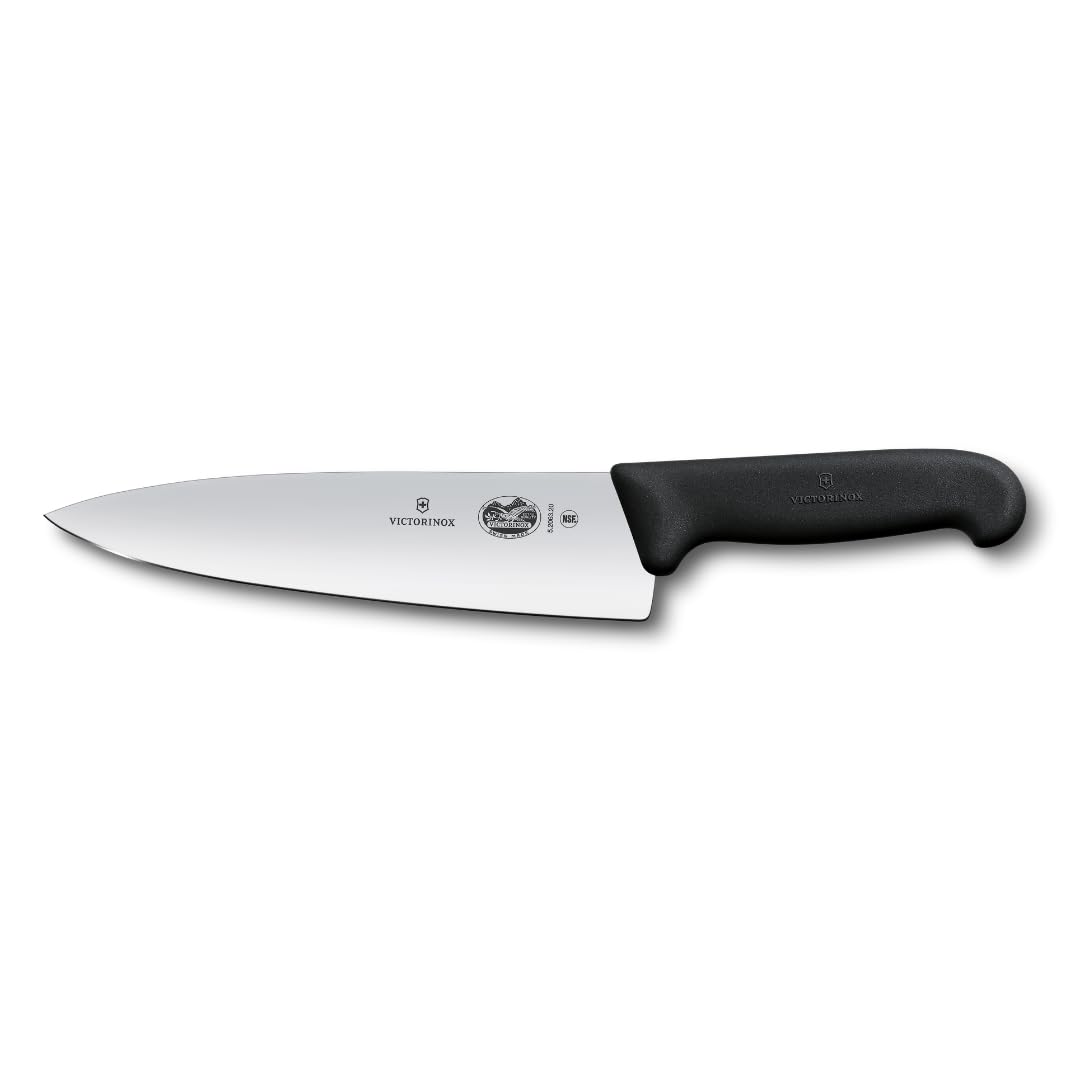
| Victorinox Fibrox Pro★ Best Overall | Reliable Daily Workhorse | Stainless Steel | 22.68 g | Fibrox (TPE) | Amazon |
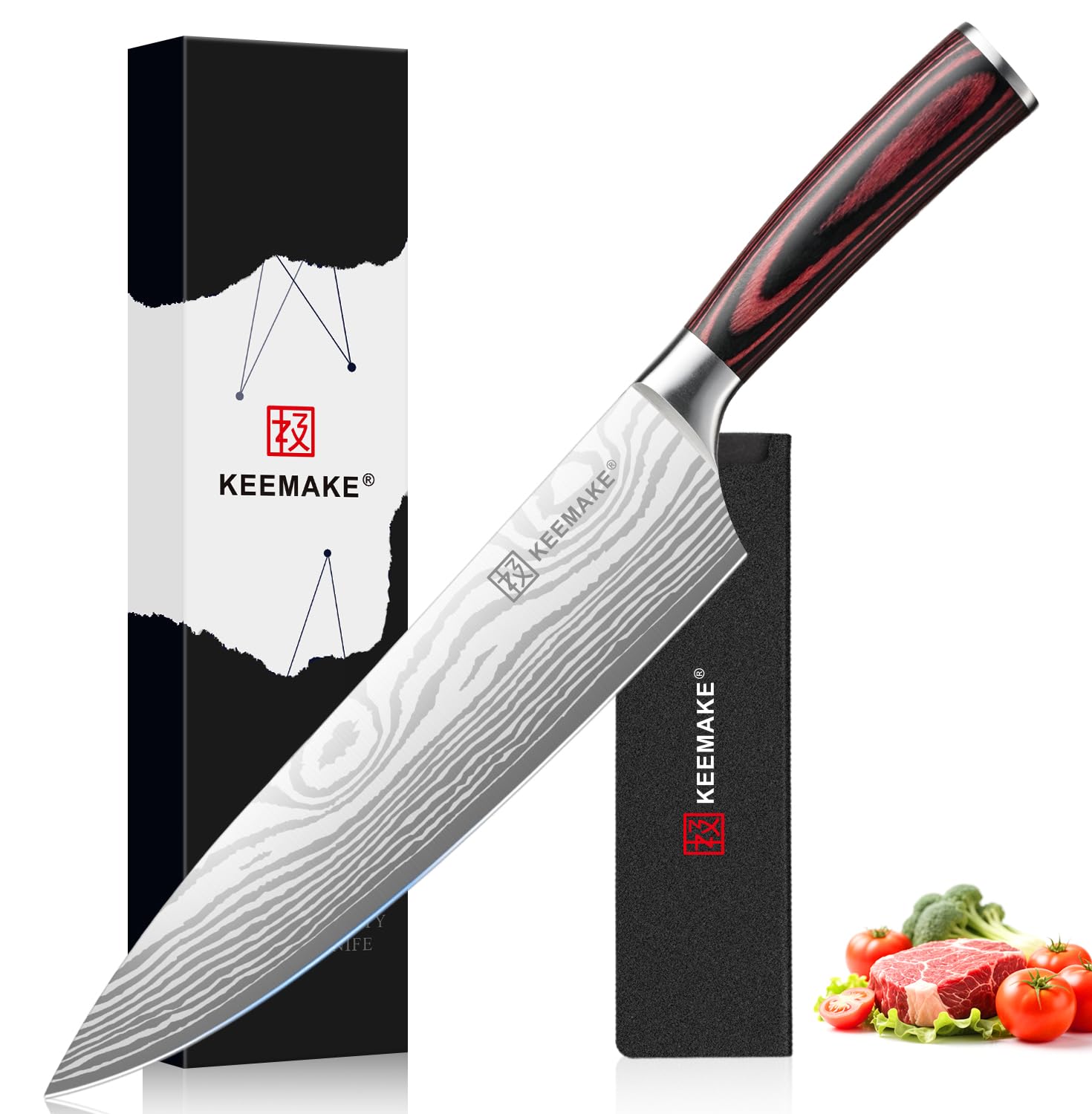
| KEEMAKE 8″ (Pakkawood)Best Value Forged | Sharp, Gift-Ready Value | 1.4116 High Carbon | 8.48 oz | Pakkawood | Amazon |
| Mercer MillenniaBest Heavy Chopper | Heavy-Duty Chopping | High-Carbon Japanese | 4.64 oz | Santoprene | Amazon |
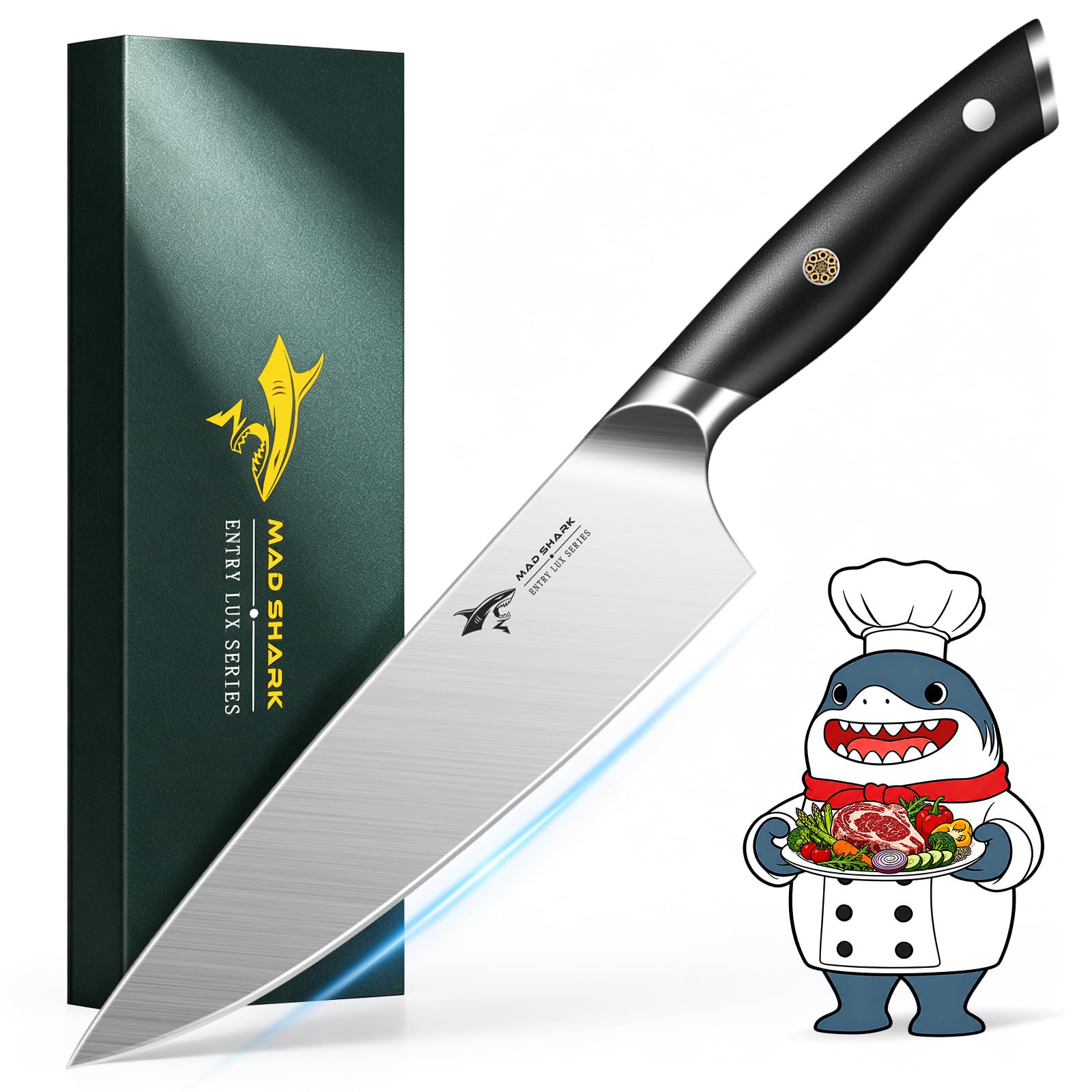
| MAD SHARK 8″ | Tall Blade & All-Purpose | German 1.4116 | 8.16 oz | ABS (Textured) | Amazon |
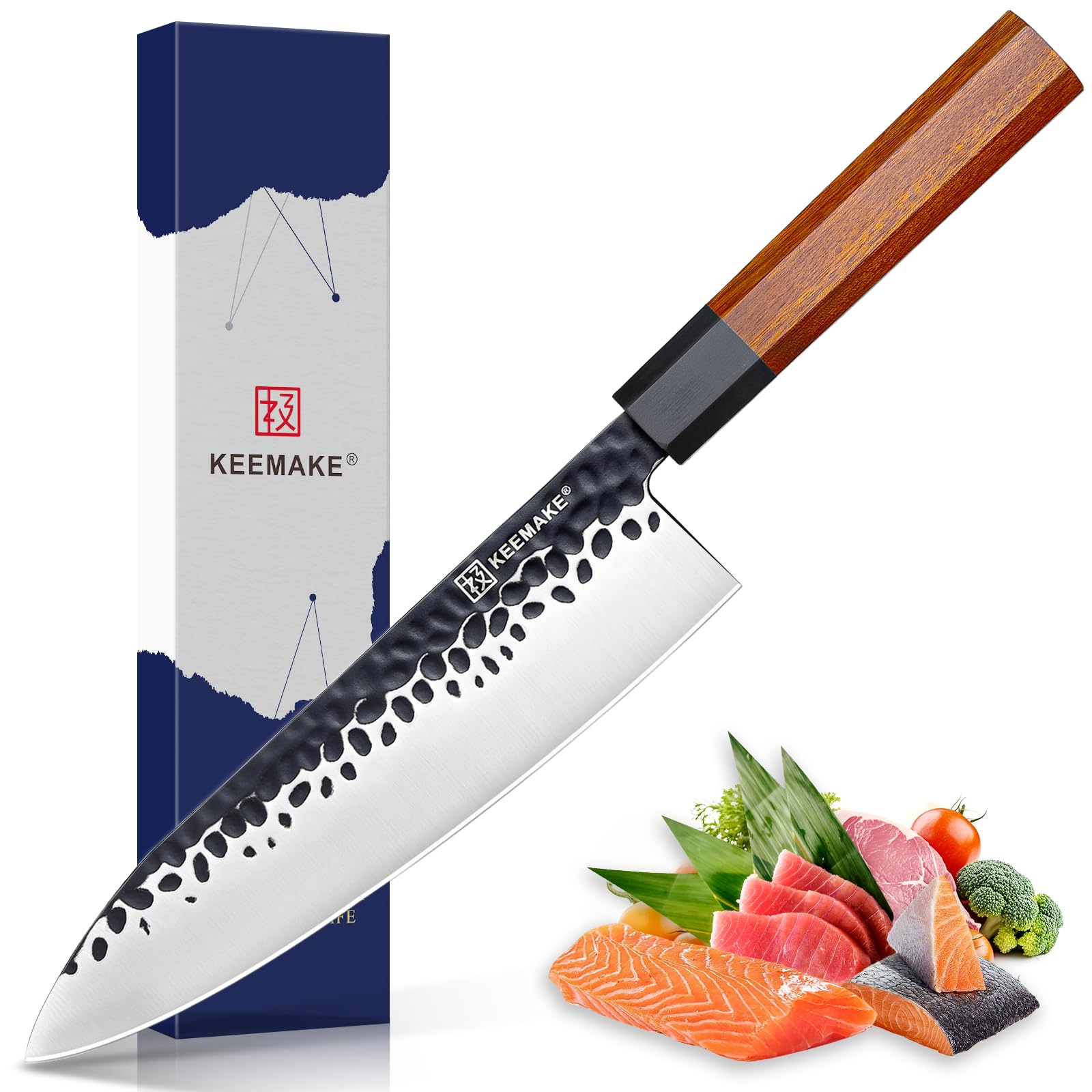
| KEEMAKE Japanese Forged | Rocking Cuts & Artisan Look | 440C High Carbon | 12.32 oz | Rosewood | Amazon |
| SHAN ZU Genbu | Lightweight Japanese Precision | Japanese Super Steel | 6.72 oz | Stainless Steel | Amazon |
| Dexter-Russell S145-10PCP | Professional-Grade Simplicity | High-Carbon Stainless | 7.2 oz | Polypropylene (White) | Amazon |
| LEVINCHY Damascus | Showpiece Sharpness | 73-Layer Damascus | 7.84 oz | Pakkawood | Amazon |
| KYOKU Shogun Series | Pro-Level VG-10 Edge | 67-Layer VG-10 | 0.4 kg | G10 Handle | Amazon |
In‑Depth Reviews
1. Victorinox Fibrox Pro 8 Inch Chef’s Knife
Our pick — over 4.5★ from 14,500+ verified ratings; the strongest balance of quality and price.
The ultimate no-drama choice when you want sharpness and comfort without overthinking.
Consistency wins here. This blade is a stamped stainless steel design with a tapered edge that cuts with ease, but the real star is that ergonomic TPE handle (a soft, non-slip rubber-like material). Even when your hands are soapy or greasy, it stays locked in your grip — a point owners praise over and over.
Performance is easy across the board. It slices through sweet potatoes with relative ease and handles meat like butter, and at a featherlight 22.68 grams (a fraction of the heft of the forged blades on this list), it prevents hand fatigue during marathon preps. It’s also dishwasher safe, meaning cleanup is a non-event after a big cook.
Buyers consistently note it’s an 8-inch blade (13.4 inches overall) that feels natural in hand, with a handle that doesn’t slip. Reviews note it cuts tomatoes, cucumbers, and carrots with minimal pressure, and the quality is a recurring theme — over 2,900 owners single out build quality as its top strength, with sharpness close behind.
Why It’s a No-Brainer
- Non-slip grip works when soapy or greasy
- Lightweight design cuts down on hand fatigue
- Dishwasher safe for easy cleanup
- Quality and sharpness are its most-praised traits
Who Might Skip It
- Stamped construction means it lacks the heft of forged knives
- Blade is thinner — not ideal for heavy cleaving
Reach for this if: you want a reliable, comfortable, sharp blade for daily cooking and cleaning with zero fuss.
Look elsewhere if: you crave the heavy, authoritative feel of a forged German blade for heavy-duty chopping.
2. KEEMAKE 8″ Chef Knife with Ergonomic Handle
A budget-friendly blade that punches far above its weight class, sharpened to a surgical 8°–12° edge.
Here’s a forged knife that thinks it’s premium. The 1.4116 high-carbon stainless steel blade hits a hardness of 58±2 HRC (Rockwell scale), which means it holds its edge through a week of family meal prep without you stopping mid-task to sharpen. It’s rust-resistant and built to handle dense squash, chicken breakdowns, and even pineapple rinds.
Handling is a joy. The curved Pakkawood handle (resin-stabilized wood) features a sloped bolster and a secure pinch grip that reduces wrist strain during long sessions. At 8.48 ounces, it gives you heft without being exhausting — a nice middle ground between the ultra-light Victorinox above and the heavier KEEMAKE forged below.
Owners talk about this knife as a steal, with one noting they saw a comparable model for at Williams & Sonoma. Sharpness and quality are the most frequently mentioned strengths — over 60 buyers call out the build quality and over 55 praise how sharp it is from the start. It arrives in an elegant gift box with a protective sheath, a detail gifting cooks appreciate.
Real-World Sharpness: It glides through ripe tomatoes without crushing them and slices through partially frozen meat — tasks that make lesser knives work hard.
The Verdict: Forged performance and premium looks at a price that makes it a top-tier value pick.
3. Mercer Culinary M18000 Millennia 8-Inch Chef’s Knife
The line cook’s secret weapon, combining formidable weight with a razor edge that stands up to abuse.
You get extra breathing room on the cutting board with this blade. While it’s listed at just 4.64 ounces in the specs — notably lighter than the KEEMAKE 8.48 ounces above — owners consistently describe it as feeling heavy and powerful in hand, a misconception born from its wide, hollow-ground blade design. The wide profile excels at chopping and helps you scoop ingredients efficiently.
The high-carbon, stain-resistant Japanese steel is one piece from tip to handle, which means easy blade maintenance and rapid sharpening back to a razor edge. The Santoprene (a springy, rubber-like) handle combines with polypropylene for durability, and textured finger points provide slip resistance — a feature a line cook called out as a utilitarian wet grip that works.
This is a knife that invites heavy use. Buyers describe gliding through garlic easily and using it as their favorite kitchen tool. Quality and sharpness are the most-praised aspects, and the versatility shows up in reviews for chopping vegetables and cheese. One buyer even compared it — and preferred it — beating a Victorinox for their needs due to the extra weight and cutting power of the wide, hollow-ground blade (a design that prevents food from sticking).
It’s a workhorse, not a showpiece: the molded plastic finger guard is “ugly,” but that’s a minor aesthetic price for a blade this effective.
Best for: cooks who prefer a heavier, more powerful blade for hard vegetables and large items, and who want an easy-to-maintain edge.
Not for: those seeking a lightweight, elegant knife for delicate precision cuts — that’s the Japanese-style blade’s job.
4. MAD SHARK 8-Inch Chef Knife
A hefty, capable blade with a generous 53mm height that makes quick work of big prep batches.
Space to chop is the defining trait here. The 53mm-tall blade gives you a spacious cutting surface, which boosts efficiency when you’re dicing a pile of onions or slicing a roasted turkey. It’s precision-crafted from German 1.4116 high-carbon stainless steel, hand-sharpened to a 15° edge per side with a hardness of 57±1 HRC — a configuration that balances sharpness and durability so you’re not constantly reaching for a sharpener.
This knife brings real physical presence. At 8.16 ounces, it’s noticeably heavier than the featherweight Victorinox and Mercer picks, but that mass translates to power. The full-tang construction — where the steel runs through the entire handle — provides the strength for when you need to bear down on ribeye or dense potatoes. The textured, non-slip ABS (acrylonitrile butadiene styrene, a sturdy plastic) handle stays secure even with wet or oily hands.
The value story resonates with owners — one confidently stated it beats a Henckel costing twice as much in a direct comparison, and the general consensus is that the quality and sharpness hold up after many uses. While it doesn’t include a sheath (you’ll need a drawer block or guard), it does come in gift-ready packaging with a microfiber cloth for easy upkeep.
What Wins Owners Over
- Tall blade makes chopping high-volume prep faster
- Full-tang build gives strength and balanced feel
- Stays sharp after many uses — praise-worthy performance
- Textured grip stays secure when wet or oily
Know Before You Buy
- Stains can develop and sticky vegetables (tomato, onion) cling to it after washing
- No sheath included — needs a storage block or guard
Pick it for: all-purpose home cooking where you want a wide blade and authoritative heft without spending premium money.
Choose something else if: you hate hand-washing blades or need a knife that releases sticky, juicy produce without clinging.
5. KEEMAKE 8 Inch Japanese Hand Forged Chef Knife
A dramatic hand-hammered blade that makes slicing feel ceremonial, backed by real cutting authority.
This knife is a piece of craft. It’s forged from high-carbon 440C steel and features a striking 5-layer pattern, hand-forged using traditional techniques that include a 60-day process with precise quenching and nitrogen vacuum cryogenic tempering. The result is a Rockwell Hardness of HRC 58, delivering a blade that resists corrosion and holds a razor edge.
The hand-sanded edge is angled at a sharp 12-15 degrees per side, making quick work of tomato skins and dense vegetables without crushing their interior. Like most of the Japanese-style blades on this list, it preserves food’s natural juices, leading to a noticeably cleaner cut. The 2.3mm-thick, 8-inch blade features a unique hand-hammered tsuchime texture that helps prevent food from sticking.
Comfort and weight surprise here. The moisture-resistant rosewood handle is shaped as an octagon — designed to fit naturally in both right and left hands — and at 12.32 ounces, this is the heaviest knife on our list. That heft comes through as raw cutting power, not fatigue, thanks to the ergonomic contours. Owners rave about its performance, with one sushi chef noting it’s a fun knife for work and another famously declaring it the best knife they’ve ever used after realizing how dull their old knives were.
Sharpness Reality: It arrives razor-sharp from the start, ready for detailed work. Owners note it will need whetstone sharpening about every other week to a month with regular use — that’s the honest upkeep of a 58 HRC blade.
Bottom Line: A gorgeous, high-performing gyuto-style knife that brings artisan flair to the kitchen at a mid-range price.
6. SHAN ZU 8 inch Japanese Chef Knife (Black Tortoise Genbu)

A serious Japanese blade that feels featherlight in hand while cutting through carrots like butter.
This is for the cook who prefers speed and precision over brute force. Constructed from genuine Japanese steel forged by the traditional 3-step Honbazuke method, this blade’s carbon content and durability are considerably higher than standard stainless steel. At just 6.72 ounces, it’s one of the lighter options here — noticeably lighter than the 8.48-ounce KEEMAKE Pakkawood knife — making quick, repetitive cuts easy.
That lightness pairs with genuine sharpness. The 32-step manufacturing process, including a hand-sharpened edge, gives it the kind of edge that makes owners marvel — one happy cook noted it “cuts carrots as if they were butter.” The K133 handle is ergonomically designed for a comfortable grip, and the Black Tortoise Genbu design (named after one of the four guardian spirits in Japanese mythology) brings an aesthetic that makes it feel special every time you reach for it.
The value proposition is strong, and owners consistently highlight blade quality and sharpness as the top reasons to buy. Many say it’s perfect from the start, with good balance and surprising performance for the price. The clean, lightweight profile makes it a favorite for home cooks who value control over power.
What You Should Know: The razor edge extends all the way to the rear of the blade with no guard — you’ll need to keep a firm grip and be mindful of the sharp heel.
Ideal Owner: This suits someone who wants a light, sharp, visually striking Japanese knife for precise slicing and dicing without feeling the knife’s weight in their hand.
7. Dexter-Russell 8″ Chef’s Knife (SANI-SAFE Series)
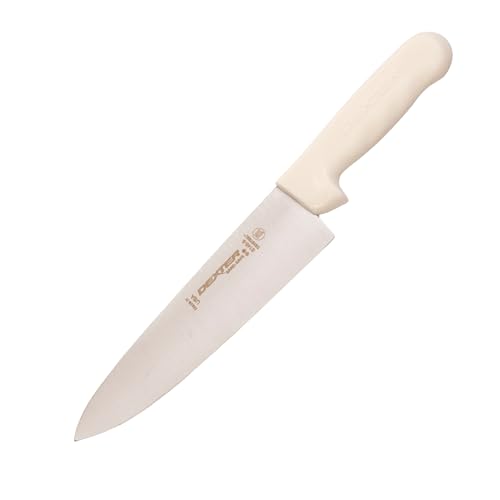
The durable, no-nonsense USA-made blade that restaurant kitchens have trusted for generations.
Simplicity and reliability are this knife’s superpowers. It’s NSF Certified — meaning it meets professional sanitation standards — and proudly manufactured in the USA. The high-carbon stainless steel blade is individually ground and honed, delivering a razor edge that one former restaurant worker says simply “never got dull” through years of professional abuse.
The design prioritizes comfort and control. The curved blade shape enables efficient rocking cuts from tip to choil, perfect for herbs and mincing. The textured, slip-resistant white polypropylene handle ensures a secure, fatigue-free grip even with wet hands — a critical feature for long services. At a balanced 7.2 ounces, the weight is distributed evenly between blade and handle, giving you control without tiring your wrist.
Owners consistently highlight the knife’s sharpness and how easy it is to maintain over time. Its impressive sharpness comes from a thin blade — described by one enthusiast as “razor-sharp,” able to slice rib bones easily. It’s a favorite starter knife for aspiring home chefs and a dependable upgrade for pros. It offers professional reliability at a price that makes it disposable enough to use hard without worry.
Built for Dependability
- Holds an edge through heavy daily use
- Professional sanitation-grade build (NSF certified)
- Evenly distributed weight for control
- Slip-resistant grip effective when wet
Honest Trade-Offs
- Handle is a hard plastic that feels less plush than rubber alternatives
- Thin, exceptionally sharp blade can be dangerous if mishandled — not a family-friendly beater
Grab this if: you cook a lot, want a knife that takes abuse, and like the idea of a utilitarian workhorse that sanitizes easily.
Pass if: you want a softer-touch ergonomic handle or need a knife safe for casual, less-experienced hands.
8. LEVINCHY Damascus Professional Chef’s Knife

A lightsaber-sharp blade wrapped in artisan Damascus aesthetics that makes every meal feel like a masterclass.
This knife is as much a work of art as it is a tool. The high-quality 73-layer Damascus steel is hand-finished with a mirror polish at an acute 8-12 degrees per side, giving it an edge owners describe as “cutting through meat and veggies like a lightsaber.” The Rockwell hardness rating of HRC 60±2 (a scale measuring steel hardness) means exceptional edge retention — this blade holds its sharpness for a long lifetime, minimizing the need for frequent honing.
The performance matches the looks. The razor-sharp forged edge meets all the requirements of a professional chef, easily handling daily kitchen tasks — chopping, slicing meat, fish, bread, and vegetables. The ergonomic Pakkawood handle is comfortable and doesn’t slip easily, ensuring you won’t feel tired or uncomfortable even during extended use, regardless of your hand size or which hand you use.
Owners are consistently impressed, with many comparing it favorably to premium German brands like Henkel and Zwilling in comfort, craftsmanship, sharpness, and edge retention. The quality and sharpness shine through in hundreds of reviews, though some buyers report the Damascus pattern is aesthetic rather than the folded-steel process of traditional Japanese smiths. A couple of owners mention you’ll need sharpening skill to keep the thin edge at its best over time.
A Cut Above
- Razor-sharp 8-12° edge glides through everything
- 73-layer Damascus steel is corrosion and stain resistant
- Comfortable Pakkawood handle for extended prep
- Comes in a high-quality black gift box
Who Should Think Twice
- Some owners note it’s not authentic laminated Damascus steel — it’s a patterned look
- Thin blade loses its edge faster than some rivals and needs skilled sharpening
Reach for this if: you want a stunning, high-performance blade that does the job brilliantly and looks gorgeous doing it.
Look elsewhere if: authenticity of the Damascus forging process matters to you, or you prefer a thicker blade that forgives a less careful touch.
9. KYOKU Chef Knife Shogun Series VG10 Core

The pro-grade VG-10 blade that stays razor-sharp for months, wrapped in a handle built for heavy shifts.
This is the upgrade for serious cooks. The 8″ blade is forged from high-end Japanese 67-layer Damascus VG-10 steel — a premium alloy known for outstanding edge retention and corrosion resistance — and it’s cryogenically treated to boost durability. Sharpened to an 8 to 12 degree edge using the traditional 3-step Honbazuke method, it delivers precise cuts through meat, fish, fruit, and vegetables with negligible resistance. The 58-60 HRC hardness keeps the edge sharp for months between sharpenings, as some owners mention.
Comfort and durability go hand-in-hand here. The fiberglass-based G10 handle features a signature mosaic pin and is built to withstand cold, heat, corrosion, and moisture. It’s ergonomically designed to distribute weight perfectly for balanced work, preventing fatigue and cramping even in professional settings requiring heavy use. Weighing in at 0.4 kg (about 14 ounces), it has a stout, quality feel — though this is a heavier knife, suited for cooks who like presence in their hand.
Owners frequently call this their all-time favorite knife, noting it’s a “big upgrade” from previous blades. It cuts through onions and tomatoes with ease, keeping the juices where they belong. The included sheath and case let you protect and store the blade safely, and the performance has earned it high praise since it’s a crowd favorite among over 900 owners.
Longevity Check: With a VG-10 core and proper cutting board use, this knife can genuinely go months between sharpenings.
In Short: This is a high-performance tool for cooks who want professional-level edge retention and aren’t afraid of a little heft.
Understanding the Specs
What is HRC Hardness Really Telling You?
It’s a measure (Rockwell scale) of how hard the steel is after heat treatment. Think of it as a trade-off dial: a knife around 55-57 HRC is tougher and more forgiving — it resists chipping and is easy to sharpen on a steel — but it won’t hold a razor edge as long. A knife at 58-60+ HRC excels at staying sharp for weeks, but the thinner, harder edge needs more care and a whetstone when it finally dulls. For a $50 knife, aim for 56-59 HRC as the balance between longevity and ease of maintenance.
8-Inch vs. Other Lengths
An 8-inch blade is the versatile all-rounder of kitchen knives for a reason. It’s long enough to slice a roast in a single pass and rock-chop herbs efficiently, yet short enough to keep precise control for dicing shallots. Professional chefs favor this length daily because it feels like a natural extension of the arm. It’s a forgiving size for beginners learning proper technique — not so long it’s unwieldy, not so short it lacks leverage for hard squash.
FAQ
Is a $50 chef knife actually worth buying?
What’s the difference between a stamped and a forged blade?
How do I make my $50 chef knife last a long time?
What does a handle made of Pakkawood or Rosewood actually mean for me?
Is it safe to put these knives in the dishwasher?
What is Damascus steel and do I actually need it?
Which is better for me: German steel or Japanese steel?
How often will I need to sharpen a good chef’s knife?
What is a 1.4116 steel blade and is it good quality?
Is a Damascus knife a showpiece, or does it improve cooking?
Final Thoughts: The Verdict
Across the board, the best $50 chef knife winner is the Victorinox Fibrox Pro because it balances zero-maintenance ease, an unbeatable non-slip grip, and a sharp, light blade that outperforms knives many times its price. If you want a forged blade with a premium wood handle that can pass as a gift, the KEEMAKE 8″ Pakkawood is the value king. And for those wanting the longest-lasting edge possible — one that goes months between sharpenings — the KYOKU Shogun Series with its VG-10 core is the one to reach for.
How We Picked
We do not accept paid placement. Every pick is matched to a real buyer and a real use-case; we do not hands-on test units.
Sources & Methodology
Specifications: manufacturer listings and product documentation. Review insights: verified customer reviews, as of September 2026. Pricing: not shown on this page (it changes often); check the current price via the retailer link.
As an Amazon Associate, Gadgets Feed earns from qualifying purchases. This does not affect which products we feature.